Jump to ratings and reviews
Rate this book

Figures in a Landscape: People and Places [Hardcover] Paul Theroux

Rate this book
Drawing together a fascinating body of writing from over 14 years of work, Figures in a Landscape ranges from profiles of cultural icons (Oliver Sacks, Elizabeth Taylor, Robin Williams) to intimate personal remembrances; from thrilling adventures in Africa to literary writings from Theroux's rich and expansive personal reading. Collectively these pieces offer a fascinating portrait of the author himself, his extraordinary life, restless and ever-curious mind.

416 pages, Hardcover

First published May 8, 2018

528 people are currently reading
936 people want to read

About the author

Paul Theroux

237 books2,605 followers
Paul Edward Theroux is an American travel writer and novelist, whose best known work is The Great Railway Bazaar (1975), a travelogue about a trip he made by train from Great Britain through Western and Eastern Europe, the Middle East, through South Asia, then South-East Asia, up through East Asia, as far east as Japan, and then back across Russia to his point of origin. Although perhaps best known as a travelogue writer, Theroux has also published numerous works of fiction, some of which were made into feature films. He was awarded the 1981 James Tait Black Memorial Prize for his novel The Mosquito Coast.

He is the father of Marcel and Louis Theroux, and the brother of Alexander and Peter. Justin Theroux is his nephew.

Ratings & Reviews

What do you think?
Rate this book

Friends & Following

Create a free account to discover what your friends think of this book!

Community Reviews

5 stars
187 (21%)
4 stars
391 (45%)
3 stars
234 (27%)
2 stars
45 (5%)
1 star
7 (<1%)
Displaying 1 - 30 of 123 reviews
Profile Image for Andrew Smith.
1,252 reviews985 followers
July 6, 2023
As a writer of novels and also the author of a good number of travel books, Paul Theroux has been on my radar for quite some time. I suppose he first became known to me as the father of documentary filmmaker Louis Theroux, of whom I’m a big fan. I’d only picked up a couple of the elder Theroux’s books – The Mosquito Coast and The Great Railway Bazaar - but I’d seen enough to know that this man could write and I’d determined that, in time, I would explore more of his work. So when the chance came up to read a collection of his essays I was quick to grab the opportunity.

There are 30 pieces here which cover quite a bit of ground. There are studies of a number writers as well as other well known figures, reflections on some of the author’s life experiences and even a touching and deeply felt rumination on his own late father. The whole thing kicks off with an amusing and self deprecating introduction, in which he explains his approach to writing his travel books (do your research, travel cheap and take your time) though he refuses to talk about any methodology for writing fiction for fear of never being able to write another word again. He is outspoken in his views and backs his opinions on places and people up with, what feels like, a good deal of thought supported by some fairly exhaustive background research.

Not every essay drew me in to the same extent, for instance I struggled somewhat with the pieces on writers with whom I’m not familiar. But the majority of the compositions did grab me, with many of them making me challenge my preconceptions of the subject matter or prompting me to re-appraise my thoughts on relationships and even some of the choices I’ve made in life. I loved his insightful recollections of time spent with actress Elizabeth Taylor as she, in turn, talked about her relationship with her close friend Michael Jackson. There’s a brilliant study of the actor and comic Robin Williams, too. And I thoroughly enjoyed how Theroux dissected why some men are particularly attracted to older women – he being one of them.

His work here is peppered with his own outspoken views and he’s not afraid to air his criticisms of people (an example being of Bono’s stance on aid to Africa) and of places (the UK, in general, comes in for a bit of a slagging). His style is sometimes ranting and I’d take issue with some aspects – his disparaging polemic on his time spent living in England certainly hit a personal soft spot – but his points are usually well argued and always interesting.

There’s a lot to like and admire here and reading these essays has certainly strengthened my desire to seek out more of his work. My sincere thanks to Houghton Mifflin Harcourt and NetGalley for providing a copy of this book in exchange for an honest review.
Profile Image for Dmitri.
250 reviews244 followers
December 28, 2024
Paul Theroux published this collection of thirty articles in 2019, written for the New Yorker and other periodicals. He begins with travel to Ecuador in search of the ayahuasca, a psychedelic vine used by native Americans, with eight or ten other spiritual seekers. His observations naturally turn to the gringos and their various character flaws. Along the way he encounters “child prostitutes, gunrunners, Big Oil, blighted jungle and FARC guerrillas” and leaves the group. Writing on Henry David Thoreau he finds the “maddening stay-at-home stubbornness of an American village explainer who has never seen Venice, Naples or Turkey and doesn’t intend to”. For all his philosophy of staying put, travel books were Thoreau’s favorites.

Theroux interviews Elizabeth Taylor, after a helicopter ride to Neverland Ranch and meeting with Michael Jackson in his mansion, comparing them to Wendy and Peter Pan. Liz and Jacko had similar childhoods, early stardom and a press frenzy, and were two sympathetic souls. He portrays her with empathy, noting her later work with AIDS patients, earlier friendships with gay men and ill fated marriages. Reflecting on a bygone era when writers lives were private, Theroux revisits Graham Greene’s serial adultery with married women and his obsession with hookers. His 1935 trek in the African bush is recounted in ‘Journey Without Maps’ and how his 1963 trip to Haiti transformed into fiction in ‘The Comedians’.

Theroux knew both Greene and Hunter S. Thompson, whom he writes about shortly after his 2005 suicide. He describes him in his natural habitat, drinking whiskey, snorting coke and chain smoking in a hotel room. After a critical article about candidate Bill Clinton in Rolling Stone he received patronizing letters from the president looking for favor but gave mockery in return. Theroux tells the story of Joseph Conrad who in his late thirties gave up a life at sea and landed in England to write in a foreign language. He compares two novels of men at sea in ‘The Nigger of the Narcissus’ and ‘Typhoon’, first where a black crewman is dying aboard the ship and second where a storm threatens a cargo of Chinese coolies.

Theroux interviews a dominatrix in New York he had met traveling in Africa, describing her client whose fantasies involve her trampling insects while he lies on the floor. He meets Robin Williams in San Francisco who had kicked coke and booze, before he fell off the wagon. He compares rock star Bono to Mrs. Jellyby from Dickens ‘Bleak House’, who badgers people for African development donations, seeing a moral hazard in foreign aid and corruption in governments. Brad Pitt and Angelina Jolie cuddling black children in Sudan reminds him of Tarzan and Jane, while Africans find it better to leave than try to improve conditions at home. He recounts a tale of his being held a captive in Malawi by a sister and her brother for sex and beer money.

Theroux describes a white farmer whose family had lived in Rhodesia for over a century and bought his land after the country became independent Zimbabwe. One night ‘Jones’ received a call telling him he had fifteen minutes to leave or be killed. African dictators are seen through the eyes of the white people who lived under their regimes. Some of the African material in this book was used in Theroux’s ‘Dark Star Safari’ when he travelled from Cairo to Capetown in 2002. He provides an overview of Stanley who found the source of the Congo River and built steamboat stations for King Leopold II told in a biography by Tim Jeal. Theroux sees Stanley as the greatest explorer of Africa, duped into helping establish the “Congo Free State”.

Theroux meets with writers Muriel Spark, Paul Bowles and the daughter of artist Thomas Hart Benton and recalls the travels of Somerset Maugham in Southeast Asia. He includes some autobiographical pieces of various people and places during his life. Theroux is probably best known for his travel writing despite identifying as a novelist. In his introduction he explains these articles, which he calls essays, were only a means to make money although by the time that they were written he was a wealthy writer. The quality of writing is very good and proves that he is a top notch journalist as well. Collections like this of previously published magazine features are convenient as standalone pieces, to be picked up and chosen by personal interests.
Profile Image for Daren.
1,570 reviews4,571 followers
March 20, 2020
This is a collection of essays from Paul Theroux - it is accurately subtitled 'People and Places' and 'Essays 2001-2016'. The vast majority have been published previously - many of those about authors are introductions to their Penguin edition books (Maugham, Greene, Conrad, Simenon), many as articles published in Granta, the New Yorker, Smithsonian and others.

They cover a wide range of topics, and were a pleasure to read, or the most part. There are thirty essays, so life is too short to discuss them all, or even half, so I have mentioned below some of the parts that stand out to me. As I usually take to rambling in these situations, I will try a bulletpoint list, and see how that goes.

- The Michael Jackson / Elizabeth Taylor story came across as creepy when I first read it - long before the death of Jackson, but re-reading it now made it even weirder.
- The Graham Greene essay is excellent (I think i have read this one before too), and having some knowledge of Greene gave me greater understanding than say Maugham, Thoreau and Simenon, who I have only passing acquaintance with.
- The essay on Robin Williams was sad to read, as it had some subtle foreshadowing of Williams' unhappiness.
- Hunter Thompson & Paul Bowles remain a mystery to me. Maybe I need to try and read them again.
- The Oliver Sacks essay was good - another person I only know through other peoples reviews. I liked the way a few of the later essays referred back to Sacks' words of wisdom. I enjoyed the way Theroux realised at the end that while he thought he was interviewing and observing Sacks, it was him being observed by Sacks. When Sacks introduced him to Shane, Theroux thought it was so he could observe Shane - when Sacks wanted to observe how Theroux interacted with Shane. All very 'outside looking in'.
- The dominatrix essay was hilarious, although seeing other reviews some saw this as the repulsive or offensive.
-Theroux does offer up some of himself in a number of these essays, such as Mrs Robinson Revisited, but ultimately his writing comes back to literary references - the great majority of which are lost on me. Particularly My life as a Reader.
- His essay about his father, and the following one on The Trouble with an Autobiography share some of his family history, and form the lead up to writing Motherland - of which I have a copy I have not yet read!
- Theroux writes well about Africa. He clearly has a lot of passion for Africa. There are some good travel experience essays in this collection - they appeal most and rate best with me.

I think there was only one essay I skipped over towards the end, which wasn't keeping me awake, and in all this was a great read. I purchased it new (rare for me) while in Singapore, as I desperately needed something other than fiction to read! I was an inspired choice, although I read 90% on returning home.

5 stars, and a book I expect to return to when relevant topics come up.


Profile Image for Paula Mota.
1,666 reviews566 followers
May 20, 2022
Não tenho intenção de escrever uma autobiografia e, quanto a permitir que outros pratiquem em mim o que Kipling chamou “superior canibalismo” (Henry James chamou aos biógrafos “exploradores post mortem”) planeio frustrá-los pondo obstáculos no seu caminho. “A biografia empresta à morte um novo terror.”

Já não lia Paul Theroux desde “A Costa do Mosquito”, um dos meus livros favoritos na adolescência, e foram os nomes de alguns dos escritores que constam do índice de “Figuras numa Paisagem” que me levaram a pegar nesta colectânea que agrega 30 ensaios que surgiram em várias publicações ao longo dos anos.
Theroux é um viajante incansável, um escritor prolífico, um grande leitor e um calhandreiro nas horas vagas.
Num livro com o subtítulo “Pessoas e Lugares”, interessaram-me sobretudo as primeiras, mas destaco “Cotovia em Monroeville”, a terra natal de Harper Lee e Truman Capote, entre textos sobre os anos passados em Inglaterra, onde tenta de forma despropositada provar que a Grã-Bretanha é tão violenta como os EUA, ou sobre o Havai, para onde foi viver depois de deixar a primeira mulher, e também sobre África, em que apresenta uma perspectiva intrigante sobre a ajuda humanitária e o perdão da dívida.
Ainda que os ensaios sobre Oliver Sacks e Robin Williams se sobreponham um pouco um ao outro, Theroux consegue transpor para o papel um olhar bastante prosaico e mundano sobre estas duas personalidades fascinantes, mas é em “Liz na Terra do Nunca” que transmite a imagem mais intimista de duas das maiores estrelas de sempre, Michael Jackson e Elizabeth Taylor, recordando o importante papel da actriz na angariação de fundos para a investigação da sida.

Montgomery Clift. James Dean. Rock Hudson. Tennessee Williams.Halston. Malcolm Forbes. Andy Warhol. Truman Capote. Atores, realizadores, costureiros, cabeleireiros, escritores, quase todos eles adoráveis e, até ela admite, dos amigos mais íntimos que teve na vida. Os seus amantes eram agressores, mas não há registo de um único incidente, mesmo menor, com um dos seus amigos gays. Quando a sida começou a cobrar as vidas de alguns deles, ela reagiu.

É aqui que surge o coscuvilheiro que habita em Theroux. Os seus ensaios sobre escritores como Muriel Spark, Paul Bowles, Joseph Conrad e Thoreau são exemplares e convidam o leitor a conhecer a sua obra, mas o que o entusiasma mesmo é a vida sexual dos visados e quanto mais promíscuos ou mais recatados melhor, porque é isso que o faz vibrar.
Sobre George Simenon:

Vivia a vida de um seigneur, à frente do seu principado, onde tudo obedecia a uma ordem segundo as suas especificações. O preenchimento da vida de Simenon é impressionante: o homem que vive com a ex-mulher, a atual mulher e a criada fiel, dorme com todas e ainda arranja tempo para ser infiel às três com prostitutas e continua a escrever.

Sobre Graham Greene:

A minha impressão é que há algo de ambiguamente homoerótico no facto de um homem manter uma relação longa com uma mulher casada que não sai de casa e continua a dormir com o marido, o que era um hábito de Greene. E há a lógica retorcida de Greene proclamar a sua fidelidade à amante ao mesmo tempo que engana a mulher e, claro, também visita prostitutas, pelas quais tinha um irremediável pendor. (...) Greene não era um Casanova, não se gabava das suas conquistas, não era colecionador (embora mantivesse uma lista ao pormenor das suas 47 prostitutas preferidas).

Sobre Somerset Maugham:

Um dos factos mais importantes que cala em Gentleman in the Parlour é que não fez a viagem sozinho. Viajou com o seu amante e companheiro, Gerald Haxton, 18 anos mais novo, que, embora fosse um bêbedo e de certo modo um rufia, era útil para quebrar o gelo, conhecer gente local e tratar das coisas da viagem - em muitos aspetos o marido de Maugham.

E ainda não conformado com o secretismo deste escritor na sua autobiografia “Exame de Consciência”:

Ficamos sem saber nada sobre o Maugham físico neste relato palavroso da sua vida e opiniões. A sua reserva sexual é compreensível, dado que essa inclinação era ilegal quando este livro foi publicado, mas não há sequer uma alusão e autobiografia no seu melhor é uma forma de alusão.

Embora acuse em alguns pontos a sobrancerias da sua idade e nacionalidade, revelando certos traços menos agradáveis da sua personalidade, usando os ensaios para se enaltecer como homem do mundo, “Figuras na Paisagem” é uma obra francamente positiva, que me leva querer conhecer autores de que só ouvira falar ou a aprofundar a obra de outros que já apreciava.

Antes dos últimos, digamos, 20 anos, os escritores não eram acessíveis ao público leitor. Não apareciam nas sessões de leitura nas livrarias, não davam palestras de borla na biblioteca nem nos autografavam o livro. Não se viam. Eram mais poderosos por estarem fora de vista, falava-se deles em voz baixa. Já morreram todos, mas alguns dos escritores que gozaram deste tipo de fama de notórios ausentes ainda chegaram a esta era da intrusão, em que os editores conspiram com os livreiros para arrastarem os escritores para a praça pública e os integrarem no mecanismo de vendas. Este exibicionismo disparatado e parolo é o que está a dar agora.
Profile Image for David.
734 reviews366 followers
April 20, 2018
Collected essays, journalism, and stories by writers age 70+ (like this one) seem to regularly appear on Netgalley for free download and review by cheapskates like me. People are justifiably skeptical about quality. Are they the last dregs of a burned-out talent? I am happy to report that this book, far from being barrel-scrapings, is a very enjoyable read. It's not the sort of book you buy and read front-cover-to-back (although I did). It's more the sort of book you dip into from time to time when you are looking for a good magazine-article-length read. I also nominate it as a great book to borrow from the library, read the articles about topics that especially interest you, and then return on time, secure in the knowledge that you have wrung the maximum enjoyment possible out of it.

There are thirty essays of varying length, plus an introduction. I think it's uncontroversial to say that readers will enjoy some more than others. Which ones you enjoy will depend on the prejudices you bring to the book. In my case, longform magazine articles about the problems and peculiarities of Manhattanites with more money than sense give me a case of the howling fantods, so I found the long New Yorker piece, mid-volume, about a professional dominatrix, to be deeply deeply uninteresting, probably the most tedious in the book, barely beating out the piece where he assaults the saintly good works of Bono with an unabridged dictionary.

I would normally prefer a trip to the dentist to reading about Elizabeth Taylor and Michael Jackson, but Theroux's article about them was surprisingly good. The man can write a clear and compelling sentence about anything he puts his mind to, and that is no small accomplishment.

Readers with no previous experience might come away with the opinion that Theroux has become a grumpy old man, but a glance at writings when much younger (not included here) will assure you that he was never, ever, mistaken for a little ray of sunshine.

That being the case, the many essays in which Theroux writes about people, places, and things that he admires (including but not limited to Thoreau, Hunter S. Thompson, Oliver Sacks, Robin Williams, traveling in Africa, Paul Bowles, living in Hawaii, Thomas Hart Benton, and his own father) are a great pleasure, at least in part because you know that Theroux is not easily pleased and is not known to engage in log-rolling for other writers, but also because he may be an even better writer when pleased than when aggravated.

Thanks to Netgalley and Penguin for the free electronic advance review copy.
Profile Image for Kasa Cotugno.
2,755 reviews587 followers
October 10, 2018
This collection is the result of Paul Theroux's boundless curiosity coupled with his talent for expressing his experiences and opinions through writing (he describes himself as a graphomaniac, and we all can be thankful for that). Equally proficient in fiction and non-, his prose zings with authenticity in either medium. Lately though he has been more reflective in his writings, and his unerring observations really cover the gamut, with personal experiences shared with the like of Muriel Spark, Elizabeth Taylor, and remarkably with Robin Williams with whom he shared a bike ride from Sausilito circling Tiburon. Each chapter teaches the reader something about a subject, whether it be the poppiest of the pop (Taylor and Michael Jackson), or, one of my favorite pieces, his piece on Thomas H. Benton, in which he gives the strongest argument yet for visiting artworks "in the paint," so to speak, and not just looking up reproductions. He seemed also to have found in Benton a kindred spirit since both shared a thirst for travel and the real experience as well as the capability of being able to share them through their different mediums, producing accurate, unparalleled renditions of life in their times.

Yes, Paul Thereoux is the gift that keeps giving, through his own gift of expression.
Profile Image for F.E. Beyer.
Author 3 books108 followers
September 28, 2023
After much trying, I’ve found a Paul Theroux book I can rate five stars. Known as a novelist and short story writer, but most famous for his travel writing, who knew his best work would be in the essay format.

The most fascinating pieces in 'Figures in a Landscape' are his evaluations of other writers including Paul Bowles, Hunter S., Simenon, and Conrad. I found his observations about Africa here more engaging than his travel books about the continent. I like the acerbic tone of his travelogues but they go on and on. He admits he writes up his travel notes and presents them as book – there seems to be no thought about what to leave out. Right now I’m struggling through his 'The Kingdom by the Sea' that details a trip around Britain in the 1980s. I’m sure Britain has thousands of villages where elderly people sit in cars eating sandwiches while staring at the sea and cranky bed and breakfast owners – but you don’t need to read about these things twenty times over.

I’ve got excited by the blurb on many of Theroux’s novels but often he doesn't come through with what’s promised. This doesn’t matter with shorter works like Saint Jack, Fong and the Indians, Kowloon Tong, and Doctor Slaughter. But when I consider his novels over four hundred pages, I wonder if they’ll be worth the commitment. In contrast, after reading this I’m keen to read more of his essays. Theroux is a good speaker too and I hope he appears on more podcasts. His breadth of experience and rich knowledge are to be cherished...given what he knows, I can understand why he gets crotchety with the troglodyte masses on his travels.
Profile Image for Raghu Nathan.
451 reviews81 followers
August 7, 2018
This is Paul Theroux’s most recent book, published in 2018. It is a collection of his essays and magazine articles which were written over a period of fifteen years starting with 2002. There is a school of thought that ageing writers tend to collect their crappy essays and articles of the past and publish them as a ‘new book’ when they are in need of some cash or not able to produce anything better. But this is not one of ‘those books’. In fact, it reveals another side of the author, a delightful one in my view. Paul Theroux has always been a curious person, interested in an amazing range of things in life. It is evident in this collection as well. In addition, we see a compassionate personality towards humanity and one who has a great thirst for reading and appreciating the literary efforts of so many others of the past and present. There are some very personal essays on his father, his mother and himself. Then, there are others which deal with celebrities like Liz Taylor, Michael Jackson and Robin Williams, all of whom he seems to have known rather well. The majority of the essays are on fellow writers and special individuals like Dr. Oliver Sacks. The writers covered include Somerset Maugham, Muriel Spark, Paul Bowles, Graham Greene and Joseph Conrad, to name a few.

The thing which always strikes me while reading Theroux is how extraordinarily well-read he is. He seems to have practically read every work of all those many writers he discusses in this book. He also lets out the secret about ‘travel writers pretending to travel alone’. He says that the great travel writers like Wilfred Thesiger, VS Naipaul, Bruce Chatwin, Somerset Maugham and Graham Greene, all travelled with a companion, though they never let it on. Naipaul travelled with his wife or mistress, even though they were never mentioned in his books. Maugham travelled with his male companion and lover. So did Bruce Chatwin. Theroux sums up the writing community after meeting Paul Bowles in his Moroccan town of Tangier, writing on Bowles in his own special prose, as follows: “...he seems to me a man who masks all feelings; he has a glittering eye but a cold gaze. He seems at once pre-occupied, knowledgeable, worldly, remote, detached, vain, skeptical, eccentric, self-sufficient, indestructible, fragile, egomaniacal, frank and hospitable to praise. He is like almost every other writer I have known in my life”. This is classic Theroux.

The essays on his personal life - his parents, his growth as a reader and writer, his own ‘Mrs.Robinson experience’ as a young man - are revealing, with the one on his father quite touching. His father’s positive qualities are brought out in a collection of non-negatives - that he hated ostentation, disorder, disobedience, chatter, backtalk, bad posture, idleness, long hair, loud noises, any sort of indecency, foul language, slang, pretense, frivolity, showy wealth, nudity, coquetishness, falsity, silliness, superior airs and overbearing intellectualism as opposed to subtle wit. He poignantly says, ‘my father’s world was his family but even so , he didn’t know us very well. He craved companionship without intimacy. He didn’t contemplate any problems because he had no solutions’. On his mother and family life, he is more acerbic, saying, ‘if there was a lesson for me, these family experiences resolved themselves in my horror of weak, vain, nagging and castrating women’.
In the essay on his own ‘Mrs.Robinson’ experience, the author sums up men as follows: ‘I still stare at women all the time, thinking, ‘Are you beautiful?’. And like all men, I flunk some, pass others and give a few of them high marks. This is what most men do all their waking hours.’

Readers familiar with Theroux would be aware of his views on NGOs, charity outfits and rock stars ‘trying’ to make Africa ‘better’. This book contains a few essays on Africa - one on the explorer Stanley, one on Zimbabwe of Mugabe and one on the ‘Rock star’s burden’! He writes that Africa has become the happy hunting ground of the mythomaniac, the rock star buffing up his or her image, the missionary with a faith to sell, the child buyer, the aid worker, the tycoon wishing to rid himself of his millions, the experimenting economist, the oil executive, the eco tourist, the travel writer, the banker, the wanker, the Mandela-hugger and your cousin, the Peace-Corps volunteer!. He doesn’t stop there, bringing his vast African experience to bear upon on the writings of Joseph Conrad and Graham Greene on Africa with the following remarks: “The ordeal that the white traveller must endure and overcome (with all stereotypical obstacles of primitivism) in order to find life-changing revelation at the remote heart of Africa is a quest myth. This fanciful supposition of the heroic romantic in a pith helmet , that l’Afrique profonde contains glittering mysteries, is one of the reasons our view of Africa is so distorted. In Conrad’s case, the revelation was ‘The horror, the horror’. In Greene’s, it was nuisance, homesickness, African porters wailing, ‘Too far!’, and psychoanalytic confirmation. But really, there is no mystery, only the obvious truth that difficult journeys, such as overland trips through Africa, tell us many things about ourselves: the limits of our strengths, our wits, our spirit, our resourcefulness, even the limits of our love”. To cap it all, he finishes with a swipe at the Rock star, Bono, and his ‘save Africa campaign’ with, “..while there are probably more annoying things than being hectored on African development by an overpaid, semi educated Irish rock star with a goofy name and a cowboy hat, I can’t think of one at the moment…!”

There are other observations in these essays which are of interest to the Paul Theroux fan. For example, he describes Singapore as ‘that tyrannized humid island of sullen overachievers’.
On travel, he writes, ‘I travel to find obstacles, to discover my limits, to ease the passage of time, to reassure myself that innocence and antiquity exist, to search for links to the past, to flee from the nastiness of urban life and the paranoia, if not outright dementia, of the technological world’.
On the English people, he says, ‘..one of the enduring but creepier features of the emotional life of the British is envy. I see it as arising out of the stifling rigidity of the class system’.
On the art of writing itself, he says, ‘it is a common misconception that an experience of books turns a reader into a writer. Reading does not make you a writer any more than a love and understanding of pictures makes you an artist.’
On sex, ‘Sex is only sometimes procreation and the rest of the time it is pure lust, from the imagery imprinted in childhood. The fulfilment in adulthood of childhood fantasies is the very definition of happiness’.

Theroux fans will sure enjoy this book. I certainly did.
Profile Image for Chris.
2,083 reviews29 followers
August 7, 2018
Thirty essays on people and places. Too many people, not enough places. The essays on people at the beginning are too long.

Theroux concentrates on writers whom he has interviewed or influenced him. He also does celebrities and a dominatrix- chapter 9- couldn’t finish that one. Fisting turned me off. LOL. We meet: Elizabeth Taylor, Hunter Thompson, Joseph Conrad, Graham Greene, Georges Simenon, Robin Williams, Muriel Spark, Oliver Sacks, Paul Bowles, and Somerset Maugham. At times it feels like Literary Criticism 101 which can be good or bad depending on your perspective.

He is best when he writes about places, especially Africa. Africa has regressed since he was a Peace Corps Volunteer. They have become addicted to aid of all sorts. What they need is good governance. He has little respect for all the do gooders throwing money and foreign medical support into Africa. Corruption is endemic and the continent can’t feed itself. Zimbabwe’s decline is discussed.

The last few essays are more personal as he talks of his love of reading, his family, and the art of writing. We know a lot about him but don’t be fooled. He still has lots of secrets. A biographer will have a tough time trying to decipher him.

Chapter 26-My Life as a Reader is absolutely gorgeous as he further discusses the link between reading and writing. If your family can’t understand your love of reading, have them read this essay.
474 reviews25 followers
June 23, 2018
Paul Theroux is the greatest travel writer of our time, perhaps the greatest travel writer America has ever produced. If you have read Theroux, you may have come across some of these essays before—or some of the content. But they remain lush. They are full. They are insightful whether he is writing of Uganda or Paul Verlaine.

“Uganda’s doing great,” President Clinton said to me at a gathering when I told him I had been traveling there.
I said, “No, it’s not. The government is corrupt. It persecutes the opposition. Life in the bush is much worse than it was in the 1960s, when I was a teacher in Kampala. And, as I said, I was there a month ago.”
“Hillary just came back.” The president smiled at my ignorance. “It’s doing great.”
And now it was my turn to smile.

He also reveals Verlaine’s wife kept her two stillborn children pickled in a glass jar on a parlor shelf. Then he constructs as good a portrait of Graham Greene as one is about to read.

My favorites in the collection besides the Greene were his writing on Hunter S Thompson, which is very warm and knowing. And the essay on his father is pure dynamite because it contains the stunning portrait of his disapproving mother. His exegesis of writers is disarmingly brutal and honest.

I treasure this work because I do not know how many more years Theroux can keep writing at the skill level he exhibits here. But here is a full helping which takes us back into his writing and thoughts and observations.
Profile Image for Ernest Ohlmeyer.
89 reviews2 followers
April 18, 2022
Paul Theroux is a well known writer of novels and travel books. This is an excellent selection of essays and magazine articles based on his traveling experiences and on his encounters with various writers, celebrities and other eccentric figures. I found most of the stories to be interesting and a few to be exceptional. Among this latter group I would include articles about the writers Graham Greene, Joseph Conrad, Simenon, and Somerset Maugham. An extremely good story was about the author’s friendship with the physician and writer Oliver Sacks. Another fascinating (and somewhat chilling) piece is about “Nurse Wolf, the Hurter”, a story about a dominatrix! Also very good were reminiscences about Theroux’s personal life and travels including an exceptional piece “Dear Old Dad - Memories of my Father” that I found to be a remarkable evocation of his relations with his father. In all, this was a great series of essays that I would highly recommend.
Profile Image for Pamela.
1,117 reviews39 followers
February 17, 2019
Paul Theroux has written many books, he's been around a while and traveled far. Somehow, even though I own one or two of his books, this is the first book I've read by Theroux. It's a collection of essays that has no overall theme, essays collected that he wrote through the years 2001-2016. All of the essays were previously published, either in magazines, or as introductions to books, and many appeared with different titles.

I do wish it was listed when the essays were written or published previously. This particularly struck me with several essays that dealt with celebrities he interviewed; Robin Williams, Elizabeth Taylor, Michael Jackson and Oliver Sacks, (okay maybe Sacks isn't a celebrity per se, but he is a famous neuroscientist), all of whom have already passed away by the time of the publication of this book.

With a few exceptions, I felt the essays got better the more I read the book. I think the middle and later essays were more engaging, less flexing of the vocabulary, stretching out to find those obscure and infrequently used words. Keep a dictionary nearby! One essay about a third the way though, "Nurse Wolf, the Hurter" was overly long and very unappealing. It just went on and on, and nearly had me quit reading the rest of the essays and the book. Happily it was the worst of the bunch and I carried on.

I think the essays collected here may have worked better as an overall book if there had been an overall theme, or sections at least, with a theme or grouping. Most essays were about other authors or celebrities, not nearly all. There also was a little repetition of some information as an idea or something in one essay appeared in another. This was particularly true near the end of the book with one essay, "Dead Old Dad: Memories of My Father" and the very next one "The Trouble with Autobiography" repeating some similar statements about his past. The last essay, his non autobiography is funny as it provides less information about himself as the previous essay.

Perhaps this book wasn't meant to be read cover to cover like most books, but to pick and choose which essay looks appealing and in whatever random order. It is a long 386 pages with the small print. I'm sure fans of Paul Theroux would enjoy the book, and for those who are new to his work as well.


I should also give thanks to Houghton Mifflin Harcourt and NetGalley for allowing me access to an advance electronic copy of the book. Although, I did read the print book my library purchased, I do appreciate the early review access.
2,828 reviews73 followers
March 14, 2019

“If I can’t stand listening to the rabid vanity of other writers talking in abstractions about their work, why should I do it myself? I am happier to see people write fiction well without moaning about how they did it. When writers complain about how tough a job writing is, making a meal of their pain, any fool can see that what they are saying is a crock. Compared with a real job, like coal mining or harvesting pineapples or putting out wildfires or waiting on tables, writing is heaven.”

I am a huge fan of travel writing, and Theroux remains one of my favourites, if not my favourite in the genre. I realise that I have at least four of his books lying around, but I seem to keep holding off in order to ration them and delay the gratification. This is the first time I’ve read his other work, but I see that he carries over many of his distinguished traits that colour his travel work, he never suffers fools gladly and he’s even less tolerant of intellectual snobbery and pretentious BS. These are just some of the reasons why I love his work so much.

“The great distinction in the world I know is not that there are old people and young people, black and white, Third Worlders and First Worlders, rich and poor, educated and uneducated, employed or out of work, but that there are people who read and those who don’t. Most don’t.”

Theroux finds himself in all sorts of fascinating places with all kinds of people, whether hunting down ayahuasca in the Amazon, interviewing Elizabeth Taylor and Michael Jackson, or wandering around NYC with Oliver Sacks, there is rarely a dull moment. Elsewhere he gets to know the Queen of algolagnia, AKA Nurse Wolf, the story of a dominatrix who he first encountered in a holiday in South America, which makes for great reading, with some fresh and reasoned insights into this enigmatic occupation. His interview with Robin Williams is also really good value.

On the down side, I thought that his piece on Graham Greene was far too long and overall I don’t think that book reviews are his strong suit either. Though that’s not to say they are all dull, the review of Hunter Thompson was really enjoyable. One of the frustrating things about this book was that none of the essays had a date on them, which was annoying, we are told 2001-2016, but this is a fairly large window. I think that the dates help to add a deeper context and allow you to make a better connection.

“There are more deficiencies in the people trying to fix Africa than in Africa itself.”

His four page recollection of the time when he met a woman in a bar in southern Africa, back in the 60s was wonderfully told. “The food was disgusting. The hut was horrible. The village was unfriendly, the bar outright hostile. The beer drinking was making me ill.” And his tense encounter with a hitchhiker in NY back in 1962 also makes for great reading.

“Animal lovers often tend to be misanthropes or loners, so they transfer their affection to the creature in their control. The classics of this type are single-species obsessives.” He talks about his hatred of anthropomorphism in particular citing the likes of Dian Fossey, the "Born Free" woman and bear bother, Timothy Treadwell and all of their related flaws and shortcomings that arouses suspicion in him.

You always learn some new bits and bobs with Theroux, and if he’s not taking you to some new and interesting places, he is looking at people and places in some new and interesting ways.
Profile Image for Lissa00.
1,352 reviews29 followers
July 3, 2019
I enjoy reading essay collections but it is extremely rare that I enjoy every single essay as much as I did in this collection. I shouldn’t be surprised, as I like everything that I have read of Theroux so far. I devoured every essay and then got to the end and to an essay entitled “My Life as a Reader” and got so excited that I had to wait until I had a guaranteed quiet moment to read it. I received a digital copy of this book through Netgalley in exchange for an honest review.
Profile Image for Quo.
343 reviews
January 25, 2023
Having read at least a dozen books by Paul Theroux, including the well-regarded travel books & five of his novels (only 2 of which I enjoyed), I am have found his fairly recent book of essays, Figures in a Landscape: People & Places, a work unlike anything I have encountered from the author.

For starters, Figures in a Landscape (2018) is much more personally reflective than any previous work I've read by Theroux, signalling perhaps a coming to terms with his life, including an attempt at resolving his relationship with parents & his family legacy. The 30 essays, many of which appear like biographical sketches, end with #30, "The Trouble with Autobiography", a kind of continuity of tableaus that eventually encompasses the author himself.

Early on, there is "Thoreau in the Wilderness", or as I prefer to think of it, Theroux on Thoreau. Whether one likes Paul Theroux or disdains his occasionally churlish personality, he writes exceedingly well, the reason I for one continue to read & to enjoy his books. His commentary on Henry David Thoreau is aptly insightful:
He traveled for experience & for information but he also traveled in search of metaphors and most of all, to carry back a narrative structure. His spirited commentary on the Maine woods & at Walden Pond is full of a kind of boyishness--taking pleasure in the primitive, often sounding like a gleeful Boy Scout.
Later, speaking about the American South as he visits Monroeville, Alabama (home of both Truman Capote & Harper Lee) & Selma, Theroux comments that "there is a haunted substratum of darkness in southern life, through which pulses many interactions; it takes a long while to perceive it & even longer to understand."
Theroux wonders what has really changed in the Old South but then from within a small, forgotten town's African Methodist Episcopal church, 50 years after the march on Selma, Theroux intones that "hopelessness is a bad place to be."

One of the longer essays is a 32 page exploration of "Greeneland", probing the life & literary tales of Graham Greene, wherein we are told that Greene had a nose for places like Haiti & he chose to write about it...
A failed state with little hope of financial independence or political stability, seemingly destined to remain one of the world's slums. The great value of his novel, The Comedians, is not a work of theology, as some critics have called it, nor its philosophizing, nor its plot.

The novel reads like an extended piece of self-criticism, written by a man who claimed not to know much about the country. It's value most of all is its setting. Greene's obsessive love for the place in all its gruesome comedy rings true even if the drama does not. Haiti had no fiction--and hardly had a face--until Greene wrote this book.
In other essays, Theroux details Joseph Conrad at sea, viewing sailing ships as "fragments detached from the earth"; Henry Morton Stanley as the ultimate African explorer but with most of what has been written about him fabricated & inaccurate; Michael Jackson in search of himself but in love with Liz Taylor ("Liz in Neverland"), with Jackson seeming to see Ms. Taylor as his "belated mother", while Liz "admired his innocence", making the pair "an exceedingly irregular couple".

Also within the array of sketches are the late Dr. Oliver Sacks, with whom Theroux spent time & saw as a "listener of seismographic sensibility, a clear-sighted & inspired observer, with an eloquence that allowed him to describe a person's condition with nuance & subtlety, a most compassionate & tolerant man." Theroux also intersected with Robin Williams who so deftly played Dr. Sacks in the film, Awakenings, struggling to keep up with Robin's innate intensity while joining him for a bicycle ride in California.

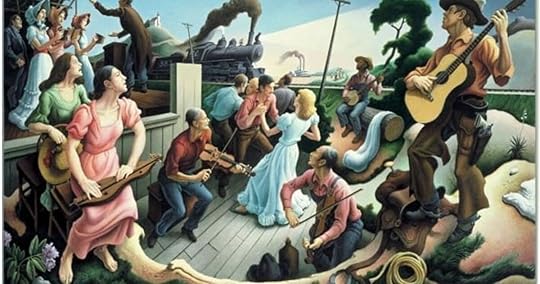
Perhaps my favorite essay within the book is an interpretation of the artist Thomas Hart Benton, who Theroux labels "an anthropologist of American life", borrowing the words of Henry James that Benton was "someone on whom nothing was lost", as he tirelessly attempted to capture the diversity of American life through his murals & other paintings, with his art arising from the tradition of reporting & storytelling. Theroux sees Benton's murals as the equivalent of Sinclair Lewis's Main Street or Babbitt, suggesting that the greatest writers & artists teach us how to see.

Herein lies one of the gifts that Paul Theroux has given me & other readers over the years--opening countless pathways to so many other books he has encountered & cherishes, as with the mention of Benton's book An Artist In America, a travelogue of the artist's obsessive travels across the country in search of material for his paintings, with Benton's subjects becoming what has been called "human architecture".

Lastly, a comment on Paul Theroux's offering of "My Life As A Reader", an essay that will likely appeal to most everyone at Goodreads:
Reading has been my refuge, my pleasure, my enlightenment, my inspiration, my word-hunger often verging on gluttony. In idle moments without a book, I read the labels on my clothes or the ingredients on cereal boxes. My version of hell is an existence without a thing to read, but I would hope to correct it by writing something.
Some of the 30 essays are better-crafted than others and I disagree with some of his inferences about Africa, including wishing to do away with what NGOs & others have brought to the ravaged continent. Nevertheless, it was captivating to read Theroux's commentary on his fellow authors Muriel Spark, Paul Bowles, Somerset Maugham & Georges Simenon. The essay on "Nurse Wolf, The Hurter" (about a dominatrix) seemed less enthralling.
All in all, Figures in a Landscape: People & Places represents an excellent, very well-written assemblage of profiles in essay form, written between 2001 & 2016. Beyond that, I even found the book's title quite appropriate.

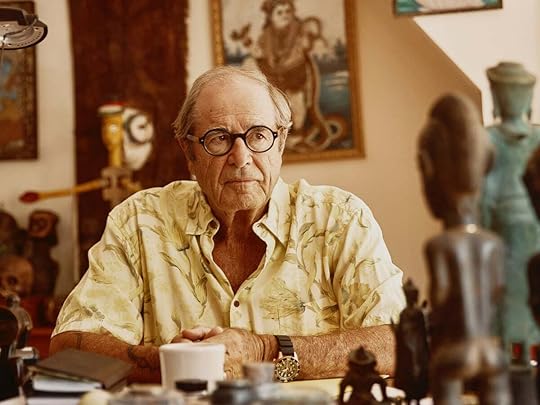
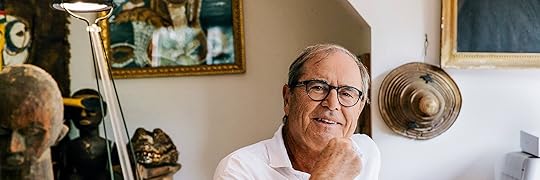
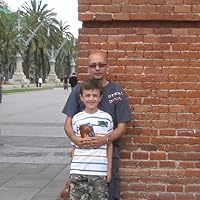
*Within my review are 2 photo images of Paul Theroux + another of a Thomas Hart Benton painting.
Profile Image for Mark Walker.
144 reviews3 followers
July 17, 2018
The “Godfather of contemporary travel writing” has probably chronicled more places in the world than almost any other author. This is his third volume of essays, following Sunrise with Seamonsters (1984) and Fresh Air Fiend (2001), for a total of 134 essays written over 53 years.
This new collection of essays is a veritable cornucopia of sights, characters, and experiences covering the globe. The collection includes varied topics and showcases his sheer versatility as a writer.
The title of the book is based on a 1945 painting by the Irish-born artist known for his grotesque, emotionally charged, raw imagery that, according to Theroux, sums up all travel writing and many essays. In the introduction of the book he provides insights into what makes a good travel writer, such as seeing the “underside, its hinterlands, its everyday life” if you want to get at the truth of a country, which is what he strives to do in many of the stories of this book. He also cautions not to be in a hurry when traveling through a new country and always go low-tech.
Theroux goes on with, “The freelancer is guided by curiosity and must, in its pursuit, be uncompromising, never betraying his or her gift by writing badly or in haste . . .” and “At its best, the freelance writer lives a life of happy accidents.” His example is an assignment in China in 1980, on a Yangtze River cruise, which led to more assignments in China and eventually a year- long travel for Riding the Iron Rooster. According to Theroux, one of the advantages in the randomness of this sort of freelance writing life is that one makes a reasonable living without having to, “put one’s work aside and enter a classroom, or apply for a fellowship, or be some sort of consultant . . ..”
His travel essays take us to Ecuador, Zimbabwe and Hawaii, among other places. He even includes a chapter on the theme, “Traveling Beyond Google” where he rails against the “don’t go there” know-it-all, stay-at-home finger-waggers who warn against what are often the best travel experiences. He reminds us how the natural disasters and unprovoked cruelty that one comes across on the road can be “. . . an enrichment, even a blessing, one of the trophies of travel, the life-altering journey.” He was even forced to tell one genial Canadian who was complaining about the horrors in some of the countries he recently visited that the place they were talking about was just a few miles from what a local newspaper labeled, “America’s homicide capital” . . . Camden, New Jersey.
Theroux did heed one finger-wagger in 1973 while passing through Singapore who warned against visiting Khmer Rouge controlled Cambodia. He pointed to the difference of traveling in a country where the state of law prevails and one in a state of anarchy, so he went to Vietnam, which wasn’t without risks, as the country was “defenselessly adrift in a fatalistic limbo of whispers and guerrilla attacks . . ..” But the real story wouldn’t actually emerge for another thirty- three years when he returned on his “Ghost Train to the Eastern Star” journey. He returned to Hue, which had been a “hellhole” during the war to find happiness after war and “almost unimaginably, there can be forgiveness.” According to Theroux, “Seven million tons of bombs had not destroyed Vietnam; if anything, they had unified it . . ..” He went on to observe that Hanoi, which had suffered more than most cities from aerial bombardment during the war, looked “. . . wondrous in its postwar prosperity, with boulevards and villas, ponds and pagodas, as glorious as it had been when it was the capital of Indochina, certainly one of the most successful and loveliest architectural restorations of any city in the world.” Lesson learned, “. . . while weighing the risks and being judicious, travel in an uncertain world, in a time of change, has never seemed to me more essential, of great importance, or more enlightening.”
Ecuador and the upper Amazon would be one of the first places Theroux introduces us in search of the “grail of psychotropics”, which was inspired by William Burroughs’ account of a drug search in Peru and down Colombia’s Rio Putumayo in his The Yage Letters. According to these letters, “Yage is yaje, Banisteriopsis caapi: vine of the soul, secret nectar of the Amazon, the shaman’s holy drink, the ultimate poison, miracle cure. More generally known as ayahuasca . . .,” a word Theroux found “bewitching.” This trek would fulfil one of Theroux’s primary reasons to travel, “…to find obstacles, to discover my limits, to ease the passage of time, to reassure myself that innocence and antiquity exist, to search for links to the past, to flee from the nastiness of urban life and the paranoia, if not outright dementia, of the technological World . . ..”
Theroux would consult his fellow Returned Peace Corps Volunteer, friend and “self-exiled writer,” Moritz Thomsen, on the location of “ayahuasqueros” along the river people in eastern Ecuador. He signed up for an “Ethnobotanical experience,” whose organizers characterized it as eight days in the rainforest, for eco-awareness and spiritual solidarity, to learn the names and uses of beneficial plants. They’d live in a traditional village of the indigenous Secoya people on Ecuador’s Oriente region on a narrow branch of Burroughs’ Putumayo, “where the ayahuasca vine clinging to the trunks of rainforest trees grows as thick as a baby’s arm.”
Almost immediately Theroux felt uneasy being part of what turned out to be a “nervous and ill- assorted bunch,” but fortunately he met the “vegetalista,” Don Pablo, who he could trust and according to Theroux, “remains one of the most gifted, insightful and charismatic people I have met in my life.” Theroux even confided in problems writing his latest novel, at which point Don Pablo spoke about the “Eye of Understanding.” “This eye can see things that can’t be seen physically,” he said, “Some people have this third eye already developed. And for others, the Eye of Understanding can be acquired through ayahuasca or some other jungle plants.” On several occasions, Theroux was able to separate from the group with a local guide and learn more about the local culture and topography.
When reflecting on the trip, Theroux realized that it had not been an ethno-botany trip of shamanism as an encounter with child prostitutes, gunrunners, Big Oil, and blighted jungle, a place surrounded by FARC guerrillas. The diminishing number of Secoyas seemed doomed. That village would soon be swallowed by the encroachment of oil people, who were only half a day’s march through the forest.” The trip had offered glimpses of danger, but what separates adventure from disaster, according to Theroux, is that you live to tell the tale.
Theroux’s book includes some gems of literary criticism and reveals real depth about the work of one of my favorite travel authors, Graham Greene, and also of David Thoreau, Joseph Conrad, and Hunter Thompson. Of Graham Greene, Theroux reminds us that he, “. . . lived and thrived, in an age where writers were powerful, priest-like, remote, and elusive . . ..” I’m one of those who worshipped anything Greene wrote, especially Journey Without Maps and Heart of the Matter, since I’d worked in Sierra Leone for several years. Yet Theroux brings a new level of insights into many authors and famous people. In this case, he was familiar with Greene’s official biographer, Norman Sherry, who occupied the same office chair Theroux would hold at the University of Singapore. According to Theroux, “Aware that he led a hidden life, Greene developed a habit of evasion, which was an almost pathological inability to come clean. His secretiveness led him at times to keep a parallel diary, in which he might chronical two versions of his day, one rather sober and preoccupied, and the other perhaps detailing a frolic with a prostitute…” He goes on to say that “Greene was a restless traveler, a committed writer, a terrible husband, an appalling father, and an admitted manic-depressive . . ..”
Biking enthusiast and comic extraordinaire, Robin Williams, is one of his most fascinating public figures Theroux introduces the reader to, and he could be better understood through psychologist Oliver Sacks, who was also profiled along with Elizabeth Taylor and a Manhattan dominatrix. Initially I was surprised at the profile of Dr. Oliver Sacks until I realized that Robin Williams starred in the Oscar nominated film in 1990 based on his Dr. Sacks book, entitled “Awakening”, which was published in 1973. Although Sack’s story is fascinating, much of what he learned reveal some of the psychological issues facing Williams.
Theroux was fascinated by Dr. Sacks’ “Street Neurology,” which refers to the assessment of a person’s condition after observing their behavior in a casual setting. He said that Sacks has “something of Sherlock Holmes in this shrewd summing up of scattered neurological clues . . ..” Dr. Sacks considered that Sherlock Holmes was possibly “autistic” and Samuel Johnson “tourettic” based on his neurological experience. Sacks proved that a person’s so-called handicap often causes the development of new skills or the discovery of assets. He was a listener of “seismographic sensitivity, a clear-sighted and inspired observer, attentive, with an eloquence that allows him to describe a person’s condition with nuance and subtlety.”
Actually, since the filming of Awakenings, he’d become a friend of Robin Williams and claimed that, “There is no one like Robin.” His insights would inform Theroux’s quest to determine, “Who’s he (Robin) when he’s at home?” After attending Julliard’s in New York City, Williams found that he expressed himself with the greatest freedom in stand-up comedy, especially late night comedy clubs, with such a crazed take on the world he seemed like a Martian, which led to his first success, Mork & Mindy (1978-1982). This period included a coked-out life marked by the death of his close friend, John Belushi, from a drug overdose. Williams freely admitted his lifestyle was self-destructive, which included excessive cocaine use and bingeing in general. Include heavy drinking, grossly overweight, using cocaine, under exercised, no discipline, “Just parties”— his self-esteem was low and he fortified his ego with performances in comedy clubs — the Comedy Store and the Improv.
During a day of biking with Williams in Marin County, Theroux got to know him better and was convinced that if he were not able to move people to laughter, he would be nearly “defenseless.” Dr. Sacks considered Robin” hyperspontaneious,” and suggested that he verges on the Tourettic, given to alarming impulses and wild associations, those same shouts and barks. “He is never better than doing stand-up comedy in front of a live nightclub audience. It is vivid and transcendent obscenity.” He went on to say, “Anarchic wit is not possible without experience of a very dark side.” When Theroux requested clarification, Dr. Sacks said, “There must have been grim and difficult passages in his past.” Both Dr. Sacks and Theroux identified many of the factors that led to Williams’ tragic death by hanging in 2014, and although this essay was evidently written before his death, since the essays in this book go as far as 2016, a “post script” from Theroux summing up Williams’ life and the tragic circumstances of his death would have been helpful.
The last four chapters provide a rare glimpse of what makes the man and one of the most prolific travel —Returned Peace Corps Volunteer authors of modern time. “My Life as a Reader” confirms that many great authors are prolific readers. “Reading has been my refuge, my pleasure, my enlightenment, my inspiration, my word-hunger, often verging on gluttony. In idle moments without a book, I read the labels on my clothes or the ingredients panel on cereal boxes. My version of hell is an existence without a thing to read, that I would hope to correct it by writing something . . ..” He goes on to reflect, “Reading took off the long dark African nights and gave me relief and hope, for no matter how badly the day went, a book was waiting for me at home, and this has continued to be the cast.” He even divides the world between those who read and those who don’t “. . . reading cannot be compartmentalized; it is a skill and a pleasure that needs to be inspired, so that it becomes a lifelong passion.”
“I did not set out to be a writer. My desire was to be a medical doctor, but this was thwarted by ten years of travel, during which I fell into writing, served an apprenticeship, and fifty years went by, and I am still at it. To me, what writers read is as interesting as what they write . . .. For my Tao of Travel, I read about 350 books and quoted from many of them. The pages of my work are filled with references to books I’ve loved.” As an avid reader, I appreciate an author who does his research and reads many more books that I ever could.
In “Dear Old Dad: Memories of My Father,” we learn some startling facts about the author. “My father —whom I loved and who loved me — never read a word I wrote, or if he did, never mentioned that fact. It was like an embarrassing secret we shared, of a creepy proclivity I had, something that we couldn’t discuss without awkwardness . . ..” He further clarifies this disconnect with, “My father did not read novels —anyone’s novels, at least not modern ones . . . and I had not become a writer to please my parents, only myself. A writer is rarely able to do both, and I know that, far from wishing to please them, I wrote as an act of rebellion.”
Theroux had an even more estranged relationship with his mother who “was a mercurial, insecure woman— as domineering people often are — and she feared me for my defiant aloofness. I knew this, and made myself more noncommittal and cooler. It antagonized her that she didn’t know what was in my head . . ..” This relationship was further strained when Theroux “fled” with a girl to Puerto Rico and upon her return she went to a “home” near Boston where she delivered a baby at Mass General. She gave the baby up for adoption, and he found out almost forty years later that the boy had been educated at an Ivy League college and ended up a multimillionaire. Both Theroux’s parents were disappointed, but according to Theroux, “But when I had needed them, they did not help, could not help, and simply were not there, except — in my mother’s case — to blame. It was a great lesson to me, a motto for my escutcheon: I am alone in this world.”
Theroux further reflects on his father with
Memories, fragments, generalizations—what do they add up to? This recollection of mine seems insubstantial, yet that itself is a revelation. I thought I knew him well. On reflection, I see he was strange, and he seems to recede as I write, as sometimes when I asked him a question about himself, he backed away. In writing about him like this, I realize I do not know what was in his heart. He is just like those skinny old men in Burma and Thailand and Vietnam who inspired me to think of him.
And yet Theroux sometimes felt that he was his father,
My father hated gabbers, gasbaggers, and ear benders, and so do I. My father had a way of inhaling deeply through his nose when he was impatient, and I do it, too . . . I have a similar temperament. I am generally humane, relatively serene, and like to be left alone, as he did. I will sometimes agree to anything to keep the peace, because he felt (as I do) that you can’t really change the narrow stubborn mind of a person who is set in his belief, and anyway why bother?
Theroux felt that his mother was literally killing his father, and described the relationship between them as,
If there was a lesson for me, these family experiences resolved themselves in my horror of weak and vain, nagging and castrating women. As soon as I sense an echo of my mother in a woman’s voice, I recognize the snarl of a she-wolf and flee . . . but only the one thing I’ve failed to do, ultimately a cynicism and a merciless refusal to see my pain—when in my life I’ve heard those things, or heard something as subtle as a sniff, a snort, a harrumph, a certain tilt of the head. I have mentally shut myself down and vowed to end the relationship, because I do not want to become the person that my father became in his old age, reduced to dependence on an unhappy woman who not only didn’t know what she wanted, but needed, most of all, someone to blame.
In the end, Theroux’s father wanted to be left alone.
He would have been appalled if he ever got wind of instances of my wayward behavior. I had a mediocre school record. I was arrested by the police at a campus demonstration in 1962 in Amherst. I had fathered an illegitimate child. I was kicked out of the Peace Corps (“terminated early”) in 1965 for a number of transgressions, my first wife and I split up in 1990, I wrote umpteen books — and these events or topics were never mentioned at all, and perhaps in my father’s mind they never happened. Or was it because they were “faits accompli” that there was nothing to say?
In the final essay, “The Trouble with Autobiography,” Theroux provides 500 words, which “are all I will ever write of my autobiography.” At the age of 67, he asked the question, “Do I write my life or leave it to others to deal with?” He has no intentions of writing about his life, and plans to put obstacles in the way of those who try, since, “Biography lends to death a new terror.” He claims that Hemingway’s A Moveable Feast is “glittering miniaturism, but largely self-serving portraiture, was posthumous . . ..” Theroux harkens back to the “mysterious B. Traven” (born Otto Feige in Germany), author of The Treasure of the Sierra Madre and ten other novels, who succeeded in frustrating any biographers by assuming multiple identities, changing his name three or four times, and living as a recluse in Mexico. He wrote, “The creative person should have no other biography than his books.”
Profile Image for John .
793 reviews32 followers
May 1, 2024
Satisfying as usual

This collection has an elegant pacing. There's themes of Africa, autobiographical reflections, and summing up. Preceding these are commissioned pieces on as wide a variety as Elizabeth Taylor, Robin Williams, Oliver Sacks, and Hunter S. Thompson. Inevitably some sections lag and others whiz, but Theroux keeps his steady voice. It's a thoughtful anthology. Not as digressing as his travel narratives, but with similar introspective interludes. If you're familiar with his world meandering accounts, you'll learn a bit about the background, as in his revisit to Malawi decades after his Peace Corps stint in the early Sixties. He crafts his voice on the page subtly but skillfully.
Profile Image for Jim.
2,415 reviews798 followers
February 20, 2020
For years I have been a fan of Paul Theroux, particularly his travel writings. While there are a few at the beginning of this collection, most of the essays are biographical in nature, including many of Theroux's encounters with other writers. Figures in a Landscape: People and Places is nowhere near my favorite Theroux, but it is worth reading to see how the author felt about his contemporaries.
Profile Image for Linda.
631 reviews36 followers
February 27, 2020
While Paul Theroux is very, well, male, he also is very literary and not as aggressively entitled about his maleness as some of his writer buddies (Mailer, et.al.). And he does offer keen insight, and when he's analyzing someone's folly and incisively critiques them, it isn't with the sole purpose of being condescending. Therefore, I recommend this book of essays for his fascinating life experiences, his  observations, and the sheer variety of interesting figures he spends a day (or more) hanging out with, from Oliver Sacks to a  professional dominatrix. He also has essays of recollection and even a look at whether we really need writers'memoirs in this world. (Answer: probably not. I concur.) 
802 reviews56 followers
August 16, 2019
The strangeness of Elizabeth Taylor, Hunter Thompson’s addiction, the genius of Benton, the secret life of Greene....all this and more. Theroux’s essays are observant, informative, opinionated, and above all, engrossing. He also has some autobiographical ones - his love for his father and ambivalence towards his mother, hitchhiking dangerously, his reading life. His travel pieces are the pick of the lot, though - Malawi, Zimbabwe, Harper Lee’s Monroeville, Hawaii...can one ever have enough of his travel writing? A truly entertaining read...Theroux doesn’t disappoint.
Profile Image for Keenan.
461 reviews13 followers
August 4, 2021
Lovely essay collection by the travel and fiction writer Paul Theroux. This guy loves to read and his essays reflect that, with profiles on writers as diverse as Georges Simenon and Hunter Thompson, and quotes from Shakespeare and the hundreds of Penguin classics he's read in his 70+ years on this planet. He's approachable when he needs to be, comfortable in the presence of celebrities and dominatrixes, humble and curious during travels in Africa and Asia, observant in danger, and studious when alone. What I like most is that his essays always feel well-grounded, rants are backed up with facts and research, and he knows when to get out of the way and let his subjects speak for themselves. The end of the collection is autobiographical in a roundabout, evasive way, and he shares interesting insights into the life and upbringing of himself and authors in general.
Profile Image for Abdulrahman.
101 reviews29 followers
April 16, 2019
If there's one essay I would highlight in this book (and there are so many of them! so many!) It is the essay he wrote about his father. I connected with it so much to the extent I almost felt the tears in my eyes after being done with it. I will go back to it for sure.

Profile Image for Jeremy Wilson.
12 reviews
June 12, 2024
My first Paul Theroux book, and it's a buffet of his work. I think about the Elizabeth Taylor feature often from this book. I bought this in Hawaii, which is an unimportant detail except to remind myself of the moment in time that I read it, and who I was then.
Profile Image for Mike.
490 reviews
February 28, 2020
Beautifully written anthology. I have read many of Theroux’s books, this is more self reflective. It has a feel of a summation of a well lived life. He reads a lot and enjoys it immensely. This is definitely not like many of of travel books, but the style is familiar and 100% Theroux......
Profile Image for Graham Bear.
415 reviews13 followers
August 25, 2021
I like Paul Theroux. Indeed he is one of my favorite authors. This collection was, of course , written in an excellent and wonderful manner. Although some of the essays would have been of no interest to me , in particular , Michael Jackson I found the essays fascinating. It is an easy read and full of anecdotes .
1 review
June 6, 2018
Throroughly enjoyed the book. Linked up with his earlier works revealing a bit more about the author, his life and family relationships. Paul is always refreshingly challenging with his phrasing and inhanced use of vocabulary. Looking forward to more.
Profile Image for Tree.
107 reviews4 followers
June 6, 2018
There was nothing incredibly deep in these essays but I enjoyed living vicariously through Theroux. He made some interesting observations of people and experiences and I might pick up another book by him one day.
Profile Image for Patrick McCoy.
1,083 reviews93 followers
January 1, 2020
Paul Theroux's Figures In A Landscape (2018) is his third collection of nonfiction pieces. There are a variety of pieces ranging from celebrity profiles (Elizabeth Taylor, Olive Sacks, and Robin Williams) to essays on travel and literary essays-including introduction to books by the likes of Joseph Conrad, Paul Bowles, Graham Greene, and Georges Simeone. Those were among my favorites but there were plenty of others that gave insight the author who wrote about his family, life, and attitude to biographies. All in all very insightful and entertaining.
Profile Image for Ana Omelete.
38 reviews15 followers
April 15, 2020
Travelling through memoirs of his own childhood, upbringing and experiences of his intense discovery of Africa (Zimbabwe, Algeria), mixed with talks with actors (such as Robin Williams and Elizabeth Taylor) and not missing chronicles about writers, like Graham Greene, Oliver Sacks (and how he managed his patients with humanity), Simenon and more, with a special chapter about the (Ir)relavance of autobiographies.
Love this author and this book is like knowing him a little better, a travel through the mind of a writer, taking is writings as the map.
12 reviews
July 15, 2025
This is a compilation of essays, profile features and travel writings. Every chapter is through the writer's lens which makes it quite interesting to read. Paul Theroux is an avid observer of people and places. Plus, he has a great way of juxtaposing his observations onto writing. He has a certain way of keeping the reader's attention fresh through his very tasteful writing style, even when writing about geese. His witty sarcasm is so entertaining that I almost can't believe that he is American. He reminds me of Roald Dahl at certain times.

The chapters cover a wide range of subjects; notable figures such as Liz Taylor, Robin Williams and Oliver Sacks, Theroux's favorite writers of choice, an anonymous dominatrix, Africa, Amazon and many more.

One thing that caught my attention is that he has a progressive, self-educated vision of the world for a well-traveled Westerner of his time. Not only he avoids common pitfalls of the colonial mindset, he successfully illustrates how capitalism is acting to destroy beauty and humanity in all parts of the world. I got the sense that he was genuinely troubled by this.

It's also a great guide for people who are interested in writing and literature. Paul Theroux is an amazing writer as well as a passionate admirer of literature. You get an immense list of books and writers with well-thought insights about them. I will keep this book by my side and refer to certain chapters to take inspiration.

Ps: Some people will say "well he was French" but I think Simenon was a rapist.
Displaying 1 - 30 of 123 reviews

Can't find what you're looking for?

Get help and learn more about the design.