I can remember when I first heard of Thor Heyerdahl. It was a new term at school, and we were given our new text books. One of the reads for English looked incomprehensible to me: it was called “The Kon-Tiki Expedition” by Thor Heyerdahl. I was 14, and could only recognise two words of this title! After school I went home and told my parents about this strange book, making an attempt at the name and title. To my astonishment, they could not only recognise the author from my garbled attempt, but knew of the book. And I found that I was soon hooked on the adventures of this brave Norwegian, who with only five companions set off in April 1947 to sail a simple balsa wood raft across the Pacific Ocean, with the bare minimum of equipment and no modern tools, to see if it could be done. They set off from South America, sailing across to the Polynesian islands. It was 4,300 miles, and took them 101 days, swept along by the Pacific’s Humboldt current.
Heyerdahl continued to search for archaeological evidence, travelling to the Galapagos islands in 1952–53. He found shards of what were suggested to be pre-Incan pots, which challenged the idea that no pre-European visitors had been there. In 1969–70, he built two boats from papyrus in the style of Egyptian boatbuilding: “Ra” and “Ra II” setting out to cross the Atlantic Ocean from Morocco in Africa to the Caribbean islands and succeeding on the second attempt.
I was thrilled by the idea of the Kon-Tiki voyage, fighting the savage elements of sea and weather, and avidly followed other lone seafarers. At that time in 1966–67 (Sir) Francis Chichester was breaking all records in sailing single-handedly around the world in “Gipsy Moth IV”, making only one stop. It took him just nine months and a day. In 1977–78 Claire Francis became the first solo yachtswoman to sail round the world. I was entranced by all these stories. What courage! I would dearly love to face such a challenge, but quickly realised that you needed quite a lot of money to even embark on developing the skills needed, never mind actually mounting an expedition.
But for Thor Heyerdahl, it was not merely the challenge of fighting the odds to survive against savage sea and weather conditions. He wanted to prove his theory, that people from South America could have reached Polynesia during pre-Columbian times. By the time of this book Aku-Aku: the Secret of Easter Island, written in 1957, Thor Heyerdahl had made several expeditions to the Polynesian islands seeking more information to develop his hypothesis; his journey by raft in the “Kon-Tiki” was merely the beginning. Now, eight years later, he mounted an expedition to unravel the mysteries of “Rapa Nui” (or Easter Island) by means of archaeological evidence.
Thor Heyerdahl selected a handful of notable archaeologists to form his expedition team, plus a photographer, steward, cook, engineer, doctor and frogman: a crew of 23 in all, including his young family who were to go along too. The ship was a converted Greenland trawler; a practical choice where exploring the destination was the object, rather than the voyage itself.
The evening before they were to arrive at “Rapa Nui”, Thor Heyerdahl filled the crew in on the earlier expeditions. It makes for sober reading. First on record was the Dutchman Roggeveen on Easter Day, 1702. He observed several races, some white, some dark, some with skin “of a reddish tint”. One man wore a ceremonial crown of feathers and his ear lobes were artificially lengthened by means of removable pegs. The islanders were cheerful and friendly, and worshipped the sun. They kept fowls and cultivated bananas, sugar canes, and sweet potatoes as their main crop. Heyerdahl was to show that the sweet potato, an indigenous South American plant, growing in southeast and central Polynesia by 1000CE remains the best and most convincing evidence of human contact between the two regions.
The Dutch sailors were astonished by the mysterious statues, but as they only stayed one day, they wrongly assumed them to be formed of clay and filled with small stones. They noted that the islanders were all “expert thieves”, and thus set the attitude for all the following visitors. The ship left, having shot one islander on board and a dozen others ashore, leaving the dead and wounded staring after them as they sailed off into the distance.
In 1770 Spaniards arrived and declared Rapa Nui to be Spanish territory, with the islanders signing the declaration with “birds and curious figures”. There were only a few people: mostly fully grown white men with black or reddish hair, and a few women, but no children. They too noted the thieving but could not work out where their possessions had gone. By the time of Captain Cook’s landing, the people seemed to be even fewer and in a miserable state. He suspected most of the population to be in hiding, because of the previous disastrous visits. When the Frenchman La Perouse visited in 1786, Captain Cook’s theory was proved correct. A couple of thousand people crawled up out out of underground tunnels and chambers, no longer so scared of visitors, because Captain Cook’s stay had been a peaceful one. The two explorers were in agreement that the statues were very old, and formed of precisely carved stone, but that some had fallen.
The next century was to prove catastrophic for the islanders. First of all an American schooner kidnapped 12 men and 10 women. After 3 days’ sailing, the men were taken out of their chains and immediately jumped overboard to swim back to the island. Regardless, the captain turned the ship round to make a new raid. Russians also landed for a few hours. Then Peruvian sailing ships arrived, again in search of slaves. The islanders signed another contract in exchange for gifts of clothes, but some men were then seized and tied up. Anyone who resisted was shot, although a few escaped into the caves. It was Christmas Day, and the sailors celebrated their success, as the contract had been to go and work labouring on the guano island off Peru. These poor slaves were eventually returned to their home, but 900 had become ill and died, plus 85 more died on the voyage back. Only 15 returned. Then came a French missionary, plus another French expedition setting factions against each other, until finally the island was annexed by Chile, its closest neighbour, who used it to graze thousands of sheep.
Such was the sorry known history of the island Thor Heyerdahl was to explore. He impressed on his crew that they were there only to dig; to find the answers to the riddle, not to study the people. But it was impossible to not form relationships with the people on the island.
One, Pedro Atan or the “mayor”, became very close to Heyerdahl. The trawler had landed at Anakena beach, the opposite side of the island from its approach, because it was less treacherous. Since this was the very place where legends said the islanders’ ancestor, Hotu Matua had landed, this was considered a lucky sign. Also the party had come from strange lands; these people were more familiar with the constellations than they were with any other countries. Heyerdahl was soon considered lucky, in digging up artefacts the people had known to be there, and by using his wits “Señor Kon-Tiki” as they called him, soon gained a reputation for having magic powers. They were more than willing to share with him their knowledge about the island.
“In Volcanic gas tunnels” describes very entertainingly Heyerdahl’s first exploration of the underground caves. Rapa Nui’s inhabitants all lived in a village called “Hangaroa”, on the West of the island but the caves were dotted around all over. There were no trees, hence very little earth. The island’s surface was lava rock, impossible to walk on comfortably, so mostly the villagers got around on horseback. As well as the lava and basalt rock, this volcanic island had many natural tunnels of obsidian (volcanic glass). Smooth-surfaced, it was just possible to squeeze along them. But accessing the tunnels was usually a perilous journey along cliff edges, and it was such a tiny opening and channel, that it was impossible to even turn one’s head. The air was bad and it was only possible to inch forward, possibly taking a wrong turn and being lost forever. The description of this, as Heyerdahl teetered precariously on a ledge, wearing only a pair of mesh underpants as there would be no room for clothes, holding on with his fingertips and a pair of nail scissors in his mouth (an offering to the cave’s stone guardians) cannot fail to make the reader hold their breath with fear, and be amused by turns.
The people were increasingly keen to show the carvings in these caves and bring other artefacts to Señor Kon-Tiki. They believed him to be another ancestor, and trusted that he would protect their ancient relics. And of course he gave them gifts: clothes, and tobacco. Heyerdahl excavated deeper than any previous archaeologists, and found images of three-masted reed boats. These were apparently known in ancient Egypt. Could such boats have crossed the Atlantic? His 1969 voyage from Morocco in Ra I had proved that a papyrus ship could survive ocean conditions for a long time.
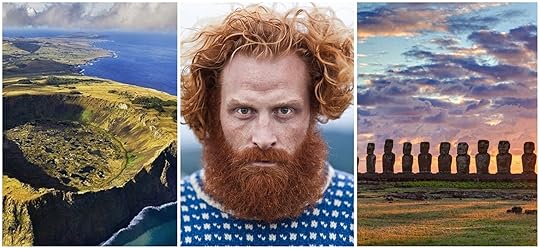
Heyerdahl and his team excavated several sites. All the moai, the monolithic human figures, were lying down: not one stood erect as in Captain Cook’s time. Heyerdahl gradually understood that they had been toppled as part of the civil wars on Rapa Nui. But how had these immense figures been moved to the perimeter of the island? The stone mostly came from one volcanic crater, “Rano Raraku”, where several half completed figures still lay, only their fronts having been yet carved. It seemed incredible, but the islanders were unanimous. Their ancestors, these immense stone figures, “had walked themselves”.
The mayor insisted that he knew the secret, but when Heyerdahl asked why he had never said so before, Pedro Atan said that nobody had asked him! He would show how they were raised to their positions, and so Heyerdahl selected one of the smaller moai for the demonstration. It took 12 men 18 days, working solidly, using poles, ropes and small stones to inch the moai upwards by careful, almost indiscernible increments. The statues walking was another gripping read. Basically it seems to have been a mistranslation. This time many more villagers were needed, all choreographed by the mayor, the method used being similar to when you try to “walk” a large fridge. Pedro Atan could recite a list of his ancestors through 11 generations, so it seem likely that this “secret method” was accurate. The backs of the moai were all unblemished, so they were unlikely to have been towed along the ground, yet the side edges of the base of the plinths they stood on were worn.
Pedro Atan told Heyerdahl many legends, which had hitherto been scoffed at. He claimed he was one of the few “long-ear” descendants left, and could name the others. For years there had been bitter battles over territory between the long-ears and the short-ears, culminating in the catastrophe of “Iko’s ditch”, or “the long-ears’ earth oven”. The long-ears wanted to make statues, and cultivate the land, and set the short-ears working to throw all the loose stones into the sea, and begin to cultivate the Poike peninsula. Eventually the short-ears rebelled and the long-ears fled to the peninsula. Their chief Iko ordered a defence trench to be dug, 2 miles long, and filled with branches and wood, to protect themselves. Eventually there was an ambush by sea, the short-ears surrounding the unsuspecting long-ears, who were slaughtered, with only a few escaping to their secret caves. The bodies of those who were killed before they could flee were thrown into their own ditch, and a huge pyre lighted. Just a quaint legend? But the Poike peninsula was grassy with no loose stones, whereas the rest of Rapa Nui was thickly covered with black and red scree and covered with lava blocks. Moreover, Heyerdahl, digging deep into the manmade trench separating the Poike peninsula, found evidence of charcoal and human bones.
Thor Heyerdahl was gradually piecing together the island’s history. An earlier archaeologist, Katherine Routledge, was responsible for terming the moai “heads”. Years of silt and sand had buried some figures up to their necks, covering up the lower parts. The first one she excavated was unfortunately a broken one, and she assumed there were no bodies beneath. She also called the red stone pieces on the top “hats”. They were made of tuff, and Heyerdahl located the area where all this stone came from: the Puna Pau crater across the island. The selection of this colour was significant: red was the colour of the islanders’ hair, which was piled up in topknots. And hair was considered sacred; their source of strength.
But Heyerdahl was digging deeper than ever before, and discovering completely different structures: walls made of carefully carved stone slabs, which were meticulously fitted together. None of the present islanders knew anything about them, nor did they know how to construct such precise pieces. Heyerdahl collected more and more evidence to show there were at least two eras. These ancient walls were similar to those in Peru. The moai belonged to a later culture, carbon dated to about 1300, and although broadly similar to some Polynesian island art, there was a whole tradition of “bird men”, unique to Rapa Nui. Other ancient carvings he discovered were of turkeys, and cats, both completely unknown in Polynesia. There is a wealth of information about the carvings, and about the flora on Rapa Nui. However, reading “Superstition Against Superstition”, I was becoming disturbed by Heyerdahl’s methods for eliciting the information. This was within in my lifetime, and Heyerdahl was an educated European. Was he “bold and respectful” as the blurb said? I did not think so.
As well as the archaeological excavations, the Mayor had boasted to Heyerdahl about his “secret caves” full of treasures. Each family had its own secret cave, he said, but no other family knew where they were, and it was taboo to even admit their existence. To prove this, he would bring Heyerdahl a few prize artefacts from his cave, but he was sworn to secrecy. Otherwise Pedro Atan’s “aku aku” would be angry. The aku aku was like the spirit of the individual, with supernatural properties. As he learned more about the ceremonies and traditions, Heyerdahl used this information to feed back to the islanders so that they believed he was indeed supernatural; an ancestor of theirs from overseas. For instance he knew that to appease the cave gods he must bite off and eat the tail end of a roasted chicken, and share the rest and sweet potatoes with the owner of the cave before entering.
Various islanders grew to trust Señor Kon-Tiki. They would creep into his tent at night, with carvings from their caves, in exchange for cloth or cigarettes. Heyerdahl tells this with barely suppressed glee, as he gradually gained more and more information about the locations—always perilous—and won some people over to be allowed to visit their cave for himself. But it gets worse.
Not only did he trick them into thinking that he was almost a god himself, and would respect their carvings as much as they themselves did, but Heyerdahl began to capitalise on this, pretending he had his own magical powers and superstitions, and manipulating the islanders who trusted him implicitly. The older ones were worried. The next generation they said, did not care so much about the old traditions. They did not respect and look after the carvings in the caves as they should. The old people worried that the cave gods and guardians would be angry and seek vengeance. Heyerdahl convinced them that the the carvings would be safe and respected in museums, where guards were employed to look after them day and night.
Thus Heyerdahl’s acceptance of a few carvings now and then, developed over a few months into illicit visits to several of the islanders’ family caves. Each time he would some away with two or three prize pieces—all he could carry—and come back later for “the rest”. This made me feel physically sick. The carvings were not only their most precious heirlooms, they had spiritual significance for the islanders. And it was all they had. There was not even one shop on the island, and their basic needs were met by what they could find or farm, and one annual visit by a naval ship from Chile. When Heyerdahl’s ship eventually left Rapa Nui, it had 1000 carvings on board. At one point Heyerdahl observed ironically that there were more artefacts from Rapa Nui in the world’s museums than remained on the island.
I asked myself, who was the thief?
For almost a month I have hesitated about this book which I loved, but whose ethics troubled me. I have read enough around the topic to be convinced that some of Heyerdahl’s theories were correct, and will write about this more in my review of the later companion book by Thor Heyerdahl about Rapa Nui: “Easter Island: The Mystery Solved”.
Some carvings have now been returned, and are in a museum on the island. One of the smaller moai (brought back by the earlier explorer Katherine Routledge) remains in the British Museum but its return has been requested, and it is only a matter of time. An airstrip talked about during Heyerdahl’s visit was constructed in 1967, and since then tourism has boomed. The island has developed an economy, whose main industry is tourism. Wooden carvings are produced using trees from other islands, which may once have grown on Rapa Nui. One of the mayor’s sons went to university, and returned to Rapa Nui to continue the archaeological work started by Heyerdahl. He has also re-erected all the moai to their original positions, which is why all the images you see of Easter island show them standing proud. The islanders remember Señor Kon-Tiki with affection, because he brought them into the present century.
Perhaps then this was inevitable. As time passed, the inhabitants of Rapa Nui could not remain unaffected. Planes would not pass overhead, leaving them undisturbed. Others would come, to destroy their way of life and pillage their cultural artefacts. It could have been worse.
So I have come to terms with Aku Aku: an engrossing read which for me should be five stars, with its stories of secret caves and ghostly magic ceremonies. Yet I am troubled by the duplicity involved in this expedition, and the deliberate ploy to separate these people from their inheritance, so have to fix it at four.