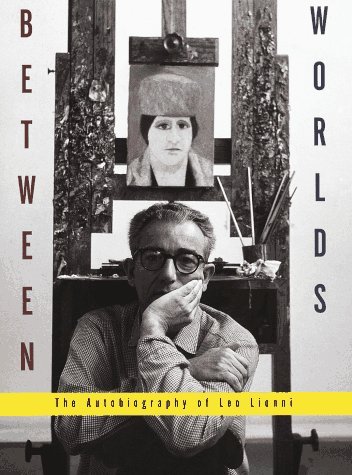
Here, sumptuously illustrated, is a superbly written account of a remarkable life--a life spent divided between Europe and America, between art and commerce--by the famous artist, art director, and children's book author Leo Lionni.
Born in Holland, half Jewish, raised in Amsterdam, Brussels, Genoa, Philadelphia--Lionni is a man of many languages and cultures but no real home. His story is one of a constant search, a search that takes him from an ideal early childhood to a strict education in Italy that proved largely irrelevant to his future, and then to exile from Fascist Italy in America; from being a highly political aspiring artist to becoming a highly successful advertising director (he invented the famous "Never underestimate the power of a woman" campaign) and a powerful force in the world of graphics as the art director of Fortune magazine; from life in the affluent commuter world of Connecticut to a return to Italy and the life of an artist. After all this--a full life by any account--he finds yet another successful vocation as the author and illustrator of children's books that have sold millions of copies throughout the world.
Lionni tells his story--it encompasses his early romance and happy marriage, and his countless extraordinary friends and acquaintances--in the most elegant and persuasive prose, the kind of English that only a distinguished European can write. And since his story is also the story of a lifetime of creativity, throughout the book are examples, in color and black-and-white, of his remarkable body of work--painting, sculpture, ceramics, mosaics, photography, graphics, and, of course, illustration. This is an autobiography both of great intellectual and artistic sophistication and of large human appeal.
Leo Lionni wrote and illustrated more than 40 highly acclaimed children's books. He received the 1984 American Institute of Graphic Arts Gold Medal and was a four-time Caldecott Honor Winner--for Inch by Inch, Frederick, Swimmy, and Alexander and the Wind-Up Mouse. Leo Lionni died in October of 1999 at his home in Tuscany, Italy, at the age of 89.
Leo Lionni has gained international renown for his paintings, graphic designs, illustrations, and sculpture, as well as for his books for children. He was born in Holland in 1910 of Dutch parents, and although his education did not include formal art courses (in fact, he has a doctorate in economics from the University of Genoa), he spent much of his free time as a child in Amsterdam's museums, teaching himself to draw.
Lionni's business training gradually receded into the background as his interest in art and design grew. Having settled in Milan soon after his marriage in 1931, he started off by writing about European architecture for a local magazine. It was there that he met the contacts who were to give him a start as a professional graphic designer. When he moved to America in 1939, Lionni was hired by a Philadelphia advertising agency as art director. Later he became design director for the Olivetti Corporation of America, and then art director for Fortune magazine. At the same time, his reputation as an artist flourished as he began to exhibit his paintings and drawings in galleries from New York to Japan.
Lionni launched his career as an author/illustrator of books for children in 1959. Originally developed from a story he had improvised for his grandchildren during a dull train ride, Little Blue and Little Yellow was the first of what is now a long list of children's picture books, including four Caldecott Honor Books.
i almost filed this under "time travel" because Lionni switches around in his life and others so often that it was hard to follow. read the first hundred and last fifty pages. Most interesting he created the cover for "The Family of Man" and becoming a children's book writer/artist was a late life decision and fortunate accident. he was already successful as an artist, an adman and an editor. the one story i really liked from the book: Lionni goes to Brentano's (remember that great bookstore? B&N is still just a sad knock-off) the morning his first book goes on sale looking for the promised window display, it isn't there, But the book is stacked next to the counter, he hangs back close enough to see who might buy it, far enough away no would think him the author or a stalker. "...a young woman who looked like the mother of a six year-year old child was moving from book to book with a fastidiously serious expression passing judgement on each one. When she picked up (Little Blue and Little Yellow) I looked away. I couldn't take it. ...she begins to purchase it... The saleslady sprang out of her chair...knocking the book out of the customer's hand. I automatically picked it up and was about to hand it to the young woman when i heard myself say "Forgive me, I am the author of the book you are about to buy. If you don't mind I'd like to autograph for you because it is the first copy to be sold." There were many ohs and ahs, my heart was doing somersaults in my chest, but I left the store feeling like I'd won the Pulitzer Prize." p219 if i'd ever finished one of the book i've started and it were published i imagine doing the same thing (alsa Stacey's has gone the way of Brentanos so perhaps at Alexander Book Co.)
Lionni is my favorite children’s book author and I have always been interested in his journey/career as an artist and art director. I was expecting the book to be more about the process of creating and was initially disappointed because it started off as a very biographical account of his life. In retrospect, he structures the book really interestingly. Most of the stories are about specific people and places from his life and how they have shaped him. He dedicates little blurbs to said person or a place he was living at the time with an interesting anecdote. I think he does this to give the reader an impression of how his artistic inspiration came to be through these experiences, which is quite beautiful once you put all the pieces together.
He grew up/lived in a very interesting time (Europe in the 1900’s under fascism). It is very noticeable to see how much fascism shaped his worldview and also his career. Not only through the circumstances of his career but also the content. He is pretty open about his disapproval for fascism (very iconic to refuse to wear the fascist uniform as a kid) and later in the book, he directly states the impact social and political encounters had on his design efforts. His principles not only held dear to him, but guided him within his professional life and it’s really vindicating to see him actually live out his values. It is clear that his art is political on its own without knowing anything about him but it was nice gaining his perspective to hammer down how his art is an expression of his beliefs.
It was nice reading that the people around him also held those values and how they held him to his standards/supported him as well.
He was very invested in the “social responsibility” of designers, which is not only seen in his earlier work, but one of the biggest themes I’ve seen in his children’s books. One quote that stuck out to me: “In practical and moral terms, you must feel responsible for every line you draw, for every decision you make.”
I liked how even when he was established in his career, he still questioned his choices and it felt very purposeful on what he chose to take on. It was cool to hear his thought process on this and you can tell he wanted to curate a meaningful career path, not just do anything and everything because he could. He had ownership of his career which is a really powerful thought.
You can really see the outline of why Lionni is so drawn to art and creating art and what art means to him. From prior research about his children’s books, I was interested in seeing certain themes of his children’s books, like community, individual responsibility, and art being of value. He makes these themes abundant throughout the book in terms of his own personal life.
I LOVE his “Power of a Woman” campaign (specifically the one with Hitler in comparison). It was cool to read about how this campaign came into fruition.
I thought he would talk more about “The Family of Man” cover he designed or his Chicago Fair Pavilion as that is what he was known for, so kind of disappointing we didn’t get to hear about that.
I do wish there were more pictures of his work in the book even though they are scattered throughout. I would enjoy a book with just pictures of his work. I also wish he talked about his children’s books more but the excerpts that he did write about them were insightful. My favorite book of his is Frederick and he just barely mentioned it. The story about how Little Blue and Little Yellow was made was interesting and I enjoyed his story about Swimmy. He brought up a point about that story that “the central moment is not so much Swimmy’s idea of a large fish composed out of lots of tiny fish but his decision, forcefully stated, that ‘I will be the eye’… he had seen the image of the large fish in his mind. That was the gift he received: to see”. I had never thought of the story from this viewpoint.
One aspect of the book I really enjoyed was him highlighting the differences of European vs. American life. He lived in both worlds but you can really see how his European influence on design set himself apart from others in the art world. He talks about American design being forced to be super clean, since there is so much money poured into the industry, versus Europe being the opposite, and how as a result, the European style tends to produce a more authentic/genuine style.
Just from the way Lionni writes, you can tell he was very careful/crafted in telling his story. Storytelling “is the essence” of his style and that is seen not only through his oeuvre, but also his life itself.
This entire review has been hidden because of spoilers.
I was hoping this would be more about the author's creative process and the stories behind his beloved children's books. It was really more of just a straightforward narration of his life from beginning to end. It wasn't a bad book, it just didn't feel like it was really a book written for someone who loves this author's other work, and I guess I just wasn't really sure who the book was meant for.
Cronistoria di una vita. Interessante ma fino ad un certo punto. Letto fino a pagina 198 poi semplicemente sfogliato. Le pagine più interessanti da pagina 234 a 240 dove parla di "un piccolo miracolo" come dice l'autore, cioè del suo libro "Piccolo blu e piccolo giallo". 6 pagine su 360 poche per dire che mi è piaciuto. Oltretutto stampato su carta lucida, pesantissima, anche in questo senso un "peso" portarselo dietro.
Incredibly talented man surrounded by other incredibly talented people. Never would I have known the breadth of his accomplishments if I hadn't gone to the Eric Carle Museum in Amherst Mass -- a must for anyone interested in art (To think that children's illustration isn't art is to be very close minded.) I would have enjoyed the book much more if the writing -- not the writer -- were a little humbler, although I forive him. Here is to Lioni for taking all his priviliges and talent and opportunities and creating such wonderful art with it. He seemed to have endless energy and ideas, and I love Frederick and Swimmy even more.
Durchaus lesbare Autobiografie, wenn auch oft etwas langatmig. Enttäuscht hat mich, dass der Mann, der mit seinen Kinderbüchern berühmt wurde, stets nach der Geburt seiner Kinder – wenn auch mit gutem Grund – ins Ausland verschwand und sich scheinbar wenig Gedanken um den Nachwuchs machte. Insgesamt schreibt er nicht sehr viel über seine Kinder und in seine Frau hat er sich verliebt, weil sie nicht so sehr dem Intellektuellen zugeneigt war. Naja…