This volume is an anthology of 18 stories about heroines with as much courage, wit and intelligence as their more familiar male counterparts. It includes Li Chi, the serpent slayer, and the old woman sly enough to outsmart the devil.
I've just read this quickly before sending it to my niece. I'm disappointed that the prose doesn't sparkle. Tchana is a pedestrian stylist and there are certainly better-written folktales. But the content is fabulous. The 'princesses' are bright, curious, patient, physically courageous, thoughtful, assertive girls; heroines every one. There's a canny old woman who outwits the the devil, and a poor peasant girl who stands up to the king. I'm particularly pleased that there are many black/brown girls, and that the excellent, evocative illustrations show strong, healthy, active bodies. Not an anorexic or silicone victim in the bunch.
This should be a good antidote to Disney. Highly recommended.
Hyman's illustrations are wonderful, as always. The stories selected are often relatively obscure ones, which was a great change from the famous few that get told over and over. The text is substantial and perfectly suitable for teens and adults as well as children. The volume is large and heavier than the standard picture book, so smaller children may find it a bit hard to hold on their own.
This book was a real mixed bag for me, which was surprising because I LOVED the author's other book, Changing Woman and Her Sisters: Stories of Goddesses from Around the World. A lot of these stories were just borderline cringe-y, and the only thing they had going for them was that the main character HAPPENED to be girl. meh.
below are a few of my favs out of the 18 stories featured:
The Serpent Slayer Nesoowa and the Chenoo The Rebel Princess The Magic Lake Grandmother's Skull Staver and Vassilissa Tokoyo The Lord's Daughter and the Blacksmith's Son
-------------
Picture Books About Mythology with Strong Female Leads: (these books feature myths from all over the world and include sources)
Trina Schart Hyman--who did the illustrations to this--is quickly becoming my reigning Queen of Illustration--alas, that she is dead. I feel that I need to own all the books she did artwork for--it's nuts. It's a fever that overtakes me. Just brilliant, beautiful work
Beautiful, earthy illustrations of fairy tales from around the world. Trina Schart Hyman has been my favorite illustrator all of my life, and I seek out her work, no matter where it is. To my glee, Hyman tends to pick fantastic projects.
I LOVE this book, the stories are interesting and they feature women being strong and smart.Every little girl should have this book. Every story in the book that we have read so far have been top notch, i am so thankful someone posted about this book.
There were so many glorious, obscure fairytales here. Lots of personality in this book and it's one I'd love to read again. Some awesome Native American stories, too.
A review of The Serpent Slayer: And Other Stories of Strong Young Women by Katrin Hyman Tchana and Trina Schart Hyman:
Content = AWESOME
This collection of stories is actually diverse. There are girls from a wide variety of cultures represented.
The Barber's Wife (Indian)
Grandmother's Skull (Native American)
The Magic Lake (Latin American)
And it's not just stories about young women, either: The Old Woman and the Devil (Middle Eastern)
Illustrations = AWESOME
Lots of different representations of beauty here, folks.
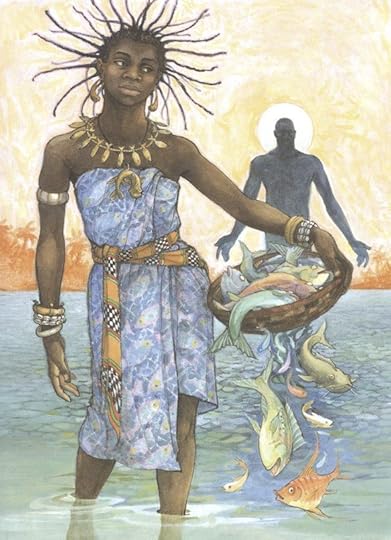
Beebyeebyee and the Water God (African)
Duffy the Lady (English)
Clever Marcela (Filipino)
Sister Lace (Chinese)
Prose = so-so
Hey, you can't have everything, I guess. The prose gets the job done, but it's nothing to write home about. But with stories like these, I'm not sure I can really even complain.
The Rebel Princess (Jewish)
Four Stars: This book was really really good and I'll definitely recommend it to people with relevant interests.
The Serpent Slayer tells the legend of Li Chi, a child of the village of Yung Ling who has volunteered to be sacrificed to a dragon terrorizing their home. A sorcerer hired by the village to find a solution for the dragon's rampaging of their farms and livestock proclaimed that the beast would only be appeased by the sacrifice of a young woman once a year. The sorcerer stuck around to enjoy the people reverence of him while girl after girl is sent off to her death. But Li Chi decides enough is enough and takes on the dragon head-on. This is one of my favorite Chinese legends and one I only learned of recently via a fascinating website called Rejected Princesses. Li Chi comes up with a plan to do what the rest of the village is too scared or cowed to try, and returns the bones of the other nine girls for proper burial. Starting the book off with a dragon-slaying badass.
The Barber's Wife is fed up with her charming but lazy husband and sends him to the king to beg for food. When he messes up the request and comes back with a plot of wasteland instead, she realizes if she wants their fortunes to turn she's going to have to do it herself. The barber's wife was a great character who used clever, sensible solutions to her problems, unlike other fairy tales I could mention where the 'clever' solution made no rational sense. She needs the property plowed but can't afford the animals, so she convinces some onlookers that a relative buried her inheritance on the property but she can't find where. Sure enough, the onlookers snuck back to find it for themselves and it was all dug up by next morning. Her solutions continue in that vein, and she keeps her husband around, who may be lazy but who's also pointedly described as good-looking and able to make her laugh.
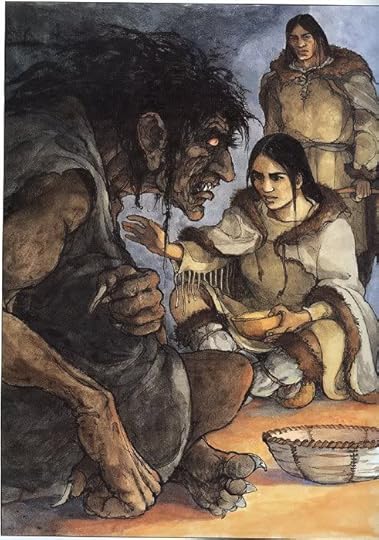
In Nesoowa and the Chenoo, Nesoowa and her husband go hunting in The North Wood which known to be walked by the Chenoo, an evil cannibal people. When alone at their camp an injured Chenoo happens across her, and she throws him off balance by welcoming him as her father and sharing her meal and fire. Nesoowa keeps up the charade for a few days, unsure how to escape, when a rival Chenoo finds them. It's a pretty good story about respect and affection winning over a monster, with a bit of magic at the end to finish him off for good.
Clever Marcela is a Filipino version of one of my favorite fairy tales. Marcela meets the Prince and a battle of wits between the two ends in marriage, provided she sticks to one rule: not to interfere with her husband's verdicts. But when he makes an absurd decision and Marcela fees compelled to correct it, she's given the boot and ordered to take whatever she wanted with her. Naturally, she solves it as any clever woman in love would. I've heard this story many times before and it always pissed me off that the King would make such an absurd ruling to begin with, so I liked that here it's addressed as him not paying attention to the case. Also the versions I'd always heard before had her father thrown in prison because he found a golden mortar and brought it to the king, who accused him of keeping the golden pestle for himself. If he did, that's his right as the one who found the damn thing. And don't act like you actually wanted the full set, what the hell is anyone going to do with a solid gold mortar and pestle? They'd be too soft to actually use. This way makes way more sense, with the king meeting Marcela and being fascinated with her right off the bat. And she gets rewarded with the title of Chief Justice, which is pretty awesome.
When the emperor hears of Sister Lace and her stunning creations, he has her brought to his palace to marry him. She refuses and is imprisoned, and he offers to release her if she can make him a live rooster in 7 days. Her skill and blood bring her creature to life, but each time the emperor refuses to grant her freedom and is attacked, and each time he demands she make something else. A sweet legend of the making of the stars; one of my favorite creation legend subjects to read.
Judith is The Rebel Princess who sets sail to escape an arranged marriage and run off with the prince/schoolmate she'd fallen in love with. The two are separated at a brief stop and Judith accidently comes into the company of a merchant's son, who threatens her into sailing off with him under the condition that they not marry until after making land in the boy's home town. He runs off to announce her, and Judith steals his ship. Trying to sail back the place she last saw her lover she becomes turned around in a storm and crosses paths with a king. Much the same happens as before and the king provides her with 11 ladies-in-waiting to serve her, whom Judith talks into becoming sailors and they all steal away. Now armed with a ship (still full of cargo), a full crew, and Judith herself (a pretty impressive weapon by this point), they happen across a crew of pirates who decided to each marry one of the women. That night the women steal their clothes, their treasure, and their lives. It's no surprise at this point that there's nowhere for Judith to go anymore but up, and when she fails to save a drowning king she is crowned in his place. A really fantastic story with a happy ending for everyone involved, including the merchant's son who'd lost a shipful of cargo and the king who'd lost the daughters of 11 noblemen. Judith gets her man and her adventure.
In a story from Cameroon, Beebyeebyee and the Water God tells of a girl who comes to the romantic attentions of a water god, and in return for her love he gives her a boatful of fish to take back to her village. The two wed but the actual fishermen get so pissed off about Beebyeebyee upstaging them that they discover her trick and kill her husband, dooming their village. Not a great character, Beebyeebyee is a lazy brat from the get-go and I have a deep sympathy for the fishermen (not that murder was a viable reaction, of course). She's cheating them out of their livelihood and yet still being just as lazy as she ever was. Nice setup; lame heroine.
Kate Crackernuts is on the hunt for a way to break a spell placed over her step-sister, who now has the head of a sheep thanks to Kate's mother's jealousy. On the way she accidently breaks a 12-Dancing-Princesses spell placed over a prince. I'm more familiar with this as Tatterhood, where the main character is more interesting than just being nice (she's an ugly, high-spirited ball of goat-riding chaos) and her quest for her sister is always front and center, not sidelined to rescue a prince. This version is fine, but it switches plots halfway through and none of the characters are particularly interesting.
In The Magic Lake, an emperor's son falls ill and he offers a reward for whomever can find the magic lake whose waters will cure him. Sumac's brothers fail to find it and try to trick the emperor with ordinary water instead, and now Sumac must find the magic lake and ask that they be freed from prison. A nice story, but there was just something about it that was missing. I think it might trace back to how she defeats the monsters. They don't present any challenge at all. And the way she found out about the lake didn't require any particular skill or attribute, just the bad luck to keep her food where birds could get to it. Anyone at all could have found the magic lake.
The Old Woman and the Devil is a brilliant story of an old woman trying to get the devil to leave her spot in the shade, and ends up making a bet that she can break up a loving couple whom even he hasn't managed to corrupt. It's a fun story with a old woman showing off just how much smarter she is than the devil, especially when she ups the ante and reunites the couple she's broken up. Loved it. And it has one of the best illustrations in the book (one I can't find online to share with you): It's an Arab fairy tale, but the devil is modeled after the old images of the bright red goatman with stubby horns and a forked tail. His outfit (I'm sorry, I'm having more trouble finding the exact words than I thought, it's a long tunic and matching but darker pants) is the bright red of the goatman, and he has the stubby horns and forked tail and goatee, but he's a tall, lanky Arab man with a bright red fez and a really annoyed expression, and it's just so damned cute. I keep going back just to look at it.
A handsome suitor captures the heart of Neruvana, who weds him and leaves with him for a hunting trip. After several days alone, they return home together, but the homestead is empty and bloody and Neruvana is shocked to find her husband casting off and abandoning her with her murdered family. But she is not entirely alone, as Grandmother's Skull calls to be dug up so it can advise the girl of her path to security, self-sufficiency, and justice. A thrilling story of revenge and ancestor magic. Neruvana is forced to do all the jobs the various family members do and she becomes an invaluable asset to herself and others. Wouldn't mind reading this one again. Also, a great moral: Don't marry someone until you're sure they're not mass murderers.
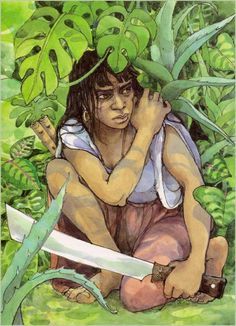
In Three Whiskers from a Lion's Chin, Maria's husband returns from war a changed man, and a visit to the bruja sends Maria on a quest to find the missing ingredient to make the charm that will return him to the man she first married. One of the best in the book, Three Whiskers takes a very unusual approach for a fairy tale. The husband has PTSD and the wife sets out into the jungle to bring back the three whiskers for the charm, and she faces all sorts of dangers using patience and persistence. Finally she returns with the hairs and is told that *spoiler* there is no magic charm, and she can bring her husband back to himself by using the same care and determination she used to get the whiskers.
Duffy the Lady is a variation of Rumpelstiltskin with a housekeeper who can't knit or spin getting a job for a squire doing exactly that. She's approached by a devil who offers to do it for her if she'll be his bride in three years time unless she guesses his name. Duffy is lazy and gossipy and takes advantage of the situation for three years, eventually marrying the squire. At the end of the contract she visits the local witch and is told to stay put and when her husband comes home the next evening to just let him talk. She does, and he tells her about coming across a witches circle dancing with a drunken demon, who was laughing about how Duffy would never guess his name is Terrytop. She wins the bet, everything knitted in the last three years falls apart, and she scolds her husband for spying on the witches circle because now they've been cursed and she hasn't been able to spin anything all day. So the moral is... what the hell is the moral of this? Duffy is a lazy liar who cheats the devil and blames the consequences on her husband.
Arevhat in Sun-Girl and Dragon-Prince breaks a spell placed on a prince, but her stepmother tries to kill her out of jealousy. Arevhat is swept downriver and comes upon a cursed hunter whom she lives with for three years and has a son with. She goes on a quest to break the hunter's curse and as a result is found by the Dragon-Prince again. A fellow Goodreads reviewer pointed out that the ending might have worked better with the three forming a polyamorous relationship. The prince and the hunter don't show any jealousy to each other and the prince spent the previous night with the new couple and everyone seems to be getting along fine, and her decision at the end seemed off the cuff and gives the impression that the three never even discussed how they'd be living now, as though the two men just assumed they'd all live together. And it's not as though it'd be the oddest thing in a children's fairy tale (for the sake of context, she says she's thirsty and both men helpfully hand her some water, and she just sorta hands the hunter their baby and says he can have him and she'll leave with/drink from the flask of the prince since she's kinda still married to him). Arevhat's character didn't gel with me at all. The story is nice enough but she seemed detached from everything going on around her. Whatever happened she just shrugged and went along with it.
Prince Staver in Staver and Vassilissa is caught bragging about his wife by the grand duke, who sees this as Prince Staver one-upping his boasts of the grand duchess and insulting him in his own home. He throws Prince Staver in the dungeon and sends out his warlords to bring Vassilissa to him, but Vassilissa isn't having any of that. She pretends to be an envoy of the khan who has come for twelve years of owed tributes, and after the grand duchess fails to convince her husband that Vassilissa is a woman, the King sends her off with Lord Staver to serve as the khan's new lute player, thinking he's just gotten rid of an annoyance and gotten out of having to pay his tributes for another year. This was a great variation of the man-refuses-to-believe-a-woman-can-be-good-at-male-dominated-pursuits trope. The grand duke is setting up contests at his wife's behest, but the best part of this story is that, not only is Vassilissa wiping the floor with his men, she's having a blast doing it. A great rendition of this story.
Tokoyo tells the tale of a samuri's daughter who sets out into exile to live with her disgraced father. She has a great deal of trouble finding him, and in the search happens across the sea serpent whose curse is harming the emperor. Another 'cure the royalty' story. It's a good one that uses a skill the heroine is known to possess from early in the story, which is a nice change to the usual heavy-handed use of deus ex machina. It's a good, solid story with a sweet reunion ending.
The Lord's Daughter and the Blacksmith's Son is a Scottish story of a stubborn girl who decides to marry the blacksmith's boy when she happens to see him one day. When her parents put their foot down she accepts the help of a wee folk to get what she wants. This one was good fun. There was no backlash from the deal with the wee folk because she'd done him a favor first and he was happy to help, so the drama came from how the help came about and how the blacksmith's son would come into it. Unfortunately the wee folk went right to him and handed over the solution to the magical mischief so we were cheated a bit in that, but otherwise it was a cute story with a headstrong but sweet 'heroine'.
In The Marriage of Two Masters, a man with a very intelligent daughter happens upon a young man travelling to meet this clever woman in the hopes of courting her. They engage in conversation and the father comes away with the impression that the man is a fool, but the daughter sees the cleverness of his questions and agrees to marry him. This was probably the only story I didn't enjoy. The suitor's questions weren't clever, they were ridiculous. How is anyone supposed to hear 'there is snow on the mountain' and take away 'you are old and your hair's gone white'. Maybe it loses something in the translation, but even after the daughter translates the comments into plain speaking, everything was either rude or pointless. If he was so clever he'd know not to talk in stupid riddles no one understands.
The verdict? Oh God, the illustrations. This was beautiful, stunning artwork. Trina Schart Hyman did an incredible job. Look at this!
My jaw is on the floor. They make the stories pop with life and I have yet to see a review that doesn't praise them. That said, the stories were wonderful as well.
This features 18 retold fairytales. Retold by Katrin Tchana and illustrated by her mother.
Preface - There were some lovely thoughts here: "The stories in this collection are about women and girls who find themselves in difficult circumstances and respond in brave, clever, and thoughtful ways ... We believe we need more books that reflect that [women's] experience [of life]. These are stories that remind us how to be strong, adventuresome, creative women. They teach us how to survive enormous suffering and come out alive with our eyes shining and our feet kicking... so that people everywhere remember the courage, strength, ingenuity, and intelligence that is every woman's heritage."
1) The Serpent Slayer - 3 stars. I really enjoyed the way this story was told. A serpent becomes a problem for a village, and the sorcerer called by the magistrate for help comes up with the solution of offering it a young girl once a year to eat. After 9 sacrifices, Li Chi turns 14 and offers to go, intending to end the beast and therefore this terrible arrangement.
2) The Barber's Wife - 2 stars. I didn't enjoy this story so much. The barber's wife, Amarjit, wasn't as honourable a character as Li Chi. She makes the most of situations but through trickery, and I didn't respect her as a character. Her husband is vain and foolish, but I couldn't help but think that she must have been a little the same to have married him. She loses her temper a lot, and appears to take pleasure in the suffering of the thieves.
3) Nesoowa and the Chenoo- 4 stars. This was a lovely story of how kindness can transform the hardest of hearts. Nesoowa and her husband Tomas go hunting in the North Woods where Chenoo (monstrous humans who turned mad due to their evil deeds and are now cannibals) live. When one comes to get Nesoowa she greets him as her father and cares for him. This trick becomes a long-term thing and the Chenoo, Elaak, doesn't seem evil. When the time comes for him to battle another Chenoo, and Toma and Nesoowa have the means to kill him and escape, they wonder if there is not another way. Magic, from the Great Spirit Glooscap, helps them.
4) Clever Marcela - 4 stars. At one point in this story Marcela is described as 'saucy' and I think that's the perfect description for her. I enjoyed reading about the clever battle of wits between her and the king, and how it fueled both romance and good sense. This was a fun and satisfying story. 4 stars
5) Sister Lace - 4 stars. This story couldn't be more different from the previous one. In this story, an Emperor covets a village girl because of her skill with lace, but she refuses to even consider marrying him. He sets her impossible tasks - to make a live rooster out of lace, then a live partridge, then a live dragon - and she succeeds because she works from the heart, and her heart is focused on her love of making lace and of sharing it with the world.
6) The Rebel Princess - 3 stars. This was a very unusual story. At the crux of it is a young couple, Judith and Zev, a princess and a prince of different kingdoms who studied together and fell in love, but weren't able to marry because Judith's father was blocking their way. They run away together, but when stopped on an island, lose each other. Judith then causes a fair amount of trouble for men that fall instantly in love with her (a merchant's son, a king, pirates, another king...). She becomes a pirate captain and then a king herself, before finally being reunited with Zev and making amends to the merchant's son who was banished and the king who was deposed because of her tricks. The ending somewhat makes up for some of the harshness of the earlier parts of the story.
7) Beebyeebyee and the Water God - 3 stars. Beebyeebyee is a strong young woman who doesn't want to be bound by the rules. She goes to fish for herself one day and meets and marries a water god who treats her well and gives her enough fish for the village. But the jealous fishermen spread rumours about her and then kill her husband. The ending felt rather abrupt to me - the water god's brother avenges him by flooding every house in the village except Beebyeebyee's. It felt a sort of weak revenge and grim ending. I would have liked to see Beebyeebyee leaving the village and starting out somewhere new and better.
8) Kate Crackernuts - 4 stars. I liked that this was a story of stepsisters who loved each other, despite the evil stepmother's machinations, and that the heroine is the 'ugly' stepsister. Of course Kate is not ugly - but her mother, who marries the king, is jealous that his daughter Anne is prettier. She arranges for Anne's head to be replaced with the head of a sheep. Kate takes pity on Anne and leads the 2 of them out to seek their fortunes. They come to a kingdom where a prince is sick and exhausted. His problem is a male version of the 12 Dancing Princesses - each night he goes to the fairy hill and dances all night. Kate likes to collect nuts and crack them and finds the solution to her sister's problem and her future husband's too. A fun story.
This book is a collection of folktales from all around the world, but what makes this anthology truly unique is that each tale has a heroine - not a hero!
Like all traditional folktales, these are simple and direct, have a series of episodes that maintain a quick flow of action, the characters are quickly delineated, there is action that clearly delineates a conflict and resolution with the ending being brief.
In this anthology all of the folktales are success stories in one way of another but what really sets them apart is that they all have a strong female character that sees the conflict through to its successful resolution. This is something we need more of, we need books that do not prolong historical gender bias.
This book is a delight, it will appeal to kids of all ages and not just to girls. Boys too will love the story of the brave Li Chi as she battles the serpent with sword and a little dog, or Judith as she becomes a swashbuckling pirate, or the tale of Sumac as she confronts the monsters of the lake, and brave Tokoyo as she battles the sea-god armed with just her courage and dagger.
There are also great possibilities that this book can bring to a classroom. They can show to primary school children that girls can be both smart and brave, which can combat, for those at the earliest ages, societal stereotypes that unfortunately continue to remain across wide-spread media.
A beautiful book and an excellent choice for someone who wants an anthology of folktales from diverse cultures which feature strong women. The full-page illustrations by Trina Schart Hyman are exquisite. Sadly, the retellings by Katrin Tchana (daughter of the illustrator) are good, but not extraordinary. Kudos to the author for citing her sources at the end and for choosing lesser-known tales. I did wonder about a few of the tales. For instance, "Three Whiskers from a Lion's Chin" seemed to be a retelling of familiar tale. I know of two similar versions -- one from Korea and another from Africa. But this tale is set in a jungle with husband and wife, Pedro and Maria. Clearly Hispanic. However, Tchana cites her sources as "Crescent Moon Bear" from Women Who Run with the Wolves and "A Discerning Old Faki" from Egyptian and Sudanese Folk Tales. How did it end up in a Central/South American jungle? Hmmm. In any case, definitely worth reading.
I was eager to pick this up when I came across it. It is rare to find stories entering on women in fairytales and folklore for children. I would say that not every story had a strong female but I did like that there were stories from different countries represented and the art was pretty. Some of the stories felt too simple but the role reversal of the male as the sickly one was a nice twist. Usually the females are the one to be rescued. I would have liked to have these stories when I was a child.
The six-year-old says: "Eh, Four stars. Some of the stories are great, some of them are weird and gross".
But this is my Goodreads, and I love weird and gross! Definitely five stars from me. Unlike so many folk tale collections this one has many real gems I had never heard before, they are well-told, and the illustrations are incredible. I love that the heroines here run the gamut from little girls to old women, beautiful princesses to slatternly maids. Can't recommend this one enough if anyone is looking to expand their fairy tale library.
This book has some great fairy tales that I've never read before. I love how the stories are so diverse and from various cultures. This book is an ideal read for bedtime. I would suggest for slightly older children as these stories are not sterilized they involve instances of violence and death.
The best stories:
Nesoowa and the Chenoo Beebyeebyee and the Water God The Old Woman and the Devil Grandmother's Skull Three Whiskers from a Lion's Chin
I really enjoyed most of the stories in this collection. It has 18 stories! I was already familiar with only one or two of the tales in the collection, so this was a treat. Loved that the tales were from various cultures. Couldn't say which one was my favorite because there were so many good ones. Would definitely recommend to fellow lovers of fairy tales.
Gorgeous illustrations. Collected stories from all over the world. Diverse group of heroines who must rely on a wide variety of attributes, but mostly cleverness, to get themselves and others out of a predicament.
These stories were fun and unique! I enjoyed trying to guess which country and culture the stories reflected (all summarized in the end). I love a good story about a heroine and want to buy this book! Sadly it belongs to the library and I hope more people read this. Especially my daughters.
Delightful stories and wonderful illustrations. I did wish that Sun-Girl and stayed with both men in the story Sun-Girl and Dragon-Prince and that Apraksiya didn't try herself to reveal Vassilissa or leave with her after all. I don't know one or two of the stories seemed to be missing an element.
my son absolutely loved these. interesting global folk tales most of which were new to us (fyi a lot focus on marriage/ getting married/ getting forced into marriage, so if that's not your thing, maybe avoid)
We LOVED this anthology of fairy tales that center amazingly strong, complex and fantastically brave female role models. An engaging bed-time read with gorgeous illustrations. Highest recommendation.
A lovely collection of stories, most of which I didn't know yet (despite having read a lot of fairy tales from around the world). The illustrations are also beautiful.