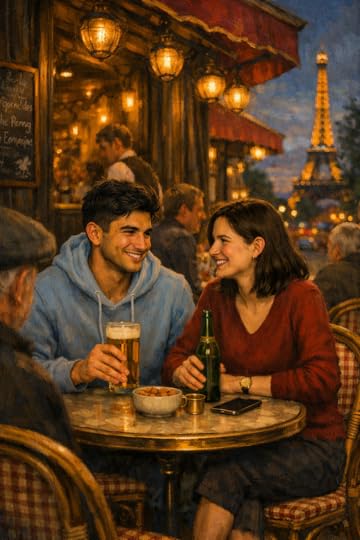
Here is Paris as you have never seen it before – a city in which every building seems to hold the echo of an unacknowledged past, the shadows of Vichy and Algeria.
American postdoctoral researcher Hannah and runaway Moroccan teenager Tariq have little in common, yet both are susceptible to the daylight ghosts of Paris. Hannah listens to the extraordinary witness of women who were present under the German Occupation; in her desire to understand their lives and through them her own, she finds a city bursting with clues and connections. Out in the migrant suburbs, Tariq is searching for a mother he barely knew. For him, in his innocence, each boulevard, Métro station and street corner is a source of surprise.
In this urgent and deeply moving novel, Faulks deals with questions of empire, grievance, and identity. With great originality and a dark humour, Paris Echo asks how much we really need to know if we are to live a valuable life.
Sebastian Faulks is a British novelist, journalist, and broadcaster best known for his acclaimed historical novels set in France, including The Girl at the Lion d'Or, Birdsong, and Charlotte Gray. Alongside these, he has written contemporary fiction, a James Bond continuation novel (Devil May Care), and a Jeeves homage (Jeeves and the Wedding Bells). A former literary editor and journalist, Faulks gained widespread recognition with Birdsong, which solidified his literary reputation. He has also appeared regularly on British media, notably as a team captain on BBC Radio 4's The Write Stuff, and authored the TV tie-in Faulks on Fiction. Honored as a Fellow of the Royal Society of Literature and appointed CBE for his services to literature, Faulks continues to publish widely, with The Seventh Son released in 2023.
I’m right down the middle on this one, so I’m giving it three stars. There were certainly things I liked about it, but there were some things that didn’t work for me. The narrative alternates between two characters who are very different, yet alike in some ways. Their paths cross in Paris while they are on journeys of self discovery and a friendship evolves. While they do connect, I had a problem connecting with them and felt removed from them for some reason I find difficult to pinpoint. Hannah returns to Paris after ten years to research “the experience of women in Paris under the German Occupation “. She seems to have lost her way, still carrying the hurt of a failed, past relationship when she was in Paris as a student ten years previous, so much so that she hasn’t been with another man in the last ten years. Tariq ,19 year old from Morocco goes to Paris trying to find his way. He is unhappy at school, unhappy at home and looking for something- perhaps to learn more about his French born mother who died when he was ten.
On his way Tariq meets Sandrine, another young person seeking something else in her life and connects with her. How Hannah connects with them felt unrealistic. Call me cynical, but I found it hard to believe that a woman on her own in a foreign country would bring a strange, disheveled, dirty looking sick girl back to her apartment. I found it equally unrealistic, again call me cynical, that one would take in this girl’s friend as a boarder without knowing much about him. Having said that, Hannah and Tariq seems to find some understanding in each other. The stories of Juliette and Mathilde reflecting the past during the German occupation WWII were for me the best part of the book and perhaps the most profound part. Reflections on the history of Algeria and France were also enlightening. Fans of Sebastian Faulks may find more here than I did.
I received an advanced copy of this book from Henry Holt and Company through NetGalley.
Sebastian Faulks gives us a novel focusing on two outsiders who arrive in Paris, American Hannah Kohler who returns to the city after 10 years when a love affair with a Russian poet, Aleksandr, broke her and from which she has never recovered and 19 year old Tariq Zafar from Morocco, who wants to know more about his dead French mother. Hannah is working on a project for her American professor who wants her to research a chapter for her book looking at the experience of French women under the German occupation between 1940-1944. Tariq, a vain, confident yet naive young man who has escaped home for the bright lights of Paris, the city is nothing as he expected. He secures a cash in hand job working for Hasim and Jamal, and ends up staying in the stern and serious Hannah's apartment.
Surprisingly, the two of them begin to connect, Hannah because she comes to appreciate Tariq's perspective, his lack of knowledge about the past leaves him free and unburdened to live in the present and Tariq, helping Hannah on her project because of his better French, learns more about the history of Paris. His friend 'Victor Hugo' supplies the traumatic colonial history of France with North Africa and the dreadful period when so many Muslims were killed and so many bodies thrown into the River Seine. Hasim and Jamal provide a picture of the hatred many North Africans feel towards France, given the racism and brutal history of the country. The period Hannah is researching is a time when the French government were complicit with the Germans, implementing anti-Jewish measures, responsible for authorising the deportation of almost 80000 Jews to Auschwitz. A collective amnesia existed about what was done, with an unwillingness by the French to examine that time, and the aftermath where it was more important to maintain order than dispense justice. Hannah looks at and documents the testimony of several women from the period, becoming immersed in their lives. Tariq sees a woman, with a strong resemblance to a photograph Hannah has, and begins following her.
Paris's war years history of women echoes down the years to Hannah and Tariq, conjoined with their personal histories. Hannah learns to live anew, recovering from her personal heartbreak and for Tariq it is a coming of age, as he forms a clearer identity of who he is and what he wants. Faulk's narrative feels uneven at times, with the second half of the novel much better than the first half. This is a novel that took its time to grow on me, I came to appreciate the differences in character and backgrounds of Hannah and Tariq, the value of their unexpected relationship in a story that I found atmospheric, complex and multilayered. Many thanks to Random House Cornerstone for an ARC.
4 stars to this story of unlikely friendship! ⭐️ ⭐️ ⭐️ ⭐️
Hannah is an American historian, and she’s studying World War II in Paris (sounds like something I’d love to do!). She harbors some resentment towards the City of Lights due to something in her past when she was younger.
Hannah meets Tariq, a Moroccan teenager, who sees Paris as a land of opportunity in stark contrast to his own he is fleeing. In need of a place to stay, he ends up boarding with Hannah. Both Hannah and Tariq are very much outsiders to the city.
Tariq begins to see Paris in a different, more complicated light, and at the same time, Hannah discovers something in her research that shakes her to her very core.
With themes of inequity and corruption versus dreams and seeking freedom, Paris Echo is a complex, beautifully-written, engaging novel of friendship and second chances. Hannah and Tariq form a bond that is healing for each of them. Hannah has to heal from her past, and Tariq has to heal for his future. The atmosphere is rich and absorbing, and the story is as well with its multiple layers.
Thank you to Henry Holt and Company for the ARC. All opinions are my own.
PARIS ECHO, by Sebastian Faulks, was an interesting (if not sometimes stuttering) book to read.
Our story is told through the eyes of two main characters--Hannah, an American postdoctoral researcher in Paris to investigate the lives of women who experienced German Occupation from 1940 to 1944; and, Tariq, a bored and flighty 19 year-old French-Algerian escaping school and life in Tangier to discover his dead mother's birthplace. Once their paths cross, we alternate between Hannah and Tariq's versions of Paris shaped by their experiences.
There were parts of Paris' World War II history shared in PARIS ECHO that I was familiar with, but I learned additional grimy details that added to the solemn subject of the story. Difficulty with the story, for me, came with the "ghost" or "alter ego" encounters that I felt detracted from the main plot.
The "ECHO" might represent people's past lives bubbling up to affect those in the present; or, it may just boil down to being knowledgeable about past history so that the past is not doomed to be repeated.
I rate this book 3 stars, even though I struggled with it I did enjoy those moments in the book where Faulks wrote some beautifully moving lines.
I'd like to thank Henry Holt and Company for this ARC and Goodreads for the Giveaways in exchange for an unbiased review.
This is my first read of Mr. Faulks and I am both impressed and emotionally moved.
The prose straddles the line between literary and popular fiction in a masterful, engaging and reliable fashion. Smooth and consistent so that the narrative is allowed to provide both psychological succor and healing to the two protagonists in a subtle and revelatory fashion.
An unlikely yet perfect friendship is struck by an adventure seeking Moroccan boy of 19 and a young thirty something year old historical American researcher who has not been able to heal her broken heart. Through their interactions with each other, Paris, personal and collective history, their imaginations and some mystical experiences the boy becomes a man and the woman acknowledges that work is not enough and that her life is equally important. These are real people that are not extraordinary but products of their cultures, genders, socioeconomics, psychologies and previous experiences.
I loved this to bits and I am so looking forward to reading more of this gent's fictions. So glad to have made your acquaintance Mr. Faulks.....
EXCERPT: I was taking a pee in the bathroom when I caught sight of myself in the mirror. My face looked so beautiful that I turned to look more closely, spraying the tiles round the toilet in my hurry. I shook my zib and put it back inside my boxers so I could study my face. It was like someone had drawn a faint shadow beneath the cheekbones, then put a touch of mascara on my lashes. The eyes had a depth I’d never seen before. I put my head to one side and smiled, then furrowed my brow as though I was being serious, but the eyes stayed the same – twinkling with a kind of humour and experience. This was the face of someone old beyond my years.
How could it be I’d never noticed before just how beautiful I was? Not regular handsome maybe like an old-time film star and not indie blank like a modern one. More a mix of soul and sexiness. With noble bones.
I flipped the glass to magnifying and back to normal. I held a hand mirror up to turn the reflection on itself, so it sat right-way on. I backed against the wall, then went fisheye close. It made no difference. True, I’d smoked a little kif, but only a little, which was all I liked, and I’d had a Coke to keep my sugar level up (a tip from a boy in my year). I felt happy to think this person was me. No harm could come to someone who looked like that. The ways of peace and righteousness were ours. Not to mention soft-skinned girls and travel to distant places.
We stared into one another’s eyes for a few more minutes.
Then he spoke.
He said, ‘You got to get out, man. You gotta get out.’
I felt myself nodding in agreement.
Because I’d known this anyway, for quite a while. There was nothing shocking in what he said, it was more of a relief.
‘Go now.’
‘I will. Any day now.’
ABOUT 'PARIS ECHO': Here is Paris as you have never seen it before – a city in which every building seems to hold the echo of an unacknowledged past, the shadows of Vichy and Algeria.
American postdoctoral researcher Hannah and runaway Moroccan teenager Tariq have little in common, yet both are susceptible to the daylight ghosts of Paris. Hannah listens to the extraordinary witness of women who were present under the German Occupation; in her desire to understand their lives and through them her own, she finds a city bursting with clues and connections. Out in the migrant suburbs, Tariq is searching for a mother he barely knew. For him, in his innocence, each boulevard, Métro station and street corner is a source of surprise.
MY THOUGHTS: Paris Echo is a slow-moving book, but one that has a certain charm. It is beautifully written, it's characters unusual but all the more captivating for that.
It is Tariq who features in the above excerpt. He is quite narcissistic, in the way that most teenagers are. And yet I could not help but warm to him. He is somewhat naive in the ways of the world - he is a 19-year-old virgin which doesn't particularly please him, yet he seems to find it quite difficult to shed his virginity. Although the reason he gives for going to Paris is that he is searching for his mother, the real reason is not that at all.
I also liked Hannah. She is very self-contained. She has had her heart broken in the past and is determined to never be in that situation again. Yet she opens her home to a much younger Moroccan boy who is destitute. Odd bedfellows (only a saying - don't read anything into it!) but they become friends and help one another out.
I enjoyed listening to the recordings of Parisian women detailing their lives in Paris under the German occupation. It provided another layer to this story and a bond between Hannah and Tariq. There is a lot of history woven into the storyline, from the German Occupation to the long and uneasy relationship between France and Algeria. I came away from this read knowing a lot more about France's history than I did prior to reading Paris Echo.
While this isn't my favorite book by this author - that accolade belongs to Birdsong, I did enjoy it. Another quietly powerful and beautifully written book from Sebastian Faulks.
⭐⭐⭐.9
#ParisEcho #NetGalley
THE AUTHOR: Sebastian Faulks was born in 1953, and grew up in Newbury, the son of a judge and a repertory actress. He and his family live in London.
DISCLOSURE: Thank you to Random House UK, Cornerstone, Hutchinson via NetGalley for providing a digital ARC of Paris Echo by Sebastian Faulks for review. All opinions expressed in this review are entirely my own personal opinions.
Paris Echo by Sebastian Faulks was published September 06, 2018
I listened to the audiobook of Paris Echo brilliantly narrated by Elham Ehsas and Deborah McBride.
Hmm, that 'Echo' in the title feels well-placed as this book seems to me to be channelling too many previous books: how many times have we read of the PhD/postdoc researcher who is uncovering stories from the archive, for example? (And I do wish authors could get their facts straight: it's pretty much impossible for someone with a PhD to walk into a postdoc without competition and without having published anything). In this case, the tales of women in Occupied Paris seem lifted from other histories and seem especially familiar to anyone who has read Les Parisiennes: How the Women of Paris Lived, Loved and Died in the 1940s, for example.
The second strand is more original in concept as Tariq, a young Moroccan man, comes to Paris to learn more about the life of his mother. Tariq's voice is vibrant and engaging but the parallels between Nazi Occupation and French colonialism are heavy-handed and unsubtle.
There's also a clumsy device that draws both plots together as Hannah, the postdoc, finds a fevered homeless girl on her doorstop and without a moment's thought, takes her into her home and nurses her back to health. Now call me cynical, but I just don't believe that that's how we generally respond to the ill and destitute. Especially when this doesn't so much throw light on Hannah's character as serve to bring Tariq into her world - all too convenient.
Overall, I found this a frustrating book because it could have been so much better than it actually is: the tepid romance between Hannah and Julian takes up too much page space, and the Occupation/imperialism theme feels rather shallow and done before. I failed to find the politics of our real world in this book.
Thanks to Random House/Cornerstone for an ARC via NetGalley.
I had to stop and check whilst reading this book, to check that it was really written by Sebastian Faulks, the author of the wonderful book "Birdsong" To me, this just didn't feel like his style of writing. It was just a tedious mess of an apparent dreary romance, crossed with a nineteen year old man that became homeless, that seemed to be on a constant quest to have sex. To learn that he had an erection every chapter did absolutely nothing for the story. If anything, it make it kind of lame. There were far too many unbelievable moments contained in here. I mean, would you honestly, being a single woman, take in a homeless person that happens to be sitting outside your house? It is a personal preference here, but I certainly couldn't. The main characters were boring, and I felt entirely detached from them throughout the book. The constant talk of French streets and train stops was mind numbingly irritating. I felt like I was on a date, and my date was trying to fill me up on pointless, mindless jargon, just to try and impress me. I'm relieved it was a short read, as this was a huge disappointment for me.
This is lighter and less dramatic than Faulks’ rather grim but magnificent magnum opus “Birdsong”, about a Brit’s life shaped by fighting in the trenches of World War 1. Here we get a tale of two characters recently come to Paris, Hannah, a serious American of about 30 who is studying the lives of women during the German Occupation during World War 2, and Tariq, a Moroccan youth of 19, seeking adventure and possibly some knowledge of the life of his half-French mother and French grandparents. She spends her time reviewing audio recordings of women about their experiences during the war and tracking down and interviewing a few very aged survivors. He ends up a housemate in her flat in a classy neighborhood while working in a fast food joint in a lower class sector of Saint-Denis, where many Arab and Middle Eastern immigrants and refugees reside. They help each other in surprising and touching ways, facilitating each other’s growth and evolution, learning much about the intersection of the personal and the historical and the lasting impact of the past on the present.
The alternating first persona narration of these two ends up making the cityscape of Paris a key character in itself. For Hannah, the voices from the past speak of homes, routes to work, cafes, and cabarets, and sites of Nazi or Resistance activities, places which begin to come alive for her when she can visit those places and see photos. Offices and jails of the SS or Gestapo send out dark vibrations. She feels haunted as if by ghosts upon visiting the bicycle racetrack where the Vichy government dumped 13,000 Jews in unspeakable conditions in 1942 and the complex in the Drancy suburb where they were then held before final shipment to death camps like Auschwitz or Ravensbruck.
Hannah homes in on two historical women, Juliette, a clothing store worker who dated a German officer with family permission, and Mathilde, a waitress who favored accommodating the victors but took up a love affair with a leader in the Resistance. True Resistance heroines are hard for Hannah to find records for because of necessary secrecy and because so many were captured and killed in the camps. Her sense that both active resistance and active collaboration were not that common is supported by her special English friend from her past stay in France in a semester abroad in school, Julian. This literature scholar and teacher argues that only about 3% of the French people were active in these extreme roles. The vast majority maintained a “wait and see” attitude and tended to support anything that could shorten the war. Hannah, with Tariq’s help in translation, asks the survivor Mathilde why she chose to stay in Paris and did nothing to counter the German invaders:
We didn’t have a country manor house! We were peasants. …I didn’t mind them. I felt sorry for some of the young ones. …It was the English we didn’t like. Because they kept the war dragging on. And the Jews. When you’re poor you just do what you have to do. You only think about the factory work. And when you might get some time off. But mostly we were thinking about food. For Tariq, all the sights and sensations of the city were new and wonderful in their diversity, the grand or peculiar names of all the Metro stops and streets a spur to his imagination. When told of the history or real figures behind the names, he begins to build knowledge and hunger for more, despite starting with a total disinterest in “stuff that happened before you were even born.” He is so loveable when he asks in ignorance: “Don’t tell me there was a painter named Auguste Bastille.” But the history infusions soon start to gain personal significance in his journeys with an old veteran, Victor Hugo, whom he helps with his puppetry shows on the Metro and in parks. Like his namesake, Victor has a tragic and romantic outlook on the history of France in North Africa, which he renders for Tariq like a master storyteller:
“Of course my own country once hoped to be a Mussleman power. The idea was to enlighten the Arab world, to bring it science, law, the rights of man, then from an alliance with them against a common enemy.” “Who’s that?” “The Americans.” “…As a result of the wars, the countries of the Maghreb, the men of Algeria, Morocco, Tunisia—people who once loved us, or at least alongside us—came to distrust France as much as they despised the other Europeans. They brought god into politics. And that was the end for France. After that, there was only massacre, torture, and despair. The end of our oriental dream.
Thus, Tariq could begin to appreciate why his Algerian friend and co-worker at the fried chicken café hates the French so much. His father had been loyal to the French in Algeria, left to imprisonment and torture after they lost the war, and led his family to neglect in the slums of Paris after immigration there with his family.
Tariq is also affected greatly upon Hugo’s vivid recounting of the Pont Saint-Michel as the bridge from which in 1961 hundreds of Algerians captured at a street protest were thrown, hands tied or already dead, to conceal how they had beaten or killed by the police after their capture at a large street protest. The man responsible, Papon, was called in for the job because he was so effective in brutally suppressing rebellion in Algeria and in the infamous rounding up Jews at the bicycle stadium back in 1942. Tariq can’t help wondering if his own mother was a witness or his grandparents killed in this atrocity:
It wasn’t their ghostly absence that I felt, as I sat by the river, staring into the silent water. What haunted me was the sense that their secrets had left a permanent void in my life.
Although Hannah had already been educated against the idea of history “as a sort of pageant” from a different world, she gains a more personal sense of how “history was neither ‘past’ nor ‘other’ but an extension of the present to which all people, whether they know it or not, are attached”:
I was excited by all this. I believed in the impact of previous existences on every day I was alive; in more excited moments I came to think that the membrane of death was semi-permeable. This belief was what gave a sense of purpose to my work.
She begins to understand how the devastation of World War 1 and the cost of millions of deaths and 1.5 million disabled damaged the spirit and expectations of the French people and made them less willing to engage to extreme sacrifices against their invaders. Mathilde’s miserable childhood with her one-legged veteran father, who worked in a slaughterhouse, comes to seem consistent with her choice of a passive approach with respect to the Nazis and, ultimately, her betrayal of her Resistance lover out of jealousy. Hannah finds parallels in her own damage by abandonment of a lover in her previous stay in Paris and shame in her vulnerability as a basis for choosing to no longer take risks to seek love. I love the eerie power of her illusion of a connection with the past when she is haunted by the smell of horses at a visit the slaughterhouse where Mathilde’s father worked, though closed for more than 50 years:
Could there be such a thing as temporal synesthesia—a condition in which you confused not two senses, like sight and smell, but in which different eras became merged? Could it be that my brain, made hyperactive by the shortcomings of the present, had actually experienced, through smell, the richer past?
I was surprised and pleased how Faulks led me through the rather mundane activities of three two visitors to France and ended up reaching for rather profound insights on the connection of the personal history to the larger drama of the historical events of war. I didn’t reach the highest level in my rating because of his tendency to spell out his messages and themes and because of a sense that they weren’t quite earned in their own right from the characters’ experiences. I liked best the ways that the two characters complemented and facilitated each other’s journey, with Hannah so wise with knowledge but stunted in her heart and Tariq naïve to history but so noble in his hunt for love and so perceptive about people’s hidden feelings.
This book was provided for review by the published through the Netgalley program.
Hannah is an American historian who is in Paris to do some research. She’s writing about the lives of women who were present in Paris during the German Occupation. She listens for hours to recordings these women made detailing what living in Paris was like at that time and how these women felt about the German soldiers. As she walks the streets of Paris, memories of her time there ten years before and the love affair she has never gotten over begin to haunt her. She’s also haunted by the ghosts of the Paris witnesses she’s listening to.
She takes in a boarder, 19-year-old Tariq, who has run away from his home in Morocco. Tarij isn’t sure why he came to Paris, possibly to find answers to all of the questions he’s had about his long dead mother. Hannah and Tariq couldn’t be more different and yet they form a friendship. Tariq is ashamed that he knows so little history and learns that many North Africans hate France for its treatment of Muslims. One of his newly found “teachers” is a man who thinks he’s Victor Hugo, a homeless man who performs puppet shows in the subway for donations.
This is a gorgeously written literary work, a slow-moving, thought-provoking book. There are several stories in this book, not only the stories of Hannah and Tariq but also of the women who witnessed Paris during the German Occupation, relating the atrocities committed, and real-life women such as Andree Borrel, a French heroine of World War II who was executed by the Germans. The ghosts of the past converge with those walking the streets of Paris in the present day and Paris’ history continues to echo into the future. This is a book that will linger long after the last page is read.
Most highly recommended.
This book was given to me by the publisher in return for an honest review.
Things you would learn from reading this book (many of which you may know, but some of which you may not):
- Extensive detail about the Paris metro – the lines, stations (and the reasons for many of their names) and interchanges
- Paris has many districts away from the main tourist areas, each with their own character
- Paris was occupied in the Second World War, and the occupation (particularly when it looked like the Axis powers would win the war) created difficult choices for the locals, particularly younger women, as to their attitude to the Germans
- Some Frenchmen chose to actively collaborate with the occupying regime – both in Vichy France but also in Paris, including in the round up of Jews to meet imposed quotas
- France has a colonial history – and one that in Algeria was far from glorious and which was made worse by its subsequent treatment of both the French descended settlers who returned and those Algerians who fought for the French
- That the last two bullets were not unconnected
- The spoken French language is difficult to understand for non-native speakers – both because of the speed at which the locals talk and the rather ridiculous number of homonyms. Did I know this by eye- no (see it even happens in English - who knew, that's new)
- The author’s novels make rather too much use of coincidence
- The author has rejected the “show not tell” mantra taught even to young children for their creative writing and replaced it with “show and tell and then repeat several times to be on the safe side”
The author has clearly spent extensive time researching the above: the descriptions of Paris are evocative, although offset by a level of metro description that would imply membership of the line-basher sub-division of the trainspotting fraternity.
Some of the wartime research is told directly in (invented) archive recordings of the voice of two women who lived through the Occupation – one of whom Hannah later meets as part of her research – and these parts are moving effective.
However much of the rest of it is told by the expedient of having two visiting characters – one (Hannah) highly knowledgeable about the City for research and professional reasons and the other (Tariq) almost comically ignorant of Paris and history (not to mention mathematics, failing a calculation that my 10 year old worked out in a minute – albeit I am not convinced that the author has any stronger a grip – the book has completely wrong calculation by Hannah also).
This set up gives extensive opportunities for exposition by dialogue, opportunities that the author has embraced with vigour.
Perhaps the largest challenge that the author faced was how to interlink these two characters and their stories – a challenge that he sidestepped by a rather implausible set of early circumstances.
Another key part of the book – one foreshadowed in two epigraphs and regularly through the book, is the idea of autoscopy and I found this the least convincing part of the book – the characters of Victor Hugo, Clemence and so on were far fetched.
My favourite part of the book was Tariq – an unusual and different character.
Overall this was an underwhelming book – more “Where My Heart Used to Beat” than “Engleby”.
Where’s Sandrine? What happened to Clémence? How did Hannah score that fabulous Paris apartment on an academic’s salary, and who’s her rental agent? Would you invite two strangers to live in your apartment, like Hannah, or would you ask a teenage boy stalker into your apartment, like Clémence?
Sebastian Faulks’ Paris Echo is a novel of contemporary Paris centering on three main characters: Hannah, an American academic in her 30s on research leave; Tariq, a Moroccan teen who’s run away from home; and Sandrine, an early 20s homeless French woman. Somewhere in about Chapter Eleven of twenty-two chapters, Sandrine serves her plot purpose and mysteriously wanders out of Paris Echo. The novel starts out a bit like a bad joke: an American, a Moroccan, and a French woman walk into a bar. But it’s not a bad joke at all, rather an interesting and engaging novel with several intriguing threads: Hannah’s research on women in the Resistance during World War Two and the wonderful tapes that she listens to of them and other women recounting their stories during the occupation; the World War Two round-up of French Jews to be sent for their mass murder in concentration camps; the French police extra-judicial killings of pro-FLN protestors on October 17th, 1961; Tariq’s search for his French mother’s roots; Hannah and Tariq’s growing friendship and appreciation of each other; Tariq’s increasing worldliness. Faulk weaves these threads through Paris Echo, providing it with its verve. Faulk also weaves some threads more completely than others throughout Paris Echo and drops stitches on others.
Faulk’s builds Paris Echo through the conceit of a series of echoes reverberating over time in French and especially Parisian history. Here’s Hannah: ”At college, we’d been asked to understand that history was neither ‘past’ nor ‘other’, but an extension of the present to which all people, whether they know it or not, are attached. Professor Putnam had recommended that her freshman students attend a lecture in quantum physics to get a first idea of the flexible nature of time.” And slightly later: ”I believed in the impact of previous existences on every day I was alive; in more excited moments I came to think that the membrane of death was semi-permeable. This belief was what gave a sense of purpose to my work.” It’s an interesting and largely effective technique for Faulks, but some of his echoes reverberate more loudly, clearly, and convincingly than others.
3.5 stars, rounded to 3. Ultimately, an interesting but disappointing novel.
Fourmillante citѐ, citѐ pleine de rêves, Où la spectre en plein jour raccroche la passant!
Paris, I love you! This year, unfortunately, my love must be satisfied with music, movies and books instead of the usual visit. After recently re-watching the Antoine Doisnel trilogy by Francois Truffaut and taking my time with Julio Cortazar’s romps though the Quartier Latin in the 1950’s, I turned to this most French of all English language writers: Sebastian Faulks.
His latest novel is a love song to this magnificent metropolis, expressed through the voices of two foreigners who are attracted to Paris by the ghosts of the past: Hannah is an American history researcher who comes back to the place where she once knew passionate love and crippling loss as a student, now on a grant to study the dark years of the German occupation in World War Two.
It was well known that for decades nothing had been published in France itself – no first-hand narratives and no analysis by French historians of the four years most people thought best forgotten.
Tariq is a Moroccan teenager who runs away from home, from being tied down by his family expectations and a restrictive society. He is hoping to find clues about his dead mother who was born in Paris, to understand his mixed heritage, Western and Oriental, and his place relative to past and current racial conflicts.
It was not their ghostly absence that I felt, as I sat by the river, staring into the silent water. What haunted me was the sense that their secrets had left a permanent void in my life.
Hannah and Tariq each engage on their personal quest through Paris history independently, but somehow their paths intertwine, just as the ghosts of past float between the two main story-lines, with a touch of supernatural mystery and echoes of the poetry of Baudelaire, de Musset or Verlaine, a curious reincarnation of Victor Hugo busking on Line 12 and echoes from the wartime poetry of Wislawa Szymborska.
This is not a plot driven novel, the story evolves almost at random, just as Hannah and Tariq jump from one line of the Metro to another: the historian tracking witness accounts from the women who were accused of cooperating with the Germans during the war; the teenager trying to survive an underworld of drugs and poverty , to find a job and a direction to his aimless wandering. Yet, at least for me, the not-a-novel is utterly captivating, especially through the device of centering each chapter on a Metro Station, of absorbing its unique signature, of getting to know the sort of people who live there, where they come from, what they dream about. Tariq, the almost tongue-tied shy teenager, is the one who somehow manages to give voice to my own enthusiasm:
‘And are you having a good time in Paris, Tariq?’ said Jasmine. ‘Wonderful,’ I said, which was at that moment true. ‘What do you like the most? The Eiffel Tower? The Latin Quarter?’ ‘No, I like the Metro best.’ Everyone began laughing, so I laughed too as I poured myself some wine. ‘I like the stations. Their crazy names. I love the funny smell, like gas and burnt rope. I like the girls I see in the carriages. And the people I come across there. One day I met this guy who does a puppet show every day on Line Twelve. He’s called Victor Hugo.’
So, the journey would have been worth the price of admission simply for its tourist guide attraction, but Faulks adds layer upon layer of meaning to his Paris canvas, revisiting some of his favorite themes from previous novels. Mainly, the argument is about the importance of the past in shaping who we are and where we are going. Characters and themes from “Birdsong” and “Charlotte Gray” are present in the witness accounts from the survivors of two world wars. The focus is not so much on actual events, but on the impact these times had on the lives of families living in Paris during the period. Hannah, more than Tariq, is the one who understands the importance of this work to shine a light on uncomfortable subjects that are nevertheless part of the collective memory of a generation.
At what point in my childhood had I known for sure that this detective work was what I’d been put on earth to do? I had, after all, had other abilities. I could play the piano to a half-decent level and had – once, anyway – played on the college tennis team. But in the end all those things had given way to the joy of setting out alone on a cold morning, awash with coffee, on a mission to redeem the lives of dead strangers.
Hannah’s reasoning can be extended to the whole scope of Faulks’ prose, his constant focus on the voices of the past, his warning that history ignored is almost guaranteed to be repeated with equally disastrous results. Tariq is not exempt from these constraints of historical heritage, as he delves on the bloody fight for liberation of his country from their colonial masters, on the secrets that still cloak the fate of his mother.
I remembered how when I’d first came to Paris it exasperated me to think that I’d never have the time to push open every door and see what lay behind. What then had I hoped to find, I asked myself as the traffic barrelled along beside me. A door, a key, one life that by its individuality would open up a world.
The author knows very well that a dry statistical enumeration of the casualties, or of the relevant moments in history would not make a very gripping tale, so he goes for the personal angle, for the local colour and emotional intensity of a couple of ‘real’ cases: Mathilde, a shopgirl in the occupied city, and Simone, an English woman working for the Resistance. These accounts are spliced into the present time journeys of Hannah and Tariq, more or less seamlessly . What I really liked about this approach is the way the author blends in poetry and psychiatry in his demonstration of the power of the past to liberate the future. Can understanding the past help you live better? is one of those rhetorical questions that the novel asks of the reader before giving us the example of Hannah and Tariq and the way their year in Paris becomes transformative.
‘Autoscopy. It’s when you have the sense of being outside yourself and seeing yourself as another person. Auto, self, scope, vision. De Musset had it a lot.’
also, Could there be such a thing as temporal synaesthesia – a condition in which you confused not two senses, like sight and smell, but in which different eras became merged? Could it be that my brain, made hyperactive by the shortcomings of the present, had actually experienced, through smell, the richer past?
My personal interpretation is that the difference for the two main narrators, between the start of the journey and its open end, is one of focus: from self-absorption and depression to acknowledgement, acceptance of past mistakes and to a more courageous engagement with the world they inhabit now, with a little more trust in the good side of people and in the merit of taking chances. A bit of romance for both Hannah and Tariq, handled with tact and subtle humor in both cases, helps to relieve the heavier impact of the wartime examples that show human nature in some of its least palatable manifestations. I liked in particular the way both love stories are centered more on intimacy and dialogue than on sex.
‘There’s something else I need to tell you,’ I said. ‘Go on.’ ‘I don’t trust happy endings.’ ‘Me neither.’ ‘They belong to airport books where a peasant woman is violently abused in the first chapter and six hundred pages later her granddaughter opens a department store on Park Avenue.’
As a sort of conclusion: “Paris Echo” is not an airport book, it is a multilayered portrait of a city and a journey of self-discovery for two people who came here to escape their past, only to find out that you must confront your inner demons before you continue the journey.
‘I think that without knowing it you realized it was time to engage with the world. You couldn’t live for ever on the screen of your cell phone. I know your idea of finding out something more about your mother was kind of vague. But maybe it was the first stirring of some hunger in you. The need to understand.’
>>><<<>>><<<
additional material that I found in my notes after writing the conclusion:
Victor Hugo had told me that they’d got that name because they used to go into the old food market at Les Halles when the bell or ‘cloche’ was sounding at the end of the day and they’d get given food that was otherwise going to be chucked out.
I saved this piece because it reminds me of several scenes from “Hopscotch” by Julio Cortazar, and it explains the origins of the nickname for the homeless of Paris [clochards]
Over the years, I’d gathered a sense of when I was in the presence of true witness. A lack of emotion was a good sign, as was an ability to live with contradictions – a willingness just to report experience and leave the judgement to others.
I like this second bookmark, because it articulates the conviction of the author that it’s better to refrain from editorializing history. Just present the facts and leave the interpretation to the reader.
‘What, really, is the difference between the commemoration of an atrocity and the perpetuation of a grievance?’
A major issue in the study of past atrocities is if it is better to keep hammering new generations with the morality issues, perpetuating grievances, or if we should move on and mend the broken hearts. As with the previous quote, Faulks leaves the question open, but he does offer a poem from a Polish survivor of the war.
Those who knew what was going on here must make way for those who know little. And less than little.And finally as little as nothing. In the grass that has overgrown causes and effects, someone must be stretched out blade of grass in his mouth gazing at the clouds.
Even if I’m not going to quote them here on Goodreads, the story is framed and enhanced with numerous references to a couple of famous French poems: ‘La nuit de dѐcembre’ by Alfred de Musset and ‘Colloque sentimental’ by Paul Verlaine. A familiarity with both will surely help with his visit to Paris.
My final bookmark is a joyous exclamation from Tariq, and I would like to aplly it to the next novel that I hope to read from mr. Faulks:
This is Sebastian Faulks’s fourteen novel, he has been published continuously over thirty five years. So it’s probably unreasonable to expect very much that’s new from him, or unexpected. Staple Faulks subject matter encompasses Paris Echo, and the title of the book tells the reader to prepare for more settings viewed by an avowed Francophile. World War Two is revisited as Petain’s Vichy France is once again put under the microscope, and the acceptance, or collusion with German occupiers is scrutinised. Readers who have enjoyed Faulks hitherto with find much to like, as did I. There are two largely separate protagonists, Tariq Zafar and Hannah Kohler (an American). Tariq is a nineteen year old Algerian through whom Faulks examines, very successfully I thought, the real life and historical consequences of the murky French colonial past in Algeria. Hannah is ’earnest’ (Faulds’s description), and while only 31 years old, she carries emotional baggage so refreshingly absent in Tariq. Hannah’s personal relationships, with Alexandr and Englishman Julian Finch were the least convincing or interesting parts of the book in my opinion. In addition to Tariq’s street wise innocence, I found the jump back in time to (women) witness accounts of German occupation a fascinating element in Paris Echo. This is Faulks’s speciality- historical fiction that focuses particularly on the two world wars in Europe. The two, fictional, women (Juliette Lemaire and Mathilde Masson) are given wholly believable voices. Their everyday accounts of the realities of civilian life during war are juxtaposed with the factual references to Andree Borrel, to Maurice Papon, and in Algeria the Harkis. Infamous camps and detention centres at Drancy and Natzweiler. History surrounded by a fictional wrap- very effective. There’s no doubt that there’s an appetite among today’s generation to absorb the stories of war seventy five years ago. Paris in the c.21st century; the diverse metropolis of the banlieue, of the outer arrondissements; areas named after historical events and people, is superbly evoked. The chapter names tell the reader that there a Paris beyond the Champs- Elysee and Haussmann architecture. Belleville, Stalingrad, Sarajevo. A bigger Paris is well publicised by Faulks.
Less successful, to my mind was Faulks’s digression into autoscopy, via the work of the poet Alfred de Musset. Some passages exploring an out of body experience, and a doppelgänger, Clemence, were rather shoe horned into the narrative, I thought.
I had the chance to hear Sebastian Faulks on his promotional tour for Paris Echo. at the superb, intimate setting of Daunts Books (Marylebone High Street), interviewed by Alex Preston. Faulks is a suave, humorous raconteur. On Paris Echo: • Faulks wants to, and hopes he has, asked a lot of the reader. With four separate voices (Tariq, Hannah, Mathilde, Juliette) • In Tariq. Faulks sets out to give the reader a person they have not met before. Faulks despairs if the lazy writing that would preface a character with a preamble ‘he was the kind of man who...’ Too general, too bland. • Faulks set out deliberately to write about a different Paris. In 2016 he hired a guide and asked to be taken to places tourists don’t visit, and to places not previously visited by the guide. • Asked by Alex Preston if Tariq represented the younger Faulks (who spent three months in Paris at age 17), Faulks said that his experience was personally brutally educative. He watched films at the cinema, and had read the Cambridge University literature course pack!! In other words, the girls, the drugs, the rock ‘n roll eluded him. • The lessons of history. There was a much more serious side to Faulks on the subject of the importance of history, both in relation to Paris Echo, and as a concern of his through his works. Faulks sits on a committee commemorating Works War One. Will this be remembered in 100 years time? Should it be? If a young person lay beneath the Thiepval Memorial to the 70,000 missing and thought- it’s gone- would that be for the best? How much history do you need to know? Hannah in Paris Echo hasn’t looked after her own life because of always researching the past- as though she wants to redeem the lives of those who have gone before. Anyway, today’s young are educated differently and don’t read lots of books.
This, deeper, reflective Faulks then talked about his other works of fiction, especially Engleby and A Week in December
A good book, not prize listed, prize winning, but a book for the internet age where the historical backdrop referenced by Faulks enables every reader to do their own research, be their own Hannah, if they wish to.
The story is separated into chapters each of them named after a metro station or area of the city. (It’s actually a really fun and quirky way of finding your way around as well) Paris is the city for reading its history through the names of its stations and streets. Some of them reveal historical battles, figures and a moment in time. Every one is a chapter in Tariq and Hannah’s stories.
I found the characters of Tariq and Hannah to be very interesting in how they give such unique viewpoints of a time and place, a setting and the people of the city over time.Both are outsiders but each wander the streets looking for something, answers, a history, a clue …..Two lost souls in a city lost to them.
Hannah’s story looking into the women during the war and how they reacted to the German occupation was interesting. Often a part of history forgotten. There were some tough ‘scenes’ to read and it made me think of all those stories women never got to tell, that we still don’t know about.
This was like a history lesson told via the metro stations with a good strong message. Two people wanting to find answers talk and help each other to form a bigger picture so they both find their own story. The city, and the past are full of surprises but it’s only by looking into the past and learning from it that we can really continue and move forward. How we deal with war, how we fall into the trap of following the crowd, drowning out individual voices, how war shapes a person…there’s lots in here to explore.
It does read a bit heavy handed at times and doesn’t flow in parts. The story also sometimes
Paris Echo is the latest historical fiction novel by one of my favorite British authors, Sebastian Faulks. This lovely book alternately tells the story of American historian Hannah Koehler, who has come to Paris to research women taking part in the French Resistance during World War II and the Nazi occupation of Paris, and that of Tariq, a young teenager who has fled his home in Morocco to come to the City of Light to see if he can learn more about his deceased Algerian mother from Paris. As these two lives intersect, as well as the voices and history from the past come to life, I couldn't put the book down as both Hannah and Tariq explore the past and how it relates to their lives and culminating in a beautiful conclusion in this powerful book.
"When the Statutory Work Order was introduced in 1942, young Frenchmen of a certain age had three choices: to go and toil in German factories for the Nazi war effort; to join the Resistance; or to disappear. For women the alternatives were less clear-cut. . . . Only a few girls could take risks carrying messages by bicycle in the countryside; life wasn't like that for the women of Paris."
"There was a difference between the solitude I liked for work and its aching sister, loneliness."
"I wished I'd been more like Hannah Koehler, who knew everything about her family and history of countries from which they'd long ago emigrated to America. She understood herself, her ancestors and her obligations to them. Her earnest work, it struck me, was a thank-you letter to the generations who had enabled her to know her place."
"My eyes were squeezed shut with effort and I heard the sound of children's footsteps going up the stairs. . . . I tried to believe it might have been a comfort for them to think--in the last hours of their lives--that in act of remembering they were, for a moment at least, something more than footsteps in a concrete stairwell."
This book wasn’t what I expected from Sebastian Faulks. It was a bit all over the board as to what type of genre it's meant to be. There is some contemporary fiction, historical fiction, and magical realism in this book. These genres sometimes worked well together, but sometimes they were dissonant, and it took me a bit of work to figure out what was going on.
In modern-day Paris, the stories of Hannah; an American post-doctoral researcher, and Tariq; a nineteen year-old Moroccan teenager, converge in Paris. Hannah is in Paris to research the lives of women who lived in Paris under the German Occupation during WWII. Tariq has run away from home, and traveled to Paris with a vague idea of finding out more about his dead mother. Through happenstance, Hannah allows Tariq (who she does not know) to stay in the spare room in her apartment. Threads of Tariq’s story, Hannah’s story and Hannah’s research about the almost forgotten Parisian women wind their way throughout the book. At some points, Tariq even interacts with a woman from the 1940’s.
There were illustrative stories about the horrible way that the French treated the Algerians during, and after their colonization of that country. There was historical information provided about some of the atrocities of the German Occupation of France, and the difficult position some Parisian women found themselves in before and after the war because of their relationships with the Germans. The Metro in Paris is actually a pretty big character in this story, as Tariq uses this as his method to travel throughout the city, and Hannah explains the historical significance of many of the Metro stop names to him.
All in all, it seemed like a bit of a mish-mash to me. While I learned something, considering the subject matter, the lessons turned out to be a bit dry for me.
‘Thank-You’ to NetGalley; the publisher, Henry Holt & Co; and the author, Sebastian Faulks; for providing a free e-ARC copy of this book in exchange for an honest review.
Two strangers in Paris for very different reasons meet, and through them the reader is taken to two important parts of France’s past – the Nazi occupation of France and France’s own colonial occupation of Algeria. Hannah is a post-doctoral student, in Paris to research a chapter for a book on women’s experiences during the Nazi occupation. Tariq is a 19-year-old from Morocco, who has left his comfortable home to try to find out more about his mother, a Frenchwoman who died when he was an infant.
I have very mixed feelings about this book. On the one hand, I knew very little about either of the parts of history Faulks discusses, and found them interesting and well written, with a feeling of having been well researched. On the other hand, the whole framing device of Hannah and Tariq and their experiences is completely unconvincing – so much so that I had to jump over an almost insurmountable credibility barrier before the book had got properly underway.
I’ll get my criticisms out of the way first, then. Hannah has just arrived in Paris, on her own, when she comes across a homeless girl in the street, a complete stranger, who appears to be ill. So she takes her back to her flat, looks after her, leaves her there while she goes out to work and doesn’t mind when the girl moves a friend in – Tariq. Well, that’s all lovely, and nobody robs her or trashes the place and Tariq becomes the perfect lodger. But. Seriously? It simply would never happen, unless Hannah was nuts and we’re not led to believe that she is. Nor did I feel that a young man in Paris for the first adventure of his life would want to spend his time living with a thirty-something landlady.
The other thing that jarred was Faulks attempt to bring a kind of ghostly vibe into the story, as each becomes consumed by the history they are researching. I could have accepted it if there were only one of them – one could have put it down to overwork, stress, over-active imagination, etc. But both beginning to see and hear people and events from the past? Partly my problem with this was that it reminded me a little of how Hari Kunzru brought the past into the present supernaturally in White Tears, and that comparison worked to Faulks’ disadvantage, since Kunzru did it so much more effectively.
But once Faulks begins to let us hear the stories of the women during the Occupation, his storytelling rests on much firmer grounds. He does this by having Hannah listen to tapes made as a kind of living history project, when the women were elderly and looking back at their experiences. I found these stories compelling and often moving, and they carried me through my problems with the framing story. He is making the point that this is a period which France prefers not to examine too closely and tends to somewhat distort by suggesting that most people were either actively or passively resisting the Germans. Faulks suggests that in fact most people were willing to go along with whoever looked like they’d be the winner – their over-riding desire was to not have the same massive loss of life as in WW1 and they didn’t think much more deeply than that. It was only after the tide of war turned against Germany that women were vilified for associating with the German soldiers – Faulks suggests that before that it was commonplace and most people weren’t overly concerned about it.
The other side of the historical aspect – France’s troubled relationship with Algeria – isn’t done quite so well, with an awful lot of info-dumping. However, since I didn’t know a lot of the info I still found it interesting reading. Faulks is obviously comparing the two episodes as opposite sides of occupation, but I felt that was a little simplistic. More interesting was the comparison of how both events are downplayed in France – a hidden past that, Faulks seems to be suggesting, must come fully into the light before France can reconcile itself with its own history and properly understand its present.
I rather wish that, instead of having the present day framing and the double history, Faulks had simply taken us back to the days of the Occupation and told a straightforward story of the women caught up in events. Somehow, the art of plain storytelling seems to be considered old-fashioned at the moment, and books become unnecessarily complex as a result, laying themselves open, as this one does, to having parts that work and parts that don’t. Overall, the good outweighed the less good for me with this one, but I feel it could have been excellent had it been more simply told. Nevertheless, recommended.
NB This book was provided for review by the publisher, Random House Cornerstone.
“Who cares about history?” “We weren’t remembering it anyway. We hadn’t been there – neither had our teachers, nor anyone else in the world – so we couldn’t remember it. What we were doing was imagining it…”
The ideas at the heart of the Age of Enlightenment spread across Europe in the eighteenth century and are credited with inspiring the French Revolution. Paris became a centre of culture and growth that welcomed artists, philosophers, and also an influx of migrant workers. The twentieth century brought further war and division with violent conflict between Jews, Muslims and Christians. Internalised hatred between neighbours was unleashed.
Paris Echo opens in contemporary times. It offers a view of the history of the city from the contrasting perspectives of two recent migrants.
Tariq is a nineteen year old raised in Tangier, a shallow narcissist who cannot look at a female without undressing her in his mind. He is studying economics at college, a route to a better life in his father’s eyes. He has little interest in world affairs but is frustrated with his current life. He decides to escape to Paris where his late mother was born and raised. A non-practising Muslim, Tariq hopes to meet Christian girls who, unlike his female friends at home, behave as he has watched on American TV.
Hannah is an American postdoc researcher returning to Paris after a decade. Her previous visit left her emotionally scarred but, as a historian, the city offers professional opportunities she is eager to utilise. Hannah’s association with Tariq is somewhat contrived but enables the author to construct a story from the points of view of the jaded academic and the naive young man.
“You couldn’t know everything […] there were only degrees of ignorance.”
Tariq secures a low paid job in a food outlet and, once he has landed decent accommodation (however unlikely this may appear), enjoys exploring the city. We see it through his eyes, especially the contrasts with his homeland. He encounters figures from the past and is intrigued. The timeframes are at times inexplicably fluid, history presented as pageant. Tariq’s story is a coming of age.
“This was, so far as I knew, my first attempt at living on this planet and I was making the whole thing up as I went along.”
Hannah spends her days researching the experiences of ordinary women during the German occupation of the Second World War. She listens to recorded accounts of their lives at the time, commenting:
“contemporary witnesses seemed unaware of the meaning of what they’d lived through”
This opinion, that it is historians who ascribe importance, suggests a lack of understanding of the impact of events on individuals and how each must somehow find a way to live with challenging memories.
“this will never, ever go away. Not until every last person who lived through it is dead.”
Hannah meets regularly with an English colleague she knew from her last visit to the city. He grows concerned at the impact the women’s testimonies are having on his friend as her empathy develops. Tariq, for all his insular concerns, can see more clearly yet is not taken seriously. Hannah continues to regard him as he was when they first met.
One of Tariq’s co-workers hates the French for what they did to the Algerians during their battle for independence. Tariq’s lack of knowledge of historical events in Paris and the ripples these caused through time is gradually remedied.
“What, really, is the difference between the commemoration of an atrocity and the perpetuation of a grievance?”
The story is engaging and fluently written with some interesting insights into the conceits of intellectuals and how differing cultures disseminate history. Both Hannah and Tariq become more aware, especially of themselves. Paris, the sense of place, is appealingly presented.
Although a pleasant enough read this book did not have the powerful impact of Birdsong or Engleby. I would say it is more akin to Charlotte Gray, On Green Dolphin Street or A Week in December. That it mostly avoids character clichés is a notable strength. Despite the occasional structural flaw it offers thoughtful perspectives.
Paris Echo is one of those books where, whilst recognising the skill of the author and the quality of the writing, I found myself wondering if I was quite clever enough to understand everything the author was trying to communicate. It’s partly for that reason that I’m only now writing this review although I read the book some weeks ago…
The book explores a number of themes including abstruse (to me, at least) concepts such as ‘autoscopy’, the sense of being outside yourself and seeing yourself as if another person. Tariq, one of the characters in the book, experiences this sensation on a couple of occasions.
The key theme, as suggested by the title, is how echoes of the past reverberate in the present. For example, Hannah is returning to Paris where she studied previously to research the lives of women in Paris during the German occupation. But she is also facing up to traumatic memories. ‘Coming to the American Library when my real material lay elsewhere had been a frivolous thing to do; but I’d wanted to reconnect with my past before I pushed out into the unknown.’ The story told from Hannah’s point of view is interspersed with transcripts of recordings (fictionalised) that she listens to as part of her research. I confess I did at times think this was merely a way for the author to insert chunks of historical detail into the book.
Tariq, on the other hand, is travelling to the place of his mother’s birth. Hannah believes Tariq views Paris as ‘some sort of lost motherland’. However, he never gets anywhere in finding out anything about his mother as far as I could see.
There were clever little touches that I liked such as the chapter headings being stations on the Paris Metro. I also liked the sense of France’s past history being so present in a physical sense, with buildings, streets and stations named after historical, military and political figures. ‘In Paris, where almost every street name was a nod to history…’ And the author doesn’t shy away from reminding the reader that France’s role in World War 2 encompassed collaboration as well as resistance.
However, there were many elements I struggled with. For instance, Tariq encounters a girl named Sandrine on his journey to France. Later, Hannah encounters Sandrine outside her building and Sandrine introduces Tariq to Hannah. A nice neat circle, one thinks. However, Sandrine then disappears completely from the story.
Tariq’s encounters with a woman he catches sight of one day and Hannah’s strange experience when visiting the site of a former concentration camp, left me frankly puzzled. Were these experiences some sort of hallucination (drug-fuelled or otherwise) or intended to be manifestation of Hannah’s belief in ‘the impact of previous existences on every day I was alive…’? I really don’t know but I’d love someone who’s read the book and thinks they know the answer to enlighten me!
I thought I would love Paris Echo but, sadly, I ended up merely confused. (3.5 stars)
I am SO SO SO excited to talk about my most recent read, Paris Echo by Sebastian Faulks! I have to admit, apparently I've been living under a rock for some time because I was completely unfamiliar with Faulks, an incredibly successful and gifted (not to mention internationally bestselling) British author.
Paris Echo is about an American scholar named Hannah who has returned to Paris, a city which has rendered her heartbroken and defeated in the past, in order to continue her research on World War II. A chance encounter brings Hannah and a teenage Muslim boy together, and she invited him in as a lodger. Tariq is new to Paris, a city to him which represents adventure, freedom, and a chance to meet girls to sleep with (he is a teenager afterall, lol). He is driven, hopeful, and so full of undiminished aspiration that I couldn't help bust feel fondness for him immediately.
The book switches back and forth between Tariq and Hannah's points of view, and I LOVED this because I felt like I was being a witness to two different Paris cities based on their encounters, opinions, and experiences. I also loved the history of women in German-occupied Paris and reading about their stories was deeply moving, and Hannah's quest to uncover a hidden piece of history was sooooooo good.
Such a beautiful story of two people, who could not be more different but also so alike, with dreams, hopes, and a hunger for uncovering truth and discovering truth and justice....this is a book NOT TO BE MISSED. I just finished it and already want to read it again!
5 out of 5 stars.
Paris Echo by Sebastian Faulks will be published November 6th, 2018 so add it to your reading list today! Thanks to NetGalley and Henry Holt & Co. for the opportunity to read and review this beautiful, fascinating novel.
I think Faulks has overstretched himself here, there is too much going on. The main present day characters are too one dimensional and underdeveloped. At times I wondered whether Tariq and Hannah were merely there to serve as techniques to carry forward the more believable and far more interesting stories of the Parisian women whose lives under the occupation Hannah was researching. Those stories of the wartime women and their families and travails were the real echoes: echoes of Faulks' earlier storytelling brilliance. I wanted to like this, especially after listening to the Penguin Podcast in which Faulks described his writing process and the creation of the characters. However I found there were just too many ideas competing for primacy and this made for a messy, unsatisfying read. I kept shaking my head in incredulity wondering why in the world Hannah would take Sandrine in from the street to give her free lodgings let alone the younger Tariq with no references no background checks. it didn't make sense and felt like a clumsy way to knit the other characters' back stories together. And whatever happened to Sandrine anyway? She just disappeared from the novel leaving that odd sensation that she too had been introduced merely as a necessary narrative device rather than a fully formed character. I was disappointed with this one but I can't say I wasn't forewarned.
I have read of Mr Faulks books and rarely have been disappointed. Paris Echo started with an original concept , a woman is writing a chapter on French women under the occupation and arrived in Paris. Simultaneously a boy arrives in the City of Light seeking excitement and glory . They meet thru circumstance . For me the story takes some turns but overall fails to thrill me. DN2.5
I liked this book. Hannah, a 30 something American woman researching the role of women during WWII, and Tajik, a 19 year old Moroccan young man searching for information on his Parisian mother, share an apartment through odd circumstances in Paris. Both learn a lot about the history of France and about themselves.
Not a lot of answers here, more a free flow of events. But it sure feels like Paris comes alive through this eclectically nice story. A lot of good historical information in here.
I would like to thank NetGalley, Sebastian Faulks, and Henry Holt & Company for the opportunity to read and review this book.
Tariq Sandrine, a Moroccan teenager, has taken the decision to travel to Paris in part to discover something about his Parisian born mother...."Paris and its beauty, by its pavement cafes and its trees and bridges, by its cathedral floating on the stream and all the other charms to which no sane person could fail to respond"...... Hannah is in Paris as part of her studies; a thesis she is writing on the women of Paris during its occupation by the Germans in 1940-1944. When Tariq and Hannah meet by chance a strange alliance develops between them, a meeting of lost souls in a city with a troubled war history.
Tariq finds employment in the guise of a fast food outlet where he is introduced to the joys of smoking hash and loose women. As a 19 year old and a late developer his part in Paris Echo is his coming of age. It is however the experiences of Hannah and her attempt to source surviving evidence either written or recorded that lends to Paris Echo a great sense of loss and hopelessness. She learns of the attitude of Parisian women to the German occupation and tearfully researches such brave resistance fighters as Andree Borrel, a young French woman trained by the Special Operations Executive (SOE) Through an act of betrayal Borrel is captured and sent to "Natzweiler" the only concentration camp ever built in France...."but when her turn came, Andree was still conscious and fought back, tearing flesh from the face of her murderer with her fingernails as he pushed her into the flames"....Fraternization, collaboration and betrayal was what defined Paris at this time..."the indifference of others; the racial hatred and propaganda and the deportations to the death camps"......
This is a poignant sobering story blending historical fact into a modern setting. Two young people trying to interpret this business of living and their role within that. For Tariq it will mean friendship, manhood and winning the girl of his dreams. For Hannah true love has always been close but will she discover its tender touch before it disappears. Paris Echo is a story full of hope with a simple message that life is for the taking and only by action can we understand the true meaning of what it is to exist. Many thanks to the good people at netgalley for a gratis copy in exchange for an honest review and that is what I have written.
The City of Lights also has a dark history, and some of the effects of the past are illustrated within a fictional story in Faulks’ latest novel. It takes place largely during the contemporary years (circa 2006) and during the Occupation of France, specifically Paris and the Vichy government, during WW II. At that time, when Germany was in power, the French government cooperated with the Nazis, killing German enemies and rounding up Jews for deportation. The French Resistance was a brave and subversive organization, especially as the native French were in danger of being slaughtered by their own people if caught working against the Axis powers.
There is also a murky past of Colonial Algeria, starting in the 19th century, which segued into the migrant movement of some Algerians to France. In this instance, instead of France being an auxiliary to another country (Germany), Algeria was an auxiliary to France under a variety of governmental systems, and bands of French-sanctioned Algerian groups, or Harkis, would kill their own people in submission to the French government. Eventually, there were uprisings of Muslim populations, fueled by the lack of autonomy, against the French people.
I only include these (very simplistic) pieces of history because much of it is not only background and setting to PARIS ECHO, but, especially in the case of the Occupation in Paris, comes alive in vivid portrayals through the two protagonists. Hannah, a thirty-one-year-old American postdoc historian, returns to Paris for a second time, having left ten years ago after a failed love affair with a Russian playwright. She’s learned to subdue, even quell ideas of romance, in favor of immersing herself in history, a place she feels safely in control. But, when listening to 1998 recordings of Parisian women who lived in and witnessed the Occupation, she learns some horrifying information that threatens to undermine her emotional quiescence.
Tariq, a nineteen-year-old Moroccan college student from Tangier, fluent in French but deficient in history, decides to run off to Paris to experience adventure. He had a romantic idea of Paris from movies and pictures he’d seen, but discovered that, for a poor black man in Paris, living the dream could be a nightmare. He was hoping to dig up some information on his half-French mother, who was raised in Paris. She died when Tariq was ten, before he could learn much about her past. Tariq has a talent for talking to anyone, and making friends easily, which eventually led him to Hannah. He soon became a lodger in Hannah’s apartment, and helps her with some tricky French translations in her research.
While Hannah lives a circumscribed life in Paris, Tariq falls in love with the Metro, and becomes an adventurer, after all, riding almost all the lines and getting off on the most untouristy stops. He gets a job working at a fast-chicken eatery, and the Muslim immigrants he works with and an old man he meets on the metro become his best teachers of Algerian history.
The narrative is slower paced than the satirical A WEEK IN DECEMBER, and the plot is generally thin. It’s told with an intellectual vibrancy, and the Paris streets and metro lines become almost a character in itself. Even the chapter headings are the names of metro lines. The energy in the novel turns primarily to theme—of identity; the tragic complicity of human life; forbearance; the search for love; and that history requires us to both remember and imagine.
The ghosts of the past cross into the present and become Tariq’s personal Rubicon, when a photograph of an enigmatic and beautiful woman from the Resistance becomes transcendent and alive for him now. Faulks plays with history on several levels, achieving the idea that the past belongs to everyone, and we must come to terms with our own past, in order to move forward into the future.
“I was bored…Who cares about history…? What’s the point of ‘remembering’ stuff that happened before you were born? We weren’t ‘remembering’ it, anyway. We hadn’t been there—neither had our teachers, nor anyone else in the world—so we couldn’t ‘remember’ it. What we were doing was ‘imagining’ it…And what was the point of that?” Tariq eventually confronts this in a most sublime way.
As for Hannah, she must confront the sublimation of her past and stop living in the past if she wanted to engage actively with her life. In many ways, Hannah and Tariq assist each other to evolve. It’s a subtle and leisurely meander around Paris and history, one that winds around and occasionally forks, with a slow and heavy current and not a lot of noise. 3.5
‘How much do we really need to know if we are to live a valuable life’
Paris Echo is a book that I have been looking forward to reading, as I am a long time fan of Sebastian Faulks. Having loved the French Trilogy, Birdsong has always been one of my top reads ever. I’m always hesitant in picking up a new release from any author I admire, as my expectations are always quite high. So what did I think….
Paris Echo tells the story of two lost souls looking to the past in an attempt to move forward with their lives. It raises the question of how important is it to know so much about the history of past generations in order to live a fulfilled life in the present.
Hannah is an American postdoctoral researcher in her late thirties, returning to Paris to carry out some research into how the women of France survived during the German Occupation. Hannah had spent time in Paris ten years previously and her visit had left her bereft and heartbroken. Growing up Hannah was quite an insular child, with books being her best friends. She didn’t mix too well with other children, preferring to be on her own, lost between the pages of a novel. Her path into continued education didn’t really surprise Hannah and her first trip to Paris opened up a whole new world to her. She discovered a city that enthralled her and of course she found romance.
Now, back after ten years, Hannah is very focused on her work and sets about uncovering some of the stories of the women who remained in Paris during WW2. As Hannah listens to the audio of some of these women, we are transported back to an occupied Paris and the Vichy government. Hannah carefully transcribes what she can and with the assistance of an old friend she gets to meet one of these women.
Hannah walks the streets of Paris and makes a journey to the Natzweiler Concentration camp in the Vosges Mountains. We are reminded of the horrors that were carried out there, in particular the true story of Andrée Borrel, a member of the French Resistance. Hannah gets very caught up in the stories of these women and soon her reality gets a little blurred as the echos of the past haunt her thoughts.
Moroccan teenager, Tariq, runs away from his home and arrives in Paris penniless and homeless. Tariq is aware that his mother spent time in Paris and he feels a need to retrace her life and perhaps walk a little in her shoes. Tariq witnesses a very different side to Paris. His steps take him into the outskirts of the city, a place where immigrants from many countries are trying to make a living and make a home. He travels around the subterranean network of the Metro meeting all sorts of folk and Tariq witnesses the echos of a different Paris, a Paris that he wasn’t quite expecting.
Hannah and Tariq are very different people in so many ways but their paths cross, as they both search in their past for something to cling to. Sebastian Faulks intertwines their stories with factual events, reminding the reader of the horrors of the Occupation and the Algerian War, which resulted in some terrible atrocities on the streets of Paris.
In reading Paris Echo I was reminded of a book I have previously read by Alex Christofi, Let Us Be True. Both books feature similar historical references and were both fascinating insights into those particular periods in Parisian/French history.
Paris Echo is quite a literary read and, to be quite honest, I’m still a little unsure of my feelings about it. I seem to be more appreciative of the style as I step back a little further from it, which is quite an odd feeling. For me, it was not quite as compelling as Birdsong, it did not have the same enduring impact on me.
Paris Echo is quite a complex tale. At times I found myself questioning what was real and what was imagined. In hindsight I think that that is exactly what Sebastian Faulks is looking to achieve. It is a book about the past and the echos we hear as we move through our present. I find myself mulling over it’s content and it’s message, asking myself….DO we need to cling to our past so much in order to live a valuable existence?
I’ll leave you with a quote from Victor Hugo that is mentioned in the opening pages
‘What is history? An echo of the past in the future. A shadow of the future on the past.’
Two narrators take us on a visit to Paris, both of them outsiders. It is an easy job to experience the city through the eyes of Tariq, a young man from Morocco on a mission to connect with the French roots of his dead mother. Our other older narrator, Hannah, is American, gathering research for publication in a journal covering experiences of French women during the German occupation of Paris. Tariq is guided toward lodging with Hannah by another outsider he teams up with on his journey to Paris, a young woman, Sandrine, who hopes to get to England. She does help initiate him in the ways of finding rides, food, places to crash. The delights of learning are beautifully portrayed in Tariq's innocence, wonder and frequent embarrassment. He does work out as a lodger at Hannah's place as he frequently assists her with French translations. He earns his keep working at a fried chicken place. Initially: "It was one thing looking after a young woman in distress - and I was intrigued by Sandrine - but this uncouth boy smoking in the apartment didn't figure anywhere in the matrix of my obligations." Difficult truths/events in French history are spotlighted by both narrators. Light and Dark are balanced well.
I have enjoyed every single book by Sebastian Faulks that I have read, and loved On Green Dolphin Street so much, so my reluctance to read Paris Echo makes no sense at all, except that the bare outline of the description made me nervous. Hannah, an American post-doc, comes to Paris ten years after her last stay, to do research into the lives of ordinary Parisian women during the Second World War. Tariq is an Algerian teenager who, through a series of events, ends up as a lodger of sorts in her small apartment. I think I was worried about what would happen in the wrong hands, that Tariq would do something terrible, or Hannah would, and I would be left feeling unhappy about the novel.
But Sebastian Faulks is not a first-time author looking to write something edgy or controversial. He knows exactly what he's doing. Here, Hannah is a naturally cautious woman who is used to being alone. She's given access to a series of recordings of women recalling their wartime experiences living in Paris and she is drawn into their lives. Meanwhile, Tariq is figuring out how to survive in a city that doesn't welcome him. His natural resilience means he's willing to explore the city and he especially loves the Metro. He gets a menial job at the fabulously named Panama Fried Poulet spends his free time exploring. The careful way they manage to form a friendship is just wonderful.
There's a clever bit of blurred time in this novel, but the main thing is how evocatively Faulks describes a Paris, not of tourists and grand avenues, but of immigrants, not always in France legally, trying to get by and of ordinary Parisian women during the war, and how they managed to survive. There were moments where it was clear that Faulks is much more comfortable with the thoughts of teenagers living eighty years ago than with a teenager today and he sometimes adds actions and thoughts to Tariq that don't feel entirely natural, but this was still and extraordinary novel, that I enjoyed thoroughly.