An unprecedented narrative of the relationship that swung the Civil War. When Pickett charged at Gettysburg, it was the all-Irish Pennsylvania 69th who held fast while the surrounding regiments broke and ran. And it was Abraham Lincoln who, a year earlier at Malvern Hill, picked up a corner of one of the Irish colors, kissed it, and said, “God bless the Irish flag.”Lincoln and the Irish untangles one of the most fascinating subtexts of the Civil Abraham Lincoln’s relationship with the men and women coming to America to escape the Irish famine. Renowned Irish-American journalist Niall O’Dowd gives unprecedented insight into a relationship that began with mutual disdain. Lincoln saw the Irish as instinctive supporters of the Democratic opposition, while the Irish saw the English landlord class in Lincoln’s Republicans. But that dynamic would evolve, and the Lincoln whose first political actions included intimidating Irish voters at the polls would eventually hire Irish nannies and donate to the Irish famine fund. When he was voted into the White House, Lincoln surrounded himself with Irish staff, much to the chagrin of a senior aide who complained about the Hibernian cabal. And the Irish would repay Lincoln’s faith—their numbers and courage would help swing the Civil War in his favor, and among them would be some of his best generals and staunchest advocates.
Niall O’Dowd is founder and editor of The Irish Voice newspaper and Irish America magazine and creator of irishcentral.com , the global Irish portal site launched in March 2009. He is also the author of Fire in the Morning, a book on the Irish in the World Trade Centre on 9/11. He is a frequent analyst on Irish-American affairs for CNN, for RTE and other radio and TV networks. Born in Tipperary and raised in Drogheda, he is based in New York
I was conflicted about how to rate this book. As a historian, if I rate it by those standards, it would rate very low indeed. There is no documentation, the thesis is supported, primarily by providing the names of Irish people affiliated with Lincoln, from maids in the household to soldiers on the field, and the writing is very haphazard. The book is replete with dubious claims. It is a disappointment.
I received this book as a gift because of my Irish heritage and my interest in the Civil War- a laudable aim and the gifter had not read the book. I read it out of an obligation so the purpose it serves for me is to warn people off of the book. My parents subscribed to O'Dowd's Irish Voice and so I was familiar with the writer but not really his work. This book does nothing to enhance his reputation, in my opinion.
In the introduction, author Niall O'Dowd notes that while there have been 15,000 books written about Abraham Lincoln, none have focused "specifically on the Lincoln-Irish connection." He suggests there have been many books on the Irish in the Civil War, "but not specifically on Lincoln and his relationships with them." Unfortunately, O'Dowd doesn't address these goals much at all in the book.
At first I thought he might do just that. Early on he notes that Mary and Abe Lincoln had Irish maids in Springfield. Then he mentions that Lincoln quoted Robert Emmet. Later in the book he notes that Lincoln's doorman and other White House staff were Irish, as were his driver and the officer in charge of capturing John Wilkes Booth were Irish. He mentions a few other Lincoln-Irish crossings throughout the book, although most seem incidental at best and none really rises to the level of his "relationships with them." O'Dowd seems to want to do this, but never really gets into it deeply enough to be all that informative. And then he abandons Lincoln nearly altogether and talks about key Irish figures and the roles - often important ones - they played in the Civil War.
On that latter point, the book does document the critical role the Irish played, both individually and collectively. Thomas Francis Meagher, Archbishop John Hughes, and Michael Corcoran all were influential Irish Catholic figures who helped bring the Irish - who mostly favored the Democrats in the North or went to fight for the South - into the Union fold. O'Dowd notes that Irish Catholics felt particularly discriminated against by the Know-Nothings, who they believed were largely folded into the Republican party. Why should they fight for black freedom from slavery when they themselves faced discrimination? The three chapters on these three key men were the longest and the most in-depth. The book comes closest to fulfilling its mission when it dives into this topic, although even here it never more than glances superficially at Lincoln's role.
And therein lies one the book's problems. Throughout the book I kept looking for a deeper analysis of the Irish plight, the decision-making that drove them to fight for the Union (or the Confederacy), and the actions Lincoln took, or didn't take, to get their support. Whenever I think he is going to do that, he bounces off the surface and skitters into some other anecdote, or simply ends the chapter and jumps to something else.
Another irritation is the lack of citations. The author often notes that so and so Lincoln scholar or so and so Irish scholar states something important, which he quotes. But there is no citation to what work the quote came from. There are no footnotes or endnotes at all. There is a short bibliography at the end of the book populated solely by a handful of popular Lincoln books and books about the Irish in the Civil War, but nothing close to primary source material. Even when he does name a book or scholar in the text, those sources are not included in the bibliography (with a few exceptions). I liked that the author included key insights from scholars, but it would have been more meaningful if he had cited the sources.
This becomes more critical because it seems he makes a few errors when it comes to Lincoln scholarship (e.g., the Lincolns' Irish maids routinely chased after four rambunctious young boys, which didn't happen because Eddie died before Willie or Tad were born and Robert was soon off to boarding school, so at worst there were never more than three). He also seems to overstate the role of Know-Nothing bigotry in the Republican party.
The writing itself seems woefully in need of an editor. It feels slapped together. There were several occasions where the paragraphs seemed almost randomly ordered. In one chapter there were three paragraphs within the span of five that said the same thing using virtually the same language. The chapters themselves, especially after the first third of the book, seemed randomly placed. Some chapters seem well-researched, others seem unfinished. Chapter Sixteen, titled "The Man They Couldn't Kill-The Irish Medal of Honor Winners," is barely a page long and almost entirely about one man. I honestly thought the rest of the chapter had somehow been inadvertently left on the printing press because of the abruptness of its end.
I did appreciate how O'Dowd revealed the Irish-ness of some key Union generals. George Meade, Philip Sheridan, and James Shields (who Lincoln had almost fought a duel with long before the war) were all of Irish stock, something I either didn't know or hadn't thought about. I was also unaware that Jefferson Davis had sent Irish Catholic Father Patrick Bannon to Ireland to slow the flow of Irish emigrants to the North (where they were often immediately signed up for the Union army). I didn't know of Charleston Bishop Patrick Lynch, who defended slavery, flagellation, and rape as, believe it or not, a way to ensure white Southern women stayed pure. I wish there had been more of this level of discussion in the rest of the book.
O'Dowd has a background that should have allowed him to provide keen insights into the Irish in the Civil War, and in keeping with his promise in the introduction, their relationships with Lincoln. Regrettably, the book addresses its topic superficially at best. I found parts of the book interesting and made me want to know more, but overall I was disappointed in the treatment of the topic.
Very disappointed with this book. The writing is atrocious—even a 7th year junior high school student would be embarrassed to turn this in to a history class. The content is not the issue — several sections are clearly plagiarized from online sources, information is repeated within each “chapter,” many chapters consist of fewer than 3 pages and have little or nothing linking them to previous or subsequent chapters. Childish scribblings. I strongly recommend avoiding this book.
Good information and easy to read. I knew the Irish were important to the Union cause, but I did not realize that they made up such a large percentage of the Army or that Lincoln had so many Irish connections in his daily life. The material about attitudes held by and about the Irish at that time also are interesting. The writing is not inspired, but it is straightforward and easy to remember.
__________________________ - Old Irish Curse: “May the cat eat you, and may the devil eat the cat.”
My cousin spent many hours and a middle-class fortune researching our family’s Irish heritage. She discovered that our mutual great-great-great grandparents arrived in America in the late 1850s, just as Lincoln was becoming a national figure. They were farmers. She also proclaimed that—and this is true--one of our ancestors in the late 1790s was an Irish “Lord.” Some people would find this latter fact to be gratifying, but it is clear that my cousin is lacking in imagination. If I had gone in search of lost ancestors I would not have stopped at a mere Lord, a two-bit baron. I have would have declared that our family of farmers were descended from King Henry the Eighth, Queen Victoria, High King Brian Boru, King Arthur, and Nat King Cole. It would not have been hard: I could have done it before breakfast. If there was nothing on TV that morning, I could have traced the family back to Noah and even to Adam himself while eating my Cheerios.
Just as I am adept at finding family ancestors, the author of Lincoln and the Irish has the ability to find links between Ol’ Abe and Paddy and Mick. He has found them everywhere. He has even out done me in my search for ancestors. I believe he has named everyone alive in 19th century America that had a drop of Irish blood or Irish whiskey in them.
Here are a few examples: He explains how James Shields, an Illinois resident with Irish roots, saved Lincoln’s life by NOT killing him in a duel after Lincoln offended him in a newspaper op-ed Abe wrote in the 1842. He brags how McManus, the old Irish doorman at the White House was the only person in those horrible years who could make Honest Abe laugh. O’Dowd spends several pages on Matthew Brady, the photographer who took Lincoln’s campaign portrait, because Brady's parents were Irish. He points out that the man who drove Lincoln and his wife to Ford’s Theater was Irish. He even credits the brevity, beauty, and moral clarity of Lincoln’s Gettysburg Address to the influence of Zachery Riney, a descendent of Irish immigrants who was Lincoln’s first teacher for a few weeks when Lincoln was 6-years old. (Now, as a layperson, you may doubt this last claim to Irish greatness, but my kindergarten teacher, Miss Forsyth taught me the ABCs, without which I could have never written this review. So, there. Thank you, Miss Forsyth.)
Despite the fact that O’Dowd seems to be assembling an All-Irish Pub Quiz about people who had insignificant connections to Abe Lincoln, he also covers some important issues.
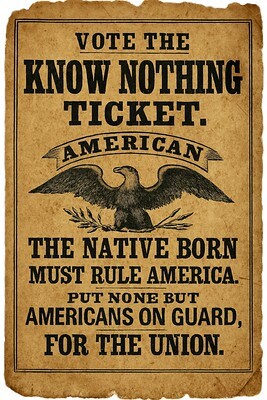
My great-great-great grandparents came to an America that despised the Irish more than any other group except for African Americans. “NO IRISH NEED APPLY.” There was even a radical but popular political party called the Know-Nothings (AKA: The American Party) that’s main political planks were Anti-Irish, Anti-Catholic, and Anti-Immigrant. In 1855, in an incident that became known as Bloody Monday, a huge mob of Know-Nothings supporters surrounded an Irish neighborhood in Louisville Kentucky in the middle the night, set fire to all the homes, and murdered at least 22 people as they tried to escape.
When the Know Nothing party dissolved in 1858 over internal disputes, many of its former members joined the newly formed Republican Party, which had a strong anti-immigrant bias. [Oh, how things have changed in the last 170 years.] As a result, Irish immigrants as a whole were opposed to Lincoln’s run for the presidency, despite the fact that Lincoln himself was pro-immigration and was fond of the Irish as individuals and as a group. . .
🌟 Star. WAIT! THE ABOVE PARAGRAPH IS NOT QUITE TRUE! I wanted the anti-immigrant 1850s Republican Party to be true. O’Dowd swears it true. It would have satisfied my 21st century grudge against current Republican policies and would have made a wickedly satisfying joke. But I had never heard that the antebellum Republican Party was anti-immigrant or anti-Catholic before, so I have just done some A.I. search and discovered that while it is true that the nascent Republican Party did tolerate nativist rhetoric in order to gain votes and did harbor many Know-Nothing supporters after the collapse of that party, it had distanced itself from the Know-Nothing movement as it matured. By the time Abe Lincoln became the Republican Party’s presidential nominee, the party had fully embraced a more inclusive vision, focusing on union, liberty, and equality. I have lost all the faith I had in the veracity of what I have read in Lincoln and the Irish. Niall O'Dowd may be a respected Irish-American journalist known for his deep involvement in Irish-American affairs and the Northern Ireland peace process like it says on the internet but will never read anything else he writes. I am a deeply disappointed son of the old sod, and if you don’t believe me, you can KISS . . . ME because I am Irish
Always worth learning more about Lincoln. After the first half, the book was arranged kind of like a museum display. There were various short stories of Irish people or incidents that had no connection to one another, but involved Lincoln. Good for fun facts!
Well, at times I did not regard the thesis of the book as being as correct as intended -- sometimes the conclusions seemed far-fetched, and I was very hopeful to believe that my ancestors could have contributed to that cause after much sacrifice. I am 75% Irish of the third generation, the other 25% being German, and I was schooled at home by both of my parents in the Irish cause and the cruel subjugation and mistreatment by the English, yet some areas I doubted from the author's conclusions, until the last third of the book when he detailed topics like the direct and outrageous recruitment of the poor Irish both on our shores at their landing, and by force before their sailing by means of the "coffin ships." Both the Union and the Confederracy realized this means of replacing the thousands who were dying in battle -- the Union was more successful than the South, so Lee's army did not achieve the necessary replacement as did his foe. The religious leaders were not as anti-slavery as one would have assumed, so those leaders did not speak out against the injustice against slavery. Also, countries like England, France, and Italy were pro-slavery, and that seems logical when one realizes their colonial abuses in other continents. Therefore, while at first I was not interested in the author's logic, I was finally swayed and accepted some new ideas. The book is filled with quotes of Lincoln's contempt for slavery and his debt to the Irish who fought for the Union, like one group who lasted longer at Gettysburg and were called The Fighting Irish. In this age of re-writing history, this was of greatest interest to me while reading this 2018 copywrited book. Also, I have a direct distain for the terrible harsh treatment the British focused on the Irish since the 16th. century, and found myself refusing to watching a recent PBS series on Victoria which incorrectly claimed her sympathy for the Irish Famine, which history disproves she waited until it was mostly over to send a measly offering. I do not think this book would have universal appeal, but it does have merit, in some regards. I did like the well-researched information about those who were present at the Ford Theater where Lincoln was killed.
I have been a long reader of Mr. Dowd's renowned website, Irish Central, and was happy to purchase this book he authored. While I do agree with a few of the reviews I have read here, that the book overall could have used a review or two more, and that there were really missed opportunities. Meaning that there were topics he teed up nicely but then just let sit. But hey, not easy to examine everything.
As another reviewer wrote, The Republic had been saved from dissolution at Gettysburg, led by an Irish American General and featuring extraordinary courage by Irish immigrants.
There are many kernels of information of which I was not privy prior to this read. These include.
The Republic had been saved from dissolution at Gettysburg, led by an Irish American General and featuring extraordinary courage by Irish immigrants. We should never forget that the Irish helped Lincoln save democracy and end slavery.
it was not the end of the Shields-Lincoln relationship. The two men would soon enough be comrades in arms against the South in yet another twist of fate. Shields was set to become a war hero; he was a senator from three different states, had a record never surpassed, and success that was a rallying point for the Irish in the Union Army. He was also a strong proponent of Irish resettlement in the Midwest.
Even though the Know-Nothing Party denounced all immigrants, it especially hated Irish Catholics. Their credo was very similar to that of the Orange Order.
Meagher stated, “Duty and patriotism prompt me.”
gone as territorial governor. He fell or was pushed off a ship. He had made many enemies, especially among radical Republicans and a group of self-styled vigilantes who hung or shot people they wanted rid of with impunity. His body was never found. Outside the state house in Montana stands a magnificent statue of him. In one of his last letters to a friend he stated: “I want my countrymen to place me up and beyond the sneers of these ‘blackguards’ who are ever so ready to run down an Irishman, whenever and wherever they have a chance.”
Meagher sent the Irish to war more than anyone. They fought well. One hundred forty-six Irishmen were awarded the Medal of Honor, the highest by far of any immigrant group. They fought and many died for Lincoln and the Union.
Bill the Butcher terrorized Irish voters at the polls. There was serious physical violence including murder attempts when they saw Irish casting votes. One man had had enough—John Morrissey, an Irish-born prizefighter and adventurer, who challenged Bill the Butcher. Their first fight was broken up, but the gangs later clashed and Poole was shot dead by a Morrisey gang member. Poole became the first Know-Nothing martyr.
Abraham Lincoln’s most famous transgender soldier and supporter hailed from the little hamlet. An estimated 400 women served as male soldiers in the Civil War, but only one, it seems, Albert Cashier, a.k.a. Jennie Hodgers from Clogherhead, spent her entire life as a man, unlike the others, who stepped back into their old identities. Her story, from immigrant to hero soldier, to a life as a man, would be unbelievable even as a Hollywood fable.
The Irish own far more than any other foreign country. Historian Damian Shiels has identified 146 Irish-born Medal of Honor winners. There are likely more, he says.
The two men, whose distant ancestors had faced each other at the Boyne, where Jackson’s side had won a famous victory, would now fight again but with a different result.
Abraham Lincoln and Niall O’Dowd have both played pivotal roles in the history of their respective countries. Both men have had a far reaching influence on their countries and the world in general, showing an incredible level of expertise in their respective fields. It is important to examine their lives and their works in order to gain a better understanding of the huge impact that each has had on the course of history.
Abraham Lincoln was born in 1809 and grew up to is the nation’s 16th president. He is most instantly recognizable for his part in freeing the slaves, which succeeded on January 1st, 1863. Lincoln was greatly impacted by the tragic death of his son in 1862, which helped him to empathize with the plight of the African American people in the United States. He believed in civil rights for all, no matter their race or gender and ultimately succeeded in his fight for freedom. In his presidency, Lincoln managed to engineer the end of the Civil War, easily the most violent conflict America has ever faced, while also introducing many progressive reforms. His influence and legacy have made him one of the most renowned of presidents, rightfully earning him a place in American history.
Niall O’Dowd has been named a “renaissance man” and is known for being a major influence on the Irish government and its culture. He is a journalist, documentary producer, and a social campaigner who is credited with helping to facilitate the peace process in Ireland. O’Dowd is a champion of Irish-American culture, having achieved an incredible level of success by embracing “The Irish Way” – a mix of creativity, tenacity, and subtle innovation. He is an acclaimed leader of Irish-Americans, having worked for over four decades to help bring about Irish prosperity, by reaching out and connecting with a range of different people, including politicians and celebrities.
The lives and works of Abraham Lincoln and Niall O’Dowd have had an incredible impact on both the United States and Ireland respectively. Lincoln has become an iconic figure in American history while Niall O’ Dowd stands as a driving force behind the Irish culture and peace process. Both have shown a deep appreciation for the struggles and successes of their countries and have strived to better each, through leadership, dedication and success. Their impact on their respective countries and the world will no doubt echo for many years
A lot of facts which are interesting, but not supported by citations. Also, there is a glaring error presented about Confederate general Thomas “Stonewall” Jackson’s death- Jackson did not die from wounds received from friendly fire at the Battle of Fredericksburg- (this was mentioned twice in the book!)- he died after being shot accidentally by fellow Confederates shortly after sundown on his victory after the Battle of Chancellorsville. Mr. O’Dowd and his Editors would have benefited from more accurate in fact-checking before publication and I was actually quite surprised this error was not mentioned in any of the previous reviews I read so far. Even the most basic Civil War buff knows this about Jackson. I still enjoyed this book despite the historical inaccuracies; it’s a fun little diversion with some interesting facts and would be a good read for someone looking for a different perspective on the Civil War.
2.5 Stars, rounded up to 3. This book was a disappointment to me as I expected more. I was surprised to find an error in the first few pages -Cobh is much more than 25 miles from Crookhaven, even by sea. There was also the birthplace of Stephen Douglas, which is not Maine. This was not a book written by a historian - instead it was clearly one from a journalist. There was a lot of repetition - such as the fact that Lincoln's law partner did not like the Irish. I did like many of the profiles of individual characters - such as the story of Stonewall Jackson and his family. If you know very little about the era, this is not a bad book, but there are so many others out that will provide much better detail.
This book is a great introduction to the Irish and their sacrifices for the Union in the Civil Wat. It also shows people who you never thought were Irish, especially seeing many Irish immigrants and Irish-Americans who were connected with Lincoln. This book also fills a big historiographical gap in Civil War history and memory, that of the immigrants who fought for the Union in the Civil War. He tells stories from the Irish Brigade to those working with Lincoln in his administration. A great read. There are some typos and inaccuracies, but there is not that many because the author writes a great narrative history as well as presenting great stories to the sacrifice of Irish immigrants and Irish-Americans for the Union in the Civil War.
While Mr. O'Dowd is correct in saying that this is an interesting topic that does not have much written about it, he was not the man who should have written this book. It is not so much a story of Lincoln and the Irish and more a collection of essays about Lincoln and some tangentially related Irish. And while a collection of essays about smaller figures in history can be quite good, this set is not. A high school student would be embarrassed to turn in any of the "chapters" of this book to their teacher and their teacher would rightly give it a failing grade. This book has pacing errors. This book has spelling errors. This book has factual issues. What this book needs most of all is a different editor, a different editor, and most importantly, a different author.
Niall O'Dowd has a recursive writing style, and little gift for linking his essay-length chapters together smoothly. But his fascinating book about Abraham Lincoln and the Irish supplies brickwork for what until its publication had been a gap in the mountains of popular literature about the American Civil War.
There are nuggets of information in this book that I've found nowhere else. And I like that O'Dowd dedicates the work (in part) "To Abraham Lincoln, for saving democracy. And to the Irish, for helping him."
My copy of the book also has sentimental value, because it's heavily highlighted by my late father.
As a descendant of Irish immigrants and a fan of Lincoln’s, this book was incredibly intriguing and informed me on a lot of Irish history that I was unaware of. The stories of the Irish in our country and their impact on our cultural fabric should not be overlooked, and this book attempted to shine the light on their influence during Lincoln’s life.
The writing, however, was extremely difficult to follow at times, with the author bouncing around to different topics in his chapters. There was little sourcing of information and it felt that some of the stories were not historically accurate.
This book was gifted to me by a friend. He knew my love of history, my roots (96 percent Irish and 5% Scottish) , and being a retired Marine would align with my interest in the account of how the Irish helped Lincoln in many ways, but especially winning the Civil War. I was familiar with many of the Irish military commander's from previous readings and I it made this read that much more interesting. I loved the book.
There is no end to books about Lincoln and the Civil War, and the topic is sliced in various ways. This book is original in its study of the Irish and the war. In some ways the author stretches the issue (was Sherman really Irish because his parents were Irish?). In other ways, he is spot on--people were recruited from Ireland to fight in the Union Army and certainly their numbers helped win the war.
Recommended for Civil War buffs and Irish people everywhere.
Our history in the USA is fascinating and our public service, is notable; be it as Police, Firefighter, Politician indeed President - of the 45 men to serve as president 23 had close Irish roots, and apart from "45" all of them since Kennedys election.
It's particularly fitting that Barack Obama's grandmother was Irish as in the UK until not so long ago some pubs displayed signs saying "No Blacks or Irish"!
I usually don't read history books - but there was something about this that interested me. The story was fascinating and I could not put it down. It is an important and major part of our American background. It looks at the concept of prejudice from many angles. There is no angle that can justify prejudice against ANY group of people. I highly recommend reading this book.
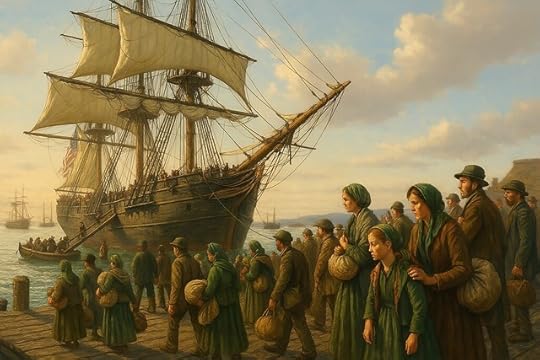
The importance of the Irish immigrants to the Civil war was never taught in school. This book ties the massive emigration from Ireland leaving the starvation and horrors of Ireland and coming to America to fight in our Civil war. Without them we would likely have not won the war.
This is a very succinct history of the role the Irish played at the time of the American Civil War. It is very engaging throughout, full of gems of information and will be of interest to anyone who is studying Lincoln and the important role the Irish played in this period of American history.
After reading Goodwin's Team of Rivals, the bar for any Lincoln related literature is at an unfair height.
To O'Dowd's credit, there was definitely some fascinating stories within. Ones that left the mind to wander history and all its forgotten tales. Without these, my rating would be lower, as overall it fell flat.
I thought I knew so much about the civil war and Lincoln, but had no knowledge of the large roll the Irish had it! It is a very interesting and fast moving book and had so much to teach all of us! It is well written and an easy read! As someone who is very interested in history it taught me a lot!
A short read about the influence of the Irish immigrants on Lincoln himself and the Civil War effort. The book could have used more research and a deeper dive and could have threaded the various aspects of Irish involvement a little more cohesively but otherwise it serves as a good overview of the impact of the Irish during this pivotal time in American history.
Solid overview of LIncoln's association with the Irish in both the military and his social life. It also has provides a good explanation of the "Know Nothing Party." One can't help but compare it to our own times.
A must read. How eerily similar the divisions are between us today as they were in the 1800’s. Sadly, we aren’t learning from the past. What a different world this would be if the Irish hadn’t sacrificed so many to keep our democracy.
A pleasant and thoughtful look at Lincoln's (and America's) relationship with the Irish. Thoroughly researched and covered the high points of Lincoln and the Irish who influenced him and who he influenced. A really good diversion.
I enjoyed the book. It’s not a great book by any stretch, and I suspect true scholars would disagree with much of what the author writes. But, for a first look at the relationship between Lincoln and the Irish, it served its purpose.
It was interesting to read about the connection between Lincoln and the Irish, but I did think at times that the author was biased and sometimes seemed to stretch the credit to the Irish. I was surprised at the number of Irish soldier who both fought in and died during the Civil War.