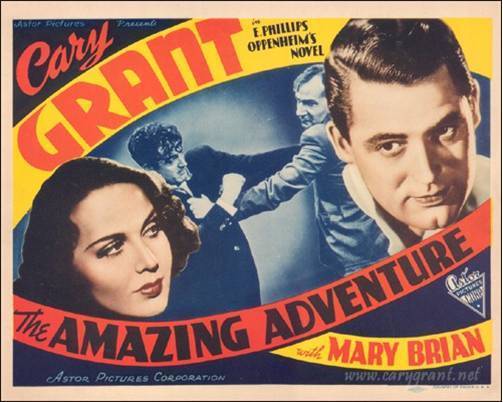
Ernest Bliss is 25, an heir to immense wealth, and obnoxious. He has never worked and lives in a continual whirl of parties and good times. When this lifestyle disagrees with his digestion, he consults a Harley Street specialist—only to have the doctor sneer at him and refuse to shake his hand. Bliss angrily blurts that he could set out that same day in an old suit with five pounds in the pocket and find an honest living for a year. If he does not succeed, he says, he will pay to build a new hospital. With that, the pampered young man begins an adventure that never takes him beyond London, but opens his eyes to the struggles of everyday people to survive.
Edward Phillips Oppenheim was an English novelist, primarily known for his suspense fiction.
He was born in Leicester, the son of a leather merchant, and after attending Wyggeston Grammar School he worked in his father's business for almost 20 years, beginning there at a young age. He continued working in the business, even though he was a successful novelist, until he was 40 at which point he sold the business.
He wrote his first book 'Expiation' in 1887 and in 1898 he published 'The Mysterious Mr Sabin', which he described as "The first of my long series of stories dealing with that shadowy and mysterious world of diplomacy." Thereafter he became a prolific writer and by 1900 he had had 14 novels published.
While on a business trip to the United States in 1890 he met and married Elise Clara Hopkins of Boston and, on return to England, they lived in Evington, Leicestershire until the First World War,and had one daughter. His wife remained faithful to him throughout his life despite his frequent and highly publicised affairs, which often took place abroad and aboard his luxury yacht.
During World War I Oppenheim worked for the Ministry of Information while continuing to write his suspenseful novels.
He featured on the cover of 'Time' magazine on 12 September 1927 and he was the self-styled 'Prince of Storytellers', a title used by Robert standish for his biography of the author.
His literary success enabled him to buy a villa in France and a yacht, spending his winters in France where he regularly entertained more than 250 people at his lavish parties and where he was a well-known figure in high society.
He later purchased a house, Le Vanquiédor in St. Peter Port, in Guernsey. He lost access to the house during the Second World War when Germany occupied the Channel Islands but later regained it.
He wrote 116 novels, mainly of the suspense and international intrigue type, but including romances, comedies, and parables of everyday life, and 39 volumes of short stories, all of which earned him vast sums of money. He also wrote five novels under the pseudonymn Anthony Partridge and a volume of autobiography, 'The Pool of Memory' in 1939.
He is generally regarded as the earliest writer of spy fiction as we know it today, and invented the 'Rogue Male' school of adventure thrillers that was later exploited by John Buchan and Geoffrey Household.
Undoubtedly his most renowned work was 'The Great Impersonation' (1920), which was filmed three times, the last time as a strong piece of wartime propaganda in 1942. In that novel the plot hinges around two very similar looking gentlemen, one from Britain and the other from Germany, in the early part of the 20th century. Overall more than 30 of his works were made into films.
Perhaps his most enduring creation is the character of General Besserley, the protagonist of 'General Besserley's Puzzle Box' and 'General Besserley's New Puzzle Box'.
Much of his work possesses a unique escapist charm, featuring protagonists who delight in Epicurean meals, surroundings of intense luxury, and the relaxed pursuit of criminal practice, on either side of the law.
95% of the time, the book is better than the movie. Unfortunately, this is part of the 5% where that is not the case.
The Amazing Adventure--the film based on this novel--is my favorite Cary Grant movie. I could watch it a thousand times and not grow bored. So, when I picked up The Curious Quest and realized this was the full adventure Mr. Ernest Bliss, I could barely contain my excitement.
But it fell short. Partially the problem lies with the plot itself--Bliss's adventures lack distinction. Either he's working for a broke entrepreneur, hired to do something less-than-legal, rescuing damsels in distress, or chauffeuring. Over and over and over again. Many of these plot lines introduce characters or situations that never get fully resolved. It needed more quality and less quantity.
Unfortunately, the 1919 publishing date also means some anti-Semitism.
I definitely went in with impossibly high expectations that the book could not meet. But even just as a book...I think it drags things out too long to be truly engaging. Do yourself a favor and just watch the movie instead. And if you love the movie already...well, don't go in with too high of expectations and you'll probably enjoy yourself.
I happened upon this book by happy accident, a Librivox recording on YouTube. What a delightful surprise!
A rich young man, Earnest Bliss, has a number of physical complaints that bring him to Dr. James, a physician who bluntly and brusquely dismisses his complaints as the consequence of "eating, drinking, and making merry." His only Rx is to challenge Earnest to work for his living for 12 months, to achieve vigor and purpose--- but he vocalizes his doubt that Earnest would ever be capable of discarding his luxuries to follow through.
Earnest is offended and makes a bet with his doctor. If he can make it through a year providing for his own bread, the Doctor owes him an apology. If Earnest loses the bet, he owes the good doctor a large sum of money as a contribution toward a new hospital.
Beginning the 12 month adventure on the streets of London, and with a mere 5 pound note in his pocket, the reader shares the adventure,, the ups and downs of Earnest's quest for employment. He sells stoves, works for a green grocer, suffers unemployment and deprivation, finds work as a chauffeur, a bus driver and sundry other jobs. The people he meets along the way are as varied as his jobs: a kindly landlord, a blackmailer, honest hard-working small businessmen, and not least--- Frances, the girl he will fall in love with.
Earnest, for the first time, can savor the luxury of a hot cup of coffee on a rainy day. He can appreciate even a poor bed after weary hours of work. A cigarette offered by a kindly employer is highly valued. All the little things he once took for granted are appreciated to the full.
Earnest wins the bet with his doctor, and the closing chapters are absolutely heartwarming. He wins much more than a bet, he wins friendship and purpose and self-respect.
I heartily recommend this excellent book, and can also point you to the expertly narrated Librivox recording. I am so happy to have found this little jewel of a book.
This story has been immensely enjoyable for me, as well as thought-provoking. Ernest Bliss, a pampered young man living on his vast inheritance in early twentieth-century London, has no purpose in life but to indulge himself in fleeting pleasures and be waited upon by his servant.
The dissipation and languor produced by his decadent lifestyle prompt him to seek medical advice from a physician he had not hitherto met. Convinced he just needed a pharmaceutical prescription of some sort to cure his malaise, he was flabbergasted to find the doctor contemptuous of him and insisting that good, honest hard work was the necessary remedy.
This precipitates an indignant, angry wager being made that finds Bliss setting off to support himself for a year without drawing on his wealth, possessions, or connections. Determined to win the bet, he develops a dogged perseverance that gradually changes his life. The ensuing experiences and misadventures are sometimes funny and entertaining, sometimes pitiful and unfortunate.
He really turned out to be a decent chap, with a growing compassion, benevolence, and tenacity that he had lacked when his wealth was at his full disposal. There was depth of character hidden beneath his luxurious ennui which was tested, strengthened, and ultimately triumphed as he struggled to earn his living like those around him--people who had previously been quite beneath his notice. He became a thoughtful philanthropist as he learned to care for various individuals throughout his twelve months of exile.
This was well worth the read! I am so glad to have seen it recommended. It's surely a new favorite I will look forward to revisiting sometime.
Note: there is quite a bit of drinking and smoking, and a few misuses of God's name.
I wasn't sure I was going to like this. I read the first five or six chapters and was debating whether I wanted to keep going. It seemed so intriguing yet uneventful. I kept going and it got much better.
In a nutshell, a spoiled young man with more money than is good for him ends up in a doctor's office complaining of vague malaise. The doctor, irritated by "his type" refuses to treat him and instead tells him to get a job and be a man. Live off only what you earn for a year. It was spoken sarcastically, and the bet was on. If the wealthy young man lost, he would donate $25,000 to the hospital.
So follows the adventures of Ernest Bliss as he suffers privations and sees the world for the first time, learning his own true value and that of others.
This novel was written in the early 1900's, I had expected it to be stuffy and difficult to read. What I got was a well-paced simple story about a millionaire who takes a bet to live for a year on only what he can earn on the streets, and the people he meets throughout that year that change his life. He meets his share of shady characters along the way, but somehow it all works out. A lovely quick read.
After seeing the Cary Grant movie The Amazing Adventure I had to read the book. I had a hard time finding this book, but I'm really glad I did. It was very entertaining!
E. Phillips Oppenheim’s book ‘The Curious Quest’ (original title: ‘The Amazing Quest of Mr Ernest Bliss’) was published in 1919, and is as unlike any of Oppenheim's later novels of espionage and detection as could be imagined. In fact, it reminded me of the following prescription from another fictional doctor in an earlier book:
“1 lb. beefsteak, with 1 pt. bitter beer every 6 hours. 1 ten-mile walk every morning. 1 bed at 11 sharp every night. And don’t stuff up your head with things you don’t understand.”
__ ‘Three Men in a Boat’ __ Jerome K. Jerome (1889)
The physician in Oppenheim's novel is not quite so genial with his wealthy client, though. He refuses to give any prescription or even shake hands with dissipated young loafer before him. He merely advises him to work for a living if he wishes to regain his health. The young patient, Mr. Ernest Bliss, worth upwards of half a million pounds (the equivalent of about £98,977,845 today (early 2026), offers the doctor a challenge: he would go out that very day with nothing in his pocket but £5 in his pocket and, after making a few arrangements for the salaries of his dependants, start working and live on what he could earn by his own hands for a whole year, using his enormous wealth for no help or alleviation from any personal difficulty. If he lost, he would pay a forfeit of £25000/- to the doctor. Sceptically, the doctor agrees, looking at the specimen before him.
Now, will the “dress suit hero" Mr Bliss, win his rash bet? Could an effete young man, used to living very well indeed, used to being waited on hand and foot, be able to survive as a menial worker? More importantly, would he have the will? (Remember, in 1919, a gentleman almost always had a valet, a man about his person, who shaved and dressed him, who drew his bath water, and who probably even squeezed his toothpaste on his brush for him!)
‘The Curious Quest’ is a quest for determination, deprivation, self-respect and self-discovery, courage and kindliness, told with great sympathy and humour.
This story was reminiscent of Jules Verne’s "Around the World in Eighty Days," with a lot of Charles Dickens thrown in and even a little Mark Twain (particularly, "Connecticut Yankee").
I first heard about the story when my wife and I watched the Cary Grant movie version of it. The movie, at just over an hour, did not have the time to develop the story, leaving is a little confused over some of the details. Since the overall story was nice enough, I decided to seek out and enjoy the original novel. I was not disappointed at all! This book could easily be made into a very long movie, or even a miniseries!
I found the very well-read audio book on LibriVox, which brought the characters very well to life by Adrian Praetzellis. I would highly recommend this book — and Mr. Praetzellis' reading of it — to everyone who enjoys the classics from ones such as Dickens, Twain, and Verne.
This was a charming concept that (maybe) hung around a little too long. Or maybe I just didn't like that Bliss seemed to be waiting out the clock, so to speak. It seemed like a bit of a cheat. For a real Groundhog-ian style redemption, shouldn't he have found a way to make a life for himself as a poor man rather than just white-knuckling it until he got his riches back? I suppose that's unrealistic. I guess it's enough that Bliss learned and grew from his experience. (Even if it did feel a bit like that scene in Trading Places where Dan Akroyd wakes up back in his own bed and tells his butler, "I had the most absurd nightmare. I was poor and no one liked me.")
A very pleasant Oppenheim opus, unpretentious and engaging throughout. It is rather episodic, but the story holds together admirably. One of the three best Oppenheim novels I've yet read.
What a ride! I stumbled onto this through a recording on librivox.org and it was too good to sleep to, so I had to find a copy. A very fun read, well written and compelling.
I liked the premise of this book, so I gave it a shot. What I got was kind of a modern fairytale with the millionaire disguised as a pauper, earning his living and learning to be a better man at the same time. He falls for a girl, and she for him, and he knows that he can save her from a string of terrible jobs if she will only last out the year with him. His struggle for the second half of the book stops being about himself and becomes all about her, as well as helping the friends he makes along the way. The end, when he returns to his own life to kick butt and take names, was the absolute best. I enjoyed this book thoroughly.
Edit: Read this aloud to my kids and they all cheered at the end.
Known as 'The Prince of Storytellers' in his prime, this novel proves that his reputation was not unfounded.
Wealthy Ernest Bliss, whose father left him a fortune, was feeling out of sorts so called on Sir James Aldroyd MD to discuss what might be the problem. The pair eventually have an interesting discussion with the doctor suggesting that Bliss should abandon his lifestyle as he had 'no moral stamina'. This upset Bliss who decided there and then to do something to change things.
He challenged the doctor to accept a donation of £25,000 for the hospital against him being able to abandon his current lifestyle and live for one year without touching any of his wealth from the date of discussion and managing to live on earnings he could make and his wits. The doctor was reluctant to take the wager but Bliss persuaded him that the money would benefit his hospital very much. The decision was, therefore, made.
And thus began Bliss's amazing quest to win the bet. Oppenheim goes on to weave a story around Bliss's adventures as he went from position to position earning very little, living very humbly and existing on the modest stipend that he managed to earn from the variety of jobs that he undertook. Along the way he performed some good turns for some of his employers and even met a young lady with whom he established a tacit relationship. And this he did without the lady, Frances, having any inkling of his true identity or wealth.
Despite many setbacks Bliss managed to maintain various jobs, moving almost seamlessly from one to another before his modest earnings were used up. Almost at the end of the 12-month period he met Frances again and, and still without giving her any of his background, persuaded her that she should not make a decision about a man she did not love as he persuaded her that things would eventually work out in their favour.
Much to the surprise of his friends, some of whom had seen him in his tatty clothes while he was carrying out his challenge and who had had a collection for him because they felt he had fallen on hard times, he re-emerged when the year was over, realising that life could be different from the way he had previously been living it.
Considering there are no murders, mysteries (apart from his deception) or gruesome passages in the book, it is thrilling enough to keep the reader on the edge of the seat throughout.
Lovely dated tale of a rich man having to spend a year earning his own money because he is bored and ill. Full of action and scams. Very early 20th century and very enjoyable.