Jump to ratings and reviews
Rate this book

Missing

Rate this book
Following a family tragedy, Jessie Noon moved from the Fens to the Midlands and now lives in the Scottish Borders with a cat, a dog and – she is convinced – a ghost in the spare room. Her husband walked out almost a year ago, leaving a note written in steam on the bathroom mirror, and Jessie hasn’t seen her son for years. When Jessie meets Robert, a local outreach worker, they are drawn to one another and begin a relationship; meanwhile, Jessie has begun receiving messages telling her I’m on my way home.

As a translator, Jessie worries over what seems like the terrible responsibility of choosing the right words. It isn’t exactly a matter of life and death, said her husband, but Jessie knows otherwise. This is a novel about communication and miscommunication and lives hanging in the balance (a child going missing, a boy in a coma, an unborn baby), occupying the fine line between life and death, between existing and not existing.

176 pages, Paperback

Published May 15, 2018

4 people are currently reading
259 people want to read

About the author

Alison Moore

94 books110 followers
Born in Manchester in 1971, Alison Moore lives next but one to a sheep field in a village on the Leicestershire-Nottinghamshire border, with her husband Dan and son Arthur.

She is a member of Nottingham Writers’ Studio and an honorary lecturer in the School of English at Nottingham University.

In 2012 her novel The Lighthouse, the unsettling tale of a middle-aged man who embarks on a contemplative German walking holiday after the break-up of his marriage – only to find himself more alienated than ever, was shortlisted for the Man Booker prize.

Ratings & Reviews

What do you think?
Rate this book

Friends & Following

Create a free account to discover what your friends think of this book!

Community Reviews

5 stars
32 (19%)
4 stars
71 (43%)
3 stars
42 (25%)
2 stars
18 (10%)
1 star
2 (1%)
Displaying 1 - 30 of 38 reviews
Profile Image for Paul Fulcher.
Author 2 books1,940 followers
December 15, 2022
Now she had to get used to being Jessie Noon again. She could have kept Will’s name of course, the same way she was keeping the dog, but she had gone rather resignedly back to Noon. She could hardly bear to write it though, and did not like to see it; she could not see it without thinking of it handwritten on police statements and printed in the newspapers.

The lovely north Norfolk coastal town of Cromer is most readily associated with its crabs, but with the quality of works coming out from Salt Publishing, increasingly with high quality contemporary British literature as well.

Alison Moore, one of the authors whose careers they have supported, was Booker shortlisted for her debut novel, The Lighthouse, and Missing should be in contention for this year's prize - subtle, carefully constructed and quietly effective, it would certainly be a welcome correction to some of the overblown novels that have marred some recent lists.

I came to this book via Salt's #JustOneBook campaign:
Dear readers, we need your help. Sadly, we're facing a very challenging time and need your custom to get our publishing back on track. Please buy #JustOneBook from our shop right now https://www.saltpublishing.com/

Salt is one of UK’s foremost independent publishers, committed to the discovery and publication of contemporary British literature. We are advocates for writers at all stages of their careers and ensure that diverse voices can be heard in an abundant, global marketplace.
and I would strongly encourage everyone to support this wonderful small independent publisher, ideally by buying books direct.

Missing is narrated from the perspective of Jessie Noon, almost 50, estranged from her son from her unsuccessful first marriage, living in Hawick in the house where she believes her great-great-grandmother lived in the 19th Century. In Hawick she met and married Will, a train driver, also separated from his first wife, but he abruptly left home in January (it is now November) leaving, rather bizarrely, a note written not on paper but in the steam on their bathroom mirror, and she has an uneasy relationship with her older sister, and particularly with her brother-in-law, who she also hasn't seen since January.

The novel is told in three alternating sections - Jessie's story the months around the end of the year (when she starts a relationship with a local man and is rather comically accused of attempting to seduce her neighbour's teenage son), flashbacks to 1995 when Jessie was 16 and was often called upon to look after her 6 year-old niece Eleanor, and brief 1st person passages from an unnamed narrator who is returning to see Jessie - her son? her husband? Eleanor? someone else? - sending her postcards to announce his visit, the first reading simply “I’m on my way home.”

Jessie is a translator (a process in which what ought to be stable shifted, a phrase that reminded me of mathematical definition of translation) and the importance of language is key to the story:

Her choice made a difference. Sometimes it seemed like a terrible responsibility. Will had agreed that it was important "but choosing this word or that word" he said "is not exactly a matter of life and death". It could be, though, said Jessie. Look she said at PC Sidney Miles and Derek Bentleyand "Let him have it"; look at Eleanor and "Stay outside". You had to be careful.

Moore cleverly combines the mundane domestic details of Jessie's life (frozen peas from the supermarket carefully stored in her lover's freezer before the two of them first fall into bed) with heavily portentous signs, or at least what Jessie sees as such (albeit these are suggestions not so much of what might happen as to what might be about to be revealed to the reader): the ominous postcards, a mystery man in the pub she is keen to avoid, cracks appearing in her house in the walls and windows, noises at night which she believes to be ghosts, stories she is translating all of which have a failure to connect, and the endings seem to hang in the air, discussions of portals and shifts between worlds, and the biographies of D H Lawrence she reads (the characters that Jessie supposed to be him, in fictional form, were always torn between staying and leaving, torn between this world, this life, and another.)

However, this isn't a novel where all is revealed on the last page - we find confirmation, if we hadn't guessed, of what happened in 1985 and also who is writing the postcards just after the halfway point, and while another revelation which explains Will's departure is deferred, it too is explained before the final pages.

Instead the ending hangs quietly in the air, and is all the more effective for it.
Profile Image for Blair.
2,032 reviews5,852 followers
February 23, 2022
(Review originally published at Nudge, now NB magazine, June 2018; removed from their site when they switched domains)

Alison Moore is an expert at conjuring up magic from the mundane. In Missing, her fourth novel, we meet Jessie Noon, a translator living quietly in Hawick, a town in the Scottish Borders. Her second husband walked out a year ago, leaving only a message written in the steam on the bathroom mirror. Though Jessie is a mother, she rarely hears from her adult son. Her relationship with her sister Gail is complicated, for reasons that will eventually be illuminated by the flashbacks scattered throughout the narrative.

At first, Jessie's life appears unremarkable. She looks after her dog and cat, cooks meals in large batches, and writes, translating books she suspects will never be read. But the world won't quite let her alone. Almost by accident she begins a new relationship with Robert, which seems, to the reader, a disorientating development since his initial approach is awkward and unwelcome. Then there are the mysteries: the unexplained sounds in Jessie's house, the significant objects that go missing, and the unnerving postcards she receives. The first one reads, simply yet ominously, 'I'm on my way home'.

It's clearly significant that Jessie works as a translator; so many pivotal moments in Missing hinge on misinterpretation of some kind. Jessie's command 'stay outside', uttered to Gail's daughter Eleanor, proves disastrously unclear. In recounting a dream, Jessie unintentionally leads her neighbour to believe she has romantic designs on a teenage boy. A conversation with her parents reveals that a long-held belief about her home – the very reason she has settled in Hawick – is incorrect, the mistaken result of a child's assumption.

This is a ghost story, and it isn't. It's about grief, carrying on, and missed connections. Like much of Moore's other work, it is concerned with the banality of domestic detail, and peppered with pinches of deadpan humour. (Many of the funniest lines stem from the fact that Jessie's ex gave their dog the ridiculous moniker 'The Four Horsemen of the Apocalypse'. This leads to sentences that unexpectedly made me laugh out loud, for example: 'In bed, with The Four Horsemen of the Apocalypse weighing down her legs, Jessie checked her phone.' There's also a strangely poignant bit of farce involving a displaced bag of frozen peas.)

Missing is certainly a quiet book, and if you hate evasiveness and lack of resolution in a story, then it may be one to avoid. Moore's is a style that gradually seduces rather than throwing out twists and cliffhangers to keep you glued to the page. Don't be fooled, though, into thinking this means it is uneventful. The brilliance of Missing lies in the fact that its calm surface conceals vicious barbs.

I received an advance review copy of Missing from Nudge. I wasn't paid for this review and I was under no obligation to be anything other than honest about what I thought of the book.

TinyLetter
Profile Image for Gumble's Yard - Golden Reviewer.
2,188 reviews1,795 followers
June 28, 2018
She thought about the words she needed: in the coma story, should she say She hurt or She ached? It would matter, which word she chose. Context was vital. If the author wrote Geliebte, Jessie had to choose whether to translate it as sweetheart, or lover, or mistress … Her choice made a difference. Sometimes it seemed like a terrible responsibility. Will had agreed that it was important “but choosing this word or that word” he said “is not exactly a matter of life and death”. It could be, though, said Jessie. Look she said at PC Sidney Miles and Derek Bentley and “Let him have it”; look at Eleanor and “Stay outside”. You had to be careful


This book is published by the brilliant Norfolk based publisher Salt and like all their books came with a handwritten postcard (in this case a vintage postcard of their seaside home town of Cromer, including its famous pier) and with a small packet of salt.

I bought this (and another book) as part of their #JustOneBook campaign - a campaign which both showcased the precariousness of the small literary presses in the UK and the sense of community among them - with other presses, book bloggers and reviewers all tweeting and re-tweeting the campaign with spectacular results.

http://www.edp24.co.uk/business/salt-...

Alison Moore’s debut novel “The Lighthouse” was shortlisted for the Booker Prize - and this novel starts with a epigraph taken Virginia Woolf’s “To The Lighthouse”: “Beneath it is all dark, it is all spreading, it is unfathomably deep; but now and again we rise to the surface and that is what you see us by”

The present day part of the novel, features Jessie Noon who years before moved to a Scottish border town in a house, she believes was owned by one of her great-great Grandmother’s. There she marries her second husband Will, a train driver. Will has now gone missing - having left a note in the steam on their bathroom mirror leaving behind his dog , Jessie now living alone but for the dog, a cat and , she wants to believe, some form of ghost living in the spare bedroom - Jessie clearly haunted in a figurative sense by something in her past wants the haunting to become tangible.

Jessie starts to receive postcards from Will saying that he is coming home, and interspersed in her chapters are enigmatic first person sections seemingly written by Will.

Even beyond the break-up of her first marriage and Will’s absence Jessie’s life seems dominated by broken and difficult relationships: she sends cards and texts to her son from her first marriage and her childhood best friend but with no reply; while her sister stays in touch her brother-in-law avoids her - seemingly unable to come to terms with her past actions and inactions; her attempts to get a dog-sitter are misinterpreted by her neighbour as a cougar-style seduction of her 17 year old son.

The writing of the Jessie sections is a striking juxtaposition of apparent mundane narration (trips to Morrisons, thoughts on her bathroom bin) and heavy use of portent/metaphor: her house for example (as well as windows, glasses and cups) are literally cracking up around her; her musings on her job as a translator, and her ear wax blocked ears, add to the metaphors of mis-communication and misunderstanding which are key to the book.

In a really beautifully crafted passage Jessie’s own painstaking deliberations over the translation books that she is not sure will ever be read reminds her of her mother’s cooking on “special occasions … hours devoted to fancy concoctions that no one had really wanted” when Jessie preferred tinned food - alphabet soup or spaghetti hoops which in a lovely simile and link to the book’s themes are “like alphabet pasta but just the Os - the language of ghosts”.

Jessie serially reads biographies of DH Lawrence - the foreknowledge that the biography will end in his death causes sadness “like a weight on her lungs, but enjoying the earlier stages when “Lawrence was still alive, still young and full of vigour” . Her progress through the biography therefore symbolically matches the “1985” sections which are interleaved in Jessie’s present day story - a time when Jessie was 18 and which culminates in a museum trip with her young niece (the daughter of her only sister) Eleanor - the effects of which echo to this day.

Even the ending of the book is foreshadowed by the short stories of one of the authors Jessie translates: “In each of these stories ….there was a failure to connect, and the endings seemed to hang in the air, they were barely endings at all”

Earlier we read she went back to the author on one story and asked in effect how the ambiguous ending of her story is completed, but realises that the author (if she ever replied - Jessie’s emails to her like so much of her communication - seemingly one-sided) “would no doubt say that not knowing was the whole point”.

And the ending of this book causes us to question the book’s very title - one we initially think refers to Will, then believe that we realise refers to a series of faded posters Jessie remembers from 1985 but then realise is more personal.

Overall an excellent novel - one I would regard as a literary and metaphorical reinterpretation of a ghost story.
Profile Image for Doug.
2,538 reviews911 followers
January 2, 2023
She caught the late morning train. She favoured the route that had only one change, minimizing the likelihood of her missing a connection. She would change at Birmingham New Street. There had been sinkholes in Birmingham, and elsewhere. She had seen them on the news; giant sinkholes in roads and driveways and gardens. Something shifted beneath the surface, and then the ground just collapsed; you went to step outside your door, or you came down the same road you always came down, and found that, where there had been solid ground, there was just a vast hole.

What a great start to the New Year - with a genuine 5-star read! This is my 4th Moore in the past month, and I've enjoyed them all, but this might be my favorite so far. I love how Moore never hits the reader over the head, but leaves hints, clues and ambiguities along the way - you really have to ferret out the plot points for yourself. Some have complained Moore is too slow, but I barreled through this in a little more than 24 hours.

For some reason (maybe an abiding fondness for their coupling in the film adaptation of The Lost Daughter - and the protagonist being here named Jessie) I kept picturing Olivia Colman as the 49-year-old lead character, and Jessie Buckley playing her in the flashbacks to 1985. If I were more ambitious and skillful, I'd attempt to write a screenplay from this myself - it would make for an intriguing film.
Profile Image for Anni.
558 reviews92 followers
January 20, 2019
Alison Moore is a master of the ‘show not tell’ school of storytelling, imbuing her novels with a pervading sense of unease in a deceptively straightforward prose style. The prosaic details of mundane life lead the reader into a false sense of security, ill-prepared (as so often in real life) for the tragic revelations to come.
Like the missing piece in her father's jigsaw puzzle, gaps in the narrative are filled by memory triggers as Jessie goes through life, estranged from family and friends in a kind of limbo and failing to connect in every sense of the word. The chapter headings (conference, communication, outreach, communion) serve to reinforce the message.
Objects go missing, train connections are missed, words are misconstrued and Jessie's motives are misunderstood. These misconceptions highlight the irony of Jessie's work as a translator, where clarity of meaning is vital to avoid ambiguity.
... a hauntingly good read!
Profile Image for WndyJW.
680 reviews153 followers
May 4, 2025
As I was reading this book I found myself wondering how Alison Moore created such strong feelings of alienation, loneliness, and unease in a simply told story. I wanted to step into the story and explain things to Jessie, a freelance translator in her late forties, and explain Jessie to the people in her life. The irony of Missing is that as a translator, Jessie knows how very important the right words are, she know it matters if words are understood in the right context, and she knows how potentially tragic not clearly understanding what was said can be. Yet, Jessie is misunderstood and misunderstands at almost every turn.

The sense that we as readers are about to discover a truth or be given the answers to questions builds throughout the book and in the end our questions are answered and we understand Jessie’s story, at least we think we understand.
Profile Image for Andy Weston.
3,175 reviews225 followers
July 29, 2018
Looking back it seems I enjoyed Moore’s The Lighthouse though I can barely remember it. But this was awful. The plot is extremely dilute, the possibility that Jessie is being haunted or psychologically disturbed following a family tragedy. Most of the story concerns Jessie’s day to day life, insisting on paragraphs dealing with the feeding of her dog and cat, details of her morning washing routine, her quandary as to whether to have jam or marmalade for breakfast, and detailed directions from Carlisle Train station to a cafe, as examples. Moore also uses ‘hoover’ as a verb which is a pet hate of mine. It did make me think that I may reignite my own ghost story writing. My previous efforts aren’t very good, but better than this.
Profile Image for Jennifer.
283 reviews7 followers
July 4, 2018
I really enjoyed this! Alison Moore writes about human relationships so well. This is a novel about human connections and communication.

Missing follows Jessie Noon, a woman nearing age 50 whose husband walked out on her almost a year ago, leaving only a short note written in the steam on the bathroom mirror one morning. Her husband left behind his dog, The Four Horsemen of the Apocalypse, for her to care for and she has her cat. In her hope that he returns, she never changes the locks. He has begun to send her strange unsigned postcards.

Throughout Missing Jessie is reading her third biography of D.H. Lawrence. Jessie gathers from her readings that for Lawrence there was always a sense of two worlds, the old England and the new, the pre- and post-Industrial age, and this world and the 'other' world. Jessie hears noises at night coming from the spare room next to her bedroom which she thinks could be a ghost.

She hasn't seen or talked to her adult son from her first marriage since he left home as a teenager; however, she continues to send him text messages.

One day walking the dog by the river she meets Robert whom she's seen around on other occasions and they begin a relationship. Although, Robert has an uptight disposition which makes him intolerable to Jessie's easy-going, somewhat flighty, nature.

Following each chapter on modern day events is a chapter looking back at Jessie's life at 18 in 1985, caring for her five-year-old niece, Eleanor. Her sister's husband doesn't care for her and it shows. One day a terrible tragedy occurs which reverberates to the present day, causing familial relations to not be as close as they once were.
Profile Image for Anne Goodwin.
Author 10 books64 followers
May 28, 2018
A refreshingly unsentimental story about how life continues after tragedy, not because those affected are particularly resilient, but because it’s the human condition to carry on. The opening quote from Virginia Woolf’s To the Lighthouse is a reminder that what might appear simple on the surface is a tangle of complexity underneath. Which rather sums up Alison Moore’s enthralling fiction.
Full review Tragic misunderstandings: Missing & Speak No Evil http://annegoodwin.weebly.com/1/post/...
Profile Image for Royce.
419 reviews
August 9, 2018
Alison Moore creates the most magical stories. Suspense builds slowly and draws the reader in by her eloquent, beautiful writing. One must read carefully as the story unfolds so you may gather all the clues that may be crucial later in the story. Fantastic and wonderful do not do this writer’s skills justice. I so look forward to reading many more of her novels.
Profile Image for Cathrine.
Author 3 books27 followers
June 30, 2018
We are puzzle pieces. Yes.

We fit into each other through Conferences, Connections, Communication, Translation (of confused meanings), through acts of Outreaching, Intercourse, Communion and visitations (all title headings to be found in Alison Moore's brilliant new book: 'Missing'.

It is a book to savor. To read slowly and reread passages. It is a book that kept me company throughout the month of June and I read it in so many beautiful places :-) !

We are puzzle pieces, we fit into each other and when a piece goes missing we give it meaning or / and we search for meaning in the hole left behind and in the missingness itself. We define ourselves rather than it as 'lost', as 'missing'.

We are lost, unable to complete the puzzle. To see the whole. Unable to connect not just the pieces but with each other. We misunderstand.

There are several parallel and possible truths (and lives) in life. Each of us tightly holding our own version of the truth that our puzzle is. Missing pieces leave us searching for meaning in the holes left in our lives. Somehow this lack starts to define life. Memory of what was in the hole haunts us.

Luckily we have multiple chances to settle into our lives.

This is what Alison Moore communicates to us through her translation of it in 'Missing'.

There are authors I rest in and with. Their words comfort in the sense that they translate to me my own meaning and self. Language so beautiful that I can sit back and rest and just receive.

Alison Moore is such a writer. She is a 'Lighthouse' 'I want' (and he would too) in my pre war house (a peace house). (These being her other titles - I highly recommend all, along with Death and the Seaside.).

I will be 'missing' her until the next book is communicated to me. There will be a hole left open in my book shelf for its meaning.

5 stars,
in gratitude,
Cathrine.
Profile Image for Jackie Law.
876 reviews
May 30, 2018
Missing, by Alison Moore, tells the story of Jessie Noon, a middle aged women living in a Scottish border town who works from home as a literary translator. Jessie has been married twice and has a grown up son. She now lives alone with her cat and dog. She believes her house harbours a ghost. She tries to keep her thoughts and feelings in order by following daily and weekly routines.

Much of the action involves the ordinary: Jessie attends a professional conference, shops for groceries, walks her dog, enters into a new relationship. Throughout there exists an undercurrent of darkness, gaps in the narrative. The sense of unease is palpable.

Interspersed with the contemporary tale are chapters set in 1985 when Jessie was eighteen. Her big sister, Gail, would call on her sibling to mind her five year old daughter, Eleanor. Although sometimes resentful of the expectation that she would help, Jessie was fond of the little girl. She did not always treat her as Gail requested, giving Eleanor cola to drink and making promises she couldn’t keep. Jessie’s relationship with her family is now strained.

At the heart of the tale are the words people use, so often misconstrued causing pain. Jessie struggles to maintain relationships despite her desires and good intentions. She understands how people regard her but cannot change what has been done or said. Others choose to leave or cut contact. Jessie may have moved location but must still find ways to live with herself.

There is a tension in the writing, a disconnect between the personal world Jessie inhabits, the expectations of those she encounters, and her desire to somehow fit in. When a postcard arrives telling her ‘I’m on my way home’ it is unclear who is sending or where home may be. The reader is offered glimpses but the portrayal of Jessie remains elusive. Subliminally she may believe her treatment by others is deserved.

This is a glorious evocation of alienation and misunderstanding. Jessie could be deemed tragic but she is also a survivor. The author has created a masterpiece. A haunting tale of devastating insight and depth.
Profile Image for Ian Mond.
745 reviews121 followers
July 7, 2018
Very little happens for a good two-thirds of Missing. We follow our protagonist, Jessie, as she attends a translation and interpretation conference in London, travels on public transport, and feeds her cat and dog. At one point she meets a bloke named Robert and they become a couple for a time. There’s an aimlessness to it all, even Jessie’s belief that there’s a ghost living in her spare room reads more like a personality quirk than an actual haunting.

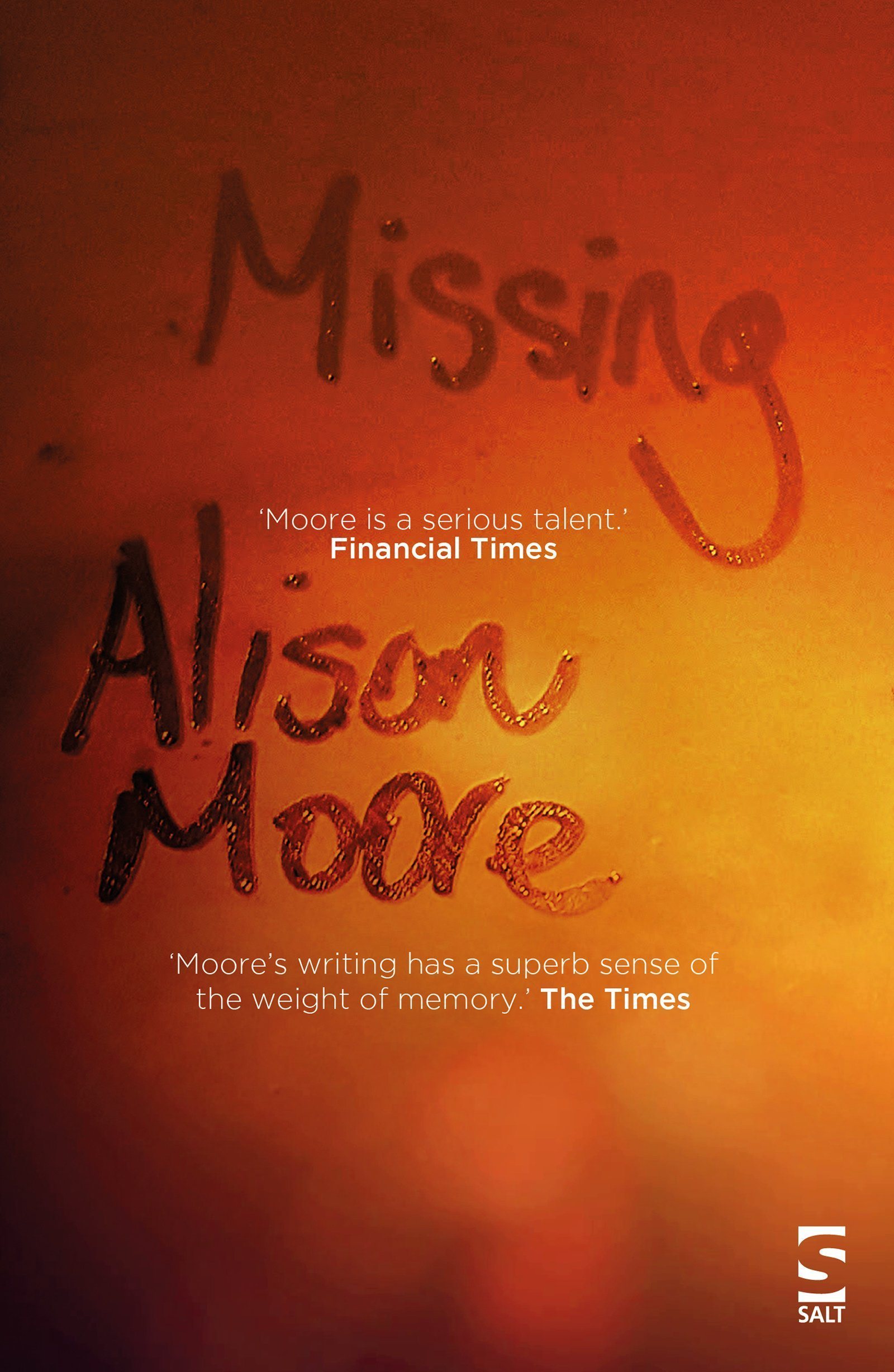
And yet Missing is an engrossing, affecting novel. It’s a book that deliberately plays against expectations. The title and the cover (the word Missing enigmatically daubed on a steamy mirror) suggests a psychological thriller, but for a chunk of the narrative the only person who goes astray is Jessie’s husband, and even he sends cryptic postcards as to his whereabouts. It’s not until the last third of the book that we discover who went missing and while it’s not a jaw-dropping surprise, it’s still a punch in the guts. Jessie’s isolation, aimlessness, even her muted relationship with Roger (and the disappearance of her husband) all make a tragic sort of sense.

Missing is a book soaked in memory. Whether it’s riding the bus or feeding the dog every action triggers a remembrance in Jessie. None of them - at least to begin with - are about the event that’s brought her to Scotland, away from (but still in touch with) her family. And yet, around the edges, these memories do hint at something not quite right, a sense of dislocation and deep unhappiness. Jessie begins the novel alone; she ends the novel alone. Her interactions with others, including Roger and her next door neighbour’s son, end poorly as if she’s not entirely in tune with the world around her. And yet there’s a glimmer of hope, a possibility of renewal in the final paragraphs of the book. If that reads like a spoiler, it isn’t. The haunting, memory-laden quality of Missing needs to be experienced to be fully appreciated. Alison Moore’s gift is talking us gently along a painful, uncomfortable journey.
270 reviews2 followers
February 8, 2023
A hard book to enjoy due to the dogged disconnected narration and odd impersonal relationships of the characters. Jessie seems to make a habit of things going missing in her life, but none of it seems to have had any major or lasting impact on her or anyone else affected. And although she has two pets, they are only ever referred to as “the dog” and “the cat”, and are often left alone without any thought, somewhat typical of Jessie’s attitude to everything.
Profile Image for Elizabeth Smith.
101 reviews3 followers
July 12, 2018
Alison Moore is an expert in creating a sense of impending doom and then hurtling the reader towards it at incredible speed. This book had all the suspense of The Lighthouse, but also something else.

Jessie Noon lives with her cat and husband’s dog, after her second husband left with no explanation. Gradually it becomes clear that all is not right with Jessie, but what happened in the past which still haunts her and where is her husband?

Moore is an expert storyteller who layers images and meaning to startling effect. An excellent book.
Profile Image for Marc Faoite.
Author 20 books47 followers
June 20, 2018
Forty-nine-year-old translator Jessie Noon lives with a cat, and perhaps with a ghost, and an inherited dog named The Four Horsemen of the Apocalypse.

It’s tricky to write about with Alison Moore’s latest novel Missing without revealing too much. Campbell’s archetypal hero’s journey involves a clear call to adventure. Let us know where the protagonist is going, and why, he implores. But with Moore there’s no brusque reassurance. All the guard rails are removed. We’re advancing tentatively with her character, unsure of what lies ahead, uncertain of white lies behind. We don’t know where we’re going, but we’re going.

Reading Missing is like crossing a frozen lake. We’re aware there are things lurking just below the surface, but unlike Hemingway’s manly iceberg, with the implicit threat of all its brooding and rugged solidity, Moore’s writing suggests something more fragile and something far more dangerous. With each tentative step forward we’re unsure whether Jessie, weighed down by her burdens, will break through the ice and carry us with her, plunging down into the dark frigid depths.

Cracks and fissures appear, things break: a glass, a window, a cup. Hearts. There are ominous creaking sounds late at night.

Jessie’s life is a catalogue of things missed or missing, from trains to husbands, jewellery to periods, children to jigsaw pieces, houses to frozen peas.

There are a number of moving parts in this story, not all of them working perfectly. We encounter a musclebound mystery man in a bar, but his reveal comes too late and too easily. Given its importance to Jessie’s circumstances it might better have been meted out in breadcrumb trail for heightened effect. But this was the only minor nit-picking glitch.

Jessie’s father is blocked in a sort of limbo, unable to advance until he finds the piece missing from his thousand-piece jigsaw puzzle. Then, like the father finally reunited with the missing component of his puzzle, all the pieces start to fall into place. But as soon as the full picture finally promises to reveal itself, we discover that something else has gone missing, and despite having made it to the other side of our frozen lake we are left feeling a little shaken and unsettled.
Profile Image for Ellie.
109 reviews39 followers
April 25, 2021
Also published on my blog.

When I picked up this book, I was expecting a thriller. The title, for one, makes it sound thriller-y, and the red cover with a font that depicts writing on a steamed up mirror only reinforces that assumption for me. A quick google shows that this book is primarily categorised as the vague ‘psychological fiction’, though to be honest I still feel as though that’s a bit of a stretch for the ways in which this novel engages with the mystery that is supposed to be the central concept.

When Jessie Noon was younger, her niece, Eleanor, vanished. This disappearance is presumably the eponymous one, though in her middle-age, Jessie finds herself abandoned by her husband. The only note he left was written on the steamed-up glass in the bathroom. While the disappearance of Eleanor is something that the novel refers back to through the use of split chronology, there’s a lack of tension. It didn’t feel as though there was a build-up to something terrible, and I didn’t really get a proper sense of the effect of Eleanor’s disappearance on the family. Throughout the novel are short passages in italics (these from Eleanor’s POV), suggesting she is coming home.

As Jessie starts to receive messages from Eleanor, I expected there to be an exploration of the effects of such a message, but there seemed to be absolutely no emotional reaction that was explored in any depth, which was a really missed opportunity to build some of the absent tension in this book. Similarly, the effect of her disappearance doesn’t really get explored. Aside from some short scenes towards the end of the book that deal with the immediate aftermath of her disappearance, there’s almost nothing. This choice caused the book to lack emotional depth for me, and meant that I really struggled to feel any kind of investment in the part of the storyline concerning Eleanor at all. In parts of the book I actually forgot that the book was meant to be about the girl’s disappearance, and not just about Jessie’s day-to-day life.

As a character, I did find Jessie intriguing. Her inner voice has moments that are very funny, which keeps the book light-hearted despite dealing with what is essentially a string of losses experienced by Jessie. The supporting characters did lack somewhat in development, which was a shame, because they were interesting, and could have been really enjoyable to read (if sometimes unlikeable as people!). The uncertainty around reality in Jessie’s life (is her house haunted?) was an extra addition that made her character more developed, and yet this was also something I felt was not properly explored.

When it comes down to it, this book simply was not long enough for what it was trying to achieve. Some people may dislike this book for not having a resolution but for me, that would be fine. However, by introducing themes and then failing to follow through on their exploration, and by writing in characters who got to have a glimpse at what they could be had they been well-developed, it seems to me that more was needed. It is a shame that the book failed in this sense, because I enjoyed many of the other aspects of it, including Moore’s writing style, but I feel like this book will be fairly easily forgettable for me.
Profile Image for Professor Weasel.
928 reviews9 followers
June 28, 2018
3 1/2 stars. Another great bedtime read for me! I looked forward to going to bed so that I could read this, which is always a good sign. This book made me CACKLE out loud with laughter - and believe me, I rarely crack a smile when reading, so this is major news!

Despite its themes of loss and absence this is a VERY funny book. Especially due to the dog's name being The Four Horsemen of the Apocalypse. I laughed especially hard at her musings about what would happen if she tripped in the house and broke her neck, and no one found her body: "the neighbours or the postman would notice a smell, and after a while someone would come in and find her lying at the foot of the stairs, and in the meantime the cat would have been eating her face. She did not know about the dog, whether it would try to intervene or whether it would just join in." I guess I have a really dark sense of humour but I found this hysterical! I love the cat and dog's presence as supporting characters in the book, especially their constant desperation to be fed.

I loved the meticulous attention to domestic detail, so reminiscent of Knausgaard. I loved how she obsessively cooked meals and froze them (I used to do this too, before losing all my Tupperware after moving house). I loved the passages about Jessie's job as a translator (very interesting that we're never explicitly told what language(s) she translates from! German?). The terrible responsibility of choosing the right word. The dad's obsession with puzzles, and the tragedy of losing a single piece (too real!!).

At first I was disappointed by the quietness of the ending; I wanted more of a "big" scene that had to do with the writer of the postcards (is it basically the husband?), and the ghost in the room. But then reading the other reviews here made me realise that that decision would have been very contrary to what the book was actually trying to do: reinterpret the ghost story and riff on miscommunication and absence instead. See what the value of a good review can do?

Salt Publishing continues to prove they have absolutely impeccable taste - I'm going to make a concentrated effort to buy books more regularly from them in the future. Long live the indies!
Profile Image for Tim Love.
145 reviews2 followers
July 11, 2019
It feels more contrived than her previous books, or maybe I'm getting used to her tricks. Instead of info-dumping, the main character, Jessie, has recollections that are rather unconvincingly triggered by events and objects. Everything (a jigsaw, a mug, etc) is an aide-memoire, setting off a cascade of memories or analogies.

Mood is generated by these unrelated snippets and flights of fancy - "For Jessie, in childhood, the real treats had been in tins: alphabet soup or spaghetti hoops, which were like alphabet pasta but just the Os, the language of ghosts", etc. She does it well, though the symbolism can become heavy handed - e.g. on p.51 there's "Her eyes strayed from her book to a crack at the top of the wall ... disappeared under the doorframe, heading out into the hallway. Or perhaps it had started out there and was coming in ... When she switched off the light, she could not see the crack, but of course it was still there". On p.132 there's "She ought to have run, like a greyhound let out of its box. She always felt so sorry for those skinny greyhounds, so thin they might just snap, pelting after a hare that they could never ever catch".

Information's artificially withheld. It's not until p.140, about 80% through the book, that we learn of the cause of Will's troubles.
Profile Image for Owen Knight.
Author 6 books20 followers
August 9, 2018
I enjoyed Alison Moore's first novel, The Lighthouse, a few years ago. I hadn't realised this was by the same author until after I bought it.
The main protagonist is learning to cope with the mysterious disappearance of her husband, from whom she inexplicably receives postcards stating that he is on his way home, although no reason is given why he left and why it is taking so long to return.
This is one of a few hints of ghosts, which the reader is unsure are real or imaginary. The title of the book refers not only to the husband, but to other events that occur during the story, which ends quite unexpectedly. I had to reread the last few chapters to check that I had not missed anything of significance.
This is a worthwhile read that holds and increases the attention demanded as it progresses. It is let down by three factors. Firstly, the frequent repetition of words or phrases in consecutive sentences. Secondly, the author includes to much trivial detail of everyday life, which does not add to the story. Thirdly, she all too often explains the character's motivation for certain thoughts and actions, unnecessarily. These faults hint at sloppy editing and should have been picked up by the publisher.
On the other hand, story is king and it is worth ignoring these factors.
Profile Image for Richard Clay.
Author 8 books15 followers
January 3, 2020
Tricky to rate. Two stars is to underrate. Three would be marginally to overrate. Moore, some of whose short fiction I've enjoyed, here sets herself the viciously difficult task of telling half the story of the kidnapping of a child. The kidnappers never appear in the story - are not even thought of - though they seem, from the suddenness and absoluteness with which the child vanishes, to be a slick and professional outfit. No, we focus instead on the child's aunt, who was in charge of the little girl when the snatch was carried out, and how the kidnapping can be seen to have ruined her life - probably without hope of repair.

It wasn't going to be easy to get this one right. Moore gives it a good go. There are some lovely touches of understatement and description. But, in some way, her prose isn't quite up to it. The mostly third-person narrative voice is rather stiff and awkward. There's too much 'English Comedy of Embarrassment'. Ultimately, it all needed to be purged of the stultifying air of self-conscious 'literary novel-ishness' that hangs around many of the sentences. A disappointment, because, having read some of her shorter pieces, I really wanted to like this one.
Profile Image for Jayne Charles.
1,045 reviews22 followers
June 6, 2019
I suspect I would like anything this author writes - she has a spare, stripped-down narrative style that concentrates attention directly on her character(s), their actions, observations and innermost thoughts. I like the way she focuses on those people on the outside of society, people who others might consider oddballs but who would consider themselves entirely normal. I also like the way she gives time and space to idle thoughts that go through her characters’ heads, whether or not they move the plot along (the bit where Jessie muses about ‘long dead’ authors raised a smile!).

I suspect I didn’t get all the subtleties in this novel. The events right at the end may well have wrapped up some plot theme that sailed over my head. On the other hand it may just be that this was a short but perfectly observed window on an imperfect life. Who knows? And given how much I enjoyed reading it, I’m not too bothered.
Profile Image for Andrew McLoughlin.
17 reviews
March 19, 2022
This is a book about loss, isolation, regret and mistakes in communication. Jessie Noon is a translator, living along with her cat and dog, in a house in the Scottish Borders. She leads a mundane life and works as a translator, where she admits difficulty in knowing what the author wanted to say, and probably getting the meaning wrong. She finds the same difficulty in her real life, where she misjudges what others want and also finds them misinterpreting her. 

Alison Moore has created a lonely world where the protagonist sees things differently from most - she sees patterns in everyday objects, and suspects the worst is possibly hiding in corners and cupboards. At the heart is a deep sorrow and maybe confusion about something from her past and a ghost story that isn’t really a ghost story 

It’s a remarkable, beautiful book crated from the clay of an ordinary existence. 
Profile Image for Laura Besley.
Author 10 books59 followers
August 14, 2021
At 174 pages, 'Missing' by Alison Moore (SALT Publishing, 2018) is a short novel, but don't let that fool you; this is a story of serious depth and weight. Moore explores the central theme of missing in a variety of ways: emotionally and physically, as well as a more intangibly, for example the constant search for precisely the right word in translation.

I was immensely impressed by how the narrative unfolded, the main character Jessie developed and Moore's pared back style of writing. Highly recommend.
Profile Image for Bronwen Griffiths.
Author 4 books24 followers
June 30, 2018
I want to give this 3.5. I nearly gave it four stars but, although I loved Alison Moore's book 'The Lighthouse' I wasn't so enthusiastic about this one. There was lots to like but I was disappointed by the ending. I can't quite put my finger on what I didn't enjoy. I think this is probably one of those books that will divide opinion.
1,543 reviews9 followers
November 27, 2018
How to make something out of the minitue of life - and be so compelling. How the English language can be misinterpreted. Could the same happen in a more highly structured one? Some very funny moments. Loved the dog's name. Can imagine that being called at the vets! Will look at her other novels too.
Profile Image for sisterimapoet.
1,299 reviews21 followers
July 30, 2019
I really enjoyed The Lighthouse by Moore - and this started with much promise. Characters, setting and premise that had potential. But then it seemed to stay at quite a flat level throughout - never really heightening the emotion, or action, or engagement. Not a bad read by any means, but not much that will stick with me in months and years time.
Profile Image for L.M. Brown.
Author 7 books18 followers
November 3, 2020
From the first page, I loved Jesse's voice, airy and distracted. Some of the observations made me laugh out loud (the dog) and I really loved the way the author threw in Jessie's memories with such authority and certainty because it made me question Jesse and everything she said. At least I thought this was Moore's purpose as memory can't be trusted so easily, can it? It's a book that seems light but has so much in it, blame, guilt, loneliness, and those terrible, short love affairs. Robert was a great character.
Profile Image for Kenzie Leckie ✨.
211 reviews3 followers
October 2, 2021
Not too sure what to think of this book. Not quite how I expected it to pan out and not the storyline I expected from it either. I enjoyed the metaphors throughout (peas in the freezer, etc) and how the importance of choosing certain words as a translater can be misinterpreted just like some of her experiences throughout. However was left still wondering at the end what will happen.
This entire review has been hidden because of spoilers.
Profile Image for Lizixer.
284 reviews32 followers
August 6, 2025
A short read into which I quickly disappeared for a few hours following Jessie in her loneliness and sadness after a family tragedy. There is a dark humour, at times, as well as a couple of mysteries that are the keys to Jessie’s state of mind.

It’s a good read, well written and intriguing - another “lives of quiet desperation” book but a superior one.
Displaying 1 - 30 of 38 reviews

Can't find what you're looking for?

Get help and learn more about the design.