A gripping account of the disastrous Russian submarine explosion that killed the entire crew, devastated the Russian people, and defined Vladimir Putin's post–Cold War regime. What were Russian officials thinking when they waited 48 hours to acknowledge their most prized submarine was in trouble? Why did they track the desperate tappings of an unknown number of trapped sailors without sending an international SOS? Why did they repeatedly decline international rescue offers while their own rescue equipment repeatedly failed to make any progress? To a world community still mystified by deadly Russian deceits surrounding the Kursk submarine disaster, Ramsey Flynn's book uncovers the truth once and for all. Cry from the Deep has quickly become the definitive account of this pivotal moment in modern Russian history, as an angry Russian people – aided and abetted by a fledging independent media – openly clashed with Vladimir Putin and his new government's Soviet–era tactics of secrecy and deception. Flynn's searing narrative also documents how western officials, in a practiced silence reminiscent of the Cold War era failed to notify their post–Soviet counterparts of the disaster, despite learning of the explosion hours before the Russians did.
In August of 2000, in the middle of a naval exercise in the Barents Sea, the massive Russian submarine, Kursk, sank with a crew of 118. How did this come to be? What actions did the Russian military and political leaders take to try to rescue the crew and save the sub? How did the rest of the world react to the event? All these questions are answered in Ramsey Flynn’s intriguing story.
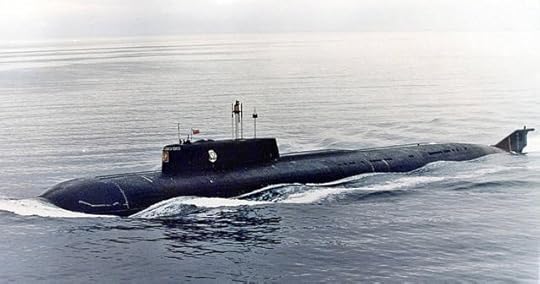
The Kursk - from Wikimedia
Flynn goes into minute detail about the hardware and personnel involved, determining exactly where most of the crew members were at the time of the incident. He looks into their past, their expertise, their families. Much of the detail, frankly, seemed somewhat excessive, but still his points got made about the personal impact of the accident on the crew and their loved ones. Of much greater interest is his portrait of Russia in a time of transition, from the Soviet era to a more open society. How did the new Russian leader, Vladimir Putin, react to the goings on? Issues of transparency are significant here. More important, no doubt, are issues of public relations and international relations. I found it educational seeing how the new Russia had differed from the old Soviet state. People had much more of an impact than they had had previously. We also see, by the end of the tale, how Putin begins to resume the dictatorial tendencies of the past. How the West reacts to the accident is fascinating as well. In a sad way it is almost comical how the intelligence services of the West were able to know so much more than the Russian leaders. The most illuminating aspect of the story for me was the picture painted of just how degraded the Russian military was. Their military infrastructure was in complete shambles. The details of this are chilling.
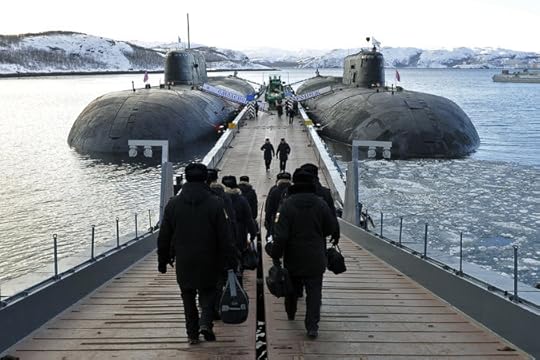
This is the photo that accompanied the NY Times article. It shows modern subs, not the Kursk
Cry From the Deep is a worthwhile read. The story of the sunken sub is interesting but the surrounding bits, about the state of the new Russia, politically and militarily, are fascinating.
=============================EXTRA STUFF
Here is a History Channel documentary about the events detailed in the book. It is a bit kitschy at times, but it interesting overall.
A powerful example of why freedom and liberty will triumph over statism every time. The American submarine service has a history of caring about the safety of it's men because the foundation of their service is individual liberty and volunteerism. This cultural value has led our service to fewer accidents and a much greater safety record than ever the Russian Navy. It is sad that they could not ask the American or the other governments on the scene (that nationality of the team on the scene first escapes me, suffice it to say their advanced submersible rescue vehicle could have saved the men trapped in the emergency compartment) for help in rescuing their sailors. As to the book itself, it is a riveting well written, face paced book.
A detailed and riveting account of the incident from both the Russian and NATO viewpoints. Besides the technical and political aspects, you also get to learn about some of the crew members and how the tragedy impacted their families.
As the book was written in 2004 (the incident was in 2000), it was interesting to read the author's predictions on how New Russia seemed to be going down the authoritarian road under Putin. That prediction was pretty much spot on.
The topic was very interesting to me, so it was a relatively quick read for me.
Can’t believe it took me so long to read an account of the Russian submarine disaster that sank the Kursk and claimed the lives of all its sailors. Told mostly from the Russian perspective, but weaving in the American role, this is an engaging, informative portrayal of the key people and events. Reading this 20 years after the event, it’s somewhat sad to reflect that much of the politics surrounding the disaster and non-rescue would likely repeat themselves today.
I've probably read more submarine related books than is normal but this account of the Kursk tragedy is one of the best stories you'll find. The author presents events in a chronological timeline that's easy to follow. What really sets this book above others is how well the emotional toll on surviving families and the Russian citizens as a whole was recounted.
Decent, but certainly not an exhaustive or authoritative account.
Read a book by a journalist, expect journalistic writing. This book was a decent narrative of events and aftermath, but was an inch deep. Also, though the author seems to have consulted with a fair few subject matter experts and to have done quite a lot of research, there were several distracting bits of inexplicably poor quality.
The Type 65-76 torpedo (which tells you right there that it's 65 cm) that killed KURSK is described as being 80 inches in diameter - this on a boat with 65-cm (26") and 53-cm (21") torpedo tubes. The explanation of how internal pressure inside a sunken submarine would rise is wrong and doesn't make sense. I would expect a submariner to be able to find nits to pick in a book about a submarine written by a journalist, but these sorts of things are silly and highlight the author's lack of expertise and the absence of a thorough review by a technical expert.
This book about the sinking of the Russian nuke sub Krusk in 2000 started out like a gang buster. I thought it had the potential of being one of those non fiction books you can't put down. But about 3/4 into it I could feel it lose its way. By the end, it turned into a diatribe against Putin. The author was simply preaching to the choir. We all know Putin's a bad guy. Tell me something significant about the Krusk and the military leaders who led the crew to their deaths. It does that in the opening 1/3 of the book but I'd have enjoyed more detail. I also would have enjoyed more detail on the role Norway plays in NATO intelligence gathering. Pretty significant, I think. But author Flynn comes right to edge of what Norway does, then veers away. Still, it's book worth reading -- especially if you are a naval buff.
I read this book, because I remember it happening, and what a horrible thing to hear on the news. I was so hoping that a good outcome would happen, but it didn't. In reading, it was amazing to find out just how Russia's Navy has deteriorated ....that they had to cannibalize submarines to keep their fleet ("of two" ?) going. So when the Kursk sank, they had no equipment to go after the guys.
A very credible account of the sinking of the Kursk. Varoious theories are in circulation about cause of this disaster, including an alleged collision with a US sub. The story presented by Ramsey Flynn seems to be the most plausible, that a torpedo's fuel went unstable and exploded inside the sub.
Excellent reading! I'm very glad I read this, though it won't be a book I read over and over. If you're interested in post-Cold War politics at all, this really shows how those relationships affected the lives of a group of "normal" military men in Russia.
While the parts of the book that covered the actual Kursk disaster were good, I felt that this had a very USian ethnocentric viewpoint of an event that, until well into the disaster, was not really related to the US. The parts of the book that covered events happening in the US felt distracting and unnecessary, especially those that happened before the US was even involved. As mentioned in another review, the end of the book felt like it was a book about Putin alone and not the Kursk anymore. In short, the coverage of the Kursk events could have been deeper, with fewer distractions. The first half to two thirds of the book were good, though.
Fascinating look at the mural and what happened. Could have done without the last bit about Putin going back to the cold war ways. Found that a bit irrelevant.
In mid-August 2000 much of the world riveted its attention on the Barents Sea as reports came in of the sinking of the Russian submarine Kursk. How did this happen? Were there survivors? Ramsey Flynn, an award-winning magazine journalist, was so drawn in that he knew he had to write about it.[return][return]Some 75 days later, Flynn set foot in Russia for the first time in his life. Four more trips, some three and a half years, and more than 300 interviews later, he completed work for Cry from the Deep, a worthy addition to the English-language books that examine the tragedy.[return][return]Recently released in paperback, the book is an absorbing look at the calamity from both a personal and institutional perspective. The personal takes the reader not only aboard the Kursk and other military vessels but also into the lives and families of several of the 118 sailors who perished. The institutional looks at how the Russian leadership responded or failed to respond and how remnants of Cold War mentality contributed to delays in offers to help from NATO countries and acceptance of those offers.[return][return]Balance of review at http://prairieprogressive.com/?p=653
I wanted this book to be better than it was. After all, Russia is fascinating, the military is fascinating, and naval tragedies are simply riveting. I also believe that Ramsey Flynn did a herculean effort in his research, if his assertations in the foreward and afterward (and notes) are to be believed. However, I felt that sometimes he strayed too far into fiction when he chose to relay the thoughts of men who died. I also felt that his verbatim passages were chosen poorly, and added little to the narrative. Flynn seemed to be using this incident as fodder to advance a (not terribly controversial)theory: that the Russian navy puts out poorly maintained, antique, barely seaworthy ships because of funding issues, and that they care for pride above human lives. I was glad to hear more about the incident. I remember being intrigued when I heard about it ten years ago. I just felt that the story itself is so fascinating that it could have and should have been absolutely compelling. Instead, it was merely a handful of interesting facts interspaced among tepid text, and I couldn't help counting the pages to see how close I was to finishing.
Ramsey Flynn does a good job of describing events leading up to the sinking of the Kursk and how Russia and other countries responded to the tragedy. It is incredibly unfortunate that officers from Russia were so slow reporting the disaster due to fears of how their careers might be impacted if the information they provided did not prove accurate. Ramsey explains the various steps which were taken to give assistance to the Russians and the constant roadblocks that the Russians put up. Flynn describes some of the central characters aboard the submarine and the challenges they faced. He writes about their families both before the tragedy and in its aftermath.
When I read this book some time ago, I rated it 4 stars like almost everybody else. I really found it interesting and informative. Too many little details but ok I could cope. Now I just watched a documentary film: Kursk - A submarine in troubled waters, and what a different angle! Very different indeed and much more credible to me. So, I feel a little cheated by this book and I am downgrading my initial rating. I was tempted to go for 1 star, but finally considering other aspects of the book I decided to give it 2.