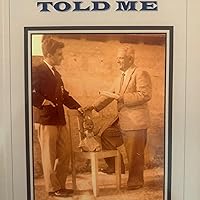
Seeing as how my father wrote this book, what would I think? Hilariously funny and has recently been re-published again by Text publishers and a very clever Dad. it is the story of Nino, who finds himself in the embarrassing situation of trying to communicate with Australians, priding himself on the fact that he spoke English. But you see...there is English and their is 'English' of the Australian kind.
Most Australians speak English like I speak Hindustani, which I don’t. In general, they use English words, but in a way that makes no sense to anyone else. And they don’t use our European vowel sounds, so that even if they do construct a normal sentence, it doesn’t sound like one. This made it necessary for me, until I become accustomed to it, to translate everything that was said to me twice, first into English and then into Italian. So my replies were always slow, and those long pauses prompted many belligerent remarks, such as ‘Well don’t stand there like a dill; d’yer wanta beer or dontcha?’ Now that I have had five years of practice, I find that I am able to think in English, and often in the Australian kind of English, so that when some character picks me for a dill, he is likely to be told quick smart to suck his scone in!
Dunno what exactly I expected from this book… Mis-adventures of an immigrant with some humour involved at most. But, what I got was absolute hilarity –I was laughing so much and I just couldn’t put the book down. Most of the hilarity, of course, was due to misunderstanding the ‘Australian English’ and Australian ways.
If you’re Australian, you may enjoy this look at yerself form another’s point of view. Even though it’s stereotypical of the Aussie working class in mid 20th century, I found it wildly entertaining and made time flew by very quickly. It’s a pretty short read too. However, I have to confess that whilst I can see traces of these type of Australian-ess around me, my Aussie friends (born & bred) don’t speak like this (I’m not referring to the accents but rather to the specific lingo).
If you are not Australian, you may find this book a bit of a struggle as the writing takes into consideration the way the people speak (accents etc), for example ‘Owyagoin’ (How you going), Orrightmate (all right, mate), etc. In addition, of course, the Aussie slang gets more than a little confusing.
In my own experience as a migrant, I didn’t find it as much of a problem –I don’t recall of having to struggle with English (nor ‘Australian English’) too much. I probably didn’t get many of the jokes and I still have a bit of a problem with some sayings now and then but other than that, if you actually hear my speak, I sound mostly Australian (excepting some little nuisance of words). At the end of the book, the author was encouraging migrants to mix into the Australian cultures and not to cling tenaciously stubbornly to one’s original cultures. Indeed, Australia provides that opportunity for a better life but to build a country which supports better life, we would all need to work together wherever you’re from.
That episode of Friday night and yesterday illustrates the informality of the Australian way of life, and the Australian’s unquenchable energy and thirst. He works hard, with much cursing and swearing, and is most unhappy when he has no work to do. He loves beer and tobacco, and impassioned arguments. He is kind and generous and abusive. He will swear at you, and call you insulting names, and love you like a brother. He is without malice. He will fight you with skill and ferocity, and buy you a beer immediately afterwards. He is a man of many contradictions, but his confidence and self-sufficing are inspiring. If he is beaten in a fight or an argument, he laughs about it the next day, and tells his mates, ‘ The bastard was too good fer me.’ He doesn’t resent a defeat of ‘that bastard who done me over’. It takes a European a long time to begin to understand him.
Great book! So relatable for those who have family who have migrated here during that time and in the Sydney, Wollongong region. Hilariously interesting!
They’re a Weird Mob is the first book by John O’Grady writing under the pseudonym Nino Culotta, and purports to tell the tale of Nino, an Italian journalist sent to Australia to write articles about the country and her people for Italians to read. Nino has learned English, so he shouldn’t have a problem, his boss thinks. But English, Nino finds, is not Australian. As Nino experiences true Aussie culture in the form of Kings Bloody Cross, labouring for a brickie, drinking in the pub, picking a fight in the street, almost being arrested, travelling on the train, being invited to tea, a buck’s night, a wedding reception, going shooting and swimming at Bondi, he relates his interactions with Australians and his puzzlement with their language. Some of the conversations he overhears, like the discussion of horse racing in a café, are confusing to me now, after having lived in Australia for 55 years. Nino learns about the attitude of many Australians to migrants, but finds his appearance and his willingness to “have a go” soon defuse this, and finds himself taking part in many Aussie-male rites of passage. He also learns that many words (ticket, drum, shout, before, only) have multiple meanings. This novel is a very long way from being Politically Correct: when Nino decides he wants to marry, the discussion on “sheilas” begins “blondes are easy on the eye, but they get dirty quick”. One needs to remember, though, that it was written in 1957, and reflects attitudes of the day, and if one bears this in mind, there are many laugh-out-loud moments. While O’Grady’s writing does an excellent job of portraying a naïve Italian migrant, his eulogising about the Australian and how to become a good one is a bit transparent. Hilarious!
Read in Mudgegonga. A first edition from 1958, belonging to my partner’s 96-year-old grandpa, which he received as a gift at Christmas of the same year from his wife (Max’s grandma). Fascinating and fitting read while here at the family farm as an immigrant doing my annual cosplay as the good Australian girlfriend. Was sceptical at first about the fact this was written by an Anglo-Australian from the perspective (and adopting a pseudonym) of an Italian immigrant, but was pleasantly surprised by the sharply accurate observations of the mid-century immigrant experience. Elements of which continue to be true today. Only thing suss about it was the takeaway that assimilation is the best way for new Australians, but it’s just one opinion and that’s fine.
If you’re Italian or Australian or a bricklayer or a builder or a sociologist you will probably like this book. I am none of those but enjoyed it immensely.
Australian readers apparently lapped this up at the time. The story of an Italian immigrant who comes to Australia to write about our funny ways and ends up staying, marketed as having been written by the selfsame. But the past is a different country, as they say, so rather than just being a book in which our own culture is reflected back at us through the lens of an Italian immigrant, this is now a book in which we must attempt to interpret the historical Australian culture that is now to some degree incomprehensible so that we can then enjoy it being reflected back at us. It's still mostly a success, but it's not the same thing that the author intended. It's not just "haha, yeah, we are like that", but, "oh, huh, were we like that?"
And the author is in fact a white Australian called John O'Grady, which makes it more of a self-parody.
There's enough continuity with our present day to make this accessibile as a humorous read that pokes fun at our lingo and manner of speaking, as well as our way of life. "Howyergoinmateorright?" Nino becomes a bricklayer and falls in with a bunch of blokes—there's no better word to describe them—who become his colleagues and his closest mates. He learns how to speak "Australian" and apparently that he needs to drink a lot of beer basically every night. He does a lot of hard work, makes friends with cops, and chats up women. And did I mention all the drinking?
Several aspects feel extremely dated in a bad way, like the cishet relationships and their "take my wife—please, take her" cynicism of married life. There's also no indigenous representation aside from a mention of "savages", ugh. And finally, the author has the temerity to put a screed to assimilation into the mouth of his Italian immigrant protagonist as the book ends, entreating all his fellow immigrants to learn English and become fully Australian. It's infuriating.
While not perfect, if you'd like to read a very easy, humorous book about Sydney in the 50s, this might be the ticket.
This is a funny and clever book. I had read it many years ago, but I still laughed all over again when I chose it for the Read Around Australia challenge. Insightful and accurate about the Australian character, it is a forerunner to the delights of comedians like Paul Hogan when he first climbed down from Sydney Harbour Bridge. If only we had more migrants like Nino Culotta who so enthusiastically embraced his new life.
This is hilarious, funny! I love the 'King's Bloody Cross'. If only our Australia was still the same. This makes me feel very nostalgic for the good days.
'Big Italian's are Greeks, ain't they'. 'Italians are little fellows, not big fellows'. 'I was an imposter, a fake, I walked sadly away'.
As an Aussie, I can proudly proclaim this as 'a fair-dinkum classic'. Sadly, hardly anyone under the age of forty says 'fair dinkum' anymore. they're a weird mob is a hilarious tale of a likable Italian migrant named Nino Culotta trying to understand the lingo we spoke Downunder in the '50s and '60s. He mixes with bricklayers, policemen, lifesavers, makes friends, learns the language, engages in fisticuffs, gets married and makes a niche for himself in Oz. Most of the slang used at the time has died out, but that does not detract from this great tale. Unusually for a humorous novel, there's quite a bit of social commentary and philosophising done by Nino. However, this only assists in assuring John O'Grady's literary genius, for the odd bit of philosophising done by Nino feels completely natural - the mood feels, scarily enough, like the way YOU occasionally philosophise inside your own head. Though not quite as good as its sequel; gone fishin', they're a weird mob is a hilarious read and a true Australian classic.
This is an Australian classic so I bought it when I was there to better understand the culture but it’s so out of date that it was annoying to read. Not quite old enough to be okay with 🙄. It’s all about assimilation and the “right” immigrants and the wrong ones. Mostly it is Australians making fun of their own English language which I’m sure was comedic at one point. But as far as I can see few of the colloquialisms are still in use so it takes a translator for the modern reader and so has lost the comedy.
3.5 rounded up to 4. Not because it was an amazing book, but because it was good fun in the same way something like Kath & Kim or The Castle is, because we like to see ourselves and our culture reflected back at us in the art we consume. The book is unsurprisingly dated in many of its ideas about women, immigrants, and the multicultural nature of Australia, though not so much that it's not possible to enjoy it despite this. The dialogue is fun, and the friendships are surprisingly touching at times.
Laugh out loud funny! They're a Weird Mob follows the story of Nino, an Italian immigrant fresh off the boat in Sydney. I'm thinking the time frame is late 50s early 60s but I honestly can't remember if they tell the reader the date. Pure hilarity and enjoyment with this read, Nino is an eloquent observer and to see the Australian vernacular captured through the eyes of a newly arrived Italian who thinks he can speak English but cannot grasp what people are saying is highly entertaining.
Loved it. Simple tale of a young Italian man, newly arrived in Australia as he gets to know the people, and the language. Some hilarious comments on our 'version' of English - this is one of my favourites:
"Most Australians speak English like I speak Hindustani, which I don't. In general, they use English words, but in a way that makes no sense to anyone else. And they don't use our European vowel sounds, so that even if they do construct a normal sentence, it doesn't sound like one." (pg. 13).
Nino's thoughts, observations and the conversations of his new friends are presented in a very immediate style, which leads to many laugh out loud moments - the circumstances of his wife-hunting was especially good - and, as an Australian, you can't fail to see a bit of yourself or people you know on almost every page.
Overall a very fond look at the rough-'round-the-edges but loyal-to-the-end Australian character. Left me feeling not a little patriotic, and just a wee bit teary.
I was encouraged to read this by my dad, when I was in high school, and it was enjoyable and humorous but I think resonated more with his own migrant experience than mine. It was interesting as an historic social commentary as well, by giving me a greater appreciation of what dad and his family experienced as Italians in 1950/60s insular, conservative, white British Melbourne.
Totally enjoyed this Australian Classic! At times it was a little dated but it took nothing away from the sheer joy of the story. Nino isn’t perfect but he makes the perfect New Australian.
Taught me how to eat spaghetti the proper, Italian way.
Later I found out that the book was actually written by an Irishman, and that real Italians over the age of five don't eat pasta that way at all.
I read this because of the movie, which was about Sydney in a time when nothing on TV was about Australia except the news, and I had not long before found out that I didn't actually live in America, despite what my TV had so insistently implied. This revelation made, I was intrigued by this place I now knew I lived in, and more than a little proud that Graham Kennedy, that famous Melbourne person, was in the movie, and so therefore so was Melbourne, for about twelve seconds.
Apart from that, it's a pretty lame and obvious "satire", and probably more than a little bit racist. Sort of like Chris Lilley's "Jonah from Tonga" but without the F-grenades.
‘Nino Culotta encouraged Australians to laugh at themselves, while providing a walloping hint for the ‘New Australians’ who were gracing our shores: ‘Get yourself accepted…and you will enter a world that you never dreamed existed,’ he wrote. ‘And once you have entered it, you will never leave it.’ The book remains just as relevant today: Weird Mob is about good people trying to make a go of things. With its rollicking and affectionate humour, it showcases our manners, our wit and our distinctive vernacular— where ‘they open their mouths no more than is absolutely necessary’.’ Jacinta Tynan
‘…a rollicking comedy about an Italian journalist in Fifties Australia trying to get his head around the natives’ vernacular. Anybody who has the subtitles on for Kath & Kim will get the joke.’ Telegraph
I have read this classic a few times, seen the movie once. It is a shame that most Australians have probably never heard of it as we sure could use a good dose of laughter and honesty right now. It was written in the 1950s and is the fictional story of an Italian migrant to Australia who has to adapt to our weird and wonderful customs and lingo. It is often hilarious and painfully honest about the Australian character, something we seem to have buried nowadays under the bollocky political and cultural correctness of our times. It is also a hopeful and uplifting book that describes acceptance and understanding, from two foreign cultures, that ends in great friendships. Mates for life, forged through hard yakka, laughs and a few beers. It is a book for the ages, as relevant now as it was back then, and just as funny as ever.
As other reviewers have noted, starts out as a mildly amusing "culture shock" slice of life situation comedy, quite well written and somewhat droll, an apparent satire on 1950s Australia, but then ends up as a jingoistic propaganda piece, which is hard to stomach when you know that the author is not actually an Italian immigrant but an Australian who actually upholds all of the Australian values he has ostensibly been satirising throughout the novel. Probably in 1957 this was OK, in the same way that acceptance of slavery and objectification of women don't negate Plato, but it does sit very uncomfortably in the 21st century
A classic and humorous introduction to those wacky Australians. (4 stars)
Writing under the guise of an Italian immigrant to Australia named Nino Culotta, John O’Grady has created a splendid and memorable story introducing the idiosyncrasies of the Australian “dialect”. Nino is an Italian journalist well-versed in English, but what he hears in Australia often leaves him confused. O’Grady draws on typically colourful and common Australian expressions such as “Owyergoin’ mate, orright?” to highlight the befuddlement of a foreigner. Nino’s confusion at work and on the streets is guaranteed to make you laugh out loud.
At the same time, O’Grady not only cleverly introduces the reader to the peculiarities of Australian-speak, but also depicts with warmth and humor the character of Australian culture. The easy-going work ethic, the value of giving everyone a fair go, and the close bond between mates is pictured with startling accuracy. Although this book was first published in 1957 and Australian culture has progressed since then, the core of the attitudes pictured by O’Grady are still distinctly present in Australian society today. His picture of the job-site, the bar scene, and the buck’s party is in many respects just as accurate today as it was in the 1950s.
Yet beneath his humorous tone, O’Grady conveys a serious message. In the end, Nino’s marriage shows that despite the natural Australian prejudices against foreigners, it is possible for “dagoes” like him to be integrated and warmly welcomed in Australian society.
O’Grady takes on a somewhat sermonizing tone in the last chapter as he explains how this is possible. Firstly he describes the typical Australian’s unquenchable energy and thirst (p.200): “He works hard, with much cursing and swearing, and is most unhappy when he has no work to do. He loves beer and tobacco, and impassioned arguments. He is kind and generous and abusive. He will swear at you, and call you insulting names, and love you like a brother. He is without malice. He will fight you with skill and ferocity, and buy you a beer immediately afterwards. He is a man of many contradictions, but his confidence and self-sufficing are inspiring. If he is beaten in a fight or argument, he laughs about it the next day, and tells his mates, `The bastard was too good fer me.’ He doesn’t resent a defeat, but is queerly proud of the physical or mental ability of `that bastard who done me over.’ It takes a European a long time to begin to understand him.” It sounds stereotypical, but most Australians will recognize themselves in O’Grady’s description, and find it more accurate than the Crocodile Dundee type stereotypes about Aussies.
Towards the very end of the book, O’Grady comes clean with his true intentions, as he offers a defence of his brand of multiculturalism. He goes on to state that “from the point of view of a European migrant, the citizens of Sydney are a weird mob”. Unless you are prepared to learn their “queer, abbreviated language” to understand them and reply appropriately, you will just be a “bloody New Australian.” Here is O’Grady’s formula for successful multiculturalism: “Mix with Australians, listen to them, work with them, and practise in secret the sentences you hear, so that you can say them exactly as you heard them. ... By keeping your temper you will win their respect; by learning their language you will win their liking ... you know that you have been accepted, and will soon be an Australian and your troubles will be over.” (p.203-4)
In O’Grady’s view, the following approach is key for this to work: “There are far too many New Australians in this country who are still mentally living in their homelands, who mix with people of their own nationality, and try to retain their own language and customs. Who even try to persuade Australians to adopt their customs and manners. Cut it out. There is no better way of life in the world than that of the Australian. I firmly believe this. The grumbling, growling, cursing, profane, laughing, beer drinking, abusive, loyal-to-his-mates Australian is one of the few free men left on this earth. He fears no one, crawls to no one, bludges on no one, and acknowledges no master. Learn his way. Learn his language. Get yourself accepted as one of him; and you will enter a world that you never dreamed existed. And once you have entered it, you will never leave it.” (p.204)
There are a few flaws. The language is reflective of Australian conversation, but the crude word choice features an overdose of “bloodys”, “bastards” and similar vocabulary that can hardly be regarded as decent. And while O’Grady has done justice to the typical Australian male’s love for his beer and his mates, he has overlooked one fixation that the average Australian male would hardly find forgivable – a love for sports. Nino’s perplexed thoughts on cricket or Australian Rules football would have made a splendid addition to an already good story. On the other hand O’Grady’s cynical picture of the average Australian’s attitude to religion appears cold, but it can’t be denied that it is accurate, because while most Australians are respectful of religion, they are in practice atheists who have little time for God.
It’s not hard to see why this 1957 classic is still enjoyed today. It is sure to be warmly appreciated by anyone with a familiarity of and fondness for Australian culture. Although some expressions are outdated, most people acquainted with the idiosyncrasies of the Australian idiom and way-of-life will find this story a keeper.
"They're a Weird Mob" is not the sort of book I normally read. Its strongest point lies in its marvellous evocation of the language of the blue-collar worker: in this case, the bricklayer. The well-educated Italian hero, Nino, accepts work as a brickie. His language skills contrast beautifully with those of his work-mates who speak in broadest Australian. There is humour throughout the tale. I particularly enjoyed the story of Nino's efforts at courtship: wonderfully unconventional and yet remarkably successful. A fun read! An Australian classic!
I enjoyed this light-hearted glimpse of the culture of working-class 1950's Australia. The characters are caricatures rather than stereotypes, especially the Italian narrator, so don't expect realism. Instead, prepare for something short, easy to read, and funny.
Surprisingly, there are a few moments of depth addressing racism and anti-immigrant bigotry interwoven with the book's humor, and they're appropriately tasteful.
I lol'ed about as much as I've lol'ed at a book in ages. I was actually listening to the audiobook whilst in the supermarket and I had to turn it off because I was lol'ing too loudly and probably looked like a crazy person.
The book's 60 years old and while I'm not sure about Sydney, here in rural(ish) Tassie I swear I meet a lot of these characters every day at work, there's even a bloke I work with who greets every single person with, "How ya goin' mate, alright?" Even women.
What is an Australian? Being married to one, this is a question I often ask myself. This very funny book, actually written by an Australian journalist using the pseudonym of an Italian immigrant, attempts to answer that question, at least in the 1950s. Thoroughly enjoyable, often hysterically funny, but also very true about Australia and Australians.
Mad funny :) The trials of an Italian in 1960s Australia, where suddenly everyone speaks rather different English to what he learned from textbooks! I loved when he was learning the use of 'bloody' and cheerfully asked a cabbie to take him to King's Bloody Cross.
Some of the writing seems a little racist to modern sensibilities, but taken with an historical perspective, an enjoyable read. The last chapter spoiled it a little for me. My Maltese parents thought that the movie was hilarious- racist bits and all.