

What do you think?
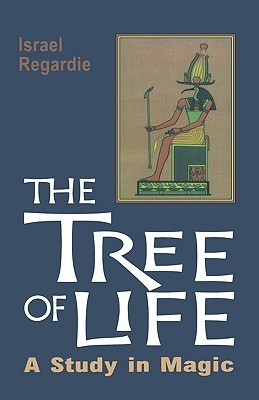
The Tree of Life, a Study in Magic
...the most comprehensive introduction available to the Golden Dawn system of initiation, and the numerous, complex and sometimes obscure mystical writings of Aleister Crowley.
Over fifty years ago Israel Regardie set himself the gigantic task of making accessible to the intelligent layman the root principles upon which Magic is built—principles which Aleister Crowley devoted his life to exploring and revealing. Drawing on his experience as personal secretary to Crowley and his involvement with the Golden Dawn system, Regardie skillfully unifies a wealth of diverse material into a marvelously coherent whole. The result is The Tree of Life, a book which has become the definitive overview of the Western Mystery Tradition.
Contents include: Yoga and Magic as the two branches of mysticism; Magic as distinct from psychic, witchcraft and other disciplines; exercise techniques for developing the will and the imagination; plus much more.
Over fifty years ago Israel Regardie set himself the gigantic task of making accessible to the intelligent layman the root principles upon which Magic is built—principles which Aleister Crowley devoted his life to exploring and revealing. Drawing on his experience as personal secretary to Crowley and his involvement with the Golden Dawn system, Regardie skillfully unifies a wealth of diverse material into a marvelously coherent whole. The result is The Tree of Life, a book which has become the definitive overview of the Western Mystery Tradition.
Contents include: Yoga and Magic as the two branches of mysticism; Magic as distinct from psychic, witchcraft and other disciplines; exercise techniques for developing the will and the imagination; plus much more.
284 pages, Paperback
First published November 30, 1931
About the author
Israel Regardie
156 books314 followersIsrael Regardie (born Francis Israel Regudy) was considered by many to be the last living Adept of the Hermetic Order of the Golden Dawn. At an early age, Regardie worked as Aleister Crowley's personal secretary. In addition to his extensive writings, Regardie practiced as a chiropractor and as a neo-Reichian therapist. He taught psychiatry at the Los Angeles College of Chiropractic and contributed articles to many psychology magazines.
Ratings & Reviews
Friends & Following
Create a free account to discover what your friends think of this book!
Community Reviews
Displaying 1 - 30 of 49 reviews
May 14, 2017
Edit - re-read in 2025
I am laughing at my original review. Not sure which edition I was reading at the time but my old review doesn’t do a great job at giving much of a picture the book attached to it. Let’s give it another go:
Mysticism could be described as attaining godhood or union with the ultimate source. Yoga is the way of the East, and ceremonial magic is the way of the West. Magic consists of ancient techniques which might also be described as theurgy, and can be found in such ancient texts such as Iamblichus’ On the Mysteries. Regardie makes the claim that real genius is achieved by these techniques and are the key to creativity. Further on, the basis of theurgy would be akin to baptism, purification, or rising on the planes as the theosophists describe it. From a Christian-normative POV, it would be akin to truly following Christ in order to be saved from hellfire. However, the theurgy performed by the original Christians in their mystery traditions and initiations was made a national religion over the first few centuries, and was entrusted only to the pontiffs. Many a scholar has pointed out that the Roman Catholic pontiffs hardly differ from the pagan ones pre-Constantine, and that any differences are merely exoteric.
This volume of Regardie’s is a thorough exploration of theurgic techniques and its claim is that all working theurgic systems fit into the Q/K/Cabalah. He repeatedly refers to Egyptian religion as the most perfect realization of any of history’s systems, although some scholars may argue we have little access to any explicit definition of what ancient Egypt’s systems were. Regardie insinuates Egypt’s pantheon and system of worship fits onto the diagram of the Kabbalistic tree of life and therefore makes a fine system of symbols and deities to work with when attempting to rise on the planes so to speak.
This work is heavily indebted to Eliphas Levi and H.P. Blavatsky, and the author cites them as such. As each chapter explores a different theme, these two figures appear in almost every one. This makes sense as Levi published the first treatise on Magic to the wider world with the title The Doctrine and Ritual of High Magic (English translation, originally in French) and Blavatsky published The Secret Doctrine in two volumes. Levi’s work is more easily accessible, but perhaps less laudable than Blavatsky’s, and both are far from perfect. Although they both had an enormous impact and influence on the accessibility of occult theory and a framework in which practitioners could draw from.
Part 1 of Regardie’s work here are the basic ideas that form what we may call modern magic, so the reader may get a cursory understanding of what this all is based on. His writing has a clunkiness to it that is at times irritating and at others endearing, but mostly feels like a product of its time as well as trying really hard to make this all sound very high-brow. Regardie was interested in psychology in the latter part of his life and goes to great lengths to bring the woo-woo into a respectable field of science. Those who are familiar with CG Jung’s Bollingen volumes will know that Freud’s one-time collaborator explores The Mysteries et al in great depth. Regardie had a respect for Jung, but was dismissive of Jungian therapy techniques. He saw psychoanalysis as a scientific validation of mysticism, the spiritual and ritual work, but saw no need for new models, since the models laid out in ancient rites worked just fine providing that the practitioner had a pure heart.
Part 2 assumes you understand what was laid out in the preliminaries, as pt. 1 is so titled, and the in depth theory can now be explained. Magical tools, which incense to use, how to train the Will (capitalization is intentional), how to ‘vibrate’ the names of deity, and astral projection, among others. The ultimate goal of magic is what is described in The Sacred Magic of Abramelin the Mage, published around 1608, as “Knowledge and Conversation with your Holy Guardian Angel” which is a six month process of strict purification rites. The practioner can then move on to Solomonic Magic safely, although it seems Regardie is saying you may find that summoning certain spirits necessary in order to be a more useful being to offer to God during your six month lead up to the K&C with your HGA. This seems like it could be very risky and lead to obsession, and should never be done without a guide, as summoning spirits without one or the K&C can lead to obsession, insanity, or worse.
My favorite chapter is the one on group ritual and initiation, which is where the best descriptions of what the ancient mysteries may have looked like are written about with the utmost care.
This 513 page book contains an introduction by the Ciceros, who now oversee the current Golden Dawn order, as well as edits and annotations made by them. It also includes a final chapter of prayers, hymns and invocations, which are quite beautiful poetically and may interest the casual reader a lot more than the theory and praxis of magic. It also has 132 beautiful illustrations from various sources, four of which are in color and have listed citations, an appendix containing a glossary of terms, and books recommended by the author for further study.
I’d recommend this book to anyone interested in the Hermetic Order of the Golden Dawn, esoteric Masonry, solitary ceremonial magic, Aleister Crowley’s magical milieu, or just a greater understanding of what Western Occultism entails and how greatly it differs from the Hollywood version. My soapbox statement is that anyone who has broken away from the church but still longs for some kind of spiritual practice that works to transform the individual in order to serve a greater purpose, or anyone interested in spiritual practice for the first time, can find a treasure trove of information and instruction on how to get started in what is called The Great Work. So mote it be!
—————-
2017’s version
A pretty big elephant whose outline is described quite clearly yet never actually addressed directly is: the power of the Catholic Church comes from very ancient techniques of magic. Theurgy is divine union by way of following instruction given in revelation, like say, the instructions God gave to Moses about the tabernacle. In fact, the Old Testament describes theurgical practice extremely well in Exodus 36-39. The Hermetic system written about here, however, is based on more ancient Gods, such as the ones that Moses learned about when he was a child. The meat of this book is Regardie's defense of the Egyptian Faith and the description of St. Ignatius' intense imaginative system.
Here's a trick: do you want something to go really well? An event, or question you need to ask your boss? Put your will into it. Think about what this means. Think about what it means to be alive (this may require you getting up before sunrise.) If you are up early, draw a symbol that you feel adequately describes the situation going well for you. This may be an abstract feeling, or an actual formula or recipe of words you want to hear from the other person or from your own mouth. Create this symbol as if it were putting that situation into itself, becoming a microcosm of the event. There's a bunch of hogwash out there on what to do next, but the very act of you focusing your will and intent on this symbol will direct your energy to the event, and it will seem supernatural.
Are you a Christian? Be a better one by living with Christ and His suffering the way St. Ignatius dares us to. The imagination and the will are just as mysterious as ever, and this book can really inspire one to a system such as Yoga or Magic. I believe that Regardie is trying to remain faithful to his one time employer, but that at heart he is ultimately a Christian, something I don't think Crowley would ever let anyone know of, if it were true about himself as well. The significance of Christ should be made more apparent through studying this book, as a transformational tool rather then dried up dogma. If you don't like the ring of that "Judeo Christian" hullaballoo, there are plenty of options including just invoking the ideas of numbers themselves, which Pythagoreans practiced as communing with the Divine.
I believe that Regardie sees the Osiris cycle as being an antitype to Christ, as the historicity of Osiris is never spoken of, the idea of God becoming a man, to die the death of a God-king should speak for itself. I think he sees Egyptian religion as having the flexibility of a pantheon to which the poets can be inspired like the Greeks, but with more intuitive beauty. Also, it's worth noting here that Egyptian religion in ancient times could mean theurgic devotion, initiation, crop rituals, and just downright superstition. Which is a great mirror for our western world as well and how we treat the spiritual world.
I would say aside from a few things, like trying to describe the Enochian system of John Dee in a short chapter, this book is a triumph. I've tried to read Barrett's Magus, and Bardon's IIH, and Lord, even some Levi myself. Regardie's style and voice is a lot of AE Waite, Manly Hall, with a little bit of The 666 thrown in for lineage's sake, I guess. I heard C and R had a falling out, in which C berates R for adding the Catholic name of Francis to the beginning of Israel. A decision he made as an adept, no doubt. One in which C treats with his usual anti-church attitude, telling R that he must have done it because he's ashamed to be Jewish. That's not the only story I've heard about The 666 being a total asshole, so I tend to believe the he was an ego- and megalomaniac. Nevertheless, Regardie had nothing but kind words to say about the man who taught him about Yoga and Hermetics, calling him a great poet at times, and a completely misunderstood genius for a new age. Whatever you views are on the infamously diabolical Aleister Crowley, this book is completely outside of that sphere. There is nothing Thelemic about this book. This is a system of getting in touch with your higher self by making your world sacred, calling to the universe's deep history for guidance, and asking them/it/He/She to aide you in The Great Work of Art. It's also not Thelemic in the sense that this system is ascetic at times, and is about detachment from this sub-lunary world, in order to commune with the divine, not about some drug induced vision to write a new Holy Book for a New Aeon.
Why don't more adepts make great works of art and make a lot of money? Regardie asks, and his response is, because these people have tasted the divine gift and they don't want to spoil it for themselves with distractions such as money. They want to make their entire life a work of art that is not marketable, but increases the goodness in this world by the value bestowed through each interaction and encounter one has with the adept who has tasted the sweet ecstasy of letting go, but chooses to stay here for his fellow man, and for the higher Will. It is a true Socratic stance to pop the emptiness of false ego's bubble, and I believe that Regardie was in the lineage of Socrates or St. Paul rather than the Great Beast he's usually associated with.
I am laughing at my original review. Not sure which edition I was reading at the time but my old review doesn’t do a great job at giving much of a picture the book attached to it. Let’s give it another go:
Mysticism could be described as attaining godhood or union with the ultimate source. Yoga is the way of the East, and ceremonial magic is the way of the West. Magic consists of ancient techniques which might also be described as theurgy, and can be found in such ancient texts such as Iamblichus’ On the Mysteries. Regardie makes the claim that real genius is achieved by these techniques and are the key to creativity. Further on, the basis of theurgy would be akin to baptism, purification, or rising on the planes as the theosophists describe it. From a Christian-normative POV, it would be akin to truly following Christ in order to be saved from hellfire. However, the theurgy performed by the original Christians in their mystery traditions and initiations was made a national religion over the first few centuries, and was entrusted only to the pontiffs. Many a scholar has pointed out that the Roman Catholic pontiffs hardly differ from the pagan ones pre-Constantine, and that any differences are merely exoteric.
This volume of Regardie’s is a thorough exploration of theurgic techniques and its claim is that all working theurgic systems fit into the Q/K/Cabalah. He repeatedly refers to Egyptian religion as the most perfect realization of any of history’s systems, although some scholars may argue we have little access to any explicit definition of what ancient Egypt’s systems were. Regardie insinuates Egypt’s pantheon and system of worship fits onto the diagram of the Kabbalistic tree of life and therefore makes a fine system of symbols and deities to work with when attempting to rise on the planes so to speak.
This work is heavily indebted to Eliphas Levi and H.P. Blavatsky, and the author cites them as such. As each chapter explores a different theme, these two figures appear in almost every one. This makes sense as Levi published the first treatise on Magic to the wider world with the title The Doctrine and Ritual of High Magic (English translation, originally in French) and Blavatsky published The Secret Doctrine in two volumes. Levi’s work is more easily accessible, but perhaps less laudable than Blavatsky’s, and both are far from perfect. Although they both had an enormous impact and influence on the accessibility of occult theory and a framework in which practitioners could draw from.
Part 1 of Regardie’s work here are the basic ideas that form what we may call modern magic, so the reader may get a cursory understanding of what this all is based on. His writing has a clunkiness to it that is at times irritating and at others endearing, but mostly feels like a product of its time as well as trying really hard to make this all sound very high-brow. Regardie was interested in psychology in the latter part of his life and goes to great lengths to bring the woo-woo into a respectable field of science. Those who are familiar with CG Jung’s Bollingen volumes will know that Freud’s one-time collaborator explores The Mysteries et al in great depth. Regardie had a respect for Jung, but was dismissive of Jungian therapy techniques. He saw psychoanalysis as a scientific validation of mysticism, the spiritual and ritual work, but saw no need for new models, since the models laid out in ancient rites worked just fine providing that the practitioner had a pure heart.
Part 2 assumes you understand what was laid out in the preliminaries, as pt. 1 is so titled, and the in depth theory can now be explained. Magical tools, which incense to use, how to train the Will (capitalization is intentional), how to ‘vibrate’ the names of deity, and astral projection, among others. The ultimate goal of magic is what is described in The Sacred Magic of Abramelin the Mage, published around 1608, as “Knowledge and Conversation with your Holy Guardian Angel” which is a six month process of strict purification rites. The practioner can then move on to Solomonic Magic safely, although it seems Regardie is saying you may find that summoning certain spirits necessary in order to be a more useful being to offer to God during your six month lead up to the K&C with your HGA. This seems like it could be very risky and lead to obsession, and should never be done without a guide, as summoning spirits without one or the K&C can lead to obsession, insanity, or worse.
My favorite chapter is the one on group ritual and initiation, which is where the best descriptions of what the ancient mysteries may have looked like are written about with the utmost care.
This 513 page book contains an introduction by the Ciceros, who now oversee the current Golden Dawn order, as well as edits and annotations made by them. It also includes a final chapter of prayers, hymns and invocations, which are quite beautiful poetically and may interest the casual reader a lot more than the theory and praxis of magic. It also has 132 beautiful illustrations from various sources, four of which are in color and have listed citations, an appendix containing a glossary of terms, and books recommended by the author for further study.
I’d recommend this book to anyone interested in the Hermetic Order of the Golden Dawn, esoteric Masonry, solitary ceremonial magic, Aleister Crowley’s magical milieu, or just a greater understanding of what Western Occultism entails and how greatly it differs from the Hollywood version. My soapbox statement is that anyone who has broken away from the church but still longs for some kind of spiritual practice that works to transform the individual in order to serve a greater purpose, or anyone interested in spiritual practice for the first time, can find a treasure trove of information and instruction on how to get started in what is called The Great Work. So mote it be!
—————-
2017’s version
A pretty big elephant whose outline is described quite clearly yet never actually addressed directly is: the power of the Catholic Church comes from very ancient techniques of magic. Theurgy is divine union by way of following instruction given in revelation, like say, the instructions God gave to Moses about the tabernacle. In fact, the Old Testament describes theurgical practice extremely well in Exodus 36-39. The Hermetic system written about here, however, is based on more ancient Gods, such as the ones that Moses learned about when he was a child. The meat of this book is Regardie's defense of the Egyptian Faith and the description of St. Ignatius' intense imaginative system.
Here's a trick: do you want something to go really well? An event, or question you need to ask your boss? Put your will into it. Think about what this means. Think about what it means to be alive (this may require you getting up before sunrise.) If you are up early, draw a symbol that you feel adequately describes the situation going well for you. This may be an abstract feeling, or an actual formula or recipe of words you want to hear from the other person or from your own mouth. Create this symbol as if it were putting that situation into itself, becoming a microcosm of the event. There's a bunch of hogwash out there on what to do next, but the very act of you focusing your will and intent on this symbol will direct your energy to the event, and it will seem supernatural.
Are you a Christian? Be a better one by living with Christ and His suffering the way St. Ignatius dares us to. The imagination and the will are just as mysterious as ever, and this book can really inspire one to a system such as Yoga or Magic. I believe that Regardie is trying to remain faithful to his one time employer, but that at heart he is ultimately a Christian, something I don't think Crowley would ever let anyone know of, if it were true about himself as well. The significance of Christ should be made more apparent through studying this book, as a transformational tool rather then dried up dogma. If you don't like the ring of that "Judeo Christian" hullaballoo, there are plenty of options including just invoking the ideas of numbers themselves, which Pythagoreans practiced as communing with the Divine.
I believe that Regardie sees the Osiris cycle as being an antitype to Christ, as the historicity of Osiris is never spoken of, the idea of God becoming a man, to die the death of a God-king should speak for itself. I think he sees Egyptian religion as having the flexibility of a pantheon to which the poets can be inspired like the Greeks, but with more intuitive beauty. Also, it's worth noting here that Egyptian religion in ancient times could mean theurgic devotion, initiation, crop rituals, and just downright superstition. Which is a great mirror for our western world as well and how we treat the spiritual world.
I would say aside from a few things, like trying to describe the Enochian system of John Dee in a short chapter, this book is a triumph. I've tried to read Barrett's Magus, and Bardon's IIH, and Lord, even some Levi myself. Regardie's style and voice is a lot of AE Waite, Manly Hall, with a little bit of The 666 thrown in for lineage's sake, I guess. I heard C and R had a falling out, in which C berates R for adding the Catholic name of Francis to the beginning of Israel. A decision he made as an adept, no doubt. One in which C treats with his usual anti-church attitude, telling R that he must have done it because he's ashamed to be Jewish. That's not the only story I've heard about The 666 being a total asshole, so I tend to believe the he was an ego- and megalomaniac. Nevertheless, Regardie had nothing but kind words to say about the man who taught him about Yoga and Hermetics, calling him a great poet at times, and a completely misunderstood genius for a new age. Whatever you views are on the infamously diabolical Aleister Crowley, this book is completely outside of that sphere. There is nothing Thelemic about this book. This is a system of getting in touch with your higher self by making your world sacred, calling to the universe's deep history for guidance, and asking them/it/He/She to aide you in The Great Work of Art. It's also not Thelemic in the sense that this system is ascetic at times, and is about detachment from this sub-lunary world, in order to commune with the divine, not about some drug induced vision to write a new Holy Book for a New Aeon.
Why don't more adepts make great works of art and make a lot of money? Regardie asks, and his response is, because these people have tasted the divine gift and they don't want to spoil it for themselves with distractions such as money. They want to make their entire life a work of art that is not marketable, but increases the goodness in this world by the value bestowed through each interaction and encounter one has with the adept who has tasted the sweet ecstasy of letting go, but chooses to stay here for his fellow man, and for the higher Will. It is a true Socratic stance to pop the emptiness of false ego's bubble, and I believe that Regardie was in the lineage of Socrates or St. Paul rather than the Great Beast he's usually associated with.
March 27, 2012
One of the first books I ever read dealing with the practical side of ritual practice and construction. It proved to be a highly influential and important read for me.
I should preface, the early version of the work, before the Ciscero's got a hold of Regardie's materials. I've seen what they've done with his other writings, but not this. I am thankful for that fact.
There is a treasure house of information that can be gleamed from this work, though the language and style will make you work for it. Regardie is sadly styling his writings on the 19th century style of Esoteric literature, similar to that found with Levi as well as Meade and the Theosophists.
The greatest benifit that I drew from this work is the attention to detail that the good dr shows in referring us back to the forerunners of the magical tradition he inherited and the interest he piqued in me to go back further than his writings and to start reading the sources like Iamblichus and Porphry and building up that foundation of knowledge that would help me build my understanding of Western mysteries.
I should preface, the early version of the work, before the Ciscero's got a hold of Regardie's materials. I've seen what they've done with his other writings, but not this. I am thankful for that fact.
There is a treasure house of information that can be gleamed from this work, though the language and style will make you work for it. Regardie is sadly styling his writings on the 19th century style of Esoteric literature, similar to that found with Levi as well as Meade and the Theosophists.
The greatest benifit that I drew from this work is the attention to detail that the good dr shows in referring us back to the forerunners of the magical tradition he inherited and the interest he piqued in me to go back further than his writings and to start reading the sources like Iamblichus and Porphry and building up that foundation of knowledge that would help me build my understanding of Western mysteries.

August 30, 2011
Written in a delightfully anachronistic style, specifically the plodding & oververbose brand of English that prompted George Orwell to write a hate rant around the same time period. Within these chapters you'll find lots of phrases like "the adept may find himself swirling in the empyrean, not unlike a spirit himself in appearance", or "this practice is not altogether without efficacy". Lots of description by negation of the opposite - kind of quaint really, I'm a sucker for such charms.
Anyway, on to the meat of the book:
This is a very clear picture of the Western Mystery tradition & forms a steady-handed introduction to the practice of that brand of magic. The editors Mrs & Mr. Cicero, especially, have provided helpfully verbose footnotes at the end of each chapter, which are a must read for those struggling to figure out what all this occult claptrap is all about.
All of the basics are covered here, the Tree of Life, the Sephiroth, various consensus interpretations of their organization and meanings, Solomon, Eliphas Levi quoted heavily, Dee, Pentagram rituals, a whole chapter devoted to the work of Abramelin the Mage, elementals, the weapons of the magician, pretty much all of those things you may have heard about the Western alchemists. Of significant note is the level of depth and emphasis in the presentation of the Egyptian roots of magic. Often this is a subject that bores me and turns me away, but here for the first time I've encountered a very reasonable set of arguments for investigating the Egyptian root of the practice with a renewed fervor.
There seem to be precious few works in this canon which are respectable and worthy of being read cover to cover, this is one of them.
Anyway, on to the meat of the book:
This is a very clear picture of the Western Mystery tradition & forms a steady-handed introduction to the practice of that brand of magic. The editors Mrs & Mr. Cicero, especially, have provided helpfully verbose footnotes at the end of each chapter, which are a must read for those struggling to figure out what all this occult claptrap is all about.
All of the basics are covered here, the Tree of Life, the Sephiroth, various consensus interpretations of their organization and meanings, Solomon, Eliphas Levi quoted heavily, Dee, Pentagram rituals, a whole chapter devoted to the work of Abramelin the Mage, elementals, the weapons of the magician, pretty much all of those things you may have heard about the Western alchemists. Of significant note is the level of depth and emphasis in the presentation of the Egyptian roots of magic. Often this is a subject that bores me and turns me away, but here for the first time I've encountered a very reasonable set of arguments for investigating the Egyptian root of the practice with a renewed fervor.
There seem to be precious few works in this canon which are respectable and worthy of being read cover to cover, this is one of them.

April 26, 2022
Studying the occult, or hidden, wisdom is like playing Dungeons and Dragons with God. When I found out the self proclaimed elites keep all this knowledge to themselves I began to study this information out of resentment. It then took on a life of its own and I found the information so interesting and so important it has consumed much of my life since. And my life, serenity, growth and soul have all blossomed exponentially. I moved from one of the darkest places on earth to one of the lightest. A move that spanned many states, months and total faith as we had no jobs and now have home in paradise. With a lifetime of horrific decision making this was one of my better moves. We are now surrounded by national forest, at least 23 rivers and three enormous lakes. We get into adventures daily in the forest and rivers and even our dogs are happier than ever before. One never knows what the Gods and Goddesses, river sprites and forest fae will have in store for a young mystic each day, but it’s sure to involve hard work, total concentration, ecstatic play and an unfolding of the soul much like a rose upon a cross. Also I find it interesting that each tome points in the direction to the next book a natural mystic ought read and study.

October 2, 2019
This year, I've been pretty intrigued with western esotericism, so I figured picking up this overview of occult practice by Aleister Crowley's secretary might be a good warm up before delving into the work of the Great Beast himself. That is if I ever get around to it without being afraid I'm going to get possessed or something. Regardie's prose is really overwrought and dry—something he admits to in his own introduction to the book, blaming it on his youth. But there's still plenty of worthwhile and interesting info about hermeticism, Qabalah, ritual practice, Will, and whatnot here. As for me, I'm still pretty much on the "this is all BS but at least it's fun to learn about" train when it comes to magick itself. It seems like a way for adults to use their imaginations powerfully and not much more, but maybe that's all it has to be. With that said, if you disagree, please don't hex me.

August 7, 2016
I was about 17 when I read this. I had been floating around different texts from Crowley and Eliphas Levi and different websites here and there for a few years before my guitar teacher, of all people (who was, coincidentally, a member of the O.T.O.), found out about my interest in the occult and gave me this book. I went from being totally lost to, well, still being lost (no book is gonna help you with that one, I guess!), but having a clear view of what I was actually trying to do.
As Regardie says somewhere, this was really one of the first (perhaps the first) book on magic intended for ordinary people. Regardie's supreme struggle, to de-mystify the mysteries! It presents itself very clearly, introduces all of the ideas non-doctrinally, etc. - encourages the student to approach the subject at their own pace, in a self-directed way. Regardie is so down to earth its a breath of fresh air after all the usual occultist hand-waving. He is like someone you might actually meet in your day-to-day life, and explains the philosophy and practice in a very clean and plainspoken way. And ah, suddenly it all falls into place! I think this is definitely the best introduction to the subject in general. And Regardie's writing is charming, as well - it's super formal in an endearing way, he even calls himself 'the author'!
That's his real name, too. Israel Regardie. (Well, 'Regurdy'). Some people were born to be magicians I guess. I bet old Edward Alexander Crowley (you pronounce 'Crow' like the bird, by the way) felt a little embarassed. (I bet he didn't really.)
There are a few little things - Regardie is very keen to differentiate this oh-so-serious white, divine magic, the art of "theurgy", from despicable witchcraft or reckless spiritism! We're magicians but we're the "good" magicians! The distinction is artificial; its all the same thing. But you couldn't say that if you wanted ordinary people to read your book, at least in the 30s. It's not really a bad thing - even Agrippa wanted people to believe that his "occult philosophy" wasn't "really" magic, etc. There is also some fossilization of that Enlightenment thinking that so infected Crowley, that we will pretend magicians are really scientists [rolls eyes] (Marxism suffers the same problem, btw!) - and yet, at the same time, wants to ground itself in total idealism and sincere mysticism, and so attempts to appropriate the entire Enlightenment under one dogma, and also lay claim to all pre-enlightenment revelation, and to the revelations of all non-western cultures, in all eras. Such is the outlook of the occult - which articulates itself as the 'key to the mysteries' - the 'secret philosophy of all ages'. In other words, it shows its old age (and privileged social positioning) in parts, but only in parts. Take its universalising with a pinch of salt, but take the rest seriously.
Anyway, it covers all the important topics a 'study in magic' should: its philosophical bases, its history, its mythology, and so on, in addition to a great number of practical subjects: Yoga, Kabbalah (under that ridiculous spelling, 'Qabalah'), correspondences, appropriate magical tools, exercises in training the will, mantras and magical names, skrying and astral projection, godforms, the knowledge and conversation of the holy guardian angel, the use of old grimoires, evocation, initiation, alchemy, and finally a series of historical prayers and invocations. It introduces the subjects very rigorously, but not so much that it functions as a manual or grimoire of its own - only enough to provide an understanding of how to learn more about practicing them. The book is a jumping off point for most areas of occult practice, but not a full curriculum in-and-of-itself, and shouldn't be approached that way.
It references not only recent teachers like Crowley, Waite and Levi, but also the teaching of the tradition's founders themselves - Agrippa, Abremelin, Iamblichus, Hermes himself, the Chaldean Oracles, and so on, as well as introducing captivating figures from other traditions, like the wide-eyed Saint Ignatius or the famous Swami Vivekananda, and particularly the Irish poet A.E.
Almost more useful than the book itself is the extensive suggested reading section at the end, pointing towards more advanced works or works on more particular topics. Following only on from the suggestions in this book one would find themselves a well-read and well-developed practitioner!
Anyway, as the author always says: invoke often! Inflame thyself with prayer!
As Regardie says somewhere, this was really one of the first (perhaps the first) book on magic intended for ordinary people. Regardie's supreme struggle, to de-mystify the mysteries! It presents itself very clearly, introduces all of the ideas non-doctrinally, etc. - encourages the student to approach the subject at their own pace, in a self-directed way. Regardie is so down to earth its a breath of fresh air after all the usual occultist hand-waving. He is like someone you might actually meet in your day-to-day life, and explains the philosophy and practice in a very clean and plainspoken way. And ah, suddenly it all falls into place! I think this is definitely the best introduction to the subject in general. And Regardie's writing is charming, as well - it's super formal in an endearing way, he even calls himself 'the author'!
That's his real name, too. Israel Regardie. (Well, 'Regurdy'). Some people were born to be magicians I guess. I bet old Edward Alexander Crowley (you pronounce 'Crow' like the bird, by the way) felt a little embarassed. (I bet he didn't really.)
There are a few little things - Regardie is very keen to differentiate this oh-so-serious white, divine magic, the art of "theurgy", from despicable witchcraft or reckless spiritism! We're magicians but we're the "good" magicians! The distinction is artificial; its all the same thing. But you couldn't say that if you wanted ordinary people to read your book, at least in the 30s. It's not really a bad thing - even Agrippa wanted people to believe that his "occult philosophy" wasn't "really" magic, etc. There is also some fossilization of that Enlightenment thinking that so infected Crowley, that we will pretend magicians are really scientists [rolls eyes] (Marxism suffers the same problem, btw!) - and yet, at the same time, wants to ground itself in total idealism and sincere mysticism, and so attempts to appropriate the entire Enlightenment under one dogma, and also lay claim to all pre-enlightenment revelation, and to the revelations of all non-western cultures, in all eras. Such is the outlook of the occult - which articulates itself as the 'key to the mysteries' - the 'secret philosophy of all ages'. In other words, it shows its old age (and privileged social positioning) in parts, but only in parts. Take its universalising with a pinch of salt, but take the rest seriously.
Anyway, it covers all the important topics a 'study in magic' should: its philosophical bases, its history, its mythology, and so on, in addition to a great number of practical subjects: Yoga, Kabbalah (under that ridiculous spelling, 'Qabalah'), correspondences, appropriate magical tools, exercises in training the will, mantras and magical names, skrying and astral projection, godforms, the knowledge and conversation of the holy guardian angel, the use of old grimoires, evocation, initiation, alchemy, and finally a series of historical prayers and invocations. It introduces the subjects very rigorously, but not so much that it functions as a manual or grimoire of its own - only enough to provide an understanding of how to learn more about practicing them. The book is a jumping off point for most areas of occult practice, but not a full curriculum in-and-of-itself, and shouldn't be approached that way.
It references not only recent teachers like Crowley, Waite and Levi, but also the teaching of the tradition's founders themselves - Agrippa, Abremelin, Iamblichus, Hermes himself, the Chaldean Oracles, and so on, as well as introducing captivating figures from other traditions, like the wide-eyed Saint Ignatius or the famous Swami Vivekananda, and particularly the Irish poet A.E.
Almost more useful than the book itself is the extensive suggested reading section at the end, pointing towards more advanced works or works on more particular topics. Following only on from the suggestions in this book one would find themselves a well-read and well-developed practitioner!
Anyway, as the author always says: invoke often! Inflame thyself with prayer!

October 21, 2017
What a slog. Some credit should be given that this is basically the book that founded a genre, but any book you read since then on the subject will probably convey more information in 1/10th the words.
August 30, 2007
A must-read for new adepts.
Read
May 4, 2018Not for me
November 16, 2025
Israel Regardie presents an overview of theurgic ceremonial magic in the over-arching background context of the Qabalistic Tree of Life. It is a very stagy kind of magic that seems to rely a lot on self-suggestion and total re-immersion rather than break ins continuity of memory characteristic of Spare's sigil magic. It seems both more and less traditional: while it is more properly ceremonial, this approach seems to bury the precise "fivefold act of consciousness" under a more generalised attempt to uplift your will to more subtle levels of the Tree of Life. The pentagram appears here mostly as a symbol that banishes unwanted lower astral spirits.
In this book, evocation always presumes an invocation while in sigil magic and even in mantras the spirits are simply loaded into either sigils or sounds and the assumption of the spirit form happens via the sigil or sound which now contains the characteristic of the deity in a compressed form. The two systems are inverted but structurally similar: one could say that Kenneth Grant's system is this kind of inverted Spareanism based on sounds and mantras(sometimes f.ex the sound of bees --> sounds of a group like Incapacitants, sometimes connecting figures to pitched sounds ---> Tunnels of Set). One could liken it to using programs like 7-zip to pack large files as compressed versions so that the recipient can download them more efficiently to unpack them with the same program. It is also compelling in that brain and neural networks work by compression, reflecting a general principle of laziness which a system like the one in this book can address only via suppressing it since it is admitted that all of it is in vain without will. Evocation here means experiencing a vision in the "outer" of the god-form whose stance you took and who you invoked to your imagination via symbolic elements associated with it. You can then tell this god to help you with something. But basically, hiddenly this book follows the same principle because it takes a gradual, ascension-focused approach from the outset: the first goetic evocation, and the first invocation for that matter, can do nothing but it gains power with repeated application, the sigil seemingly being only a prop among others rather than the central feature it is in non-ceremonial sigil magic.
However, there is something more fascinating to the immersive aspect that magic like this presents, especially in its astral aspect with the Body of Light-exercises where you are asked to imagine yourself as the invoked god-form inside you and investigate the internal spaces mapped by the Tree of Life, resolving its conflicts until you graduate to the next level. The importance of motivation is emphasised often here and that is really the strength of the book: taking the microcosmic aspect more seriously than the more technically clever Spare-system which can only result in spirit possession and "accomplishment of goals". Even that is paradoxical in Spare's and Temple of Set's/CoS's system because it's not really "you" whose goals are being fulfilled or who's even experiencing it. In fact, this collapse is written into their system and yet the system is necessarily maintained based on a motivation that presupposes a denial of this collapse. Shiva Sutras say that "mind is mantra" but this is only mentation and mental processes: with a genuine vision of micro-macrocosm recursion chasing of mentation goals is very clearly rejected in favour of purificatory right hand path-logic. This is also the difference between the downward-pointing pentagram(Spare, satanism) and traditional pentagram(Crowley, Golden Dawn). I guess many people saw the liberatory developments in mytho-poetic self-expression and first thing to go was banishing rituals but from the framework of the body of light, the little guy, it becomes clear why it is good to assert the God-directed intention because Regardie is absolutely right that without it you move to the territory of mentation and intelligence without any progress.
This is not to say that the somewhat rigid framework of this book cannot be updated for the current era with various different types of exercises which do not necessarily emphasise the will so much. The problem with too much initial will is that it distorts gnosis and there's probably its own dangers of a different kind from the mentational/Buddhist-side. It could be conceived more as an exploration of the language of your form. Body is already a source of tricks and feedbacks which might help to short-circuit the idea of just willing your way through it. It helps to understand that Kabbalists and Indian sages actually knew modern scientific facts about neurons probably via merely an application of the microcosmic techniques, particularly the one depicted at the end of this book with beautiful restraint. With the upcoming advent of nanobots/VRs applied to perspectival science and the concomitant revolution of the concept of the object (not magnified, not zoomed, only registering light in its own perspective: the organs no longer obviously parts of humans but humans could exist for organs etc.) the body of light/aeon of the child-methods will only become more florid and relevant.
In this book, evocation always presumes an invocation while in sigil magic and even in mantras the spirits are simply loaded into either sigils or sounds and the assumption of the spirit form happens via the sigil or sound which now contains the characteristic of the deity in a compressed form. The two systems are inverted but structurally similar: one could say that Kenneth Grant's system is this kind of inverted Spareanism based on sounds and mantras(sometimes f.ex the sound of bees --> sounds of a group like Incapacitants, sometimes connecting figures to pitched sounds ---> Tunnels of Set). One could liken it to using programs like 7-zip to pack large files as compressed versions so that the recipient can download them more efficiently to unpack them with the same program. It is also compelling in that brain and neural networks work by compression, reflecting a general principle of laziness which a system like the one in this book can address only via suppressing it since it is admitted that all of it is in vain without will. Evocation here means experiencing a vision in the "outer" of the god-form whose stance you took and who you invoked to your imagination via symbolic elements associated with it. You can then tell this god to help you with something. But basically, hiddenly this book follows the same principle because it takes a gradual, ascension-focused approach from the outset: the first goetic evocation, and the first invocation for that matter, can do nothing but it gains power with repeated application, the sigil seemingly being only a prop among others rather than the central feature it is in non-ceremonial sigil magic.
However, there is something more fascinating to the immersive aspect that magic like this presents, especially in its astral aspect with the Body of Light-exercises where you are asked to imagine yourself as the invoked god-form inside you and investigate the internal spaces mapped by the Tree of Life, resolving its conflicts until you graduate to the next level. The importance of motivation is emphasised often here and that is really the strength of the book: taking the microcosmic aspect more seriously than the more technically clever Spare-system which can only result in spirit possession and "accomplishment of goals". Even that is paradoxical in Spare's and Temple of Set's/CoS's system because it's not really "you" whose goals are being fulfilled or who's even experiencing it. In fact, this collapse is written into their system and yet the system is necessarily maintained based on a motivation that presupposes a denial of this collapse. Shiva Sutras say that "mind is mantra" but this is only mentation and mental processes: with a genuine vision of micro-macrocosm recursion chasing of mentation goals is very clearly rejected in favour of purificatory right hand path-logic. This is also the difference between the downward-pointing pentagram(Spare, satanism) and traditional pentagram(Crowley, Golden Dawn). I guess many people saw the liberatory developments in mytho-poetic self-expression and first thing to go was banishing rituals but from the framework of the body of light, the little guy, it becomes clear why it is good to assert the God-directed intention because Regardie is absolutely right that without it you move to the territory of mentation and intelligence without any progress.
This is not to say that the somewhat rigid framework of this book cannot be updated for the current era with various different types of exercises which do not necessarily emphasise the will so much. The problem with too much initial will is that it distorts gnosis and there's probably its own dangers of a different kind from the mentational/Buddhist-side. It could be conceived more as an exploration of the language of your form. Body is already a source of tricks and feedbacks which might help to short-circuit the idea of just willing your way through it. It helps to understand that Kabbalists and Indian sages actually knew modern scientific facts about neurons probably via merely an application of the microcosmic techniques, particularly the one depicted at the end of this book with beautiful restraint. With the upcoming advent of nanobots/VRs applied to perspectival science and the concomitant revolution of the concept of the object (not magnified, not zoomed, only registering light in its own perspective: the organs no longer obviously parts of humans but humans could exist for organs etc.) the body of light/aeon of the child-methods will only become more florid and relevant.

June 11, 2019
Finally finished this big beast after wrestling with it for a few months! The Tree of Life is a great historical/theoretical reference book of the Western magical tradition, but its verbosity and antiquated ideas weigh it down occasionally. The gems within it shine brightly, but you can find them elsewhere in better packaged boxes.

April 4, 2017
A bit torturous but worthwhile if only for the sense of accomplishment in finishing, lol.
August 29, 2026
The Tree of Life remains one of the great synthetic works of twentieth-century ceremonial magic because Israel Regardie understood that the Western magical tradition is not fundamentally a collection of rituals. It is a theory of consciousness, cosmos, symbol, and spiritual transformation within which ritual becomes intelligible.
Regardie begins from an explicitly mystical premise. Magic and yoga are presented as parallel disciplines directed toward communion with a reality exceeding the ordinary ego, with ceremonial magic functioning as a characteristically Western method of approaching that goal. This immediately distinguishes the book from manuals concerned chiefly with acquiring powers or producing isolated phenomena. For Regardie, magical technique is ultimately subordinate to the transformation of the magician.
The Hermetic Qabalah supplies the architecture for that transformation. The Tree of Life becomes simultaneously cosmology, psychology, symbolic taxonomy, and map of ascent. Divine names, planetary powers, gods, angels, colors, perfumes, magical implements, and states of consciousness acquire significance through their placement within an interconnected symbolic universe. Regardie is particularly good at showing why correspondence matters. It is not simply an exercise in memorizing which color or incense belongs to which sphere. Correspondence allows multiple symbolic languages to converge upon the same idea until consciousness is saturated with it.
His description of magic as a mnemonic process remains particularly insightful. Ritual gathers image, sound, gesture, scent, divine name, movement, imagination, and emotion into a deliberately constructed symbolic environment. These sensory and psychic stimuli continually remind consciousness of the spiritual reality the operation is intended to evoke. The magician effectively builds an embodied mandala and then steps inside it.
This is one reason Regardie’s discussions of implements, circles, perfumes, sigils, circumambulation, music, and divine names remain valuable even when particular historical claims have aged. He understands ceremonial detail functionally. The wand, robe, incense, gesture, and spoken formula are meaningful insofar as they educate consciousness and organize magical intention.
The same principle underlies his treatment of the Body of Light, skrying, and astral projection. Regardie does not regard visionary experience as intrinsically trustworthy merely because it is vivid. He repeatedly emphasizes training, discrimination, verification, and the dangers of fantasy masquerading as revelation. That skepticism within an otherwise thoroughly occult worldview is one of his strengths. A magician must cultivate imagination intensely without becoming indiscriminately credulous toward everything imagination produces.
His discussion of the assumption of godforms is likewise central. Rather than merely petitioning divine powers externally, the magician learns to identify consciousness temporarily with a sacred form. Egyptian deities become especially important within Regardie's examples, though his Egyptology naturally reflects the occult scholarship available in his period rather than contemporary historical understanding. What remains powerful is the technique itself: symbolic identification used as a method of expanding the boundaries of habitual personality.
Regardie eventually brings these principles toward the Holy Guardian Angel and the Sacred Magic of Abramelin. This movement clarifies the hierarchy implicit throughout the book. Evocation, astral work, ritual correspondences, and ceremonial technique are stages within a larger initiatory project whose culmination is conscious relationship with the divine genius. Magical development is therefore not measured merely by how many spirits one can summon but by the degree to which the magician becomes integrated around a transcendent center.
The psychological dimension of this deserves attention because Regardie was among the occultists who most persistently attempted to place ceremonial magic into conversation with modern psychology. His synthesis can sometimes feel historically dated, particularly where psychoanalytic terminology is treated as though it transparently explains ancient religious symbols. Yet the underlying intuition remains productive: magical initiation involves confrontation with unconscious material as much as ascent toward divine states.
This prevents his mysticism from becoming simple spiritual escapism. The aspirant does not reach illumination by constructing increasingly elaborate metaphysical fantasies while remaining psychologically unchanged. The personality itself must be disciplined, integrated, and gradually rendered capable of bearing more intense symbolic and spiritual experience.
The breadth of the book is extraordinary. Regardie moves through Iamblichean theurgy, Qabalah, Egyptian symbolism, astral theory, pentagram ritual, Abramelin, Solomonic magic, Goetia, initiation, alchemy, Eucharistic symbolism, necromancy, and invocation without treating them as entirely unrelated historical curiosities. His project is synthetic in the specifically Hermetic sense: beneath their differences, he searches for recurrent technologies of ascent, invocation, purification, and transformation.
That synthesis is also where caution is required. Contemporary scholarship has substantially revised many historical assumptions inherited by early twentieth-century occultists. Egyptian religion, Jewish Kabbalah, late antique theurgy, medieval grimoires, and Renaissance magic each deserve to be studied within their own cultural settings before being absorbed into a universal occult system. Regardie’s correspondential genius sometimes creates relationships more philosophically elegant than historically demonstrable.
The Ciceros’ edition is therefore particularly useful. Their annotations and explanatory material help contextualize difficult passages, correct or clarify points where necessary, and make the work considerably easier to navigate without attempting to rewrite Regardie into a contemporary author. The additional illustrations, glossary, bibliography, and editorial apparatus turn an already important text into a much more serviceable reference work.
What impresses me most, however, is how much subsequent occult literature has normalized ideas that Regardie was helping to make publicly accessible. The Tree of Life was written when the technical language and inner logic of ceremonial magic were still far less available outside initiatory orders. Reading it now can create the deceptive impression that some of its material is familiar or even obvious. In many cases, it feels familiar precisely because Regardie helped establish the vocabulary through which later generations learned to discuss Western magic.
The book is consequently both historical document and living manual. Parts of its scholarship belong unmistakably to its period, while its understanding of magical training remains remarkably durable.
Regardie’s great insight was that ceremonial magic is a discipline for reorganizing consciousness through symbol until the distinction between cosmology and psychology begins to collapse. The Tree of Life maps the universe, certainly, but its more demanding proposition is that the magician must eventually discover that map within himself.
Nearly a century later, that remains one of the more sophisticated accounts of what ceremonial magic is actually attempting to accomplish.
Regardie begins from an explicitly mystical premise. Magic and yoga are presented as parallel disciplines directed toward communion with a reality exceeding the ordinary ego, with ceremonial magic functioning as a characteristically Western method of approaching that goal. This immediately distinguishes the book from manuals concerned chiefly with acquiring powers or producing isolated phenomena. For Regardie, magical technique is ultimately subordinate to the transformation of the magician.
The Hermetic Qabalah supplies the architecture for that transformation. The Tree of Life becomes simultaneously cosmology, psychology, symbolic taxonomy, and map of ascent. Divine names, planetary powers, gods, angels, colors, perfumes, magical implements, and states of consciousness acquire significance through their placement within an interconnected symbolic universe. Regardie is particularly good at showing why correspondence matters. It is not simply an exercise in memorizing which color or incense belongs to which sphere. Correspondence allows multiple symbolic languages to converge upon the same idea until consciousness is saturated with it.
His description of magic as a mnemonic process remains particularly insightful. Ritual gathers image, sound, gesture, scent, divine name, movement, imagination, and emotion into a deliberately constructed symbolic environment. These sensory and psychic stimuli continually remind consciousness of the spiritual reality the operation is intended to evoke. The magician effectively builds an embodied mandala and then steps inside it.
This is one reason Regardie’s discussions of implements, circles, perfumes, sigils, circumambulation, music, and divine names remain valuable even when particular historical claims have aged. He understands ceremonial detail functionally. The wand, robe, incense, gesture, and spoken formula are meaningful insofar as they educate consciousness and organize magical intention.
The same principle underlies his treatment of the Body of Light, skrying, and astral projection. Regardie does not regard visionary experience as intrinsically trustworthy merely because it is vivid. He repeatedly emphasizes training, discrimination, verification, and the dangers of fantasy masquerading as revelation. That skepticism within an otherwise thoroughly occult worldview is one of his strengths. A magician must cultivate imagination intensely without becoming indiscriminately credulous toward everything imagination produces.
His discussion of the assumption of godforms is likewise central. Rather than merely petitioning divine powers externally, the magician learns to identify consciousness temporarily with a sacred form. Egyptian deities become especially important within Regardie's examples, though his Egyptology naturally reflects the occult scholarship available in his period rather than contemporary historical understanding. What remains powerful is the technique itself: symbolic identification used as a method of expanding the boundaries of habitual personality.
Regardie eventually brings these principles toward the Holy Guardian Angel and the Sacred Magic of Abramelin. This movement clarifies the hierarchy implicit throughout the book. Evocation, astral work, ritual correspondences, and ceremonial technique are stages within a larger initiatory project whose culmination is conscious relationship with the divine genius. Magical development is therefore not measured merely by how many spirits one can summon but by the degree to which the magician becomes integrated around a transcendent center.
The psychological dimension of this deserves attention because Regardie was among the occultists who most persistently attempted to place ceremonial magic into conversation with modern psychology. His synthesis can sometimes feel historically dated, particularly where psychoanalytic terminology is treated as though it transparently explains ancient religious symbols. Yet the underlying intuition remains productive: magical initiation involves confrontation with unconscious material as much as ascent toward divine states.
This prevents his mysticism from becoming simple spiritual escapism. The aspirant does not reach illumination by constructing increasingly elaborate metaphysical fantasies while remaining psychologically unchanged. The personality itself must be disciplined, integrated, and gradually rendered capable of bearing more intense symbolic and spiritual experience.
The breadth of the book is extraordinary. Regardie moves through Iamblichean theurgy, Qabalah, Egyptian symbolism, astral theory, pentagram ritual, Abramelin, Solomonic magic, Goetia, initiation, alchemy, Eucharistic symbolism, necromancy, and invocation without treating them as entirely unrelated historical curiosities. His project is synthetic in the specifically Hermetic sense: beneath their differences, he searches for recurrent technologies of ascent, invocation, purification, and transformation.
That synthesis is also where caution is required. Contemporary scholarship has substantially revised many historical assumptions inherited by early twentieth-century occultists. Egyptian religion, Jewish Kabbalah, late antique theurgy, medieval grimoires, and Renaissance magic each deserve to be studied within their own cultural settings before being absorbed into a universal occult system. Regardie’s correspondential genius sometimes creates relationships more philosophically elegant than historically demonstrable.
The Ciceros’ edition is therefore particularly useful. Their annotations and explanatory material help contextualize difficult passages, correct or clarify points where necessary, and make the work considerably easier to navigate without attempting to rewrite Regardie into a contemporary author. The additional illustrations, glossary, bibliography, and editorial apparatus turn an already important text into a much more serviceable reference work.
What impresses me most, however, is how much subsequent occult literature has normalized ideas that Regardie was helping to make publicly accessible. The Tree of Life was written when the technical language and inner logic of ceremonial magic were still far less available outside initiatory orders. Reading it now can create the deceptive impression that some of its material is familiar or even obvious. In many cases, it feels familiar precisely because Regardie helped establish the vocabulary through which later generations learned to discuss Western magic.
The book is consequently both historical document and living manual. Parts of its scholarship belong unmistakably to its period, while its understanding of magical training remains remarkably durable.
Regardie’s great insight was that ceremonial magic is a discipline for reorganizing consciousness through symbol until the distinction between cosmology and psychology begins to collapse. The Tree of Life maps the universe, certainly, but its more demanding proposition is that the magician must eventually discover that map within himself.
Nearly a century later, that remains one of the more sophisticated accounts of what ceremonial magic is actually attempting to accomplish.
September 9, 2025
## Resumen
El libro es un buen resumen del sistema mágico de Regardie, práctico y bien expuesto. Se basa en gran medida en la [[Golden Dawn]] y la [[cábala hermética]] y, directa o indirectamente, en la [[teosofía]], el [[gnosticismo]], el [[neoplatonismo]] ([[Jámblico]], [[Porfirio]], [[Proclo]]) y el [[1458 - El Libro de Abramelín - Abraham de Worms]].
### árbol de la vida
Usa como base de su exposición el [[árbol de la vida - cábala]], que está compuesto de cuatro planos, más fundamental y abstracto cuanto más elevados.
- En el primero se encuentran el fundamento de la realidad, la primera energía o divinidad de la que emana el cosmos y la dualidad que es su derivado inmediato. El [[abismo - cábala]] separa este plano (ideal) de los siguientes (actuales).
- En el segundo se encuentran los arquetipos universales, una suerte de [[Ideas - Platón]].
- En el tercero se encuentran las ideas concretas de los seres concretos del mundo, una especie de reflejo espiritual del mundo material, de pre-diseño ideal del mundo.
- El cuarto es el mundo material que ven nuestros sentidos.
El árbol de la vida, con sus diez [[sefirot]] repartidas en los cuatro planos, ofrece una suerte de «alfabeto mágico» de la existencia.
> First of all, the philosophy of the Qabalah is a philosophy of evolution. The universe, with all its planets and worlds and independent beings, was conceived to be the emanation from a primeval substance-principle which some have called God, the Absolute, the Infinite, the All, and so forth. In the Qabalah, this principle which is the One Reality is named Ain Soph, the Infinite.
A lo largo del libro recorre en detalle el simbolismo y los correlatos metafísicos de cada sefirá.
### Imaginación y voluntad
La herramienta de la que disponemos para explorar los planos superiores es la [[imaginación - magia]].
> One of the highest powers we have, a power marvellously creative beyond description or expression, is Imagination. It is, postulates Iamblichus, “superior to all nature and generation, and through which we are capable of being united to the Gods, of transcending the mundane order, and of participating eternal life, and the energy of the supercelestial Gods. Through this principle, therefore, we are able to liberate ourselves from fate.
La imaginación y la [[voluntad - magia]] son las herramientas fundamentales del mago.
> By means of a consciously imposed asceticism, by denying oneself while in training certain things normally considered necessary, to learn in short the art of self-conquest and how to live, is to set oneself free from the vicissitudes of the eternal flux and reflux which is life, and obtain a highly trained will.
### cuerpo astral
El método privilegiado para la exploración de lo planos superiores es el desdoblamiento imaginativo del cuerpo material y el cuerpo astral, que porta la conciencia a los planos superiores.
> in the so-called Astral Light he may perceive an exact reflection of himself in all his several parts and qualities and attributions, an examination of that reflection tending naturally to a species of self-knowledge.
> Why individuals—particularly some Theosophists—should lust after, or contemplate as they do, astral or other occult powers for their own sake is a pathological morbidity, and as such is a thing which surpasses my comprehension.
Hay variaciones.
> Pertaining to the realm of Tipharas is a higher aspect of this astral body which does enter very largely into practical Theurgy. It is not really an astral body, in the sense of a vital model giving life to the physical, but it is a mental or thought body, the direct vehicle of the ideal and spiritual faculties, whose substance is that of the higher or divine Astral. According to Blavatsky this is the Mayavi-rupa, the thought or dream body, the sheath of the mind and memory and emotion, known and named in Theurgy as the Body of Light.
Ascendiendo con el cuerpo de luz se accede al plano de símbolos y energias abstractas. El mago puede explorar los símbolos y sus significados de forma empírica en este plano.
> It will be in practice of this kind that the Theurgist will discover that what were conventional symbols in the exterior world are dynamic realities,
### entidades superiores, alma del mundo
Los planos superiores están habitados con entidades que podemos invocar y con las que podemos relacionarlos.
> Evocations are undertaken by the Magician not out of curiosity nor to satisfy a thirst for power, but with the sole object of bringing these hidden facets of his own consciousness within the scope of his will, and thus subjecting them to his domination.
Al ser el mundo material un último reflejo de los planos espirituales, lo que aprendamos en nuestros viajes imaginativos también nos informa del mundo material y puede afectarle.
El alma o conciencia humana es una con el alma divina o conciencia del mundo (ver:: [[eso eres tú - Tat Tvam Asi - Chandogya Upanishad]]). Por este motivo es natural afirmar que las prácticas imaginativas nos ofrecen conocimiento cierto y pueden afectar la materia. Cuando el alma humana se eleva con técnicas meditativas o ascéticas se acerca al alma del mundo. La substancia fundamental de la existencia es la energía/conciencia.
> The result which the Magician above all else desires to accomplish is a spiritual reconstruction of his own conscious universe and incidentally that of all mankind, the greatest of all conceivable changes.
> One of the fundamental postulates of Magic is that Man is an exact image in miniature of the universe
### Jerarquía de planos de conciencia y existencia
Las partes del árbol de la vida se corresponden con la jerarquía de estados de la conciencia, que se corresponde con la jerarquía metafísica de planos de la existencia.
> Just as there are various grades of mineral, animal and vegetable life and innumerable degrees of intelligence among men, so according to the magical traditions, this same hierarchical scale of intelligence exists beyond and above man.
> There are hierarchies of consciousness which are celestial and there are those which are terrestrial; some divine, others demoniac, and still others including the highest Gods and universal Essences. This is the pivotal centre of the whole of the magical philosophy. It is at one and the same time a monotheism and polytheism in a single philosophic system.
En el [[Libro egipcio de los muertos]]:
> Each of the several strata or regions in the Astral World, both gross and divine, was mapped out with a precision which even to-day has neither rival nor equal.
Por qué no, ya seguir hasta el final:
> With these centres, the first manifestations, there sprang from the latent homogeneity a heterogeneous group of divine entities or cosmic Intelligent forces who became the architects and builders of the universe. From their own individual spiritual essence, lesser hierarchies were born, and these in turn emanated or created from themselves yet other groups until eventually the human souls came into being, the reflected offspring of the blessed Gods. These intelligent forces have been variously named Gods, Daimons, Universal Essences, Dhyan Chohans, Aeons, Teletarchæ and many other names. They all imply the same fundamental idea of conscious (though not necessarily self-conscious, intellectual) centres of force, wisdom, and intelligence who emanate or create, in one way or another, from themselves the manifested finite universe.
### La luz astral
Entre lo material y lo espiritual, hay un fluido que todo lo permea, la [[luz astral - magia]] o «espíritu santo», una especie de éter que no puede ser medido con instrumentos físicos. (Por algún motivo dice que es «eléctrico» y «magnético», seremos caritativos y supondremos que son metáforas).
> The control of this plane constitutes from one point of view the Great Work. Some Magicians, including the distinguished Levi, were of the opinion that the central magical secret is that of the willed direction of this arcanum.
> Being the vehicle wherein are dynamically recorded the passions and thought impressions of all mankind, the memory of lower nature, and being present on the earth all the time, inasmuch as it is all-permeant and but one plane removed from the physical, its contents must influence enormously the minds of weak and sensitive men.
> For disclosing the various layers of mind and soul, together with their contents in dynamic form, the Astral Light and its investigation in the fiery solar body is the means par excellence, than which there is none better.
Lo hace corresponder con el [[inconsciente colectivo - Jung]].
Este fluido es manipulable y produce efectos en el mundo material.
> Since the plastic substance of the Astral Light is peculiarly susceptible to the manipulation of imaginative currents, and since the images made in that Light produce perceptible changes, if the Will be strong enough to vitalize those images, the Magician seeks to apply these facts to his own sphere.
### Lo que quiere el mago
No es solo conocimiento lo que anhela el mago/místico, sino un contacto (*acquaintance*) con la realidad espiritual del mundo, con la divinidad. La técnica del misticismo tiene dos ramas pricipales:
> Yoga and Magic, the reflective and the exaltive methods respectively, are both different phases comprehended in the one term Mysticism.
> All the practices and exercises in the Yoga systems are so many scientific steps, having as their one objective the complete abeyance of all thought at will. The mind must be thoroughly emptied at will of its content. Magic, on the other hand, is a mnemonic system of psychology in which the almost interminable ceremonial details, the circumambulations, conjurations, and suffumigations are deliberately intended for the exaltation of the imagination and soul, with the utter transcending of the normal plane of thought.
### Ángel guardián
El primer paso en la interacción del alma con los planos superiores es el contacto con el [[ángel guardián · augoeides - magia]]. El augoeides es el yo verdadero, más profundo, que habita el tercer plano; es la idea de yo, el plan de creación del yo encarnado.
> At the commencement of his career, the Magician is obliged to comprehend that his one aspiration is to his Higher Self, to his Holy Guardian Angel, and that any faculties which are obtained must be harnessed to that aspiration.
> The object of Magic, then, is the return of man to the Gods, the uniting of the individual consciousness during life with the greater being of the universal Essences, the more embracing consciousness of the Gods who are the everlasting sources of light and life and love.
En la línea Junguiana, al ángel guardián ([[sí-mismo · self - Jung]]) hay que ofrecer en sacrificio el ego.
> This Ruach calling itself “I,” changing momentarily with the passing of time, upset by the flux and pressing surge of mutable thoughts and convulsive emotions, is just the one thing which is not “I”. Simply a vehicle, it has assumed—as an ape simulates the actions of its master—the prerogative of a separate existence, divorcing itself from its own divine lord, the energy which alone gives it life and sustenance. In Magic it is this empirical ego, this lower self which must be offered up in sacrifice to the Holy Guardian Angel.
> Now the ideal which to the Magician constitutes his greatest treasure, and to which the whole tenor of his life's activities is directed, is the recovery of the knowledge of his Holy Guardian Angel, the Augoeides, that nobler part of his consciousness which is real, permanent, and the bountiful, undying source of inspiration and spiritual sustenance. Hence there is, in reality, one perfect ritual in Magic; one goal which takes precedence over all others: the invocation of the Holy Guardian Angel, union with whom should even precede the invocations of the Gods or the Universal Essences, following the procedure laid down by Iamblichus.
>
> In other words, just what the Theurgist has conceived in imagination his Angel to be, in just that form does the Angel manifest, welling up from the deepest font of being within the heart as revelation and inspiration.
### Ceremonias, círculo, altar, lámpara, armas elementales
> By the use of the Circle, the Magician asserts that within this self-imposed limitation he confines his labours; that he limits himself to the attainment of a specific end, and that no longer is he in a maze of illusion and perpetual change as a blind wanderer without aim, objective or aspiration.
> Around this Circle are inscribed divine names. Many of them will differ with the nature of each ceremony, and it is upon the innate power and influence inherent in the names that the Magician relies as a protection against the vicious demons without—the hostile thoughts of his own ego.
> The function of the Circle is simply to set a spatial limit within which spiritual work may proceed unmolested and without fear of intrusion by demoniac and extraneous forces.
> Erected within this figure, as the foundation of all his work, the symbol of the lower Will, is the Altar on which are arrayed the magical instruments to be employed. It is the fundamental centre of the Magician's work, the pivot to which he again and again returns from the circumambulation.
> The lamp must always hang above the Theurgist's head, and is never kept in the altar cupboard. It symbolizes in every system the undimmed radiance of the Higher Self, the Holy Guardian Angel.
[[armas elementales - magia]]
> Those weapons, the so-called elemental weapons, are arrayed on the top of the Altar prior to the operation. These consist of the Wand, the Sword or Dagger, the Cup and the Pentacle, representing the letters of Tetragrammaton, and the four elements from which the whole gamut of heterogeneity in the cosmos has been built.
> The Wand is the Will, representing the wisdom and spiritual presence of the creative Self, the Chiah, and it should be upright and mighty, a worthy figure of his divine force.
> Passive and receptive, the Cup or Chalice is a true symbol of his Neschamah, the intuition and understanding which is ever open awaiting the supernal dew which daily descends.
> The sword is of cold steel, hard and sharp and piercing like the all-pervading and penetrant air, ever in a state of perpetual flux and motion. By this symbol is understood the Ruach, or the mind, which, when without training, is volatile and in a state of constant motion, without stability or easy concentration.
> Since it is a cutting instrument, one used for analysis and dissection, banishing in ceremonial magic is its prime function, and it should never be employed at all in works having as their climax the invocation of the highest.
> the Cup is used but rarely, and then only in the highest invocations, to bear the libations; in evocations it plays no part at all.
> Round, inert, and constructed of wax, a fitting symbol of the earth, plastic and awaiting cultivation by intelligence, the Pentade is a token of the body, the Temple of the Holy Ghost, about to receive through the theurgic and telestic rites the influx of the divine spirit.
### Entrenamiento de la voluntad, yoga
> An extremely efficient technique has been evolved by a contemporary Magician; a most practical system free from all the unpleasant implications and moral tendencies of the older systems. According to this system,1 the technique is so arranged as to cover the whole field of human action, speech and thought, and thus is applicable to the entire constitution of man. At base, it is in agreement with the general conception of asceticism that a certain action, word or thought, which has become habitual and a part of the Ruach, should be denied one. Such as, for example, vowing for a provisional period of, say, a week, to refrain from crossing the legs over the knee when sitting down, or perhaps forming the decision not to raise the left hand to head or face. The great advantage of this system is that there is no moral bias in these suggestions.
> Now for every violation of this oath to refrain from a certain course of action, a certain punishment should be inflicted.
> The mind must be trained to concentrate under all circumstances. As a preliminary to magical practice of this kind, the technique of Yoga is a tremendous advantage. One may even state for that true success in all Magic a thorough grounding in Yoga technique is an absolute essential.
### Entrenamiento de la transferencia al cuerpo astral
> The technique, briefly, is as follows. Seating himself comfortably in a chair—or if he be trained in the assumption of a Yoga posture and is easy therein, so much the better—and tranquillizing his mind and emotions as far as may be possible, the Magician should try to imagine standing before him an exact duplicate of his own body.
### Técnicas y peligros de los ritos
> But obsession at all costs must be avoided. The possession of the human frame by a dog-faced demon is subversive to magical aim and procedure. Hence certain methods have been devised to prevent the possibility of obsession, leaving the body quite safe while the soul wings its way to the sacred fires. Some authorities believe that the surrounding of the body with an imaginary circle of white light is one of the most effective of all protective methods.
> Before the commencement of a vision, or any operation in Magic, it is advisable for the student to perform a thorough banishing, which is both purifying and protective. The quickest and best method of banishing is through the Banishing Ritual of the Pentagram.
> A general conjuration should follow reciting the authority by which the Magician works, and enumerating the powers which in the past have been productive of great results by other Magicians. By this time, the consciousness of the Magician should have begun to exalt itself by reason of the burning of the incense, the psychology of the robes, the lyricism and the intoxicant value of the invocation with its long reverberating list of barbarous names and the enumeration of wonders and commands and imprecations, in addition to the bewildering effect, as it were, of the lights, figures and seals. The climax of the operation, the spirit's manifestation, then occurs almost automatically. The Key of Solomon then gives more or less the correct procedure until, when the Spirit has appeared in visible form and has obeyed the Magician, the License to Depart and the banishing ritual should once again be recited to close the entire ceremony.
El libro es un buen resumen del sistema mágico de Regardie, práctico y bien expuesto. Se basa en gran medida en la [[Golden Dawn]] y la [[cábala hermética]] y, directa o indirectamente, en la [[teosofía]], el [[gnosticismo]], el [[neoplatonismo]] ([[Jámblico]], [[Porfirio]], [[Proclo]]) y el [[1458 - El Libro de Abramelín - Abraham de Worms]].
### árbol de la vida
Usa como base de su exposición el [[árbol de la vida - cábala]], que está compuesto de cuatro planos, más fundamental y abstracto cuanto más elevados.
- En el primero se encuentran el fundamento de la realidad, la primera energía o divinidad de la que emana el cosmos y la dualidad que es su derivado inmediato. El [[abismo - cábala]] separa este plano (ideal) de los siguientes (actuales).
- En el segundo se encuentran los arquetipos universales, una suerte de [[Ideas - Platón]].
- En el tercero se encuentran las ideas concretas de los seres concretos del mundo, una especie de reflejo espiritual del mundo material, de pre-diseño ideal del mundo.
- El cuarto es el mundo material que ven nuestros sentidos.
El árbol de la vida, con sus diez [[sefirot]] repartidas en los cuatro planos, ofrece una suerte de «alfabeto mágico» de la existencia.
> First of all, the philosophy of the Qabalah is a philosophy of evolution. The universe, with all its planets and worlds and independent beings, was conceived to be the emanation from a primeval substance-principle which some have called God, the Absolute, the Infinite, the All, and so forth. In the Qabalah, this principle which is the One Reality is named Ain Soph, the Infinite.
A lo largo del libro recorre en detalle el simbolismo y los correlatos metafísicos de cada sefirá.
### Imaginación y voluntad
La herramienta de la que disponemos para explorar los planos superiores es la [[imaginación - magia]].
> One of the highest powers we have, a power marvellously creative beyond description or expression, is Imagination. It is, postulates Iamblichus, “superior to all nature and generation, and through which we are capable of being united to the Gods, of transcending the mundane order, and of participating eternal life, and the energy of the supercelestial Gods. Through this principle, therefore, we are able to liberate ourselves from fate.
La imaginación y la [[voluntad - magia]] son las herramientas fundamentales del mago.
> By means of a consciously imposed asceticism, by denying oneself while in training certain things normally considered necessary, to learn in short the art of self-conquest and how to live, is to set oneself free from the vicissitudes of the eternal flux and reflux which is life, and obtain a highly trained will.
### cuerpo astral
El método privilegiado para la exploración de lo planos superiores es el desdoblamiento imaginativo del cuerpo material y el cuerpo astral, que porta la conciencia a los planos superiores.
> in the so-called Astral Light he may perceive an exact reflection of himself in all his several parts and qualities and attributions, an examination of that reflection tending naturally to a species of self-knowledge.
> Why individuals—particularly some Theosophists—should lust after, or contemplate as they do, astral or other occult powers for their own sake is a pathological morbidity, and as such is a thing which surpasses my comprehension.
Hay variaciones.
> Pertaining to the realm of Tipharas is a higher aspect of this astral body which does enter very largely into practical Theurgy. It is not really an astral body, in the sense of a vital model giving life to the physical, but it is a mental or thought body, the direct vehicle of the ideal and spiritual faculties, whose substance is that of the higher or divine Astral. According to Blavatsky this is the Mayavi-rupa, the thought or dream body, the sheath of the mind and memory and emotion, known and named in Theurgy as the Body of Light.
Ascendiendo con el cuerpo de luz se accede al plano de símbolos y energias abstractas. El mago puede explorar los símbolos y sus significados de forma empírica en este plano.
> It will be in practice of this kind that the Theurgist will discover that what were conventional symbols in the exterior world are dynamic realities,
### entidades superiores, alma del mundo
Los planos superiores están habitados con entidades que podemos invocar y con las que podemos relacionarlos.
> Evocations are undertaken by the Magician not out of curiosity nor to satisfy a thirst for power, but with the sole object of bringing these hidden facets of his own consciousness within the scope of his will, and thus subjecting them to his domination.
Al ser el mundo material un último reflejo de los planos espirituales, lo que aprendamos en nuestros viajes imaginativos también nos informa del mundo material y puede afectarle.
El alma o conciencia humana es una con el alma divina o conciencia del mundo (ver:: [[eso eres tú - Tat Tvam Asi - Chandogya Upanishad]]). Por este motivo es natural afirmar que las prácticas imaginativas nos ofrecen conocimiento cierto y pueden afectar la materia. Cuando el alma humana se eleva con técnicas meditativas o ascéticas se acerca al alma del mundo. La substancia fundamental de la existencia es la energía/conciencia.
> The result which the Magician above all else desires to accomplish is a spiritual reconstruction of his own conscious universe and incidentally that of all mankind, the greatest of all conceivable changes.
> One of the fundamental postulates of Magic is that Man is an exact image in miniature of the universe
### Jerarquía de planos de conciencia y existencia
Las partes del árbol de la vida se corresponden con la jerarquía de estados de la conciencia, que se corresponde con la jerarquía metafísica de planos de la existencia.
> Just as there are various grades of mineral, animal and vegetable life and innumerable degrees of intelligence among men, so according to the magical traditions, this same hierarchical scale of intelligence exists beyond and above man.
> There are hierarchies of consciousness which are celestial and there are those which are terrestrial; some divine, others demoniac, and still others including the highest Gods and universal Essences. This is the pivotal centre of the whole of the magical philosophy. It is at one and the same time a monotheism and polytheism in a single philosophic system.
En el [[Libro egipcio de los muertos]]:
> Each of the several strata or regions in the Astral World, both gross and divine, was mapped out with a precision which even to-day has neither rival nor equal.
Por qué no, ya seguir hasta el final:
> With these centres, the first manifestations, there sprang from the latent homogeneity a heterogeneous group of divine entities or cosmic Intelligent forces who became the architects and builders of the universe. From their own individual spiritual essence, lesser hierarchies were born, and these in turn emanated or created from themselves yet other groups until eventually the human souls came into being, the reflected offspring of the blessed Gods. These intelligent forces have been variously named Gods, Daimons, Universal Essences, Dhyan Chohans, Aeons, Teletarchæ and many other names. They all imply the same fundamental idea of conscious (though not necessarily self-conscious, intellectual) centres of force, wisdom, and intelligence who emanate or create, in one way or another, from themselves the manifested finite universe.
### La luz astral
Entre lo material y lo espiritual, hay un fluido que todo lo permea, la [[luz astral - magia]] o «espíritu santo», una especie de éter que no puede ser medido con instrumentos físicos. (Por algún motivo dice que es «eléctrico» y «magnético», seremos caritativos y supondremos que son metáforas).
> The control of this plane constitutes from one point of view the Great Work. Some Magicians, including the distinguished Levi, were of the opinion that the central magical secret is that of the willed direction of this arcanum.
> Being the vehicle wherein are dynamically recorded the passions and thought impressions of all mankind, the memory of lower nature, and being present on the earth all the time, inasmuch as it is all-permeant and but one plane removed from the physical, its contents must influence enormously the minds of weak and sensitive men.
> For disclosing the various layers of mind and soul, together with their contents in dynamic form, the Astral Light and its investigation in the fiery solar body is the means par excellence, than which there is none better.
Lo hace corresponder con el [[inconsciente colectivo - Jung]].
Este fluido es manipulable y produce efectos en el mundo material.
> Since the plastic substance of the Astral Light is peculiarly susceptible to the manipulation of imaginative currents, and since the images made in that Light produce perceptible changes, if the Will be strong enough to vitalize those images, the Magician seeks to apply these facts to his own sphere.
### Lo que quiere el mago
No es solo conocimiento lo que anhela el mago/místico, sino un contacto (*acquaintance*) con la realidad espiritual del mundo, con la divinidad. La técnica del misticismo tiene dos ramas pricipales:
> Yoga and Magic, the reflective and the exaltive methods respectively, are both different phases comprehended in the one term Mysticism.
> All the practices and exercises in the Yoga systems are so many scientific steps, having as their one objective the complete abeyance of all thought at will. The mind must be thoroughly emptied at will of its content. Magic, on the other hand, is a mnemonic system of psychology in which the almost interminable ceremonial details, the circumambulations, conjurations, and suffumigations are deliberately intended for the exaltation of the imagination and soul, with the utter transcending of the normal plane of thought.
### Ángel guardián
El primer paso en la interacción del alma con los planos superiores es el contacto con el [[ángel guardián · augoeides - magia]]. El augoeides es el yo verdadero, más profundo, que habita el tercer plano; es la idea de yo, el plan de creación del yo encarnado.
> At the commencement of his career, the Magician is obliged to comprehend that his one aspiration is to his Higher Self, to his Holy Guardian Angel, and that any faculties which are obtained must be harnessed to that aspiration.
> The object of Magic, then, is the return of man to the Gods, the uniting of the individual consciousness during life with the greater being of the universal Essences, the more embracing consciousness of the Gods who are the everlasting sources of light and life and love.
En la línea Junguiana, al ángel guardián ([[sí-mismo · self - Jung]]) hay que ofrecer en sacrificio el ego.
> This Ruach calling itself “I,” changing momentarily with the passing of time, upset by the flux and pressing surge of mutable thoughts and convulsive emotions, is just the one thing which is not “I”. Simply a vehicle, it has assumed—as an ape simulates the actions of its master—the prerogative of a separate existence, divorcing itself from its own divine lord, the energy which alone gives it life and sustenance. In Magic it is this empirical ego, this lower self which must be offered up in sacrifice to the Holy Guardian Angel.
> Now the ideal which to the Magician constitutes his greatest treasure, and to which the whole tenor of his life's activities is directed, is the recovery of the knowledge of his Holy Guardian Angel, the Augoeides, that nobler part of his consciousness which is real, permanent, and the bountiful, undying source of inspiration and spiritual sustenance. Hence there is, in reality, one perfect ritual in Magic; one goal which takes precedence over all others: the invocation of the Holy Guardian Angel, union with whom should even precede the invocations of the Gods or the Universal Essences, following the procedure laid down by Iamblichus.
>
> In other words, just what the Theurgist has conceived in imagination his Angel to be, in just that form does the Angel manifest, welling up from the deepest font of being within the heart as revelation and inspiration.
### Ceremonias, círculo, altar, lámpara, armas elementales
> By the use of the Circle, the Magician asserts that within this self-imposed limitation he confines his labours; that he limits himself to the attainment of a specific end, and that no longer is he in a maze of illusion and perpetual change as a blind wanderer without aim, objective or aspiration.
> Around this Circle are inscribed divine names. Many of them will differ with the nature of each ceremony, and it is upon the innate power and influence inherent in the names that the Magician relies as a protection against the vicious demons without—the hostile thoughts of his own ego.
> The function of the Circle is simply to set a spatial limit within which spiritual work may proceed unmolested and without fear of intrusion by demoniac and extraneous forces.
> Erected within this figure, as the foundation of all his work, the symbol of the lower Will, is the Altar on which are arrayed the magical instruments to be employed. It is the fundamental centre of the Magician's work, the pivot to which he again and again returns from the circumambulation.
> The lamp must always hang above the Theurgist's head, and is never kept in the altar cupboard. It symbolizes in every system the undimmed radiance of the Higher Self, the Holy Guardian Angel.
[[armas elementales - magia]]
> Those weapons, the so-called elemental weapons, are arrayed on the top of the Altar prior to the operation. These consist of the Wand, the Sword or Dagger, the Cup and the Pentacle, representing the letters of Tetragrammaton, and the four elements from which the whole gamut of heterogeneity in the cosmos has been built.
> The Wand is the Will, representing the wisdom and spiritual presence of the creative Self, the Chiah, and it should be upright and mighty, a worthy figure of his divine force.
> Passive and receptive, the Cup or Chalice is a true symbol of his Neschamah, the intuition and understanding which is ever open awaiting the supernal dew which daily descends.
> The sword is of cold steel, hard and sharp and piercing like the all-pervading and penetrant air, ever in a state of perpetual flux and motion. By this symbol is understood the Ruach, or the mind, which, when without training, is volatile and in a state of constant motion, without stability or easy concentration.
> Since it is a cutting instrument, one used for analysis and dissection, banishing in ceremonial magic is its prime function, and it should never be employed at all in works having as their climax the invocation of the highest.
> the Cup is used but rarely, and then only in the highest invocations, to bear the libations; in evocations it plays no part at all.
> Round, inert, and constructed of wax, a fitting symbol of the earth, plastic and awaiting cultivation by intelligence, the Pentade is a token of the body, the Temple of the Holy Ghost, about to receive through the theurgic and telestic rites the influx of the divine spirit.
### Entrenamiento de la voluntad, yoga
> An extremely efficient technique has been evolved by a contemporary Magician; a most practical system free from all the unpleasant implications and moral tendencies of the older systems. According to this system,1 the technique is so arranged as to cover the whole field of human action, speech and thought, and thus is applicable to the entire constitution of man. At base, it is in agreement with the general conception of asceticism that a certain action, word or thought, which has become habitual and a part of the Ruach, should be denied one. Such as, for example, vowing for a provisional period of, say, a week, to refrain from crossing the legs over the knee when sitting down, or perhaps forming the decision not to raise the left hand to head or face. The great advantage of this system is that there is no moral bias in these suggestions.
> Now for every violation of this oath to refrain from a certain course of action, a certain punishment should be inflicted.
> The mind must be trained to concentrate under all circumstances. As a preliminary to magical practice of this kind, the technique of Yoga is a tremendous advantage. One may even state for that true success in all Magic a thorough grounding in Yoga technique is an absolute essential.
### Entrenamiento de la transferencia al cuerpo astral
> The technique, briefly, is as follows. Seating himself comfortably in a chair—or if he be trained in the assumption of a Yoga posture and is easy therein, so much the better—and tranquillizing his mind and emotions as far as may be possible, the Magician should try to imagine standing before him an exact duplicate of his own body.
### Técnicas y peligros de los ritos
> But obsession at all costs must be avoided. The possession of the human frame by a dog-faced demon is subversive to magical aim and procedure. Hence certain methods have been devised to prevent the possibility of obsession, leaving the body quite safe while the soul wings its way to the sacred fires. Some authorities believe that the surrounding of the body with an imaginary circle of white light is one of the most effective of all protective methods.
> Before the commencement of a vision, or any operation in Magic, it is advisable for the student to perform a thorough banishing, which is both purifying and protective. The quickest and best method of banishing is through the Banishing Ritual of the Pentagram.
> A general conjuration should follow reciting the authority by which the Magician works, and enumerating the powers which in the past have been productive of great results by other Magicians. By this time, the consciousness of the Magician should have begun to exalt itself by reason of the burning of the incense, the psychology of the robes, the lyricism and the intoxicant value of the invocation with its long reverberating list of barbarous names and the enumeration of wonders and commands and imprecations, in addition to the bewildering effect, as it were, of the lights, figures and seals. The climax of the operation, the spirit's manifestation, then occurs almost automatically. The Key of Solomon then gives more or less the correct procedure until, when the Spirit has appeared in visible form and has obeyed the Magician, the License to Depart and the banishing ritual should once again be recited to close the entire ceremony.
This entire review has been hidden because of spoilers.

February 23, 2019
The florid writing aside, this really did feel like a great intro into the world of the western ceremonial tradition. It’s worth the read for the historic importance of the work, but Regardie isn’t the best at really taking the time to connect his threads. Definitely not useful when it comes to actual practical application!
July 12, 2007
Reading this now. Regardie is more accessible and easier to understand than Crowley. He was his secretary and has really organized the systems for us. Pure Golden Dawn stuff.
June 6, 2022
I didn't finish it, it's full of interesting info but I'm not interested anymore.
Read
May 9, 2008have to read this one several times... in life

September 14, 2024
Israel Regardie was a prominent figure in the Hermetic Order of the Golden Dawn; a direct student of Crowley and one of the big guns of the occult world. ‘The Tree of Life’ is considered by many (including himself) to be Regardie’s magnum opus, so I figured it would provide a natural bridge to further titles like ‘The Garden of Pomegranates’ and ‘The Middle Pillar’.
The text seemed to appear on cue, since much of the meaning and symbolism can only be transmitted in the aftermath of initiation. My hope was that Regardie would demystify a lot of the archaic prose found in a lot of early 20th century, ‘scientific illuminism’ literature. As it turns out, this is another esoteric, word salad to add to the pile (!). 😵
Why it’s great
Despite the slog, ‘The Tree of Life’ is hands-down, the finest study of magic I’ve ever come across. For years, I’ve floundered around the smorgasbord of magical disciplines, never fully understanding where one ends and another begins. I often wonder how solitary practitioners manage without the accountability and structure of an order. Without experience, it’s hard to grasp the difference between invocation and evocation, not to mention where Enochian and Solomonic maps find context in the grand scheme.
‘The Tree of Life’ has broadened my understanding of the term magic and how it can be used to name and transmute subconscious blocks, to prepare the vessel (pyramid or talisman) for knowledge and conversation (K&C) with the holy guardian angel (HGA). It’s also given me a mental map of how all the foundational texts fit together. From ‘The sacred magic of Abramelin the Mage’, to ‘Secret symbols of the Rosicrucians’, ‘The book of the Angel Raziel’, ‘Egyptian book of the dead’, ‘Transcendental Magic’ and last but definitely not least; the greater and lesser Solomonic texts. I now have a much better idea of immediate study priorities, along with how to avoid unnecessary rabbit holes. After all, mysterious rituals and sexy symbolism can so easily distract from the ‘one star in sight’ purpose for showing up in the first place!
1. Theurgy 101 👑
There’s a ton of Theurgy content in the book. I struggled initially to distinguish between assuming a God-form and the idea of spirit conjuration, so it might be good to define both, to clarify what Theurgy isn’t.
● Theurgy - an invocation to embody a divine archetype, or God-form (chapter 11 expands on this really well).
● Spirit conjuration (see Goetia practices in chapter 13) - an evocation to summon an external spirit into a designated space.
2. ‘That’ Astral light chapter ⚡
Regardie’s precise, almost scientific, way of describing the ‘etheric substance on the subtle plane of Yesod’ blew my mind 🤯 (chapter four). He suggests that numbers, symbols, sigils and emblems exist as living entities on the Astral. This spooky substance is also said to hold an eternal memory, capable of reflecting our story back at us:
“There are no solitary acts and there are no secret acts; all that we truly will, that is, all that we confirm by our deeds, is written in the Astral light.” 👀
My own observation is that descriptions of the gross aspects of Yesod seem to hold similar qualities to the ‘middle world’ of wandering spirits in core shamanic terms (upper/middle/lower worlds).
Chapter 10 lays out a basic template for working with the Body of Light, with the ultimate goal of conscious separation from the physical body. The steps are as follows:
● Meditating on Tattva symbols to build sensitivity.
● Visualising and inhabiting an exact duplicate of the physical body.
● Keeping the body safe with protection rituals such as the LBRP.
● The final transfer of consciousness into the vision.
Once this technique has been mastered, initiations can apparently take place entirely on the Astral plane, as opposed to a physical temple. --This gets a big wow from me! 🤩
3. Parallels of the Ruach (ego, lower self, or “I”) 👇
The training of the five Sephiroth below the Abyss closely resembles my previous studies of an ancient map of the cosmos, known as the Medicine Wheel. Its aim is to help us balance the four elemental forces within (with a focus on the ‘what’, rather than ‘who’), in order to achieve a healthy equilibrium. Or in Ruach terms (chapter 5), the dissolution of false ego and subsequent offering of the lower self to the HGA. “He who loses his life shall find it.”
4. Egyptian myths of Liber Resh vel Helios 🐪
Liber Resh vel Helios contains a truckload of divine names. Exploring Egyptian mythology feels like a necessity, to uncover the various familial stories of murder and vengeance (chapter six). Myth has it that Horus murdered and decapitated his mother, Isis, when she intervened in his battle against Set (the murderer of his father). Her intent was to restore cosmic order, which led to an intervention by Thoth. Her head was transformed into that of a cow, forever linking her to the goddess Hathor. 🐮
--As you do! 👀
5. Deconstructing ‘Love is the Law’
Chapter 12 prompted me to reflect on the meaning and application of ‘Love is the Law’. Crunching this down to a few succinct statements was a fun task and I love the participatory nature of meeting the HGA half way with an intuitive, inner compass (aspiration IS inspiration).
🧭
Love is the internal compass, memory is the map and imagination is the instrument: So long as the three are in perfect alignment, our creative giveaway will reveal a higher purpose, eventually manifesting the vision of the angel.
6. Solomonic brain farts 🤯
I’ve always been interested in the ethics of spirit conjuration and the Goetia section took a week to fully unpack. Chapter 13 raised the following questions:
● What is a ‘demon’ and how are these spirits positioned as ‘morally ambiguous’, as opposed to straight up ‘evil’?
● Why dabble with external entities if the singular goal is one of self-knowledge and obtaining K&C with one source / HGA?
● In the absence of K&C, how can we be sure that a selected Goetia spirit will serve our best interests, or do anything other than provide distraction through elaborate ritual?
● Doesn’t Liber AL explicitly state; ‘Bind nothing’? (Ch.1, v22)
I’m a tough nut to crack on this subject, but Regardie does a fantastic job of presenting a case in favour of evocation prior to K&C. He hints that in some circumstances, Goetic practices can help prepare for K&C by ‘filling the gaps on the ladder’ or confronting and resolving psychological obstacles.
7. Bat blood, virgin kids and lambs 🩸
Regardie namechecks French occultist, Éliphas Lévi throughout the text. Particularly in discussions of astral maps, pentagram symbolism, theurgy and planetary attributions. He’s also extremely critical of the later editions of Transcendental Magic, calling them “despicable” and claiming they “cater to the animal lusts of depraved ignoramuses”. (Chapter 13). Having researched this, Regardie seems to be referring to rituals geared towards manipulation for personal gain, including forcing someone to love you or to compel others to act against their will.
--The supreme object of Magic is the knowledge of the Higher Self and gradual improvement/sacrifice of the Ruach. Anything else, according to Regardie, is Black Magic.
Lévi also appears to be drawn to some colourful symbolism (!), such as bat blood, virgin kids and lambs, which aren’t particularly 21st century friendly when taken literally. 😂
8. The race against time ⌛
At 46, I often find myself stressing unnecessarily about the time required to achieve K&C and enact anything close to True Will. Chapter 14 spells out a lot of these preoccupations and the overwhelming message was that showing up is enough, persistence is key and not even death can interrupt the work.
“For pure will, unassuaged of purpose, delivered from the lust of result, is every way perfect.”
Liber AL, Chapter 1, Verse 44
“The Magician must work as though omnipotence were his and that eternity were at his disposal”.
Eliphas Levi - I love this quote!
9. Tired binary tropes
Regardie is extremely keen to differentiate magic and theurgy from new-age forms of spiritualism or ‘psychism’ (including Theosophy). He reiterates this point on numerous occasions, calling the modern spiritualist movement ‘abhorrent’ and a ‘descent into animal consciousness’, reducing practitioners to ‘helpless prey’ (see point 7 above). I have little personal interest in mediumship, but I find myself questioning whether these practices are as harmful as Regardie suggests. I can certainly see the potential for distraction, but the framing of magical practices as good vs evil, or black & white, feels a tad like a Christianised, colonial-era perspective.
--Might we call this an old-aeon way of thinking?
See also, “cleanse my soul from all the uncleanness of sin”, found in an invocation from ‘The sacred magic of Abramelin the Mage’. The punitive tones on display here are no different to the Bible-bashing, fire-and-brimstone blatherings of the Catholic Church. I find myself needing to work hard to reappraise these guilt-inducing statements into positive opportunities for growth. I also note Regardie’s occasional gendered language in referring to spiritualists as ‘she’ and magicians as ‘he’. I wonder if this was intentional and whether moments like these speak to the cultural backdrop of 1932, more than a present day reality. Similarly, there are few, if any, female spirits in the Goetia, which likely reflects the patriarchal Medieval and Renaissance periods.
--It’s encouraging to see modern occultists embrace a more fluid and inclusive approach to gender! ✊
10. The alchemical transformation and convocation 🧪
The mass of symbolism contained in alchemical transformation is confounding at first (lots of lactating mermaids, red lions and white eagles). However, chapter 16 does a great job of explaining the role of the tetragrammaton in constructing a magical talisman.
The athanor (furnace) and cucurbite (vessel) are used as metaphors, to illustrate the union of opposites (inner fire vs conscious focus), along with the alchemical process of dissolving & recombining to achieve spiritual refinement (YHVH). Chapter 16 also explores the purpose of convocation, where the initiate becomes the talisman. The process is to channel supernal light into a sacrament, to be consumed during the mystic repast. The Holy Grail, envisioned above the altar, is considered the ‘heart of the ritual’, with the bread referred to as the ‘dew of immortality’ or ‘quintessence.’
In short: A HECK OF A READ.
The text seemed to appear on cue, since much of the meaning and symbolism can only be transmitted in the aftermath of initiation. My hope was that Regardie would demystify a lot of the archaic prose found in a lot of early 20th century, ‘scientific illuminism’ literature. As it turns out, this is another esoteric, word salad to add to the pile (!). 😵
Why it’s great
Despite the slog, ‘The Tree of Life’ is hands-down, the finest study of magic I’ve ever come across. For years, I’ve floundered around the smorgasbord of magical disciplines, never fully understanding where one ends and another begins. I often wonder how solitary practitioners manage without the accountability and structure of an order. Without experience, it’s hard to grasp the difference between invocation and evocation, not to mention where Enochian and Solomonic maps find context in the grand scheme.
‘The Tree of Life’ has broadened my understanding of the term magic and how it can be used to name and transmute subconscious blocks, to prepare the vessel (pyramid or talisman) for knowledge and conversation (K&C) with the holy guardian angel (HGA). It’s also given me a mental map of how all the foundational texts fit together. From ‘The sacred magic of Abramelin the Mage’, to ‘Secret symbols of the Rosicrucians’, ‘The book of the Angel Raziel’, ‘Egyptian book of the dead’, ‘Transcendental Magic’ and last but definitely not least; the greater and lesser Solomonic texts. I now have a much better idea of immediate study priorities, along with how to avoid unnecessary rabbit holes. After all, mysterious rituals and sexy symbolism can so easily distract from the ‘one star in sight’ purpose for showing up in the first place!
1. Theurgy 101 👑
There’s a ton of Theurgy content in the book. I struggled initially to distinguish between assuming a God-form and the idea of spirit conjuration, so it might be good to define both, to clarify what Theurgy isn’t.
● Theurgy - an invocation to embody a divine archetype, or God-form (chapter 11 expands on this really well).
● Spirit conjuration (see Goetia practices in chapter 13) - an evocation to summon an external spirit into a designated space.
2. ‘That’ Astral light chapter ⚡
Regardie’s precise, almost scientific, way of describing the ‘etheric substance on the subtle plane of Yesod’ blew my mind 🤯 (chapter four). He suggests that numbers, symbols, sigils and emblems exist as living entities on the Astral. This spooky substance is also said to hold an eternal memory, capable of reflecting our story back at us:
“There are no solitary acts and there are no secret acts; all that we truly will, that is, all that we confirm by our deeds, is written in the Astral light.” 👀
My own observation is that descriptions of the gross aspects of Yesod seem to hold similar qualities to the ‘middle world’ of wandering spirits in core shamanic terms (upper/middle/lower worlds).
Chapter 10 lays out a basic template for working with the Body of Light, with the ultimate goal of conscious separation from the physical body. The steps are as follows:
● Meditating on Tattva symbols to build sensitivity.
● Visualising and inhabiting an exact duplicate of the physical body.
● Keeping the body safe with protection rituals such as the LBRP.
● The final transfer of consciousness into the vision.
Once this technique has been mastered, initiations can apparently take place entirely on the Astral plane, as opposed to a physical temple. --This gets a big wow from me! 🤩
3. Parallels of the Ruach (ego, lower self, or “I”) 👇
The training of the five Sephiroth below the Abyss closely resembles my previous studies of an ancient map of the cosmos, known as the Medicine Wheel. Its aim is to help us balance the four elemental forces within (with a focus on the ‘what’, rather than ‘who’), in order to achieve a healthy equilibrium. Or in Ruach terms (chapter 5), the dissolution of false ego and subsequent offering of the lower self to the HGA. “He who loses his life shall find it.”
4. Egyptian myths of Liber Resh vel Helios 🐪
Liber Resh vel Helios contains a truckload of divine names. Exploring Egyptian mythology feels like a necessity, to uncover the various familial stories of murder and vengeance (chapter six). Myth has it that Horus murdered and decapitated his mother, Isis, when she intervened in his battle against Set (the murderer of his father). Her intent was to restore cosmic order, which led to an intervention by Thoth. Her head was transformed into that of a cow, forever linking her to the goddess Hathor. 🐮
--As you do! 👀
5. Deconstructing ‘Love is the Law’
Chapter 12 prompted me to reflect on the meaning and application of ‘Love is the Law’. Crunching this down to a few succinct statements was a fun task and I love the participatory nature of meeting the HGA half way with an intuitive, inner compass (aspiration IS inspiration).
🧭
Love is the internal compass, memory is the map and imagination is the instrument: So long as the three are in perfect alignment, our creative giveaway will reveal a higher purpose, eventually manifesting the vision of the angel.
6. Solomonic brain farts 🤯
I’ve always been interested in the ethics of spirit conjuration and the Goetia section took a week to fully unpack. Chapter 13 raised the following questions:
● What is a ‘demon’ and how are these spirits positioned as ‘morally ambiguous’, as opposed to straight up ‘evil’?
● Why dabble with external entities if the singular goal is one of self-knowledge and obtaining K&C with one source / HGA?
● In the absence of K&C, how can we be sure that a selected Goetia spirit will serve our best interests, or do anything other than provide distraction through elaborate ritual?
● Doesn’t Liber AL explicitly state; ‘Bind nothing’? (Ch.1, v22)
I’m a tough nut to crack on this subject, but Regardie does a fantastic job of presenting a case in favour of evocation prior to K&C. He hints that in some circumstances, Goetic practices can help prepare for K&C by ‘filling the gaps on the ladder’ or confronting and resolving psychological obstacles.
7. Bat blood, virgin kids and lambs 🩸
Regardie namechecks French occultist, Éliphas Lévi throughout the text. Particularly in discussions of astral maps, pentagram symbolism, theurgy and planetary attributions. He’s also extremely critical of the later editions of Transcendental Magic, calling them “despicable” and claiming they “cater to the animal lusts of depraved ignoramuses”. (Chapter 13). Having researched this, Regardie seems to be referring to rituals geared towards manipulation for personal gain, including forcing someone to love you or to compel others to act against their will.
--The supreme object of Magic is the knowledge of the Higher Self and gradual improvement/sacrifice of the Ruach. Anything else, according to Regardie, is Black Magic.
Lévi also appears to be drawn to some colourful symbolism (!), such as bat blood, virgin kids and lambs, which aren’t particularly 21st century friendly when taken literally. 😂
8. The race against time ⌛
At 46, I often find myself stressing unnecessarily about the time required to achieve K&C and enact anything close to True Will. Chapter 14 spells out a lot of these preoccupations and the overwhelming message was that showing up is enough, persistence is key and not even death can interrupt the work.
“For pure will, unassuaged of purpose, delivered from the lust of result, is every way perfect.”
Liber AL, Chapter 1, Verse 44
“The Magician must work as though omnipotence were his and that eternity were at his disposal”.
Eliphas Levi - I love this quote!
9. Tired binary tropes
Regardie is extremely keen to differentiate magic and theurgy from new-age forms of spiritualism or ‘psychism’ (including Theosophy). He reiterates this point on numerous occasions, calling the modern spiritualist movement ‘abhorrent’ and a ‘descent into animal consciousness’, reducing practitioners to ‘helpless prey’ (see point 7 above). I have little personal interest in mediumship, but I find myself questioning whether these practices are as harmful as Regardie suggests. I can certainly see the potential for distraction, but the framing of magical practices as good vs evil, or black & white, feels a tad like a Christianised, colonial-era perspective.
--Might we call this an old-aeon way of thinking?
See also, “cleanse my soul from all the uncleanness of sin”, found in an invocation from ‘The sacred magic of Abramelin the Mage’. The punitive tones on display here are no different to the Bible-bashing, fire-and-brimstone blatherings of the Catholic Church. I find myself needing to work hard to reappraise these guilt-inducing statements into positive opportunities for growth. I also note Regardie’s occasional gendered language in referring to spiritualists as ‘she’ and magicians as ‘he’. I wonder if this was intentional and whether moments like these speak to the cultural backdrop of 1932, more than a present day reality. Similarly, there are few, if any, female spirits in the Goetia, which likely reflects the patriarchal Medieval and Renaissance periods.
--It’s encouraging to see modern occultists embrace a more fluid and inclusive approach to gender! ✊
10. The alchemical transformation and convocation 🧪
The mass of symbolism contained in alchemical transformation is confounding at first (lots of lactating mermaids, red lions and white eagles). However, chapter 16 does a great job of explaining the role of the tetragrammaton in constructing a magical talisman.
The athanor (furnace) and cucurbite (vessel) are used as metaphors, to illustrate the union of opposites (inner fire vs conscious focus), along with the alchemical process of dissolving & recombining to achieve spiritual refinement (YHVH). Chapter 16 also explores the purpose of convocation, where the initiate becomes the talisman. The process is to channel supernal light into a sacrament, to be consumed during the mystic repast. The Holy Grail, envisioned above the altar, is considered the ‘heart of the ritual’, with the bread referred to as the ‘dew of immortality’ or ‘quintessence.’
In short: A HECK OF A READ.
November 13, 2018
Very good resource on magic(k), incorporating Qabbalah with Crowley, by Crowley's secretary Regardie.
A little hard to read at times and lacking in a sense of humour - partly understandable in that it was written by a young zealot - but comes into its own in the final chapter, on invocations. Here are numerous beautiful and powerful pieces of sacred poetry, often calling on the gods of ancient Egypt, and quoting the Book of the Dead. Worth reading if only for this and contains a useful bibliography pointing you on to further works of reference on matters magical.
I read this spurred on by Illuminatus to do more reading into western occultism. Next, or soon, I plan to revisit Crowley, since this is very much an offshoot of his work, and he remains the undisputed master. His poem, quoted in the section above praised, is the most beautiful part of this well-composed grimoire.
I am, paranthetically, glad that Leary and Wilson showed up to inject a little humour into magick, else likely the practise would not have survived the hilaritas of the '60s.
A little hard to read at times and lacking in a sense of humour - partly understandable in that it was written by a young zealot - but comes into its own in the final chapter, on invocations. Here are numerous beautiful and powerful pieces of sacred poetry, often calling on the gods of ancient Egypt, and quoting the Book of the Dead. Worth reading if only for this and contains a useful bibliography pointing you on to further works of reference on matters magical.
I read this spurred on by Illuminatus to do more reading into western occultism. Next, or soon, I plan to revisit Crowley, since this is very much an offshoot of his work, and he remains the undisputed master. His poem, quoted in the section above praised, is the most beautiful part of this well-composed grimoire.
I am, paranthetically, glad that Leary and Wilson showed up to inject a little humour into magick, else likely the practise would not have survived the hilaritas of the '60s.

October 10, 2018
Very valuable teachings on spiritual elevation and practises towards attainment for theurgists. Differentiation between good and bad magic, evil in the heirarchial tree, as opposed to mastery and adeptness of genuine methodolgy for god people.
Rites and rituals, their associated experiences during the upward elevation of the spirit from dense form to radiant form, is remarkably communicated in this work.
This document must be read several times. Those in the system of yoga and salvation, who wish to become adepts through mantra, commitment, sustained prayer and spiritual merit, may benefit from the lessons it offers.
Rites and rituals, their associated experiences during the upward elevation of the spirit from dense form to radiant form, is remarkably communicated in this work.
This document must be read several times. Those in the system of yoga and salvation, who wish to become adepts through mantra, commitment, sustained prayer and spiritual merit, may benefit from the lessons it offers.
January 30, 2021
This book is a must read for anyone at all interested in the occult and ceremonial magick. It’s straightforward, beautifully written, and honest.
The illustrations and footnotes were by far the most helpful.
In the chapter on evocations, Regardie has a lengthy section on spirits of goetia. Most aspiring mystics that I’ve come across in online boards work the goetia regardless of the dangers. They deem it necessary. BUT, the footnotes refer you to focusing on the spirits in Regardies book “The Golden Dawn,” as they are more pure and not trying to fxxx you up.
Onto the next book!
The illustrations and footnotes were by far the most helpful.
In the chapter on evocations, Regardie has a lengthy section on spirits of goetia. Most aspiring mystics that I’ve come across in online boards work the goetia regardless of the dangers. They deem it necessary. BUT, the footnotes refer you to focusing on the spirits in Regardies book “The Golden Dawn,” as they are more pure and not trying to fxxx you up.
Onto the next book!
This entire review has been hidden because of spoilers.

July 20, 2025
Save yourself the time and skip reading this book. It was written in 1936 when sexism was the norm and the author does quote some sexist remarks. The whole book is basically a literature review, going over information that other people have written, especially The Key of Solomon and Transcendental Magic. If you’ve already read those, no need to waste your time on this one. The first 10% of the book admonishes specific authors and exalts other authors. Lastly, the author encourages the reader to cut themselves with a razor blade on their arm as punishment each time the exercise is failed. The book is a product of its time and is heavily influenced by Christian ideology.
September 11, 2026
Regardie is basically showing you the whole engine room of western ceremonial magic, Qabalah, divine names, ritual tools, invocation, evocation, skrying, astral travel and enough metaphysics to keep you arguing with the margins for weeks. I dont buy his sharp separation between "real magic" and things like witchcraft or psychic work, but hes unusually good at explaining why all this Golden Dawn machinery is supposed to fit together instead of just handing you rituals full of Hebrew and hoping awe takes care of the rest. Dense as hell in places but once youve read it you start seeing its bones inside half the occult books written afterward.

July 30, 2023
Wow took me three years to finish this?! It was a text slog but on occasion gave profound insights. 4 stars is generous but 3 isn’t just. The wealth of knowledge in this book can be a lot to take in for new initiates but the journey of learning through each concept, chapter, and incantation is well worth the slog and is in the end quite rewarding. If you’re looking to get into this, buckle in with a strong cup of coffee and read intently through each line (even through the archaic English texts) and you might just find some bit of magic on the other side of the cover.
November 22, 2024
Pretty good intro to what magic is (basically techniques for reconnecting oneself with the divine/higher self/Will), and gives a general idea of what it's like. Also explains Kabbalah, which is basically a framework through which one can view the material world, the divine, and the relationship between the two. The writing style is kind of a slog. Also if you're a seeker of how to actually do this you'd probably be better off skipping straight to a more practical book. But! It's pretty good nonetheless. And it's probably a better introduction than the Kybalion.
May 28, 2021
I read this for research purposes and actually enjoyed parts. It's a little antiquated in language, and refers to the Judo-Christian branch of magic for the most part, but there are some valuable insights. I'm struck by the psychological aspect of magical practice, and the strengthening of the imagination.
November 16, 2025
I had an opportunity to read the original first edition, which was straight to the point and inspiring. This current edition is also inspiring, with the addition of footnotes, opinions and edits. I recommend this book.


November 23, 2018
A broad study of high magic that manages to be also readable and approachable is a rare find. Fascinating.
Displaying 1 - 30 of 49 reviews