Jump to ratings and reviews
Rate this book

Georges Gorski #1

Dispariţia lui Adèle Bedeau

Rate this book
Manfred Baumann este un lup singuratic. Simţindu-se stingher în compania altor oameni, îşi petrece serile bând de unul singur şi urmărind-o în secret pe Adèle Bedeau, tulburătoarea chelneriţă a unui local lipsit de strălucire dintr-un orăşel anonim din Franţa. Într-o zi, tânăra dispare într-un mod misterios, iar inspectorul Gorksi, un poliţist bântuit de eşecul de-a nu fi rezolvat o crimă mai veche, anchetează cazul. Atât suspiciunile inspectorului, cât şi cele ale celorlalţi membri ai comunităţii, se îndreaptă spre Manfred.


Mai mult decât un roman poliţist şi un omagiu adus scrierilor lui Georges Simenon, Dispariţia lui Adèle Bedeau reprezintă portretul fascinant al unui inadaptat social împins până la limită de propria-i imaginaţie febrilă.

416 pages, Paperback

First published July 1, 2014

417 people are currently reading
4527 people want to read

About the author

Graeme Macrae Burnet

9 books870 followers
Graeme Macrae Burnet was born in Kilmarnock in 1967. He studied English Literature at Glasgow University before spending some years teaching in France, the Czech Republic and Portugal. He then took an M.Litt in International Security Studies at St Andrews University and fell into a series of jobs in television. These days he lives in Glasgow.

He has been writing since he was a teenager. His first book, The Disappearance of Adèle Bedeau (2014), is a literary crime novel set in a small town in France. His second novel, His Bloody Project (2015), revolves around the murder of a village birleyman in nineteenth century Wester Ross. He likes Georges Simenon, the films of Michael Haneke and black pudding.

Ratings & Reviews

What do you think?
Rate this book

Friends & Following

Create a free account to discover what your friends think of this book!

Community Reviews

5 stars
1,057 (20%)
4 stars
2,424 (46%)
3 stars
1,364 (26%)
2 stars
282 (5%)
1 star
72 (1%)
Displaying 1 - 30 of 622 reviews
Profile Image for Candi.
707 reviews5,513 followers
April 18, 2020
"People loved nothing more than a murder on their doorstep, preferably a bloody and vicious murder. The idea that something dramatic had happened in their midst lent a passing thrill to their lives."

Three years ago I read Graeme Macrae Burnet’s Booker-nominated His Bloody Project and was highly impressed by its inventiveness! I’ve had plans to read this one, Burnet’s debut novel, ever since. I was not at all disappointed in this. It’s well-written and riveting. It takes place in the small border town of Saint Louis, France. The pace of life there is rather slow, and like many such small towns, you can’t get away with doing anything even as simple as changing your beverage of choice without someone taking notice. When Adèle, a young, voluptuous waitress, goes missing from a local establishment, it becomes the talk of the entire town.

"She was a sullen girl, reluctant to engage in conversation with the regulars, yet Manfred was sure she enjoyed their attention."

The protagonist, Manfred Baumann, is a creepy, unlikeable, obsessive-compulsive sort of man who fits the bill perfectly for a slow-burn, psychological thriller like this! As a regular at the Restaurant de la Cloche where Adèle worked, he naturally becomes a witness in the disappearance case led by Inspector Gorski. But Manfred is a highly unreliable witness. The reader is left with many questions – just the way I prefer it in my mysteries! Both Manfred and Gorski have something haunting them from their pasts. Dark memories will surface and become intertwined with the current events. Gorski is an interesting character in his own right, and I appreciated the tense interplay between the two men.

"Gorski was used to being lied to…. What interested him was not so much the fact that someone lied, but how they behaved when they did so."

I can’t say much more without getting into spoilerish territory. Though I called this a slow-burn, there’s nothing plodding about the book at all. For me it was a completely absorbing page-turner. You might not want to get inside the head of Manfred, but you will undoubtedly get stuck there. And it’s a disturbing, lonely, sexually-repressed and perverted place to dwell! If you like your stories dark and prefer to loathe rather than love your characters, then add this one to your list. I guarantee your satisfaction!

"The darker the work, the more he relished it."
Profile Image for Diane S ☔.
4,901 reviews14.6k followers
November 27, 2017
3.5 incredibly dark and insidiously creepy. Manfred, such an unlikable character, a man who is immersed in his routines, socially awkward, and well, extremely dull. When a young woman, a waitress at a restaurant Manfred visits daily, goes missing, he finds himself subject to police scrutiny. Gersky, whose first case as a young policeman, was never solved to his satisfaction, relentlessly pursues Manfred.

A very thought provoking, though slowly paced, psychological study of a man whose tightly controlled life begins to unravel. It was interesting to see how many reacts to this new pressure brought to bear on his life. As I said none of these characters are particularly likable, but in this story that didn't seem to matter, though usually I do have a harder time connecting to a story when there is not a character in which I can relate. Here though it made the story even more interesting. Seeing inside the thoughts of this man as well as those of the policeman give the reader a first hand look at the destruction of a person's psyche. The ending, well let's just say I didn't expect it, but as in the novel, a truisms because regardless of the trauma suffered by some, for others life goes on as normal..

ARC by Edelweiss.
Profile Image for Jeffrey Keeten.
Author 5 books252k followers
July 19, 2019
”Gorski drained the remains of his coffee, placed the cup carefully back on the table.

‘Have you ever harboured any thoughts about Adele Bedeau?” he asked.

‘What sort of thoughts?’

Gorski fixed him with his gaze. ‘You know what sort of thoughts, carnal thoughts.’

Manfred could hardly tell Gorski that he spent his evenings surreptitiously spying on her and often went home and masturbated thinking about her heavy breasts and wide behind.”


It is hardly normal behavior for anyone to admit that they harbor carnal desires for a person to a police officer, especially if it is in regards to a rather lovely waitress who has mysteriously disappeared. The escalation of carnal obsession is frequently the motive for behavior that brings someone into conflict with law enforcement. Manfred struggles with knowing how to act normal. He observes other people and tries to take his cues from them, but then he buttons down his behavior so tightly that he ends up seeming...well...odd.

For instance, he eats in the Restaurant de la Clouche every day and orders the same thing on the same day of the week every week. One might believe that he comes there every day just to see Adele, on the off chance that he might get an opportunity to look down the front of her dress or see her dress tighten over her buttocks as she bends down to pick something up. There is that, but it’s also about not having to think about what he is supposed to do and in his mind seem an innocuous creature of habit.

”I wish I wasn’t myself.” We all have felt that way before, but maybe not to the extent of Manfred.

As dirty as he feels about masturbation, it is his way of controlling himself so that he can react normally. When he was younger, he was rather regimental about it, same time, same place, twice daily. Now, he has the Chez Simone, a brothel that he visits once a week, on the same day, and he has an unusual request...are any of you even shocked at this point?

It is damned annoying when you are a man who struggles to conform and who is wound too tightly to have a girl you have an association with go missing. Inspector Gorski keeps popping around to ask him more questions. He is a rather annoying man who looks at him in a rather knowing way. Manfred wonders if he reads detective novels. ”Gorski spent the money he earned on detective novels and books on criminology and psychology. He devoured Simenon, learning, he thought, the subtle arts of detection from the inscrutable Maigret.”

One of the reasons I picked this book up is that I have read that this is an ode to the great Simenon, and certainly it exhibits all the hallmarks of a Simenon novel.

As Gorski puts more subtle pressure on Manfred, he is a kettle at full boil under his normal/abnormal circumstances. Manfred starts to reflect on whether this is about Adele or about something from his past.

What did really happen to Adele Bedeau?

The truth is proving elusive.

”Georges Simenon wrote that ‘Everything is true while nothing is accurate?’ It is as fitting a formulation for The Disappearance of Adele Bedeau.”

I love the dark and sinister elements of the novel with the ratcheting up of tension as my thoughts about what is really going on keeps changing with each new revelation. It is fascinating to read about someone trying so desperately to conform, but because he is trying so hard to be normal, he actually appears odd to those around him. How many times have I heard in a conversation...What will the neighbors think? We are all very aware that we are being watched and evaluated constantly. Imagine the added anxiety you would feel if you had a secret crawling just beneath the surface of your skin. Something, if revealed, that you know would forever inhibit your ability to hide amongst the herd of supposedly common, regular people.

If you wish to see more of my most recent book and movie reviews, visithttp://www.jeffreykeeten.com
I also have a Facebook blogger page at:https://www.facebook.com/JeffreyKeeten
Profile Image for Dem.
1,263 reviews1,431 followers
September 21, 2017
Cleverly written and dark. The true power of The Disappearance of Adèle Bedeau as with Burnet's novel His Bloody Project lies Not in what is said....but what is unsaid

Having loved ManBooker Prize Finalist 2016 His Bloody Project His Bloody Project by Graeme Macrae Burnet I was delighted when a goodreads friend recommended this novel to me as a book really worth reading.

The Disappearance of Adèle Bedeau is a literary mystery novel that is at heart an engaging psychological portrayal of an outsider pushed to the limit by his own feverish imagination.

This is a slow burner and in place an intense and disturbing read. I loved the suspense created in the novel, its an intense and sometimes disturbing read but a book that captured my imagination from page one and I loved the writing. Graeme Macrae Burnet is a very talented writer and I really look forward to his next book.
Profile Image for Robin.
575 reviews3,654 followers
December 17, 2017
Elegant, understated debut laced with a tinge of Meursault

Graeme Macrae Burnet swept many of us up with his Booker nominated historical thriller and I include myself in that group. This, his debut novel, rings many of the same bells, and in some ways can be seen as His Bloody Project's little sister. It's almost impossible to read this book without making comparisons between the two. Readers may notice some or all of the following similarities:

1) Both books involve the author in his characteristic stage setting motif, creating a faux historical reality. In HBP, the author is set up as the relative who stumbles upon documents detailing the supposed true story of Roddy Macrae. In Adèle Bedeau, the author is set up as the book's translator (from the original French) who makes notes at the end of the book.
2) Both involve a mystery - a sophisticated who-really-dunit of sorts.
3) Both involve a main character who is a loner, who craves connection, and at the same time has a twisted sexuality tinged with violence.
4) Both books are very readable. This one practically read itself!

Even with these significant similarities, I found this book unique because of its distinct noir atmosphere (and French setting). It has a more conventional narrative. I enjoyed the juxtaposition of the characters of Gorski, the detective, and Manfred, our paranoid, antisocial protagonist. I relished echoes from Camus' L'Étranger - from obvious references (Manfred wrote a school paper on the book) to more subtle nods (mentions of Arabs and Algeria). I also couldn't help but be reminded in parts of Of Mice and Men - to explain further would be going into major spoiler territory, sorry!

I didn't find the unfolding of this story to be surprising, as opposed to HBP, which packed such a punch that it knocked me sideways. This is a quieter story without the clever "gotcha" at the end. It is, however, a stylish character study with thoughtful things to say about what justice can look like, and how one can create a prison of one's own life.
Profile Image for Roger Brunyate.
946 reviews740 followers
August 10, 2018
 
A Maigret Mystery — and a literary one
    It was an evening like any other at the Restaurant de la Cloche. Behind the counter, the proprietor, Pasteur, had poured himself a pastis, an indication that no more meals would be served and that any further service would be provided by his wife, Marie, and the waitress Adèle. It was nine o'clock.
    Manfred Baumann was at his usual place by the bar. Lemerre, Petit and Cloutier sat around the table by the door, the day's newspapers folded in a pile between them. On their table was a carafe of red wine, three tumblers, two packets of cigarettes, an ashtray and Lemerre's reading glasses. They would share three carafes before the night is out.

This is the opening of Graeme Macrae Burnet's 2013 debut novel. Skip the title page and start right in with the passage above. Sound familiar? Provincial French bar, the regulars at their respective tables, the taciturn proprietor, evening passing into night. The noir atmosphere could be the start of a Georges Simenon novel, whether a mystery featuring Inspector Maigret, or one of his gritty psychological novels, the so-called romans durs. In fact, it is a mixture of both. Not only does Macrae Burnet clearly intend an hommage to the French writer, but his two principal characters, the bank manager Manfred Baumann and Detective Inspector Georges Gorski, both have Simenon soundtracks running through their heads.

This being a mystery novel, there is little more I should say about the plot itself. In fact, it soon turns out that there are three possible crimes: present, past, and future. The present case is the unexplained disappearance of the restaurant waitress, Adèle, which Gorski soon begins to treat as a murder. The past one is the murder of a teenage girl twenty years ago, when Gorski was just beginning his career. And the possible future crime involves another youngish woman in a situation that begins to look increasingly perilous. The reader soon realizes that Manfred Baumann might be involved in all three; the mystery is not in the facts, but how the three time-frames intertwine, and especially what is going on in the minds of the two protagonists. Gorski, whose childhood reading of Maigret led him to become a cop, remains haunted by his failure in the earlier case. Baumann, an awkward loner, over-imagines what people think of him, and shapes his answers to Gorski's questions as though he were a character in crime fiction rather than an honest citizen simply telling what he knows. From the midway point on, I found it impossible to put the novel down, not so much that I wanted to know the solution to some mystery, but because I felt tangled in an incipient tragedy that I was powerless to avert. Highly recommended.

+ + + + + +


Graeme Macrae Burnet

But there is another mystery here, of a different kind. Look at that title page:
The Disappearance
of Adèle Bedeau

by
Raymond Brunet

Translated and with an afterword
by Graeme Macrae Burnet
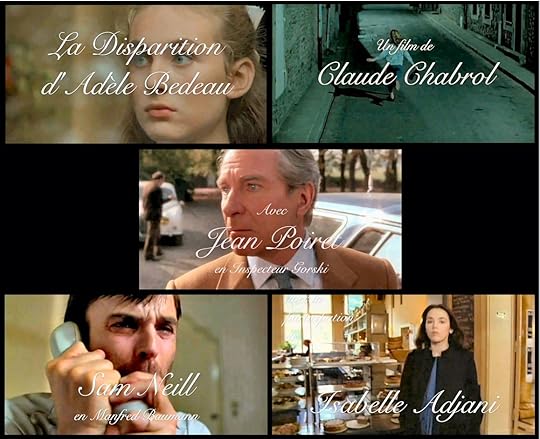
What? And more particularly, Why? If you think about it, Raymond Brunet is a pretty obvious pseudonym for Macrae Burnet. But he goes much further. His "Translator's Afterword" is a four-page biography of the supposed author, whose life has much in common with that of Manfred Baumann in the novel. He is supposed to have lived in the town where the novel is set, Saint-Louis, a real community on the Rhine, facing the border with Germany and Switzerland on the opposite bank, and depicted in absolute detail in the novel; you can even follow the characters' movements with a street plan. But there is even more. Macrae Burnet says that "Brunet's" book, after its inauspicious French publication in 1982, achieved the status of a cult classic with the success of the screen version by Claude Chabrol in 1989. And, if you look online, you can even find a 90-second trailer for this movie, starring Isabel Adjani and Sam Neill. It is totally convincing, but neither Chabrol's filmography nor those of any of the actors supposedly involved list it. The film simply does not exist!


Screen shots from the movie trailer

So I ask again, why go to all this trouble? One of the things I most appreciated about his Man-Booker shortlisted second novel, His Bloody Project (2016) was that you could not be quite sure whether it was fact or fiction. Purportedly about a murder by a mid-19th-century Macrae ancestor, the book consists of a personal diary and various legal documents that appear totally authentic; only with difficulty did I conjecture that they were all made up. But this earlier novel is clearly fiction, so why pretend it is not his own? I think for the sake of authenticity. Rather than have readers ask who is this 21st-century Scot to think he can turn his hand to classic French noir, he invents a French author of the period to do the job for him, and backs it up with every grain of authenticity he can muster. It is an astonishing performance, but really only a footnote to the book itself.

And that, I am glad to say, is fully good enough to stand on its own.
Profile Image for Sarah Joint.
445 reviews1,019 followers
October 18, 2017
Dark, odd, and entirely worth the read. I can see a lot of people not liking how slow it is, but I thought it was a fascinating character study of two intriguing people who shouldn't be thrown together, but are.

Manfred in an observer in life, not a participant. He assumes everyone else is observing him the way he observes them, noting his habits and proclivities. He doesn't realize they're participants in life. They're too busy living and don't consider him to be of note, but he's oblivious.

One of his very favorite people to observe, Adele Bedeau, is a pretty young waitress at his regular restaurant. She's friendly but cool to him. She certainly doesn't encourage his attention whatsoever, but she has it. He even follows her a couple of times when she leaves work. Not in a creepy way. It's not like he's some kind of stalker. He's simply... curious.

Adele disappears one night without a trace, and the police are stumped. Detective George Gorski is convinced Manfred is keeping something from him, which he is. Gorski starts to relate this disappearance to another twenty years ago when he was just a rookie... a different young lady who was found dead in the woods. He's never been satisfied with the conviction for her murder. Will Adele be found when it's too late as well? And why does he feel so hung up on Manfred?

Manfred is a man who never gets close to anyone. He has many secrets, some which would destroy his life. But is Adele one of them?

Polarizing ending, intriguing premise, a little dirty, old school feel. I loved it.

I received an ARC of this book from Net Galley and Skyhorse Publishing, thank you! My review is honest and unbiased.
Profile Image for LA.
487 reviews587 followers
July 26, 2017
UPDATE: Heads up for fans of His Bloody Project - Adele is not Burnet's latest release but one that precedes HBP. I got a softback copy of it from Amazon a few months ago with no problem. It is very good!
-------------------------------
A 4.5 star debut, this clever little noir novel is set in a hamlet on the French-Swiss border, a town where nearly everybody knows one another by sight. We are introduced to two Frenchmen in their 40s - one, a bachelor banker who is neurotic and socially awkward, and the other a police inspector married to a woman rather embarrassed to admit that her spouse is a lowly cop.

As the title explains, a young woman named Adele has gone missing and after a time period is presumed dead. Inspector Gorski initially has no body to retrieve and few leads to trace, but we readers know that the banker, Manfred Baumann, has recently become romantically interested in the waitress and that he was among the last to see her alive in the little village of Saint-Louis. When he lies about this to Inspector Gorski, we are not sure that it is because of his typical paranoia or whether there is something hidden in Baumann's actions.

There are flashbacks along the lifelines of both men that are done with ease and with no clunky chapter breaks. Particularly for a debut novelist, the structure of the story telling was clear and easy, building into a really nice character study, growing suspenseful unease, and dotted with interesting sideline characters.

This, I liked. Sometimes, it can take a writer an entire page to carry us to disgust with a side character. Burnet did so in two sentences flat: "Lemerre had never married. 'I don't believe in keeping animals in the house,' was his customary explanation."

There are also a handful of female characters who arrive on the pages as bright and assertive, and as a woman, I appreciated that they were drawn with strength and some depth.

This quick little read is an engaging crime story, although because I'd already read His Bloody Project (twice in three months!) there were certain attributes of distrust already roiling around in my belly. I wished that I'd read The Disappearance of Adèle Bedeau first, but it still was an addicting book.

My only complaint with the tale is the faux "Translator's Afterward" that appears like a postscript after the story closes. I read in an interview that because Burnet wanted to set the book in France but his French phrasing was pretty inauthentic, he posed as the translator instead of the author. Of course, he did this with a wink and a nod, not truly trying to deceive us. This same approach was extremely effective (and I thought clever) in his later book. This little bit at the end of Adele, however, mentioned the "real" author, how the book was made into a more successful movie (listing a real world director for it), and how the original author's later life somewhat mirrored the book. Meh. This just did not work for me. I did see a YouTube link to the faux movie trailer but did not click on it.

My star rating is for the story itself, and not the meta-fictional bit at the end. Graeme Macrae Burnet can write like hell, and if you have not gotten around to either this short debut or his Man Booker shortlisted novel, GET AFTER IT!

For those of you in the USA, most public libraries have got free audio-book loans for His Bloody Project, and the narration is outstanding. The story seems straight forward, but after you've finished, forgotten details may pop up and knock you over.

But that's another review! 4.5 for Adele!!!
Profile Image for Andrei Bădică.
392 reviews10 followers
September 4, 2018
De când nu am mai citit un roman polițist? De foarte mult timp, știu sigur. Îmi plac la nebunie cărțile polițiste, bine construite, cu o intrigă minunat sugerată, crime peste crime și posibili vinovați la tot pasul. Autoarea mea preferată de romane polițiste este celebra Agatha Christie, care nu mai are nevoie de nicio prezentare, fiind cunoscută în întreaga lume și apreciată pentru strălucitele sale cărți polițiste cu Hercule Poirot, Miss Marple și alții, precum Tommy și Tuppence, Ariadne Olivier... Vreau să scriu și eu într-o bună zi romane polițiste, dar știu că este foarte dificil de realizat acest lucru.
"Dispariția lui Adele Bedeau" de Graeme Macrae Burnet este un roman polițist, de mister și thriller. Pe lângă acestea, se mai încadrează și în categoria romanelor de dragoste, deoarece sunt prezente mai multe povești de iubire. Una dintre acestea este cea dintre personajul principal al cărții Manfred Baumann și o fată de avocat pe nume Juliette. Povestea de dragoste a lor a început pe când Manfred avea șaisprezece ani. Nu voi insista prea mult pe aceasta, pentru că mi se pare mai misterioasă și mai palpitantă dispariția lui Adele Bedeau, așa cum bine ni se relevă din titlul cărții. Voi încerca să redau cât mai bine acțiunea fără a povesti întregul roman, căci sunt convins că mulți nu-l vor devora așa cum am făcut eu. Drept urmare, nu voi spune cine a fost făptașul acestei dispariții; vă revine vouă, dragi iubitori de lectură, să descoperiți adevărul cazului.
Adele Bedeau, chelneriță la Restaurant de la Cloche, în vârstă de optsprezece-nouăsprezece ani, dispare la un moment dat fără nicio explicație. Totuși exista o persoană care a văzut ce s-a întâmplat în seara dinaintea dispariției sale, dar când a fost chestionată de inspectorul Gorski nu a spus nimic. De ce? Pentru că nu voia să aibă de-a face cu poliția sub nicio formă. Mulți oameni martori ai unor infracțiuni nu relatează deloc poliției din cauză că ar putea fi și ei în pericol. Este de datoria noastră morală să raportăm imediat și fără să stăm pe gânduri dacă ne aflăm în asemenea situații. Cei care încalcă legea trebuie pedepsiți conform acesteia și să nu umble liberi pe stradă, astfel punându-ne și pe noi în mare pericol. Urmează zile de interogatorii efectuate de inspectorul Gorski și oamenii săi din poliție. Sunt chestionați Manfred Baumann, bărbatul de treizeci și șase de ani acum, domnul Pasteur și soția sa Marie, proprietara blocului în care locuia Adele, doamna Huber, precum și partenerii de bridge ai lui Manfred: Lemerre, Petit și Cloutier. Nimeni nu pare să știe ce s-a întâmplat cu chelnerița și de ce a dispărut așa brusc fără măcar să-l anunțe pe șeful său.
Recunosc că nici eu nu prea îmi imaginam cum s-a petrecut una ca aceasta, dar aveam să aflu pe parcurs ce dădeam pagină cu pagină și pe măsură ce deveneam din ce în ce foarte curios de evoluția lucrurilor. Am o mare slăbiciune pentru romanele polițiste, pentru că sunt frumos scrise și oferă o gamă largă de presupuneri în ceea ce privește vinovatul. Este adevărat că necesită mult timp și mare atenție, dar vă garantez că merită savurate moment cu moment. Nici "Dispariția lui Adele Bedeau" nu m-a dezamăgit, ba chiar m-a impresionat, deoarece a adus în atenția mea viața lui Manfred Baumann, un inadaptat social care nu știa cum să se comporte cu oamenii, îi evită și nu poate să se integreze în niciun grup format din aceștia. Prezentarea unei astfel de persoană a conferit romanului o nouă perspectivă de abordare a subiectului, după părerea mea și, totodată, a primit un plus de la mine din acest motiv. Se citește ușor, intriga este foarte bine dezvoltată, eficiența inspectorului de poliție Gorski este rodul experienței lui de peste douăzeci de ani și pasajele superb scrise m-au captivat încă de la bun început.
Manfred Baumann continuă să nege că a văzut-o pe Adele Bedeau în seara în care a dispărut, cu toate că inspectorul poliției din orășelul Saint-Louis, Franța, Georges Gorski, l-a chemat din nou să-și schimbe declarația. Se pare că a apărut o persoană la poliție, mai precis prietenul Adelei Bedeau, Alex Ackermann, care a declarat că l-a văzut pe Manfred în seara dispariției ei. Ba chiar a mai adăugat că l-a observat și în seara precedentă dispariției unde era împreună cu însăși Adele Bedeau. Oricare din acești bărbați ar fi putut foarte bine să o răpească pe Bedeau. Inspectorul Gorski, văzând că Baumann a rămas ferm pe declarațiile sale, îi zice că este liber. Manfred se teme că are pe urmele lui oameni care-l urmăresc oriunde se duce. În fiecare persoană de pe stradă întrezărește un posibil urmăritor. De cine a fost răpită Adele Bedeau? Încă de când Gorski a venit prima oară la Manfred ca să-i spună că anchetează dispariția chelneriței în mintea mea a stăruit mereu întrebarea de mai sus. Consider că cu cât misterul persistă, iar lista suspecților este din ce în ce mai lungă, cu atât am parte de un veritabil roman polițist!
La finalul cărții asistăm la multe răsturnări de situație. Nu vreau să vă stric deliciul acestui roman spunându-vă ce s-a petrecut acolo. Veți fi surprinși de întorsătura neașteptată și neintuită pe care lucrurile au luat-o. Așadar, nu îmi rămâne să vă spun decât lectură savuroasă să aveți! Eu am avut din plin!
Un roman polițist bun și un thriller pe măsură.

"Probabil că, polițist fiind, se obișnuise ca oamenii să nu se simtă în largul lor în prezența lui. Și într-adevăr, o prea mare relaxare din partea interlocutorului ar fi putut sugera că persoana respectivă era obișnuită să aibă de-a face cu oamenii legii, așadar ar fi fost imediat un personaj suspect."
"- Dar este o întrebare interesantă: de ce să mintă? Trebuie să concedeți, mă gândesc eu, că atunci când o persoană minte, trebuie să aibă un motiv pentru a face asta."
Profile Image for Daniel Shindler.
319 reviews206 followers
August 12, 2024
There is a cinematic quality to the opening passages of “ The Disappearance of Adele Bedeau.” The Restaurant de la Cloch in the French border town of St.Louis reeks of lassitude, tedium and ennui. The patrons gravitate to seats as if nameplates are attached. The same amounts of wine and cigarettes are regularly consumed at one core table, whose occupants engage in a never ending cycle of repetitive banter. A young waitress, Adele Bedeau, sullenly circulates among the tables . She radiates a magnetic allure that draws furtive glances from the older cafe patrons as she silently discharges her duties. The movements in the cafe recur night after night with unrelenting sameness until the night that Adèle suddenly and inexplicably disappears.

Adele’s disappearance jolts the somnolent town and initiates a slow dance of thrust and retreat between the novel’s two principal characters. Manfred Baumann is a habitue at the cafe. He has a nightly routine that does not vary. He is an outsider, skulking on the fringes of the cafe’s activity, observing events with an interest bordering on voyeuristic.Baumann is the last person to see Adèle before she vanished. Thus he becomes a person of interest for Detective Georges Gorski.

Detective Gorski’s interest in Baumann is grounded in unarticulated and unacknowledged temperamental similarities that link the two men.Both are beset by insecurities and operate on the fringes of their respective social orbits. Manfred’s father is Swiss, marking him as an outsider in this French border town.Gorski has risen beyond his family’s tradesman origins to marry above his station while enduring an ongoing uneasy detente with his wife. Each man copes with repressed desires that are sublimated with idiosyncratic traits.Unbeknownst to either man, they are both haunted by an earlier crime that silently draws their trajectories together.

The relationship between Baumann and Gorski is the focus of the novel. The parries and thrusts of their interactions proceed at a deliberate, almost somnolent pace that explores the inner workings of each man’s mind. Both men are grappling with demons from the past. As the two circle, approach and retreat the reader is drawn into their inner thoughts.

The novel is stronger on characterization and atmosphere than on plot. For me, the novel employs the structure of a Hitchcock film. In Hitchcock’s world and in this novel, the reason or consequence for the initial action is immaterial, only serving to engage the audience and provide a springboard for the tension or central conflict that follows.Viewed through this prism, Adele’s disappearance is a classic Hitchcock macguffin. It plunges the reader into a world rife with implication and quiet despair. There is a “ translator’s afterword” that adds a twist to the novel. It should be read carefully since its contents might prompt a reexamination of the main text.4.5 stars.
Profile Image for Libros Prestados.
472 reviews1,045 followers
August 1, 2021
Macrae Burnet es un genio en crear personajes que tal vez no merezcan el castigo que esperan o temen, pero merecen algún castigo. También es buenísimo en crear personajes masculinos turbios, grises y que tienen "problemas" con las mujeres.

Así que toda la novela crea tensión en saber si van a acusar a Manfred de un delito que no cometió (esto no es spoilers, vemos la historia desde su punto de vista) o si va a salirse de rositas de todo.

Como en "Un plan sangriento", el protagonista no es del todo agradable, pero en este caso no cae muy simpático y el autor hace un gran trabajo en que entiendas su estado de ánimo y también su grado de responsabilidad, sin que de verdad lo exoneres de todo lo que hace.

"La desaparición de Adéle Bedeau" es una novela negra diferente y a mí me gustó mucho.
Profile Image for JimZ.
1,297 reviews757 followers
February 23, 2020
I liked this book quite a bit. One of those books where you can’t quite figure out whether the protagonist did something bad while you are reading most of the book, as well as how many bad things is he going to do in the book. In the inner cover of the front book jacket there is this bit of info which influenced my mind set so that I thought this guy was definitely no good: “As Manfred cowers beneath Gorski’s watchful eye, the murderous secrets of his past begin to catch up with him and his carefully crafter veneer of normalcy falters.” Murderous? Hmmm…..

Manfred Baumann is a loner. A young woman, Adele Bedeau, does not show up for work as a waitress one day at the restaurant she works at and has not been seen by her landlady for several days. Manfred secretly spies on Adele before this. We know he is probably capable of being involved in her disappearance in a sinister way. A provincial inspector, Inspector Gorski, is on to him…calls him in for questioning. Interviews other people about Manfred. Manfred becomes extremely paranoiac…he imagines people he meets in everyday situations but are new to him are spies reporting back to Inspector Gorski.

I was kept guessing throughout the book.

This novel (first published in 2014) is completely different from Burnet’s later novel, His Bloody Project, which I had read and liked a lot. Except there is one commonality: he called that work ‘historical fiction’ and he calls this work ‘historical fiction’ too. At the end of the book is a translator’s afterword written by Burnet himself and dated February 2014 which says the book was actually written by a the French author Raymond Brunet in 1982 and was made into a film, La Disparition d’Adele Bedeau, by Claude Chabrol in 1989 and then later on into a play. So something does not add up because on the front cover of the book Graeme Macrae Burnet is clearly identified as the author…but wait, what’s this? On the title page Raymond Brunet is identified as the author of “a historical thriller” and there is this…”Translated and with an afterword by Graeme Macrae Burnet.” What is going on? I won’t divulge that…I don’t do spoilers. 😊 The Afterward is actually as crucial/interesting to read as the text which precedes it.

I cannot recommend this book enough. And two last things:
1) Some Goodreads friends recommended I read Georges Simenon and his works of psychological novels (romans dur). As I was reading The Disappearance of Adele Bedeau, I was thinking to myself “Yeesh, this seems like I am reading a Georges Simenon psychological novel. I need to tell my Goodreads friends about this.” So then what do I find in the Translator’s Afterward (it’s the final two sentences)— “In the preface to his autobiographical novel Pedigree, Georges Simenon wrote that: ‘Everything is true while nothing is accurate.’ It is as fitting a formulation for The Disappearance of Adele Bedeau.”
2) Review: https://www.npr.org/2017/10/25/559062...
Profile Image for Peter Boyle.
581 reviews742 followers
May 15, 2022
My first encounter with Graeme Macrae Burnet was when His Bloody Project was shortlisted for the 2016 Booker Prize. I was very impressed with its atmospheric tale of murder on the Scottish Highlands. So I told myself that I must investigate his back catalogue at some point.

This novel was his debut and it revolves around two very different characters. Manfred Baumann is a bank manager who eats lunch every day at Restaurant de la Cloche, in the small French town of Saint-Louis. He's a loner, a quiet individual with few friends. His parents passed away when he was younger and he was brought up by his grandparents. The staff at Restaurant de la Cloche know him well at this point, though they have little interaction with him. However he is quite taken with Adèle, a young waitress. He attempts to engage her in conversation one evening and she responds politely to him. And then she disappears, with Manfred being one of the last people to have seen her. Inspector Georges Gorski is assigned to the case. He's still haunted by the murder of a teenage girl in the town several years ago, a crime he was unable to solve. And he can't shake the notion that Adèle's disappearance might be connected. His investigation leads him to Manfred, who seems to know more than he is letting on.

There is a fascinating mystery at the heart of this story, and it kept me enthralled. Just what really happened to Adèle, and how involved was Manfred? I changed my mind a few times, but he has some secrets in his past that influenced my decision. Macrae Burnet does an excellent job of imagining out the motivations of the protagonists. Manfred overthinks everything - he is incredibly anxious and self-conscious, every little interaction he experiences is analyzed endlessly. Meanwhile Gorski is a dogged investigator, a man who trusts his instinct as much as the detective process (maybe a little too much). The ending might not be to everybody's tastes, but I thought it worked well, and made me re-evaluate assumptions I had made of both characters. It's an intelligent and captivating tale - I shall certainly seek out more of this talented author's work.
Profile Image for Jill.
Author 2 books2,056 followers
August 17, 2017
Right from the start, there’s something that’s a little odd about The Disappearance of Adele Bedeau. The title page names Raymond Brunet as the writer, with Graeme Macrae Burnet as the translator. Of course, we know that’s not true. Does the author view himself as merely a translator of the facts? And are the facts…actually the facts?

Soon enough, we enter the world of the protagonist, the Ultimate Outsider, Manfred Baumann. Manfred’s life is—in a word—unremarkable. He considers himself nothing more than an observer, always struggling to fit in. He lunches regularly at the Restaurant de la Cloche, ordering the same meal nearly every day, going through the same rituals with other diners, heading from there to his bank job where he performs the same duties, and then going home to the same drab place, only to repeat the same rituals the next day.

The only thing that breaks his routine is some disturbing news: Adele, his regular waitress whom he sometimes fantasizes about, is missing. No one knows if she has just disappeared or has fallen upon dire circumstances. We do know, though, that Manfred was one of the last people who saw her.

Manfred is pitted against Inspector Gorski, and the two of them, unknowingly, share something very important in common. That “something” has the power to implode Manfred’s world and to redeem Gorski’s.. As Manfred’s inherent paranoia and obsessions heighten, Gorki’s own obsessiveness to correct an old wrong increases. In ways, Manfred and Gorski are mirror images of the other: both suffering the pangs of alienation. (In Gorski’s case, he is constantly put down by his wife, who resents his lower-class style and demeanor and lets him know it at every single turn).

This book is bound to be compared – a bit unfavorably – to Graeme Macrae Burnet’s masterly later work, His Bloody Project. I preferred to judge each book on its own merits. The Disappearance of Adele Bedeau is a fine psychological mystery with well-developed characters and a post-modern afterword that will make you sit up and think. Burnet eschews easy answers to provide a complex reading experience that is less about Adele’s disappearance than it is about the invisibility of characters that haunt our everyday lives.


Profile Image for Natalia Luna.
365 reviews195 followers
July 11, 2021
Más que un thriller esta es una novela sobre la psicología de un hombre inadaptado, paranoico, solitario y con grandes deseos de encajar en la sociedad. Y muy siniestro.
Sus pensamientos quedan expuestos para el lector así como los del detective que lo investiga.
Pensé que me iba a aburrir y no ha sido así porque es un muy buen libro que nos mete en la mente de los personajes y nos hace partícipes de sus vidas.
Hay momentos de auténtico escalofrío.
Diferente, sin duda.
Profile Image for Nancy Oakes.
2,018 reviews918 followers
March 11, 2017
A bit darker and he could have been channeling Simenon's romans durs with this book. Whoa.

At page 90 I started thinking that this book has a Simenon sort of feel to it, and then on page 95, I came across a passage describing one of the characters who "devoured Simenon." By the time I finished this book, I came to the conclusion that the author must also be a fan of the Belgian author, because like Simenon's romans durs, Burnet's focus in The Disappearance of Adèle Bedeau isn't so much on a specific crime, but rather on what's going on inside the heads of the two main characters.

for a brief look at plot, etc., with no spoilers, feel free to click through to my reading journal . Otherwise, continue on.

The book is not a crime story per se -- the titular disappearance of Adèle is the frame upon which rests an examination into the past and present of these two men, each in their own way outsiders, as well as a portrait of a small town where life has gone on virtually unchanged. In the "Translator's Afterword," we also discover that the author has been having a bit of metafictional fun with his readers, with the claim that the novel was the work of Raymond Brunet, born in Saint-Louis, and that his life has some bearing on the character of Manfred Baumann. He goes on to inform us of the publication and film adaptation of the novel and other interesting points, but I'm not quite sure why the author felt the need to do this since the book certainly stands on its own.

The Disappearance of Adèle Bedeau may not be the ideal book for readers looking for an action-packed thriller, but it's certainly a good choice for those who enjoy an intense glimpse into the strangeness of the human psyche and the outside forces that can help to determine why people do what they do. Recommended.

Profile Image for Ken.
2,562 reviews1,375 followers
October 7, 2018
An excellent debut novel!

Loner Manfred Baumann spends he’s time observing waitress Adèle Bedeau, but one day she simply vanishes.

The curious dark tale is incredibly riveting, the complex socially awkward Manfred is such a fascinating character.
I’d be interested in reading more Burnet.
Profile Image for switterbug (Betsey).
936 reviews1,494 followers
September 1, 2017
After reading both this book and GMB’s second one, HIS BLOODY PROJECT, one after the other, I’m amused and impressed by what I would call his new brand of meta-fiction. I don’t want to spoil it for readers working it out for themselves, but the author’s sly tricks might keep you scratching your head regarding the approach of ending this book, and beginning the second one. I’ll leave it at that, and just talk about my enthusiasm for his work.

Adèle is a young, sullen waitress at the Restaurant de la Cloche, a restaurant/bar in Saint-Louis, a small nothing of a town not far from the border of Switzerland. There’s a regular crowd that frequents the place and plays poker, where quirky loner and creature of habit, Manfred Baumann, joins in the game once a week. The rest of the week after work as a pallid bank manager, he sits at the bar, eyes Adèle in the bar mirror, and ruminates about his empty life.

When Adèle goes missing, Inspector Georges Gorski from the local police department starts investigating. He’s a taciturn sort with a visible melancholy, some of which relates to an unsolved murder 20 years ago, when he was a fresh rookie. His appearance in this investigation makes the introverted Manfred uncomfortable, and the story, a slow burn, is primarily focused on his growing paranoia. He doesn’t like to partake much of the human race, except for his rather flaccid social life at the bar, and a regular visit to Strasbourg. He presents with a heavy dose of social anxiety and inability to chat up women without a lot of bumbling.

Gorski is not the main subject here, but his presence looms large, especially as the narrative progresses. To Manfred, Gorski is his nemesis; each time Baumann is questioned by the detective, his cage is increasingly rattled. Gorski is a man who dislikes hunches, and prefers to proceed with logic and concrete evidence, not on intuition, so his manner of investigation is incremental and built on logic.

The reader, who is privy to Manfred’s present thoughts, is in for a few surprises. The author excels at his craft, with his dark wit and nuanced, sophisticated style. The writing flowed as if it was effortless, but, after the conclusion, reflecting on the architecture of the story, I was even doubly impressed. The author created a scintillating psychological thriller, unpacking his characters and plot with a taut restraint.

I eagerly look forward to Graeme Burnet Macrae’s next book, coming out in October, another mystery featuring Georges Gorski, titled THE INCIDENT ON THE A 35.
Profile Image for Toby.
861 reviews375 followers
December 22, 2016
A really quite faithful attempt to write a Simenon or Highsmith like novel. A debut from the Booker shortlisted Burnet that makes you question why he chose to write this way and why he preferred to frame it as a "newly discovered" work that he had translated, complete with biographical details for his (deliberately) lazily pseudonymous fictional author. He gets lots of the repressed outsider tropes perfect and the general plotting is entirely accurate a representation of those middling Simenon and Highsmiths, whilst he also makes reference to the work of Sjowall & Wahloo as an influence on his detective. It's certainly much better than the attempt made by Ariel Winter in The Twenty Year Death. But, again, why bother? The answer seems to be simply because he could. The question of what it is that drives Burnet to have attributed the bulk of his published writings (in this and His Bloody Project) to other authors is perhaps far more interesting than this generally quite enjoyable and easy to read book.
Profile Image for Julie.
2,558 reviews34 followers
March 12, 2025
This book is hard to rate. I almost gave up several times due to its unpleasant creepiness and I'm not sure that I made the right choice in persevering to the end. It made my skin crawl and I felt a bit nauseated by the characters. You could say that this makes the author successful in his mission, however it dinted my enjoyment and I'm not inclined to continue with this series.
Profile Image for Sofia.
1,349 reviews293 followers
July 8, 2024
I've come to this, his debut novel, late in the day, late because I've already read His Bloody Project and Case Study. Now I've read this one, his homage to the noir, to George Simenon.

I'm a Simenon fan, so this one pushed my buttons. The atmosphere created, the mind as a corner into which a rat is backed without a way of escape. The dark, the thoughts going round and round. Bauman living an imprisoned life, always outguessing himself, always with a cover, with a story just in case.

I have to admit that I felt sad for Bauman. Some people never get a break.

Excellent narration by Geoffrey Breton
179 reviews97 followers
December 12, 2016
Excellent in every way. Loved it! I'd stand in line for the next book.
Profile Image for Leercomoformadevida.
285 reviews61 followers
August 22, 2021
Para mí, es una auténtica obra de arte. De lo mejor que he leído este año sin duda. Se vende como thriller, el título te lleva a pensar en ello, pero es mucho más que un thriller al uso. La investigación está en un segundo plano, y lo que realmente destaca es el personaje de Manfred Baumann, que acompañaremos a lo largo de la historia, y en un segundo plano, pero también importante, Gorski, el inspector de policía.

La descripción y el desarrollo psicológico de Baumann es sobresaliente. Diría que nos encontramos ante un thriller muy elegante, con una narrativa excelsa y además, con unos toques de humor que sólo había visto antes en @luisadmirado y su “La Cruz de Euge”.

Y el epílogo pues ya te aclara ciertas cosas que no voy a especificar para no caer en ningún tipo de spoiler pero que te deja con la boca abierta.

En definitiva, un libro escrito en 1982, con un misterio de fondo, pero donde sobresale su narrativa y el desarrollo psicológico del protagonista, un tipo solitario, socialmente torpe y con muchos fantasmas en su interior. No os perdáis esta novela que se desarrolla en Saint Louis, una pequeña ciudad de Francia, que además te sacará algunas carcajadas.

Frases destacadas:

“Las personas mentían por inercia y ni aun acreditando la inverosimilitud de sus falsedades daban su brazo a torcer”

“Allí aprendió una lección: el trabajo de detective nada tenía que ver con la intuición o la inspiración. Mayormente consistía en seguir cual esclavo los procedimientos. Lo demás era suerte”.

“El hombre que no se aferra a un clavo ardiendo, se ahoga”

“Lo que Manfred escogiera hacer no tenía trascendencia para nadie salvo para él mismo. Y a pesar de todo, incluso mientras caía en la cuenta de ello, ¿no había buscado un bar sin ventanas en una calle apartado donde no pudieran verle?”
Profile Image for Doug.
2,546 reviews913 followers
September 1, 2016
Judged against Burnet's 2nd novel, the Booker-nominated 'His Bloody Project' (which I enjoyed immensely and impelled me to read this earlier effort), Bedeau is decidedly disappointing. Most of that stems from the fact that the later novel revels in its time/setting, 1860's Scotland - and Burnet's evocation of 1980's backwater France here just doesn't measure up. But Bedeau also succumbs to a first novel's many pitfalls - it is overwritten, slow moving and its conclusion is ... underwhelming. It seems to want to be an odd conflation of Simenon and Camus - both of whom get name-checked. One of the factors that DOES, more or less, add to the book's cachet is the afterward, which (as in 'Project') claims that Burnet is not the actual author, but in this case, the translator of a genuine French novel that filmmaker Claude Chabrol adapted into a celebrated 1989 film. That film, bien sûr, does NOT exist, but there is a 'trailer' for it that is quite charming: https://physicalimpossibility.com/201...
Profile Image for Kasa Cotugno.
2,755 reviews586 followers
August 17, 2017
Burnet really likes to have fun with his readers. Last year he was shortlisted for the Man Booker award with His Bloody Project, a work of incredible imagination and originality. This book actually preceded that one, and only now is being published in America due to Burnet's success. The fun here starts on the very first page, and by that, I mean the Very First Page. Read carefully until the final, and I do mean the final page, it satisfies on so many levels but would be unfair to a future reader to explain. I know this is probably an annoying set up, but I'm still smiling just thinking about Burnet's accomplishment.
Profile Image for Mary.
475 reviews945 followers
February 12, 2018
Get your Simenon fix here!

Excellent literary psychological mystery/European noir. Perfectly unnerving.
Displaying 1 - 30 of 622 reviews

Join the discussion

Can't find what you're looking for?

Get help and learn more about the design.