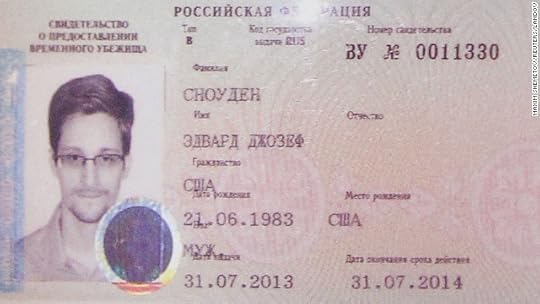
Napięcia polityczne na Ukrainie, które z wielką siłą dały znać o sobie na przełomie 2013 i 2014 roku, a następnie międzynarodowy konflikt wokół kwestii przyszłości Ukrainy, niemoc Zachodu wobec rosyjskiej aneksji Krymu i nieprzewidywalność Władimira Putina rzuciły nowe światło na sprawę Edwarda Snowdena. Ten młody informatyk, pracownik najbardziej prestiżowych amerykańskich instytucji zajmujących się bezpieczeństwem – CIA oraz Agencji Bezpieczeństwa Narodowego, ujawnił w 2013 roku tysiące poufnych rządowych dokumentów, z których świat dowiedział się m.in. jak administracja Baracka Obamy inwigiluje internautów. Edward Lucas zagląda za kulisy tej, jak to nazywa, najbardziej kompromitującej historii amerykańskich służb specjalnych i argumentuje, że Snowden jest rosyjskim szpiegiem. „Operacja Snowden” odbiła się szerokim echem wśród czytelników i komentatorów życia politycznego na całym świecie. Jej tezom Snowden gorliwie zaprzecza w wywiadach dla największych światowych gazet.
Edward Lucas is a British journalist. Lucas works for The Economist, the London-based global news weekly. He was the Moscow bureau chief from 1998 to 2002, and thereafter the central and east European correspondent. He has also been a correspondent for The Independent and the BBC. Lucas also writes occasionally for The Daily Mail.
The author is a journalist with The Economist who has covered the Soviet Union/Russia for many years. Contrary to other reviewers of this book, I didn't find Lucas to be a conspiracy theorist or given to undue speculation. Lucas's book has two main arguments: (1) Snowden's revelations have done more than good, and (2) Snowden may be an unwitting pawn of the Russian intelligence services. Lucas supports the first argument with plenty of evidence; and Lucas admits that the second argument is a hypothesis that fits certain of the facts but that he cannot prove.
First, Lucas argues that Snowden's conduct has been disastrous. Lucas is not an apologist for the American intelligence services. He thinks that National Intelligence Director James Clapper should have resigned for telling the Senate in 2013 that intelligence officials did not collect data on Americans. And Lucas believes that it may have been beneficial for Snowden to leak certain documents, such as the FISA order regarding Verizon's provision of call data to the NSA. Lucas faults American intelligence services for being too vast, too eager to harass whistleblowers, and too ready to classify information.
But Lucas writes that the volume and kinds of data leaked by Snowden surpassed Snowden's purported goal of seeking to spark a debate about surveillance and privacy. What was Snowden's point in revealing how the NSA intercepts radio transmissions of Taliban fighters in Pakistan? Or in revealing a self-assessment by U.S. intelligence that it lacks sufficient information on China's next-generation fighter aircraft? Lucas notes that this is the kind of intelligence work that most Americans would probably expect/hope the country's intelligence services to perform. Lucas wonders who elected Snowden, Greenwald and Poitras to determine U.S. foreign policy and intelligence capabilities?
And Lucas criticizes the naivete of people who believe that American interests are so closely aligned with its allies' interests that there is no need for spying among allies, such as listening in on Angela Merkel's phone calls. Not only have these revelations compromised America's access to valuable information, they have driven wedges between the U.S. and the its Western allies.
Second, Lucas argues that Snowden could be the naive pawn of Russian intelligence services. Most reviewers criticize Lucas for this hypothesis. But, while people may disagree with Lucas's idea, it is unfair to criticize him for presenting it. Lucas admits that Snowden could just be a misguided whistleblower with reckless allies. But he also argues that we cannot foreclose the possibility that Snowden is a pawn in an intelligence war between Russia and the West. Given Lucas's upfront disclosure that he lacks adequate information to confirm this hypothesis, what is wrong with Lucas's presentation of a theory that matches certain of the known facts? These includes: the odd absence in Snowden's extensive revelations of surveillance practices of the Russian or Chinese governments, possible Russian involvement in past intelligence leaks (e.g., regarding the Echelon program in the 1990's) that divided the U.S. from its allies, the Soviet Union's use of anti-war/nuclear demonstrators to influence American capabilities, and Snowden's escape to Russia. Lucas wrote his book before Snowden asked Putin on Russian television in April 2014 about Russia's surveillance practices (and Putin gave his answer about Russia's respect for the rule of law). But Snowden's willingness to participate in Putin's propaganda lends further support to Lucas's hypothesis--as does Putin's response that Russia's intelligence services don't have as much money as U.S. counterparts, implicitly suggesting that Russia needs to look for other ways to blunt America's electronic spying.
...first overseas...now domestically...you're being watched
Snowden has been under several charges: “theft” (of documents) and “espionage”.... In his defense he’s been arguing that “intelligence agencies can go too far”.
Those programs he disclosed about (Prism, Tempora….) are unconstitutional and “dangerous” ; that’s the reason why he became a whistleblower.
He left the apparently cozy job in Hawaii for the intelligence company Booz Allen Hamilton; he had a past record connected with some US government intelligence agencies.
He left for Hong-Kong, then to Moscow. Previously, he had told girlfriend Laura about the dire situation, now on, he was in: every purchase, or dialing, or boarding …she would make would be “in the hands of the system”….he would be “immediately implicated”: Snowden,…. Citizen 4.
Yet Lucas, an experienced researcher on espionage subjects, considers Snowden not a whistleblower, but a spy,a Russian operative.
To this charge, Snowden replied with the laughter (of absurdity) while in Moscow and over the interview with journalists from The Guardian.
Snowden has been trying to make his own defense; he received lawyers’ advice. He searched on previous similar cases; he asked for a “fair trial”…but “they declined”.
-Spy?... the USA would be "his home” (of choice) …but he encountered a great "resistance on the agencies"; so he’s “happier in Russia”.
Lucas's tone undermines his message, and as a journalist, he should know that. The use of disparaging terms such as "Snowdenista," repetition of main ideas, assertions of what he "would do" in another person's shoes, and being heavy-handed on his criticism rather than stating the facts objectively as a person with experience and knowledge, does the reader, the thesis of the essay, and Lucas himself a disservice.
Lucas could have been more convincing with his argument. He spends a couple of paragraphs talking about how intelligence collection and the system that runs it could work better, and this topic deserves more time within the context of the piece. It feels rather like he's withholding information to further his cause while he sneers his way through the essay. One way to convince a reader is to show the other side then deflate its power through evidence, examples, and a measured weighing of events.
I don't doubt cast doubt on the knowledge Lucas's experience has given him and the resulting convictions he holds. But his argument is disappointing in the way it is structured, and, worse, sometimes it is garbled.
Very well laid out essay on Snowden as a "useful idiot" who meant to damage the US. He was no whistle blower. Russia may or may not have been involved (they definitely profited from Snowden), but Snowden's actions damaged the relationships between America and our allies, corroded our country's trust in our intelligence services, and paralyzed US/British intelligence agencies.
A good, short (85 pages) story on what Snowden did. The author didn't get into a lot of details on the specifics Snowden exposed, but laid out how his actions damaged the US. He shows Snowden did not do this to expose the lack of checks and balances to prevent the NSA from collecting on citizens, but to harm the US. Unfortunately he was very successful.
I recommend this for anyone interested in national security. It is free in Kindle format on Amazon.
While the author brought up some interesting points to consider, most of it was conjecture. It was more a long opinion piece than one based on actual facts or documents that would provide even circumstantial evidence.
Questioning the worst intelligence leak in US history
Edward Lucas’s book is about Edward Snowden, the infamous American leaker of over a million documents that he took from the NSA while he was a private contractor working with that agency. The first part of this book seemed more like an extended editorial, perhaps not unexpected given Lucas is a journalist working with The Economist magazine. Only half way through did the book pick up speed as Lucas began to question Snowden’s motives in this leak. Lucas analyzes many of Snowden’s actions noting that Snowden’s stated purpose in taking the NSA documents and publicly posting them are inconsistent. Lucas notes that Snowden claimed outrage that the NSA was needlessly spying against individual citizens and allies of the US. Lucas explains that many of the documents Snowden took didn’t even have anything to do with this allegation. While our allies might have claimed outrage at the US “spying” yet they too engage in exactly the same activity. Lucas questions Snowden’s motives for making the stolen documents public. Snowden claimed that he wanted to expose the abuses of how the NSA overstepped their legal boundaries in spying. Yet Lucas said this could have been accomplished by stealing select documents only, not stealing over one million documents, an amount which would have been impossible for Snowden to read and assess for value. He points out that while Snowden may have claimed outrage, his actions actually served to endanger irreparably the well-being of the US and may have endanger the safety of numerous agents and their networks who provided information to the US. This is far in excess of whistleblowing which legally is defined at a far lower threshold than what Snowden took. Instead to Lucas, Snowden’s actions seem to be more rooted in causing damage to the US being all else, not just righting an injustice. Snowden didn’t claim outrage at all spying, just the electronic mass surveillance undertaken by the NSA. Lucas points out that not one major issue has been proven that the US acted illegally. He also shows that Snowden’s claim that the NSA wasn’t protecting people’s privacy was actually far worse when the documents he took weren’t at all secure and were passed along without proper precautions to protect innocent bystanders. Yet the one country who Snowden fled to, Russia, had clear motive in wanting to see the US harmed through the release of this information, and certainly uses highly questionable espionage techniques, something which doesn’t appear to disturb Snowden’s righteous sensibilities at all. Lucas suggests through a series of unexplained questions surrounding Snowden’s actions, that possibly Snowden might have been at worst a Russian spy, or at least a pawn of the Russians who unwittingly did their bidding through stealing the NSA documents and then publishing them. Or could he have been a whistleblower, as he would like the world to believe, who did irreparable damage to the US at far greater levels of severity than he needed to use to prove his point. Lucas doesn’t reach a definitive conclusion that about Snowden’s motives. He lays it out to the reader, and allows us to reach out own conclusions. Lucas doesn’t believe the NSA was without some fault, but he does believe that Snowden’s motives were less altruistic than what he claims as too many coincidences point otherwise. I did appreciate the perspective that Lucas presents in this book because it raises important questions about the incident and the motivations behind it.
Lucas asked the question was Snowden a true whistleblower or a spy?
Written in 2014 Snowden's total surveillance revelations were still fresh so one might excuse Mr Lucas's naivety.
Having read Snowden's Permanent Record I trust his motives and having 10 years pass since , I think we can safely say he was never a Russian spy.
Today total surveillance is the norm and we are inching towards a global government and a digital currency.
To say the above is for our protection is simply ludicrous and underestimates the genius of those who's plans for world dominance are now coming to fruition thanks to the Covid pandemic accelerating their NWO.
Snowden was a whistleblower and a damned good one.
I didn't know all that much about the Snowden incident. I found this thought provoking and interesting. A very fast read, well written and a good value for an ebook. It was also very easy to follow, even though I knew very little about the whole ordeal before reading this. I will definitely be following the story more closely as it develops.
Lucas makes acompelling point that Snowden was an uneducated and misinformed fool. However, his case that he was duped by the Russian intelligence services is somewhat strained and more conjectural. This short book is well organized and liberally supported with a lot of documentation. I would recommend it as a good primer on the Snowden controversy.
Edward Lucas, of The Economist and elsewhere, presents a short case against Edward Snowden's leak of classified intelligence material. He also makes a case for the leaks being heavily influenced by Russian intelligence services. As someone who has previously been fairly sympathetic to Snowden's claimed motives, I found this alternative take interesting - Lucas makes some great points about the disproportionate harm caused by Snowden's actions, especially in contrast to the minimum actions he could have taken to achieve the same ends. I think this has also changed my mind a bit about the nature of the public debate around the intelligence services (though I don't totally buy Lucas's "regulate the use rather than the development of tools" approach). Good stuff, short enough to read in one sitting.
I did not find this the easiest read, but could see well-argued support for a proposition of seeing Snowden as either a misguided whistleblower, or a spy working with Russian intelligence, but not as much of the media portrayed as a heroic figure
Menjelaskan lebih dalam tentang pembeberan yang dilakukan oleh Edward Snowden. Tetapi penulisannya masih kurang teratur susunannya sehingga agak sulit dimengerti
interesting book decrying the snowdenistas. written from the government's point of view. spying is simply a part of life. allies on allies, allies on enemies, allies on us, us on us. I don't deny this nor do I consider it absolutely evil. that is, except for the us on us. I am for the government bugging illegal aliens, foreigners, especially Arabs. I am for all espionage carried out on any and all countries by the US. however, when the US stores meta data of its own citizens to be used at some hypothetically future time, problem. I am not knowledgeable enough on the Snowden case to be dogmatic either way. I am for strong defense which includes espionage on many levels. I am not for selling our freedoms in the name of security.
A disappointment. I was expecting some background and the history of events that lead up to the leaks and the how it all played out. But this is an op-ed piece, blasting Snowden as a traitor. I haven't made up my mind yet, basically because I was around when Ellsberg released the Pentagon Papers and my viewpoint on that matter has evolved 180 degrees, as has my whole political outlook. I need to learn more about what happened and why and to have some time to digest it all. I was hoping this book would help, and although it did reason out why the author was against the leaks, it clearly wasn't objective.
Took a bit to get past the author's gloating and self-promotion (though not nearly as bad as Greg Mortenson). The topic at hand is probably too large for this format and so it felt very high level. In general, I appreciated this perspective on the issue. I'm a fairly trusting person and have a decent tolerance for government secrecy. There should be oversight and some transparency about how that happens, but rogue action like Snowden's, without really knowing a lot about it, has always seemed pretty irresponsible to me. I'm sure there are other sides to the argument but I appreciated having some time to think about the topic while reading this short.
The author acknowledges that his main premise, that the Snowden leaks were a Russian plot, lacks any direct supporting evidence. He claims, justifiably, that it is supported by Occam's razor, laying out a convincing argument that there is more to the public story than meets the eye and that the plot "has Russian fingerprints, however faint and smudged". Whether a reader accepts this premise is likely based on his or her prior sentiments.
It is a well written, well researched hit piece on Snowden when the author isn't making "The KGB is at the gates"-style conjectures worthy of John Birch Society's "International Communist Conspiracy". In fairness the author always mentions that these conjectures don't have the weight of evidence and may not be true, but then why make them if not to paint Snowden as a spy?
Mr Lucas is an excellent author and made a compelling case for not hailing Mr Snowden as a hero. Prior to reading the book I was of the opinion that Mr Snowden was in the right. I no longer believe so. Wether you agree with Mr Snowden or not this book deserves a read.
Although I took my time reading this short account, I really enjoyed it. Lucas's thoughts are very eye opening and point Snowden out as the traitor I believe he is. Lucas doesn't skip over our government's agencies and the boundaries of privacy that Snowden has kindly informed citizens has been broken.
I found this author's thinking behind what may have caused Snowden to choose the path he did regarding exposing NSA's "spying" on its citizens, allies and foes. It's mind boggling and begs the question why he chose to put our country/security at such a high risk. A very interesting book, in my opinion.
I didn't really agree with some of what the author said, and I didn't feel like his arguments for his point of view were very convincing. I think it would have been helpful if it had given some background information first. It wouldn't be a good introduction on the subject. I thought this would be an interesting subject and I normally love Kindle Singles, but this one was boring.
For those following the Snowden NSA story with open minds and intellectual curiosity, this is a must read - even if its most sensational claim of Russian sponsorship doesn't really hold up (thin real evidence).
Gives me another perspective about Snowden, but it doesn't change my mind that Snowden is whistleblower and should be commended for that. Anyway, there's some interesting analysis about espionage in this book
More of a verry long essay than a true book. It gave me some things to think about in terms of the operation of world intelligence services, and the admittedly odd behavior of Snowden during this kerfluffle that I hadn't thought about before.
Thought-providing Kindle single from a veteran intelligence community reporter of The Economist. Definitely offers some uncomfortable food for thought!