

What do you think?
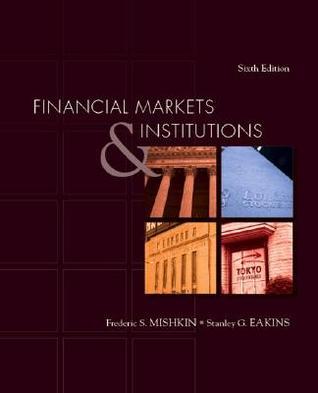
Financial Markets and Institutions (Prentice Hall Series in Finance)
In Financial Markets and Institutions, best-selling authors Mishkin and Eakins provide a practical introduction to prepare readers for today’s changing landscape of financial markets and institutions. A unifying framework uses a few core principles to organize readers' thinking then examines the models as real-world scenarios from a practitioner’s perspective. By analyzing these applications, readers develop the critical-thinking and problem-solving skills necessary to respond to challenging situations in their future careers.
Why Study Financial Markets and Institutions?; Overview of the Financial System. Fundamentals of Financial What Do Interest Rates Mean and What Is Their Role in Valuation?; Why Do Interest Rates Change?; How Do Risk and Term Structure Affect Interest Rates?; Are Financial Markets Efficient? Central Banking and the Conduct of Monetary Structure of Central Banks and the Federal Reserve System; Conduct of Monetary Tools, Goals, Strategy, and Tactics. Financial The Money Markets; The Bond Market; The Stock Market; The Mortgage Markets; The Foreign Exchange Market; The International Financial System. Fundamentals of Financial Why Do Financial Institutions Exist?; What Should Be Done About Conflicts of Interest? A Central Issue in Business Ethics. The Financial Institutions Banking and the Management of Financial Institutions; Commercial Banking Structure and Competition; Savings Associations and Credit Unions; Banking Regulation; The Mutual Fund Industry; Insurance Companies and Pension Funds; Investment Banks, Security Brokers and Dealers, and Venture Capital Firms. The Management of Financial Risk Management in Financial Institutions; Hedging with Financial Derivatives. On the Finance Companies.
For all readers interested in financial markets and institutions.
Why Study Financial Markets and Institutions?; Overview of the Financial System. Fundamentals of Financial What Do Interest Rates Mean and What Is Their Role in Valuation?; Why Do Interest Rates Change?; How Do Risk and Term Structure Affect Interest Rates?; Are Financial Markets Efficient? Central Banking and the Conduct of Monetary Structure of Central Banks and the Federal Reserve System; Conduct of Monetary Tools, Goals, Strategy, and Tactics. Financial The Money Markets; The Bond Market; The Stock Market; The Mortgage Markets; The Foreign Exchange Market; The International Financial System. Fundamentals of Financial Why Do Financial Institutions Exist?; What Should Be Done About Conflicts of Interest? A Central Issue in Business Ethics. The Financial Institutions Banking and the Management of Financial Institutions; Commercial Banking Structure and Competition; Savings Associations and Credit Unions; Banking Regulation; The Mutual Fund Industry; Insurance Companies and Pension Funds; Investment Banks, Security Brokers and Dealers, and Venture Capital Firms. The Management of Financial Risk Management in Financial Institutions; Hedging with Financial Derivatives. On the Finance Companies.
For all readers interested in financial markets and institutions.
752 pages, Hardcover
First published December 1, 1994
About the author
Frederic S. Mishkin
59 books80 followersFrederic Stanley "Rick" Mishkin is an American economist and professor at the Columbia Business School. He was a member of the Board of Governors of the Federal Reserve System from 2006 to 2008.
Mishkin's research focuses on monetary policy and its impact on financial markets and the aggregate economy.
Mishkin's research focuses on monetary policy and its impact on financial markets and the aggregate economy.
Ratings & Reviews
Friends & Following
Create a free account to discover what your friends think of this book!
Community Reviews
Displaying 1 - 10 of 10 reviews

November 28, 2017
How utterly boring. If only this had been the first course of my degree it would have been much better, but now this didn't present any extraordinary concept. Anyway, let's hope for a good grade on my final

June 14, 2021
This book gave a systematic way of seeing the financial markets and institutions, and how they work. The only textbook I've ever finished reading out of school so far because it's that great!
March 20, 2024
My favorite Finance textbook ever.
I had a course based on this textbook in my sophomore year of college and the professor recommended we buy the textbook if we liked the course.
As someone who had some basic finance notions but who had trouble seeing the big picture at the time, this textbook is the perfect start for anyone who wants to get a good grasp of the financial system as a whole. It deals with everything you need to know regarding: what the financial system is, central banking (although I would’ve liked the book to go deeper on that front), financial institutions, financial markets and derivatives.
Overall a great introduction to the field of finance and to the financial system. I also read the 8th version so I’m guessing newer versions are probably even more interesting. I can’t recommend this textbook enough.
I had a course based on this textbook in my sophomore year of college and the professor recommended we buy the textbook if we liked the course.
As someone who had some basic finance notions but who had trouble seeing the big picture at the time, this textbook is the perfect start for anyone who wants to get a good grasp of the financial system as a whole. It deals with everything you need to know regarding: what the financial system is, central banking (although I would’ve liked the book to go deeper on that front), financial institutions, financial markets and derivatives.
Overall a great introduction to the field of finance and to the financial system. I also read the 8th version so I’m guessing newer versions are probably even more interesting. I can’t recommend this textbook enough.
December 28, 2017
Overall the information presented was done in a way that is standard for a textbook. The main issue is that even though the authors keep releasing newer editions my teacher was quick to point out that a lot of the information was years out of date or was just plain incorrect to start with.

May 11, 2023
A very detailed and systematic textbook for self-learners. The latest version has been thoroughly updated to cover many recent events.

September 20, 2020
As an introduction to the financial system, this is pretty good. I did not read the entire thing because I learnt most of the basics in the corresponding seminar. But the book really helped clear some things up or just add some more complex knowledge that the seminar hinted at, but did not want to make mandatory learning. If you want to understand how the financial system basically works (what are bonds, what is the money market, how do exchange rates affect the economy and what exactly do banks and the FED do?), then this is a great read. A huge plus is the easy navigation in the PDF edition (and I'm sure Kindle as well), where you get a detailed breakdown of what is being talked about and can just click the links to get right where you need to go if you only want to look up something specific.
There also questions at the end of every chapter to test your knowledge. That's really neat. What I'm missing though are real life examples of the things talked about or some issues surrounding them. Bonds are interesting for example, especially municipal bonds which are tax free. So, they are used by well off people to stow their capital if tax rates are high. But the book does not go into that at all. There is no critique or deep dive into what some of these things mean for participants. It's just very dry and presents only hard facts without any application. If you want to dive deeper and see how these things might be used instead of just knowing how they function, you'd need another book.
There also questions at the end of every chapter to test your knowledge. That's really neat. What I'm missing though are real life examples of the things talked about or some issues surrounding them. Bonds are interesting for example, especially municipal bonds which are tax free. So, they are used by well off people to stow their capital if tax rates are high. But the book does not go into that at all. There is no critique or deep dive into what some of these things mean for participants. It's just very dry and presents only hard facts without any application. If you want to dive deeper and see how these things might be used instead of just knowing how they function, you'd need another book.

November 19, 2016
B r i l l i a n t!

Read
May 9, 2018Çox şeyi o biri kitabından kopyalayıb qoyub.

Read
October 11, 2025read Ch1-13:
accessible, tries its best to translate high-concept financial instruments and structures into something useful on a personal level.
accessible, tries its best to translate high-concept financial instruments and structures into something useful on a personal level.

Read
April 12, 2012school material, very interesting
Displaying 1 - 10 of 10 reviews