Op weg naar de hemel is afkomstig uit de gelijknamige bundel Op weg naar de hemel, die nog tien andere spannende korte verhalen over de duistere facetten van het menselijke karakter bevat.Een vrouw bezeten van stiptheid neemt een noodlottige beslissing.Roald Dahl, de alom geprezen schrijver van Sjakie en de chocoladefabriek, De GVR, Matilda en vele andere klassiekers voor kinderen, schreef ook bundels met korte verhalen voor volwassenen. Veel van deze betoverend angstaanjagende verhalen zijn verfilmd, en laten tot op de dag van vandaag iedere lezer huiveren. Dahl kan met recht de grootmeester van het korte verhaal worden genoemd.
Roald Dahl was a beloved British author, poet, screenwriter, and wartime fighter pilot, best known for his enchanting and often darkly humorous children's books that have captivated generations of readers around the world. Born in Llandaff, Wales, to Norwegian parents, Dahl led a life marked by adventure, tragedy, creativity, and enduring literary success. His vivid imagination and distinctive storytelling style have made him one of the most celebrated children's authors in modern literature. Before becoming a writer, Dahl lived a life filled with excitement and hardship. He served as a Royal Air Force pilot during World War II, surviving a near-fatal crash in the Libyan desert. His wartime experiences and travels deeply influenced his storytelling, often infusing his works with a sense of danger, resilience, and the triumph of the underdog. After the war, he began writing for both adults and children, showing a rare versatility that spanned genres and age groups. Dahl's children's books are known for their playful use of language, unforgettable characters, and a deep sense of justice, often pitting clever children against cruel or foolish adults. Some of his most iconic titles include Charlie and the Chocolate Factory, Matilda, The BFG, James and the Giant Peach, Fantastic Mr Fox, and The Witches. These works are filled with fantastical elements and moral undertones, empowering young readers to challenge authority, think independently, and believe in the impossible. Equally acclaimed for his work for adults, Dahl wrote numerous short stories characterized by their macabre twists and dark humor. His stories were frequently published in magazines such as The New Yorker and later compiled into bestselling collections like Someone Like You and Kiss Kiss. He also wrote screenplays, including the James Bond film You Only Live Twice and the adaptation of Ian Fleming's Chitty Chitty Bang Bang. Despite his literary success, Dahl was a complex and sometimes controversial figure, known for his strong opinions and difficult personality. Nonetheless, his books continue to be treasured for their wit, originality, and the sense of wonder they inspire. Many of his stories have been adapted into successful films, stage plays, and television specials, further cementing his legacy. Dahl's impact on children's literature is immeasurable. His ability to connect with young readers through a mix of irreverence, heart, and imagination has made his stories timeless. Even after his death, his books remain in print and continue to be read by millions of children worldwide. His writing not only entertains but also encourages curiosity, courage, and compassion. Roald Dahl's work lives on as a testament to the power of storytelling and the magic of a truly original voice. He remains a towering figure in literature whose creations continue to spark joy, mischief, and inspiration across generations.
Mrs Foster was always anxious when she had to be somewhere, on this occasion she was afraid (petrified) of missing her flight from NYC to Paris to visit her daughter and grandchildren.
Mr Foster never failed to drag his heels, seemingly in an attempt to make her late, or infuriate her, or both. He always seemed to saunter out of his room at the last minute, or need to go back into the house to find something.
This story went somewhere I didn't expect.
As someone who is, like Mrs Foster, always anxious to be out of the door on time - people like Mr Foster make me mad too. I have lived with people like this, and it seems they seem to do it to make us anxious types, EVEN MORE ANXIOUS!!!!!!!!
So yes, this was a very relatable story. But as I said before, it went somewhere I didn't expect.
Highly recommended and thanks for putting this on my radar Laysee!!!
“All of her life, Mrs Foster had had an almost pathological fear of missing a train, a plane, a boat, or even a theatre curtain.” I can relate to that. She and her husband are in their sixties, and live, less relatably, in a New York mansion with four servants.
It quickly becomes evident that this is a subtly abusive marriage: Mr Foster gaslights her and is frequently and deliberately late, but: “She would never dare to call out and tell him to hurry. He had disciplined her too well for that.”
Mrs Foster plans to fly to Paris to spend six weeks with their daughter’s family, and is especially looking forward to spending time with her grandchildren. She promises to write every week, even though he won’t write back as he “doesn’t hold with letter-writing unless there’s something specific to say”. And “like the faithful wife she was”, she does so, and returns home on the agreed date, despite wanting to stay.
Things take a dark and unexpected turn (I wonder if it was filmed as one of ITV’s “Tales of the Unexpected” in the 1980s and 1990s). There is plenty of plausible deniability, and the truth will never be clear.
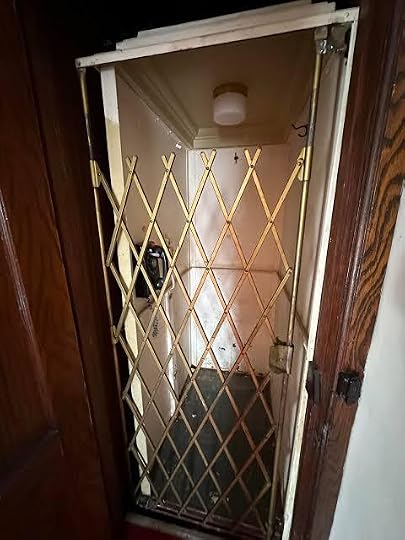
Image: Expanding/contracting door of a 1920s domestic (Source)
Dark side of Dahl
Much as I've enjoyed many Dahl stories for myself and as a parent, he’s a very controversial author these days, at least in the UK. Some of it can be dismissed as “of its time” (although a few years ago, his publisher reached an agreement with his estate to edit his books to remove or dilute references to weight, mental health, race, and gender), but other aspects less so - especially his lifelong, explicit anti-Semitism.
However, this story has no such issues, and he's clearly on the side of the abused woman.
5★ "It is really extraordinary how in certain people a simple apprehension about a thing like catching a train can grow into a serious obsession."
That obsession can be extremely annoying for everyone else to live with, and Mr Foster had obviously become so fed up with his wife's "almost pathological fear of missing a train, a plane, a boat or even a theatre curtain", that he found ways to amuse himself with it.
It's almost like teasing a child or a dog by keeping something just out of reach. He seemed to purposely dawdle to make it hard for their chauffeur to get them to their destination on time.
"On one or two special occasions in the later years of their married life, it seemed almost as though he had wanted to miss the train simply in order to intensify the poor woman’s suffering."
Oh, surely not! Yet, Mrs. Foster, who had been an exemplary wife for many years and never gave her husband any reason to complain, began to wonder if perhaps he actually was delaying on purpose.
When she finally summoned the courage to fly from New York to Paris to visit her daughter's family and the grandchildren she'd yet to meet, she was especially anxious. Her husband insisted on seeing her off at the airport, and missing this transatlantic flight would mean cancelling her trip.
He says it will be foggy, so the flight will be cancelled anyway. He's such a bundle of cheer, isn't he?
So what happens? Only the most delicious twisty Roald Dahl story is what. This was published in The New Yorker on 27 February 1954, and I first read it probably ten years later in Kiss Kiss, a collection of his stories that my dad gave me. I think that was my introduction to this unusual man, and I loved it.
Dahl is probably better known now for his children's stories, but be warned that his work for adults can get pretty dark and haunting - just so you know!
I enjoyed this short story by Roald Dahl tremendously. As someone who has read hardly any fiction for years, I am finding it very rewarding to be a member of The Short Story Club here on GR.
Unlike most of the world, I'm not a Dahl fan. I read one or two of his children's books years ago, and I'm afraid I found them boring On top of that there have been ongoing discussions about his unpleasant prejudices, which have not been endearing. However, I thought this story was an absolute delight.
The two main protagonists are Mr and Mrs Foster. She is a woman neurotic about being on time, and he is someone who enjoys teasing her, by repeatedly threatening to make her late.
As someone who's punctilious about time, I identified strongly with the wife's controlled panic, which Dahl describes superbly well. Her husband's teasing hostility is also well portrayed - appearing all the more sadistic in nature due to its precisely calculated execution. Most of the story has us on tenterhooks. The wife has an important commitment, where it is crucial she arrives on time. Will she manage to reach her destination on time or not? Besides the tension of this situation, her husband also mentions locking their house up when they go away, rather than paying their servants full wages for looking after the house. Thus he comes across as being unkind to his servants as well as his wife.
Finally, I loved the ending the story! What a great surprise. Who doesn't enjoy a toe rag getting his comeuppance, especially when there is an unexpected twist. Highly recommended!
This entire review has been hidden because of spoilers.
I always love Roald Dahl’s (short) stories. They are completely different than his children’s stories, which are also nice, but not something I read regularly. This particular short story is wonderfully written and has a slightly suspenseful mood throughout the whole story. You can feel something is going to happen, but what? Even though it is not spelled out for you, you can guess well enough what happened at the end of the story.
“She glanced at him again, and this time she noticed with a kind of horror that he was staring intently at the little place in the corner of her left eye where she could feel the muscle twitching.”
A good story keeps me on the edge of my seat. This one accomplished that. The missing piece was a much-needed casual mention early on that would have helped the ending out.
.داستانهایی که رولد دال برای کودکان نوشته به نظرم خیلی بامزهتر و جذابترن. چیزی که توی تمام نوشتههای رولد دال دیده میشه اون شیطنت هست و خیلی دوستداشتنیه.
داستان اول و دوم این کتاب رو نمیدونم به خاطر ترجمهاش بود که آخرش رو درست نفهمیدم چی شد یا واقعاً گنگ و نامفهوم بود؟
el final estuvo muy bueno pero tuve q googlear xq no lo había entendido, si a la primera lo captaba hubiera sido un sólido 4 o 5. Me gusta q sea corto pero igual pasa de todo, y me dio ansiedad durante las 10 hojas.
I loved this story because it reminds me of myself and my getting on time somewhere problems. I loved how the main character took charge of own life and did what she wanted to do to get somewhere on time. I also had to laugh a little how it ended for her husband who saw her anxiety as a game. I give this a 4.
The more I read works by Roald Dahl, the more I like this author. Each one is peculiar and exciting in its own way. “The Way up to Heaven” is a short story with sharp plot twists and I’d even say that its ending is really terrifying.
“The Way up to Heaven” is about a strange married couple, about two persons who have been together for a very long time. But since I’m bad at understanding human relationships, I can’t surely say if it’s strange. Their marriage isn’t normal, of course… However that’s the way people usually behave when they are married for so many years, isn't that? They start to annoy each other, get some unpleasant habits and often scold each other because of some nonsenses (or not nonsenses, but it’s still a fact). That’s what happens to mr. and mrs. Foster. They are old, have a big apartment in NY and stable life where there isn’t anything to wish. But their relationship is like a real nightmare. Mrs. Foster has an obsession of being late for everything, and she can’t cope with it. But it’s just a feature of her character anyway. However her husband extremely hates it about her, moreover, he does everything to spite her (for example, force her to be late for train, plain and so on). The woman understands it at the back of her mind, and still she can’t believe that her husband is so cruel.
Eventually it turns out that the woman is not so weak-willed as it may seem at the first sight. She consciously kills mr. Foster, though it happens indirectly. And in my opinion it’s reasonable enough, for this man has been tortured her for a very long time. And he is “rewarded” by a cruel death in the elevator, starving and suffocating.
The moral of the story is don’t behave like a scoundrel – it will certainly boomerang against you!
This entire review has been hidden because of spoilers.
I’ve read a handful of Dahl’s darker adult short stories - although, if you’ve read his children’s books, you know that he didn’t always shy away from dark topics! Nevertheless, The Way Up to Heaven is my favorite of the lot. A woman’s whose anxieties over being late are exacerbated by her cruel husband achieves a shocking and satisfying revenge. Definitely check this one out!