

What do you think?

The Doorman
Reinaldo Arenas is the most highly acclaimed writer of Cuba’s post-revolutionary generation. The Doorman , his first work set in the United States, breaks new ground with the extraordinary and tragic story of Juan, a young Cuban refugee who becomes a doorman at a luxury apartment building in Manhattan. Oddly alienated from the tenants, Juan finds himself being seduced by their pets–a bear, a rattlesnake, an orangutan, goldfish, cats, dogs–who speak to him, determined to recruit him to their a revolt against humans and human society, and a mass flight to liberty. Fantastic, satirical, dizzyingly inventive, The Doorman is a bittersweet parable about freedom and community, told with a profound sense of humanity.
208 pages, Paperback
First published January 1, 1989
About the author
Reinaldo Arenas
58 books372 followersArenas was born in the countryside, in the northern part of the Province of Oriente, Cuba, and later moved to the city of Holguín. In 1963, he moved to Havana to enroll in the School of Planification and, later, in the Faculty of Letters at the Universidad de La Habana, where he studied philosophy and literature without completing a degree. The following year, he began working at the Biblioteca Nacional José Martí. While there, his talent was noticed and he was awarded prizes at Cirilo Villaverde National Competition held by UNEAC (National Union of Cuban Writers and Artists). His Hallucinations was awarded "first Honorable Mention" in 1966 although, as the judges could find no better entry, no First Prize was awarded that year.
His writings and openly gay lifestyle were, by 1967, bringing him into conflict with the Communist government. He left the Biblioteca Nacional and became an editor for the Cuban Book Institute until 1968. From 1968 to 1974 he was a journalist and editor for the literary magazine La Gaceta de Cuba. In 1973, he was sent to prison after being charged and convicted of 'ideological deviation' and for publishing abroad without official consent.
He escaped from prison and tried to leave Cuba by launching himself from the shore on a tire inner tube. The attempt failed and he was rearrested near Lenin Park and imprisoned at the notorious El Morro Castle alongside murderers and rapists. He survived by helping the inmates to write letters to wives and lovers. He was able to collect enough paper this way to continue his writing. However, his attempts to smuggle his work out of prison were discovered and he was severely punished. Threatened with death, he was forced to renounce his work and was released in 1976. In 1980, as part of the Mariel Boatlift, he fled to the United States. He came on the boat San Lazaro captained by Cuban immigrant Roberto Aguero.
In 1987, Arenas was diagnosed with AIDS; he continued to write and speak out against the Cuban government. He mentored many Cuban exile writers, including John O'Donnell-Rosales. After battling AIDS, Arenas died of an intentional overdose of drugs and alcohol on December 7, 1990, in New York City. In a suicide letter written for publication, Arenas wrote: "Due to my delicate state of health and to the terrible depression that causes me not to be able to continue writing and struggling for the freedom of Cuba, I am ending my life... I want to encourage the Cuban people abroad as well as on the Island to continue fighting for freedom... Cuba will be free. I already am."
In 2012 Arenas was inducted into the Legacy Walk, an outdoor public display which celebrates LGBT history and people
His writings and openly gay lifestyle were, by 1967, bringing him into conflict with the Communist government. He left the Biblioteca Nacional and became an editor for the Cuban Book Institute until 1968. From 1968 to 1974 he was a journalist and editor for the literary magazine La Gaceta de Cuba. In 1973, he was sent to prison after being charged and convicted of 'ideological deviation' and for publishing abroad without official consent.
He escaped from prison and tried to leave Cuba by launching himself from the shore on a tire inner tube. The attempt failed and he was rearrested near Lenin Park and imprisoned at the notorious El Morro Castle alongside murderers and rapists. He survived by helping the inmates to write letters to wives and lovers. He was able to collect enough paper this way to continue his writing. However, his attempts to smuggle his work out of prison were discovered and he was severely punished. Threatened with death, he was forced to renounce his work and was released in 1976. In 1980, as part of the Mariel Boatlift, he fled to the United States. He came on the boat San Lazaro captained by Cuban immigrant Roberto Aguero.
In 1987, Arenas was diagnosed with AIDS; he continued to write and speak out against the Cuban government. He mentored many Cuban exile writers, including John O'Donnell-Rosales. After battling AIDS, Arenas died of an intentional overdose of drugs and alcohol on December 7, 1990, in New York City. In a suicide letter written for publication, Arenas wrote: "Due to my delicate state of health and to the terrible depression that causes me not to be able to continue writing and struggling for the freedom of Cuba, I am ending my life... I want to encourage the Cuban people abroad as well as on the Island to continue fighting for freedom... Cuba will be free. I already am."
In 2012 Arenas was inducted into the Legacy Walk, an outdoor public display which celebrates LGBT history and people
Ratings & Reviews
Friends & Following
Create a free account to discover what your friends think of this book!
Community Reviews
Displaying 1 - 30 of 53 reviews

October 27, 2018
The main character, Juan, fled Cuba by boat ten years ago and is now a doorman at a ritzy apartment building in New York. We’re told on the first pages that he is dying of grief, partly at the loss of his home country, but also because he “…could not or would not adjust to this practical world.” He’s lonely despite having a woman friend and being friendly with all the tenants. He constantly scribbles observations about the tenants in a notebook and talks with them about searching for “the door to happiness.”

By the start of the second chapter we realize we are in a fantasy world. The flat-out crazy tenants confirm it. We have a man who is obsessed with eating and handing out candy. There’s a female alcoholic sex addict; a crazy inventor who self-destructs while adding bionic body parts; a woman who constantly tries to commit suicide; a minister of a church of “constant body contact;” a tenant with a pet adult bear, two gay men who engage in bizarre behavior and so on. (Note that the author was openly gay – see biographical info below.)
Toward the end of the book the fantasy gets kicked up a notch. The building’s animals start talking to the doorman and holding meetings. They elect him as their leader and they and he eventually leave the building en masse on a cross-county journey looking for the promised land. This occurs after extended debate among the animals at which they air their special interests for a new homeland – water, forest, tropical, desert, etc. I took it as a parody of the endless conflicting demands by citizens of a democracy. And the leaving for a new homeland, is a parody of the author’s exile from Cuba.
Like the main character, the author ended up a man without a country who could not stand (but could not forget) the land he left behind, but also could not fit into the reality of his new land. It helps me to understand the story by being aware of the author’s own fascinating but tragic life. The paragraphs below are from Wikipedia:
Arenas’ writings and openly gay life were, by 1967, bringing him into conflict with the Communist government in Cuba. He left the Biblioteca Nacional and became an editor and later a journalist. In 1974, he was sent to prison after being charged and convicted of 'ideological deviation' and for publishing abroad without official consent. He escaped from prison and tried to leave Cuba by launching himself from the shore on a tire inner tube. The attempt failed and he was rearrested and imprisoned at the notorious El Morro Castle alongside murderers and rapists. Threatened with death, he was forced to renounce his work and was released in 1976. In 1980, as part of the Mariel Boatlift, he fled to the United States.
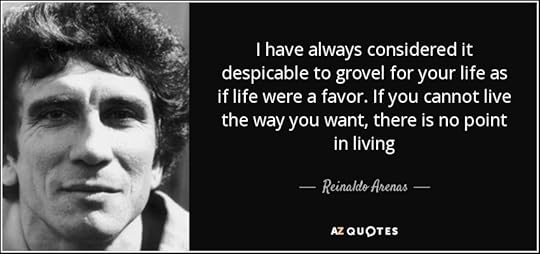
In 1987, Arenas was diagnosed with AIDS; he continued to write and speak out against the Cuban government. [Although Arenas was initially a supporter of Castro and the Revolution.] After battling AIDS, Arenas died of an intentional overdose of drugs and alcohol on December 7, 1990, in New York City. In a suicide letter written for publication, Arenas wrote:
“Due to my delicate state of health and to the terrible depression that causes me not to be able to continue writing and struggling for the freedom of Cuba, I am ending my life...I want to encourage the Cuban people abroad as well as on the Island to continue fighting for freedom... Cuba will be free. I already am.”
A tragic but fascinating life and the book is a good read.
Top photo from https://www.pinterest.com/pin/5298767...
Lower photo from azquotes.com
By the start of the second chapter we realize we are in a fantasy world. The flat-out crazy tenants confirm it. We have a man who is obsessed with eating and handing out candy. There’s a female alcoholic sex addict; a crazy inventor who self-destructs while adding bionic body parts; a woman who constantly tries to commit suicide; a minister of a church of “constant body contact;” a tenant with a pet adult bear, two gay men who engage in bizarre behavior and so on. (Note that the author was openly gay – see biographical info below.)
Toward the end of the book the fantasy gets kicked up a notch. The building’s animals start talking to the doorman and holding meetings. They elect him as their leader and they and he eventually leave the building en masse on a cross-county journey looking for the promised land. This occurs after extended debate among the animals at which they air their special interests for a new homeland – water, forest, tropical, desert, etc. I took it as a parody of the endless conflicting demands by citizens of a democracy. And the leaving for a new homeland, is a parody of the author’s exile from Cuba.
Like the main character, the author ended up a man without a country who could not stand (but could not forget) the land he left behind, but also could not fit into the reality of his new land. It helps me to understand the story by being aware of the author’s own fascinating but tragic life. The paragraphs below are from Wikipedia:
Arenas’ writings and openly gay life were, by 1967, bringing him into conflict with the Communist government in Cuba. He left the Biblioteca Nacional and became an editor and later a journalist. In 1974, he was sent to prison after being charged and convicted of 'ideological deviation' and for publishing abroad without official consent. He escaped from prison and tried to leave Cuba by launching himself from the shore on a tire inner tube. The attempt failed and he was rearrested and imprisoned at the notorious El Morro Castle alongside murderers and rapists. Threatened with death, he was forced to renounce his work and was released in 1976. In 1980, as part of the Mariel Boatlift, he fled to the United States.
In 1987, Arenas was diagnosed with AIDS; he continued to write and speak out against the Cuban government. [Although Arenas was initially a supporter of Castro and the Revolution.] After battling AIDS, Arenas died of an intentional overdose of drugs and alcohol on December 7, 1990, in New York City. In a suicide letter written for publication, Arenas wrote:
“Due to my delicate state of health and to the terrible depression that causes me not to be able to continue writing and struggling for the freedom of Cuba, I am ending my life...I want to encourage the Cuban people abroad as well as on the Island to continue fighting for freedom... Cuba will be free. I already am.”
A tragic but fascinating life and the book is a good read.
Top photo from https://www.pinterest.com/pin/5298767...
Lower photo from azquotes.com

December 16, 2015
I'm a devoted fan of Arenas, THE premiere Cuban writer ("Before Night Falls" being one of the best autobiographies of all time). And I admire the rather intrepid tone-&-subject switch in the second part of the novel. And the message of universality amongst all God's creatures is one to admire and entertain in the brain. And the book could be made into one compelling & intriguing genre film (I see Wes Anderson directing...).
But it is way too startling. That jump. The first half of "The Doorman" is actually very comical, even "Confederacy of Dunces" like in its parody. Picaresque. But then the rug is swiped right from under us, in what can only be called a "Dr. Doolittle" meets philosophy-101 episode just too jarring to ignore.
This latter work is O.F.F.R.A. (Only for Fans of Reinaldo Arenas), and, even then, a minor work of this immense auteur.
But it is way too startling. That jump. The first half of "The Doorman" is actually very comical, even "Confederacy of Dunces" like in its parody. Picaresque. But then the rug is swiped right from under us, in what can only be called a "Dr. Doolittle" meets philosophy-101 episode just too jarring to ignore.
This latter work is O.F.F.R.A. (Only for Fans of Reinaldo Arenas), and, even then, a minor work of this immense auteur.

November 17, 2022
Esa voz que narra, que pareciera hablar por varias o muchas personas (un millón para ser exactos).¿Quiénes son?
Esa voz omnipresente que lo ve y lo sabe todo sobre Juan, el portero.
Ese portero alunado, que se siente predestinado para algo, que observa detrás del cristal de la puerta del edificio que custodia cómo cae la noche en New York: un atardecer de siluetas de altas torres (donde aún existe el Trade Word Center) y de amarillas luces que lo iluminan todo.
Este portero que ve en cada inquilino del edificio una historia y una posibilidad para llevar a cabo su plan de predestinado.
Y el variopinto conjunto de vidas y personajes de los inquilinos de este edificio, en cada inquilino una historia más surrealista que la otra; todos con sus historias a cuestas, algunas absurdas y difíciles de creer.
Esa voz omnipresente que lo ve y lo sabe todo sobre Juan, el portero.
Ese portero alunado, que se siente predestinado para algo, que observa detrás del cristal de la puerta del edificio que custodia cómo cae la noche en New York: un atardecer de siluetas de altas torres (donde aún existe el Trade Word Center) y de amarillas luces que lo iluminan todo.
Este portero que ve en cada inquilino del edificio una historia y una posibilidad para llevar a cabo su plan de predestinado.
Y el variopinto conjunto de vidas y personajes de los inquilinos de este edificio, en cada inquilino una historia más surrealista que la otra; todos con sus historias a cuestas, algunas absurdas y difíciles de creer.
October 11, 2020
This novel was laugh out loud funny until it became tragic. The author explored the concept of freedom in the context of an immigrant who doesn’t really belong in his new country yet is exiled from his home country. Freedom and the best place to live depends on each person’s preference. Juan really wanted to please people and didn’t understand why he couldn’t befriend residents in the swanky building where he worked. He didn’t understand that they looked down on him. Then he became psychotic. The two parts didn’t segue well and the author’s philosophy was not subtle enough to make this a great novel but it gives me a lot to think about. I liked that he got meta with a reference to himself.

August 5, 2023
Esta novela satírica la escriben todos los exiliados cubanos en EEUU; es la historia de Juan, un connacional suyo con problemas de adaptación a la forma de vida norteamericana.
Cuando parece que el protagonista encuentra un trabajo estable como portero de un edificio de departamentos de lujo en Manhattan, la historia toma un vuelco absoluto que desconcierta al inicio, pero conforme avanza la fábula la historia toma gran fuerza no solo por su humor sino por su crítica al capitalismo y al régimen cubano por igual.
Cuando parece que el protagonista encuentra un trabajo estable como portero de un edificio de departamentos de lujo en Manhattan, la historia toma un vuelco absoluto que desconcierta al inicio, pero conforme avanza la fábula la historia toma gran fuerza no solo por su humor sino por su crítica al capitalismo y al régimen cubano por igual.

August 13, 2019
I was drawn into Reinaldo Arenas after reading his biography and discovering his relationship with the Cuban government. His protagonist, Juan, is a Cuban émigré who works as a doorman at a Manhattan apartment. We see the tenants in the apartment portrayed as caricature-like figures with obsessions. The dose of surrealism increases as the reader gets absorbed into the narrative. Early chapters depict stories involving our doorman, such as a homosexual sex scene that ends up with a bizarre injury, interactions with a suicidal woman or a man wanting to replace his body parts in order to become a bionic human.
The narrative becomes fable-like in the second half where each pet living in the apartment delivers a speech. The imaginative allegories reminded me of Animal Farm. Although I found that part a bit too lengthy for my taste, I appreciate that it allows the reader to adopt Juan’s point of view. The planned revolution against humans has all the right causes according to animals and Juan is their designated middleman. Cleopatra is an aristocratic cat that has human like qualities like speaking and appreciation of fine arts. She is the head of the revolutionary animal gang. I couldn’t help but agree with all the accusations against the human race and that we are so entitled. I liked the twist when the outsiders accused Juan of theft, bestiality and schizophrenia and he ended up in a mental hospital.
I could clearly see parallels between Arenas’ personal life and the Doorman. The search for a new land where all the animals would be free is a metaphor for Cubans fleeing their homes. As a gay Cuban and a later critique of the revolution, Arenas was imprisoned for his writings and open homosexuality. After escaping Cuba, he led a life in the United States where he spoke on behalf of people who were humiliated and discriminated against. Throughout the novel I kept thinking who the narrator could be. It is revealed in the conclusion that the narrator is all the people in exile, who possess weapons that could help them take revenge, which is represented by the Doorman in this novella.
The narrative becomes fable-like in the second half where each pet living in the apartment delivers a speech. The imaginative allegories reminded me of Animal Farm. Although I found that part a bit too lengthy for my taste, I appreciate that it allows the reader to adopt Juan’s point of view. The planned revolution against humans has all the right causes according to animals and Juan is their designated middleman. Cleopatra is an aristocratic cat that has human like qualities like speaking and appreciation of fine arts. She is the head of the revolutionary animal gang. I couldn’t help but agree with all the accusations against the human race and that we are so entitled. I liked the twist when the outsiders accused Juan of theft, bestiality and schizophrenia and he ended up in a mental hospital.
I could clearly see parallels between Arenas’ personal life and the Doorman. The search for a new land where all the animals would be free is a metaphor for Cubans fleeing their homes. As a gay Cuban and a later critique of the revolution, Arenas was imprisoned for his writings and open homosexuality. After escaping Cuba, he led a life in the United States where he spoke on behalf of people who were humiliated and discriminated against. Throughout the novel I kept thinking who the narrator could be. It is revealed in the conclusion that the narrator is all the people in exile, who possess weapons that could help them take revenge, which is represented by the Doorman in this novella.

January 13, 2018
This is effectively two novellas that share a protagonist (a Cuban doorman in NYC). The first is a surreal series of encounters by the doorman with the people who live in the building where he works. Its essence is the attempt of everyone to proselytize each other, in a variety of ways. The second is a fablistic series of animals presenting their views of the world every bit as self-centeredly as the humans they share the building with. The darkness in this novel is deep, but it is offset to some extent by the silliness, satire, and parody of the book’s tone and events.
I found the novel's comical, first-person plural narration by other Cuban-Americans (as entertainingly unbelievable as everything else in the novel) very enjoyable.
I found the novel's comical, first-person plural narration by other Cuban-Americans (as entertainingly unbelievable as everything else in the novel) very enjoyable.

January 2, 2026
Uno de los puntos fuertes de Reinaldo sigue siendo para mí el estilo de su narración: el ritmo, el tono, lo cercano de su lenguaje y de su dolor. En este libro sigue manteniendo esa voz que me llevó a sus novelas. Varios de los relatos de este libro genuinamente me hicieron reir. Además, muestra esa irreverencia respecto de sí y de sus compatriotas exiliados.
February 13, 2019
"Швейцар" кубинского американского писателя кубинского происхождения Рейнальдо Аренаса - роман с сюжетом, центральными идеями, отличным изложением и большим количеством цветистого абсурда.
Сам Аренас поделил книгу на две части, но с точки зрения "разбитости" книги их, скорее, три. В первой части романа молодой кубинец-эмигрант Хуан встречается с жильцами дома, в котором работает, собственно, швейцаром, и эти жильцы - ну очень странные персонажи. С ними со всеми что-то сильно не так, и каждый из них пытается в это "не так" затащить и швейцара. Сумасшедший изобретатель - как бы сейчас сказали, биохакер, - хочет из всех вокруг сделать киборгов, сумасшедшая миллионерша берёт взаймы у швейцара и обретается с бездомными, проповедник не пойми чего устроил ковчег в собственной квартире. А Хуан открывает дверь в lobby, но слишком много думает и хочет открывать другие двери, метафизические. Проблема в том, что эти двери он хочет открывать для других, и не знает, как подступиться
В условно второй - ещё более параноидальной - части книги Хуан общается с питомцами жильцов на их партийном собрании, которое начинается с выступления гремучей змеи-человеконенавистницы:
И это уже совсем другая книга, здесь гораздо больше безысходности, и строится она из длинных, немного в духе Фиделя Кастро, речей змеи, крысы, мухи и прочих.
Программные заявления животных говорят суть об одном: человек - зло, но зло неизбежное, и без него им никак не выжить. Сами животные ничуть не менее странны, чем их хозяева, чего стоит, например, медведь, который цитирует Библию на латыни. Ближе к концу книги (третья часть) Хуан попадает в психушку, и это единственное событие во всём романе, которое похоже на правду, всё остальное - шизофрения в чистом виде, которая и заканчивается эпичным побегом из психбольницы и жизнеутверждающим исходом всего зоопарка в сторону экватора.
С самого начала в каждом предложении в книге, особенно в первой её половине, видится двойное дно - это не просто фантастическая история, это история, в которой подтекст зазывно смотрит на читателя из-за каждой занавески. Кажется, что Аренас больше всего говорит про себя, и в книге есть многое из его жизни и его мыслей. Иногда это отношение к жизни и смерти, иногда восприятие действительности:
Естественно, присутствует эмиграция, ненависть к режиму, потеря родины и отрицание тоски по ней. В книге прямо сказано, что кубинские эмигранты есть во всех слоях американского общества, и через персонажей - отношение эмигрантов к новой и старой родине - желание абсолютно мимикрировать и раствориться в США и никогда не вспоминать про Кубу:
В свете сложных взаимоотношений со страной проживания символична фигура маньяка-стоматолога, который хочет, чтобы улыбки его авторства были у всех, начиная с его собак. Но Аренас словами Хуана отказывается от голливудской улыбки и, кажется, что вместе с этим отрицает и большую американскую мечту, предпочитая ей вечные поиски:
Какие еще персонажи, и, соответственно, мысли есть в "Швейцаре"? Есть геи в образе и глазами других, и их поиски идеального мужчины, мелькают СПИД и ужас, связанный с ним, много написано про депрессию и непреодолимую тягу к суициду. Всё это в жизни Рейнальдо Аренаса было, но ему мало, и про себя как писателя он пишет напрямую, оправдывая выбор третьих лиц для рассказа истории Хуана:
Итого мы имеем абсурдный микро-роман с автобиографической ноткой. Несмотря на несерьёзный размер, в книге всего много, есть о чём подумать, но в итоге не хватает главного - целостности и цельности. А по поводу размера - такие книги и не должны быть большими, потому что выносить настолько больной надрыв долго для читателя будет слишком.
Сам Аренас поделил книгу на две части, но с точки зрения "разбитости" книги их, скорее, три. В первой части романа молодой кубинец-эмигрант Хуан встречается с жильцами дома, в котором работает, собственно, швейцаром, и эти жильцы - ну очень странные персонажи. С ними со всеми что-то сильно не так, и каждый из них пытается в это "не так" затащить и швейцара. Сумасшедший изобретатель - как бы сейчас сказали, биохакер, - хочет из всех вокруг сделать киборгов, сумасшедшая миллионерша берёт взаймы у швейцара и обретается с бездомными, проповедник не пойми чего устроил ковчег в собственной квартире. А Хуан открывает дверь в lobby, но слишком много думает и хочет открывать другие двери, метафизические. Проблема в том, что эти двери он хочет открывать для других, и не знает, как подступиться
...к своему таинственному делу, поиску самой главной двери.
В условно второй - ещё более параноидальной - части книги Хуан общается с питомцами жильцов на их партийном собрании, которое начинается с выступления гремучей змеи-человеконенавистницы:
Вы задумывались над тем, насколько спокойной и счастливой стала бы наша жизнь, если бы человек исчез?
И это уже совсем другая книга, здесь гораздо больше безысходности, и строится она из длинных, немного в духе Фиделя Кастро, речей змеи, крысы, мухи и прочих.
Страх! Страх! Страх! Стены мира возведены из страха. И самое грустное — то, что мир существует, потому что существует страх. Мир потому и мир, что это всего лишь зона страха. И тот, кто этого не понимает, погибает. Все в заговоре против нас. Все нам враги. И в то же время все в заговоре против всего.
Программные заявления животных говорят суть об одном: человек - зло, но зло неизбежное, и без него им никак не выжить. Сами животные ничуть не менее странны, чем их хозяева, чего стоит, например, медведь, который цитирует Библию на латыни. Ближе к концу книги (третья часть) Хуан попадает в психушку, и это единственное событие во всём романе, которое похоже на правду, всё остальное - шизофрения в чистом виде, которая и заканчивается эпичным побегом из психбольницы и жизнеутверждающим исходом всего зоопарка в сторону экватора.
С самого начала в каждом предложении в книге, особенно в первой её половине, видится двойное дно - это не просто фантастическая история, это история, в которой подтекст зазывно смотрит на читателя из-за каждой занавески. Кажется, что Аренас больше всего говорит про себя, и в книге есть многое из его жизни и его мыслей. Иногда это отношение к жизни и смерти, иногда восприятие действительности:
... телевизор, который показывал на одном экране одновременно все каналы, перемешивая самые несоединимые действия, пейзажи и эпохи.
Естественно, присутствует эмиграция, ненависть к режиму, потеря родины и отрицание тоски по ней. В книге прямо сказано, что кубинские эмигранты есть во всех слоях американского общества, и через персонажей - отношение эмигрантов к новой и старой родине - желание абсолютно мимикрировать и раствориться в США и никогда не вспоминать про Кубу:
Во-первых он решил никогда больше не произносить ни одного слова по-испански; во-вторых, настолько обжиться на приёмной родине, чтобы в скором времени никто не смог сказать, что он родился на юге провинции Санта Клара в забытом Богом городишке под названием Муэлас Кьетас.
В свете сложных взаимоотношений со страной проживания символична фигура маньяка-стоматолога, который хочет, чтобы улыбки его авторства были у всех, начиная с его собак. Но Аренас словами Хуана отказывается от голливудской улыбки и, кажется, что вместе с этим отрицает и большую американскую мечту, предпочитая ей вечные поиски:
...совсем неведомы тяготы жизни, и непохоже, чтобы его одолевало желание найти особую и таинственную дверь для каждого обитателя этого здания.
Какие еще персонажи, и, соответственно, мысли есть в "Швейцаре"? Есть геи в образе и глазами других, и их поиски идеального мужчины, мелькают СПИД и ужас, связанный с ним, много написано про депрессию и непреодолимую тягу к суициду. Всё это в жизни Рейнальдо Аренаса было, но ему мало, и про себя как писателя он пишет напрямую, оправдывая выбор третьих лиц для рассказа истории Хуана:
Что касается Рейнальдо Аренаса, то его явно выраженный, навязчивый и достойный порицания гомосексуализм способен отложить отпечаток на какой угодно текст или ситуацию, затемняя объективность истории, которая никоим образом не претендует на описание случая сексуального отклонения.
Итого мы имеем абсурдный микро-роман с автобиографической ноткой. Несмотря на несерьёзный размер, в книге всего много, есть о чём подумать, но в итоге не хватает главного - целостности и цельности. А по поводу размера - такие книги и не должны быть большими, потому что выносить настолько больной надрыв долго для читателя будет слишком.

March 9, 2025
Texte très curieux et original.

April 4, 2025
¿Pueden creer que lloré? (Poco pero sí)
Una hermosa fábula alegorica que representa a cada persona que tuvo que ser exiliada de su propia tierra. Me gustó mucho.
3.5 ★★★✮☆
Una hermosa fábula alegorica que representa a cada persona que tuvo que ser exiliada de su propia tierra. Me gustó mucho.
3.5 ★★★✮☆

April 20, 2025
I don’t know if I care enough to unpack surrealism and second person plural narrators, but wtf did I just read

April 28, 2022
голубь вяхирь так начал свою речь:
Красиво расписано. Признаюсь честно - купилась.
Знаете, ведь от сатиры к шизофреническому бреду один шаг. Как жаль, что автор не просто перешел черту, а с разбега прыгнул "бомбочкой" на дно.
Мне обещали n-ое количество персонажей со странностями, на деле же я получила самых настоящих психопатов и гг под стать им. Нельзя просто так запихнуть в книгу кучу всего из ряда вон выходящего, обозвать это сатирой и радоваться. А читателям то как потом жить со всем этим дерьмом в голове? В общем, если вы хотите узнать о паре-тройке самых колоритных персонажей (мой личный топ больных ублюдков), то продолжайте читать, НО я не в ответе за то, что может приключиться с вашей психикой!

Раз. Два. Полете-е-ели!
Скажу сразу, самым адекватным персонажем тут является тетка-суецидница. Если к большему шоку вы морально не готовы, в таком случае, пожалуйста, лучше не читайте, ибо ваша жизнь не будет прежней! Психика вообще может треснуть пополам!
***

☆Третье место☆
Возможно, вполне безобидный герой, но очень криповый. Встречайте! Мечта всех аутистов, гроза интровертов - мистер Локпес! Нет, он не шумный сосед, который устраивает тусовки 24/7, мистер Локпес священник. Ага, из той категории сам-не-ведаю-что-проповедую, потому что его религия - прикосновения.
С самого начала думаешь, что это даже неплохая идея, наверно, но чем дальше читаешь, тем стремнее становится!
Жуть, правда? Мало того мистер Локпес частенько устраивал такие себе "вписки" со своими прихожанами. Один фрик может казаться безобидным, а вот целая толпа его единомышленников - мой маленький ад!
*Тач ми. Та-та-тач ми.*
*Ю тач май тралала.*
***

☆Второе место☆
Окажись вы на параде сумасшедших, парочка геев обязательно попадет в поле вашего зрения!
Существует негласное правило: "Если героя зовут Оскар, то он точно колоритныйдолбоеб персонаж". В книге целых два Оскара, какое счастье, которые привели достаточно аргументов для подтверждения вышеупомянутой теории.
С этими прелестными героями нашему гг придется разделить их странные игрища. Та-а-ак, что тут у нас? Гейский перепихон на троих! Ахахаха, наконец-то!

Мой словарный запас иссяк! Я не знаю как описать этот треш! Что ЭТИМ автор хотел нам сказать? Помогите найти смысл!
***

☆Первое место☆
Если вы еще не закрыли вкладку и дочитали до этого места, поздравляю (сочувствую)! Вы - герой, которого не заслуживает эта книга! Сейчас перед вами предстанет самый настоящий кошмар! Готовы?
Вот он - ниндзя, который использовал дилдо вместо звездочек!
Тут нечего добавить! Маразм да и только. Хуже больного извращенца может быть только тетка, которая несмотря на такие "эксперименты" чокнутого старика продолжает с ним встречаться.
***
Знаете, после "Первой части" сам Люцифер не страшен. Автор, видимо, решил прекратить эту экзекуцию и слегка сбавить темп в следующих главах.
Я дочитала - это единственное, что меня порадовало, теперь нужно будет только одолжить у моей сестры капельку забывчивости, чтобы этот ужас, именующийся "Швейцаром", вылетел из головы!
P.S. Пошел к черту, Рейнальдо Аренас!

Роман Рейнальдо Аренаса интересен не только увлекательным сюжетом и блестящими наблюдениями автора. Писатель стремится видеть в обычной жизни неординарные, драматические черты. Он создает художественный мир, основанный на острых переживаниях, активно включает в сферу литературы немыслимые в ней прежде вещи, поэтизирует насилие и страдания.
Красиво расписано. Признаюсь честно - купилась.
Знаете, ведь от сатиры к шизофреническому бреду один шаг. Как жаль, что автор не просто перешел черту, а с разбега прыгнул "бомбочкой" на дно.
— Если парашют не раскроется, с тобой все равно ничего не случится, — объяснила ему Нэнси со своей обычной бодростью, затягивая последний ремень.
Мне обещали n-ое количество персонажей со странностями, на деле же я получила самых настоящих психопатов и гг под стать им. Нельзя просто так запихнуть в книгу кучу всего из ряда вон выходящего, обозвать это сатирой и радоваться. А читателям то как потом жить со всем этим дерьмом в голове? В общем, если вы хотите узнать о паре-тройке самых колоритных персонажей (мой личный топ больных ублюдков), то продолжайте читать, НО я не в ответе за то, что может приключиться с вашей психикой!
Раз. Два. Полете-е-ели!
Скажу сразу, самым адекватным персонажем тут является тетка-суецидница. Если к большему шоку вы морально не готовы, в таком случае, пожалуйста, лучше не читайте, ибо ваша жизнь не будет прежней! Психика вообще может треснуть пополам!
***
☆Третье место☆
Возможно, вполне безобидный герой, но очень криповый. Встречайте! Мечта всех аутистов, гроза интровертов - мистер Локпес! Нет, он не шумный сосед, который устраивает тусовки 24/7, мистер Локпес священник. Ага, из той категории сам-не-ведаю-что-проповедую, потому что его религия - прикосновения.
Спешим заверить, — поскольку мы смогли это установить, — что эти контакты сеньора Локпеса, будучи физического свойства, тем не менее имеют сугубо духовное начало. Ни разу — заявляем категорически, поскольку изучили вопрос досконально — упоминаемые физические контакты вышеназванного сеньора со своими ближними не носили непристойного характера.
С самого начала думаешь, что это даже неплохая идея, наверно, но чем дальше читаешь, тем стремнее становится!
Безобидная, но страстная приверженность учению толкала его на то, чтобы прикасаться к людям в поездах, в кино, а то и вовсе посреди улицы, что обернулось для него — и еще обернется — многочисленными оскорблениями, арестами, уплатой штрафов, которые до сегодняшнего дня достигали от двадцати пяти долларов до двух тысяч. Впрочем, сеньор Локпес, равно как и его последователи, воспринимают подобные невзгоды как «испытания», которым их подвергает вера и которые они должны стойко выдержать, чтобы выйти из них укрепившимися и сплоченными.
Жуть, правда? Мало того мистер Локпес частенько устраивал такие себе "вписки" со своими прихожанами. Один фрик может казаться безобидным, а вот целая толпа его единомышленников - мой маленький ад!
*Тач ми. Та-та-тач ми.*
Ближе к утру религиозное рвение верующих, вдохновляемых сеньором Локпесом, не поддавалось описанию. Квартира, битком набитая людьми разных рас и возрастов, гудела от истово кружившихся присутствующих, которые не забывали касаться своих соседей. К концу ритм движений ускорился, а среди дотрагивающихся послышалось что-то вроде гимна, напеваемого с закрытым ртом, похожего то ли на стон, то ли на бормотание, напоминающее колыбельную, под звуки которой и под раскачивание и взаимные прикосновения всем хотелось убаюкать друг друга. Прошло три часа, а действо не только не прерывалось, но с каждым разом становилось все более напряженным и умопомрачительным.
*Ю тач май тралала.*
***
☆Второе место☆
Окажись вы на параде сумасшедших, парочка геев обязательно попадет в поле вашего зрения!
Существует негласное правило: "Если героя зовут Оскар, то он точно колоритный
Бульдог кидался на зверька, но натыкался на тело одного из Оскаров Таймсов; тот подтягивал кролика к своей обнаженной плоти затем, чтобы как только собака приготовится его разорвать, слегка отпустить поводок и отвести опасность. Тогда огромный бульдог кусал не преследуемого зверя, а растянувшегося Оскара Таймса, который после нескольких недель тренировки добился того, чтобы клыки каждый раз вонзались бы ему в ягодицы.
С этими прелестными героями нашему гг придется разделить их странные игрища. Та-а-ак, что тут у нас? Гейский перепихон на троих! Ахахаха, наконец-то!
Они брались за руки и ударялись животами, наклонялись и стукались лысинами. Наконец, отступили к горам газет, наваленных около стен, и, повернувшись спиной друг к другу, вновь встретились, ударившись ягодицами, таким образом как бы обменявшись приветствием перед началом пиршества. Но тут случилось нечто непредвиденное и ужасное: при столкновении пустые бутылки из-под воды «Перье», покоящиеся в их задницах, про которые они, увлекшись, забыли, лопнули, причинив обоим глубокие и почти смертельные раны. Вновь кипы экземпляров нью-йоркской газеты обагрились кровью, а смех сменился жалобный воем.
Мой словарный запас иссяк! Я не знаю как описать этот треш! Что ЭТИМ автор хотел нам сказать? Помогите найти смысл!
***
☆Первое место☆
Если вы еще не закрыли вкладку и дочитали до этого места, поздравляю (сочувствую)! Вы - герой, которого не заслуживает эта книга! Сейчас перед вами предстанет самый настоящий кошмар! Готовы?
Накануне свидания с Брендой Хилл Артур Макадам вернулся домой с тем самым гигантским дрессированным приматом, которому и отвесил поклон наш швейцар. Той же ночью в кромешной тьме, постепенно созданной мистером Макадамом, надушенная и обряженная в одежду господина Макадама обезьяна ублажала Бренду Хилл, в то время как сам сеньор Макадам тут же рядом постанывал на тысячу ладов и выкрикивал всякие возбуждающие словечки, довольствуясь мастурбацией.
Вот он - ниндзя, который использовал дилдо вместо звездочек!
Вооружившись купленными приспособлениями, господин Макадам начал новую жизнь в сексе.
Тут нечего добавить! Маразм да и только. Хуже больного извращенца может быть только тетка, которая несмотря на такие "эксперименты" чокнутого старика продолжает с ним встречаться.
Сеньор Макадам на время замял дело, выписав ей чек на тысячу долларов и заверив, что на следующем свидании все будет взаправду и к полному ее удовольствию.
***
Знаете, после "Первой части" сам Люцифер не страшен. Автор, видимо, решил прекратить эту экзекуцию и слегка сбавить темп в следующих главах.
Диалоги умирали, не успев родиться, и даже само молчание молило о слове, хотя бы самом заурядном, лишь бы оно избавило его от молчания.
Я дочитала - это единственное, что меня порадовало, теперь нужно будет только одолжить у моей сестры капельку забывчивости, чтобы этот ужас, именующийся "Швейцаром", вылетел из головы!
P.S. Пошел к черту, Рейнальдо Аренас!

February 23, 2021
Una cara distinta, y a la vez muy parecida, de Arenas. Este libro va dedicado a Lázaro (considerado un hermano por Arenas), en cuya vida tras el exilio se basa para el personaje de Juan. Me parece que las fuertes críticas que recibe este libro dado su grado de fábula (animales que hablan, moralejas que plantea) son algo exageradas por un supuesto infantilismo. A final de cuentas, ¿no son las mismas ratas que bailan y gritan en torno a fray Servando en EMA? El libro en sí habla de la búsqueda de "la llegada, la entrada, el retorno que no lleve al mismo sitio" que parece no abandonar a todos los exiliados al saberse extraños y a la vez incapaces de volver; la eterna añoranza. Disfruté encontrar una cara distinta de Arenas en esta obra, pese a que no le dé el lugar en que estimo novelas como Otra vez el Mar y El mundo alucinante.

September 16, 2024
Me costó varias décadas (y muchas horas de terapia) aceptarme como un tipo "raro". No necesariamente loco, pero si estructuralmente extraño, que en ciertos contextos puede ser considerado un tipo de demencia.
Esta novela trata sobre otro tipo raro, un migrante cubano en el Nueva York de los 80's que trabaja como portero en un elegante edificio. En honor a la verdad, todos son raros en ese "building", desde la señora que gracias a la más insólita suerte siempre sobrevive a sus intentos de suicidio, hasta el inventor obsesionado con reemplazar cada parte del cuerpo con un mecanismo, pasando por el donjuan impotente que usa a un oso para que lo reemplace en la cama. Pero el único que es acusado de locura es él, el portero, en parte porque es el sospechoso mas fácil de señalar (pobre, migrante y empleado), y en parte porque es el único cuya "rareza" no puede ser explicada como excentricidad: los animales del edificio han decidido hablarle y confiar en él para escapar de los humanos en un masivo Éxodo. Pudo haber mentido y justificar sus diálogos interespecie a partir de un elaborado espectáculo de ventrilocuismo, pero decidió no hacerlo y, al fin y al cabo, "nada más loco que decir siempre la verdad".
Es un libro que fácilmente podría ser etiquetado como"realismo mágico", uno que juega con el humor y el absurdo para criticar el "american way of live" y su tendencia a la falsedad y a mantener las apariencias, así como a escupir a los que considera más débil.
***
Imaginen a un joven escritor de la provincia rural cubana. Siendo aún adolescente, colabora con un grupo de barbudos que quiere derrotar la terrible dictadura de Batista. Cuando la revolución triunfa, se le abre un fabuloso mundo educativo literario que le permite conocer y trabajar con consolidadas plumas como José Lezama y Virgilio Piñera, pero a la vez sufre una cruel persecución desde el nuevo gobierno de Fidel que no le perdona dos cosas: ser un escritor que se atreve a criticarlo, y ser abiertamente homosexual. La cárcel, los centros de reeducación, la censura y la tortura, física y psicológica, fueron su rutina por varias décadas en la isla.
Imaginen que a inicios de los 80 ese escritor, totalmente roto por dentro y avergonzado de su país y de si mismo (fue forzado a desprestigiar públicamente su identidad), ve en el famoso y masivo Éxodo del Mariel una oportunidad de escapar, para lo cual falsifica su apellido.
Llegar a Miami no le trajo paz: la diaspora cubano - gringa era demasiado conservadora y homofóbica para sentirse a gusto. El Nueva York de los 80, aunque con mejor vibra para su identidad y estilo de vida, tampoco fue un lugar feliz, en parte porque jamás logró adaptarse al "sueño americano" que en gran medida despreciaba, en parte porque su espíritu estaba muy dañado por lo padecido y por la certeza de que no volvería a una isla que ya desconocía y hasta despreciaba, y en parte porque el SIDA, por entonces una condena de muerte, lo asechaba.
Antes de morir terminó su "pentagonía" de novelas, una colección literaria sobre sus propias agonías como cubano que le sirvió como catarsis. No murió de SIDA: se había prometido que nunca más permitiría que otro tuviera el poder de decidir sobre su vida y su muerte. Una calculada y autodestructiva sobredosis de drogas, alcohol y calmantes, determinó su fin. No era un secreto, así que las editoriales prefirieron esperar a su muerte para publicarlo masivamente; salía más rentable de esa forma.
Esta novela trata sobre otro tipo raro, un migrante cubano en el Nueva York de los 80's que trabaja como portero en un elegante edificio. En honor a la verdad, todos son raros en ese "building", desde la señora que gracias a la más insólita suerte siempre sobrevive a sus intentos de suicidio, hasta el inventor obsesionado con reemplazar cada parte del cuerpo con un mecanismo, pasando por el donjuan impotente que usa a un oso para que lo reemplace en la cama. Pero el único que es acusado de locura es él, el portero, en parte porque es el sospechoso mas fácil de señalar (pobre, migrante y empleado), y en parte porque es el único cuya "rareza" no puede ser explicada como excentricidad: los animales del edificio han decidido hablarle y confiar en él para escapar de los humanos en un masivo Éxodo. Pudo haber mentido y justificar sus diálogos interespecie a partir de un elaborado espectáculo de ventrilocuismo, pero decidió no hacerlo y, al fin y al cabo, "nada más loco que decir siempre la verdad".
Es un libro que fácilmente podría ser etiquetado como"realismo mágico", uno que juega con el humor y el absurdo para criticar el "american way of live" y su tendencia a la falsedad y a mantener las apariencias, así como a escupir a los que considera más débil.
***
Imaginen a un joven escritor de la provincia rural cubana. Siendo aún adolescente, colabora con un grupo de barbudos que quiere derrotar la terrible dictadura de Batista. Cuando la revolución triunfa, se le abre un fabuloso mundo educativo literario que le permite conocer y trabajar con consolidadas plumas como José Lezama y Virgilio Piñera, pero a la vez sufre una cruel persecución desde el nuevo gobierno de Fidel que no le perdona dos cosas: ser un escritor que se atreve a criticarlo, y ser abiertamente homosexual. La cárcel, los centros de reeducación, la censura y la tortura, física y psicológica, fueron su rutina por varias décadas en la isla.
Imaginen que a inicios de los 80 ese escritor, totalmente roto por dentro y avergonzado de su país y de si mismo (fue forzado a desprestigiar públicamente su identidad), ve en el famoso y masivo Éxodo del Mariel una oportunidad de escapar, para lo cual falsifica su apellido.
Llegar a Miami no le trajo paz: la diaspora cubano - gringa era demasiado conservadora y homofóbica para sentirse a gusto. El Nueva York de los 80, aunque con mejor vibra para su identidad y estilo de vida, tampoco fue un lugar feliz, en parte porque jamás logró adaptarse al "sueño americano" que en gran medida despreciaba, en parte porque su espíritu estaba muy dañado por lo padecido y por la certeza de que no volvería a una isla que ya desconocía y hasta despreciaba, y en parte porque el SIDA, por entonces una condena de muerte, lo asechaba.
Antes de morir terminó su "pentagonía" de novelas, una colección literaria sobre sus propias agonías como cubano que le sirvió como catarsis. No murió de SIDA: se había prometido que nunca más permitiría que otro tuviera el poder de decidir sobre su vida y su muerte. Una calculada y autodestructiva sobredosis de drogas, alcohol y calmantes, determinó su fin. No era un secreto, así que las editoriales prefirieron esperar a su muerte para publicarlo masivamente; salía más rentable de esa forma.

November 9, 2021
Reinaldo Arenas es de esos autores que conocí por recomendación y acabaron siendo lecturas indispensables. Antes de este libro había leído su autobiografía "Antes de que anochezca", donde habla sobre los detalles trágicos de su persecusión por ser homosexual y disidente en Cuba, su exilio en Nueva York y su lucha contra el sida que eventualmente culmina con su suicidio y una carta abierta donde expresa su esperanza de una Cuba libre (no la bebida). Por su autobiografía supe también que Reinaldo Arenas dedica "El portero" a Lázaro, otro cubano que conoce en el Hotel Monserrate después de salir de la prisión de El Morro:
"Mi situación era cada vez más difícil y ya no tenía ni dónde caerme muerto, cuando se me apareció en mi puerta un adolescente bellísimo, descalzo y sin camisa y me pidió un cigarro; yo no tenía ninguno pero le dije que entrara y cerré la puerta."
Ambos logran escapar de Cuba en el éxodo de Mariel, aunque no juntos. Pero se encuentran en Nueva York, donde Lázaro consigue un trabajo de portero y cuyas visitas inspiraron a Reinaldo Arenas a escribir esta novela.
Desde la contraportada se revelan los personajes extravagantes que habitan el edificio residencial en Manhattan donde trabaja Juan, el personaje principal del relato. Cada uno de los personajes parece obsesionado con algún tipo de búsqueda filosófica; ya sea de la verdad, la felicidad, la libertad o incluso el sentido de la existencia. De esta manera el señor Roy Friedman reparte caramelos a diestra y siniestra con una firme creencia en el espíritu de generosidad, el inventor Walter Skirius sostiene la tesis de que suplantando los órganos naturales por réplicas mecánicas nos liberaríamos de las limitaciones de la condición humana, y la señorita Mary Avilés está determinada a suicidarse a pesar de sus varios intentos fallidos en este propósito. Por otra parte, Juan está convencido de que es el elegido para conducir a los demás a un tipo de puerta que lleva a la felicidad, y es esta búsqueda que lo lleva a tratar de convencer a los demás inquilinos de su objetivo y eventualmente a comunicarse también con los animales del edificio liderados por una perra que pertenece a una raza única y excesivamente costosa.
Para mí los distintos personajes del libro son a la vez su fuerza y debilidad, ya que aunque cada uno de ellos es bastante interesante, llega un punto donde la novela parece más ser un catálogo de seres excéntricos cuya aparición significa un ensayo inevitable sobre sus búsquedas metafísicas. Por otro lado, es precisamente esta característica la que permite mostrar diferentes puntos de vista y cambios inesperados en la narración. Para mí la novela se lee por una parte un poco como "Las mil y una noches", puesto que cada capítulo Juan es presa de la voluntad de un inquilino diferente, y por otro lado, justo a la mitad la novela se transforma en una fábula parecida a "La Granja" en el exilio cubano, donde los animales revelan su conocimiento de los planes de Juan y traman un escape definitivo de la opresión humana.
Reinaldo Arenas es un autor que no da una respuesta simple a los problemas que plasma en su obra. A pesar de tematizar cuestiones tan existenciales, logra hacerlo con momentos de gran humor e irreverencia. Es una lástima que en su vida haya sufrido tantas vejaciones y no haya disfrutado el reconocimiento que merecía.
"Mi situación era cada vez más difícil y ya no tenía ni dónde caerme muerto, cuando se me apareció en mi puerta un adolescente bellísimo, descalzo y sin camisa y me pidió un cigarro; yo no tenía ninguno pero le dije que entrara y cerré la puerta."
Ambos logran escapar de Cuba en el éxodo de Mariel, aunque no juntos. Pero se encuentran en Nueva York, donde Lázaro consigue un trabajo de portero y cuyas visitas inspiraron a Reinaldo Arenas a escribir esta novela.
Desde la contraportada se revelan los personajes extravagantes que habitan el edificio residencial en Manhattan donde trabaja Juan, el personaje principal del relato. Cada uno de los personajes parece obsesionado con algún tipo de búsqueda filosófica; ya sea de la verdad, la felicidad, la libertad o incluso el sentido de la existencia. De esta manera el señor Roy Friedman reparte caramelos a diestra y siniestra con una firme creencia en el espíritu de generosidad, el inventor Walter Skirius sostiene la tesis de que suplantando los órganos naturales por réplicas mecánicas nos liberaríamos de las limitaciones de la condición humana, y la señorita Mary Avilés está determinada a suicidarse a pesar de sus varios intentos fallidos en este propósito. Por otra parte, Juan está convencido de que es el elegido para conducir a los demás a un tipo de puerta que lleva a la felicidad, y es esta búsqueda que lo lleva a tratar de convencer a los demás inquilinos de su objetivo y eventualmente a comunicarse también con los animales del edificio liderados por una perra que pertenece a una raza única y excesivamente costosa.
Para mí los distintos personajes del libro son a la vez su fuerza y debilidad, ya que aunque cada uno de ellos es bastante interesante, llega un punto donde la novela parece más ser un catálogo de seres excéntricos cuya aparición significa un ensayo inevitable sobre sus búsquedas metafísicas. Por otro lado, es precisamente esta característica la que permite mostrar diferentes puntos de vista y cambios inesperados en la narración. Para mí la novela se lee por una parte un poco como "Las mil y una noches", puesto que cada capítulo Juan es presa de la voluntad de un inquilino diferente, y por otro lado, justo a la mitad la novela se transforma en una fábula parecida a "La Granja" en el exilio cubano, donde los animales revelan su conocimiento de los planes de Juan y traman un escape definitivo de la opresión humana.
Reinaldo Arenas es un autor que no da una respuesta simple a los problemas que plasma en su obra. A pesar de tematizar cuestiones tan existenciales, logra hacerlo con momentos de gran humor e irreverencia. Es una lástima que en su vida haya sufrido tantas vejaciones y no haya disfrutado el reconocimiento que merecía.

September 3, 2018
Burla al exilio, a los gays, a la cultura norteamericana. Problema de identidad. Burla al exilio, a los gays, a la cultura norteamericana. Problema de identidad. Voz narrativa plural, un millón de cubanos. Los migrantes ya asimilados, espías, homofóbicos. Novela clef. Radiografía de la sociedad norteamericana: opulencia, consumismo, tecnología, éxito, proselitismo del éxito, fundamentalismo. Radiografía del sector exitoso de los exilados cubanos. Excentricidad vacía. Literatura testimonial, en este caso con intermediarios. Pretende ser objetivo. Juan como arma de poder. Todo gran poder necesita un libro que lo legitime. Nosotros es recurso retórico individual. El portero es un inadaptado, que se resiste al “contemporary way of life”. Burla utopista, Arenas viene de una utopía fallida. NY como mundo sumergido: subway y autobuses como animales marinos. Fábula 12 animales, santa cena, “Rebelión en la granja”. Manipulación de la concepción del universo en términos antropocéntricos. Registro cultural básico de esta posición: Biblia. Animales mitifican el occidentalismo. El perro se apropia de la Biblia para justificar su apoyo al hombre. “Nosotros” vigila a los animales. Los animales hacen un recuento de la historia de la humanidad. El portero es el amigo entre los enemigos. En la sociedad occidental todos están presos de sus estructuras. Cleopatra usa a los animales como cortina de humo para escapar, hace una revolución para su bienestar personal. Humanos y animales abogan desde el proselitismo a su utopía basada en sus individualidades excluyentes. Alegoría de la humanidad. Si tienen un gesto generoso es porque les conviene. No inventar utopismos en las otredades, para el que lo propone está bien. La novela crea fantasía en la primera parte para dar verosimilitud a la segunda. Inmigración: el asimilado no puede regresar. Discursos de imposición. No hay diálogos, sólo soliloquios. En Juan se refleja la enajenación de “nosotros” los aculturalizados. Tanto los humanos como los animales no se ponen de acuerdo sobre el regreso.

August 23, 2023
Reinaldo Arenas no teme mezclar la fantasía con el sci-fi para, en una línea un tanto parecida a la de Boris Vian y aquellos escritores del absurdo y la hipérbole cotidiana, desternillarse de risa y preguntarse al mismo tiempo por el sentido del ser humano. Acá, de la mano de Juan, un portero apabullado por diversos trabajos fracasados, conocemos a todos los inquilinos de ese rascacielos luminoso y delirante en el que la diferencia de clases, la incomunicación y las nimiedades sirven al humor y la pregunta por la vida auténtica, por la felicidad y la posibilidad de una vida plena.
Juan, que quiere ayudar a todos, termina ayudándose a sí mismo una vez escucha a los animales del lugar. Cada uno, a su manera, cree ver en sus sueños egoístas un paraíso que, tan sólo caminando en manada, en compañía de los otros, es siquiera alcanzable. Eso sí, el viaje cambia a todos: nos conduce por senderos y experiencias que nos permitan apreciar el mundo de otra manera. Mucho de ello hay acá, en esta fábula contra la cotidianidad absurda y el afán de dinero contemporáneo, contra la vida sin sentido y frívola que llevamos muchas veces por mera inercia e incapacidad.
Juan, que quiere ayudar a todos, termina ayudándose a sí mismo una vez escucha a los animales del lugar. Cada uno, a su manera, cree ver en sus sueños egoístas un paraíso que, tan sólo caminando en manada, en compañía de los otros, es siquiera alcanzable. Eso sí, el viaje cambia a todos: nos conduce por senderos y experiencias que nos permitan apreciar el mundo de otra manera. Mucho de ello hay acá, en esta fábula contra la cotidianidad absurda y el afán de dinero contemporáneo, contra la vida sin sentido y frívola que llevamos muchas veces por mera inercia e incapacidad.

June 22, 2026
Que bien se siente volver a leer a Reinaldo, mi primera novela después de leer su biografía, una historia muy divertida con momentos cómicos Pero también con un protagonista que lleva una vida triste, me encantó el tono de Reinaldo de contar está historia, mezclando eso toque de humor mientras explota temas filosóficos y que nos atraviesen como personas diariamente como la búsqueda de la felicidad, la identidad, la migración, la soledad.
Me ví en más de una circunstancia reflejado en Juan el protero, encartado en su cotidianidad gris, soñando constantemente en formas de salir y encontrar un respiro. Me sorprendió bastante el tono y recursos fantásticos que toma la hiatoria a partir de laitad, incorporando está perspectiva animal, leyendo todo respecto a los animales, recordé las películas de animales que hablan que me gustaba ver cuando era chico.
Al final fue un libro que me conmovió ya que está dedicado a Lázaro un amigo muy especial en la vida de Reinaldo quien escribió este libro en honor a él.
Me ví en más de una circunstancia reflejado en Juan el protero, encartado en su cotidianidad gris, soñando constantemente en formas de salir y encontrar un respiro. Me sorprendió bastante el tono y recursos fantásticos que toma la hiatoria a partir de laitad, incorporando está perspectiva animal, leyendo todo respecto a los animales, recordé las películas de animales que hablan que me gustaba ver cuando era chico.
Al final fue un libro que me conmovió ya que está dedicado a Lázaro un amigo muy especial en la vida de Reinaldo quien escribió este libro en honor a él.

May 10, 2025
what if i told you there was a god backwards is dog joke in this. nothing could have prepared me for how this book would end . like it was unrecognizable from the premise and i ended up loving it so much
my first time reading surrealist fiction and i guess what made the experience so much better was the fact that i had no idea it was surrealist LOL . from the description i just expected a fun read chronicling the interactions of a doorman with the residents and then all of a sudden the rug gets pulled out from under me and there are talking animals????????
funny, witty, satirical— the kind of book that got me excited to wake up the next day and continue reading. i literally left off with 15 pages left when i went to boracay and literally sped through the final few pages the second i got home
really just a good find as someone who picked it out just based on its cover . a cool blue cover with a picture of a beige dial phone on tiger print carpet in the middle
my first time reading surrealist fiction and i guess what made the experience so much better was the fact that i had no idea it was surrealist LOL . from the description i just expected a fun read chronicling the interactions of a doorman with the residents and then all of a sudden the rug gets pulled out from under me and there are talking animals????????
funny, witty, satirical— the kind of book that got me excited to wake up the next day and continue reading. i literally left off with 15 pages left when i went to boracay and literally sped through the final few pages the second i got home
really just a good find as someone who picked it out just based on its cover . a cool blue cover with a picture of a beige dial phone on tiger print carpet in the middle
April 1, 2025
A pretty dumb book. Hard to describe it any other way once the second part starts. Too bad, as the first part had promise, following an episodic Dead Souls-kind of structure where he critiques different kinds of decadence as the Doorman enters each tenant's room. Once it starts with the animals, he loses me pretty quick. At least it was short.
In general it seems that Arenas is always trying to walk a tightrope in some of his work. In the best of the moments, like Graveyard of the Angels, the satire and symbolism works very well. In others, like the second half of this book and in Singing from the Well, it just becomes laboured, at some points Rabelaisian.
In general it seems that Arenas is always trying to walk a tightrope in some of his work. In the best of the moments, like Graveyard of the Angels, the satire and symbolism works very well. In others, like the second half of this book and in Singing from the Well, it just becomes laboured, at some points Rabelaisian.

November 5, 2024
📚 El portero de Reinaldo Arenas es una novela fascinante sobre el exilio, la locura y la supervivencia en un microcosmos neoyorquino con personajes excéntricos y sus mascotas. Una fábula barroca y conmovedora de uno de los grandes autores cubanos.
Lee mi reseña completa en el siguiente enlace: https://mediarueda.blog/el-portero-de...
Lee mi reseña completa en el siguiente enlace: https://mediarueda.blog/el-portero-de...
November 24, 2024
This book could really go either way. It’s written so well and some could say so poorly. To me that’s what makes it so interesting, beautiful, and a bit jarring. Definitely if you have a liking for philosophy and twisted craziness. Definitely learn about the author before reading though it gives you a little more understanding to what’s going on and possible connections.

November 7, 2020
This is one of my favourite books, mostly for its use of the second-person plural narrator. Arenas's surrealism is always engaging. The symbolism of the door; the challenges of the doorman's life of an immigrant all make compelling reading.

June 18, 2017
Una de las mejores novelas de narrativa cubana de los 80. Divertida, interesante. Ampliamente recomendada.

October 29, 2020
Lectura infaltable. Recomendadísimo. Muy pero muy valioso.

December 27, 2020
Si se comienza de la nada solo por confianza en el autor, me parece que es mucho más significativa la forma en que la novela se transforma en fábula.

October 16, 2021
3.5 so interesting and wacky

July 10, 2022
Like laugh out loud funny, insightful, all around good. Missing some of the real Arenas beauty in prose.
September 23, 2022
Me encantó la primera mitad. El lenguaje es un gusto.
Displaying 1 - 30 of 53 reviews