So, I saw “Star Wars: The Force Awakens”. (As if you expected me not to.) And I loved it. LOVED IT. It was everything I expected from the new movie, maybe even a little more. Director J.J. Abrams did a wonderful job of keeping the film respectful of the tone of the original series while still making it accessible for new generations of fans. I loved the new characters. I loved the storyline. I even loved all the unanswered questions and missing back-stories that I know will gradually be revealed in the inevitable sequels. End of movie review...
Anyone who is a book-lover AND a film-lover knows that while the two mediums are similar in many ways, they are also vastly different in a lot of ways. Books can do things films can’t do and vice versa. Sometimes the differences are irreconcilable. (I won’t even go into the differences between books and video games, mainly because I don’t play video games, so I can’t intelligently speak about them.)
When dealing with this whole new “canon” of Star Wars literature, it’s important to note that most of the new books written specifically as lead-ins to the new movie have been published primarily within the last several months prior to the Dec. 18 release. This generally suggests that they were possibly written in conjunction with the film’s production teams, and that the writers, producers, and the director may have had some input.
This can be a good thing. Occasionally, it means that the events and characters within the books are aligned carefully with their filmic counterparts, adding more depth and back-story to what is presented on the screen, thus giving the viewer a better appreciation of what is going on and the motives behind some of the characters’ actions.
This can also be a not-so-good thing. Generally, film producers and directors (unless they are, themselves, also writers) have a different worldview and aesthetic than writers. Things that may seem “cinematic” and wonderful on the screen don’t always translate well to the page, and things that are “literary” and work great on the page don’t always translate well to the screen. It’s like a painter trying to chisel a sculpture for the first time: the artistic vision isn’t in question, it’s the artist’s choice of medium to best express that vision that’s questionable.
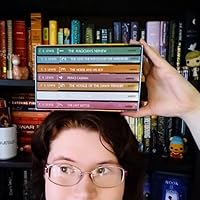
A recent series of books, ostensibly targeted to young adult readers, were published simultaneously as a lead-in to the new movie. Indeed, written on the covers of these books are the words “Journey to Star Wars: The Force Awakens”, in case one forgets.
I am unsure of the order in which these books are to be read, if indeed there is an order, as no indication is given about that. Most, if not all of them, appear to be stand-alone novels.
I read Jason Fry’s “The Weapon of a Jedi” first, which indicates on the dust jacket that the story is set between “A New Hope” and “The Empire Strikes Back”. It also indicates that there are supposed to be clues to characters and events in “The Force Awakens”.
Fry’s writing is good, nothing spectacular. The novel is short, probably best described as a novella. It’s a quick, enjoyable read.
What Fry does really well in this story is take a well-loved character---in this case, Luke Skywalker---and expand on what we already know about him. The story takes place after the Battle of Yavin. Luke is being lauded as the young X-wing pilot who single-handedly destroyed the Death Star. Secretly, he doesn’t like the accolades and attention. He just wants to fight for the Rebel Alliance and fly his X-wing. Unfortunately, within him stirs the embryonic Force of a fledgling Jedi Knight, the last and only Jedi Knight in the universe.
Without a master to help teach him the ways of the Force, Luke must learn to utilize and hone his powers himself. Much of the book is set within Luke’s head, as he deals with the fact that his destiny lies within the Force.
What Fry doesn’t do really well in this book is create action or give any hints as to what his main point is.
The main problem with the book is that it seems to be solely written as a way to introduce a new character, Sarco Plank, who presumably plays an important part in the new movie, or subsequent movies. Having seen the new movie, Sarco’s character in the film is on-screen for approximately one second, doesn’t speak, has absolutely no relevance to the film’s storyline, and isn’t even named (as far as I recall).
I can only assume that Sarco’s character will have a bigger part in the next two films.*
Basically, “The Weapon of a Jedi” is less of a novel than it is a bit of merchandise and an advertisement for the new movie. I’m hoping that the other books in this “new canon” succeed where Fry’s novel fails.
*8/1/2022 addendum: He doesn't. At all.