

What do you think?

Taj Mahal: A History from Beginning to Present
Taj Mahal * * *Download for FREE on Kindle Unlimited + Free BONUS Inside!* * * Read On Your Computer, MAC, Smartphone, Kindle Reader, iPad, or Tablet. The Taj Mahal in Agra is arguably the most iconic image of India and is visited by eight million tourists annually. It was characterized as “pure, perfect and unutterably lovely” by the British Viceroy, Lord Curzon, and in 1983, UNESCO declared it a World Heritage Site of “outstanding universal value.” For centuries the world has believed that it was built by Shah Jahan in 1631 to immortalize his love for his wife, Mumtaz Mahal. Certain mysteries and myths that surround the monument have recently come to the fore in the country, stimulating a public debate about the place it holds as a true representation of Indian culture. Inside you will read about... ✓ The Life of Mumtaz The Jewel of the Palace ✓ The Building of the Taj Mahal ✓ A UNESCO World Heritage Site ✓ Myths, Conjecture, and Controversy ✓ The 22 Locked Rooms in the Basement And much more! This book presents the five main historical figures of the Mughal Empire in India during that period as well as many details of how the Taj Mahal was built. It traces the events that have led to the present controversy.
108 pages, Kindle Edition
Published January 9, 2018
About the author
Hourly History
860 books911 followersAt Hourly History, we focus on publishing history books that are concise, straightforward and take no longer than one hour to read.
Receive our new eBooks for free every Friday.
Sign up at: www.hourlyhistory.com/free
Receive our new eBooks for free every Friday.
Sign up at: www.hourlyhistory.com/free
Ratings & Reviews
Friends & Following
Create a free account to discover what your friends think of this book!
Community Reviews
Displaying 1 - 15 of 15 reviews

October 13, 2021
Very good book, a lot of history behind the Taj & a very interesting one it is. I recommend this book to anyone that enjoys history.
August 7, 2022
I barely knew anything about the Taj Mahal before reading this so I learned quite a bit.
I didn't find it to be very well written though, at some points it seemed various facts from other sources were just listed in no particular order, without a proper narrative flow.
The interesting thing for me was just learning a little bit about the overall context of the Mughal Empire and about Shah Jahan.
Apparently he was a very energetic and aggressive man. I was amazed to learn that he moved 36 times between 1628 and 1657 with each move requiring 100,000 bulls to cart everything. That speaks to a very particular personality.
I later read that in current dollars it cost over 1 billion dollars which is pretty impressive considering the world economy was much smaller back then.
This made me curious about the economic consequences of building this. Would this amount of resources have been better spent? Perhaps on military defense or building roads? Apparently extravagant spending was one of the reasons why Shah Jahan was overthrown by his son.
And finally I tried to learn a bit about the architecture, but it was a bit hard to visualize since there are no pictures. But the idea that there was a lot of symmetry is interesting.
Overall it was pretty interesting, hopefully I get to visit this building I've been hearing about all my life one day!
I didn't find it to be very well written though, at some points it seemed various facts from other sources were just listed in no particular order, without a proper narrative flow.
The interesting thing for me was just learning a little bit about the overall context of the Mughal Empire and about Shah Jahan.
Apparently he was a very energetic and aggressive man. I was amazed to learn that he moved 36 times between 1628 and 1657 with each move requiring 100,000 bulls to cart everything. That speaks to a very particular personality.
I later read that in current dollars it cost over 1 billion dollars which is pretty impressive considering the world economy was much smaller back then.
This made me curious about the economic consequences of building this. Would this amount of resources have been better spent? Perhaps on military defense or building roads? Apparently extravagant spending was one of the reasons why Shah Jahan was overthrown by his son.
And finally I tried to learn a bit about the architecture, but it was a bit hard to visualize since there are no pictures. But the idea that there was a lot of symmetry is interesting.
Overall it was pretty interesting, hopefully I get to visit this building I've been hearing about all my life one day!

January 13, 2022
4 stars
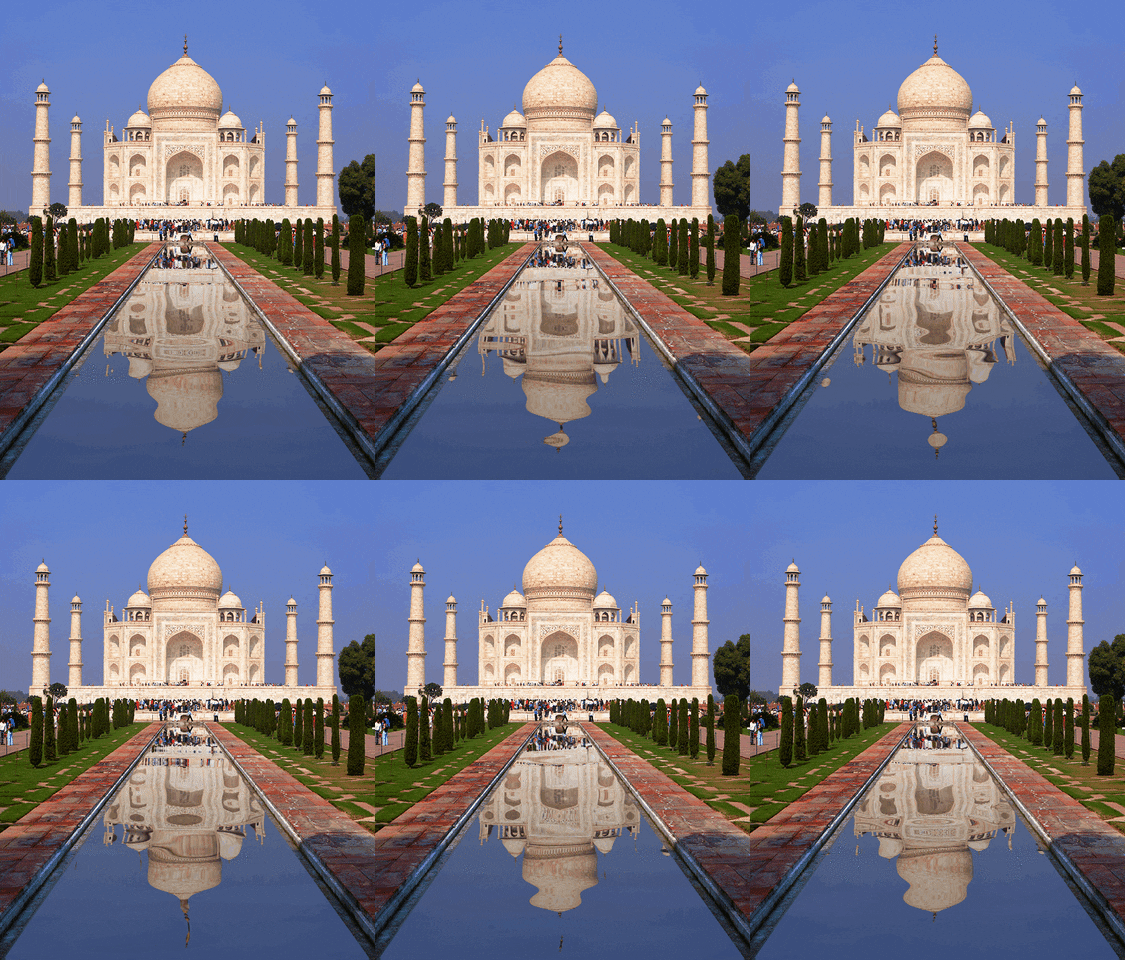
I visited the Taj Mahal a few months back and wanted to refresh my memory around it, hence landed upon this book which turned out to be a good choice. First things First, Taj is something that you need to see vs read. However, if someone is interested to know about this one of the seven wonders of the world, then it's a good book to start with. The book is short, precise and highlights the points that are relevant from a short read. It covers its history, reasoning behind its architecture, attacks faced by it, and development later.
The book ends with the controversy related to it which I'll say was an interesting part. A few things I learned were like:
- Taj has been covered during world war 2/1971 war so it cannot be destroyed or used as a marker by an enemy.
- A person named Natwarlal fraudulently sold Taj.
- It confirmed that Shah Jahan never cut the hands of 20000 laborers once taj was built (something our guide in taj said as well).
Overall, a good read, and will recommend it to someone interested in it.
I visited the Taj Mahal a few months back and wanted to refresh my memory around it, hence landed upon this book which turned out to be a good choice. First things First, Taj is something that you need to see vs read. However, if someone is interested to know about this one of the seven wonders of the world, then it's a good book to start with. The book is short, precise and highlights the points that are relevant from a short read. It covers its history, reasoning behind its architecture, attacks faced by it, and development later.
The book ends with the controversy related to it which I'll say was an interesting part. A few things I learned were like:
- Taj has been covered during world war 2/1971 war so it cannot be destroyed or used as a marker by an enemy.
- A person named Natwarlal fraudulently sold Taj.
- It confirmed that Shah Jahan never cut the hands of 20000 laborers once taj was built (something our guide in taj said as well).
Overall, a good read, and will recommend it to someone interested in it.
March 2, 2022
This is an engaging history of one of the wonders of the world. The book focuses on the story of Shah Jahan and his love for Mumtaz Mahal, for whom the Taj Mahal was built as a tomb; however, it also focuses on the architecture of the monument. It offers some interesting insights into Islamic architecture, introducing the reader to concepts such as hasht-bihisti, or the Eight Gardens of Heaven, a room layout favored by Muslim architects. It finally offers a brief overview of the Taj Mahal's modern history and the threats to its survival.

January 15, 2018
The writer(s) at Hourly History have once again excelled in their research and writing skills by taking a fairly mundane topic, a building, and creating a fascinating web of history, culture, engineering, politics and religion. My mental picture of the Taj Mahal has been enriched a thousand fold. This book has also given me an amazing insight into the religious and political winds swirling around the Taj Mahal.
July 5, 2018
Very well articulated, give a holistic view of history!
Include some pictures in between to show the complex yet beautiful symmetry of the taj mahal. Thanks a lot for sharing the history so nicely
Include some pictures in between to show the complex yet beautiful symmetry of the taj mahal. Thanks a lot for sharing the history so nicely

January 18, 2018
Informative
This book was very informative. An amazing amount of love that he had for his late wife to build such an incredible monument.
This book was very informative. An amazing amount of love that he had for his late wife to build such an incredible monument.

February 16, 2018
While some of this was a bit over my head, I was in awe of the history surrounding this amazing landmark. To see it should be on everyone's bucket list
September 14, 2018
Mediocre
A fair overview of a famous monument, but the prose reads like every paper I wrote my freshman year of college.
A fair overview of a famous monument, but the prose reads like every paper I wrote my freshman year of college.

January 1, 2020
Interesting
I learned a lot that I hadn't previously about the construction of the Taj Mahal. I appreciated the contextualization in the modern era.
I learned a lot that I hadn't previously about the construction of the Taj Mahal. I appreciated the contextualization in the modern era.
July 3, 2020
Nice
There's a lot of anti-Muslim opinion these days because of the extremists. Honestly, I didn't know the Taj :) was built by a Muslim leader. I'm one of them as hasn't seen it!
There's a lot of anti-Muslim opinion these days because of the extremists. Honestly, I didn't know the Taj :) was built by a Muslim leader. I'm one of them as hasn't seen it!
March 17, 2022
Interesting
I enjoyed reading the book but I found it a rather personal experience of the Taj. I found it a beautiful serene place, but to me it was also a cold and sterile place.
I enjoyed reading the book but I found it a rather personal experience of the Taj. I found it a beautiful serene place, but to me it was also a cold and sterile place.

November 13, 2023
I would have like more on the actual site and not all of the fluff that was added.

June 13, 2021
An interesting overview of this magnificent structure. Construction started in 1632 and took 21 years to complete. Ruler Shah Jahan ordered the structure built as a tomb for his favorite wife Mumtaz Mahal and he spared no expense in the design and execution of that design. Since he was an enthusiastic advocate of architecture he himself oversaw all aspects of the architectural design. I was a bit surprised that the dominant religion of that day was not Hindu but Islam. Shah Jahan was himself Muslim. Once complete the body of his wife Mumtaz Mahal was transferred there. Shah Jahan was himself buried there alongside his wife.
Maintenance of the structure wavered somewhat over the centuries but the Taj Mahal remains the prime destination of eight million tourists every year. It earns twice the income of the next rival Indian structure, the Red Fort.
Maintenance of the structure wavered somewhat over the centuries but the Taj Mahal remains the prime destination of eight million tourists every year. It earns twice the income of the next rival Indian structure, the Red Fort.
October 11, 2019
The opening lines of this book explain that 'romantic love' is an idea that wasn't popular until the 19th and 20th centuries. Before that time, people talked about their love of their country or king or God. Romantic love stories emerged as the novel emerged. The story of the Taj Mahal is definitely a tale of romantic love.
Much of the book is about the efforts to maintain this Wonder of the World for future generations. The video and photos added so much to the enjoyment of this book. This is a quick overview of the Taj Mahal; it is great for whetting one's interest in this unique mausoleum.
Much of the book is about the efforts to maintain this Wonder of the World for future generations. The video and photos added so much to the enjoyment of this book. This is a quick overview of the Taj Mahal; it is great for whetting one's interest in this unique mausoleum.
Displaying 1 - 15 of 15 reviews