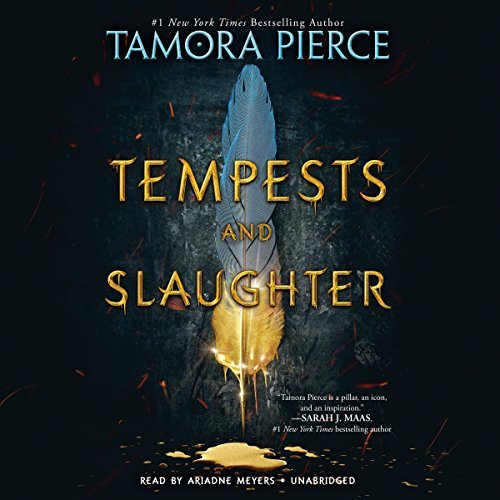
A preface to this review: it’s not hyperbole to say that this is the book I have been waiting longer for than any other. I first read Tamora Pierce’s work in the early 2000s, and I remember being thrilled when Lady Knight came out in hardcover in 2002. It’s safe to say I’ve been anticipating the promised ‘Young Numair book’ for around fifteen years - over half my lifespan.
And now it’s here and… I can’t help feeling like if I hadn’t been anticipating it, I wouldn’t particularly care.
Here’s the thing. Tamora Pierce has done the ‘early years at a fantasy school’ thing before, three times by my count, and she’s done it better, with more sense of plot momentum and purpose. In all three instances, her characters had clear goals and threats - Alanna reaches for her knighthood while struggling to keep her gender secret; Kel spends her first year on probation; the Circle kids have to learn to live together or risk their futures. Tempests and Slaughter just… doesn’t have that. There’s no sense of destination. Events just occur, and while I can see how they’ll be groundwork for later books, it leaves this installment feeling almost pointless. I expected the climax to result in Ozorne becoming heir - a turning point for all three main characters, and one that approaches throughout the book as other heirs in the line of succession die - but even that hasn’t happened yet.
Don’t get me wrong - I appreciate and enjoy the opportunity to see into these characters’ origins. Ozorne is the most fascinating, because he seems genuinely sweet until he starts kicking people in the street - he’s volatile and at times terrifying, but I was left with a strong sense that the later events of his life were, to a degree, an accident of birth; that in a different family, he might have turned out okay. Anyone who’s read the Immortals Quartet knows the kind of emperor he will become, and his background doesn’t absolve him of responsibility for his choices or his crimes, but… it does make them even more of a tragedy.
Varice Kingsford is, too, a tragedy in the making. I’ve never disliked her; as she says in Emperor Mage, she just wants to make beautiful things, and that’s no crime. Here, we get to see her as a spirited, fiercely loyal young woman… but, simultaneously, as someone who takes no issue with the status quo as long as she gets to be in the middle of it. It’s easy to see how this will drive Arram/Numair away from her, as he grows stronger in his convictions that something is rotten in the empire of Carthak.
And Arram - oh, Arram. Confession time: I’ve been half in love with Numair Salmalin since I was about eleven, and so of course that affection extended to his adolescent self*. He’s fundamentally good in a way that I just adore, juggling for the children of typhoid patients and doing favors for gods and trying to satiate the endless spring of his curiosity. Like most of Tamora Pierce’s protagonists, his sense of justice gets him into fights he can’t win. And… also like most of her protagonists, he has to deal with puberty and his own sexual awakening. I should have expected this, given the frank way Pierce has always treated menstruation and contraception when writing about women, but reading about Arram’s first ‘morning wood’ took me by surprise. Still, I respect the fact that she didn’t shy away from that aspect of coming-of-age, and that Arram has several different romantic relationships in his adolescence - a realistic detail which is so often missing in recent young adult novels.
If this book had covered less time, but been more rich in its details and interactions, I think it might have been stronger. I know that Numair and Ozorne were friends, but I’m not as emotionally invested in that friendship as I thought I would be. Perhaps this is on me, for coming into this book with so many expectations, but I anticipated the friendship between Arram, Ozorne, and Varice being the heart of this series, and that makes it weird that long chunks of this book are spent with Arram away from his companions.
I’m still looking forward to the rest of the series, of course. Honestly, because I’d always sort of expected this prequel series to focus on Arram in his late teens at the earliest, I expect I’ll take to the later books better - there won’t be as much of a jarring disconnect between the anticipations I’ve built up and the reality.
(*reading about your biggest fictional crush as a child half your age is really Weird and kind of uncomfortable at points, and it required a bit of doublethink for me to get through it.)