

What do you think?
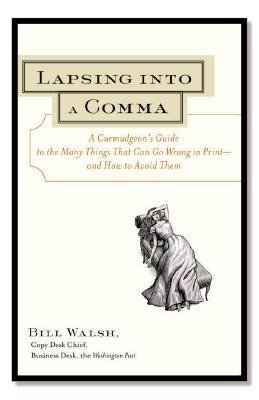
Lapsing Into a Comma: A Curmudgeon’s Guide to the Many Things That Can Go Wrong in Print—and How to Avoid Them
No writer's or editor's desk is complete without a battered, page-bent copy of the AP Stylebook. However, this not-so-easy-to-use reference of journalistic style is often not up-to-date and leaves reporters and copyeditors unsatisfied.
Bill Walsh, copy chief for the Washington Post's business desk, addresses these shortcomings in Lapsing into a Comma. In an opinionated, humorous, and yes, curmudgeonly way, he shows how to apply the basic rules to unique, modern grammar issues. Walsh explains how to deal with perplexing situations such as trendy words, foreign terms, and web speak.
Bill Walsh, copy chief for the Washington Post's business desk, addresses these shortcomings in Lapsing into a Comma. In an opinionated, humorous, and yes, curmudgeonly way, he shows how to apply the basic rules to unique, modern grammar issues. Walsh explains how to deal with perplexing situations such as trendy words, foreign terms, and web speak.
256 pages, Paperback
First published August 1, 2000
About the author
Bill Walsh
4 books29 followersLibrarian note:
There is more than one author in the GoodReads database with this name
Bill Walsh was born in Pottsville, Pa., and grew up in Madison Heights, Mich., and Mesa, Ariz. He is a 1984 journalism graduate of the University of Arizona and has worked as a reporter and editor at the Phoenix Gazette and an editor at the Washington Times and the Washington Post. He is now a multiplatform editor at the Post.
There is more than one author in the GoodReads database with this name
Bill Walsh was born in Pottsville, Pa., and grew up in Madison Heights, Mich., and Mesa, Ariz. He is a 1984 journalism graduate of the University of Arizona and has worked as a reporter and editor at the Phoenix Gazette and an editor at the Washington Times and the Washington Post. He is now a multiplatform editor at the Post.
Ratings & Reviews
Friends & Following
Create a free account to discover what your friends think of this book!
Community Reviews
Displaying 1 - 30 of 74 reviews

March 13, 2013
I'm being an asshole and rating this one star instead of the three I think it deserves because I think the author is an asshole. Seems fair. The text is riddled with half-hearted attempts at making jabs at non-white, -cis, -male folks funny. My personal favorite is this part of the entry under gender, sex in the style guide: "An evolution of gender I'm not willing to accept is its politicization. People who content that no sexual behavior should be considered unusual have adopted the word to express such thoughts as Johnny is a member of the male sex, but he likes to wear dresses, so he's of the female gender." I cannot even begin to figure out whether Walsh is being deliberately obtuse or trying to make folks sound stupid, but whatever. One star for you. Probably more useful for those dealing with AP Style, I wouldn't buy this if Walsh were going to get any money, so try to get it used.

July 31, 2018
Every author should probably have this book on their nightstands, and read a chapter every night before going to bed. That’s where my copy is now. Plus a copy of “The Elephants of Style” by the same author – Bill Walsh. This book should be every author’s “bible.”
To be honest, the title of the book gave away that it is brilliant. The word play is clever but more importantly, it hints at that Bill Walsh encourages his readers TO THINK.
Chapter 1 is titled,” Beyond Search and Replace, Using Your Head as Well as Your Stylebook.” Walsh warns, “Be skeptical of stylebooks.” And, he takes things from there.
Walsh dedicates a lot of space to covering “He or she,” “him or her”, “his or her,” “his or hers; he also covers profanity and “physical descriptions.” This is information all of us can use.
Which can be explained very quickly when reading the section, “Dirty Mind, Clean Copy, Why Every Copy Desk Could Use a 13-Year-Old Boy.
[quote] “....In trying to think of a headline for a reporter’s first-person account of the wonders of his Palm hand-held computer (they’re no longer called Palm Pilots) my first idea was ‘A Man and His Palm: A Love Story.”...”
Yes, this style book is funny, too. Very funny. Reading this book, you’ll think about things you never thought about. A good example: The difference between Preschool and Pre-school. pre-school is an adjective that means “before school.” And – the term pre-school-age children might also refer to newborns. Right. I knew that, so why did I use these words incorrectly, at least half a dozen times?
Naturally, I also found out that I made an error in my last book (and my editor did not see it). In my book I wrote, “Presently, Johnny sang his signature song...”
This was the first time, I used the word “presently” in any book (and I have written more than twenty.) Walsh advises, “PRESENTLY The traditional meaning is “in a short while.” Avoid using it as a synonym for “currently.”
Can you see why you need to read this book?
Finally, as a boxing fan, I want to give a shout-out to Bill Walsh for using many examples from the world of boxing. All are well-chosen (and rare).
For instance, in the section “African-American” vs. “Black,’ Walsh writes, “ There is no racial difference between African-Americans and African-Canadians, so how can African-American constitute a race? I suppose you could refer to boxer Frank Bruno as an African-Briton, ...
5 stars, I am a fan,
Gisela Hausmann, author and blogger
To be honest, the title of the book gave away that it is brilliant. The word play is clever but more importantly, it hints at that Bill Walsh encourages his readers TO THINK.
Chapter 1 is titled,” Beyond Search and Replace, Using Your Head as Well as Your Stylebook.” Walsh warns, “Be skeptical of stylebooks.” And, he takes things from there.
Walsh dedicates a lot of space to covering “He or she,” “him or her”, “his or her,” “his or hers; he also covers profanity and “physical descriptions.” This is information all of us can use.
Which can be explained very quickly when reading the section, “Dirty Mind, Clean Copy, Why Every Copy Desk Could Use a 13-Year-Old Boy.
[quote] “....In trying to think of a headline for a reporter’s first-person account of the wonders of his Palm hand-held computer (they’re no longer called Palm Pilots) my first idea was ‘A Man and His Palm: A Love Story.”...”
Yes, this style book is funny, too. Very funny. Reading this book, you’ll think about things you never thought about. A good example: The difference between Preschool and Pre-school. pre-school is an adjective that means “before school.” And – the term pre-school-age children might also refer to newborns. Right. I knew that, so why did I use these words incorrectly, at least half a dozen times?
Naturally, I also found out that I made an error in my last book (and my editor did not see it). In my book I wrote, “Presently, Johnny sang his signature song...”
This was the first time, I used the word “presently” in any book (and I have written more than twenty.) Walsh advises, “PRESENTLY The traditional meaning is “in a short while.” Avoid using it as a synonym for “currently.”
Can you see why you need to read this book?
Finally, as a boxing fan, I want to give a shout-out to Bill Walsh for using many examples from the world of boxing. All are well-chosen (and rare).
For instance, in the section “African-American” vs. “Black,’ Walsh writes, “ There is no racial difference between African-Americans and African-Canadians, so how can African-American constitute a race? I suppose you could refer to boxer Frank Bruno as an African-Briton, ...
5 stars, I am a fan,
Gisela Hausmann, author and blogger

January 8, 2019
I’m not going to finish this book. Forget “curmudgeon”, this author is abrasive and arrogant. I’m also not sure who was the intended audience. It’s not humorous enough to read for entertainment and not thorough enough to be saved as a desk reference style guide.
December 13, 2015
It's good but I've noticed books by grammar people have a tendency to slide into reactionary talking-points

March 21, 2019
Stylebooks are living, breathing documents. English evolves constantly. So reading a book published nearly a generation ago about journalism and best practices was a little trippy. The best way to describe Bill Walsh’s “Lapsing into a Comma: A curmudgeon’s guide to the many things that can go wrong in print – and how to avoid them” is that it serves as a time capsule. (It was published in 2000.)
There are recommendations in here that have fallen by the wayside (does anyone even use the term “world wide web” anymore?) or been overruled by the Associated Press editors. There are pop culture and political references in here that are kind of quaint now. (Borders! Alta Vista! Newt Gingrich!) But worst, there are some attitudes about LGBTQ folks in “Lapsing into a Comma” that have aged poorly and well, if you know me, I disagree with them. A lot.
That said, the most valuable point in this book comes from one of the first lines, “Be skeptical of stylebooks.” In general, I like this attitude because editors shouldn’t thoughtlessly follow “the rules.” We should understand the logic behind them and know when deviate from them. That’s the best part of this book.
For me, the most valuable things in here were the notes on punctuation and display text. I’m a better editor for having read those parts.
I apologize for the delay in getting this review done, I had a computer issue and then well, a bunch of time-sensitive things had to get done. The good news is that I had some time to reflect on the material in here and digest it.
If I were ever to teach an editing class, I’d use this book as an assignment and ask the two following questions: What advice should we follow? What advice should we ignore?
There are recommendations in here that have fallen by the wayside (does anyone even use the term “world wide web” anymore?) or been overruled by the Associated Press editors. There are pop culture and political references in here that are kind of quaint now. (Borders! Alta Vista! Newt Gingrich!) But worst, there are some attitudes about LGBTQ folks in “Lapsing into a Comma” that have aged poorly and well, if you know me, I disagree with them. A lot.
That said, the most valuable point in this book comes from one of the first lines, “Be skeptical of stylebooks.” In general, I like this attitude because editors shouldn’t thoughtlessly follow “the rules.” We should understand the logic behind them and know when deviate from them. That’s the best part of this book.
For me, the most valuable things in here were the notes on punctuation and display text. I’m a better editor for having read those parts.
I apologize for the delay in getting this review done, I had a computer issue and then well, a bunch of time-sensitive things had to get done. The good news is that I had some time to reflect on the material in here and digest it.
If I were ever to teach an editing class, I’d use this book as an assignment and ask the two following questions: What advice should we follow? What advice should we ignore?

September 12, 2019
It turns out that this book was on my shelf for a long time before I even added it to my to-read list, and then it languished far too long on the list. It's Bill Walsh, so it's solid and fun to read, but its salient characteristic is that it is outdated. More often than anything else I was wondering whether he would still be holding on to some of the preferences he was holding on to somewhat stubbornly even in 2000, although some of those preferences he would clearly have had to give up the fight for long ago. I enjoyed "The Elephants of Style" more.

March 23, 2015
This was a very fun book to dip in and out of for a few weeks. Its target audience is really folks working in the (dying) print newspaper business rather than the casual reader/writer with a penchant for thinking about style and grammar, but I still got a lot out of it. Walsh brings not only a wealth of editing experience to this book but also a winning and charming wit; for example, when he takes on the rapidly deteriorating standards for grammatical rules governing the proper spelling of names in our new “virtual,” overly-branded world, he writes:
Funny, right? One of my favorite entries in his “Curmudgeon’s Stylebook” is for “Reese’s Monkeys”: “Unless they’re chocolate on the outside and peanut butter on the inside, you probably mean Rhesus monkeys.”
I recognized a lot of errors I see in other people’s writing as well as errors I am prone to make myself. I also had to stop myself every now and then and think about what I just read (“hey, that’s right – when Homer Simpson refers to the Flanderses next door, he is correct!”) Inevitably, there are things I passionately disagree about; the most serious stylistic error Walsh makes is not to insist that writers use a serial comma (or “Oxford comma”) immediately before the coordinating conjunction in a series of three or more terms (it should read “cars, bikes, and trucks” NOT “cars, bikes and trucks” – that’s just so wrong!)
It’s always fun to catch an inevitable typo in a book about style – when Walsh discusses “retronyms” (“…the addition to a word of a qualifier that once would have seemed painfully redundant,” i.e. postal mail), he starts huffing and puffing and writes, “Mail doesn’t mean ‘postal mail’ to you in a non-AOL-start-up-screen situation? Say gin martini in front of me an you’d think I was on the Tanqueray payroll.” I’d also think you’ve had enough of those martinis to start slurring your conjunctions into articles!
Finally, look at that excerpt I just used – AOL? And don’t most of us think of “e-mail” (Walsh insists on the hyphen, and I agree!) when we hear “mail” and not “postal mail?” The point is that the book is very dated, at least the year 2000 edition that I read. The English language has changed dramatically with computers, social media, and the Web now being our primary mode of written communication and Walsh’s book seems a bit slow on the uptake. In addition, sometimes his examples seem painfully idiosyncratic – the amount of time he spends talking about fast-food brand names, Playboy, and sports either reflects what is going on at the business desk of the Washington Post or whatever is happening in his own life, but either way that makes me a little sad.
Ultimately, though, this book is fun and informative and I think most readers will actually enjoy sitting down to think about how they and others use language.
…people don’t trust these simple rules anymore. They all laughed when Sarah Jessica Parker’s character in the movie “L.A. Story” gave her name as “SanDeE*,” but now this crap is being taken seriously. The dot-com era has leveled a wall that Adidas and K.D. Lang and “Thirtysomething” had already cracked, and suddenly writers and editors faced with a name are asking “Is that capitalized?” – a question that’s about as appropriate as asking a 5-year-old “Do you want that Coke with or without rum?”
Funny, right? One of my favorite entries in his “Curmudgeon’s Stylebook” is for “Reese’s Monkeys”: “Unless they’re chocolate on the outside and peanut butter on the inside, you probably mean Rhesus monkeys.”
I recognized a lot of errors I see in other people’s writing as well as errors I am prone to make myself. I also had to stop myself every now and then and think about what I just read (“hey, that’s right – when Homer Simpson refers to the Flanderses next door, he is correct!”) Inevitably, there are things I passionately disagree about; the most serious stylistic error Walsh makes is not to insist that writers use a serial comma (or “Oxford comma”) immediately before the coordinating conjunction in a series of three or more terms (it should read “cars, bikes, and trucks” NOT “cars, bikes and trucks” – that’s just so wrong!)
It’s always fun to catch an inevitable typo in a book about style – when Walsh discusses “retronyms” (“…the addition to a word of a qualifier that once would have seemed painfully redundant,” i.e. postal mail), he starts huffing and puffing and writes, “Mail doesn’t mean ‘postal mail’ to you in a non-AOL-start-up-screen situation? Say gin martini in front of me an you’d think I was on the Tanqueray payroll.” I’d also think you’ve had enough of those martinis to start slurring your conjunctions into articles!
Finally, look at that excerpt I just used – AOL? And don’t most of us think of “e-mail” (Walsh insists on the hyphen, and I agree!) when we hear “mail” and not “postal mail?” The point is that the book is very dated, at least the year 2000 edition that I read. The English language has changed dramatically with computers, social media, and the Web now being our primary mode of written communication and Walsh’s book seems a bit slow on the uptake. In addition, sometimes his examples seem painfully idiosyncratic – the amount of time he spends talking about fast-food brand names, Playboy, and sports either reflects what is going on at the business desk of the Washington Post or whatever is happening in his own life, but either way that makes me a little sad.
Ultimately, though, this book is fun and informative and I think most readers will actually enjoy sitting down to think about how they and others use language.

January 29, 2008
One complaint I have with this website is the rating system. I wish three stars meant more of a middle ground, but unfortunately, two stars gets the "it was OK" rating. So, on my scale, this book would get three stars, but it was only OK. It was definitely not as entertaining or practical as Lynne Truss's book "Eats, Shoots and Leaves." This book was written more as a reference book, and more for newspaper writers/editors.
I did learn some interesting things, but I probably won't remember most of them. There is one thing I would like to point out, though, as I am on the topic of a grammar and punctuation book. I didn't think this was a common problem among American people, but as the Christmas cards and letters started coming in last year, I realized that it is a huge problem, even among highly educated people. Here goes. . . .
When a family name is signed on a letter, an apostrophe makes the name possessive. This is not the intent when signing your name!
For example, if I were to receive a letter that said, "Love, The Smith's" I would instantly think: the Smith's what? The Smith's Christmas newsletter? The Smith's expression of horrible punctuation? WHAT?! Instead, the Smiths should simply make their name plural by adding an s: "Love, The Smiths."
If you disagree with me, email me and I will direct you to plenty of punctuation websites that prove this is true. Please, please, please don't add an apostrophe!!!! Lynne Truss states that those of us with names ending in s have a choice to make: Truss' or Truss's. Some websites say no apostrophe should be used, and that it should be Trusses. I'm still doing my research on this one. . . .
One more English lesson for the day, and this rule is similar to, although opposite from, the one listed above. Only add an apostrophe to "its" if you are joining two words. If you are making it possessive, DO NOT add an apostrophe:
It's going to rain today. It's been a good life.
Freedom has its price. Life has its ups and downs.
If in doubt, ask yourself if the sentence would function as "it is" or "it has." If so, use an apostrophe. If not, don't!
Back to the book review: I believe I am a huge stickler for good punctuation and grammar, but this author takes that to the extreme. He is very intense; much more so than the average writer.
I did learn some interesting things, but I probably won't remember most of them. There is one thing I would like to point out, though, as I am on the topic of a grammar and punctuation book. I didn't think this was a common problem among American people, but as the Christmas cards and letters started coming in last year, I realized that it is a huge problem, even among highly educated people. Here goes. . . .
When a family name is signed on a letter, an apostrophe makes the name possessive. This is not the intent when signing your name!
For example, if I were to receive a letter that said, "Love, The Smith's" I would instantly think: the Smith's what? The Smith's Christmas newsletter? The Smith's expression of horrible punctuation? WHAT?! Instead, the Smiths should simply make their name plural by adding an s: "Love, The Smiths."
If you disagree with me, email me and I will direct you to plenty of punctuation websites that prove this is true. Please, please, please don't add an apostrophe!!!! Lynne Truss states that those of us with names ending in s have a choice to make: Truss' or Truss's. Some websites say no apostrophe should be used, and that it should be Trusses. I'm still doing my research on this one. . . .
One more English lesson for the day, and this rule is similar to, although opposite from, the one listed above. Only add an apostrophe to "its" if you are joining two words. If you are making it possessive, DO NOT add an apostrophe:
It's going to rain today. It's been a good life.
Freedom has its price. Life has its ups and downs.
If in doubt, ask yourself if the sentence would function as "it is" or "it has." If so, use an apostrophe. If not, don't!
Back to the book review: I believe I am a huge stickler for good punctuation and grammar, but this author takes that to the extreme. He is very intense; much more so than the average writer.
August 11, 2008
Although this book is written primarily for newspaper editors and doesn't focus that much on book publishing, it is still a very handy copyediting reference, particularly for more contemporary terms that are still evolving. The tone is humorous and it was a surprisingly entertaining read for a style guide.

July 17, 2007
This book makes copyediting fun -- great writing style with useful tips/guidelines.

February 14, 2021
Bill Walsh makes it clear that he is a liberal copy editor for the Washington Post...and that's fine. I have no problem reading books written by liberals on how to write propr sentences. But, he won't get a 5 star rating from me because stating his political bias has nothing to do with writing proper sentences, and insulting the right-wing by calling them "kooks" (p. 26) has nothing to do with sentence structure. On the other hand he did use CNN as an example of lying journalists (p. 62). Something we all know but lefts won't ever admit. CNN came to the pinnacle of their lies in 2016 when Donald Trump became President, and they continue to this day.
Times have sure changed since the publishing of this book in 2000, or Bill Walsh was clueless of the facts that mainly left-wing politicians (Democrats) and some Republicans are the ones leading us to a one-world government, not the "right-wing-conspiracy-nut community", as he claims (p. 87). Today, in 2018, the media is following the left, along with the uninformed and the millennials who are attending college today are being indoctrinated with this socialist one-world propaganda. That's why there is such a division and escalating chaos here in America today. Walsh is no longer with us today to see that this transition in the U.S. is true and being lead by the left-wing-conspiracy-nut community. He died March 15, 2017.
Now, see? Wouldn't it have been better had he left out all the jabs towards the people on the right and kept the focus on the proper way of writing sentences? Bill Walsh was known as the "Grammar Geek" of the Washington Post. Regardless, there really are a lot of good writing tips in here. That...I can appreciate!
The Enlish language is forever evolving and sometimes there are no hard and fast rules for phrasing sentences and word use. Some of it is purely editor's preference.
Words are added or removed from dictionaries depending on how often they are used or not. Words can become so popular even if it's wrong. For example: Hacker is really a person who knows commuter programming very well. Cracker is one who looks for ways to criminally break into commuters to steal identities and such. But, somehow someone got away with using the word hacker and it became so popular and is now the word for criminals breaking into computers, and you might even be hard-pressed to even find the original meaning of cracker in today's dictionary because it is politically unacceptable.
Chapter 10, which is the last half of the book, is Bill Walsh's search-and-replace editing style guide of words and phrases he doesn't like to see in newsprint and he gives suggestions on the proper words and phrases to use in its place. A lot of this information can apply to other writings as well. He goes over the subtle play on words, hyphens and punctuations that could slightly change the meaning of a sentence ... some things I never would have thought about.
Times have sure changed since the publishing of this book in 2000, or Bill Walsh was clueless of the facts that mainly left-wing politicians (Democrats) and some Republicans are the ones leading us to a one-world government, not the "right-wing-conspiracy-nut community", as he claims (p. 87). Today, in 2018, the media is following the left, along with the uninformed and the millennials who are attending college today are being indoctrinated with this socialist one-world propaganda. That's why there is such a division and escalating chaos here in America today. Walsh is no longer with us today to see that this transition in the U.S. is true and being lead by the left-wing-conspiracy-nut community. He died March 15, 2017.
Now, see? Wouldn't it have been better had he left out all the jabs towards the people on the right and kept the focus on the proper way of writing sentences? Bill Walsh was known as the "Grammar Geek" of the Washington Post. Regardless, there really are a lot of good writing tips in here. That...I can appreciate!
The Enlish language is forever evolving and sometimes there are no hard and fast rules for phrasing sentences and word use. Some of it is purely editor's preference.
Words are added or removed from dictionaries depending on how often they are used or not. Words can become so popular even if it's wrong. For example: Hacker is really a person who knows commuter programming very well. Cracker is one who looks for ways to criminally break into commuters to steal identities and such. But, somehow someone got away with using the word hacker and it became so popular and is now the word for criminals breaking into computers, and you might even be hard-pressed to even find the original meaning of cracker in today's dictionary because it is politically unacceptable.
Chapter 10, which is the last half of the book, is Bill Walsh's search-and-replace editing style guide of words and phrases he doesn't like to see in newsprint and he gives suggestions on the proper words and phrases to use in its place. A lot of this information can apply to other writings as well. He goes over the subtle play on words, hyphens and punctuations that could slightly change the meaning of a sentence ... some things I never would have thought about.

November 9, 2023
2.5 stars -- Walsh was a curmudgeon when he wrote this, and since he wrote it in 2000, he comes across as even more of a curmudgeon today. I enjoyed some of the first half of this book, but then again I actually enjoy reading about grammar and linguitics, and how standards change through time. The second half is really just an entry-style reference book that was written to be consumed in 2000 or shortly thereafter, as many of the entries have to do with how the movies stars and famous people of that era spell their names. So really boring. Read as a bathroom book, its small sections make it work. Read as a history book, it might be fun; so maybe wait a few decades and it will actually get better. However, read as just your next normal next book to read: nope. Not recommened unless you are a grammar historian.

January 27, 2026
Bill Walsh’s ‘Lapsing into a comma’ is an invaluable guide to punctuation, and I assume the target audience is writers, editors and anyone interested in mastering the intricacies of punctuation in the English language.
Many may not understand the word, ‘curmudgeon’ a bad-tempered person. Maybe, a grump. Bill Walsh’s use of this word sets the tone, which is opinionated, with a blend of with, humor, plain speak, and strong opinions.
The book is accessible and will not be a problem for anyone to follow. Some may consider him opinionated. Bill Walsh follows the AP stylebook, whereas many essayists may follow the Chicago Manual of Style.
The only problem in the book is that, even though it is lively and easy to follow, it contains so many suggestions that most people will find it hard to remember everything that has been said!
Use the book as a reference.
Many may not understand the word, ‘curmudgeon’ a bad-tempered person. Maybe, a grump. Bill Walsh’s use of this word sets the tone, which is opinionated, with a blend of with, humor, plain speak, and strong opinions.
The book is accessible and will not be a problem for anyone to follow. Some may consider him opinionated. Bill Walsh follows the AP stylebook, whereas many essayists may follow the Chicago Manual of Style.
The only problem in the book is that, even though it is lively and easy to follow, it contains so many suggestions that most people will find it hard to remember everything that has been said!
Use the book as a reference.
November 24, 2022
I purposely hunted down a used copy of this on AbeBooks in February 2014.... then it languished on my shelf until November 2022. It was a pretty quick read, although the style book section was more of a slog than the first half. The standout element to me, however, was how dated the book has become. I can only take so many references to OJ Simpson and the Clintons/Monica Lewinsky. Also, the Internet was still causing all kinds of issues for copy editors in 2000 and I feel that by now, even some of Walsh's adamant defenses are outdated. Is anyone still that riled up about "voicemail" or "email" or Web site vs. Web page?
He's rather abrasive and some of his viewpoints haven't aged particularly well, but I did learn a few things so I suppose it was worth the read.
He's rather abrasive and some of his viewpoints haven't aged particularly well, but I did learn a few things so I suppose it was worth the read.

October 18, 2017
Now that I've read two of Bill Walsh's books, I'm struck by how much material he reuses. (And yes, I realize that this was his first book, but his third book was easiest to track down at my library, so I started there.) Sure, there may be some issues he's really bothered by, but that doesn't mean he should repeat them in print. You said it well once, Bill; now talk about something new!

June 26, 2017
Funny to read a 17 year old book covering weird constructions entering the lexicon then, to realize how many of them either dropped off or became totally normal, and to be reminded of how many of our culture wars get fought on a linguistic battlefield.
May 29, 2020
A fun read, helps to show how grammar and the written word have a strong subjective element. Thoughts derived from years at the editor's desk on how we get it wrong, and how we could try harder to get it right.

September 19, 2021
Mr Walsh’s approach to language, shaped by the technical limitations of 1990s newsrooms, is a miserly one. I can’t readily speak to how valuable this book might be in the newspaper world of today, but it’s certainly a poor guide for anyone who has more than a few hours to write and edit.
October 25, 2019
Word nerds unite!

June 27, 2020
A useful and witty companion to Strunk and White's classic stylebook.

July 9, 2020
Grammar puns? Yes, please.

June 26, 2023
Delightful book for anyone who loves the subtitles of written English. Humorous, witty, clever, entertaining, and enlightening!! Great book!!
December 16, 2024
I learnt a few things, but I found the author’s tone rather arrogant, and sometimes he just said, “this is obviously wrong,” without explaining why, which is not very helpful for a guide.

April 18, 2023
(copied and pasted from my Editing final)
Bill Walsh was (as of 2000) a journalist of nineteen years working at The Washington Post. He designed Lapsing into a Comma: A Curmudgeon’s Guide to the Many Things That Can Go Wrong in Print––and How to Avoid Them with writers and copy editors in mind, but anyone with an interest in linguistics or (though not Walsh’s intention) the evolution of language in the twenty-first century will likely find at least the first third enjoyable and even useful if they’re lucky. The book succeeds in providing Walsh’s perspective on stylistic choices made by copy editors in a clear and often amusing manner, but some of his more passionate opinions were certainly more applicable in 2000 than today.
Consisting of 226 pages, plus index, Lapsing into a Comma spends its first third covering larger topics like Walsh’s many views on compounds, honesty in journalism, and arbitrary capitalization. One primary focus is “disturbing trends in the information age” (p. 13). He holds strong stances on an atrocious trend toward unhyphenating “on-line” and “e-mail,” citing fervent AltaVista searches to support his rapidly escalating disappointment in humanity’s evolving linguistic tastes because of the (consciously capitalized) Internet. He considers website (as opposed to Web site) “gibberish” (p. 223). Over twenty years later, these opinions prompt smirks from readers, but not all of Walsh’s points are irrelevant. He notes, “Internet discourse is unfiltered, and in losing the filter that blocks material without mass appeal, we also lose the filters that separate fact from fiction and standard from substandard language. The power of the usage police has been significantly diluted” (p. 17). Yes, Walsh’s mention of standard versus substandard language reeks mildly of classism and a specific breed of academic pretentiousness, but his position stands: the internet’s contribution to publication unregulated by the Big Five or universities has resulted in less attention paid to grammatical style.
In the last two thirds of Lapsing, Walsh gets specific with “The Curmudgeon’s Stylebook,” which explores intricate details of grammar, spelling, and pronunciation. Though applicable in many editorial contexts, the book is clearly a product of Walsh’s journalism background, as many of its examples center subjects likely to come up in journalism or politics (e.g., Opponents of a bill that would cut the capital-gains tax held a news conference yesterday (p. 97)). Highlights include Walsh’s declaration that he is “pissed” (p. 107) not to be included on one of Hollywood’s fact-checking teams, his careful reminder that the term Books on Tape is trademarked and that audio book is the more legally cautious label, and a recommended hyphen for buck-naked. True, picking out Lapsing’s most outdated and niche style entries may seem to limit a comprehensive review, but I find that they distinguish an overall trend: bottom line, Walsh wrote this book to entertain his audience and present his most nitpicky takes rather than provide a genuinely useful stylebook an editor will pick up as a daily tool.
Lapsing into a Comma’s frequent mentions of the Clinton administration (over two dozen occurrences, for those counting) and reminder that AOL is America Online, not American Online (p. 100), among other indicators, signal the book’s primary limitation: for all Walsh’s laments over wasted ink, many of his rants and recommendations are now entirely irrelevant and transform his book into more amusing cultural artifact than practical copy editing guide. I award him three generous stars; the entertainment value––an amalgamation of intentional dirty humor and gloriously outdated 2000s perspectives on hyphenation––combined with a moderately useful stylebook makes Lapsing into a Comma worth the read, but not worth the money. Check Lapsing out from a library, borrow it from a friend, but barring time travel to an early 2000s newsroom, it’s not quite relevant enough to justify $14.55 from Amazon.
Bill Walsh was (as of 2000) a journalist of nineteen years working at The Washington Post. He designed Lapsing into a Comma: A Curmudgeon’s Guide to the Many Things That Can Go Wrong in Print––and How to Avoid Them with writers and copy editors in mind, but anyone with an interest in linguistics or (though not Walsh’s intention) the evolution of language in the twenty-first century will likely find at least the first third enjoyable and even useful if they’re lucky. The book succeeds in providing Walsh’s perspective on stylistic choices made by copy editors in a clear and often amusing manner, but some of his more passionate opinions were certainly more applicable in 2000 than today.
Consisting of 226 pages, plus index, Lapsing into a Comma spends its first third covering larger topics like Walsh’s many views on compounds, honesty in journalism, and arbitrary capitalization. One primary focus is “disturbing trends in the information age” (p. 13). He holds strong stances on an atrocious trend toward unhyphenating “on-line” and “e-mail,” citing fervent AltaVista searches to support his rapidly escalating disappointment in humanity’s evolving linguistic tastes because of the (consciously capitalized) Internet. He considers website (as opposed to Web site) “gibberish” (p. 223). Over twenty years later, these opinions prompt smirks from readers, but not all of Walsh’s points are irrelevant. He notes, “Internet discourse is unfiltered, and in losing the filter that blocks material without mass appeal, we also lose the filters that separate fact from fiction and standard from substandard language. The power of the usage police has been significantly diluted” (p. 17). Yes, Walsh’s mention of standard versus substandard language reeks mildly of classism and a specific breed of academic pretentiousness, but his position stands: the internet’s contribution to publication unregulated by the Big Five or universities has resulted in less attention paid to grammatical style.
In the last two thirds of Lapsing, Walsh gets specific with “The Curmudgeon’s Stylebook,” which explores intricate details of grammar, spelling, and pronunciation. Though applicable in many editorial contexts, the book is clearly a product of Walsh’s journalism background, as many of its examples center subjects likely to come up in journalism or politics (e.g., Opponents of a bill that would cut the capital-gains tax held a news conference yesterday (p. 97)). Highlights include Walsh’s declaration that he is “pissed” (p. 107) not to be included on one of Hollywood’s fact-checking teams, his careful reminder that the term Books on Tape is trademarked and that audio book is the more legally cautious label, and a recommended hyphen for buck-naked. True, picking out Lapsing’s most outdated and niche style entries may seem to limit a comprehensive review, but I find that they distinguish an overall trend: bottom line, Walsh wrote this book to entertain his audience and present his most nitpicky takes rather than provide a genuinely useful stylebook an editor will pick up as a daily tool.
Lapsing into a Comma’s frequent mentions of the Clinton administration (over two dozen occurrences, for those counting) and reminder that AOL is America Online, not American Online (p. 100), among other indicators, signal the book’s primary limitation: for all Walsh’s laments over wasted ink, many of his rants and recommendations are now entirely irrelevant and transform his book into more amusing cultural artifact than practical copy editing guide. I award him three generous stars; the entertainment value––an amalgamation of intentional dirty humor and gloriously outdated 2000s perspectives on hyphenation––combined with a moderately useful stylebook makes Lapsing into a Comma worth the read, but not worth the money. Check Lapsing out from a library, borrow it from a friend, but barring time travel to an early 2000s newsroom, it’s not quite relevant enough to justify $14.55 from Amazon.

May 19, 2016
I loved this book when I first read it a while ago, which is why it originally had a 5-star. However, upon rereading it (with a lot more confidence in my own abilities as a writer and grammarian, realization of its focus on writing for newspapers and such, and the passing of time) I am giving it 4 stars. I love the grouchy humor even when I️ disagree. I love that it’s not too stuffy to read, as opposed to a reference book like a dictionary that you wouldn’t just sit down and read through. However, many of the entries are now outdated. I’m sorry, Mr. Walsh, but it’s email and online and website now, and remaining pure to their hyphenated forms will make you look dated and out-of-touch. I will continue to hang onto this style book, because plenty of it is still helpful and relevant, but with the knowledge that some entries no longer apply.
October 5, 2015
Bill Walsh goes beyond the AP Stylebook by explaining why he makes some style decisions. His explanations about when to hyphenate compound adjectives and verbs was especially useful. I understand his objection to email instead of 3-mail, but don't agree with it. He at least has a reason: the word stands for electronic mail and there fore should be hyphenated. There is a great discussion about why journalists don't have to use corporation logos as the model for the written name. There are also entries dealing with the subtle use of commas and other style points. It's a very useful book if you are using AP style and also want ideas on the finer points of style or items that AP doesn't go in to.

March 18, 2008
As far as readability, Bill Walsh has an engaging style, and I enjoyed reading his thoughts on editing. I agreed with most of what he had to say, but even taking into account his background as a newspaper guy, I felt like his points were a little too pro-AP style to win me over entirely. I mean, seriously, what's wrong with an en dash? Just because newspapers can't use it, the rest of the world should abandon it? Whatever. Still, I would recommend it for someone who is interested in editing or in simply understanding some of the mysteries of editing.
February 18, 2011
I found some of the advice to be slightly old fashioned, particularly a lot of the discussion of hyphenation and dealing technological terms. About a third of the book is Walsh's own usage guide. There was discussion of some of the usual culprits (like "hopefully") but also a lot of other random things like making sure people's names are spelled right, etc. A lot of the things Walsh talks about deal with newspapers, not necessarily book editing or other fields of editing. Overall, I feel that I've read better books are are similar.

May 27, 2014
This is more of a random style guide and reference book, if anything. Walsh offers his own commentary in some places, but there are only a few "chapters" in the traditional style at the beginning of the book. The rest is just an alphabetical list of common errors. It's mostly straightforward, but there are places where I think Walsh could have been a little more clear in his explanations, or offered more examples instead of so many quippy jokes.
Useful for anyone, really, who is writing academically or professionally, but this reference is geared toward AP people.
Useful for anyone, really, who is writing academically or professionally, but this reference is geared toward AP people.
September 7, 2016
A very witty usage guide for copy editors in print media, particularly those in the USA. Bill Walsh's ironic curmudgeonly style is entertaining even though some issues were obscure and complicated to follow. It is a very comprehensive handbook on style and correctness and I marked many pages that had new tips for my own writing and editing, realising afresh just how many pitfalls there are in print. It was published in 2000 to address the changes brought by the new electronic age and is possibly now somewhat dated.
3,5
3,5
Displaying 1 - 30 of 74 reviews