

What do you think?

The Patch
An "album quilt," an artful assortment of nonfiction writings by John McPhee that have not previously appeared in any book
The Patch is the seventh collection of essays by the nonfiction master, all published by Farrar, Straus and Giroux. It is divided into two parts.
Part 1, "The Sporting Scene," consists of pieces on fishing, football, golf, and lacrosse--from fly casting for chain pickerel in fall in New Hampshire to walking the linksland of St. Andrews at an Open Championship. Part 2, called "An Album Quilt," is a montage of fragments of varying length from pieces done across the years that have never appeared in book form--occasional pieces, memorial pieces, reflections, reminiscences, and short items in various magazines including The New Yorker. They range from a visit to the Hershey chocolate factory to encounters with Oscar Hammerstein, Joan Baez, and Mount Denali.
Emphatically, the author's purpose was not merely to preserve things but to choose passages that might entertain contemporary readers. Starting with 250,000 words, he gradually threw out 75 percent of them, and randomly assembled the remaining fragments into "an album quilt." Among other things, The Patch is a covert memoir.
The Patch is the seventh collection of essays by the nonfiction master, all published by Farrar, Straus and Giroux. It is divided into two parts.
Part 1, "The Sporting Scene," consists of pieces on fishing, football, golf, and lacrosse--from fly casting for chain pickerel in fall in New Hampshire to walking the linksland of St. Andrews at an Open Championship. Part 2, called "An Album Quilt," is a montage of fragments of varying length from pieces done across the years that have never appeared in book form--occasional pieces, memorial pieces, reflections, reminiscences, and short items in various magazines including The New Yorker. They range from a visit to the Hershey chocolate factory to encounters with Oscar Hammerstein, Joan Baez, and Mount Denali.
Emphatically, the author's purpose was not merely to preserve things but to choose passages that might entertain contemporary readers. Starting with 250,000 words, he gradually threw out 75 percent of them, and randomly assembled the remaining fragments into "an album quilt." Among other things, The Patch is a covert memoir.
256 pages, Hardcover
Published November 13, 2018
About the author
John McPhee
131 books1,958 followersJohn Angus McPhee is an American writer. He is considered one of the pioneers of creative nonfiction. He is a four-time finalist for the Pulitzer Prize in the category General Nonfiction, and he won that award on the fourth occasion in 1999 for Annals of the Former World (a collection of five books, including two of his previous Pulitzer finalists). In 2008, he received the George Polk Career Award for his "indelible mark on American journalism during his nearly half-century career". Since 1974, McPhee has been the Ferris Professor of Journalism at Princeton University.
Ratings & Reviews
Friends & Following
Create a free account to discover what your friends think of this book!
Community Reviews
Displaying 1 - 30 of 131 reviews

November 15, 2018
"A thousand details add up to one impression."
-- Cary Grant, quoted in John McPhee's 'The Patch'
"...an interloper [at Princeton], a fake professor, a portfolio without minister."
-- Robert Fagles & Robert Hollander, both describing John McPhee
In my Goodreads "About Me" I'm pretty blunt:
"I won't review your self-published book. I promise. Even if your book is published by a traditional publishing house (Penguin, etc), I'm not going to read and review it UNLESS I've read you before (most likely). If your name is Thomas Pynchon, Don DeLillo, John le Carré, Robert Caro, John McPhee, etc., sure... PLEASE send me ALL your books. I'm totally game. Otherwise, you are just wasting both of our time."
That usually scares away most self-published prose pimps, but the other day I landed a REAL fish. Someone at Farrar, Straus and Giroux sent me a quick note complimenting me (I'm a whore for compliments) AND asking if I wanted a soon-to-be-published book by John McPhee to read, enjoy, and yes ... perhaps ... review?
My kids would tell you that in a choice between meeting John McPhee and God, I'd be hard pressed to choose, because to me John McPhee IS GOD. So, of course I took the book. I got it a couple days ago and just finished it today.
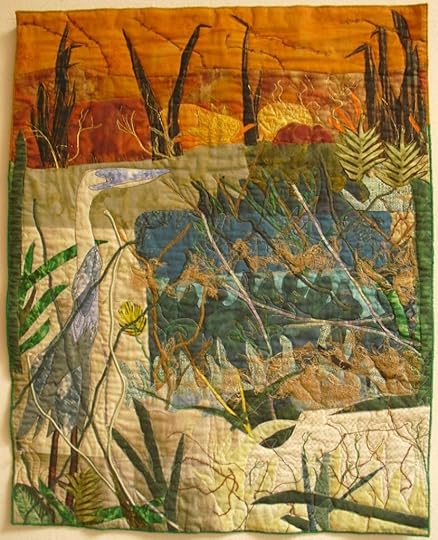
Ann Baldwin May's quilt 'Great Blue Heron at Dusk'
Lovely. The book is essentially a memoir, told through prose patches and resurrected scratches. Pieces that have been overlooked or published and never reprinted were culled, edited, and sewn together (at 87, there is a lot of past prose to examine).
Part I of the book contains six sporting essays that range from fishing for pickerel in New Hampshire (The Patch), to chasing errant golf balls (The Orange Trooper), to golf at St. Andrews (Linksland and Bottle), to coach Bill Tierney (Princeton's and later Denver's) championship lacrosse coach (Pioneer).
Part II is essentially a collection of small pieces (some just a paragraph, others several pages) that seem random. They span McPhee's interests and curiosities from people, to places, to science, sports, and errata. It is only as these patches come together that you begin to realize McPhee is essentially taking you on a trip through his memory as a writer, a father, and a person. McPhee's talent as a writer bubbles up, but so too does McPhee's essential humanity. His narrative nonfiction informs, seduces, and entertains.
McPhee, along with Tom Wolfe, Gay Talese, etc., helped spread New Journalism through his essays and books. His writing is curiosity distilled with patience + carefully filtered through literary prose + reduced with McPhee's unique talent of observing the crucial character in the perfect place at the exact right time. It is a gift from a literary starets, a psalm from our desert father of nonfiction. In this book McPhee is unfolding a quilt whose patern slowly transforms into McPhee. It is a love note from a father to his family (the book is dedicated to his 10 grandchildren) and most certainly to his readers and fans.
-- Cary Grant, quoted in John McPhee's 'The Patch'
"...an interloper [at Princeton], a fake professor, a portfolio without minister."
-- Robert Fagles & Robert Hollander, both describing John McPhee
In my Goodreads "About Me" I'm pretty blunt:
"I won't review your self-published book. I promise. Even if your book is published by a traditional publishing house (Penguin, etc), I'm not going to read and review it UNLESS I've read you before (most likely). If your name is Thomas Pynchon, Don DeLillo, John le Carré, Robert Caro, John McPhee, etc., sure... PLEASE send me ALL your books. I'm totally game. Otherwise, you are just wasting both of our time."
That usually scares away most self-published prose pimps, but the other day I landed a REAL fish. Someone at Farrar, Straus and Giroux sent me a quick note complimenting me (I'm a whore for compliments) AND asking if I wanted a soon-to-be-published book by John McPhee to read, enjoy, and yes ... perhaps ... review?
My kids would tell you that in a choice between meeting John McPhee and God, I'd be hard pressed to choose, because to me John McPhee IS GOD. So, of course I took the book. I got it a couple days ago and just finished it today.
Ann Baldwin May's quilt 'Great Blue Heron at Dusk'
Lovely. The book is essentially a memoir, told through prose patches and resurrected scratches. Pieces that have been overlooked or published and never reprinted were culled, edited, and sewn together (at 87, there is a lot of past prose to examine).
Part I of the book contains six sporting essays that range from fishing for pickerel in New Hampshire (The Patch), to chasing errant golf balls (The Orange Trooper), to golf at St. Andrews (Linksland and Bottle), to coach Bill Tierney (Princeton's and later Denver's) championship lacrosse coach (Pioneer).
Part II is essentially a collection of small pieces (some just a paragraph, others several pages) that seem random. They span McPhee's interests and curiosities from people, to places, to science, sports, and errata. It is only as these patches come together that you begin to realize McPhee is essentially taking you on a trip through his memory as a writer, a father, and a person. McPhee's talent as a writer bubbles up, but so too does McPhee's essential humanity. His narrative nonfiction informs, seduces, and entertains.
McPhee, along with Tom Wolfe, Gay Talese, etc., helped spread New Journalism through his essays and books. His writing is curiosity distilled with patience + carefully filtered through literary prose + reduced with McPhee's unique talent of observing the crucial character in the perfect place at the exact right time. It is a gift from a literary starets, a psalm from our desert father of nonfiction. In this book McPhee is unfolding a quilt whose patern slowly transforms into McPhee. It is a love note from a father to his family (the book is dedicated to his 10 grandchildren) and most certainly to his readers and fans.

August 30, 2021
This book by one of my favorite writers is in two parts. The first - The Sporting Scene - has six essays, more or less, covering fishing (really about fathers and sons), football (really about what you could possible say to the coach of the New England Patriots), golf (a little bit about The Open, but also about seeing a golf ball in the bottom of a clear river, and then following it to its source*), lacrosse (McPhee loves lacrosse), and how you should never have direct eye contact with a bear.
The second part is called An Album Quilt, and it's a potpourri of short fragments about seemingly unconnected subjects. They've never appeared in book form before and they're kind of dated (Gerald Ford is President for a lot of them and one bit is about how the word processor is coming to the New York Times). It's a rummage sale of observations, which I do not say disparagingly. Indeed, I actually read them in the order presented, something I almost never do in short story collections.
McPhee follows birdwatchers and a man who invented hand-held altimeters. He considers Cary Grant, Sophia Loren, Barbra Streisand, Jackie Gleason, William Randolph Heart's mistress, Peter O'Toole, Peter Sellers, Mort Sahl. Of Marcello Mastroianni, he writes as no one else can: His handsome face, young in its outlines but creased with premature wrinkles, has a frightened look, as of a mantis who has lost faith in the efficacy of prayer.
Of musical collaboration: Although the Kerns and Hammersteins were close friends, Hammerstein's wife, Dorothy, could not abide hearing people refer to "Jerome Kern's 'Ol' Man River.'" She would say to them, "Oscar Hammerstein wrote 'Ol' Man River.' Jerome Kern wrote Ta-ta dumdum, Ta ta-ta dumdum."
Then there was the time Jenny Lind performed in Washington, D.C.: She began her first Washington concert before an audience that included the Fillmores, Senator Thomas Hart Benton of Missouri, Henry Clay of Kentucky, and fourteen empty seats in the front row, reserved for the seven members of Fillmore's cabinet and their wives, who were at the Russian ministry soaking up vodka. Jenny Lind was singing "Hail Columbia" when they swayed down the aisle and took their seats. Daniel Webster of Massachusetts, Secretary of State, stood up potted and sang along with her, while his wife tugged furiously at his long black tails.
He writes, too, about plate tectonics in Los Angeles, license plates of politicians in D.C., how bears are the only performing animals in the Moscow State Circus, where Los Vegas gets its water, and how they make Hershey chocolate bars.
There's also the time he locked his keys in his car in Lower Manhattan, his lunch date with a Mensa group, the letter he received from William McKinley's daughter after he once wrote about a certain mountain called Denali, the full inclusion of a high school writing assignment by his own daughter, and about the time he had his first alcoholic drink at age ten and still made it, albeit late, to his piano lesson.
And here's how he describes his own craft: A professional writer, by definition, is a person clothed in self-denial who each and almost every day will plead with eloquent lamentation that he has a brutal burden on his mind and soul, will summon deep reserves of "discipline" as seriatim, antidotes to any domestic chore, and, drawing the long sad face of the sad poet, will rise above his dread of his dreaded working chamber, excuse himself from the idle crowd, go into his writing sanctum, shut the door, shoot the bolt, and in lonely sacrifice turn on the Mets game.
Geez, I love this guy.
_________________
*Environmentalists have expressed concern about the amount of zinc in lost golf balls and what will happen when it escapes, to which golfdom responds that there is less zinc in a million golf balls than in five bottles of mouthwash.
The second part is called An Album Quilt, and it's a potpourri of short fragments about seemingly unconnected subjects. They've never appeared in book form before and they're kind of dated (Gerald Ford is President for a lot of them and one bit is about how the word processor is coming to the New York Times). It's a rummage sale of observations, which I do not say disparagingly. Indeed, I actually read them in the order presented, something I almost never do in short story collections.
McPhee follows birdwatchers and a man who invented hand-held altimeters. He considers Cary Grant, Sophia Loren, Barbra Streisand, Jackie Gleason, William Randolph Heart's mistress, Peter O'Toole, Peter Sellers, Mort Sahl. Of Marcello Mastroianni, he writes as no one else can: His handsome face, young in its outlines but creased with premature wrinkles, has a frightened look, as of a mantis who has lost faith in the efficacy of prayer.
Of musical collaboration: Although the Kerns and Hammersteins were close friends, Hammerstein's wife, Dorothy, could not abide hearing people refer to "Jerome Kern's 'Ol' Man River.'" She would say to them, "Oscar Hammerstein wrote 'Ol' Man River.' Jerome Kern wrote Ta-ta dumdum, Ta ta-ta dumdum."
Then there was the time Jenny Lind performed in Washington, D.C.: She began her first Washington concert before an audience that included the Fillmores, Senator Thomas Hart Benton of Missouri, Henry Clay of Kentucky, and fourteen empty seats in the front row, reserved for the seven members of Fillmore's cabinet and their wives, who were at the Russian ministry soaking up vodka. Jenny Lind was singing "Hail Columbia" when they swayed down the aisle and took their seats. Daniel Webster of Massachusetts, Secretary of State, stood up potted and sang along with her, while his wife tugged furiously at his long black tails.
He writes, too, about plate tectonics in Los Angeles, license plates of politicians in D.C., how bears are the only performing animals in the Moscow State Circus, where Los Vegas gets its water, and how they make Hershey chocolate bars.
There's also the time he locked his keys in his car in Lower Manhattan, his lunch date with a Mensa group, the letter he received from William McKinley's daughter after he once wrote about a certain mountain called Denali, the full inclusion of a high school writing assignment by his own daughter, and about the time he had his first alcoholic drink at age ten and still made it, albeit late, to his piano lesson.
And here's how he describes his own craft: A professional writer, by definition, is a person clothed in self-denial who each and almost every day will plead with eloquent lamentation that he has a brutal burden on his mind and soul, will summon deep reserves of "discipline" as seriatim, antidotes to any domestic chore, and, drawing the long sad face of the sad poet, will rise above his dread of his dreaded working chamber, excuse himself from the idle crowd, go into his writing sanctum, shut the door, shoot the bolt, and in lonely sacrifice turn on the Mets game.
Geez, I love this guy.
_________________
*Environmentalists have expressed concern about the amount of zinc in lost golf balls and what will happen when it escapes, to which golfdom responds that there is less zinc in a million golf balls than in five bottles of mouthwash.

April 8, 2019
John McPhee is a master of the form. I’d long heard as much and I only wish I’d got to him sooner. This book is a bit of a marvel: there are essays and sumptuous little vignettes in here that are pretty difficult to sell but impossible to fault. Each possesses novelistic nuance; he can deftly switch tone in the middle of a sentence and then wind it back round again before its end. I don’t know how he does it. There’s an essay in here about a golf tournament - snoozerama, in anyone else’s hands, right? I’d read a full book of them from this fella. If you haven’t read McPhee give him a go.

December 2, 2018
There is a luminous thread of wanting that sews this quilt of essays together. Even as days pass there is the feeling of trying to bind memories tighter into a collective covering; knowing that this is what will keep you warm even as the world grows colder. John McPhee is like the traveling friend we see only once in awhile - coming home with stories that are bittersweet with longing and roads not taken.

July 25, 2019
McPhee selected, edited and "quilted" uncollected stuff from his long writing career into this little book. I'm a big McPhee fan, so I read it all. But I liked some parts more than others. It was almost all new to me. OK, as usual, you need to read the author/publisher blurb first, right up there at the top of the page.
Got it? You have to guess at the age of individual bits and pieces from context, and I suppose it doesn't matter that much. More sports-related stuff than I would have liked -- though I liked the long piece on the 2010 British Open at the Old Course in St. Andrews a lot. That and the Orange Trapper piece, about his long interest in recovering lost golf balls from roughs and water hazards, were my favorites. His tale of avoiding a greenskeeper who was about to run him off, peddling away on his bicycle "at a speed so blazing" that he couldn't match it now, "but that was years ago, when I was eighty." !
Minnesota Fats! "Still the greatest pool shark in the world." This little piece is about Jackie Gleason's part in "The Hustler", I think, and how he prepared for the job. And Cary Grant once got a telegram from a reporter, "HOW OLD CARY GRANT?" He wrote back, "OLD CARY GRANT FINE. HOW YOU?" And another 140 pages of such excerpts, sometimes just a paragraph, seldom over a page or two. All worthwhile reading. A real treat for McPhee fans.
Got it? You have to guess at the age of individual bits and pieces from context, and I suppose it doesn't matter that much. More sports-related stuff than I would have liked -- though I liked the long piece on the 2010 British Open at the Old Course in St. Andrews a lot. That and the Orange Trapper piece, about his long interest in recovering lost golf balls from roughs and water hazards, were my favorites. His tale of avoiding a greenskeeper who was about to run him off, peddling away on his bicycle "at a speed so blazing" that he couldn't match it now, "but that was years ago, when I was eighty." !
Minnesota Fats! "Still the greatest pool shark in the world." This little piece is about Jackie Gleason's part in "The Hustler", I think, and how he prepared for the job. And Cary Grant once got a telegram from a reporter, "HOW OLD CARY GRANT?" He wrote back, "OLD CARY GRANT FINE. HOW YOU?" And another 140 pages of such excerpts, sometimes just a paragraph, seldom over a page or two. All worthwhile reading. A real treat for McPhee fans.

September 19, 2021
While I was reading this book, I thought about Whitney Balliett, who like John McPhee, wrote for the New Yorker. Unlike McPhee, Balliett wrote almost entirely on one subject, jazz, and he limited himself to relatively short essays. Whitney Balliett could write an essay on a someone (usually it would be a singer) whom I had no interest in and make me want to listen again, thinking that I'd missed something. Of course, when I did listen, I'd remember why I'd never enjoyed their music.
Balliett had writing skills and persuasive skills that captivated me while I was reading, but often left me disappointed afterward.
The Patch (I thought of a patchwork quilt while I was reading it, but the book title comes from the title of one of the essays) covers a variety of subjects - fishing, lacrosse (and lacrosse coaches - one in particular), golf and golf balls, bears in New Jersey, Oscar Hammerstein (a somewhat overrated popular song lyricist, in my opinion - I'll take Lorenz Hart, Ira Gershwin, or Johnny Mercer any day), the making of Hershey's chocolate, Joan Baez, fat cats who play golf at Burning Tree Golf Course, Marcello Mastroianni, Mensa, Peter Sellers, handheld altimeters, and Barbara Streisand, among others. None of these subjects hold any interest for me, but John McPhee made most of them tolerably interesting while I was reading. When I was finished reading, though, that was it. I felt that I had eaten a meal of comprised of empty calories and no real nourishment.
All of that said, I did enjoy a few of the essays, including his reply to William McKinley's daughter, who wrote to him railing because he referred to Mount McKinley as Denali. His reply was a gentle one. If I had been in his place, mine would not have been, so I give him credit for being a gentleman.
I also enjoyed his piece on Princeton basketball coach Pete Carril, his listing of various celebrities' stage names (and who knew that Rip Torn was really Rip Torn? I didn't), and his daughter, Martha's
clever piece written as a high school assignment to use 47 words including aspersion, brusque, contagious, flaccid, diaphanous, effulgence, dilatory, and forty others of that ilk in a short essay. She did it in an ingenious way. The acorn doesn't fall far from the tree.
If you read the essay subjects that I've listed and think you might have an interest in them, go for it. Perhaps this book is for you rather than for me.
Balliett had writing skills and persuasive skills that captivated me while I was reading, but often left me disappointed afterward.
The Patch (I thought of a patchwork quilt while I was reading it, but the book title comes from the title of one of the essays) covers a variety of subjects - fishing, lacrosse (and lacrosse coaches - one in particular), golf and golf balls, bears in New Jersey, Oscar Hammerstein (a somewhat overrated popular song lyricist, in my opinion - I'll take Lorenz Hart, Ira Gershwin, or Johnny Mercer any day), the making of Hershey's chocolate, Joan Baez, fat cats who play golf at Burning Tree Golf Course, Marcello Mastroianni, Mensa, Peter Sellers, handheld altimeters, and Barbara Streisand, among others. None of these subjects hold any interest for me, but John McPhee made most of them tolerably interesting while I was reading. When I was finished reading, though, that was it. I felt that I had eaten a meal of comprised of empty calories and no real nourishment.
All of that said, I did enjoy a few of the essays, including his reply to William McKinley's daughter, who wrote to him railing because he referred to Mount McKinley as Denali. His reply was a gentle one. If I had been in his place, mine would not have been, so I give him credit for being a gentleman.
I also enjoyed his piece on Princeton basketball coach Pete Carril, his listing of various celebrities' stage names (and who knew that Rip Torn was really Rip Torn? I didn't), and his daughter, Martha's
clever piece written as a high school assignment to use 47 words including aspersion, brusque, contagious, flaccid, diaphanous, effulgence, dilatory, and forty others of that ilk in a short essay. She did it in an ingenious way. The acorn doesn't fall far from the tree.
If you read the essay subjects that I've listed and think you might have an interest in them, go for it. Perhaps this book is for you rather than for me.

April 12, 2019
A truly excellent collection of essays on a wide range of topics, written over a long period of time throughout McPhee's career. Topics of essays in this collection range from golf to bears, baseball to fishing, and McPhee is equally engaging when talking about all of them (I honestly never thought I'd say that about an essay on golf, but that one ended up being one of my favourites). I'm not exaggerating when I say that it felt like on every page I would stop reading to marvel at a turn of phrase. Now to read his entire back catalogue!

December 7, 2018
No one writes better than McPhee. And he’s so funny. A few of his essays (most about topics I have 0 interest in) had me laughing out loud. The middle of the book is just a collection of scattered writings that are not even essays but paragraphs. Still, it’s delightful.

Read
September 7, 2018‘A bountiful cornucopia of insightful essays that display the wide range of his interests and tastes...McPhee delights in cracking open subjects, both ordinary and esoteric, and making them accessible to the layperson in works that testify to his virtuosity as one of the greatest living American essayists.’
Publishers Weekly (starred review)
Publishers Weekly (starred review)

September 13, 2020
I've read a small handful of John McPhee's books and there are times when I love his writing, times when I really dislike his writing and times when I think he's just okay. This book embodies the full range.
I love his curious mind, unpretentious style and subtle humor. I'd recommend "Uncommon Carriers" and "The Pine Barrens" to almost anyone as my favorite McPhee books. I'd also warn against "A Sense of Where You Are."
I have mixed feelings about "The Patch." The stories range from extremely short to magazine feature length and the subject matter covers a lot of ground but is mainly focused on sports (fishing, golf, lacrosse) and celebrities. I really disliked the largest story, about golfing at St. Andrew's. If I was a golfer or a fan of the sport I probably would have loved the book.
I think mostly everyone should read at least one John McPhee book in their lifetime, just maybe not this one.
I love his curious mind, unpretentious style and subtle humor. I'd recommend "Uncommon Carriers" and "The Pine Barrens" to almost anyone as my favorite McPhee books. I'd also warn against "A Sense of Where You Are."
I have mixed feelings about "The Patch." The stories range from extremely short to magazine feature length and the subject matter covers a lot of ground but is mainly focused on sports (fishing, golf, lacrosse) and celebrities. I really disliked the largest story, about golfing at St. Andrew's. If I was a golfer or a fan of the sport I probably would have loved the book.
I think mostly everyone should read at least one John McPhee book in their lifetime, just maybe not this one.

September 23, 2021
This is my first exposure to the collected writings of John McPhee. I borrowed this kindle book from the library and feel certain that I would have derived more enjoyment from the printed page. Thus...next visit to library I will look out for his work in book format.
The subjects are many and varied, his descriptions rich with detail as well as humour and the sheer breadth and depth of all that he covered is incredible from water deposits in Nevada to Hershey's Chocolate factory with Sophia Loren in between.
I particularly enjoyed his piece on Burning Tree Club in Bethesda, Md as that is a place I spent some years back in the 1960's (lived in Maryland, not that I ever visited the all-male golf club). The reading of the license plates in the parking lot there was notably amusing.
Library Loan
The subjects are many and varied, his descriptions rich with detail as well as humour and the sheer breadth and depth of all that he covered is incredible from water deposits in Nevada to Hershey's Chocolate factory with Sophia Loren in between.
I particularly enjoyed his piece on Burning Tree Club in Bethesda, Md as that is a place I spent some years back in the 1960's (lived in Maryland, not that I ever visited the all-male golf club). The reading of the license plates in the parking lot there was notably amusing.
Library Loan


January 6, 2019
Anything John McPhee writes will be exquisite, interesting, personal, and educational. The "patchwork quilt" of short excerpts worked less welll for me than the longer pieces, but it is interesting to see the breadth of topics he's written on and the thematic resonances over the decades.

April 8, 2020
John McPhee’s writing is exquisite. He writes essays and narrative nonfiction with prose that seems to melt in your mouth, and linger in your imagination. His eye for detail and ability to characterize his subjects makes them feel ready to jump off the page. Every time I finish one of his books, I wish I hadn’t. Have I gushed enough? Perhaps not. In the first half of this volume, he makes me care about golf, something I didn’t think was possible. In the second, he amalgamates decades of writing, pulling together a few paragraphs to a few pages from dozens of pieces. Devoid of context, the craft of McPhee’s writing takes center stage and is revealed to be flawless. I have remarked more than once that I would read John McPhee writing about anything, and in this book, I get my wish.

July 16, 2020
Just wonderful.
January 16, 2021
McPhee is a first ballot hall-of-famer and the master of creative non-fiction. Back in high school, my mother started passing on to me his Annals of the Former World articles from the New Yorker, and kept on clipping and sending me his essays for years afterwards. He has made his mark describing subjects that don't inherently seem like they will be universally interesting, like geology, engineering projects, oranges. But his special skill is in the respect he holds for the people he profiles, and in making the esoteric seem essential and personal.
The Patch is a minimally curated collection of essays from, I assume, the 1960's to the present. I suspect intentionally, the time or context of his essays is never clarified, which leads the reader to ponder them from both a past and present perspective.
The eponymous first essay, a melding of fishing for pickerel and ruminating on his father's death, is the most powerful. The second half of the book is his Album Quilt, a scrapbook of short essays, and scraps of essays, that somehow all hangs together. I especially enjoyed the 1975 story about the introduction of the Teleram P-1800 Portable Terminal to the New York Times. The wonder/amazement at the first exposure to computerized word processing, and the skepticism of the old-hand reporters was a great reminder of how far we have come, the pace of technological progress, and our natural resistance to change.
Funny too: "When I bring Fagles fish from the Delaware River, as I sometimes do, he asks that they be gutted, finned, and scaled, and wrapped in my work."
The Patch is a minimally curated collection of essays from, I assume, the 1960's to the present. I suspect intentionally, the time or context of his essays is never clarified, which leads the reader to ponder them from both a past and present perspective.
The eponymous first essay, a melding of fishing for pickerel and ruminating on his father's death, is the most powerful. The second half of the book is his Album Quilt, a scrapbook of short essays, and scraps of essays, that somehow all hangs together. I especially enjoyed the 1975 story about the introduction of the Teleram P-1800 Portable Terminal to the New York Times. The wonder/amazement at the first exposure to computerized word processing, and the skepticism of the old-hand reporters was a great reminder of how far we have come, the pace of technological progress, and our natural resistance to change.
Funny too: "When I bring Fagles fish from the Delaware River, as I sometimes do, he asks that they be gutted, finned, and scaled, and wrapped in my work."

November 13, 2018
I can't recall how I discovered John McPhee, but I have grown to love his writing style. He is a master of the longform nonfiction piece. Books like Coming Into the Country and Uncommon Carriers are wonderful explorations into all kinds of interesting aspects of life (life in Alaska, life as a long-haul trucker).
The Patch is a deliberate hodge-podge of pieces never before collected in book form. The book is divided into two parts, the first centered around sports, and the second a patchwork of writing over the decades. What I loved about the book is the diversity of pieces contained within. From fishing for pickerel, to the best techniques for finding golf balls on or near golf courses; from bears roaming New Jersey to a profile of Cary Grant. There is a little of everything here.
McPhee has the ability to make any subject interesting. In a piece on football, he discusses where the yellow flags originate. Another piece reveals the meaning behind license plates of various members of Congress. There's a piece of Sophia Loren, and a piece on the names celebrities use in place of their real names. There's a piece on covers for Time magazine prepared but never run.
In a piece on a Mensa conference in the 1960s that McPhee was invited to attend as a reporter, he writes about the humorous keynote speaker, who happened to be Isaac Asimov. There were pieces on synthetic food, the lines to get into Radio City Music Hall, William Randolph Hurst, the Hershey Chocolate factory, and a camp in Vermont that McPhee attended as a young councilor.
One of my favorite pieces was a very short one on writing. I am a writer, and a lifelong New York Yankees fan, which is why I found this so amusing:
The Patch is a deliberate hodge-podge of pieces never before collected in book form. The book is divided into two parts, the first centered around sports, and the second a patchwork of writing over the decades. What I loved about the book is the diversity of pieces contained within. From fishing for pickerel, to the best techniques for finding golf balls on or near golf courses; from bears roaming New Jersey to a profile of Cary Grant. There is a little of everything here.
McPhee has the ability to make any subject interesting. In a piece on football, he discusses where the yellow flags originate. Another piece reveals the meaning behind license plates of various members of Congress. There's a piece of Sophia Loren, and a piece on the names celebrities use in place of their real names. There's a piece on covers for Time magazine prepared but never run.
In a piece on a Mensa conference in the 1960s that McPhee was invited to attend as a reporter, he writes about the humorous keynote speaker, who happened to be Isaac Asimov. There were pieces on synthetic food, the lines to get into Radio City Music Hall, William Randolph Hurst, the Hershey Chocolate factory, and a camp in Vermont that McPhee attended as a young councilor.
One of my favorite pieces was a very short one on writing. I am a writer, and a lifelong New York Yankees fan, which is why I found this so amusing:
A professional writer, by definition, is a person clothed in self-denial, who each and almost every day will plead with eloquent lamentation that he has a brutal burden on his mind and soul, will summon deep reserves of discipline as seriatim antidotes to any domestic chore, and drawing the long sad face of the pale poet, will rise above his dread of his dreaded working chamber, excuse himself from the idle crowd, go into his writing sanctum, shut the door, shoot the bold, and in lonely sacrifice, turn on the Mets game.

November 13, 2018
Another fantastic essay collection by John McPhee. Informative and enlightening, entertaining and moving, and so much more. I can't say enough about him and his writing. The master who has taught dozens how to be better writers and thinkers. Read him if you enjoy nonfiction, read him if you don't, keep his advice in mind when reading and writing, and never forget to explore the world of McPhee.

June 29, 2019
I was not too chuffed about the opening bunch of sports essays—though McPhee can make lacrosse and golf more interesting than you’d think. But the second half of the book—the “album quilt” of short bursts of everything under the sun—is terrific. A grand finale fireworks display.
November 28, 2018
John McPhee could write the description on a can of peas and I would want to read it. My father was a fan and introduced me to McPhee starting with Coming into the Country when it was first published. His is a beautifully engaging style of writing. These pieces which had been published in the New Yorker are no exception.
March 1, 2019
A pleasant meandner--several essays, mostly nature or sports, then a compendium of older, unpublished excerpts from short journalism.
January 4, 2019
This collection of Mcphee's essays is absolutely marvelous.

December 24, 2018
Magic. That's the best way I can describe McPhee's style and output. Yeah, yeah: I know writing is hard; he tells us so:
"A professional writer, by definition, is a person clothed in self-denial who each and almost every day will plead with eloquent lamentation that he has a brutal burden on his mind and soul, will summon deep reserves of "discipline" as seriatim antidotes to any domestic chore, and, drawing the long sad face of the pale poet, will rise above his dread of his dreaded working chamber, excuse himself from the idle crowd, go into his writing sanctum, shut the door, shoot the bolt, and in lonely sacrifice turn on the Mets game." (137)
He makes it seem so easy to us readers, his prose, his descriptions rewarding us beyond the everyday. We learn about, uh, things. And, lo, we are amazed. Not to mention entertained. Such as the schematic or diagram of the famous loop of holes on The Old Course. (64) "It is a sequence of holes so hallowed in the game that Amen Corner, at Augusta National, has been compared with it, but while the Loop is far more complex geometrically, as golf goes it is less difficult. Birdies are to be made, just lying there for the taking, unless the wind is blowing hard, which it nearly always is. The prow of the linksland is much like the bow of a ship in the winter North Atlantic."
This book was worth the money and the time to read for his cheat sheet on the male tennis standouts of the 70s. (149-151) For the chance to meet Marion Davies (152) and Jenny Lind (167). And for the slightly longer section of quilt about Bob Bingham and birding. (200-206) I had read much of this content before in The New Yorker, but once, twice, then yet again, I find I can never read him too much. There's always something there still.
Must be the magic.
"A professional writer, by definition, is a person clothed in self-denial who each and almost every day will plead with eloquent lamentation that he has a brutal burden on his mind and soul, will summon deep reserves of "discipline" as seriatim antidotes to any domestic chore, and, drawing the long sad face of the pale poet, will rise above his dread of his dreaded working chamber, excuse himself from the idle crowd, go into his writing sanctum, shut the door, shoot the bolt, and in lonely sacrifice turn on the Mets game." (137)
He makes it seem so easy to us readers, his prose, his descriptions rewarding us beyond the everyday. We learn about, uh, things. And, lo, we are amazed. Not to mention entertained. Such as the schematic or diagram of the famous loop of holes on The Old Course. (64) "It is a sequence of holes so hallowed in the game that Amen Corner, at Augusta National, has been compared with it, but while the Loop is far more complex geometrically, as golf goes it is less difficult. Birdies are to be made, just lying there for the taking, unless the wind is blowing hard, which it nearly always is. The prow of the linksland is much like the bow of a ship in the winter North Atlantic."
This book was worth the money and the time to read for his cheat sheet on the male tennis standouts of the 70s. (149-151) For the chance to meet Marion Davies (152) and Jenny Lind (167). And for the slightly longer section of quilt about Bob Bingham and birding. (200-206) I had read much of this content before in The New Yorker, but once, twice, then yet again, I find I can never read him too much. There's always something there still.
Must be the magic.
October 11, 2019
Disappointing from page one. This odd collection falls far short of the standard McPhee set for himself in memorable and formidable earlier works. In the first part McPhee descends into name-dropping of the other old (and dead) white men he fishes and doesn't play golf with. In the second, McPhee evidently scours his attic for dubious literary treasures. More name-dropping, more aging and aged reflections on subjects you didn't care about anyway. All in all, it makes me wonder if McPhee, like some old jazz musicians I've heard, needs money. Don't give it to him in this case.

December 27, 2018
What a delight! I have heard a lot about John McPhee yet this is the first book I read by him. And it won’t be the last. His writing seems so effortless yet I am embarking on his “Draft 4” and might be able to tell what is behind all the wonders of words and phrases.
His portraits of people are especially vivid, and he is able to describe a golf course with alacrity too. His writings are alive, full of fresh and bones.
His portraits of people are especially vivid, and he is able to describe a golf course with alacrity too. His writings are alive, full of fresh and bones.

December 20, 2018
There are few greater pleasures than reading McPhee's prose. Rolling his sentences around on your tongue like a fine Burgundy, letting them linger. This curation of unreleased prose vintages going back 40 years contains some of his most elegant, crisp, and buttery sentences.

January 23, 2019
Some of these were fine, but the eponymous pieces is probably the best thing I've ever read.*
*Though I think it wouldn't be the same if I wasn't a voracious McPhee reader familiar with all of this other work.
*Though I think it wouldn't be the same if I wasn't a voracious McPhee reader familiar with all of this other work.

January 30, 2019
This compilation of short profiles, notes, scenes and brief descriptions of incidents was not my favorite McPhee effort. There were a number of those gems on subjects that if written by someone else would not in the least hold your interest. That is the talent of John McPhee. Always a good read.

December 1, 2021
I'm not a big non-fiction reader, although for the last few years I've reserved November for non-fiction reading in hopes of shortening the stacks of unread non-fiction on the shelves. I like non-fiction, especially biographies. But I'm starting to trend to essays as my favorite non-fiction. I read non-fiction slower than fiction, especially when it involves a topic with which I am not familiar. I think books of essays are best read over time a longer period of time than a fiction book so there is time to ruminate on each essay, especially if it is full of food for thought. I found this book to be full of such interesting food and it is brilliantly written.
The GR description of this book is accurate (something that is not often seen!). The book is divided into two parts. I liked all the essays in the first part that are loosely gathered under the topic sports. What makes them interesting is that they look at sports through some very different lenses. For example, the essays concerning golf. I am not a golfer or a fan of golf but these essays were great. I loved the look at St. Andrews golf course in Scotland and learning what real links were. But the one that I thought brilliant was about golf balls. It is a must read. You not only learn about golf balls but also about social status.
The second half is truly a patchwork quilt. McPhee looked through pieces he had written for various magazines over the years and selected bits of them. Each bit provides an astute look at something or someone -- Richard Burton, Joan Baez, Rockefeller grants to civil servants, Mensa, Jackie Gleason, and much, much more.
The only other book I've read by McPhee was The Founding Fish, which I read in 2012 but did not write a review for. I do, however, still remember how impressed I was that McPhee made shad so interesting! I am going to keep an eye open for more McPhee books in my explorations of second-hand bookstores! This one I shall pass onto a younger friend who has introduced me to some excellent books of essays in the past.
The GR description of this book is accurate (something that is not often seen!). The book is divided into two parts. I liked all the essays in the first part that are loosely gathered under the topic sports. What makes them interesting is that they look at sports through some very different lenses. For example, the essays concerning golf. I am not a golfer or a fan of golf but these essays were great. I loved the look at St. Andrews golf course in Scotland and learning what real links were. But the one that I thought brilliant was about golf balls. It is a must read. You not only learn about golf balls but also about social status.
The second half is truly a patchwork quilt. McPhee looked through pieces he had written for various magazines over the years and selected bits of them. Each bit provides an astute look at something or someone -- Richard Burton, Joan Baez, Rockefeller grants to civil servants, Mensa, Jackie Gleason, and much, much more.
The only other book I've read by McPhee was The Founding Fish, which I read in 2012 but did not write a review for. I do, however, still remember how impressed I was that McPhee made shad so interesting! I am going to keep an eye open for more McPhee books in my explorations of second-hand bookstores! This one I shall pass onto a younger friend who has introduced me to some excellent books of essays in the past.


March 9, 2019
When I was in the professor business I frequently found myself listening to advisees struggling to settle on a major or a career choice. My advice, when confronted with such handwringing, was usually... it doesn’t matter, everything is inherently interesting if you devote effort to it and indulge your intellectual curiosity. In other words just pick something and dive in head first. I like to use the example of the man who sold sand to the Arabs. I was fortunate enough to be seated next to the "Sandman" on a transatlantic flight. He was en route to Riyadh and captivated me for hours listening to stories about his dealings with various sheikhs and princes, but most fascinating was what he shared about sand. Turns out there are seemingly infinite varieties of sand, not to mention various grades of most types. Each type and grade has a purpose as well as a unique composition and an often singular origin. And so it turns out that the Saudis, although they obviously have plenty of sand, don’t have the kind of sand you need for certain types of filtration, hence the market for what the sandman sells. I digress. The point being.... what student could possible imagine that sand could be interesting and could offer amazing jet-setting career opportunities? If sand can so fascinate then anything can. John McPhee's writings offer further proof of that bit of wisdom. His essays are invariably engaging, though the subjects may seem mundane at first, because of his intense curiosity and his willingness to dive down whatever rabbit hole appears in front of him. The Patch is no different than his other books, unless you want to call attention to the impressive range of rabbit holes he has gone down in his career. I loved most of it, but his sports reportage is less interesting when it recounts sports events with a nod to the people involved. Impeccably structured and written though those pieces are, they lack dimension... that special McPhee 3D cat-scan treatment that elevates his writing to another level. Not bad, just not up to his usual standard. For example, I found his essay on golf balls, far more captivating than his report on the 2010 Open at St. Andrews.
Part 2 of The Patch is best described as "snippets". These are short pieces in no particular order and with no particular rhyme or reason. They are a kind of snack food for a wandering mind. Unlike real snacks you do want to fill up on them. And Part 1 is a feast for the mind as well. Feel free to overindulge.
Part 2 of The Patch is best described as "snippets". These are short pieces in no particular order and with no particular rhyme or reason. They are a kind of snack food for a wandering mind. Unlike real snacks you do want to fill up on them. And Part 1 is a feast for the mind as well. Feel free to overindulge.
Displaying 1 - 30 of 131 reviews