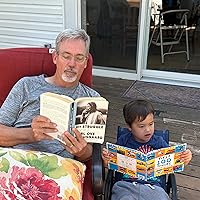
1980s in downtown Pittsburgh, a story of two black brothers who took very different paths. The author, apparently a widely read author of many novels, tells the story of his brother as dictated from inside a penitentiary. The brother, Robby, is 10 years his junior and had been incarcerated for over a decade for his presence in a murder resulting from a botched robbery where he as present. But this is as much about the author, and his deeply conflicted inner life, as his brothers. He feels guilt as the failed “Keeper” of his brother (this term also used to discuss those who maintain the prison system) who strayed by seeking what he felt was his only path to glory, a street crime boss. The author took his out when he could, being smarter and luckier, and left his past behind by hundreds of miles. What I enjoyed about this book is the unvarnished outpouring, and richly detailed of life in urban black poverty in the 1960s and 1970s. It’s not easy to get this view from my safe, white, privileged vantage. Wideman alternates his experiences with his brother’s story, told in common, colorful slang. It explains how difficult it is to escape the environs of one’s upbringing, and the unique experience of being black in a world controlled by mostly white men. This isn’t a political statement; in fact, the author does a laudable job helping the reader understand what day to day life can be with rich prose and very little pontification. Poor Robby doesn’t recognize the risk of his dope habit and takes foolish risks in his unquenchable hustle for a little more cash. Only in prison can his trapped brain reckon the consequences of his actions and see his mistakes. The soul-crushing routine of prison stifles a creative and intelligent young man and, thankfully, his brother recovers his flame by sharing his story. I wonder where the brothers are now, and I would certainly love to hear there has been redemption. But I fear this is unlikely because of the fear instilled in law and order politics and business interests in the prison industry. An interesting aspect of the book is the period during the late 1960s, especially 1968, and how the MLK murder both empowered and destroyed key parts of our cities. This is a story of a family trying to hold together during turbulent times, centering on the one son that slipped away and may forever pay a price for the errors of his youthful ways.
Wideman is a teacher, and beautifully lays his process down in a preface from 2004 in this edition (xvi): “I write because I’m lonely….to remind myself I own a voice with the power to construct a thing of my world, no matter how private or subjective or useless to anyone else on the planet…”
Here he recounts the fertile history of his grandfather, part of the great migration from the south (p. 22): “He found a raw, dirty, double-dealing city. He learned its hills and rivers, the strange names of Dagos and Hunkies and Polacks who’d been drawn, as he had, by steel mills and coal mines, by the smoke and heat and dangerous work that meant any strong-backed, stubborn you man, even a black one, could earn pocketfuls of money. … Like so many others, he boarded in an overcrowded rooming house, working hard by day, partying hard at night against the keen edge of exhaustion. When his head finally hit the pillow, he didn’t care that the sheets were still warm from the body of the man working nights who rented the bed ten hours a day while Harry pulled his shit at the mill.”
Wideman illustrates the character of his beloved mother, the strength and glue of the family through hard times (p. 70): “Her easy disposition and sociability masked the intensity of her feelings. Her attitude to authority of any kind, doctors, clerks, police, bill collectors, newscasters, whites in general partook of her constitutional gentleness. She wasn’t docile or cowed. The power other people possessed or believed they possessed didn’t frighten her; she accommodated herself, offered something they could accept as deference but that was in fact the same resigned, alert attention she paid to roaches or weather or poverty, any of the givens outside herself that she never pushed herself or her point of view on people she didn’t know. …On the other hand, she knew the world was a vale of tears and one’s strength, granted by God to deal with life’s inevitable calamities, should not be squandered on small stuff.”
The brothers’ mother fretted her whole life over her family, especially Robbie, her youngest and she dealt with his “keepers” and the those administering the system as best she could as she saw her son slowing despairing from any hope whatsoever (p. 72): “She could see their side, but they steadfastly refused to see hers. And when she realized fairness was not forthcoming, she began to hate. In the lack of reciprocity, in the failure to grant that Robby was first a man, then a man who had done wrong, the institutions and individuals who took over control of his life denied not only his humanity but the very existence of the world that had nurtured him and nurtured her – the world of touching, laughing, suffering black people that established Robby’s claim to something more than a number.”
The author’s father, even in the 60s, was oddly missing from the book, but when he makes an appearance it is memorable as in this colorful bit that displays the author’s skill and dark humor (p. 106): “Daddy could still shake him up. Edgar Wideman was six foot tall and weighed around two hundred hard pounds. Robby knew Daddy could tear up his behind and knew that if he pushed the wrong way at the wrong time, Edgar would punch him out. My father’s rage, his fists were the atom bomb, the nuclear deterrent. Robby feared him so he gauged his misconduct with a diplomat’s finely honed sensitivity to consequence and repercussion. Yet Robby understood that he had launched himself on a collision course. His determination to become an independent power setting his own rules would bring on a confrontation with Daddy. The shit had hit the fan sooner or later, so it became a question of biding his time, of marshaling his forces, and convincing himself that he’d survive the holocaust generally intact.”
Here’s Robby, telling his story and how he started down his path, the rage of being black in America (p. 152): “How else I’m spozed to think? Couldn’t see myself on no porch in no rocking chair crying the blues. Like, what else I’m spozed to do? No way Ima be like the rest of the niggers scuffling and kissing ass to get by. Scuffling and licking ass till the day they die and the shame is they ain’t even getting by. They crawling. They stepped on. Mize well be roaches or some goddamn waterbugs. White man got em backed up in Homewood and he’s sprinkling roach power on em. He’s steady shaking and they steady dying. You know I ain’t making nothing up. You know I ain’t trying be funny. Cause you seen it. You run from it just like I did. You know the shit’s still coming down and it’s falling on everybody in Homewood. You know what I’m talking about. Don’t tell me don’t, cause we both running. I’m in here but it’s still falling on me. It’s falling on Daddy and Mommy and Dave and Gene and Tish and all the kids. Falls till it knocks you down.”
Finally, the author openly shares his inner conflict about his relationship with his brother who so often is out of mind (p. 222): Gradually, I’m teaching myself to decompartmentalize. This book is part of the unlearning of my first response to my brother’s imprisonment. In spite of good intentions, I constantly backslide. In large matters, like arranging for Omar to accompany me on a visit, or small neglecting to relay somebody’s greeting to my brother or a hello from Robby to some friend on the outside, I’ll revert to my old ways. My oversights embarrass me, shake me up, because I’m reminded that in crucial ways my brother still doesn’t exist for me in the intervals between visits. The walls become higher, thicker, unbreachable when I allow myself to be part of the conspiracy.”