

What do you think?
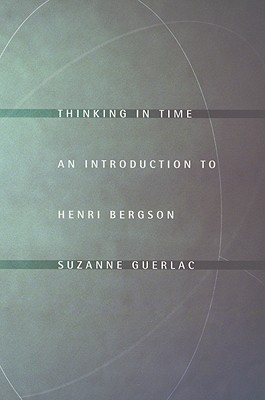
Thinking in Time: An Introduction to Henri Bergson
"In recent years, we have grown accustomed to philosophical language that is intensely self-conscious and rhetorically thick, often tragic in tone. It is enlivening to read Bergson, who exerts so little rhetorical pressure while exacting such a substantial effort of thought.... Bergson's texts teach the reader to let go of entrenched intellectual habits and to begin to think differently--to think in time.... Too much and too little have been said about Bergson. Too much, because of the various appropriations of his thought. Too little, because the work itself has not been carefully studied in recent decades."--from Thinking in Time
Henri Bergson (1859-1941), whose philosophical works emphasized motion, time, and change, won the Nobel Prize for Literature in 1927. His work remains influential, particularly in the realms of philosophy, cultural studies, and new media studies. In Thinking in Time, Suzanne Guerlac provides readers with the conceptual and contextual tools necessary for informed appreciation of Bergson's work.
Guerlac's straightforward philosophical expositions of two Bergson texts, Time and Free Will (1888) and Matter and Memory (1896), focus on the notions of duration and memory--concepts that are central to the philosopher's work. Thinking in Time makes plain that it is well worth learning how to read Bergson effectively: his era and our own share important concerns. Bergson's insistence on the opposition between the automatic and the voluntary and his engagement with the notions of "the living," affect, and embodiment are especially germane to discussions of electronic culture.
Henri Bergson (1859-1941), whose philosophical works emphasized motion, time, and change, won the Nobel Prize for Literature in 1927. His work remains influential, particularly in the realms of philosophy, cultural studies, and new media studies. In Thinking in Time, Suzanne Guerlac provides readers with the conceptual and contextual tools necessary for informed appreciation of Bergson's work.
Guerlac's straightforward philosophical expositions of two Bergson texts, Time and Free Will (1888) and Matter and Memory (1896), focus on the notions of duration and memory--concepts that are central to the philosopher's work. Thinking in Time makes plain that it is well worth learning how to read Bergson effectively: his era and our own share important concerns. Bergson's insistence on the opposition between the automatic and the voluntary and his engagement with the notions of "the living," affect, and embodiment are especially germane to discussions of electronic culture.
- GenresPhilosophyNonfiction
230 pages, Paperback
First published April 1, 2006
Ratings & Reviews
Friends & Following
Create a free account to discover what your friends think of this book!
Community Reviews
Displaying 1 - 8 of 8 reviews

June 13, 2010
if you like this review i now have website: www.michaelkamakana.com
220712: this is the quote that best sums up bergson:
questions relative to the subject and the object should be thought of as a function of time rather than space Matter and Memory
220701: (this is eleven years later reread) recent read (220625)Bergson’s Philosophy of Self-Overcoming: Thinking without Negativity or Time as Striving, previous Bergson: Thinking Beyond the Human Condition. this has inspired me to read this intro a fourth (4th) time, as I am in the process of downsizing my shelves and this must go. decided to keep his work, other work. now regretful because I do really really like this book. this time I realise I do not talk of her interrogation of Matter and Memory, which in some ways is his most significant work...
rather than conceptualising mind-matter dispute bergson insists on mind-memory. rather than the mind as engaged in epistemological searching the mind operates for the body as an organ of 'acting', not 'knowing'. and to this end b theorises 'pure perception', which is complete, instantaneous, theoretical, vs 'concrete perception', which is our usual experience of time, as informed by memory, limitations, actual, which is the way we live. 'pure perception' is impersonal, is pretext for memory, and 'concrete' interweaves past and present. there are two forms of memory: 'automatic memory' and 'image memory'. the first is at work whenever we do something without reflection, without thought, the second is when we 'imagine' or act voluntarily, which can be thought of as dream state though we do not need to be asleep...
b insists perception and memory are not 'degrees' of difference, that is, quantitatively, but difference in 'kind', that is, quality. we can only act in the present, but this does not mean the past does not exist, have affect, even if this is 'virtual', that is, not 'actual'... the past continues, 'lives' so to speak, in 'pure memory', and operates as the unconscious...it is no less illusion in time than space is illusion of valley over the horizon. there is reprint of the diagram b uses to visualise our encounter with the plane of the real, our actual contact, continuing into the past, continuing to be real but now virtual, as perception becomes memory...
b works with biology as known then, in conceiving the nervous system as reflecting the evolution of our human freedom to choose, according to 'delays' of 'imagining' memory, in his idea similar to switchboard allowing this impulse through to the mind, delaying this other. it is essential to understand that the mind is not the brain, does not operate from necessity, no matter how AI researchers try to simulate (and fail). this book is from 2006 so there might be some progress but it seems, from what is read, we are still beholden to the computational model of the brain, though guerlac does hold out hope this is being better understood as inadequate. there is conclusion of some quotes very useful:
sensation is the beginning of freedom
time is a form of energy
the past is a reality
my perception is outside my body
the same feeling, by fact of being repeated, is new feeling
memory does not consist in regression from present to past, but in contrary, in progress from past to present
questions relative to subject and object should be thought of as a function of time rather than space
perception is nothing but occasion for remembering
nothing is less than the present
movement is quality, not quantity
we only perceive the past
time is invention or nothing at all
020711: this is a later later later later addition: by now it should be apparent that bergson is one of my favorite philosophers. best on bergson i have read, given five, though partly sentiment as this is one of the first i read, partly more that i loved the philosophy more than just the book. this one concentrates on Time and Free Will: An Essay on the Immediate Data of Consciousness and Matter and Memory and not Creative Evolution, and though i do not imagine full comprehension there are others enjoyed of his thought: Philosophy and the Adventure of the Virtual: Bergson and the Time of Life best total selection of bergson's work is: Henri Bergson: Key Writings...
this is a later later later addition: why am I revisiting this review? well now I have read many more works, even some introductory analytic philosophy, tried deleuze and guattari, find them often opaque, often fascinating, and have read critical examination of Bergson's , not enough to fully critique yet but does deeply interrogate his entire metaphysics, enjoying that one such I bought it and will reread it...
this is a later later addition: so, reading him again, 3rd time, inspired by lawlor's The Challenge of Bergsonism. Early Twentieth-Century Continental Philosophy easy reading, maybe because some ideas are so familiar. could read him over and over. this after lawlor is interesting because in trying to see his pure perception, his memory and matter substrate, in how our experienced world is not resolved in timeless, undirected, abstract mathematical formulae. easier to read of him, like attending lectures, than read him without guidance. there is this wonderful idea we should see the world as essentially suffused in time, this time as duration, as how the future is freedom. have in some ways perhaps thought too much of new and not enough of persisting past. see lawlor.
this is a later addition: i have other texts by bergson- laughter, Laughter. The Creative Mind, Time and Free Will: An Essay on the Immediate Data of Consciousness, Matter and Memory already read- others that i will read next, but then i suppose there might be deleuze, other more recent or contemporary continental thinkers. .now read Creative Evolution
first review: i knew of bergson only as someone sartre and proust and merleau-ponty refer to. i am not studying him. i am not professionally astute enough to pass judgment on how accurate and helpful guerlac is here. i can only say that this is one of the few works of philosophy i am re-reading.
i am interested in continental thought, the sort Bergson works through, which deals with the world given as immediate data of consciousness, nothing more or less. i love the idea we have misunderstood time on a spatial thought-model: thinking in terms of a line or a circle. i am moved by his exploration of novelty. i try to connect this with buddhist concepts of time, with process, with change. this is one of those books that clarify how much more interested i am in continental rather than analytic philosophical work. i read it again, i read it anew, as one of the signal insights of bergson is every time is a new moment even if you have been there before- this is simply new with the memory of the old, so it is new.
think the difference between quality- that is, consciousness- and quantity- that is, the world- think of pure perception, of memory filling in the gaps of senses, of matter and memory. think difference between level of illumination versus brightness. think in time: difficult but rewarding, this is the theme of his metaphysics, to think of how indivisible is real duration, real time, rather than points on a line which plots history not act. in western philosophy we talk ourselves into dead end paradox by ignoring time. there are so many things to think of in here. time is real. time is heterogeneous, new every moment as quality, not homogeneous as matter and thus divisible...
intensity, multiplicity, duration- these are keys in Bergson, in recognition of freedom expressed not beyond categories of experience but in immediacy of time. which in error we conceptualize similar to space, a tendency embedded in our human project of living, a prejudice we must overcome. for there is the entire inner consciousness which does not exist as space but as time. which is not repeatable, never identical, not subject to conservation of energy but accumulates... how music or melody of song is an apt model for our experience of living time, of real duration, of past flowing into future...or something like that.
think in time. questions of subject and object should be understood not as space, as thing beyond perception, but as time. postructuralism heeds bergson's defining difference from the inanimate to living, much as thought must be seen not computational but active, not contemplative, not judgment.
think in time and there is a whole new way of seeing worlds physical and metaphysical: great intro.
more
Time and Free Will: An Essay on the Immediate Data of Consciousness
Matter and Memory
Creative Evolution
The Two Sources of Morality and Religion
Henri Bergson: Key Writings
Philosophy and the Adventure of the Virtual: Bergson and the Time of Life
Bergsonism
Bergson’s Philosophy of Self-Overcoming: Thinking without Negativity or Time as Striving
Updating Bergson: A Philosophy of the Enduring Present
Bergson: Thinking Beyond the Human Condition
Deleuze, Bergson, Merleau-Ponty: The Logic and Pragmatics of Creation, Affective Life, and Perception
Henri Bergson
Thinking in Time: An Introduction to Henri Bergson
The Bergsonian Philosophy of Intelligence
Bergson and the Stream of Consciousness Novel
Morality in Evolution: The Moral Philosophy of Henri Bergson
The Crisis in Modernism: Bergson and the Vitalist Controversy
The Philosophy of Science Fiction: Henri Bergson and the Fabulations of Philip K. Dick
220712: this is the quote that best sums up bergson:
questions relative to the subject and the object should be thought of as a function of time rather than space Matter and Memory
220701: (this is eleven years later reread) recent read (220625)Bergson’s Philosophy of Self-Overcoming: Thinking without Negativity or Time as Striving, previous Bergson: Thinking Beyond the Human Condition. this has inspired me to read this intro a fourth (4th) time, as I am in the process of downsizing my shelves and this must go. decided to keep his work, other work. now regretful because I do really really like this book. this time I realise I do not talk of her interrogation of Matter and Memory, which in some ways is his most significant work...
rather than conceptualising mind-matter dispute bergson insists on mind-memory. rather than the mind as engaged in epistemological searching the mind operates for the body as an organ of 'acting', not 'knowing'. and to this end b theorises 'pure perception', which is complete, instantaneous, theoretical, vs 'concrete perception', which is our usual experience of time, as informed by memory, limitations, actual, which is the way we live. 'pure perception' is impersonal, is pretext for memory, and 'concrete' interweaves past and present. there are two forms of memory: 'automatic memory' and 'image memory'. the first is at work whenever we do something without reflection, without thought, the second is when we 'imagine' or act voluntarily, which can be thought of as dream state though we do not need to be asleep...
b insists perception and memory are not 'degrees' of difference, that is, quantitatively, but difference in 'kind', that is, quality. we can only act in the present, but this does not mean the past does not exist, have affect, even if this is 'virtual', that is, not 'actual'... the past continues, 'lives' so to speak, in 'pure memory', and operates as the unconscious...it is no less illusion in time than space is illusion of valley over the horizon. there is reprint of the diagram b uses to visualise our encounter with the plane of the real, our actual contact, continuing into the past, continuing to be real but now virtual, as perception becomes memory...
b works with biology as known then, in conceiving the nervous system as reflecting the evolution of our human freedom to choose, according to 'delays' of 'imagining' memory, in his idea similar to switchboard allowing this impulse through to the mind, delaying this other. it is essential to understand that the mind is not the brain, does not operate from necessity, no matter how AI researchers try to simulate (and fail). this book is from 2006 so there might be some progress but it seems, from what is read, we are still beholden to the computational model of the brain, though guerlac does hold out hope this is being better understood as inadequate. there is conclusion of some quotes very useful:
sensation is the beginning of freedom
time is a form of energy
the past is a reality
my perception is outside my body
the same feeling, by fact of being repeated, is new feeling
memory does not consist in regression from present to past, but in contrary, in progress from past to present
questions relative to subject and object should be thought of as a function of time rather than space
perception is nothing but occasion for remembering
nothing is less than the present
movement is quality, not quantity
we only perceive the past
time is invention or nothing at all
020711: this is a later later later later addition: by now it should be apparent that bergson is one of my favorite philosophers. best on bergson i have read, given five, though partly sentiment as this is one of the first i read, partly more that i loved the philosophy more than just the book. this one concentrates on Time and Free Will: An Essay on the Immediate Data of Consciousness and Matter and Memory and not Creative Evolution, and though i do not imagine full comprehension there are others enjoyed of his thought: Philosophy and the Adventure of the Virtual: Bergson and the Time of Life best total selection of bergson's work is: Henri Bergson: Key Writings...
this is a later later later addition: why am I revisiting this review? well now I have read many more works, even some introductory analytic philosophy, tried deleuze and guattari, find them often opaque, often fascinating, and have read critical examination of Bergson's , not enough to fully critique yet but does deeply interrogate his entire metaphysics, enjoying that one such I bought it and will reread it...
this is a later later addition: so, reading him again, 3rd time, inspired by lawlor's The Challenge of Bergsonism. Early Twentieth-Century Continental Philosophy easy reading, maybe because some ideas are so familiar. could read him over and over. this after lawlor is interesting because in trying to see his pure perception, his memory and matter substrate, in how our experienced world is not resolved in timeless, undirected, abstract mathematical formulae. easier to read of him, like attending lectures, than read him without guidance. there is this wonderful idea we should see the world as essentially suffused in time, this time as duration, as how the future is freedom. have in some ways perhaps thought too much of new and not enough of persisting past. see lawlor.
this is a later addition: i have other texts by bergson- laughter, Laughter. The Creative Mind, Time and Free Will: An Essay on the Immediate Data of Consciousness, Matter and Memory already read- others that i will read next, but then i suppose there might be deleuze, other more recent or contemporary continental thinkers. .now read Creative Evolution
first review: i knew of bergson only as someone sartre and proust and merleau-ponty refer to. i am not studying him. i am not professionally astute enough to pass judgment on how accurate and helpful guerlac is here. i can only say that this is one of the few works of philosophy i am re-reading.
i am interested in continental thought, the sort Bergson works through, which deals with the world given as immediate data of consciousness, nothing more or less. i love the idea we have misunderstood time on a spatial thought-model: thinking in terms of a line or a circle. i am moved by his exploration of novelty. i try to connect this with buddhist concepts of time, with process, with change. this is one of those books that clarify how much more interested i am in continental rather than analytic philosophical work. i read it again, i read it anew, as one of the signal insights of bergson is every time is a new moment even if you have been there before- this is simply new with the memory of the old, so it is new.
think the difference between quality- that is, consciousness- and quantity- that is, the world- think of pure perception, of memory filling in the gaps of senses, of matter and memory. think difference between level of illumination versus brightness. think in time: difficult but rewarding, this is the theme of his metaphysics, to think of how indivisible is real duration, real time, rather than points on a line which plots history not act. in western philosophy we talk ourselves into dead end paradox by ignoring time. there are so many things to think of in here. time is real. time is heterogeneous, new every moment as quality, not homogeneous as matter and thus divisible...
intensity, multiplicity, duration- these are keys in Bergson, in recognition of freedom expressed not beyond categories of experience but in immediacy of time. which in error we conceptualize similar to space, a tendency embedded in our human project of living, a prejudice we must overcome. for there is the entire inner consciousness which does not exist as space but as time. which is not repeatable, never identical, not subject to conservation of energy but accumulates... how music or melody of song is an apt model for our experience of living time, of real duration, of past flowing into future...or something like that.
think in time. questions of subject and object should be understood not as space, as thing beyond perception, but as time. postructuralism heeds bergson's defining difference from the inanimate to living, much as thought must be seen not computational but active, not contemplative, not judgment.
think in time and there is a whole new way of seeing worlds physical and metaphysical: great intro.
more
Time and Free Will: An Essay on the Immediate Data of Consciousness
Matter and Memory
Creative Evolution
The Two Sources of Morality and Religion
Henri Bergson: Key Writings
Philosophy and the Adventure of the Virtual: Bergson and the Time of Life
Bergsonism
Bergson’s Philosophy of Self-Overcoming: Thinking without Negativity or Time as Striving
Updating Bergson: A Philosophy of the Enduring Present
Bergson: Thinking Beyond the Human Condition
Deleuze, Bergson, Merleau-Ponty: The Logic and Pragmatics of Creation, Affective Life, and Perception
Henri Bergson
Thinking in Time: An Introduction to Henri Bergson
The Bergsonian Philosophy of Intelligence
Bergson and the Stream of Consciousness Novel
Morality in Evolution: The Moral Philosophy of Henri Bergson
The Crisis in Modernism: Bergson and the Vitalist Controversy
The Philosophy of Science Fiction: Henri Bergson and the Fabulations of Philip K. Dick

September 15, 2017
Guerlac's book was a marvelous introduction to Bergson's thought. Focusing on 'Time and Freewill' and 'Matter and Memory' it was one of the clearest and most detailed explanations of 'duration' I've read. Especially useful was her exploration of the role Bergson could play in contemporary discussions of cybernetics, AI, and the interface of humans and machines. As a biologist trying to situate myself in Bergson's thought I am beginning to sense how misunderstood Bergson's thought is about the élan vital (vigorously mocked in Biology textbooks as simply a kind of teleological vitalism), and see that some of his thought may be useful for contextualizing current discussions about complexity, emergence, and especially the revolution in evolution in a developmental context. I'm now ready to read 'Creative Evolution' again with a better understanding of its context in light of the two books this work focuses and the depth of thought Bergson was exploring. One of the most useful books I've read on Bergson yet.
January 27, 2023
para a disciplina de metafísica.

May 24, 2013
This rather shoddily produced book appears to have been thrown together rather quickly (note, among other things, the repetition on pp. 2 and 29 of the same quoted passage), and the material presented often left me wondering why this and not something else? For instance, chapter 2 contextualizes Bergson, but almost exclusively in terms of science. As the Bergson under examination is a philosopher, why are so few philosophers mentioned in this chapter? Guerlac is not a fool, and she has read Bergson carefully, but she has not taken the time to present her findings in a properly constructed scholarly framework. And her lapses are sometimes grotesque: in chapter 3, Kant is identified as an empiricist!
To cite some of Guerlac's less egregious errors, a passage on page 3 ascribed to Louis de Broglie was in fact written by Papanicolaou, and both that passage and the one following are inaccurately quoted. The block quotation on pp. 20 and 21 is not accurate. On page 27 the title of Darwin's most famous text is mangled, and the attempt to distinguish Lamarck's ideas (recently given new life) from Darwin's is bungled. The quotation in line 5 of page 28 is not from Bergson. (The suggestion that Bergson sets up intuition in opposition to science, set forth on this page, is wrong. Bergson saw intuition as a complement to the techniques proper to science.)
Too often, in the introductory chapters, Guerlac does not identify the Bergsonian work she quotes, contributing to a tendency widespread among philosophers and literary critics to view an author as standing outside of time. But thinkers do change over time, and it's important in a work of this sort to look carefully at when they said what.
To cite some of Guerlac's less egregious errors, a passage on page 3 ascribed to Louis de Broglie was in fact written by Papanicolaou, and both that passage and the one following are inaccurately quoted. The block quotation on pp. 20 and 21 is not accurate. On page 27 the title of Darwin's most famous text is mangled, and the attempt to distinguish Lamarck's ideas (recently given new life) from Darwin's is bungled. The quotation in line 5 of page 28 is not from Bergson. (The suggestion that Bergson sets up intuition in opposition to science, set forth on this page, is wrong. Bergson saw intuition as a complement to the techniques proper to science.)
Too often, in the introductory chapters, Guerlac does not identify the Bergsonian work she quotes, contributing to a tendency widespread among philosophers and literary critics to view an author as standing outside of time. But thinkers do change over time, and it's important in a work of this sort to look carefully at when they said what.

July 20, 2013
I'm tired of resignedly pretending I don't think the capital-driven technocratic age we are galloping into will ultimately turn out to be a cul de sac for individual humans, human society, and the natural world of which we are still a part. Or that the possible "gains" represented by treating ourselves and the world as biochemical machines are not already being offset by incalculably larger losses. So Bergson, once considered reactionary because he rejected empiricism and dialectics, or "soft" because he championed the reality of subjective experience, including affect, is looking better than ever. And this is a great introduction, accessible to anyone with even a rudimentary interest in philosophy. Time is real, says Bergson, it is irreversible, it is a creative force, and living beings are always, inevitably, beings in time. Sounds much better to me than a dystopia where individuals (who can pay) meld themselves with machines to try to remain "living" as long as possible, or a disembodied, virtual experience completely replaces an embodied one. It seems truer than ever that if we as a species don't understand what it means to be alive, we won't be able to create a life worth living.

September 29, 2022
The complaints about this book needing an editor (Or a new one) are valid as there are instances of repetition, and also where a footnote is essentially repeated right after the sentence in which the footnote is cited. This can be frustrating.
However I found Guerlac's explication of Bergson's major contributions to be incredibly useful when compared to other sources out there. I would read this first before attempting to read Bergson, and for that matter Deleuze. Speaking of Deleuze, I am now realizing how Deleuze is essentially Bergsonisim just re-wrapped in 60-80's post-structuralism and is not quite as fresh and exciting as I first thought. Kind of like listening to a band and thinking 'Wow the way they construct these melodies with the underlying chord changes is remarkable' and then you discover the Beatles and you are like, 'Ohh now I get it'
However I found Guerlac's explication of Bergson's major contributions to be incredibly useful when compared to other sources out there. I would read this first before attempting to read Bergson, and for that matter Deleuze. Speaking of Deleuze, I am now realizing how Deleuze is essentially Bergsonisim just re-wrapped in 60-80's post-structuralism and is not quite as fresh and exciting as I first thought. Kind of like listening to a band and thinking 'Wow the way they construct these melodies with the underlying chord changes is remarkable' and then you discover the Beatles and you are like, 'Ohh now I get it'

February 22, 2023
The book is very thorough and clear. It focuses on Bergson's 'Time and Free Will' and 'Matter and Memory', blending explanations and extracts from the texts. Although there are some repetitions throughout the book, they are not too disturbing, and I guess they can even turn out to be useful for studying. I also appreciated the final chapter about reception, which deals in particular with Deleuze's bergsonism. I would totally recommend it to anyone interested in approaching Bergson or brushing up their knowledge.

February 21, 2022
Everyone should be reading Bergson. Guerlac makes it easier.
Displaying 1 - 8 of 8 reviews