Originally published as two books: "The Three Greatest Prayers," and "God's Greatest Gifts." Deeply insightful, straightforward, and clear explanations of the Apostles' Creed, the Commandments, and the Sacraments; this book gives you a basic course in the Faith, taught by the Church's greatest theologian.
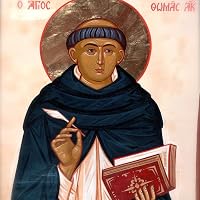
Philosophy of Saint Thomas Aquinas, a Dominican friar and theologian of Italy and the most influential thinker of the medieval period, combined doctrine of Aristotle and elements of Neoplatonism, a system that Plotinus and his successors developed and based on that of Plato, within a context of Christian thought; his works include the Summa contra gentiles (1259-1264) and the Summa theologiae or theologica (1266-1273).
People ably note this priest, sometimes styled of Aquin or Aquino, as a scholastic. The Roman Catholic tradition honors him as a "doctor of the Church."
Aquinas lived at a critical juncture of western culture when the arrival of the Aristotelian corpus in Latin translation reopened the question of the relation between faith and reason, calling into question the modus vivendi that obtained for centuries. This crisis flared just as people founded universities. Thomas after early studies at Montecassino moved to the University of Naples, where he met members of the new Dominican order. At Naples too, Thomas first extended contact with the new learning. He joined the Dominican order and then went north to study with Albertus Magnus, author of a paraphrase of the Aristotelian corpus. Thomas completed his studies at the University of Paris, formed out the monastic schools on the left bank and the cathedral school at Notre Dame. In two stints as a regent master, Thomas defended the mendicant orders and of greater historical importance countered both the interpretations of Averroës of Aristotle and the Franciscan tendency to reject Greek philosophy. The result, a new modus vivendi between faith and philosophy, survived until the rise of the new physics. The Catholic Church over the centuries regularly and consistently reaffirmed the central importance of work of Thomas for understanding its teachings concerning the Christian revelation, and his close textual commentaries on Aristotle represent a cultural resource, now receiving increased recognition.
St. Thomas Aquinas is a doctor of the Church, but his manner of teaching is so accessible! Sometimes the writing of some saints is too deep for me to clearly understand, but not his. His language reminds me of that of St. Teresa of Avila, another of my heroes. He would preach to the poor and simple, and he had a true gift for comprehensible communication, and the gift of Wisdom.
In this book he explains the layered meanings behind certain beliefs and prayers. He breaks down each one into its various phrases and increments, then breaks those down into deeper meanings. Following are some of the topics he expounded on:
-The Apostles Creed -The Nicene Creed -The Lord's Prayer -The Hail Mary -The Ten Commandments -The Sacraments
This is just a very small portion of his writings, as his magnum opus is the Summa Theologica. That one is a little intimidating due to it's sheer size, so this is a small alternative into a relatively few matters of the faith. One day I will read it, though! I've been considering it for many years, and from what I have seen and heard, it is well worth the read.
We say our prayers without thinking or quite understanding the words we are saying.
In reading The Aquinas Catechism, you will find a good understanding in the meaning of The Apostles Creed, Our Father, Hail May, The Ten Commandments, The Sacraments.
A series of catechetical Lenten sermons written by St Thomas Aquinas, something like a "Summa for the simple". He does a very good job of explaining the Christian faith simply. Highly edifying and it makes for excellent reading, whether it is Lent or not.
St Thomas Aquinas, though a very intellectual writer, is able to communicate the complex truths of the Catholic faith in simple words, such that anyone may understand them. His commentary on the Apostles’ Creed, explaining the faith, is thorough and not only explains what is to be believed, but also refuted errors along the way. His commentary on the Ave Maria, though only half of what today is the Hail Mary prayer, is, by far, my personal favorite section of the book. It is beautiful, thoroughly, and Catholic. His treatment of the Sacraments is very simple, but also very detailed, giving what the form and matter for each Sacrament is. This book is also very useful, because (1) St Thomas gives a large amount of Biblical and Patristic citations when explaining literally any point, and (2) because the editor has included an Appendix at the end which neatly summarizes everything touched upon in the different commentaries, sections, and subsections. Highly recommend.
“Thus is the Virgin blessed, but still more blessed is her Fruit” (page 170).
I had never read Thomas Aquinas before as I’d considered him too academic or challenging to read, and perhaps his Summa Theologica is such. However, this was a very readable book with simple, yet profound truths. St. Thomas Aquinas writes about the foundations of the faith- the Apostle’s Creed, the prayers of the Church, the 10 commandments, and the sacraments. I especially liked his take on the Apostle’s Creed and the Lord’s Prayer. He breaks down these rote memorizations into very practical sentiments.
This book took me about a year to finish. I had trouble processing it at first due to it being written in a fancier format. But as I got accustomed to it I found it insightful and empowering. If you are Catholic and want to better understand concepts like the Our Father and sacraments better this would be great. If you are simply curious about Catholics and their beliefs this is also very beneficial. It covers a good amount of information in a level of detail that does not feel overwhelming to making your head spin.
A brilliant resource for understanding core Catholic teachings. I found it a great way of explaining the Creed and the Commandments, linking each point clearly to Scripture. It manages to be both theological and practical, which made it easier to reflect on the faith more deeply.
Clarity. Structure. Simplicity. Not particularly convincing as an apologetics tool, but a splendid manual of the basics nevertheless. The format of this edition is really helpful.