As part of the New Gods saga, Jack Kirby's Mister Miracle focuses on Scott Free's attempt to escape his past and create his own future. Raised on the war-ravaged world of Apokolips, Scott became a master escape artist in order to flee his planet and fight in the epic battle against his former home world's tyrant, Darkseid. Taking on the persona of Mister Miracle and fighting alongside the love of his life, Big Barda, Scott proves that a man, not his upbringing, determines his destiny. Also included in this book is an introduction by master illusionist and Mister Miracle fan David Copperfield. Contains: Mister Miracle (1971) #1-10.
Jack Kirby (born Jacob Kurtzberg) was one of the most influential, recognizable, and prolific artists in American comic books, and the co-creator of such enduring characters and popular culture icons as the Fantastic Four, the X-Men, the Hulk, Captain America, and hundreds of others stretching back to the earliest days of the medium. He was also a comic book writer and editor. His most common nickname is "The King."
Scartabellando tra vecchie scatole e terze file in libreria uno scopre anche che aveva acquistato e letto questa versione in b/n dei primi 10 numeri del Mister Miracle di Kirby, edizioni Paly Press dei '90 e che come molte di quel periodo ha la colla di brossura pessima e perde pagine e copertina. Sebbene le storie siano buone, l'edizione era scadente allora ed è scadente oggi. Ma il Re fu sempre il Re. 3 stelle
As a kid I always like the story of other worlds and Apokolips, Big Barda, Granny, the galactic tyrant Darkseid, and Darkseid's second-born son Orion. But JK's face drawing is very weird and the whole Mister Miracle (Scott Free) Houdini thing got old really quick. "Jack Kirby based Barda's physical appearance on Lainie Kazan, who had recently appeared topless in Playboy. Mark Evanier, Kirby's assistant on the Fourth World comics, has stated, 'Jack based some of his characters (not all) on people in his life or in the news... the characterization between Scott 'Mister Miracle' Free and Barda was based largely—though with tongue in cheek—on the interplay between Kirby and his wife Roz.'" Hmm I wonder how that conversation went, Hey honey I made you the hero's gf with the body of a female hercules, oh and everybody as the same weird boxy face, hope you like it!
This installment of The Fourth World Saga was almost a five star rating for me. Like The Forever People, Jack Kirby uses his mythos to comment upon Nazism and similar evils by paralleling the movement with the forces of Darkseid and Granny Goodness. The one off villains vary in quality, but Scott Free (Mister Miracle) and Big Barda are well-rounded characters whose subject positions lend themselves towards a Christ and Amazon lens respectively. The biggest weak point for me lies within the character Funky Flashman, a parody of Stan Lee that seems more bizarre than it is striking commentary upon Kirby's former boss.
When I first checked out this monochromatic reprint edition of a brilliant comics endeavor by Jack "King" Kirby at my college library almost twenty years ago, I was blown away: the "King's" cosmic escape artist had potential then, and still does now, as a superhero of a radically different kind. If you were human, but had to endure your formative years on a planet like Apokolips (whose motto seriously ought to be, quote, "You're gonna hate it here...no, really!"), you'd wish like hell for a means of escaping such a life, too. Such is precisely what young Scott Free yearns for, and eventually he becomes a man who can literally slip out of just about any deadly situation, with the help of a childhood friend named Barda (later one of Apokolips' Female Furies) and also of a three-foot-five skeptic called Oberon. Mister Miracle's methods of cheating (or just avoiding) death by traps he gets himself into (not always intentionally) hinge mostly on the technology provided him by Mother Box, compact computer to the gods and men of New Genesis (Apokolips' much more clement, paradise-like counterpart planet), but Scott also has his wits, which he must employ against villains like the diabolically calculating Dr. Bedlam (with his "paranoid pill"); the cocky and indestructible-fisted Steel Hand of Intergang; the almost hilariously pompous (and high-ranking on Apokolips) Dr. Wermon Wunderbar; and perhaps most painfully of all, Granny Goodness, who enslaves and shatters the spirits of innocent children with her dungeon-like reform school and hideously punishing methods of discipline, all of whom click with Lord Darkseid, although the lattermost malefactor is more the problem of New Gods like Orion, luckily (as usual) for Mr. M. He even has to count his enemies among his friends sometime; despite his romance with the powerful Big Barda, who yearns to rebel completely against the methods of Darkseid, at one point Scott falls in with the pathetically duplicitous talent agent Funky Flashman, whose life he saves, but Flashman has a bummer of a way of displaying the obligatory gratitude. This is classic comics entertainment all around, which you'd expect from Kirby even after his Marvel legacy had officially ended. Such might have been considered practice for the "King" to launch the coveted Fourth World Saga for DC, of which Mister Miracle was originally a part. Well, its point is driven home: read it and simply escape.
The mysterious Scott Free stumbles upon Mister Miracle, an aging escape artist who is embroiled in a feud with Steel Hand and his gang. Scott is inquisitive about Mister Miracle's abilities and helps him out, but the aging hero is killed during their first outing together. Determined to avenge him, Scott dons the Mister Miracle costume and takes down Steel Hand. As the new costumed escape artist, Mister Miracle and assistant Oberon take on various missions which often rely on Scott's ability to free himself from perilous situations. We soon learn that Scott is actually from Apokolips, where as a young child he was raised under the brutal tutelage of Granny Goodness. It's been suggested by Mark Evanier that Kirby was using the Mister Miracle/Granny Goodness relationship to vent about his own experiences with the comic industry.
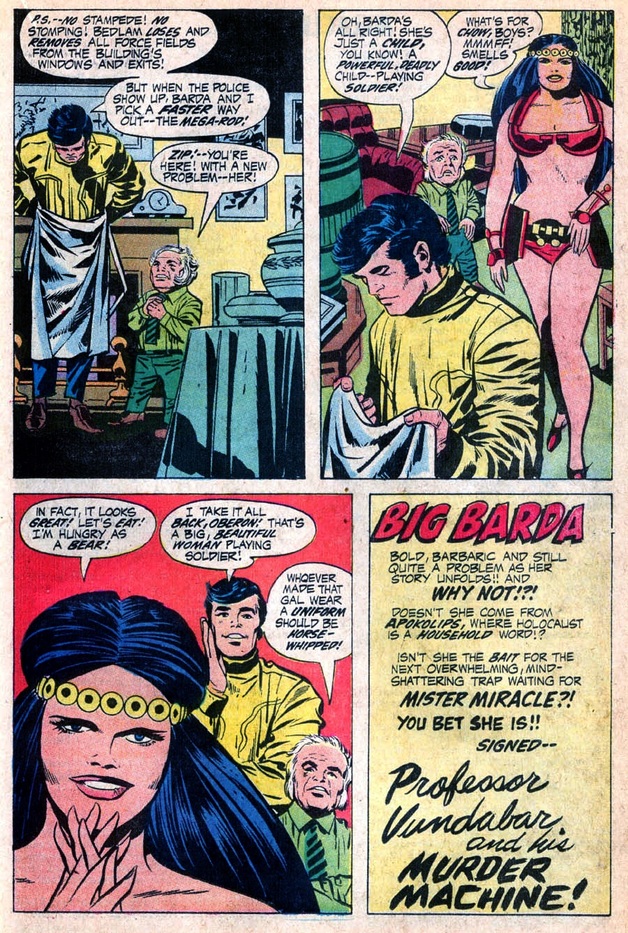
Scott is later joined by fellow member of Granny Goodness' Home for Orphaned Youth, Big Barda. From a young age, Barda was groomed to assume the mantle of leadership of the Female Fury Battalion, but Barda breaks free of Granny's control to join forces with Scott. Together with Oberon, the trio take on more high stakes missions, and even travel up the boom tube to make a foray into Apokolips.
The series is fun and serves as a great outlet for Kirby to experiment visually and craft dynamic action sequences. Though the writing can be rough at times, it does match the raw, energetic style seen in the artwork. The stories move at a brisk pace with at times rushed endings to individual issues, but the storytelling is pretty economical. After just ten issues, I felt like I knew what Scott Free's deal was quite well.
As always, the book looks great, but the story wasn't as tight as Kirby's New Gods title. I trust that more will be revealed in future issues, but this volume was pretty mediocre.
I read these in the original comic format when they came out. Jack Kirby changed his style in the early 1970s and I fell out of being a fan of his art and stories. While I do like several of the characters he created for his 4th world stories, particularly Darkseid and Orion, overall I never could seem to get into the books. If you are a Kirby fan then these are the core of his creation. Recommended
Sacrilege, I know, but I think Kirby's Fourth World stuff is kind of crappy. The stories are chock full of deus ex machina and really poor character designs if you ask me. I don't get people's great love for this stuff.
Kirby does 5 star work, but this edition is in Black and White/grayscale. Do yourself a favor and get the Fourth World Omnibus Volumes, they're very well done!
Literally, I think, one of Kirby's most colorful (based on his costume) creations, Mister Miracle is an escape artist beyond compare. While Kirby's sense of how Scott Free performs his escapes is sometimes lacking in explanation, it doesn't detract from his thrilling exploits in the slightest. Michael Chabon was commented that he was surprised no one had previously created an escape artist superhero while he was creating the Escapist (see The Amazing Adventures of Kavalier & Clay, which I highly Rickommend) clearly he'd never read Mister Miracle. But there are some pretty big differences between those two characters, so I'll let it slide. This is part of Kirby's epic Fourth World saga and even though the stories presented here are done so in black & white, they are still enjoyable and fun to read.