

What do you think?
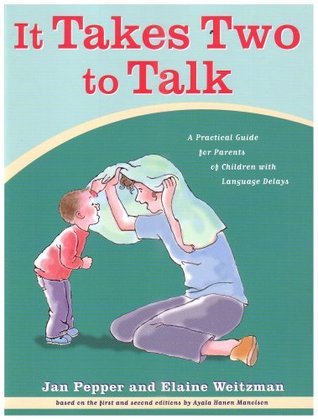
It Takes Two to Talk: A Practical Guide for Parents of Children With Language Delays
It Takes Two to Talk gives parents the tools to play a leading role in their child's early language intervention. Written in simple language and beautifully illustrated, the It Takes Two to Talk guidebook shows parents how to use responsive interaction strategies that have been shown to increase children's language skills. Easily integrated into everyday routines like mealtime, playtime, and book reading, It Takes Two to Talk strategies help parents make language-learning a natural, ongoing part of family life.
171 pages, Paperback
First published November 30, 2004
Ratings & Reviews
Friends & Following
Create a free account to discover what your friends think of this book!
Community Reviews
Displaying 1 - 30 of 39 reviews

June 26, 2009
This book (and the course by the same title) is phenomenal. By far the least cost for the greatest gain of any intervention we've done for our daughter's language. We learned to wait and follow her lead to encourage more spontaneous language, to cue her to take turns and have conversations, to expand on her language to add to her comprehension and vocabulary--I could go on and on. Tonight we compared videos taken before we all started the program, to ones taken this week--the difference in all of us, parents and kids, was amazing. We all learned and grew so much in just eight weeks. I only wish I'd learned about this program sooner. If you can take the course, do it, the videos are PRICELESS--but if the course is not available to you, I think the book would still be very helpful.

September 9, 2021
This book is so helpful. Our son was a little late speaking so he has been working with a speech therapist. This book covers everything we have learned with the speech therapist. The pictures and examples have been especially useful as we implement skills.

December 19, 2007
This book was recommended by a speech therapist. I also got a DVD from the Hannen institute in Canada that encourages communication through songs and rhymnes. The main principles I took from this are to listen more to your children, wait for them to initiate, try not to say the word "say" instead get to know their interests. They break down steps that are very easy to remember about being patient with our little ones that are still learning to talk. It has helped my daughter, Chelsea who has communication delay and Down syndrome.

May 23, 2011
A lot is common sense but it's a useful resource.

November 3, 2019
Breaks down where your child is in speech so you can tailor your responses to their developmental needs. Nothing earth-shattering and it's all a bit common sense but the examples and games are helpful to see how to respond to your child. Quick read.
I had looked into purchasing this book when it was first recommended by our pediatrician to look into speech therapy at two. At that time, it would have been more helpful, as he was in an earlier stage of communication. Since he's been in preschool, his language has developed rapidly and this book isn't as useful since he's in a later stage. However, it did solidify what I was already noticing in my own communication with my son (a lot of yes-no questions, quick to respond without waiting for him). It would be useful for all the caregivers in a child's life, not just one parent since communication is learned through a variety of interactions.
I had looked into purchasing this book when it was first recommended by our pediatrician to look into speech therapy at two. At that time, it would have been more helpful, as he was in an earlier stage of communication. Since he's been in preschool, his language has developed rapidly and this book isn't as useful since he's in a later stage. However, it did solidify what I was already noticing in my own communication with my son (a lot of yes-no questions, quick to respond without waiting for him). It would be useful for all the caregivers in a child's life, not just one parent since communication is learned through a variety of interactions.

October 7, 2011
This book is a remarkable guide to teaching a parent how to help their developmentally late child. My daughter has always been fast at reaching milestones, but we noticed she was having a hard time when it came to speaking. Through this program (a class that the book goes along with) I learned that my daughter isn't technically a late speaker, but rather has an articulation problem. I highly recommend this book to any parent who has or will have another baby. It can only help improve upon skills you may or may not already have.

July 24, 2014
Informative, easy to read, easy to understand.
It gave me clear indication of what my toddler's stage of communication was, with strong advice of how a parent can assist their child with delayed speech syndrome, learning to talk. This shows how important a parents role is in child learning communication.
This was 'homework' set by our speech therapist, and I've found this invaluable.
Did start to repeat information after a while and I started to skim. But the fundamentals of understanding are there.
It gave me clear indication of what my toddler's stage of communication was, with strong advice of how a parent can assist their child with delayed speech syndrome, learning to talk. This shows how important a parents role is in child learning communication.
This was 'homework' set by our speech therapist, and I've found this invaluable.
Did start to repeat information after a while and I started to skim. But the fundamentals of understanding are there.

April 10, 2011
This is the book is basically the textbook to the Hanen method, a program designed to help babies and toddlers communicate. The material is approachable and easy to read, but the key is practice and repetition. It is still early, but I've seen some positive results with my speech-delayed son.

September 21, 2011
I used this book for school and it is a really useful one since it gives you a good idea of how to communicate with kids and what you should or shouldn't do. Useful for parents or people who work with children and who want to know more about how they can communicate with kids.

October 6, 2011
The book is awesome but the course is even better! It expands upon ideas in the book and helps you put the concepts into practice. It helped me know how to bring the language out of my speech-delayed son. Absolutely phenomenal! (But take the course... hence the 4 stars)

October 13, 2011
The Hanen program is great for young kids with language and communication delays. The book is best when taken with the course, but even if you can't take the course, read the book. A parenting essential.

June 11, 2010
Excellent for parents who have children with language delays. This is a textbook for a course, but since I couldn't take the class I read it on my own. It has been tremendously helpful!!

March 7, 2014
Great guide. Gave me some excellent understanding into how to encourage communication with my 2 year old. Easy read. Lots of examples and sweet little drawings to illustrate each technique.
October 8, 2014
Useful resource. Common sense practices broken down into strategies.
December 14, 2015
Some really great advice and tips for helping your late-talker to communicate. Clear instructions, lots of examples, and in my (admittedly limited) experience, it works.

July 27, 2016
Great book for parents of children with a speech delay! I only wish I had read it sooner. This includes and expands on everything our son's therapists have been telling us for the past 2 years.
February 24, 2020
I grew impatient with the speech therapy waiting list, and decided to shell out for this book before exploring private options. I'm very glad I did. The first section is not rocket science, but it is quite encouraging to hear that you are doing some of the right things already, and it's probably not all your fault that your child is struggling with speech. Thus far the main advice from the health visitor had been to turn off the TV (we don't own one).
The book divides communication into four stages (Discoverers, Communicators, First Words Users, and Combiners), and further splits this down into receptive and expressive language. So my child is currently a First Word User in terms of understanding, and a Communicator in terms of speaking. I found this analysis really helpful, and the authors refer to it throughout the book to help you decide which techniques and ideas are most applicable to your child.
I suspect I will refer to this book, but my main practical take away points from first reading are:
-It's helpful to sometimes model to your child how they might talk back to you. So don't always say ' Yes! A cat! What a big black cat! It's sitting on the wall.' Sometimes, just say 'Cat!'.
-In the latter part of the book they encourage you to really hone in on a precise strategy for a few particular areas, to persuade your child to say just one or two more things. They have some great ideas. We are currently focussing on 'Wheeeee' when coasting on the balance bike, and 'Shhhhhh' to ask to be pushed again in the swing.
I have already had better specific advice for my child from this book than from any health professional thus far. I don't know what the future holds for us, but I can see that it would continue to be highly relevant through the stages of speech development.
The book divides communication into four stages (Discoverers, Communicators, First Words Users, and Combiners), and further splits this down into receptive and expressive language. So my child is currently a First Word User in terms of understanding, and a Communicator in terms of speaking. I found this analysis really helpful, and the authors refer to it throughout the book to help you decide which techniques and ideas are most applicable to your child.
I suspect I will refer to this book, but my main practical take away points from first reading are:
-It's helpful to sometimes model to your child how they might talk back to you. So don't always say ' Yes! A cat! What a big black cat! It's sitting on the wall.' Sometimes, just say 'Cat!'.
-In the latter part of the book they encourage you to really hone in on a precise strategy for a few particular areas, to persuade your child to say just one or two more things. They have some great ideas. We are currently focussing on 'Wheeeee' when coasting on the balance bike, and 'Shhhhhh' to ask to be pushed again in the swing.
I have already had better specific advice for my child from this book than from any health professional thus far. I don't know what the future holds for us, but I can see that it would continue to be highly relevant through the stages of speech development.

March 12, 2022
A useful manual for parents with children with language delays, emphasizing a more naturalistic approach to language development. Each chapter is short and manageable, allowing a busy, working parent the chance to learn without demanding a huge investment of time.
A Speech-Language Pathologist may find this as a hand reference for parent coaching. None of the material is technical, nor is the text overburdened with jargon. And each chapter presents easy, actionable (or teachable) skills for parents to use with their young ones.
Of course, even these "easy" skills can take a lot of practice to master, and it should never be taken for granted that parents automatically know how to do these things. If that were the case, there'd be no need for books like these...
A Speech-Language Pathologist may find this as a hand reference for parent coaching. None of the material is technical, nor is the text overburdened with jargon. And each chapter presents easy, actionable (or teachable) skills for parents to use with their young ones.
Of course, even these "easy" skills can take a lot of practice to master, and it should never be taken for granted that parents automatically know how to do these things. If that were the case, there'd be no need for books like these...
August 18, 2026
This book is phenomenal for teaching kids language. They should have given this book a different title so that all parents would be compelled to buy it. It has changed the way I communicate with my daughter, who does not have a speech delay, and I have seen huge leaps in skill and improvements on her part. I just wanted to read something that actually teaches the parent how not just to communicate but to TEACH. It was so helpful it should be given out at the hospital or something. Every parent would benefit from reading this book. Can you get by without it? Obviously. But I feel so much more tuned to teach now.

February 11, 2020
A pretty straightforward guide to helping children with speech delays learn to communicate. A lot of the advice was common sense (I already employ most of the strategies and activities given), but I did like how everything was tailored to your child's specific communication level. The most important thing I got from this book (and our speech therapy sessions) is that when waiting for your child to take a turn, pause for an awkwardly long amount of time. Trust me, it usually works.

June 24, 2021
En el título se indica que es una guía para padre con niños y niñas con retraso del lenguaje, por eso me esperaba más herramientas enfocadas a estos niños y niñas. He visto un amplio abanico de ejemplos y propuestas pero enfocadas a niños y niñas que aún no saben hablar debido a su madurez. Aún así, puede ayudar y las imágenes muestran diversidad familiar, muy encertadas.

March 3, 2026
This book has been so helpful for Gwen and I in learning to communicate together. Im so grateful we were able to get it from the library, but I may end up buying it later as I’m sure I’ll be referencing it for a long time. I highly recommend this for any parent who has a speech delayed or a nonverbal child.

October 20, 2022
3.5/5 A well structured book full of clear, practical advise for parents of children with speech delays. Includes some useful checklists to establish their child's current level of communication and offers good ideas for setting manageable goals suited to their developmental stage.
June 4, 2017
I need this book .

May 18, 2019
Use it for most of my early intervention clients.

June 27, 2019
I read this book quite awhile ago when we first started dealing with my son's speech delay and getting him into speech therapy. It was extremely helpful and I hightly recommend it.
March 23, 2020
I found this to be a helpful book for children with speech delays. Easy and practical methods for encouraging expressive and receptive speech.

March 7, 2021
Written in a way that is easy to digest, especially for busy moms. Had a few good take aways, and made me feel confident Im doing the right thing to help my little one communicate.

September 10, 2021
So helpful! I read a little at a time and tried to put each chapter into practice. I think it’s working!

April 29, 2022
I will update this to 5 stars if it actually helps my child talk.
Displaying 1 - 30 of 39 reviews