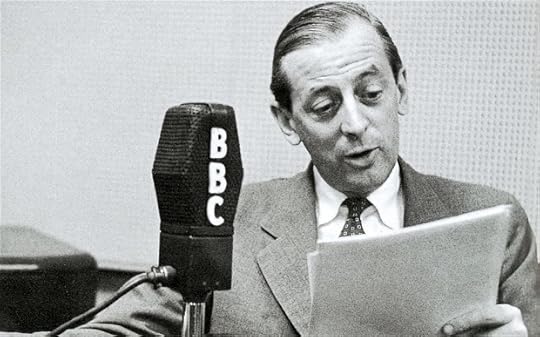
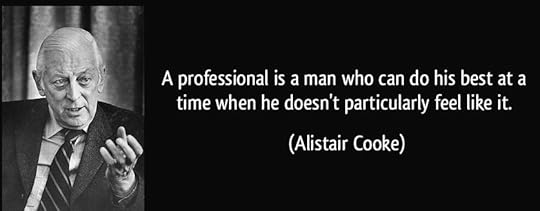
This is a selection of Alistair Cooke’s iconic radio program, Letters from America. Cooke, a Brit by birth, immigrated to the United States in his early twenties, and spent virtually the rest of his career as a kind of cultural ambassador for his adopted home. Though my first experience of Cooke was from his documentary, America, for most of his professional life he was a friendly, disembodied voice on the radio, speaking with a winsome trans-Atlantic accent about Yankee mores.
Cooke’s program is remarkable for its mere longevity—fifty-eight years, from 1946 to 2004. To put this in perspective, my grandmother was an adolescent when the program made its debut, and I was an adolescent when Cooke called it quits. Life is not so short after all, at least in Cooke’s case. This selection opens with a broadcast Cooke made in 1945, about the collision of a B-25 bomber into the Empire State Building; and it includes the tragic September 11 attacks, fifty-six years later. By that time, Cooke had seen the Korean War and both the Gulf Wars, had been personally present at the assassination of Bobby Kennedy, and had totally changed the technology used to record and transmit his letters.
But the program is also remarkable for its substance and style. Cooke was a wonderful writer in his own quiet way—affable, conversational, yet eloquent and even lyrical. He had a manner of putting his talks together so that they seemed to ramble, and yet they always came around to an amusing or touching point, often in the very last sentence. His curiosity led him here and there—music, sports, politics, cinema, etymologies—and he had quite a few of his own hobbyhorses, such as golf and vice-presidents. As he grew older, his talks grew increasingly personal and full of his own reminiscence, which added an extra dimension to his reflections. To top it off, Cooke was blessed with an excellent radio voice, the perfect vehicle for his prose.
The real value of these letters is cumulative. As the years went by, Cooke himself became a kind of living link with the past, capable of seeing current events in the perspective of history. His memory was capacious and he was always ready to supplement his talks with some arcane bit of Americana. The final impression is of a man simply awash in the rolling years. Most striking for me—listening to the letters at this historical moment—was that Cooke managed to be a commentator on American life without being politically partisan. This was immensely refreshing, and probably good for my blood pressure.
This particular edition* is excellent, consisting of the actual recordings, interspersed with commentary and context by Matt Frei. It also includes an hour-long BBC special on Cooke’s life. One comes away from the program almost in awe of the man—not that he was saintly or a genius, but that he was so very persistently original. We will not see his like again.
*I could not find this edition on Goodreads, but it is available as an audiobook.