Jump to ratings and reviews
Rate this book

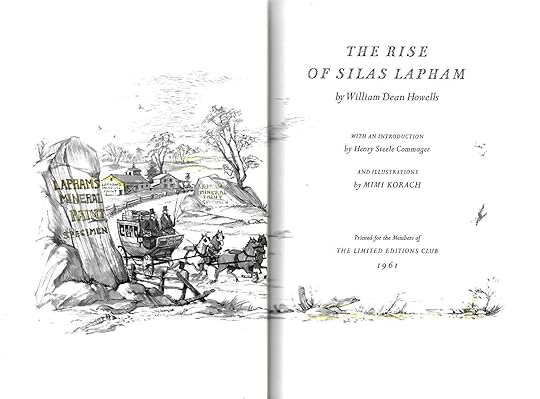
The Rise of Silas Lapham

Rate this book
William Dean Howells' richly humorous characterization of a self-made millionaire in Boston society provides a paradigm of American culture in the Gilded Age.

After establishing a fortune in the paint business, Silas Lapham moves his family from their Vermont farm to the city of Boston, where they awkwardly attempt to break into Brahmin society.

368 pages, Paperback

First published January 1, 1885

188 people are currently reading
3201 people want to read

About the author

William Dean Howells

1,179 books100 followers
Willam Dean Howells (1837-1920) was a novelist, short story writer, magazine editor, and mentor who wrote for various magazines, including the Atlantic Monthly and Harper's Magazine.

In January 1866 James Fields offered him the assistant editor role at the Atlantic Monthly. Howells accepted after successfully negotiating for a higher salary, but was frustrated by Fields's close supervision. Howells was made editor in 1871, remaining in the position until 1881.

In 1869 he first met Mark Twain, which began a longtime friendship. Even more important for the development of his literary style — his advocacy of Realism — was his relationship with the journalist Jonathan Baxter Harrison, who during the 1870s wrote a series of articles for the Atlantic Monthly on the lives of ordinary Americans.

He wrote his first novel, Their Wedding Journey, in 1872, but his literary reputation took off with the realist novel A Modern Instance, published in 1882, which described the decay of a marriage. His 1885 novel The Rise of Silas Lapham is perhaps his best known, describing the rise and fall of an American entrepreneur of the paint business. His social views were also strongly represented in the novels Annie Kilburn (1888), A Hazard of New Fortunes (1890), and An Imperative Duty (1892). He was particularly outraged by the trials resulting from the Haymarket Riot.

His poems were collected during 1873 and 1886, and a volume under the title Stops of Various Quills was published during 1895. He was the initiator of the school of American realists who derived, through the Russians, from Balzac and had little sympathy with any other type of fiction, although he frequently encouraged new writers in whom he discovered new ideas.

Howells also wrote plays, criticism, and essays about contemporary literary figures such as Henrik Ibsen, Émile Zola, Giovanni Verga, Benito Pérez Galdós, and, especially, Leo Tolstoy, which helped establish their reputations in the United States. He also wrote critically in support of American writers Hamlin Garland, Stephen Crane, Emily Dickinson, Mary E. Wilkins Freeman, Paul Laurence Dunbar, Sarah Orne Jewett, Charles W. Chesnutt, Abraham Cahan, Madison Cawein,and Frank Norris. It is perhaps in this role that he had his greatest influence. In his "Editor's Study" column at the Atlantic Monthly and, later, at Harper's, he formulated and disseminated his theories of "realism" in literature.

In 1904 he was one of the first seven people chosen for membership in the American Academy of Arts and Letters, of which he became president.

Howells died in Manhattan on May 11, 1920. He was buried in Cambridge Cemetery in Massachusetts.

Noting the "documentary" and truthful value of Howells' work, Henry James wrote: "Stroke by stroke and book by book your work was to become, for this exquisite notation of our whole democratic light and shade and give and take, in the highest degree documentary."

Ratings & Reviews

What do you think?
Rate this book

Friends & Following

Create a free account to discover what your friends think of this book!

Community Reviews

5 stars
627 (14%)
4 stars
1,426 (32%)
3 stars
1,592 (36%)
2 stars
517 (11%)
1 star
162 (3%)
Displaying 1 - 30 of 317 reviews
Profile Image for James.
Author 20 books4,366 followers
September 24, 2017
Book Review
3 of 5 stars to The Rise of Silas Lapham by William Dean Howells. Most of the works of literature that made up the canon during the late nineteenth century were classified as realistic literature. These realistic works resembled life as realistically as possible, ranging from youthful adventures in the South, to small town gossip of a few central families and to morals vs. business in Bostonian society. In Howell’s novel The Rise of Silas Lapham, Silas and his family moved from their farm in Vermont to the city of Boston where Silas hoped to continue making it big in the paint business. Throughout the time that he was earning all of his money and trying to settle in the elitist class of Boston society, Silas continually lost his morals and ethics. While Silas’ loss of morals was parallel with his rise in wealth, his gain in morals was parallel with his loss of wealth. All of these aspects of American life at this time were “infused with a moral purpose which transformed society, sometimes for good, but also for evil.” The moral purpose/guide in Silas’ case was his wife, Persis Lapham, who constantly reminded her husband that his greed was overcoming him. Persis wisely said to Silas, “No; you had better face the truth, Silas. It was no chance at all. You crowded him out. A man that had saved you! No, you had got greedy, Silas. You had made your paint your god, and you couldn’t bear to let anybody else share in its blessings” (IV, 47). Silas’ moral decline and Persis’ recognition of this was evident amongst people of similar nature in society of the late nineteenth century. Society at this time was sometimes holistic, but it was also dirty. When society was preserved, the baser aspects of human life were overcome with reason.” Yet, it was not uncommon for morals to come and go during this time, better known as the Gilded Age. It may have seemed all golden and wonderful on the outside amongst the people (Silas’ wealth in The Rise of Silas Lapham), but on the inside (Silas’ wasn’t really accepted into Brahmin society) it was a cheap version of the truth; every aspect of human life was corrupted, and reason was lost without the establishment of an honest society. Silas’ greed is a representation of the life and times of the many [wo]men who lived in the realistic period. Everything was about keeping up appearances, but there was never anything to back up the facade that was put on. There was no straight black and white; shades of gray and murky ethics dominated during this period of realism known historically as The Gilded Age.

About Me
For those new to me or my reviews... here's the scoop: I read A LOT. I write A LOT. And now I blog A LOT. First the book review goes on Goodreads, and then I send it on over to my WordPress blog at https://thisismytruthnow.com, where you'll also find TV & Film reviews, the revealing and introspective 365 Daily Challenge and lots of blogging about places I've visited all over the world. And you can find all my social media profiles to get the details on the who/what/when/where and my pictures. Leave a comment and let me know what you think. Vote in the poll and ratings. Thanks for stopping by. Note: All written content is my original creation and copyrighted to me, but the graphics and images were linked from other sites and belong to them. Many thanks to their original creators.
Profile Image for Jan-Maat.
1,684 reviews2,491 followers
Read
May 28, 2019
My curiosity led me into reading this book because of review which said that it was unusual because the plot was resolved by means of double entry book-keeping.

As it turns out this is not the case. This is not the great accountancy novel, set in post American Civl War Boston that we have all been waiting for, in which dastardly book-keeping is resolved by some forensic analysis and a last-minute audit.

Other points of interest the Romantic role of woodshavings, and civil war veteran novels, the imagery of house building in the modern novel
Profile Image for Chrissie.
2,811 reviews1,421 followers
February 2, 2018
I recommend this book to those of you who like American Realism - "a style in art, music and literature that depicted contemporary social realities and the lives and everyday activities of ordinary people. The movement began in literature in the mid-19th century." (Wikipedia) This book was published in 1885. Mark Twain, Henry James, Theodore Dreiser, Jack London, Frank Norris, Upton Sinclair and Edith Wharton are authors of this school of writing and authors you most probably recognize.

William Dean Howells saw the value of the ordinary in everyday life. He sought a shift from the romanticism and idealism characterizing earlier literature. This is not to say that love and romance is absent from this book. Nor is this to say that morality is not a central theme. There is a love affair and morality is in fact its central theme. Morality in business and morality in love. What makes this a book of American Realism is how the story is drawn. Characters are not drawn in black or white but rather each character is splotched with black and white and gray. Each character is good and bad, makes mistakes, sometimes learns from a mistake and sometimes doesn't. I like this and the lives described felt very real too me.

There is humor. Tell me, how many times have you had to go to a party you did not want to go to?! The hassle of the proper clothes to wear, the talk at the party and falling into the trap of too much alcohol. The time setting of this book is in the 1870s, but not that much has changed since then! Still today, many tie themselves in knots to be accepted into the right social group. That is another theme of this book. The setup is a family that has become successful in the sale of a unique kind of paint and they have moved themselves from Vermont to Boston. What happens then?

The plot has not just one but several elements that all tie together - business deals, a triangle love affair, disputes within marriages and a fire. It is the plot, how the different parts fit together and how the sum of the parts are so realistically drawn that is the attraction of this book.

When I closed the book, I marveled at its realism, but I must also acknowledge that I never became all that engaged in any of the characters' private dilemmas. I observed from the outside. Each character may have been well drawn, but in my heart, I felt for none of them.

The audiobook is narrated by Grover Gardner. What can I say? He always gives a very good performance. He reads clearly and with feeling but doesn't over-dramatize.
Profile Image for Evripidis Gousiaris.
232 reviews112 followers
December 14, 2020
Ξεκίνησα το παρόν βιβλίο όπως κάθε άλλο της σειράς Orbis Literae, χωρίς δηλαδή να διαβάσω το οπισθόφυλλο και με τυφλή εμπιστοσύνη στους επιμελητές της σειράς.

Διάβασα τις πρώτες 100+ σελίδες σε διάστημα μιας εβδομάδας χωρίς να βρω κάτι το ιδιαίτερο και χωρίς να καταλάβω πού ακριβώς το πάει ο συγγραφέας. Βαρετό και αδιάφορο δεν ήταν σε καμία περίπτωση όμως ο πρωταγωνιστής και η οικογένεια του φαινόταν να μην έχουν κάτι το ξεχωριστό να μου προσφέρουν. Επομένως από τις πρώτες 100+ σελίδες αναμενόταν να είναι μια αργή ανάγνωση. Ξαφνικά όμως δεν μπορούσα να το αφήσω και διάβασα τις υπόλοιπες 400+ σελίδες σε μια ημέρα.

Ο William Dean Howellsθεωρείται εκπρόσωπος του Ρεαλισμού. Παρουσιάζει μια απλή καθημερινότητα χωρίς τις περιπέτειες ή τις έντονες συγκινήσεις, λόγου χάρη, των Ρομαντικών κειμένων. Η πλοκή φαίνεται να οικοδομείται σε απλές καθημερινές δραστηριότητες με αναμενόμενη κατάληξη και δεν υπάρχει τίποτα απρόβλεπτο ως προς τα γεγονότα. Εκείνη ακριβώς την στιγμή ο συγγραφέας με μια απλή του πρόταση ή μια μικρή σκηνή, αφαιρεί τα βασικά θεμέλια του οικοδομήματός που έχτιζε τόσες σελίδες στο μυαλό του αναγνώστη. Το οικοδόμημα όμως δεν καταρρέει. Θα μείνει ετοιμόρροπο αφήνοντας τον αναγνώστη σε μια κατάσταση αγωνίας με την απειλή της κατάρρευσης. Οτιδήποτε ακολουθεί μετέπειτα, όσο ασφαλές ή σίγουρο φαίνεται να είναι, μπορεί ανά πάσα στιγμή να αναιρεθεί.

Για να το θέσω λίγο διαφορετικά, Ο William Dean Howells παρέχει όλα τα υλικά στον αναγνώστη για να χτίσει ένα γερό σπίτι. Και ο αναγνώστης το κάνει για να συνειδητοποιήσει αργότερα ότι ο συγγραφέας ουδέποτε του είπε να χτίσει αυτό το σπίτι. Το σπίτι όμως χτίστηκε, και δυστυχώς χτίστηκε σε άμμο. Το οικοδόμημα είναι πλεόν ευάλωτο σε κάθε καταιγίδα του συγγραφέα. Παρακολουθείς έτσι με αγωνία και το παραμικρό αεράκι ή αναμπουμπούλα σε τρομάζει.

Εκτός από την πλοκή και την πορεία του βιβλίου που με εξέπληξαν, με έκανε ιδιαίτερη εντύπωση οι ήρωες του βιβλίου. Κανένας δεν είναι τυχαίος και όλοι αντιπροσωπεύουν κάτι. Κυρίως όμως με εντυπωσίασε ο τρόπος που παρουσιάζεται το ζεύγος Λάπαμ και η θέση της συζύγου σε αυτόν τον γάμο. Ο συγγραφέας φαίνεται να επιβεβαιώνει το ρητό «Πίσω από κάθε μεγάλο άνδρα κρύβεται μια σπουδαία γυναίκα» με την διαφορά ότι η κυρία Λάπαμ δεν κρύβεται καθόλου πίσω. Έχει πρωταγωνιστικό ρόλο σε όλους τους διαλόγους του ζεύγους, και πραγματικά δεν γίνεται να μην σε εντυπωσιάσει η χημεία, η επικοινωνία, ο σεβασμός και ο θαυμασμός που υπάρχει μεταξύ τους.

Από το βιβλίο δεν απουσιάζει το χιούμορ ή η σάτιρα καθώς ο συγγραφέας διακωμωδεί καταστάσεις της καθημερινότητας και συχνά ειρωνεύεται το Ρομαντικό ρεύμα και τρόπο σκέψης καθότι ο ίδιος είναι ρεαλιστής. Αντίστοιχα υπάρχουν στιγμές που προσφέρουν έντονη συγκίνηση και φράσεις που όταν λέγονται, συγκλονίζουν.

Τέλος, να αναφέρω ότι ενώ ο τίτλος στο μεγαλύτερο μέρος του βιβλίου φαίνεται παραπλανητικός και άτοπος, στο τέλος ο αναγνώστης παίρνει αρκετή ικανοποίηση μόλις κατανοήσει το νόημά του.

Το προτείνω σε όσους έχουν διαβάσει και τους άρεσε ο Henry James ή ο Mark Twain (και οι δύο δήλωναν φαν του William Dean Howells) , καθώς και σε όσους αρέσει γενικά το ρεύμα του Ρεαλισμού. Προσωπικά, θεωρώ ότι δίκαια είναι μέρος της σειράς Orbis Literae και ξαφνιάστηκα με τον χαμηλό μέσο όρο που έχει στο Goodreads.
Profile Image for Werner.
Author 4 books718 followers
May 11, 2012
Recently, I was looking over some of my old notes on classics that I've read; that list isn't as long as I'd like, but it was also startling to note how few of the books on it I've actually reviewed on Goodreads. I try to make time to do a book review roughly every week, and if I'm not reviewing a book I've just finished, I take the opportunity to review one that I've already read; but those number in the hundreds, and the choice of which one to review is often rather random. So I've decided, for the rest of this year, to try to concentrate my "retrospective" reviews on the classics as much as I can. (Maybe that will partly make up for flopping royally, as I surely will, on my classics reading challenge for 2012! :-) ) This 19th-century masterpiece of American Realism was an easy choice for the first beneficiary of this agenda.

Critics reckon Howells as one of the three leading masters of Realist fiction in the era between the Civil War and World War I, the other two being Twain and Henry James; but he tends to be the least well known and read of that triumvirate today. That's a shame, because (based on what I've read of all three) his literary gifts were at least the equal of either of the others. And in this novel, which isn't nearly as well-known as it deserves to be (I read it only as background reading for teaching American Literature when we were homeschooling our girls; and I regret that I waited so long to read it!), he created, IMO, a landmark classic of American letters.

There's a lot for the fan of serious "mainstream," or descriptive, fiction to enjoy here: good storytelling that demonstrates that regular life can be the stuff of absorbing fiction; sharply-drawn characters (both male and female, though the focus is more on the former) who aren't stereotypes, and who come very much alive to the reader; a keen authorial eye for social foibles, without being harshly condemning of the characters; and a strong sense of place --Howells wasn't born or bred in Boston, but he lived there long enough to be familiar with it and to evoke it well. This is a tale of family dynamics, of romance with an unexpected twist, of the social conflicts between old and new money in that time and place; a "novel of manners" that succeeds in making that type of fiction more interesting than the conventional label for it sounds. All this is delivered in literate, smooth prose that (despite the 1885 publication date) didn't strike me as noticeably stilted nor convoluted (it really shouldn't be daunting for any intelligent modern reader). But the deepest dimension of truly great fiction is its moral dimension, a core message that bears witness to the bedrock truth that the most important earthly thing in our lives is how we treat each other; and it's here that this novel really shines. Howells casts a penetrating eye over the class snobbery of that day (which isn't really any different now), the false priorities and vanity that promote ostentatious waste of money to buy status, and the myriad small ways that we either treat each other with kindness and respect, or fail to do so. But the central, climactic moral choice of the novel is a single, simple one: will the title character accept his own total financial ruin --or save himself from it by participating (only in the most passive way, by mere silence) in just one dishonest swindle, of people he doesn't even know and will never have occasion to encounter again?
Profile Image for David Lentz.
Author 17 books343 followers
August 3, 2011
This is a good American novel which is well shy of greatness because the author's characters read with a few exceptions more like simple archetypes of the American Dream. The novel concerns the eponymous Silas who has discovered a paint mine and brought his high quality paint to market. His business success generates sufficient revenues to merit the construction of a new home on the water side of Beacon Street in the Back Bay of Boston. There he meets the archetypal Brahmin family, the Coreys, who have issues with the Lapham family's humble origins. The writing style is straight-ahead narrative, which proves to be a struggle to become immersed in: there's no stylistic invention here but the craftmanship is respectable. The dialogue seems stilted, cold and formal in places but that may tend to be so in Boston. The novel is emotively neutral: Silas is an honest man of action but deeply stoic with little to say even in the worst crises. Howells can write well enough but his style does not engage. I have a similar complaint of Henry James who seems to write elegantly and prolifically about little of importance. However, the writing style of James is luminous. As a Bostonian who has lived in the Back Bay, I was intrigued by his descriptions of it and Beacon Hill in the latter half of the 19th century. This book was also one of the earliest novels to focus upon the rise of business owners in pursuit the American Dream. The ethical idealism of Lapham and his wife -- some might say their naivete -- prove to be a challenge in the profitable pursuit of business in the big city. The family of Silas seems drawn credibly as is the young Tom Corey but pretty much everyone else seemed flat and archetypal. Howells was very well connected as a writer in Boston and traveled widely abroad during his life among the upper class. Howells is concerned about the true nature of the chimera of success and whether an investment in the dogged pursuit of it for financial gain is worth all the time and effort spent to gain it. That's a fair and relevant question, of course, to consider in your own life as you read "The Rise Silas Lapham." Sorry, but while I respect the writing, this novel simply left me fairly flat.
Profile Image for Catherine Vamianaki.
488 reviews48 followers
June 7, 2021
Η ζωή ενός αυτοδημιουργητου με το όνομα Σαιλας Λαπαμ. Απέκτησε πλούτη μετά απο σκληρή δουλειά. Εχει δυο κόρες και μια αξιόλογη συζυγο. Ξαφνικά ο γιός μιας αριστοκρατικής οικογένειας ο Τομ Κορευ θα αγαπήσει την μια κόρη και τότε αρχίζουν τα προβλήματα...
Θα περάσει πολλές στεναχώριες ο Σαιλας με θέματα της δουλειάς του. Ισως τα χάσει όλα...
Μια διαφορετική ιστορία γραμμένη από τον William Dean Howells.
Profile Image for Carol.
1,412 reviews
November 17, 2017
Another book I read as a result of my recent interest in the lesser-known authors and novels of the ninetheenth century, Silas Lapham was pretty good. Part tragedy, part comedy of manners, it gave me a good look at the late nineteenth century clash between old money and new money. The comedy part comes in with the irony that Silas Lapham views his honest earning of a fortune through commercial enterprise as a sign of his social worthiness, while the old money upper class society views that same thing as a sign of his social unworthiness. And neither side ever becomes aware of this difference in perspective as the root of the gap between them. The tragedy is Lapham's loss of his fortune through honest errors and an unwillingness to engage in shady dealings. And yet, Silas and his family come through their financial ruin with their characters not only intact, but also strengthened and edified. It is to Howells' credit as a writer that this aspect of the novel is not treated with mushy sentimentality.
Profile Image for Marilena ⚓.
795 reviews71 followers
February 25, 2021
Αυτό που ξεχωρίζει στο βιβλίο είναι ο ρεαλισμός.
Ο συγγραφέας τα περιγράφει τόσο απλά και αληθινά, χωρίς να προσπαθεί να συγκινήσει ή να μαγέψει.
Αυτό είναι το όμορφο κομμάτι, ότι δεν έχει δράση ή περιπέτεια ή αγωνία, αλλά παρόλα αυτά καθηλώνει τον αναγνώστη μέχρι τέλους.
Profile Image for Rachel.
462 reviews16 followers
January 13, 2011
Silas Lapham is a self-made millionaire in the paint business, rich but lacking the social status that comes with inherited wealth. After his wife and daughters do a favor for the better-placed Corey family, the family scion Tom Corey begins to work for Lapham and also to call on the family regularly, presumably to court the prettier daughter Irene. Silas and his wife Persis become socially ambitious, not entirely on their on behalf, but more to ensure the future of their daughters, symbolized by the building of a $100,000 house on Boston's Beacon Street. When Tom reveals that it is the older daughter Penelope who he wants to marry, the family is thrown into moral crisis. At the same time, Lapham enters into a series of bad business deals with his former partner in an effort to make up for pushing him out of the paint business just before it became successful. He leverages his business to the point of bankruptcy, and can save it only by comprising his own sense of fairness.

This is definitely not an action-packed novel and small events take on huge importance for the characters in a way that might not resonate with a contemporary reader. What made the book compelling to me was the innate goodness of all the major characters and their constant struggle to balance morality and self-sacrifice. Also, I just really liked Silas. He's rough and a bit of a blowhard, but he's so fundamentally decent you can't help but root for him. The scene of the Corey dinner party where he can't follow the conversation and drinks too much wine out of nervousness is particularly endearing in a horrifying, humiliating sort of way. The Corey family, despite their snobbishness, are likewise very decent people as they seem to feel it would be bad manners to be otherwise. Maybe it's just me, but I am finding good manners particularly refreshing lately. I would recommend this book to anyone who's in a patient mood; otherwise, the thing about the stupid wood shaving will make you insane.
Profile Image for Elizabeth (Alaska).
1,569 reviews553 followers
June 29, 2018
From the very first paragraph, this felt as comfortable as putting on old comfy clothes and stretching out in the recliner. I read this in Complete Works of William Dean Howells where there is a very short introduction. I was reminded that Howells is among those of a group of realist writers. My favorites Anthony Trollope and of course Honoré de Balzac are also among this group. No wonder he feels so comfortable!

The GR description says: After establishing a fortune in the paint business, Silas Lapham moves his family from their Vermont farm to the city of Boston, where they awkwardly attempt to break into Brahmin society. I must admit I don't know who wrote this, but perhaps he did not read the book. Silas Lapham has indeed made a fortune in the paint business, but the family does not try to break into Brahmin society. Actually, they seem quite content to keep to themselves. Still, relationships form and people are not always as comfortable as they might be in other novels of the period.

Howells has a good time making fun of novels of the period. One such plot is discussed at more length by the characters, only to have the plot of Silas Lapham turn in the same direction. It was an interesting device to move the story along. I will happily turn to Howells again. Though this is perhaps his best known work - and maybe his best work also - this is still just 4 stars from me.
Profile Image for Steve.
396 reviews1 follower
Read
April 8, 2022
Silas Lapham, a paint entrepreneur, furthers his father’s initial discovery in Vermont, then moves to Boston to build his company. Married, with two daughters, he embarks on a project in Back Bay Boston, on the water side of Beacon Street, to construct a new family home, a monument to his financial success. Enter Tom Corey with established Boston lineage, who seeks employment with Mr. Lapham and the hand of one of the two Lapham daughters, though there’s uncomfortable confusion as to which. We’re brought along on a rather anodyne portrayal of later 19th century American life as Silas Lapham’s business flows and ebbs. Mr. Howells here does little to further our understanding of the possible in the human experience, as was the case with much popular writing of this era; the characters are flat, and the plot moves ponderously, too heavily weighted with the caparisons of virtue – you see, it’s not about the money after all, folks. I’ll keep this volume off the prized shelf.
10 reviews6 followers
October 26, 2011
This is a fabulous book, and it made me proud to be an American (no really!). It's a little slow in the middle, but persevere and you will be rewarded.

For a guy who said that novels were wicked, William Dean Howells sure did write a lot of novels. I've been told that his corpus is a very moral one, and there's very little innuendo in any of his novels. I'm reading "Sister Carrie" right now, and let me tell you, there's certainly not any prostitution in "Silas Lapham." Neither is there binge drinking, gambling, other Victorian wickedness, murder, theft, or smoking (except by upstanding gentlemen who gather in the smoking room to partake of expensive cigars). Even then, Howells carefully points out the evils of liquor by humorously getting the tea-drinking Lapham accidentally drunk. He makes a fool of himself and then promptly repents the next day.

Why did I like the novel so well? Because of the character of Persis, Lapham's wife, who, although middle-class, is a truly swell lady. At last, a woman with a strong back-bone who aids her husband rather than unmanning him. Also, she hasn't any interest in female flippery, but still behaves like a lady. The relationship between these two characters makes the book well-worth reading.

Also, I appreciated how clean this whole text was. It was a nice change after reading reading other 'unsavory' novels which I will not mention here ('Lolita' cough cough, by Nabokov. cough cough). Okay, so call me old-fashioned if you want, but is it so bad that I enjoy reading novels I could recommend to my Grandmother (who reminds me of Persis by the way ;) )? Besides, this novel demonstrates that it doesn't need a plot-line full of garbage in order to be well constructed. Also, he tells a good story without being overly moralizing. If you know what I'm talking about, pick up "Silas Lapham." If you don't know what I'm talking about, then shame on you! You should also read "Silas Lapham."

Profile Image for Manray9.
391 reviews121 followers
May 28, 2019
William Dean Howells was a leader of American Realist fiction. In the late 19th century he was prominent, but now has been forgotten outside of a few classrooms. His The Rise of Silas Lapham is a distinctly American novel of manners depicting the conflicts of life in the Gilded Age. It is a rags to riches and back to rags again tale. Silas Lapham becomes wealthy as a paint magnate, but longs for the social prominence so important in the Boston of the 1880s. The novel sketches the parallels between the materialism of his business ambitions and the push for his beautiful, but flighty, younger daughter to marry into the aristocratic Corey family of Beacon Hill. Both endeavors come to lamentable ends. Lapham is redeemed morally after his business failure, while his daughter finds a new, more levelheaded, perspective on life. He regains happiness only with the loss of his fortune and the abandonment of his social aspirations. The coveted Mr. Corey finds true love in the arms of Lapham's less attractive, but sensible, older daughter.

Louis Auchincloss, who provided the introduction to this Signet Classic edition, is profuse in praise of Howells. He cites Howells' success in dramatizing the “process of amalgamation between the old and new rich.” He assesses that amalgamation as already “hovering” in 1885. Auchincloss traces the literary figure of the social climber from Mark Twain's The Gilded Age, through Trollope's The Way We Live Now, past Edith Wharton's The House of Mirth and up to Nancy Mitford. Such stories are less weighty today. Howells' The Rise of Silas Lapham is of interest now only as a literary artifact of the Gilded Age and an early example of American Realism. As a novel it contains too much feminine hand-wringing and intense moral anguish over ultimately petty issues. I consider it Three Star material.
Profile Image for Michele.
675 reviews210 followers
September 30, 2018
The Norton Critical Edition says that this novel is an early example of Realism, and I'd have to say that "realistic" is the perfect adjective for this story. People don't behave stupidly just for the sake of amping up the melodrama, women don't marry the wrong man simply because it's expected of them, misunderstandings between husband and wife are cleared up relatively promptly rather than dragged out for hundreds of pages, the self-made man isn't shown as the acme of perfection, and tbe blue-bloods (while a bit decadent and lazy) are not evil or hateful. One doesn't get the full meaning of the title until the very end -- the rise is not a worldly one but a moral one.

Amusingly, I found what I consider a blatantly obvious mistake in the Norton notes. The blue-blood father, whose last name is Corey, remarks to his son how silent he (the son) is, and attributes it to an ancestor Giles Corey. The Norton-provided footnote makes some blah comment about "Giles Corey was evidently the patriarch of the Corey family." It seems much more likely that this is a reference to Giles Corey of the Salem witch trials, who famously refused to plead guilty or not guilty. According to the law at the time a person who refused to plead could not be tried, so they pressed him (put a board on him and then piled rocks on top) in an effort to get him to speak. He died after three days, still silent.
Profile Image for Wanda.
648 reviews
September 16, 2015
15 SEP 2015 - a good, solid read. Silas Lapham is a self-made man who, when faced with a moral dilemma, did the right thing even when doing the right thing proved to be very hard on a personal level for him. I admire this trait in Silas.
Profile Image for Kim.
712 reviews13 followers
August 19, 2023
The Rise of Silas Lapham is a realist novel by William Dean Howells published in 1885. Howells was particularly known for his tenure as editor of The Atlantic Monthly, as well as for his own prolific writings, including the Christmas story "Christmas Every Day" which sounds lovely and I have to go find it, and the novels The Rise of Silas Lapham and A Traveler from Altruria and a whole lot more. Howells is known to be the father of American realism, although I don't know how he got that title, and he rejected the conventions of sentimental romantic novels as unrealistic and deceitful. I wonder how many sentimental romantic novels he read? That just made me almost want to go find one, almost.

Howells grew up in Ohio, I can't name one place since it seems the family moved all over the state. His father was a newspaper editor and at an early age Howells helped his father with typesetting and printing work. In 1856 Howells was elected as a clerk in the State House of Representatives, which sounds awful. In 1858 he began to work at the Ohio State Journal where he wrote poetry and short stories. He got married on Christmas Eve which would be awesome. We should have done that. Eventually he ended up living in Massachusetts and wrote for various magazines, including The Atlantic Monthly and Harper's Magazine.

He published his first novel Their Wedding Journey in 1872, but it was his 1885 novel, The Rise of Silas Lapham that became his biggest success and that's where we are right now, with Silas and his family.

The story follows the materialistic rise of Silas Lapham from rags to riches, and his ensuing moral susceptibility. Silas earns a fortune in the paint business, but he lacks social standards. This seems to be a big deal, I don't know why, but it is. The novel begins with Silas, now a middle-aged gentleman native of rural New England, being interviewed for a newspaper story about his life and how he went from poor farming boy to wealthy paint person. In this interview he says this:

Bartley saw his opportunity at the word paint, and cut in. "And you say, Mr. Lapham, that you discovered this mineral paint on the old farm yourself?"

Lapham acquiesced in the return to business. "I didn't discover it," he said scrupulously. "My father found it one day, in a hole made by a tree blowing down. There it was, lying loose in the pit, and sticking to the roots that had pulled up a big, cake of dirt with 'em. I don't know what give him the idea that there was money in it, but he did think so from the start. I guess, if they'd had the word in those days, they'd considered him pretty much of a crank about it. He was trying as long as he lived to get that paint introduced; but he couldn't make it go. The country was so poor they couldn't paint their houses with anything; and father hadn't any facilities. It got to be a kind of joke with us; and I guess that paint-mine did as much as any one thing to make us boys clear out as soon as we got old enough. All my brothers went West, and took up land; but I hung on to New England and I hung on to the old farm, not because the paint-mine was on it, but because the old house was--and the graves. Well," said Lapham, as if unwilling to give himself too much credit, "there wouldn't been any market for it, anyway. You can go through that part of the State and buy more farms than you can shake a stick at for less money than it cost to build the barns on 'em. Of course, it's turned out a good thing. I keep the old house up in good shape, and we spend a month or so there every summer. M' wife kind of likes it, and the girls. Pretty place; sightly all round it. I've got a force of men at work there the whole time, and I've got a man and his wife in the house. Had a family meeting there last year; the whole connection from out West. There!" Lapham rose from his seat and took down a large warped, unframed photograph from the top of his desk, passing his hand over it, and then blowing vigorously upon it, to clear it of the dust. "There we are, ALL of us."


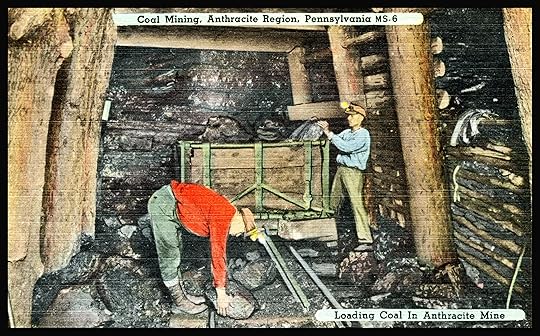
I live in Pennsylvania close to coal mining parts of the state. I now have in my mind men going into these mines, not bringing up cars filled with coal, but filled with paint. A different mine for each color, I can't get it out of my head.


And so the wealthy Silas and his family buy a home at Nankeen Square at the South End, where they think the best of society live, they are wrong. "Society" moved away from there years ago which doesn't really matter to them until their daughters become old enough to meet other young society ladies. Men too for that matter. Mrs. Lapham had the ladies of the neighborhood to tea and Lapham brought customer's home to pot-luck suppers, but neither of them imagined having dinners. The two girls had gone to the public schools and never finished at a private school for girls. They never learned to embroider or do needle-work. They learned to dance, but not in the private classes, they didn't even know there were private classes. There was a great gulf between the Lapham girls and society. The Lapham girls are nowhere near "society", to fix this their parents decided to build a mansion in the area where all society is now living. And eventually society does invite them to a dinner, but what should Lapham wear:

Finally, all that dress-making in the house began to scare him with vague apprehensions in regard to his own dress. As soon as he had determined to go, an ideal of the figure in which he should go presented itself to his mind. He should not wear any dress-coat, because, for one thing, he considered that a man looked like a fool in a dress-coat, and, for another thing, he had none--had none on principle. He would go in a frock-coat and black pantaloons, and perhaps a white waistcoat, but a black cravat anyway. But as soon as he developed this ideal to his family, which he did in pompous disdain of their anxieties about their own dress, they said he should not go so. Irene reminded him that he was the only person without a dress-coat at a corps reunion dinner which he had taken her to some years before, and she remembered feeling awfully about it at the time. Mrs. Lapham, who would perhaps have agreed of herself, shook her head with misgiving. "I don't see but what you'll have to get you one, Si," she said. "I don't believe they ever go without 'em to a private house."

He held out openly, but on his way home the next day, in a sudden panic, he cast anchor before his tailor's door and got measured for a dress-coat. After that he began to be afflicted about his waist-coat, concerning which he had hitherto been airily indifferent. He tried to get opinion out of his family, but they were not so clear about it as they were about the frock. It ended in their buying a book of etiquette, which settled the question adversely to a white waistcoat. The author, however, after being very explicit in telling them not to eat with their knives, and above all not to pick their teeth with their forks,--a thing which he said no lady or gentleman ever did,--was still far from decided as to the kind of cravat Colonel Lapham ought to wear: shaken on other points, Lapham had begun to waver also concerning the black cravat. As to the question of gloves for the Colonel, which suddenly flashed upon him one evening, it appeared never to have entered the thoughts of the etiquette man, as Lapham called him. Other authors on the same subject were equally silent, and Irene could only remember having heard, in some vague sort of way, that gentlemen did not wear gloves so much any more......

The night before the dinner came, and the question of his gloves was still unsettled, and in a fair way to remain so. He had bought a pair, so as to be on the safe side, perspiring in company with the young lady who sold them, and who helped him try them on at the shop; his nails were still full of the powder which she had plentifully peppered into them in order to overcome the resistance of his blunt fingers. But he was uncertain whether he should wear them. They had found a book at last that said the ladies removed their gloves on sitting down at table, but it said nothing about gentlemen's gloves.


Also in this novel we have the Corey family, these people are those society people. The Coreys are "old money" cream of Boston society. One of these Corey's is young Tom Corey. Tom joins Howells paint company because he doesn't want to rely on his wealthy father his entire life, but wants to find his own place in the world. And he ends up spending a lot of time with the Howells, time that isn't in the paint company. Howells said he didn't like sentimental romantic novels, but there is a romance in the novel and it is sweet. We have two daughters and a young society man in the book after all, there has to be a romance. I loved this book, it is seldom I hate no one in the book. There isn't a single person I want to take hold of and throw out of the story altogether. I'm glad I read it and probably will again, once I get through all the other books I have here, so it may take a while.

Profile Image for Jim Leckband.
783 reviews1 follower
August 25, 2013
The more accurate title would be "The Rise and Then Somewhat Depressing Train Wreck That Could Be Seen For 200 Pages of Silas Lapham".

Silas Lapham is a self-made millionaire from the very wrong side of the tracks who doesn't know what to do with his money. His only passion is his paint and his morality. Oh...his morality. Do we ever read about his morality. Apparently, early on he bought out his partner who brought capital to his business. The partner wasn't helping the business and didn't have the vision Lapham had. This colossal sin (!) sets up the rest of the novel for which Lapham pays with his business, house and all his fortune.

Of course, Lapham could have forestalled the bankruptcy at least 8,467 times by my count if he would have done a little moral jiu-jitsu that business people do every day. We're not talking Simon Legree here. But no, Howells sets up Lapham as the man who can't do wrong even as his paint empire spills out of the bucket. And this is the Paradise Lost paradox - we care about (or are more interested in) devils more than the saints. Here is an apt quote from a Balzac book that I'm reading after this one:
The moralist cannot deny that, as a rule, well-bred though very wicked men are far more attractive and lovable than virtuous men; having crimes to atone for, they crave indulgence by anticipation, by being lenient to the shortcomings of those who judge them, and they are thought most kind.
Lapham's sole wickedness that I can ferret out is that he loves to brag about his paint and his coming up from nothing. We get some comedy out of it, but it is still middling stuff.
The side plot of Lapham's daughters and the aristocratic Tom Corey is the best part of the book, if a little melodramatic. Everyone gets to self-sacrifice to their hearts content and it is fun to see them trying to beat each other to the pyre.

There are a lot of unsubtle digs in the novel at novels of the day and their unreality and sentimentality. It is obvious that "Lapham" is a rejoinder to those novels - but I'm not sure that it is much of an improvement as it is not terribly exciting without the "amping" up that unreality and sentimentality can give.
Profile Image for Helynne.
Author 3 books47 followers
June 24, 2021
This is one of our most unappreciated gems of 19th-century American literature, I believe, since I rarely hear of it, and read it myself only as an assignment in a literature class. The novel, which is considered a classic in American realism, could also be entitled The Rise and Fall and Subsequent Rising Again of Silas Lapham because of the materialistic and moral lessons of the title character. Lapham is a simple man, who undergoes the classic rags-to-riches story by way of the development of a phenomenal new paint that comes from materials found on his own land. Lapham, his wife, and two daughters, are pleased with their new social status, but ignorant in the ways of the upper class, and naive about proper behavior, protocol, etc., Silas's subsequent "fall" from the upper class could have been avoided, but comes about because of his own integrity, and moral choices he feels he must make. So, one is left to ponder if Silas is really a poor man at the end of the story or an infinitely better one. A subplot involving Lapham's two daughters--one pretty, one not so pretty--and the unlikely romances that face each one is also ironic.
Profile Image for Elizabeth.
1,020 reviews
July 22, 2019
Various elements of this novel made me want to compare it with a variety of other much-loved authors (of mine and others). The titular character contains elements of Fitzgerald's Gatsby, the trenchant social critique recalls Wharton, the plot (particularly the marriage plot) could have been taken right out of the pages of Jane Austen. And, despite these (worthy) comparisons, this novel is also all its own: it's a realistic yet also somewhat satirical look at the rise of America's nouveau riche at a time when America itself was still in its building stages. The novel reflects on all of the complications such social striving engendered, and does so in a way that manages to be both critical and also sympathetic to those on both sides of the aisle (i.e., the social strivers and the born-wealthy). The clash between these two hits its crescendo in the novel's brilliant middle-section, particularly at a dinner party where the Laphams are guests of the Boston Brahmin Coreys. This scene alone makes the entire book worth reading, though I wish it ended on as high a note as this climactic moment.
Profile Image for Al.
1,657 reviews58 followers
May 28, 2019
This book, which might more accurately be entitled "The Fall of Silas Lapham", is set in late 19th Century Boston. Mr. Lapham is a self-made millionaire paint manufacturer, living with his wife and two marriage-eligible daughters in a reasonable house, and aspiring to a grander one. He is crude and rugged, and the family is not successful in mingling with Boston's moneyed elite. Mr. Howells explores the conflicts and stresses on the Lapham family as the son of one of Boston's First Families goes to work for Silas and begins to court one of his daughters. A series of social and financial debacles ensues, and Howells uses these developments to illustrate the corrosive effect of class consciousness on social and business relationships.
Howells has been criticized for not having much to say in his novels, but I found this book to be very interesting. Howells is fair with his characters, and doesn't whitewash any of them. His dialogue and character analysis ring true. There is a truly tragic element to the story, and the clash of nouveau riche and old money would have appealed particularly to the reading public of this era.
Profile Image for Evan.
Author 3 books130 followers
September 18, 2014
This book is worth reading simply because of the structure -- it is perfectly symmetrical. there is an epiphany at the exact center and the opening and closing chapters are two different confessions -- one public, one private. It's an amazing work, though most people don't read it at this point.

EDIT: this book is also HILARIOUS. It’s hard to convince someone of this on the first read, but there’s a definite thread of manners comedy in here as well as the darker humor of a story of two families that don’t want to dislike one another but have a hard time finding a reason to socialize when the son of the Old Money Coreys seemingly courts the daughter of the New Money Laphams.

Also, there’s a character named Zerilla.
Profile Image for kenzie.
326 reviews27 followers
November 28, 2018
i had to read this for school, and wow, this was a wreck.

listen, i get it might have been good when it came out, but it's really not now. it's slow, the main character makes paint for a living, and the book is 80% his talking about his paint, 10% a boring, irritating, love triangle, and 10% anticlimactic climaxes of subplots.

the love triangle of this book was almost the worst part, but that took a close second to the paint details. (there was a part where a guy was talking to another guy after talking to the mc, and he said something like, "he coated me in his paint and let it dry while he kept talking about it" and that's a summary of the entire book, let's be real here)
Profile Image for Michelle.
2,611 reviews54 followers
October 30, 2008
I was pleasantly surprised by this rags-to-riches-to rags closeup of "nouveau riche meets bluebloods" story. Why had I never heard of Howells before? I'll be looking up more. I heard him referred to in a book as "The American Dickens" but he reminds me more of Wharton, just he is kinder to his characters. None of them were perfect or romanticized but all were sympathetic and I enjoyed reading about what happened to them. Howells' comments on novels were amusing. I'll definitely be looking up more from this author.
Profile Image for Shane.
12 reviews
March 31, 2012
Oh, the books I've read. This is by far the worst of them. The first forever of pages talks about nothing but paint and the Lapham family paint factory. The rest of the novel is nothing more than a poorly played out soap opera. The characters all seem shallow and despite the hard times that come about in the book - it never seems in touch with the hard times the rest of America was dealing with at the time. I don't have time to shed tears for the wealthy men (self-made or not) who mismanaged their empire.
Profile Image for Illiterate.
2,775 reviews56 followers
March 7, 2018
A self-made man struggles with capitalism and class. Howells’ moralistic plot sees vice beget problems and virtue bring solutions - yawn.
Profile Image for Mario G.
91 reviews7 followers
March 8, 2021
If you enjoy American realism and realism in general (to me, someone like Dostoyevsky falls under this somewhat elusive category), I would urge you to check this out as it is one of the first of its kind, published in the late 19th century. The story is produced so simply that it hovers over parable territory, but true to the realist tradition, it faithfully reproduces conservative American life during those times. It's quite tongue-in-cheek, and includes a recurring internal joke about novels and the idea that people will read any fiction as long as its characters partake in self-sacrifice that I thought was great, considering that self-sacrifice is this novel's primary theme.

This being said, this book is more interesting for fans of the realist genre; if that's not your thing, I'd recommend you seek elsewhere.
Displaying 1 - 30 of 317 reviews

Can't find what you're looking for?

Get help and learn more about the design.