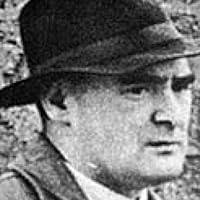
“On a late-winter evening in 1983, while driving through fog along the Maine coast, recollections of old campfires began to drift into the March mist, and I thought of the Abnaki Indians of the Algonquin tribe who dwelt near Bangor a thousand years ago.”
- Norman Mailer, from the opening lines of Harlot’s Ghost
That opening line should have been a warning.
This is an epic novel about the history of the Central Intelligence Agency. But by all means, let us start a thousand years ago, with the Algonquin of Maine. Hell, we have well over a thousand pages to go – till the inconclusive end – so we might as well start at the beginning.
The very beginning.
***
In a book riddled with diversion after digression after redirection, until the detour becomes the plot, and the plot is but a dream of a giant turtle perched upon a tiny rock in an alternate universe where novels move toward resolution, we might as well start as far away from the point as possible.
My mom always said I was stubborn. I suppose this is a thing all parents say to their kids. Now, though, I have my proof: I finished this.
I finished Harlot’s Ghost even though it is absolutely terrible. I finished Harlot’s Ghost despite it being the most Normal Mailer-ish thing Norman Mailer could ever have pulled from his fevered mind. (It is almost a Norman Mailer parody). I finished Harlot’s Ghost despite the half-assed psychoanalyzing, the ridiculous nesting-egg framework, the laughably pretentious prose (I stopped counting the times one character told another to “expatiate”), the utterly unlikable characters, and the fact that this is boring.
Yes, I said it. The word I hate. The word I loathe to use in book reviews. The word I hate in life. When my kids tell me they’re bored, I tell them that no one who can read – and who has time – can ever be bored.
As with so many of the parenting things I say, this turned out to be so, so wrong.
Harlot’s Ghost is boring.
Think about this: Norman Mailer wrote a 1,000-plus page novel about the CIA, covering the Cold War in Berlin, the Bay of Pigs, and Operation Mongoose, and it is as far away from interesting as is possible.
More than that, Mailer made it about himself. This is Norman Mailer writing a novel that would make people stop and think: “Oh, how brilliant he is!” Now that I’ve written that down, it occurred to me that I should have expected this.
Anyway, this is literary onanism of the most insufferable sort. Yet I finished, because – as I mentioned above – I am stubborn.
***
This is the story of Harrick (Harry) Hubbard, as told by Harrick Hubbard, in the most indulgent way that can be imagined.
We start at the end, which in this case is 1983, and Harry is driving back from a tryst with his mistress. Waiting at home is his wife, Kittredge, who we soon learn Harry stole from his CIA mentor (and James Jesus Angleton stand-in) Hugh Montague (codename: Harlot). As he drives, there is a meandering discourse on Harry’s family history, a pirate ghost, and ruminations about sex with his mistress. When he arrives, however, he finds out that something has happened to Hugh. Soon enough, Harry is on a plane to the USSR, carrying with him his memoir.
It is his memoir that provides the bulk of this story. But for Mailer, a book within a book is not enough. Accordingly, he decides to narrate much of Harry’s story in epistolary fashion, as a series of lengthy (like, Tolstoy-length) letters between Harry and Kittredge (and sometimes, between Harry and his dad, fellow CIA officer Cal). Take that Joseph Conrad! Your nested narratives have nothing on Mailer!
There are so many problems with this conceit, it’s hard to know where to begin.
***
So, let’s begin with the sheer stupidity of telling such a massive, detailed, discursive tale by structuring it as a series of letters between two navel-gazing narcissists. No one writes this much. Wait, that’s not true. No one who is not Norman Mailer, writing his longest novel – which is saying something – writes this much. There is a point when Harry is supposed to be preparing for the Bay of Pigs, but instead explains everything that’s going on in a “letter” to Kittredge. At one point, without irony, he tells Kittredge he is so tired that he can barely stay awake. I laughed out loud, in a derisive manner. Are you kidding me, Harry? You’re tired? Here’s an idea: STOP WRITING THIS STUPID LETTER AND GO TO BED!
Sorry for yelling. But this shows the depth of this novel’s lack of awareness. No wonder the Bay of Pigs failed. Apparently, the case officers were too busy over-sharing with their best friends’ wives to pay attention to invasion details.
***
Another huge problem is familiar to the epistolary genre: it takes you out of the action. By filtering everything through letters between Kittredge and Harry, we seldom get to witness events up close. Indeed, much of the time, Kittredge and Harry aren’t even participants. They’re just passing on hearsay. For example, there is an extended (see: endless) sequence involving a woman named Modene Murphy (based on Judith Campbell Exner) who is having an affair with JFK, and hanging out with the mob. We never get inside Modene’s head. We never follow her as she meets Sinatra, has sex with Kennedy, or dates Sam Giancana. Instead, we are subjected to a series of wiretaps between Murphy and her friend, in which Murphy describes what happened in great detail. Thus, instead of a firsthand story, we have a letter about a discussion about something that happened somewhere else. That’s three layers of separation between the reader and the drama.
***
The most incredible thing about the letters, though, is that you’re supposed to believe that two putatively excellent CIA agents would write everything down on paper (including top secret intelligence), and pass that classified information on to another person using the U.S. Postal Service. Mailer, in his afterword, pats himself on the back about how accurate his novel is, about how much inside dish he unearthed, and how his fiction is closer to the truth than anyone dares. Ha! Besides being insidious (there isn’t a conspiracy theory that isn’t passed off as gospel, and Mailer is basically saying he has the inside dope they’re all true), it’s shockingly implausible. You have three CIA officers (Harry, Cal, and Kittredge) all ignoring the most basic trade craft (not to mention breaking the law) by listing our national secrets on paper and then passing them to third parties. Through the postal service. As though they were sending Christmas cards rather than engaging in borderline-treasonable activity.
***
This wouldn’t be such a big deal, perhaps, if the story was any good. It’s not, however. Harlot’s Ghost mainly fails because nothing happens. There is no excitement, no thrills, no nothing, really.
Well, we learn a lot about Harry’s sex life. When he talks about his time at an elite prep school, the focus is on his sexual abuse at the hands of a chaplain. When he talks about his training at the Farm, he is unable to describe a class in lock-picking without comparing it to the physical act of love. When Harry goes to Berlin, he ends up in a gay club, is propositioned by fellow agent Dix Butler, and gets gonorrhea (no detail is spared). Most of his time in Argentina is devoted to an affair he has with another man’s wife. The spy games I expected never materialized.
For that, please pick up Robert Littel’s The Company. Both books cover the same territory, share many of the same characters, and are as large as well-fed babies. The Company, though, is propulsive, exquisitely plotted, and seems to know the first thing about intelligence work, e.g., a good case agent doesn’t mail top secret info to non-cleared individuals using first-class mail, just because he is a raging egoist who doesn’t know the difference between sex and lock-picking.
***
No matter how bad this got (and it got pretty bad), I plunged on. That’s due to the stubbornness I mentioned above. It was also due to a need to know how it ended, simply for my peace of mind.
I didn't even get that.
The final words of Harlot’s Ghost are: “To be continued.”
That’s right. Despite the prodigious length of this exercise, Mailer doesn’t come close to finishing. There was meant to be a sequel. Unfortunately, life is seldom long enough for all our plans and projects.
I doubt I would’ve picked up a sequel, even if one had been produced. After all, since I’ve put this down, I’ve never once given a half-second’s thought to Harry, Kittredge, Harlot, or the rest. Nevertheless, the worst part of this truly horrible reading experience might be the fact that I’ll never learn the conclusion to a story I don’t care about in the least.
I don’t give out one-star ratings very often. The reason is that I typically pick a book I think I’m going to like, if not love. After all, I’m not a fast reader, and my time is valuable (at least to me). Every so often, though, I end up taking a wrong turn on Literary Lane and arrive at a blind alley that also happens to be on fire.
When that fire has been lit by Norman Mailer, it gives me a bit of pause. I’ve read many reviews describing with rapture the luminosity of Mailer’s genius. I have started to wonder if perhaps I missed something. It is possible.
But there’s no way in hell I’m going back to find out.