

What do you think?

The Legend Of Sleepy Hallow
The Legend of Sleepy Hollow" is a short story of speculative fiction by American author Washington Irving, contained in his collection of 34 essays and short stories entitled The Sketch Book of Geoffrey Crayon, Gent.. Written while Irving was living abroad in Birmingham, England, "The Legend of Sleepy Hollow" was first published in 1820. Along with Irving's companion piece "Rip Van Winkle", "The Legend of Sleepy Hollow" is among the earliest examples of American fiction with enduring popularity, especially during Halloween because of a character known as the Headless Horseman believed to be a Hessian soldier who lost his head to a cannonball in battle.
44 pages, Kindle Edition
First published January 1, 1820
About the author
Washington Irving
5,995 books1,101 followersPeople remember American writer Washington Irving for the stories "
Rip Van Winkle
" and "
The Legend of Sleepy Hollow
," contained in
The Sketch Book
(1820).
This author, essayist, biographer and historian of the early 19th century wrote newspaper articles under the pseudonym Jonathan Oldstyle to begin his literary career at the age of nineteen years.
In 1809, he published The History of New York under his most popular public persona, Diedrich Knickerbocker.
Historical works of Irving include a five volume biography of George Washington (after whom he was named) as well as biographies of Oliver Goldsmith, Muhammad, and several histories, dealing with subjects, such as Christopher Columbus, the Moors, and the Alhambra, of 15th-century Spain. John Tyler, president, appointed Irving to serve as the first Spanish speaking United States minister to Spain from 1842 to 1846.
This author, essayist, biographer and historian of the early 19th century wrote newspaper articles under the pseudonym Jonathan Oldstyle to begin his literary career at the age of nineteen years.
In 1809, he published The History of New York under his most popular public persona, Diedrich Knickerbocker.
Historical works of Irving include a five volume biography of George Washington (after whom he was named) as well as biographies of Oliver Goldsmith, Muhammad, and several histories, dealing with subjects, such as Christopher Columbus, the Moors, and the Alhambra, of 15th-century Spain. John Tyler, president, appointed Irving to serve as the first Spanish speaking United States minister to Spain from 1842 to 1846.
Ratings & Reviews
Friends & Following
Create a free account to discover what your friends think of this book!
Community Reviews
Displaying 1 - 30 of 9,159 reviews

October 19, 2019
What?!
All this time I was feeling sorry for him, and it turns out Ichabod Crane was a douchebag!

Ok, this is my first time hearing the actual short story. So, I've been going off of movies and cartoons as my reference to what The Legend of Sleepy Hollow was all about. And if you haven't read it, you may have some of the same preconceived notions that I did. Stop me if this doesn't sound familiar...
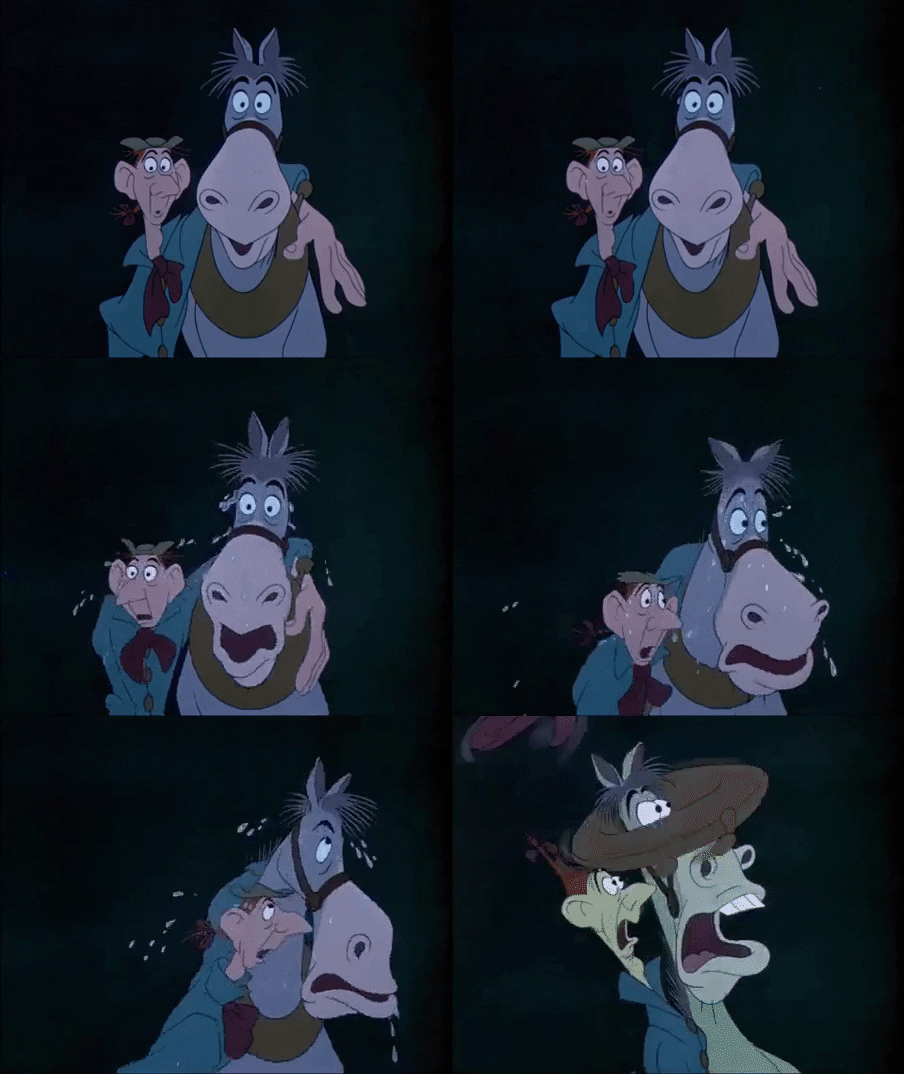
Poor, awkward Ichabod falls in love with the town beauty, and she (because women are saints) likes him back.

The evil bully, who also wants the girl, viciously drives Crane out of town by using the Headless Horseman story.

Whether or not the Horseman got him or he just ran away is up for grabs.
The End.

Well. Boy, was I in for the shock of my life.
Turns out, sweet old Ichabod was only really interested in the girl because her father was wealthy! And the evil bully was more of a rowdy prankster who didn't want Crane moving in on the girl he was already courting. <--getthefuckoutofhereIchabod!

Oh, and the story makes it pretty obvious that Crane just shit his pants and ran off at the end, so there's no real wondering about whether or not the Headless Horseman got hold of him.
Which was fine by me. I'm glad he's not dead, but I'm also glad the greedy little fucker didn't get his hands on any of that money. Brom deserved to chuckle his way down the aisle while thinking about the mysterious pumpkin found by the river.

Anyway, here's what I took away from this experience:
If a character is gangly and a bit of a nerd, most of the time, people automatically feel like they are somehow the heroes of the story. If a character is outgoing and generally well-liked, they must be the villain.
THAT'S SO WRONG!
I mean, yeah. We all root for the underdog who is trying to break out of a bad situation that isn't their fault, right?
But sometimes (and you know this is true) the supposed underdog is a really annoying dick who brings down shit on their own head and then whines about it. So, to me, this story was about a simpering little queef who got exactly what was coming to them.
And Justice was served in the form of a meatheaded jokester (dare I say hero?) named Brom.

At any rate, this was a highly entertaining short story, and just about the perfect sort of thing to read around Halloween.
This was the audiobook version I listened to, and it was pretty cool.
Publisher: Blackstone Publishing
Edition: Unabridged
Anthony Heald - Narrator
All this time I was feeling sorry for him, and it turns out Ichabod Crane was a douchebag!
Ok, this is my first time hearing the actual short story. So, I've been going off of movies and cartoons as my reference to what The Legend of Sleepy Hollow was all about. And if you haven't read it, you may have some of the same preconceived notions that I did. Stop me if this doesn't sound familiar...
Poor, awkward Ichabod falls in love with the town beauty, and she (because women are saints) likes him back.
The evil bully, who also wants the girl, viciously drives Crane out of town by using the Headless Horseman story.
Whether or not the Horseman got him or he just ran away is up for grabs.
The End.
Well. Boy, was I in for the shock of my life.
Turns out, sweet old Ichabod was only really interested in the girl because her father was wealthy! And the evil bully was more of a rowdy prankster who didn't want Crane moving in on the girl he was already courting. <--getthefuckoutofhereIchabod!
Oh, and the story makes it pretty obvious that Crane just shit his pants and ran off at the end, so there's no real wondering about whether or not the Headless Horseman got hold of him.
Which was fine by me. I'm glad he's not dead, but I'm also glad the greedy little fucker didn't get his hands on any of that money. Brom deserved to chuckle his way down the aisle while thinking about the mysterious pumpkin found by the river.
Anyway, here's what I took away from this experience:
If a character is gangly and a bit of a nerd, most of the time, people automatically feel like they are somehow the heroes of the story. If a character is outgoing and generally well-liked, they must be the villain.
THAT'S SO WRONG!
I mean, yeah. We all root for the underdog who is trying to break out of a bad situation that isn't their fault, right?
But sometimes (and you know this is true) the supposed underdog is a really annoying dick who brings down shit on their own head and then whines about it. So, to me, this story was about a simpering little queef who got exactly what was coming to them.
And Justice was served in the form of a meatheaded jokester (dare I say hero?) named Brom.
At any rate, this was a highly entertaining short story, and just about the perfect sort of thing to read around Halloween.
This was the audiobook version I listened to, and it was pretty cool.
Publisher: Blackstone Publishing
Edition: Unabridged
Anthony Heald - Narrator

October 15, 2017
Such heavy description, but still a good Halloween classic!

October 20, 2016
“I recollect that, when a stripling, my first exploit in squirrel-shooting was in a grove of tall walnut-trees that shades one side of the valley. I had wandered into it at noon time, when all nature is peculiarly quiet, and was startled by the roar of my own gun, as it broke the Sabbath stillness around, and was prolonged and reverberated by the angry echoes. If ever I should wish for a retreat, whither I might steal from the world and its distractions, and dream quietly away the remnant of a troubled life, I know of none more promising than this little valley…From the listless repose of the place, and the peculiar character of its inhabitants, who are descendants from the original Dutch settlers, this sequestered glen has long been known by the name of SLEEPY HOLLOW…”
- Washington Irving, The Legend of Sleepy Hollow
Pull up a chair and have seat. Do you want a drink? Please, I insist. I’ve been drinking for hours. As you can see, I have a fire going in the fireplace, to ward off the chill of a winter you can already sense around the corner. It is dark outside the window. The nights come fast as the days shorten. The wind is howling. That is the wind – right? Its shriek sounds almost alive, almost human. Here, have another drink. Scoot closer to the fire. I want to tell you a terrifying story.
The 2016 election cycle.
Wake up. Are you okay? You lost consciousness and fell out of your chair. No, I didn't rifle through your pockets. No, you aren't missing a ten-dollar bill. Moving on. I probably should have given you more warning, since the political theater we have experienced these past months (years?) has filled me with more dread than anything Stephen King could ever conjure.
Just recently, I attempted to watch the evening news, which is silly, I know, but I am old fashioned in some ways. Specifically, I like it when someone tells me the weather; it makes me feel someone is accountable. With the exception of a couple Viagra commercials, dispiriting in and of themselves, every commercial was a political ad. They were run in sequence, the first candidate calling the second candidate a tax-lover, followed by the second calling the first a terrorist-lover, and then circling back to the first calling the second a liar. Since I live near the border of two states, my misery is compounded. Strikingly, not a single advertisement referenced any positive position statement. It was all grossly negative hyperbolic attacks. If you were to get all your political information from watching the ads sandwiching the evening newscast, you would come to a shocking revelation. Everyone running for elected office this year is in cahoots with ISIS!
My advice. Take a break. Take a drink. (There are so many things to mix Baileys with). Read a book. Better yet, read a seasonal book, one that puts you in the mood for the finer things of fall. Forget about politics. It’s time to focus on pumpkin pie, pumpkin bread, and pumpkin beer. It’s time to read – or in my case reread – Washington Irving’s The Legend of Sleepy Hollow.
Irving’s short story is familiar to most. Even if you’ve never read it, you’ve probably consumed some of it by cultural osmosis. It concerns a love triangle between itinerant school teacher Ichabod Crane; the lovely Katrina van Tassel, daughter of a wealthy planter; and local big-man-on-campus Brom van Brunt, who goes by the baller nickname of Bram Bones.
The setting is rural New York State, in the years following the American Revolution. The exact year is unclear, though I’ve seen it placed in the 1790s. Ichabod, a striving pedagogue with a taste for the high life, has come to teach in “the drowsy shades of Sleepy Hollow.” As drawn by Irving, Crane is a memorably awkward figure.
This sketch gives you a good idea of Irving’s excellent powers of description. He masterfully renders his setting. The farms, the forests, the babbling brooks, are all made vivid in your imagination. The “great fields of Indian corn,” the “golden ears peeking from leafy coverts.” A sloop “loitering” on the river, “dropping slowly down with the tide, her sail hanging uselessly against the mast.” The hues of the forest in “their sober brown and yellow…some trees of the tenderer kind…nipped by the frost into brilliant dyes of orange, purple, and scarlet.” Irving paints this beauty with color and detail, with sound and scent.
Imbedded in these descriptions is a sense of the vastness of the wilderness, and how its trackless depth gave rise to superstitions, to tales of spooks and goblins and galloping Hessians lacking heads.

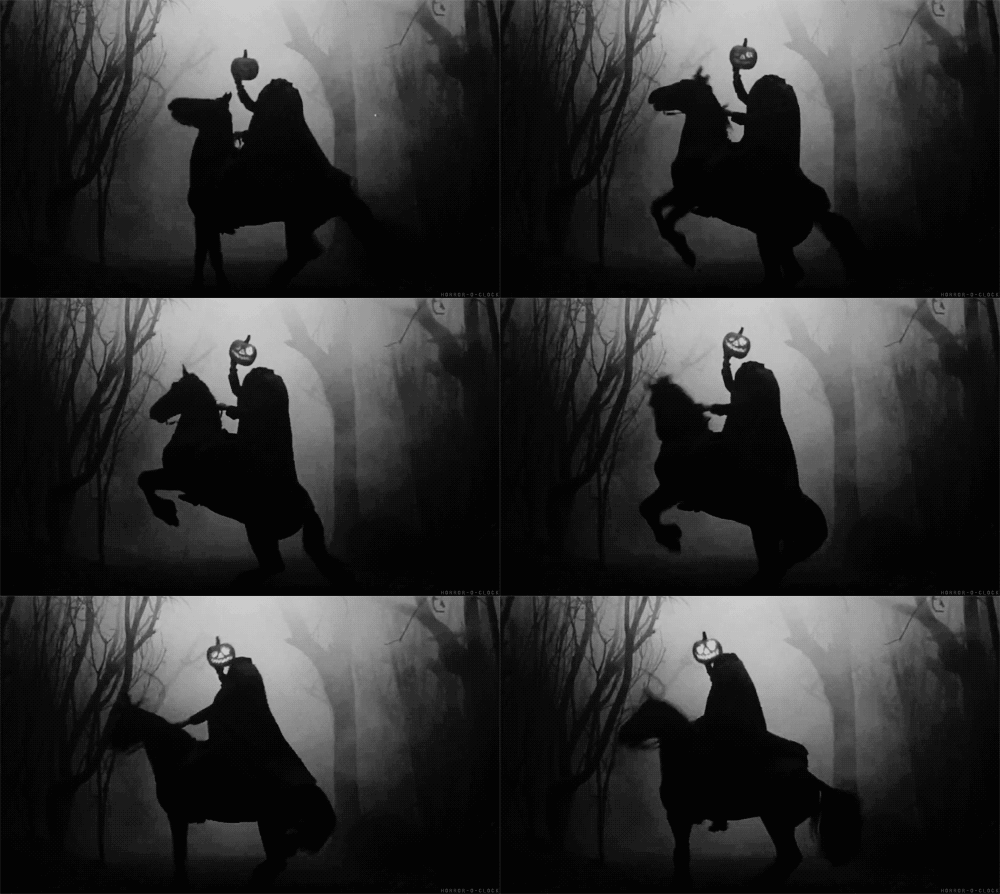
File Photo: The Headless Horseman, as captured in this undated photo that was definitely not taken in my front yard, but rather in Sleepy Hollow
This is not a scary story. It only borders on the spooky. The achievement of The Legend of Sleepy Hollow is in its near-perfect atmospherics. Irving delivers Sleepy Hollow in all its rustic glory: the sweep of her fields; the wend of her roads; the beliefs of her people.
And the food! Oh, the descriptions of the food!
You just gained five pounds reading that. I probably should have warned you.
The Legend of Sleepy Hollow has become a timeless American classic since its publication in 1820. It has been adapted (often terribly) into plays, musicals, cartoons, movies, and television shows. The original remains deceptively simple, a good-naturedly mythologized vision of pastoral America. In a few short pages, it wonderfully evokes a time, a place, and a season. Year after year, it never fails to inject me with the spirit of the fall. It leaves me with comforting visions of turning leaves, sharpening weather, roaring fires, hot drinks, and warm pies. Right now, that is exactly the type of escape I need.
- Washington Irving, The Legend of Sleepy Hollow
Pull up a chair and have seat. Do you want a drink? Please, I insist. I’ve been drinking for hours. As you can see, I have a fire going in the fireplace, to ward off the chill of a winter you can already sense around the corner. It is dark outside the window. The nights come fast as the days shorten. The wind is howling. That is the wind – right? Its shriek sounds almost alive, almost human. Here, have another drink. Scoot closer to the fire. I want to tell you a terrifying story.
The 2016 election cycle.
Wake up. Are you okay? You lost consciousness and fell out of your chair. No, I didn't rifle through your pockets. No, you aren't missing a ten-dollar bill. Moving on. I probably should have given you more warning, since the political theater we have experienced these past months (years?) has filled me with more dread than anything Stephen King could ever conjure.
Just recently, I attempted to watch the evening news, which is silly, I know, but I am old fashioned in some ways. Specifically, I like it when someone tells me the weather; it makes me feel someone is accountable. With the exception of a couple Viagra commercials, dispiriting in and of themselves, every commercial was a political ad. They were run in sequence, the first candidate calling the second candidate a tax-lover, followed by the second calling the first a terrorist-lover, and then circling back to the first calling the second a liar. Since I live near the border of two states, my misery is compounded. Strikingly, not a single advertisement referenced any positive position statement. It was all grossly negative hyperbolic attacks. If you were to get all your political information from watching the ads sandwiching the evening newscast, you would come to a shocking revelation. Everyone running for elected office this year is in cahoots with ISIS!
My advice. Take a break. Take a drink. (There are so many things to mix Baileys with). Read a book. Better yet, read a seasonal book, one that puts you in the mood for the finer things of fall. Forget about politics. It’s time to focus on pumpkin pie, pumpkin bread, and pumpkin beer. It’s time to read – or in my case reread – Washington Irving’s The Legend of Sleepy Hollow.
Irving’s short story is familiar to most. Even if you’ve never read it, you’ve probably consumed some of it by cultural osmosis. It concerns a love triangle between itinerant school teacher Ichabod Crane; the lovely Katrina van Tassel, daughter of a wealthy planter; and local big-man-on-campus Brom van Brunt, who goes by the baller nickname of Bram Bones.
The setting is rural New York State, in the years following the American Revolution. The exact year is unclear, though I’ve seen it placed in the 1790s. Ichabod, a striving pedagogue with a taste for the high life, has come to teach in “the drowsy shades of Sleepy Hollow.” As drawn by Irving, Crane is a memorably awkward figure.
He was tall, but exceedingly lank, with narrow shoulders, long arms and legs, hands that dangled a mile out of his sleeves, feet that might have served for shovels, and his whole frame most loosely hung together. His head was small, and flat at top, with huge ears, large green glassy eyes, and a long snipe nose, so that it looked like a weathercock perched upon his spindle neck, to tell which way the wind blew. To see him striding along the profile of a hill on a windy day, with his clothes bagging and fluttering about him, one might have mistaken him for the genius of famine descending upon the earth, or some scarecrow eloped from a cornfield.
This sketch gives you a good idea of Irving’s excellent powers of description. He masterfully renders his setting. The farms, the forests, the babbling brooks, are all made vivid in your imagination. The “great fields of Indian corn,” the “golden ears peeking from leafy coverts.” A sloop “loitering” on the river, “dropping slowly down with the tide, her sail hanging uselessly against the mast.” The hues of the forest in “their sober brown and yellow…some trees of the tenderer kind…nipped by the frost into brilliant dyes of orange, purple, and scarlet.” Irving paints this beauty with color and detail, with sound and scent.
Imbedded in these descriptions is a sense of the vastness of the wilderness, and how its trackless depth gave rise to superstitions, to tales of spooks and goblins and galloping Hessians lacking heads.
The dominant spirit…that haunts this enchanted region…is the apparition of a figure on horseback without a head. It is said by some to be the ghost of a Hessian trooper, whose head has been carried away by a cannon-ball, in some nameless battle during the revolutionary war; and who is ever and anon seen by the country folk, hurrying along in the gloom of night, as if on the wings of the wind.
File Photo: The Headless Horseman, as captured in this undated photo that was definitely not taken in my front yard, but rather in Sleepy Hollow
This is not a scary story. It only borders on the spooky. The achievement of The Legend of Sleepy Hollow is in its near-perfect atmospherics. Irving delivers Sleepy Hollow in all its rustic glory: the sweep of her fields; the wend of her roads; the beliefs of her people.
And the food! Oh, the descriptions of the food!
Fain would I pause to dwell upon the world of charms that burst upon the enraptured gaze of my hero, as he entered the state parlour of Van Tassel’s mansion. Not these of the bevy of lasses…but the ample charms of a genuine Dutch country tea-table, in the sumptuous time of autumn. Such heaped-up platters of cakes of various and almost indescribable kinds, known only to experienced Dutch housewives! There was the doughy dough-nut, the tenderer oly koek, and the crisp and crumbling cruller; sweet cakes and short cakes, ginger cakes and honey cakes, and the whole family of cakes. And then there were apple pies, and peach pies, and pumpkin pies; besides slices of ham and smoked beef; and moreover delectable dishes of preserved plums, and peaches, and pears, and quinces; not to mention broiled shad and roasted chickens…Heaven bless the mark! I want breath and time to discuss this banquet as it deserves, and am too eager to get on with my story. Happily, Ichabod Crane was not in so great a hurry as his historian, but did ample justice to every dainty.
You just gained five pounds reading that. I probably should have warned you.
The Legend of Sleepy Hollow has become a timeless American classic since its publication in 1820. It has been adapted (often terribly) into plays, musicals, cartoons, movies, and television shows. The original remains deceptively simple, a good-naturedly mythologized vision of pastoral America. In a few short pages, it wonderfully evokes a time, a place, and a season. Year after year, it never fails to inject me with the spirit of the fall. It leaves me with comforting visions of turning leaves, sharpening weather, roaring fires, hot drinks, and warm pies. Right now, that is exactly the type of escape I need.

November 5, 2020
Having seen the movie I thought I’d give the book a go, and I’m so glad I did. It was both comical and creepy at the same time. Really enjoyable.

October 31, 2020
The Legend of Sleepy Hollow might be one of the most perfect spooky tales to read, listen to, or tell on a cool October night. I listened to the whole thing on one, chilly, misty, fall walk. As the leaves fell from the trees and the dew from the fog condensed on my coat, I was transported to Sleepy Hollow and the mysterious tale of Ichabod Crane and his encounter with the Headless Horseman.
I am writing this review on Halloween (even though I read it a few days ago) and can tell you this story is short enough that if my review makes you want to read it, you still have time to fit it into your plans for Halloween night. In fact, after finally reading this story that I previously only knew from pop culture references, I might make it a tradition to reread it during future Octobers. Tonight I plan to watch the classic Disney cartoon with my kids and, from what I remember, it stayed pretty true to the story.
I guess you can tell by now that I was very pleased with my experience. For a classic, it is very easy to read and follow (not always the case with classics). It is the perfect balance of spooky supernatural legend, mystery, humor, and historical fiction. You will be transported across the years, maybe a little freaked out, and left to make your own decisions about the encounter between Ichabod and The Headless Horseman!
I am writing this review on Halloween (even though I read it a few days ago) and can tell you this story is short enough that if my review makes you want to read it, you still have time to fit it into your plans for Halloween night. In fact, after finally reading this story that I previously only knew from pop culture references, I might make it a tradition to reread it during future Octobers. Tonight I plan to watch the classic Disney cartoon with my kids and, from what I remember, it stayed pretty true to the story.
I guess you can tell by now that I was very pleased with my experience. For a classic, it is very easy to read and follow (not always the case with classics). It is the perfect balance of spooky supernatural legend, mystery, humor, and historical fiction. You will be transported across the years, maybe a little freaked out, and left to make your own decisions about the encounter between Ichabod and The Headless Horseman!

March 17, 2015
I thought this story and I were Meant To Be.

A few days before reading this, I read and reviewed Washington Irving's other famous story, Rip Van Winkle, and really enjoyed it. And then I read The Fold, which has this exchange between a high school student and his teacher in the first few pages:
Ichabod Crane, a schoolteacher, is an outsider in the beautiful New York valley of Sleepy Hollow, but he's a native of Connecticut, not England. When you Google "Ichabod Crane" nowadays, you get mostly this:
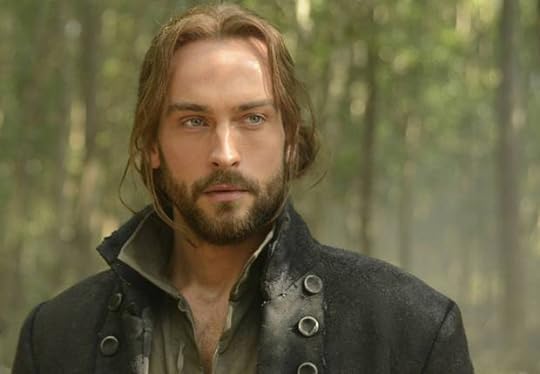
. . . which, nice as he is to look at, is not the real Ichabod. Washington Irving writes:

What Disney also got right was distilling Irving's story down to the the good stuff. Irving just spends too long describing the countryside, Ichabod and his avarice and questionable habits, the coquettish Katrina and her family farm (Ichabod wants to wed Katrina, but mostly because she's beautiful, she's rich, and she's got huge ... tracts of land), and Brom Bones and his jealousy. All of these descriptions were nicely done, but didn't hold my interest like I had hoped. And if there was any symbolism of post-Revolutionary War Great Britain in Ichabod, other than just his greed, I couldn't find it. He's not at all admirable--as well as being greedy, he's pompous, self-absorbed and superstitious--but I also found him kind of pitiful.
When the Headless Horseman (aka "Galloping Hessian of the Hollow") finally appears, the excitement ramps up.

And there's the enduring mystery: What really happened that night? And what became of Ichabod Crane? (Actually, I think the story itself makes it fairly clear what happened.
It was interesting reading the original version of the tale and comparing it to the heavily Disney-influenced version in my head. And the character of Ichabod Crane is well-drawn. Overall the story was just a little too detailed and slow for me.
Free on Gutenberg, here (at the end of this original collection of Washington Irving stories, with some really charming original illustrations) and here (just the story itself).
Art credits: http://poolichoo.deviantart.com/art/S... and Disney Studios. :)
A few days before reading this, I read and reviewed Washington Irving's other famous story, Rip Van Winkle, and really enjoyed it. And then I read The Fold, which has this exchange between a high school student and his teacher in the first few pages:
“Ichabod Crane isn’t really the hero of ‘The Legend of Sleepy Hollow’.”And I really love symbolism, so I was all set to love this story. It just didn't quite work out the way I'd envisioned.
“Explain.”
“He’s, like, the British. You told us that when you said we couldn’t just watch the TV show to learn the story. You said that sometimes the bad guy is right there in front of us.”
Ichabod Crane, a schoolteacher, is an outsider in the beautiful New York valley of Sleepy Hollow, but he's a native of Connecticut, not England. When you Google "Ichabod Crane" nowadays, you get mostly this:
. . . which, nice as he is to look at, is not the real Ichabod. Washington Irving writes:
He was tall, but exceedingly lank, with narrow shoulders, long arms and legs, hands that dangled a mile out of his sleeves, feet that might have served for shovels, and his whole frame most loosely hung together. His head was small, and flat at top, with huge ears, large green glassy eyes, and a long snip nose, so that it looked like a weathercock perched upon his spindle neck to tell which way the wind blew.Disney got this one right.
What Disney also got right was distilling Irving's story down to the the good stuff. Irving just spends too long describing the countryside, Ichabod and his avarice and questionable habits, the coquettish Katrina and her family farm (Ichabod wants to wed Katrina, but mostly because she's beautiful, she's rich, and she's got huge ... tracts of land), and Brom Bones and his jealousy. All of these descriptions were nicely done, but didn't hold my interest like I had hoped. And if there was any symbolism of post-Revolutionary War Great Britain in Ichabod, other than just his greed, I couldn't find it. He's not at all admirable--as well as being greedy, he's pompous, self-absorbed and superstitious--but I also found him kind of pitiful.
When the Headless Horseman (aka "Galloping Hessian of the Hollow") finally appears, the excitement ramps up.
And there's the enduring mystery: What really happened that night? And what became of Ichabod Crane? (Actually, I think the story itself makes it fairly clear what happened.
It was interesting reading the original version of the tale and comparing it to the heavily Disney-influenced version in my head. And the character of Ichabod Crane is well-drawn. Overall the story was just a little too detailed and slow for me.
Free on Gutenberg, here (at the end of this original collection of Washington Irving stories, with some really charming original illustrations) and here (just the story itself).
Art credits: http://poolichoo.deviantart.com/art/S... and Disney Studios. :)
October 17, 2022
I remember the movies and I think I recall we read and analyzed this short story in school. I think it was around Halloween as a fun activity but I really could not remember the story at all. It was a favourite of my husband's but I could not find his old childhood copy anywhere around the house. Luckily, Hoopla had the audio available.
It's a good short story for the season. Written very well and like all the classics very descriptive. The town and atmosphere is vividly set-up as well as the food descriptions! Really, my mouth started to water when Ichabod Crane attended the party at the Van Tassel's...the descriptions of the foods available were delectable!
What occurs on Ichabod's return home was a little suspenseful but I did not find it really creepy. It was fun listening to this one on Audio. The narrators voice was hauntingly perfect. A fun and quick story for the season 🎃
It's a good short story for the season. Written very well and like all the classics very descriptive. The town and atmosphere is vividly set-up as well as the food descriptions! Really, my mouth started to water when Ichabod Crane attended the party at the Van Tassel's...the descriptions of the foods available were delectable!
What occurs on Ichabod's return home was a little suspenseful but I did not find it really creepy. It was fun listening to this one on Audio. The narrators voice was hauntingly perfect. A fun and quick story for the season 🎃

May 21, 2026
In a small market town commonly referred to as Tarry Town is a glen known as Sleepy Hollow, thought to still hold 'witching power'. The main haunting of the region is an apparition of a headless horseman, said to be the ghost of a Hessian trooper who lost his head to a cannonball in battle.
Ichabod Crane is a teacher at the local schoolhouse who finds temporary lodging by flitting from one parent to another by helping out on their farms. He is also quite taken with a beautiful woman named Katrina Van Tassel, whom he hopes to marry, but he has a love rival in Brom Bones. When Katrina eventually rebuffs him at a party one night, he heads out for a ride, only to never be seen again.
A gloomy, atmospheric gothic tale that is written in wonderful, descriptive, poetic-style prose. The story itself is quite basic, and the headless horseman is little more than a bit part, which was surprising given it's what the whole book is known for. It always surprises me how much these classics get watered down with the various adaptations, so when you do get around to reading the original story, it bears scant resemblance.
The ending is left with a touch of mystery as to whom it was Ichabod Crane encountered on his journey and where he disappeared to, but given the story is heavily based on a love triangle and there are hints of foreshadowing earlier on with regard to pranks and mischief, it certainly leads us to a particular conclusion.
I did like this for the most part, but it does veer off into irrelevant rambling at points. I also don't think the postscript at the end was needed, as it deviated from the ambience of the rest of the book. Plus, it didn't really add anything to the plot arc other than to let us know a man is narrating a tale from what has been passed down through the grapevine, so it may or may not be true. Which only reinforces the ambiguity and, to be fair, was probably the author's intention.
Ichabod Crane is a teacher at the local schoolhouse who finds temporary lodging by flitting from one parent to another by helping out on their farms. He is also quite taken with a beautiful woman named Katrina Van Tassel, whom he hopes to marry, but he has a love rival in Brom Bones. When Katrina eventually rebuffs him at a party one night, he heads out for a ride, only to never be seen again.
A gloomy, atmospheric gothic tale that is written in wonderful, descriptive, poetic-style prose. The story itself is quite basic, and the headless horseman is little more than a bit part, which was surprising given it's what the whole book is known for. It always surprises me how much these classics get watered down with the various adaptations, so when you do get around to reading the original story, it bears scant resemblance.
The ending is left with a touch of mystery as to whom it was Ichabod Crane encountered on his journey and where he disappeared to, but given the story is heavily based on a love triangle and there are hints of foreshadowing earlier on with regard to pranks and mischief, it certainly leads us to a particular conclusion.
I did like this for the most part, but it does veer off into irrelevant rambling at points. I also don't think the postscript at the end was needed, as it deviated from the ambience of the rest of the book. Plus, it didn't really add anything to the plot arc other than to let us know a man is narrating a tale from what has been passed down through the grapevine, so it may or may not be true. Which only reinforces the ambiguity and, to be fair, was probably the author's intention.

February 25, 2016
م
موجة الحر الابدية حولت مصر الى هذا الوادي النعسان

اما هناك في" الوادي النعسان" حيث الكل يمشون في حالة حلم يقظة مستمر..يؤمنون بكل الخوارق ..هنا تطير النيازك و تسقط النجوم
ولكن تظل الروح المسيطرة على سليبي هولو هو شبح بلا رأس

يمتطي حصانا. .باحثا للابد عن رأسه
..و بين الأسماء الهولندية الثقيلة و الطباع الريفية الخبيثة..و في جو رومانسي مشوب بالاستغلال ..نتعرف على ايشابود كرين المدرس و الناظر لمدرسة الوادي الذي يقع صريع ثراء و جمال كاترينا فان تاسل..
و تدور احداث النوفيلا الصغيرة في طريق بعيد جدا عن احداث الفيلم الهوليودي الضخم الشهير فلا يوجد ضباط او مباحث و لا أثرياء مقطوعي الرأس لاسباب ثأرية بل ان الشبح يقذف جمجمة على من يريده. .
حتى من الصعب أن تصنف كرعب😱...و قد أخذها ايرفنج عن اسطورة الدولاهين الايرلندية القديمة
و لكن الطريف حقا ان واشنطون ايرفنج عندما توفي دفن في مقبرة الكنيسة الهولندية المسماة " سليبي هولو " بنيويورك
موجة الحر الابدية حولت مصر الى هذا الوادي النعسان
اما هناك في" الوادي النعسان" حيث الكل يمشون في حالة حلم يقظة مستمر..يؤمنون بكل الخوارق ..هنا تطير النيازك و تسقط النجوم
ولكن تظل الروح المسيطرة على سليبي هولو هو شبح بلا رأس
يمتطي حصانا. .باحثا للابد عن رأسه
..و بين الأسماء الهولندية الثقيلة و الطباع الريفية الخبيثة..و في جو رومانسي مشوب بالاستغلال ..نتعرف على ايشابود كرين المدرس و الناظر لمدرسة الوادي الذي يقع صريع ثراء و جمال كاترينا فان تاسل..
و تدور احداث النوفيلا الصغيرة في طريق بعيد جدا عن احداث الفيلم الهوليودي الضخم الشهير فلا يوجد ضباط او مباحث و لا أثرياء مقطوعي الرأس لاسباب ثأرية بل ان الشبح يقذف جمجمة على من يريده. .
حتى من الصعب أن تصنف كرعب😱...و قد أخذها ايرفنج عن اسطورة الدولاهين الايرلندية القديمة
و لكن الطريف حقا ان واشنطون ايرفنج عندما توفي دفن في مقبرة الكنيسة الهولندية المسماة " سليبي هولو " بنيويورك

September 28, 2021
No review coming for this. I re-read it for background in reviewing The Horseman, in which the famed rider of Sleepy Hollow is given a new take. The original is a fun read, with Ichabod as a gold-digger of a school-teacher looking to get with the beautiful local heiress, to the chagrin of the Gaston of the town, one Brom Bones, who does his best to scare off the interloper. It speaks to the period, place (there is a lot of local scenic and cultural color) and superstitious bent of area residents. Whether Irving thought this was the case, or made it up of whole cloth I have no idea. God knows there are plenty today who subscribe to all forms of unprovable nonsense. Worth checking this one out if you are planning to read Horseman. Oh, looks like I wrote a tiny review after all. Didn't intend to. I did, however, intend to watch the TV series, Sleepy Hollow, which was delicious fun, but the very handsome Ichabod Crane on that show bears no resemblance to the gangly, unattractive Crane of the original story, which goes off in very different directions.
My actual review of The Horseman on Goodreads, and on my site, Coot’s Reviews. Head on over and say Hi!


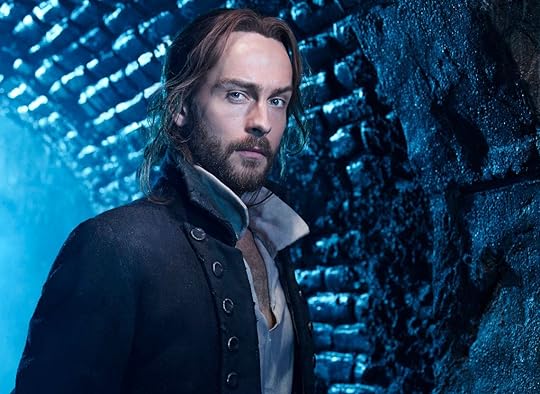
Tim Mison as Ichabod Crane in the show Sleepy Hollow
My actual review of The Horseman on Goodreads, and on my site, Coot’s Reviews. Head on over and say Hi!
Tim Mison as Ichabod Crane in the show Sleepy Hollow

October 12, 2016
This little treasure was simply delightful! Quite honestly, I didn’t expect to enjoy it quite so much. I’ve seen the various movie adaptations over the years and figured there wasn’t really anything more to be gained by reading this short story. I was wrong – the eloquence of the written word brought the legend up to a whole other level for me.
Everyone is probably familiar with the tale of the Headless Horseman and the little valley of Sleepy Hollow, situated near the small town of Tarry Town, New York. The descriptions of the countryside were remarkably vivid and evoked such a lovely image and feeling of autumn in New York, a personal favorite time of year. Ichabod Crane is well-known to those familiar with early American literature. You need not have seen the Disney movie to picture this oddball of a figure! Washington Irving draws an image of a somewhat ungainly fellow who is a bit of a freeloader and a fortune hunter. He is well-versed in Cotton Mather’s “History of New England Witchcraft”, and, like the rest of the village folk, is not immune to superstitions and the thrill of tall tales. A wonderful description of Sleepy Hollow and its inhabitants really exemplifies the expressiveness of the prose:
"Certain it is, the place still continues under the sway of some witching power, that holds a spell over the minds of the good people, causing them to walk in a continual reverie. They are given to all kinds of marvelous beliefs, are subject to trances and visions, and frequently see strange sights, and hear music and voices in the air. The whole neighborhood abounds with local tales, haunted spots, and twilight superstitions; stars shoot and meteors glare oftener across the valley than in any other part of the country, and the nightmare, with her whole ninefold, seems to make it the favorite scene of her gambols. The dominant spirit, however, that haunts this enchanted region, and seems to be commander-in-chief of all the powers of the air, is the apparition of a figure on horseback, without a head."
What happens to those with a lively imagination? You’ll have to take this wild ride through the valley with Ichabod to find out. You most likely won’t tremble with fear, but you may become just a wee bit spooked by the dark phantom. Even if you don’t feel the least bit rattled, you will be entertained! You may even muster up a little chuckle, just like my old pal Brom Bones who always managed a laugh whenever this story was re-told.
Everyone is probably familiar with the tale of the Headless Horseman and the little valley of Sleepy Hollow, situated near the small town of Tarry Town, New York. The descriptions of the countryside were remarkably vivid and evoked such a lovely image and feeling of autumn in New York, a personal favorite time of year. Ichabod Crane is well-known to those familiar with early American literature. You need not have seen the Disney movie to picture this oddball of a figure! Washington Irving draws an image of a somewhat ungainly fellow who is a bit of a freeloader and a fortune hunter. He is well-versed in Cotton Mather’s “History of New England Witchcraft”, and, like the rest of the village folk, is not immune to superstitions and the thrill of tall tales. A wonderful description of Sleepy Hollow and its inhabitants really exemplifies the expressiveness of the prose:
"Certain it is, the place still continues under the sway of some witching power, that holds a spell over the minds of the good people, causing them to walk in a continual reverie. They are given to all kinds of marvelous beliefs, are subject to trances and visions, and frequently see strange sights, and hear music and voices in the air. The whole neighborhood abounds with local tales, haunted spots, and twilight superstitions; stars shoot and meteors glare oftener across the valley than in any other part of the country, and the nightmare, with her whole ninefold, seems to make it the favorite scene of her gambols. The dominant spirit, however, that haunts this enchanted region, and seems to be commander-in-chief of all the powers of the air, is the apparition of a figure on horseback, without a head."
What happens to those with a lively imagination? You’ll have to take this wild ride through the valley with Ichabod to find out. You most likely won’t tremble with fear, but you may become just a wee bit spooked by the dark phantom. Even if you don’t feel the least bit rattled, you will be entertained! You may even muster up a little chuckle, just like my old pal Brom Bones who always managed a laugh whenever this story was re-told.

October 27, 2022
"The Legend of Sleepy Hollow" by Washington Irving was first published in 1820!
In Tarry Town, New York there is a quiet glen know as Sleepy Hollow where spindly schoolmaster, Ichabod Crane arrives from Connecticut to teach the local children. He has hopes of marriage to the beautiful eighteen-year-old Katrina Van Tassel, daughter of a wealthy farmer.
Ichabod may have formidable competition from the town brute and bully, Abraham 'Brom Bones' Van Brunt, who already has plans for this vision of beauty!
The writing is nothing short of spectacular! It's beautifully descriptive, and fluidly poetic.
If I were a child, I would be mesmerized by the 'Headless Horseman' cover art and the anticipation of the scary premise.
As an adult, all the drama is in the writing style and the voice of the wonderful narrator, Anthony Heald, who does an impeccable performance.
I have to profess, I wanted more than this short story could provide but I am wholly satisfied with the total package. 3.75 stars rounded up!
In Tarry Town, New York there is a quiet glen know as Sleepy Hollow where spindly schoolmaster, Ichabod Crane arrives from Connecticut to teach the local children. He has hopes of marriage to the beautiful eighteen-year-old Katrina Van Tassel, daughter of a wealthy farmer.
Ichabod may have formidable competition from the town brute and bully, Abraham 'Brom Bones' Van Brunt, who already has plans for this vision of beauty!
The writing is nothing short of spectacular! It's beautifully descriptive, and fluidly poetic.
If I were a child, I would be mesmerized by the 'Headless Horseman' cover art and the anticipation of the scary premise.
As an adult, all the drama is in the writing style and the voice of the wonderful narrator, Anthony Heald, who does an impeccable performance.
I have to profess, I wanted more than this short story could provide but I am wholly satisfied with the total package. 3.75 stars rounded up!

September 5, 2016
I spent a few weeks every summer in the Catskill Mountains at a resort with my godparents, parents and grandparents. I used to walk around the forest, searching for the headless horsemen. The cottages we always stayed in were either "Rip Van Winkle" or "Legend of Sleepy Hollow." Such good memories on the place and this book. Even before the movie, it launched my thirst for mystery and the hunt! And when they used this to make a few movies and then the TV show, I loved the whole concept. A must-read for folks interested in mystery and a little bit of the gothic... in the classics realm.
About Me
For those new to me or my reviews... here's the scoop: I read A LOT. I write A LOT. And now I blog A LOT. First the book review goes on Goodreads, and then I send it on over to my WordPress blog at https://thisismytruthnow.com, where you'll also find TV & Film reviews, the revealing and introspective 365 Daily Challenge and lots of blogging about places I've visited all over the world. And you can find all my social media profiles to get the details on the who/what/when/where and my pictures. Leave a comment and let me know what you think. Vote in the poll and ratings. Thanks for stopping by.
About Me
For those new to me or my reviews... here's the scoop: I read A LOT. I write A LOT. And now I blog A LOT. First the book review goes on Goodreads, and then I send it on over to my WordPress blog at https://thisismytruthnow.com, where you'll also find TV & Film reviews, the revealing and introspective 365 Daily Challenge and lots of blogging about places I've visited all over the world. And you can find all my social media profiles to get the details on the who/what/when/where and my pictures. Leave a comment and let me know what you think. Vote in the poll and ratings. Thanks for stopping by.

October 5, 2018
Simply classic!
Delightfully written, this classic American folktale recounts the exploits of schoolmaster Ichabod Crane during his brief stay in the cozy little town of Sleepy Hollow. The town is wrought however, with ghost stories dangling upon the lips of its citizens and goblins lurking in every corner. Ichabod, the ever faithful disciple of the great Cotton Mather and hopeful victor in the battle for the Love of Katrina Van Tassel, is unamused by these folk legends and braves the odds in order to win the favor of his lovely lady.
A little bit slow in the beginning. Washington Irving likes to paint the scene very vividly for his readers. He also tends to use a lot of anecdotes in his writing. But the older English style that it is written in is beautiful and adds to the subtle reminder that this is a classic of American literature.
I loved this book. I can't believe it took me this long to read it but I'm glad I finally did.
I highly recommend this book to EVERYONE!!! 😁
Delightfully written, this classic American folktale recounts the exploits of schoolmaster Ichabod Crane during his brief stay in the cozy little town of Sleepy Hollow. The town is wrought however, with ghost stories dangling upon the lips of its citizens and goblins lurking in every corner. Ichabod, the ever faithful disciple of the great Cotton Mather and hopeful victor in the battle for the Love of Katrina Van Tassel, is unamused by these folk legends and braves the odds in order to win the favor of his lovely lady.
A little bit slow in the beginning. Washington Irving likes to paint the scene very vividly for his readers. He also tends to use a lot of anecdotes in his writing. But the older English style that it is written in is beautiful and adds to the subtle reminder that this is a classic of American literature.
I loved this book. I can't believe it took me this long to read it but I'm glad I finally did.
I highly recommend this book to EVERYONE!!! 😁

October 10, 2017
Fun read and a great way to kick off my month of Halloween reads. I know the story, watched countless movie versions of the story, but never actually read the book. Still didn't....I listed to this one via audio. A fun read, but I wanted more gothic, creepy-ness. I wanted more Headless Horseman.
The audio narration was wonderful! The narrator's voice had an edge of spookiness to it (a very good thing). Glad I read this one but yeah, I prefer the movie version 'Sleepy Hollow', which I watch every Halloween.
The audio narration was wonderful! The narrator's voice had an edge of spookiness to it (a very good thing). Glad I read this one but yeah, I prefer the movie version 'Sleepy Hollow', which I watch every Halloween.

June 2, 2019
A reread for me, quite a humdinger of a little story with the silly, scarecrow of a school teacher and his stupendous imagination getting the best of him and leaving the girl as a prize for his clever rival.

August 18, 2019
Equal parts hilarious, creepy, classical and of course legendary!
A part of the story was included in our fourth grade course book,
I never understood what it meant.
Now had an amazing time reading it.
Specially the funny use of Headless Horseman!
Loved the ending!
A part of the story was included in our fourth grade course book,
I never understood what it meant.
Now had an amazing time reading it.
Specially the funny use of Headless Horseman!
Loved the ending!

October 15, 2014
Though I've seen the movie versions countless times and listened to Bing Crosby croon about Brom Bones every Halloween for decades, this was my first time reading the story and it was MAGICAL!
I really enjoyed Irving's style. His descriptions paint joyful pictures without being too wordy or grandiose. The passages about Icabod's boundless appetite and his lust for Katrina's huge . . . tracts of land are priceless.
Reading this story has given me a new appreciation for Irving. My goals now are:
1) Read Rip Van Winkle and Tales of the Alhambra posthaste.
and
2) Win millions of dollars ASAP so I can buy a farm in the Hudson River Valley. I feel the need for my own picturesque tracts of land.

Sleepy Hollow, New York
I really enjoyed Irving's style. His descriptions paint joyful pictures without being too wordy or grandiose. The passages about Icabod's boundless appetite and his lust for Katrina's huge . . . tracts of land are priceless.
Reading this story has given me a new appreciation for Irving. My goals now are:
1) Read Rip Van Winkle and Tales of the Alhambra posthaste.
and
2) Win millions of dollars ASAP so I can buy a farm in the Hudson River Valley. I feel the need for my own picturesque tracts of land.
Sleepy Hollow, New York

October 30, 2022
I've seen different adaptations of this story before, but this was my first time reading it. Or rather listening to the audiobook.
What made this story a very enjoyable experience for me was the narrator, B.J. Harrison. I was actually really surprised by how many audio versions of this story there are. I think that it's not easy to narrate this story, because the author used long sentences with a lot of commas, and many narrators sound like robots while reading it.
However, B.J. Harrison's narration is quite the opposite. It feels like he is telling the story, and not reading it. He has such a soothing voice and he really brings this story to life. It's cozy and atmospheric and I enjoyed it a lot more than if I had read it myself.
What made this story a very enjoyable experience for me was the narrator, B.J. Harrison. I was actually really surprised by how many audio versions of this story there are. I think that it's not easy to narrate this story, because the author used long sentences with a lot of commas, and many narrators sound like robots while reading it.
However, B.J. Harrison's narration is quite the opposite. It feels like he is telling the story, and not reading it. He has such a soothing voice and he really brings this story to life. It's cozy and atmospheric and I enjoyed it a lot more than if I had read it myself.
April 15, 2022
La Leyenda de Sleepy Hollow, es uno de los "pocos" y raros casos en los que las adaptaciones superan al libro. Desde la clásica película y obra maestra de Tim Burton, perfecta para mí en todos los sentidos de lo que Sleepy Hollow y el jinete sin cabeza representa, como también la adaptación que hizo Disney, que innumerables veces miré de pequeño.
La historia de Irving, sin embargo, es la historia de Ichabod Crane, un maestro de escuela, en su intento de cortejar a la heredera Katrina Van Tassel en Sleepy Hollow, también conocido como Tarrytown, Nueva York. La historia se centra en el intento inútil de Crane de alejar a Van Tassel de Brom Bones, lo que solo enfurece a Brom y hace que también termine cotejando a Katrina.
Esta escrito en base a una descripción de lo que era la comunidad holandesa y sobretodo la vida rural en las áreas fuera de Nueva York, más o menos a principios del siglo XIX. Irving nos muestra vívidas descripciones de las ocupaciones de los campesinos, las granjas de animales, colinas y prados alrededor del río Hudson durante la estación de otoño en la que se desarrolla la mayoría de la obra.
También habla de las comidas y mercados, ya que el protagonista, Ichabod Crane, le gusta demasiado la comida.
Es, más que nada, un "triángulo amoroso" y, la historia del jinete sin cabeza, que hizo famosa a esta novela solo aparece en el desenlace, un sencillo recurso que uso Irving al final del libro.
Lo mejor sin duda del libro, ese climax final, es el cuento que ha sobrevivido a lo largo del tiempo, el mito del jinete sin cabeza. Hay un jinete o no, lo vio o no. Nadie lo sabe. Pero por si acaso, mejor cruzar el puente.
Desafortunadamente, la escena con el jinete es solo una página y para mí no da miedo en absoluto, ni logra ese efecto a través de la ambientación que pensé que lograría. No fue para mi una escena que logre lo que tendría que lograr y que ambas adaptaciones sí me aportaron.
Debido a que esperaba una historia con una mejor ambientación, más ambiciosa y mucho más aterradora, ese clásico Sleepy Hollow, y darle más importancia a lo que yo pensaba que seria la base del relato, el jinete, pues esta fue una gran decepción, aunque Irving escriba bien. La historia y lo que plantea no tiene apenas nada que ver, viniendo desde el punto de vista de las adaptaciones. Y aun así, decepciona un poco por lo dicho.
La mejor parte de la historia sin duda ha sido la prosa de Irving con todas las descripciones de la vida en el pueblo, que han sobrevivido al paso del tiempo y han convertido a Irving en uno de los mejores maestros narradores, y de los más originales de América. Quizás disfrute más sus otras historias, como Rip Van Winkle, otra historia que ya conozco. Pero quiero leer algún día.
Siglos después de Washinton Irving, el director, Tim Burton, dirigió una adaptación cinematográfica con el mismo título que es probablemente su obra maestra y, para mi, sin duda, una de las mejores películas de terror de la década de los 90. Una parte de la película de Burton está en deuda con Washington Irving. Sin duda, pero para mí esa adaptación es verdaderamente Sleepy Hollow y la leyenda del jinete sin cabeza, una obra maestra y atemporal que de niño me hizo pasar un mal rato.
La historia de Irving, sin embargo, es la historia de Ichabod Crane, un maestro de escuela, en su intento de cortejar a la heredera Katrina Van Tassel en Sleepy Hollow, también conocido como Tarrytown, Nueva York. La historia se centra en el intento inútil de Crane de alejar a Van Tassel de Brom Bones, lo que solo enfurece a Brom y hace que también termine cotejando a Katrina.
Esta escrito en base a una descripción de lo que era la comunidad holandesa y sobretodo la vida rural en las áreas fuera de Nueva York, más o menos a principios del siglo XIX. Irving nos muestra vívidas descripciones de las ocupaciones de los campesinos, las granjas de animales, colinas y prados alrededor del río Hudson durante la estación de otoño en la que se desarrolla la mayoría de la obra.
También habla de las comidas y mercados, ya que el protagonista, Ichabod Crane, le gusta demasiado la comida.
Es, más que nada, un "triángulo amoroso" y, la historia del jinete sin cabeza, que hizo famosa a esta novela solo aparece en el desenlace, un sencillo recurso que uso Irving al final del libro.
Lo mejor sin duda del libro, ese climax final, es el cuento que ha sobrevivido a lo largo del tiempo, el mito del jinete sin cabeza. Hay un jinete o no, lo vio o no. Nadie lo sabe. Pero por si acaso, mejor cruzar el puente.
Desafortunadamente, la escena con el jinete es solo una página y para mí no da miedo en absoluto, ni logra ese efecto a través de la ambientación que pensé que lograría. No fue para mi una escena que logre lo que tendría que lograr y que ambas adaptaciones sí me aportaron.
Debido a que esperaba una historia con una mejor ambientación, más ambiciosa y mucho más aterradora, ese clásico Sleepy Hollow, y darle más importancia a lo que yo pensaba que seria la base del relato, el jinete, pues esta fue una gran decepción, aunque Irving escriba bien. La historia y lo que plantea no tiene apenas nada que ver, viniendo desde el punto de vista de las adaptaciones. Y aun así, decepciona un poco por lo dicho.
La mejor parte de la historia sin duda ha sido la prosa de Irving con todas las descripciones de la vida en el pueblo, que han sobrevivido al paso del tiempo y han convertido a Irving en uno de los mejores maestros narradores, y de los más originales de América. Quizás disfrute más sus otras historias, como Rip Van Winkle, otra historia que ya conozco. Pero quiero leer algún día.
Siglos después de Washinton Irving, el director, Tim Burton, dirigió una adaptación cinematográfica con el mismo título que es probablemente su obra maestra y, para mi, sin duda, una de las mejores películas de terror de la década de los 90. Una parte de la película de Burton está en deuda con Washington Irving. Sin duda, pero para mí esa adaptación es verdaderamente Sleepy Hollow y la leyenda del jinete sin cabeza, una obra maestra y atemporal que de niño me hizo pasar un mal rato.

January 10, 2015
Ichabod Crane goes for a wild ride.
Washington Irving first published The Legend of Sleepy Hollow in 1820. Besides being an iconic story and a fine example of early American literature, this is also a revealing historic illustration of life in the Dutch portions of early nineteenth century New York. We get to spend some time with the corpulent and satisfied Dutch farmers and glimpse early American culture.
Irving’s language is typical of narrative fiction from his time, but is also resplendent as very early speculative fiction.
Ichabod’s fear of the occult is well placed but fans of Disney’s 1949 animation will be pleased to note a charming and more sophisticated original vision.

Washington Irving first published The Legend of Sleepy Hollow in 1820. Besides being an iconic story and a fine example of early American literature, this is also a revealing historic illustration of life in the Dutch portions of early nineteenth century New York. We get to spend some time with the corpulent and satisfied Dutch farmers and glimpse early American culture.
Irving’s language is typical of narrative fiction from his time, but is also resplendent as very early speculative fiction.
Ichabod’s fear of the occult is well placed but fans of Disney’s 1949 animation will be pleased to note a charming and more sophisticated original vision.

April 30, 2022
I’m kind of curious about something lately: I read The Legend of Sleepy Hollow and I truly loved the story; I enjoyed the descriptions—basically the whole story is made up of long descriptive paragraphs, without dialogues or even characters’ thoughts—the typical gloomy atmosphere, and especially the last part, almost close to the ending of the book. Having said that, I think I mainly enjoyed this story because I found one of the best audiobooks I have ever heard so far*. It was beautifully narrated, had a good pace, tone and voice, and furthermore, sound effects which were so spot on.
In short, I loved the content, that is true, and at the same time, the fact that someone made a great performance recording this audiobook, which was also crucial to enjoying this content**, right?
Perhaps I am rambling, I know, I’m sorry, and nonetheless all this stuff comes down to one question: might the format of a book have a great impact on your reading experience? I was wondering if, for instance, you pick up a paperback or a hardcover, an ebook or an audiobook, your experience reading that book and whether or not you enjoy the content of that novel will change depending on the format you choose. In my experience, and as a reader who likes reading in all these formats, I did not use to notice the difference, however, now that this idea is in my mind, I can’t help but think of my previous reads and if the whole ‘journey’ reading them might have been different picking up another format. I don’t know, and I guess someone will be tossing and turning tonight.
Regarding my reading experience, I have never seen before the adaptations of this short story—which, to my understanding, are very well known—and so this is literally my first contact with The Legend of Sleepy Hollow. As I said, the descriptions are beautifully written, and especially if you are into reading gothic novels from the beginning of the nineteenth century, you are probably going to love such descriptions; they are a lot though, so you might feel overwhelmed by the amount of descriptions that you have to read at some point. My recommendation will be to read the book at your own pace and not in a rush.
In conclusion, I’d truly recommend this classic, I know the legend is so famous (it is a shame that I didn’t know anything about it before), but I truly believe that everyone may enjoy such a good story.
“If ever I should wish for a retreat, whither I might steal from the world and its distractions, and dream quietly away the remnant of a troubled life, I know of none more promising than this little valley.”
——
* Here you can enjoy listening to the audiobook that I have mentioned.
** Don’t get me wrong, I do believe the content is actually great, and yet this question just came to me and I couldn’t help thinking of other possible scenarios.
In short, I loved the content, that is true, and at the same time, the fact that someone made a great performance recording this audiobook, which was also crucial to enjoying this content**, right?
Perhaps I am rambling, I know, I’m sorry, and nonetheless all this stuff comes down to one question: might the format of a book have a great impact on your reading experience? I was wondering if, for instance, you pick up a paperback or a hardcover, an ebook or an audiobook, your experience reading that book and whether or not you enjoy the content of that novel will change depending on the format you choose. In my experience, and as a reader who likes reading in all these formats, I did not use to notice the difference, however, now that this idea is in my mind, I can’t help but think of my previous reads and if the whole ‘journey’ reading them might have been different picking up another format. I don’t know, and I guess someone will be tossing and turning tonight.
Regarding my reading experience, I have never seen before the adaptations of this short story—which, to my understanding, are very well known—and so this is literally my first contact with The Legend of Sleepy Hollow. As I said, the descriptions are beautifully written, and especially if you are into reading gothic novels from the beginning of the nineteenth century, you are probably going to love such descriptions; they are a lot though, so you might feel overwhelmed by the amount of descriptions that you have to read at some point. My recommendation will be to read the book at your own pace and not in a rush.
In conclusion, I’d truly recommend this classic, I know the legend is so famous (it is a shame that I didn’t know anything about it before), but I truly believe that everyone may enjoy such a good story.
“If ever I should wish for a retreat, whither I might steal from the world and its distractions, and dream quietly away the remnant of a troubled life, I know of none more promising than this little valley.”
——
* Here you can enjoy listening to the audiobook that I have mentioned.
** Don’t get me wrong, I do believe the content is actually great, and yet this question just came to me and I couldn’t help thinking of other possible scenarios.

December 9, 2015
This is a short story. Certainly one of the most famous (at least by name) of early American literature. Perhaps one of the first examples of the “gothic” genre, before Edgar Allan Poe and H.P. Lovecraft.
It is however interesting to note that, for the most part, this piece of writing is a description of the Dutch community and rural life in the early 19th century New York suburban area. Irving provides vivid descriptions of the peasant’s occupations, the animal farms, the chirping of birds, the hills and meadows around the Hudson River during the fall. He also lingers on meals and local groceries, of which the protagonist, a school teacher by the name of Ichabod Crane, is highly fond.
It is, more than anything else, a love triangle story, and, in fact, the ghost story with the headless rider, which made this novella so famous, is a device (a bad Halloween joke to deter a rival) that appears almost by the by within the plot, and takes place at the denouement.
Two centuries after Washinton Irving, Tim Burton directed a movie adaptation of the same title that is probably his masterpiece and certainly one of the best horror pictures of the 1990s. Only a tiny part of Burton’s film is indebted to Washington Irving.
It is however interesting to note that, for the most part, this piece of writing is a description of the Dutch community and rural life in the early 19th century New York suburban area. Irving provides vivid descriptions of the peasant’s occupations, the animal farms, the chirping of birds, the hills and meadows around the Hudson River during the fall. He also lingers on meals and local groceries, of which the protagonist, a school teacher by the name of Ichabod Crane, is highly fond.
It is, more than anything else, a love triangle story, and, in fact, the ghost story with the headless rider, which made this novella so famous, is a device (a bad Halloween joke to deter a rival) that appears almost by the by within the plot, and takes place at the denouement.
Two centuries after Washinton Irving, Tim Burton directed a movie adaptation of the same title that is probably his masterpiece and certainly one of the best horror pictures of the 1990s. Only a tiny part of Burton’s film is indebted to Washington Irving.

October 30, 2021
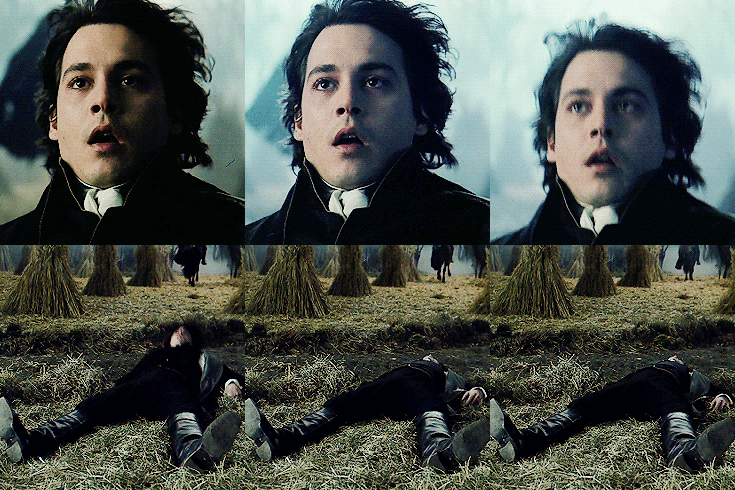
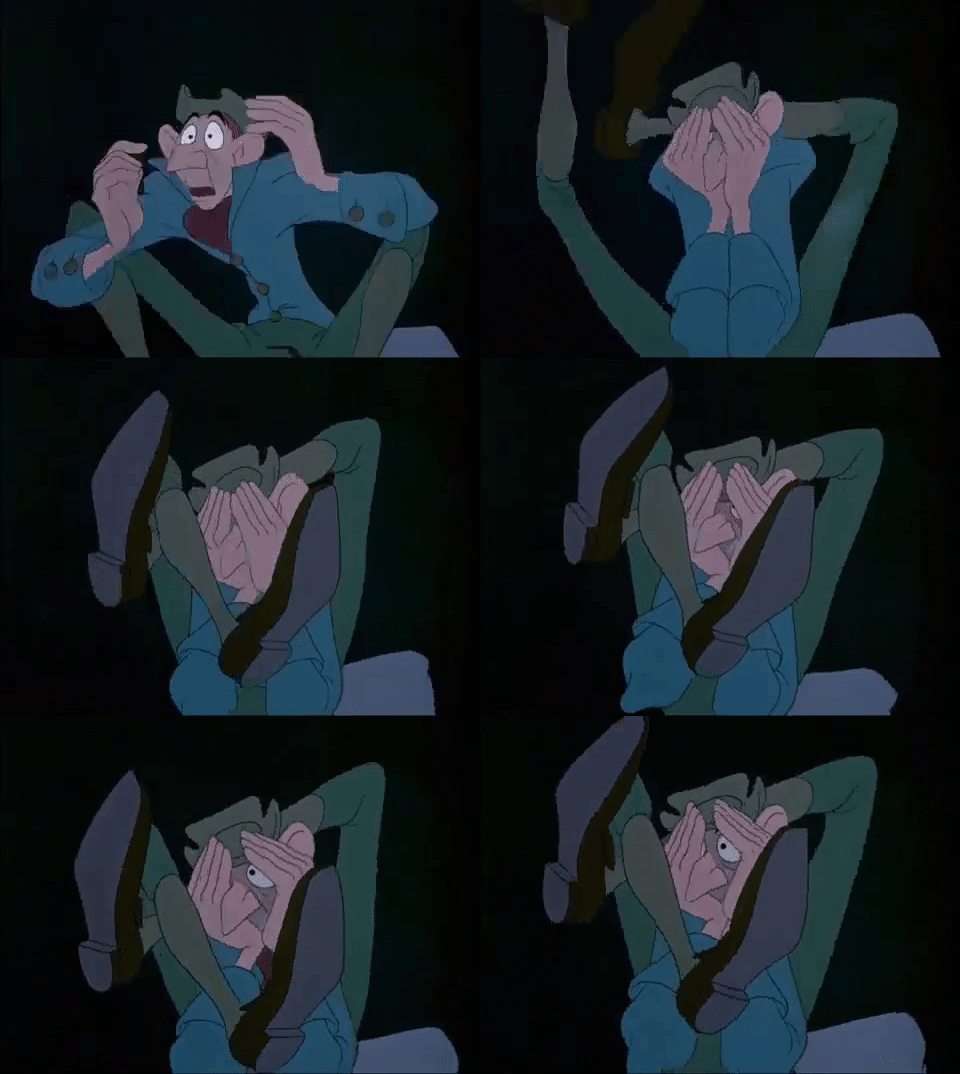
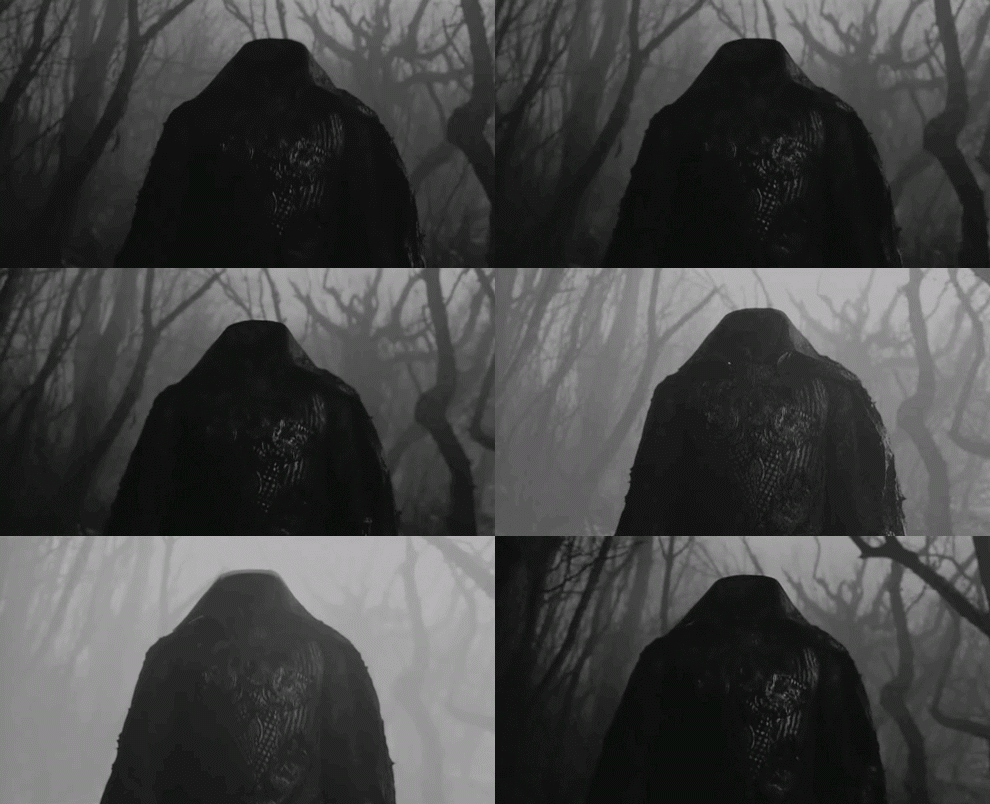
Geh, 2.5 Stars! I prefer the Johnny Depp and Old Cartoon!
Mel 🖤🐶🐺🐾🎃🍁🍂
Mel 🖤🐶🐺🐾🎃🍁🍂

September 28, 2015
I really wanted to like this story but it definitely wasn't my cup of tea. Honestly, I found the story boring. The author spent too much time on description, so the story was quite slow and it dragged. I was also really disappointed with the end. I expected that the ending will scare me at least a little but, but it didn't. The story ended pretty abruptly, and now that I've finished it, I'm glad it did. Even though this was a pretty short story, it sure felt like a long one.
Now I'm off to see the movie. Hopefully I'll enjoyed it more than I enjoyed this short story.
Now I'm off to see the movie. Hopefully I'll enjoyed it more than I enjoyed this short story.

July 25, 2020
An immortal story by a writer that is iconic and foundational for American literature. I can see why he was one of the first American authors that earned living by writing - his storytelling is a fine craft. Irving effortlessly creates a drowsy, dreamy atmosphere and sets readers in a different world. The first important element of the story are descriptions of land and life of everyday people that have lyrical, imaginative quality.
''From the listless repose of the place, and the peculiar character of its inhabitants, who are descendants from the original Dutch settlers, this sequestered glen has long been known by name of Sleepy Hollow ... Certain it is, the place still continues under the sway of some witching power, that holds a spell over the minds of the good people, causing them to walk in a continual reverie.''
The Sleepy Hollow is described as an idyllic, magical place and Irving demonstrates beautifully that he is a talented classical storyteller. I can see why this work has value in the world literature, the storyline itself is simple, but the imagery used has strong, unforgettable quality, and at the same time is blending very well with a witty, satirical undertone as another aspect of Irving's writing. The themes of seduction, love triangle, the rivalry between same-sex are present, as well as an amusing little character study of the protagonist. The supernatural element is very well connected to the personality flaws of the main character, as unconscious and conscious fears that define what we believe to be true in this world and therefore set a part of our whole destiny are explored - for me, that should always be the heart of horror genre. The high education is also mocked as people who assume they have it, always have a blind spot as our Ichabod Crane - the main character superstitions and preoccupation with a fantasy world of witches and goblins are exposed as the naivety of his thought system, no matter his love for books or education. He was an unquestioning believer in every story he heard. These kinds of shortcomings in thought processes fueled by unavoidable irrationally make our perception of the world equally unreliable as this story. We as readers and listeners must be logical and ask questions rather than take someone else narrative, philosophy, world-view for granted. I don't read in gothic or horror genre often but I'm glad I've read this one in reading through classical works of literature.
In the end, the quote that captures well romantic and humorous elements of Irving's writing.
''I profess not to know how women's hearts are wooed and won. To me they have always been matters of riddle and admiration. Some seem to have but one vulnerable point, or door of access; while others have a thousand avenues, and may be captured in a thousand different ways. It is a great triumph of skill to gain the former, but a still greater proof of generalship to maintain possession of the latter, for man must battle for his fortress at every door and window. He who wins a thousand common hearts is therefore entitled to some renown; but he who keeps undisputed sway over the heart of a coquette is indeed a hero.''
''From the listless repose of the place, and the peculiar character of its inhabitants, who are descendants from the original Dutch settlers, this sequestered glen has long been known by name of Sleepy Hollow ... Certain it is, the place still continues under the sway of some witching power, that holds a spell over the minds of the good people, causing them to walk in a continual reverie.''
The Sleepy Hollow is described as an idyllic, magical place and Irving demonstrates beautifully that he is a talented classical storyteller. I can see why this work has value in the world literature, the storyline itself is simple, but the imagery used has strong, unforgettable quality, and at the same time is blending very well with a witty, satirical undertone as another aspect of Irving's writing. The themes of seduction, love triangle, the rivalry between same-sex are present, as well as an amusing little character study of the protagonist. The supernatural element is very well connected to the personality flaws of the main character, as unconscious and conscious fears that define what we believe to be true in this world and therefore set a part of our whole destiny are explored - for me, that should always be the heart of horror genre. The high education is also mocked as people who assume they have it, always have a blind spot as our Ichabod Crane - the main character superstitions and preoccupation with a fantasy world of witches and goblins are exposed as the naivety of his thought system, no matter his love for books or education. He was an unquestioning believer in every story he heard. These kinds of shortcomings in thought processes fueled by unavoidable irrationally make our perception of the world equally unreliable as this story. We as readers and listeners must be logical and ask questions rather than take someone else narrative, philosophy, world-view for granted. I don't read in gothic or horror genre often but I'm glad I've read this one in reading through classical works of literature.
In the end, the quote that captures well romantic and humorous elements of Irving's writing.
''I profess not to know how women's hearts are wooed and won. To me they have always been matters of riddle and admiration. Some seem to have but one vulnerable point, or door of access; while others have a thousand avenues, and may be captured in a thousand different ways. It is a great triumph of skill to gain the former, but a still greater proof of generalship to maintain possession of the latter, for man must battle for his fortress at every door and window. He who wins a thousand common hearts is therefore entitled to some renown; but he who keeps undisputed sway over the heart of a coquette is indeed a hero.''
October 30, 2018
Let's get the rotten parts out of the way first - the story has flaws. Painful to admit, but it's long-winded and rambling, too much focus and writing concentrates on irrelevant scenes and parts and character trails, drawing out the wrong things. Sometimes it's for clarity, at times for snuck-in humor, but just maybe it was either because the author was writing without pre-planning or trying to pad. Irregardless, pacing is inconsistent besides the strong beginning and unforgettable ending, so sometimes the attention wilts.
But really who cares, because this is the epic 'The Legend of Sleepy Hollow'.

Where else do you get the inventions of wicked trails in foggy forests with undead Pumpkinheaded legends on top of black, hell-driven steeds? Small town with a small-minded but lovable schoolmarm with a name as cool as Ichabod Crane?
I like the additions to the story that have come over through the years in cinema form -- I'm actually a fan of the Johnny Depp comedy version, even if reviews were mixed on the Burton production. I think it's my favorite version, but all that aside, the book is beautifully written in a flowing style and humorous with character description.
This one worked well with the voice of the actor from the show, Sleepy Hollow, Tom Mison. His voice suited the story perfectly, and I enjoyed the music at the beginning and conclusion. There are plenty of other audiobook versions of this one, though, if you want to explore and tinker.
Recommended for all.
But really who cares, because this is the epic 'The Legend of Sleepy Hollow'.
Where else do you get the inventions of wicked trails in foggy forests with undead Pumpkinheaded legends on top of black, hell-driven steeds? Small town with a small-minded but lovable schoolmarm with a name as cool as Ichabod Crane?
I like the additions to the story that have come over through the years in cinema form -- I'm actually a fan of the Johnny Depp comedy version, even if reviews were mixed on the Burton production. I think it's my favorite version, but all that aside, the book is beautifully written in a flowing style and humorous with character description.
This one worked well with the voice of the actor from the show, Sleepy Hollow, Tom Mison. His voice suited the story perfectly, and I enjoyed the music at the beginning and conclusion. There are plenty of other audiobook versions of this one, though, if you want to explore and tinker.
Recommended for all.

May 4, 2017
The legends and tales of Dutch-colonial New York inspired Washington Irving to his greatest literary achievements; he took key elements from America’s colonial and Revolutionary heritage, combined them with age-old traditions of world folklore, and set down stories that became a vital part of the emerging literature of the young United States of America. And even if some of the stories in the collection that Irving originally titled The Sketch Book of Geoffrey Crayon, Gent. may seem somewhat dated by modern standards, the two stories that frame the book – “Rip Van Winkle” and “The Legend of Sleepy Hollow” – unquestionably deserve the pride of place that they hold within American literary history.
There is a definite element of American literary nationalism to The Sketch Book, as one can see near the beginning of the book when Irving writes that “never need an American look beyond his own country for the sublime and beautiful of natural scenery” (p. 7). That nationalistic tone is not surprising when one considers that Irving was writing at a time when it was widely taken for granted that only England, with its age and its storied history, could be a source for great literature written in the English language.
By contrast, Irving and other ambitious young writers who were part of what came to be called the “Young America” movement believed that, as the United States of America had achieved something new as a republic in a world of monarchies, so the writers of the new republic could achieve something comparably innovative in the field of letters. Irving followed his belief in these ideas so successfully that he ultimately became the first American who was able to make a living as a professional writer.
Considering Irving’s status as a “Young America” literary U.S. nationalist, a reader might be surprised to find how many of the sketches in The Sketch Book have content that is English rather than American; a group of sketches in which Irving recounts his experience of a traditional English Christmas is sometimes printed separately, as a holiday-season collection titled “Old Christmas.” Yet most contemporary readers of Irving's Sketch Book have probably gone there to read the two particularly resonant tales that frame the book – “Rip Van Winkle” and “The Legend of Sleepy Hollow.”
"Rip Van Winkle," which appears near the beginning of The Sketch Book, uses folkloric motifs to explore the theme of historical change, and specifically of the historical process that brought the United States of America into being. The title character is described by the story’s narrator as “one of those happy mortals, of foolish, well-oiled dispositions, who take the world easy, eat white bread or brown, whichever can be got with least thought or trouble, and would rather starve for a penny than work for a pound.” The narrator takes some pains to emphasize that “The great error in Rip’s composition was an insuperable aversion to all kinds of profitable labor”, and that “In a word, Rip was ready to attend to anybody’s business but his own; but as to doing family duty, and keeping his farm in order, he found it impossible” (p. 27).
Rip’s ways earn him the constant scorn of his wife, of whom it is said that “a tart temper never mellows with age, and a sharp tongue is the only edged tool that grows keener with constant use” (p. 28). Seeking to evade his wife’s constant scolding, Rip goes with his dog into the Catskill mountains, meets some strange beings dressed like Dutchmen from centuries past, serves them while they bowl a game of ninepins, helps himself to a draught of their homebrewed beer, falls asleep – and wakes up sometime later, coming home to his village and finding everything unfamiliar. Things are moving much faster, and a man “was haranguing about rights of citizens – elections – members of Congress – liberty – Bunker’s Hill – heroes of ’76…a perfect Babylonish jargon” (p. 33) to poor confused Rip, who then says the worst possible thing by calling himself “a loyal subject of the king” (p. 33).
Accused of being a Tory, poor Rip seems to be in some trouble before it is ascertained that he honestly does not know that New York, over the time of his long sleep, has ceased to be a moribund backwater colony of Great Britain and has become a bustling state of the United States of America. The mysterious beings whose ale Rip sampled are said, by folklorists of the region, to be the spirits of explorer Henry Hudson and his Dutch crew; having sailed up the Hudson River in 1609 and claimed the region for Holland, they return periodically to see how things are going. It takes some time for Rip to understand “that there had been a revolutionary war – that the country had thrown off the yoke of old England – and that, instead of being a subject to his majesty George the Third, he was now a free citizen of the United States” (p. 36). Rip, for his part, simply seems happy to be free of his nagging wife (who died a couple of years before he reawakened).
Near the end of the "Sketch Book," one finds "The Legend of Sleepy Hollow" (“Found Among the Papers of the Late Diedrich Knickerbocker,” as Irving assures us in a folkloric parenthesis). The feckless schoolmaster Ichabod Crane, a transplanted New Englander (and therefore a vulnerable and not-very-knowledgeable outsider) arrives in Sleepy Hollow to begin a career as a schoolmaster.
Ichabod, a New Englander who grew up in a region haunted by fears of demonic incursions upon the lives of ordinary people, applies to his new home his superstitious fears of supernatural legends, particularly when he learns that in this community, “The dominant spirit…that haunts this region, and seems to be commander-in-chief of all the powers of the air, is the apparition of a figure on horseback without a head. It is said by some to be the ghost of a Hessian trooper whose head had been carried away by a cannonball in some nameless battle during the Revolutionary War” (p. 252).
Crane’s fears of legends like that of the Headless Horseman turn out to be less fateful, for him, than his meeting Katrina Van Tessel, the beautiful daughter of the community’s wealthiest landowner:
All these, however, were mere terrors of the night, phantoms of the mind that walk in darkness; and though he had seen many spectres in his time, and been more than once beset by Satan in divers shapes in his lonely perambulations, yet daylight put an end to all these evils; and he would have passed a pleasant life of it, in despite of the devil and all his works, if his path had not been crossed by a being that causes more perplexity to mortal man than ghosts, goblins, and the whole race of witches put together, and that was – a woman. (p. 256)
The degree of education that Ichabod has acquired gives him some status within the community (though he is not a very good or compassionate teacher), and before long he begins to dream of winning the love of the winsome Katrina Van Tassel. Yet the ungainly Ichabod is a foil, not a romantic hero; the Van Tassel fortune and the rich foods on the Van Tassel seem to motivate him more than Katrina’s beauty and sweetness. Moreover, Katrina already has a sweetheart – the boisterous Brom Van Blunt, a strong and handsome bully-boy of the region, who immediately sees Ichabod as a rival and begins inventing ways to harass the schoolmaster. All the more strange, therefore, that Katrina initially seems amenable to Ichabod’s courtship. The narrator says in this connection that “I profess not to know how women’s hearts are wooed and won. To me, they have always been matters of riddle and admiration” (p. 260).
The situation of conflict in Sleepy Hollow that has been brought on by Ichabod Crane’s entrance into the community is resolved one night when Ichabod is making his way homeward, only to find that he is being followed by a horseman. His nervousness turns to terror when he gets his first look at the horseman:
On mounting a rising ground, which brought the figure of his fellow-traveller in relief against the sky, gigantic in height and muffled in a cloak, Ichabod was horror-struck on perceiving that he was headless! But his horror was still more increased on observing that the head, which should have rested on his shoulders, was carried before him on the pommel of the saddle. (p. 269)
Desperately trying to reach the church bridge, in the belief that reaching consecrated ground will keep him safe, Ichabod makes his way across the bridge, and the chase reaches its exciting climax:
[N]ow Ichabod cast a look behind to see if his pursuer should vanish, according to rule, in a flash of fire and brimstone. Just then he saw the goblin rising in his stirrups, and in the very act of hurling his head at him. Ichabod endeavored to dodge the horrible missile, but too late. It encountered his cranium with a tremendous crash; he was tumbled headlong into the dust, and…the goblin rider passed by like a whirlwind. (p. 270)
The next day, when the burghers of Sleepy Hollow arrive at the scene, nothing is found except two sets of horse tracks, “the hat of the unfortunate Ichabod, and close beside it a spattered pumpkin” (p. 271). Ichabod’s disappearance, while given a supernatural explanation, is forgotten fairly quickly – “As he was a bachelor, and in nobody’s debt, nobody troubled his head any more about him” (p. 271) – though there is a strong suggestion, toward the tale’s end, that there needs no Headless Horseman come from the grave to explain Ichabod’s disappearance:
Brom Bones…who shortly after his rival’s disappearance conducted the blooming Katrina in triumph to the altar, was observed to look exceedingly knowing whenever the story of Ichabod was related, and always burst into a laugh at the mention of the pumpkin – which led some to suspect that he knew more about the matter than he chose to tell (p. 272).
These details – coupled with the fact that earlier on the night of Ichabod’s disappearance, he had visited the usually welcoming Katrina, “fully convinced that he was on the high road to success”, only to leave, a short time later, “with an air quite desolate and chop-fallen” (p. 267) – strongly suggest that Katrina encouraged Ichabod’s attentions in order to make man-about-town Brom jealous and get him to commit already, and that Brom assumed a Headless Horseman disguise in order to eject Ichabod Crane from Sleepy Hollow once and for all.
These sorts of lovers’ tricks – like other elements of “The Legend of Sleepy Hollow” – are, of course, characteristic of many folklore tales throughout the world. An important part of Irving’s genius seems to have consisted in applying American cultural elements – Henry Hudson, George Washington, the Stars and Stripes, Bunker Hill, the Spirit of ’76, a pumpkin, a Hessian soldier from the Revolutionary War – to these longstanding folkloric traditions in a way that would make his tales resonate with readers of the young United States.
I re-read The Sketch Book in connection with a visit to New York's Hudson Valley, where Washington Irving is virtually a living presence. The community of North Tarrytown actually changed its name to Sleepy Hollow in order to emphasize the Washington Irving connection. Headless Horseman images are everywhere, and one can visit the Sleepy Hollow cemetery, pay respects at Irving’s grave, and see a wooden bridge where it is easy to imagine the Horseman’s pursuit of poor Ichabod (though the site of the original bridge, while decorated with a stylish modernist statue of the chase, is now a thoroughly ordinary and easily overlooked concrete bridge along U.S. Route 9).
Another example of Irving's ongoing influence: Tim Burton's 1999 film Sleepy Hollow. The plot of the film had relatively little to do with Washington Irving's story; but the making of the film, like the changing of the name of North Tarrytown to Sleepy Hollow, shows how truly Washington Irving and his best-known fictional creations are still with us. Rip Van Winkle’s long sleep in the Catskills comes to seem as consequential as that of King Arthur at Glastonbury, and the Headless Horseman still waits for all of us to cross his path.
There is a definite element of American literary nationalism to The Sketch Book, as one can see near the beginning of the book when Irving writes that “never need an American look beyond his own country for the sublime and beautiful of natural scenery” (p. 7). That nationalistic tone is not surprising when one considers that Irving was writing at a time when it was widely taken for granted that only England, with its age and its storied history, could be a source for great literature written in the English language.
By contrast, Irving and other ambitious young writers who were part of what came to be called the “Young America” movement believed that, as the United States of America had achieved something new as a republic in a world of monarchies, so the writers of the new republic could achieve something comparably innovative in the field of letters. Irving followed his belief in these ideas so successfully that he ultimately became the first American who was able to make a living as a professional writer.
Considering Irving’s status as a “Young America” literary U.S. nationalist, a reader might be surprised to find how many of the sketches in The Sketch Book have content that is English rather than American; a group of sketches in which Irving recounts his experience of a traditional English Christmas is sometimes printed separately, as a holiday-season collection titled “Old Christmas.” Yet most contemporary readers of Irving's Sketch Book have probably gone there to read the two particularly resonant tales that frame the book – “Rip Van Winkle” and “The Legend of Sleepy Hollow.”
"Rip Van Winkle," which appears near the beginning of The Sketch Book, uses folkloric motifs to explore the theme of historical change, and specifically of the historical process that brought the United States of America into being. The title character is described by the story’s narrator as “one of those happy mortals, of foolish, well-oiled dispositions, who take the world easy, eat white bread or brown, whichever can be got with least thought or trouble, and would rather starve for a penny than work for a pound.” The narrator takes some pains to emphasize that “The great error in Rip’s composition was an insuperable aversion to all kinds of profitable labor”, and that “In a word, Rip was ready to attend to anybody’s business but his own; but as to doing family duty, and keeping his farm in order, he found it impossible” (p. 27).
Rip’s ways earn him the constant scorn of his wife, of whom it is said that “a tart temper never mellows with age, and a sharp tongue is the only edged tool that grows keener with constant use” (p. 28). Seeking to evade his wife’s constant scolding, Rip goes with his dog into the Catskill mountains, meets some strange beings dressed like Dutchmen from centuries past, serves them while they bowl a game of ninepins, helps himself to a draught of their homebrewed beer, falls asleep – and wakes up sometime later, coming home to his village and finding everything unfamiliar. Things are moving much faster, and a man “was haranguing about rights of citizens – elections – members of Congress – liberty – Bunker’s Hill – heroes of ’76…a perfect Babylonish jargon” (p. 33) to poor confused Rip, who then says the worst possible thing by calling himself “a loyal subject of the king” (p. 33).
Accused of being a Tory, poor Rip seems to be in some trouble before it is ascertained that he honestly does not know that New York, over the time of his long sleep, has ceased to be a moribund backwater colony of Great Britain and has become a bustling state of the United States of America. The mysterious beings whose ale Rip sampled are said, by folklorists of the region, to be the spirits of explorer Henry Hudson and his Dutch crew; having sailed up the Hudson River in 1609 and claimed the region for Holland, they return periodically to see how things are going. It takes some time for Rip to understand “that there had been a revolutionary war – that the country had thrown off the yoke of old England – and that, instead of being a subject to his majesty George the Third, he was now a free citizen of the United States” (p. 36). Rip, for his part, simply seems happy to be free of his nagging wife (who died a couple of years before he reawakened).
Near the end of the "Sketch Book," one finds "The Legend of Sleepy Hollow" (“Found Among the Papers of the Late Diedrich Knickerbocker,” as Irving assures us in a folkloric parenthesis). The feckless schoolmaster Ichabod Crane, a transplanted New Englander (and therefore a vulnerable and not-very-knowledgeable outsider) arrives in Sleepy Hollow to begin a career as a schoolmaster.
Ichabod, a New Englander who grew up in a region haunted by fears of demonic incursions upon the lives of ordinary people, applies to his new home his superstitious fears of supernatural legends, particularly when he learns that in this community, “The dominant spirit…that haunts this region, and seems to be commander-in-chief of all the powers of the air, is the apparition of a figure on horseback without a head. It is said by some to be the ghost of a Hessian trooper whose head had been carried away by a cannonball in some nameless battle during the Revolutionary War” (p. 252).
Crane’s fears of legends like that of the Headless Horseman turn out to be less fateful, for him, than his meeting Katrina Van Tessel, the beautiful daughter of the community’s wealthiest landowner:
All these, however, were mere terrors of the night, phantoms of the mind that walk in darkness; and though he had seen many spectres in his time, and been more than once beset by Satan in divers shapes in his lonely perambulations, yet daylight put an end to all these evils; and he would have passed a pleasant life of it, in despite of the devil and all his works, if his path had not been crossed by a being that causes more perplexity to mortal man than ghosts, goblins, and the whole race of witches put together, and that was – a woman. (p. 256)
The degree of education that Ichabod has acquired gives him some status within the community (though he is not a very good or compassionate teacher), and before long he begins to dream of winning the love of the winsome Katrina Van Tassel. Yet the ungainly Ichabod is a foil, not a romantic hero; the Van Tassel fortune and the rich foods on the Van Tassel seem to motivate him more than Katrina’s beauty and sweetness. Moreover, Katrina already has a sweetheart – the boisterous Brom Van Blunt, a strong and handsome bully-boy of the region, who immediately sees Ichabod as a rival and begins inventing ways to harass the schoolmaster. All the more strange, therefore, that Katrina initially seems amenable to Ichabod’s courtship. The narrator says in this connection that “I profess not to know how women’s hearts are wooed and won. To me, they have always been matters of riddle and admiration” (p. 260).
The situation of conflict in Sleepy Hollow that has been brought on by Ichabod Crane’s entrance into the community is resolved one night when Ichabod is making his way homeward, only to find that he is being followed by a horseman. His nervousness turns to terror when he gets his first look at the horseman:
On mounting a rising ground, which brought the figure of his fellow-traveller in relief against the sky, gigantic in height and muffled in a cloak, Ichabod was horror-struck on perceiving that he was headless! But his horror was still more increased on observing that the head, which should have rested on his shoulders, was carried before him on the pommel of the saddle. (p. 269)
Desperately trying to reach the church bridge, in the belief that reaching consecrated ground will keep him safe, Ichabod makes his way across the bridge, and the chase reaches its exciting climax:
[N]ow Ichabod cast a look behind to see if his pursuer should vanish, according to rule, in a flash of fire and brimstone. Just then he saw the goblin rising in his stirrups, and in the very act of hurling his head at him. Ichabod endeavored to dodge the horrible missile, but too late. It encountered his cranium with a tremendous crash; he was tumbled headlong into the dust, and…the goblin rider passed by like a whirlwind. (p. 270)
The next day, when the burghers of Sleepy Hollow arrive at the scene, nothing is found except two sets of horse tracks, “the hat of the unfortunate Ichabod, and close beside it a spattered pumpkin” (p. 271). Ichabod’s disappearance, while given a supernatural explanation, is forgotten fairly quickly – “As he was a bachelor, and in nobody’s debt, nobody troubled his head any more about him” (p. 271) – though there is a strong suggestion, toward the tale’s end, that there needs no Headless Horseman come from the grave to explain Ichabod’s disappearance:
Brom Bones…who shortly after his rival’s disappearance conducted the blooming Katrina in triumph to the altar, was observed to look exceedingly knowing whenever the story of Ichabod was related, and always burst into a laugh at the mention of the pumpkin – which led some to suspect that he knew more about the matter than he chose to tell (p. 272).
These details – coupled with the fact that earlier on the night of Ichabod’s disappearance, he had visited the usually welcoming Katrina, “fully convinced that he was on the high road to success”, only to leave, a short time later, “with an air quite desolate and chop-fallen” (p. 267) – strongly suggest that Katrina encouraged Ichabod’s attentions in order to make man-about-town Brom jealous and get him to commit already, and that Brom assumed a Headless Horseman disguise in order to eject Ichabod Crane from Sleepy Hollow once and for all.
These sorts of lovers’ tricks – like other elements of “The Legend of Sleepy Hollow” – are, of course, characteristic of many folklore tales throughout the world. An important part of Irving’s genius seems to have consisted in applying American cultural elements – Henry Hudson, George Washington, the Stars and Stripes, Bunker Hill, the Spirit of ’76, a pumpkin, a Hessian soldier from the Revolutionary War – to these longstanding folkloric traditions in a way that would make his tales resonate with readers of the young United States.
I re-read The Sketch Book in connection with a visit to New York's Hudson Valley, where Washington Irving is virtually a living presence. The community of North Tarrytown actually changed its name to Sleepy Hollow in order to emphasize the Washington Irving connection. Headless Horseman images are everywhere, and one can visit the Sleepy Hollow cemetery, pay respects at Irving’s grave, and see a wooden bridge where it is easy to imagine the Horseman’s pursuit of poor Ichabod (though the site of the original bridge, while decorated with a stylish modernist statue of the chase, is now a thoroughly ordinary and easily overlooked concrete bridge along U.S. Route 9).
Another example of Irving's ongoing influence: Tim Burton's 1999 film Sleepy Hollow. The plot of the film had relatively little to do with Washington Irving's story; but the making of the film, like the changing of the name of North Tarrytown to Sleepy Hollow, shows how truly Washington Irving and his best-known fictional creations are still with us. Rip Van Winkle’s long sleep in the Catskills comes to seem as consequential as that of King Arthur at Glastonbury, and the Headless Horseman still waits for all of us to cross his path.

October 25, 2013
For most classics that I read it is easy to discern how they have stood the test of time and attain their classic status. However, a few titles, like Moby-Dick; or, The Whale and Three Men in a Boat hold little or no appeal to me at all, and why would anybody want to read them is beyond me. I am consigning The Legend of Sleepy Hollow to the “not for me” pile (though I am careful not disrespect any classics because they are still being read more than a hundred years after first publication, just because I don’t like them doesn't mean they are not any good).
I was expecting a quick and creepy Halloween read but found the story to be lyrical and jocular in tone but entirely devoid of any “fear factor”. The prose style is indeed a pleasure to read. I like how Ichabod Crane is characterized and described as looking like a “scarecrow eloped from a cornfield”. Crane’s predilection for fanciful tales also resonates with me and beautifully described:
Unfortunately, after the half-way point has passed by with nothing very interesting happening the author’s breezy style begins to outstay its welcome. I find myself losing interest in Irving’s prolonged descriptions of inconsequential things like birds and trees and such, and the complete absence of any dialogue does not help. To cap it all off the “horrific” climax turns out to be very much an anti-climax for me, and the epilogue renders the entire story rather pointless.
It's ironic that in today’s popular culture Icabod Crane is usually depicted as a heroic figure. The original Crane as featured in this story is very much an anti-hero, he is not brave, decent, honest or even good looking. The Headless Horseman in Irving’s story eventually turns out to be something is a lame duck (I hope this is sufficiently vague not to be a spoiler). Both the 1999 Tim Burton movie and the new Sleepy Hollow TV series (2013) have taken the image of the Horseman from this story and upgraded him into a much more frightening and supernatural antagonist.

As a general rule, movie and TV adaptations are always inferior to the literary source material. Here is an exception that proves the rule, I find both the movie and TV show (series 1 only) much more entertaining, dark and intense than Irving’s original story. So I suppose I do have something to be grateful to Washington Irving for after all.
Not my pick for a Halloween read.
I was expecting a quick and creepy Halloween read but found the story to be lyrical and jocular in tone but entirely devoid of any “fear factor”. The prose style is indeed a pleasure to read. I like how Ichabod Crane is characterized and described as looking like a “scarecrow eloped from a cornfield”. Crane’s predilection for fanciful tales also resonates with me and beautifully described:
"His appetite for the marvelous, and his powers of digesting it, were equally extraordinary; and both had been increased by his residence in this spell-bound region. No tale was too gross or monstrous for his capacious swallow."
Unfortunately, after the half-way point has passed by with nothing very interesting happening the author’s breezy style begins to outstay its welcome. I find myself losing interest in Irving’s prolonged descriptions of inconsequential things like birds and trees and such, and the complete absence of any dialogue does not help. To cap it all off the “horrific” climax turns out to be very much an anti-climax for me, and the epilogue renders the entire story rather pointless.
It's ironic that in today’s popular culture Icabod Crane is usually depicted as a heroic figure. The original Crane as featured in this story is very much an anti-hero, he is not brave, decent, honest or even good looking. The Headless Horseman in Irving’s story eventually turns out to be something is a lame duck (I hope this is sufficiently vague not to be a spoiler). Both the 1999 Tim Burton movie and the new Sleepy Hollow TV series (2013) have taken the image of the Horseman from this story and upgraded him into a much more frightening and supernatural antagonist.
As a general rule, movie and TV adaptations are always inferior to the literary source material. Here is an exception that proves the rule, I find both the movie and TV show (series 1 only) much more entertaining, dark and intense than Irving’s original story. So I suppose I do have something to be grateful to Washington Irving for after all.
Not my pick for a Halloween read.

September 19, 2018
I finished this book just before going to bed last night, and I must say, it took me a while to get to sleep because I couldn’t stop thinking about the headless horseman.
Then sometime in the middle of the night I heard a ringing, clicking sound on the metal footboard of my bed. I sat up with a startle, just as I saw the headless horseman on his horse leaping over my bed and out through the closed French doors into the backyard. I could not sleep for the remainder of the night or so I thought, but the next morning when I woke up I realized that I had slept some, but the dream was still vivid in my mind. I began making the bed, and just as began pulling the covers to the top of the bed, I found an old horse shoe near the footboard. I shuttered! It hadn’t been a dream after all.
This book was a wonderful tale, Sleepy Hollow sounded like such a beautiful glen that is filled with peace and quiet during the day with only the sounds of a quail or the tapping of a woodpecker. But even so, stories abound of visions and other strange sights. Sometimes people who walk its roads hear music and voices, but this, more than likely, was only during the night.
How can such a peaceful glen become so spooky at night, you might ask? Well, I think it is because of the people’s big imaginations.
The most frightening story is that of a headless horseman, the ghost of a man who had been killed in the Revolutionary War. It is said that at night he gallops along the roads and is especially fond of the church cemetery nearby where he is buried. Why is he so frightening? I did not know at first. What harm does he cause? I did not know this either, except that he was headless and that is enough to frighten someone to death if they have a bad heart. But who is out that late anyway? I don’t know, except for one man, Ichabod Crane. Why is the horseman headless? That I know. A cannon ball had taken off his head during the war. And who was Ichabod Crane that he should be out on that road at night? He was the school master. His life in Sleepy Hollow was yet another tale.
He was the man that I have remembered most of my life, some 60 plus years when I was a young girl in the 8th grade listening to the teacher describe him from this book. And the teacher, I believe, or wish to believe, was Mr. Bailey, who was my favorite teacher, as well as my brother’s. Mr. Bailey loved telling ghost stories, and that is why I think it was he who told us this story. Here is what was read to us students about Ichabod Crane:
“He was tall, but exceedingly lank, with narrow shoulders, a long arms and legs, hands that dangled a mile out of his sleeves, feet that might have served for shovels, and his whole frame most loosely hung together. His head was small, and flat at top, with huge ears, large green glassy eyes, and a long snipe nose, so that it looked like a weather-cock perched upon his sprinkle neck to tell which way the wind blew. To see him striding along the profile of a hill on a windy day, with his clothes bagging and fluttering about him, one might have mistaken him for the genius of famine descending up the earth, or some scarecrow eloped from a cornfield.”
Why was Ichabod Crane out on the road that fateful night? I cannot tell. You need to read the story. I will tell you this much: If you read this book and finish it just before you go Trick or Treating, you may be sorry, for you may just draw the headless horseman to you, being so late in the evening. You may just find yourself alone walking from house to house asking for treats, and instead you may find a trick, for what happened to Ichabod Crane, as I later found out, could very well happen to you. Then if you read this book late at night, you may also be visited by the headless horseman after you go to sleep just as I was. Or maybe even worse, you may have these visits for many nights thereafter, as I may have, because you will have drawn him to you, again, being so late at night with this story so heavy on your mind. So, if you read this book, read it in the morning when the world is still peaceful and quiet. When, perhaps, all that you can hear is the whippoorwill and the songbirds waking up in the morning or as in the book, the tapping of a woodpecker or the sound of quails.
Then sometime in the middle of the night I heard a ringing, clicking sound on the metal footboard of my bed. I sat up with a startle, just as I saw the headless horseman on his horse leaping over my bed and out through the closed French doors into the backyard. I could not sleep for the remainder of the night or so I thought, but the next morning when I woke up I realized that I had slept some, but the dream was still vivid in my mind. I began making the bed, and just as began pulling the covers to the top of the bed, I found an old horse shoe near the footboard. I shuttered! It hadn’t been a dream after all.
This book was a wonderful tale, Sleepy Hollow sounded like such a beautiful glen that is filled with peace and quiet during the day with only the sounds of a quail or the tapping of a woodpecker. But even so, stories abound of visions and other strange sights. Sometimes people who walk its roads hear music and voices, but this, more than likely, was only during the night.
How can such a peaceful glen become so spooky at night, you might ask? Well, I think it is because of the people’s big imaginations.
The most frightening story is that of a headless horseman, the ghost of a man who had been killed in the Revolutionary War. It is said that at night he gallops along the roads and is especially fond of the church cemetery nearby where he is buried. Why is he so frightening? I did not know at first. What harm does he cause? I did not know this either, except that he was headless and that is enough to frighten someone to death if they have a bad heart. But who is out that late anyway? I don’t know, except for one man, Ichabod Crane. Why is the horseman headless? That I know. A cannon ball had taken off his head during the war. And who was Ichabod Crane that he should be out on that road at night? He was the school master. His life in Sleepy Hollow was yet another tale.
He was the man that I have remembered most of my life, some 60 plus years when I was a young girl in the 8th grade listening to the teacher describe him from this book. And the teacher, I believe, or wish to believe, was Mr. Bailey, who was my favorite teacher, as well as my brother’s. Mr. Bailey loved telling ghost stories, and that is why I think it was he who told us this story. Here is what was read to us students about Ichabod Crane:
“He was tall, but exceedingly lank, with narrow shoulders, a long arms and legs, hands that dangled a mile out of his sleeves, feet that might have served for shovels, and his whole frame most loosely hung together. His head was small, and flat at top, with huge ears, large green glassy eyes, and a long snipe nose, so that it looked like a weather-cock perched upon his sprinkle neck to tell which way the wind blew. To see him striding along the profile of a hill on a windy day, with his clothes bagging and fluttering about him, one might have mistaken him for the genius of famine descending up the earth, or some scarecrow eloped from a cornfield.”
Why was Ichabod Crane out on the road that fateful night? I cannot tell. You need to read the story. I will tell you this much: If you read this book and finish it just before you go Trick or Treating, you may be sorry, for you may just draw the headless horseman to you, being so late in the evening. You may just find yourself alone walking from house to house asking for treats, and instead you may find a trick, for what happened to Ichabod Crane, as I later found out, could very well happen to you. Then if you read this book late at night, you may also be visited by the headless horseman after you go to sleep just as I was. Or maybe even worse, you may have these visits for many nights thereafter, as I may have, because you will have drawn him to you, again, being so late at night with this story so heavy on your mind. So, if you read this book, read it in the morning when the world is still peaceful and quiet. When, perhaps, all that you can hear is the whippoorwill and the songbirds waking up in the morning or as in the book, the tapping of a woodpecker or the sound of quails.
Displaying 1 - 30 of 9,159 reviews