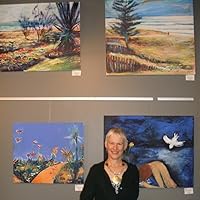
In her quest to make a garden of pleasure, author Jenny Allen followed the practices of permaculture, an organic method of gardening based on using nature's solutions to achieve abundance. This practice releases the gardener from the drudgery of repetitive tasks.
Jenny Allen lives in the hinterland about 30 km inland from the Queensland Sunshine Coast in the rolling hills of Maleny.
She has designed over 100 Permaculture gardens and taught in countries such as Jordan and the Palestinian Territories. She has a Double Major in Politics, a Diploma in Permaculture and a Certificate in Teaching English as a Foreign Language. While studying for her University Exams she cycled 1200km across Australia's Nullabor Desert.
The ABC has featured Jenny and her Permaculture garden. She told the ABC that she loves to stop doing and simply be in the garden as if she is part of it. The garden is like a sanctuary for her but also her home where she can have fun, peace, tranquillity, food, entertainment, firewood and insights into the mysteries of nature. In Jenny's words "just being here is contentment enough".
The photographs are beautiful, and there are a lot of good tips. The text is pretty hokey, full of silly jokes that don't even get a laugh for being bad. This is like the kind of coffee table books that you would get for your mother because a)you want her to think you are NOT a TOTAL tree hugging hippy-dippy freak, b)she has a garden or enough yard to start a garden and you sincerely wish she'd get involved with the beauty that is permaculture, or c)she has been wanting to visit Australia and this will also cover a) and b) as well as introducing her to the flora of the "Land Down Under". The book is a worthwhile introduction for some one with ADHD, but the most unfortunate thing about most books on permaculture out there is that they are usually centered around Australia. That means you need to do extra work determining how to apply these principles to whatever region you live in, along with what plants both native and introduced are available to your area, and hope that your dictionary (book form or on-line, assuming you have convenient internet access) covers words that appear to me to be those only familiar to Australians. I borrowed this from the library; if your public or school library has a copy, I definitely recommend checking it out- you have nothing to lose and maybe a good amount to gain as far as giving your imagination a pleasant treat goes.
Three chapters in, I'm loving the beautiful photos and am still hopeful I'll glean some ideas that I can implement in my temperate North American yard. However, it is very focused on tropical plants that I couldn't even dream of growing, and the author's 'Look at me! I've created Shangri La and can entertain like Martha Stewart' tone is a bit grating at times.
Maybe I just need to get to chapter where she gives tips for creating microclimates in your yard. If I could find a way to grow Chocolate Pudding fruit in Wisconsin, I might not be feeling quite so peaky about this book...
*** Alas, there will be no pudding fruit growing in my yard unless I move closer to the equator, and Ms. Allen has failed to sell me on her book. If you happen to live in the south Pacific, by all means check this book out. If you live in a temparate region, there won't be a whole lot that you can apply to your own home. I will stick to saying that Gaia's Garden, which has far fewer flashy photos but way more useful information, is the best out there for permaculture novices.
Jenny Allen has produced a gorgeous introduction to Permaculture in a book that is beautifully illustrated with glorious photographs and detailed hand-drawn pictures, is eminently practical, and at times very funny. Heck...this may be the funniest gardening book ever published! She has a beautiful command of creative wordsmithing, weaving ideas and concepts in her unique blend of humour and practical advice.
The book recounts her journey of developing a property in Queensland into a Permaculture Paradise. Don't expect the plantings to be the same if you live in Iceland, but take from this book the motivation and courage to implement and adapt the concepts wherever you may live, or just appreciate it for the positive story and beautiful aesthetics. Alternatively, come along and appreciate how amazing life in Queensland can be.
Entertaining and educational, each chapter surprises anew with a refreshing mixture of quotes, antidotes, and information covering everything I would want to know about permaculture, plus much more.
Drawing on what is obviously many years of practical experience, Jenny shares bounteous wisdom, tips and suggestions that would take a lifetime to learn by trial and error. She even provides lessons learnt and what not to do.
The open and honest style of this treasure trove left me feeling like I had spent a month on a guided tour exploring the home of a good friend. I am convinced others will love it just as much.
The idea of Permaculture appeals to me. Applying good design concepts to your garden makes such good sense, but few of us actually do it. I have read a few books on Permaculture, but none as beautiful and inspiring as this. The photography is excellent, drawing the readers attention to the beauty to be found in nature, in one's own garden.
Jenny Allen writes about her own gardening experiences and throws in some education on Permaculture and techniques for making good compost tea. It was the perfect book to read, sat on my deck, looking out on to my own garden in the Easter sunshine. Who knows, I may even apply some of the ideas.
It is always good to read an Australian book suited to our own region. While Jenny is based in Queensland, she did call out which plants would survive all the way down in South in Melbourne or even Hobart. So much better than reading a UK or US based book and trying to work out a translation of heat zones / cold zones.
If you enjoy gardening and good photography, this is the book for you. If you want a serious introduction to Permaculture other books may have more depth, but this one is more fun!
Paradise in Your Garden is the version I own and the images and concepts in this book inspired my dream of creating a food garden.
During the three years I waited for my apartment to sell and went through several surgeries I read and reread Jenny's book and visualized her use of permaculture principles and the abundant food she has created in my own garden.
I loved the personal touches which made it feel what she had achieved was something I too could achieve.
There were so many foods and concepts that were new and yet made so much sense in creating a healthy way of living and eating.
I wanted a new way of gardening that could rebuild individual's health and also that of a damaged planet and this book had answers.
Paradise in Your Garden inspired me to begin my own permaculture journey.
Haven't finished the book yet but so far it's another great Australia Permaculture reference. Based on the author's experience on their own property in South East Queensland. The style of this book lets you flick through the pages and read about the things that seem interesting, which is the style I prefer in Gardening books. There's lots of suggestions for useful plants and solutions to common problems. I think my favourite part so far is the Bush Tucker plants
It's permaculture in Australia. So the 'general' info was applicable and great, but the more detailed stuff, suggested plants, certain environments,etc... were just too different to be of much help to us Yanks.
If you had to read one book to understand permaculture it would not be this book.... This is however a nice bit of additional reading with nice pictures and some great tips and anecdotes to learn from.
Can't believe I'm reading a gardening book: must be that time of life! But hey at least it was an Australian setting, nice pictures and well laid out. Didn't fully understand all the details but I think mainly because I am a complete cactus-killing novice and don't know one plant from another.
I loved this book - such terrific ideas! I esepecially loved the lessons learnt section where the author shared stories about parts of her design that didn't work out.