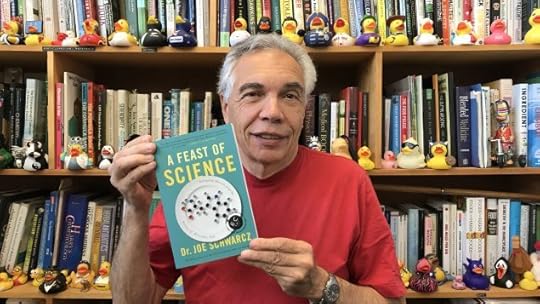
An entertaining and digestible volume that demystifies science, from the author of 16 bestselling popular science books Crave answers? A Feast of Science demystifies the chemistry of everyday life, serving up practical knowledge to both inform and entertain. Guaranteed to satiate your hunger for palatable and relevant scientific information, Dr. Joe Schwarcz proves that “chemical” is not necessarily synonymous with “toxic.” Are there fish genes in tomatoes? Can snail-slime cream and bone broth really make your wrinkles disappear? What’s the problem with sugar, resistant starch, hops in beer, microbeads, and “secret” cancer cures? Are “natural” products the key to good health? And what is “fake news” all about? Dr. Joe answers these questions and more. Cutting through the fat of story, suggestion, and social-media speculation, A Feast of Science gets to the meat of the chemical reactions that make up our daily lives.
Dr. Joe Schwarcz holds a PhD in chemistry and is host of the radio program The Dr. Joe Show, directo of McGill University's Office for Science & Society and the author of fourteen bestselling books. Well known for his informative and entertaining lectures, Dr. Schwarcz has received numerous awards for teaching and deciphering science for the public.
As both a tea blogger and someone with physical disabilities, I am constantly bombarded with outlandish claims on how everything is either a miracle drug or is going to kill me gruesomely, with very little (or a gross misunderstanding of) science involved in these claims. It drives me more than a little crazy. This book brings the science to combat various claims (my favorite, of course, was the guy who was convinced fish genes were in tomatoes) that fear-monger.
This book reads very easily, with a casual tone similar to a personal blog, my only complaint stems from that. If you are reading a (well constructed) blog they usually have a way of navigating the content, and sadly this book is very unorganized. I loved the tone and subject matter but the lack of consistent organization made my eye twitch. Even with that complaint I definitely recommend reading this book, if you are a person who thinks Dr Oz is a miracle worker or want to scream every time someone tells you tea will cure cancer, this book will either educate you or feel more than a little refreshing.
A series of information bytes: the author takes a myth or deception currently floating around (soap cures restless legs, latest miracle supplement cures cancer, etc.), and picks it apart from a reductionist scientific background. If more people would think this way, we'd see fewer rumors floating around online these days!
The thought behind this book is important—think through what you're reading before you believe it—but the organization is pretty random and there is no continuity. It felt a little like browsing through a blog or related sound bytes on the radio. The concepts and explanations are interesting, but so little time is spent on each that I'm not sure a real believer could ever be convinced of the wrongness of their favorite quackery.
Pretty interesting series of shorter stories on various bits of scientific information. There is a lot of misinformation on the Internet, and the author addresses some topics related to health, food and medicine. I've read one of the author's earlier books, which I found interesting so this one was a logical follow up to pick up. The short chapters (about 10 pages) make it easy to just pick up the book and read one chapter without having to do a deep dive in one topic. Perfect for reading on public transport or a work break.
Author Joe Schwarcz is host of the radio program The Dr. Joe Show, director of McGill University's Office for Science & Society, and the author of fourteen bestselling books.
Joe Schwarcz:
A Feast of Science was an interesting collection of short science-related stories.
The formatting of the book is a bit unorthodox; it is presented as a collection of dozens of 1-4 page short bits of writing on many various science-related topics. The topics covered here by Schwarcz run the gamut; from the pesticide glyphosate, to bacteria, to Nikola Tesla, to ether, to morphine, to condoms, to skin creams, and many, many more. The general theme of the book is Schwarcz combatting pseudoscientific woo with sound research and empirical data.
Thankfully Schwarcz writes in an easy and engaging style, as the formatting of this one will possibly throw some readers off.
A Feast of Science tells the reader of the dangers of pseudoscience posing as legitimate treatment. Homeopathy, psychic surgery, alkaline treatments for cancer and more are covered here. Schwarcz also takes a shot at some well-known charlatans; including Dr. Oz, Joseph Mercola, Deepak Chopra, and Vani Hari, the "Food Babe". Schwarcz gets some bonus points for relaying this science to the layperson in an easily accessible format here. Science communicators like Schwarcz are important in today's age of mass disinformation and internet quacks.
Despite its unorthodox format, I did enjoy the writing here. And while a fair amount of what was covered was not new to me, the broad scope of the book ensures most readers will likely find something of interest here. 4 stars.
4 stars Why didn't I know about Dr. Schwarcz before? I love the no nonsense approach to scientific or not so scientific claims from this fellow Canadian! This book offers very interesting tidbits on a variety of subjects, most of them health related, that all link back to chemistry. The book wasn't organized into sections - it just jumped from one subject to the next, with each new piece prefaced by a title. I can't say I minded the format as each topic was quite interesting and well delivered. You can tell that this is not the author's first book. It is very well written and unlike other popular science books I've read lately, it inserts some humour without being awkward. It was very informative and confirmed I had the right ideas about food and unnecessary scares and concerns.
This was a great book. I'll admit, I didn't learn as much new trivia as I had hoped, but I definitely refined information I already knew. And I certainly gained more respect for chemistry than I had. While I've always understood inherently that it was all around us, this really drove it home. All that being said, the presentation of this book makes it a quick read. Almost along a similar line of an Uncle John's Bathroom Reader, though with more intelligent content.
* I was granted access to an ARC of this book for review.
A Tapas Bar of Science? An Izakaya of Science? Lots of small bites, anyway. The general theme is the practical use of scientific results to influence public policy and practice. Vaccines, nutritional supplements, pesticides, various medical procedures: Schwarcz outlines both the science and the widely believed but probably not true beliefs around these and many other topics. And for the most part this is really useful.
My one mild criticism is that Schwarcz relies a bit too heavily on putative benefit / risk analyses regarding practices whose effects are not yet fully known. That is an approaach that, in practice, favors the status quo. The use of neonicotinoids in pesticides, for example, has been proposed as a cause of the collapse of bee colonies. The EU concluded in 2013 that there was enough evidence to justify a moratorium on the use of certain neonicotinoids in pesticides. And recently (after the publication of Schwarcz' book) the EU concluded that there is a proven risk (see Neonicotinoids: risks to bees confirmed and the supporting analysis linked from there). Schwarcz somewhat downplays the evidence that was available at the time, and points out the counter-evidence: there have been bee colony collapses in areas where neonicotinoids haven't been applied. This comes down to a question of how we should deal with large systemic risk in the face of uncertain knowledge or contradictory evidencce. My view is that we should be cautious and conservative, in the sense of restricting the use of new chemical compounds or technologies until they have been proven to exceed a very high safety bar. The downside of that approach is that we might miss out for a time on benefits from a practice that is in fact safe. Another downside, the only one that actually matters, is that large multinational corporations will miss out on substantial profits while the safety evaluation is conducted. But the downside of the "innocent until proven guilty" approach is that it can result in widespread human suffering and death, ecological destruction, and displacement of stable agricultural practices and social structures. And once a technology, or chemical, or drug, is introduced and is generating profits, it is possible that even when hazards of its use are known, the companies that profit from its sale will hide or attempt to discredit that evidence. Thalidomide, tobacco, asbestos, and CO2 driven global warming come to mind.
But despite that rather lengthy discursion, this really is a good and useful book.
This is yet another great book from the no-nonsense but always entertaining Dr. Joe Schwarcz. He gives science a very good name, showing how every aspect of our lives is connected in some way with science. The content is is full of interesting "morsels" of facts, presented in the most appetizing manner. The range of topics is incredible, from TV shows, ancient history, "health" fads old and new, the environment, food and drink, our consuming ways...open to any page and you will find something that catches your attention, a new piece of information, something that makes you laugh, or that might make you stop and think. Buy this book for yourself, but also get an extra copy to give someone. They will thank you!
I've long been a fan of Joe Schwarcz's books, and I'm surprised they aren't better known. His writing style is easy to follow, something which can't be said of more highly acclaimed science writers (Gleick, Mukherjee, Ridley, etc.). Also, chemistry is a relatively neglected topic these days.
This particular book repeatedly targets what the author feels are pseudo-science and dodgy medical treatments. In my case he's preaching to the choir, so amen to that, but fans of Dr Oz, Gwyneth Paltrow and their ilk will find this pretty tiresome.
The core of this book is to provide a series of "morsels" from science in everyday life with the intention of making the reader more literate. However, I did not like the author's style in this. They spent the book meandering between different topics without a good organization. While each topic tended to lead into the next, it didn't seem like the author had an intentional flow.
Each morsel itself seemed like the author was ranting, with the author rushing into a new topic, and then not having a satisfying ending before rushing into the next. This style really ruined the book for me. I really enjoy reading about science, but I found myself continually losing interest through this format.
Each chapter is just a few pages. Too much information for me to take in for a first read. He debunks many beliefs we are sold. Frequently debunking, as well as explaining a new fad claim. Loved reading about the plastics and land fills. He uses scientific names, which for us who haven't had a science class in years, makes one really think. But I plan to reread many of the chapters. Thanks Sheldon Cooper. Whoops! I mean thanks Dr. Joe Schwarcz.
Another book that takes apart alternative therapies and medicine. "Intriguing" is stretching it a bit... I suppose if you are not in the sciences or aren't bombarded with pseudoscientific thinking on a regular basis, you might find something new here... otherwise this is nothing different from the countless other skeptic pop-sci.
While I do agree with some of the other reviewer’s that the chapters are somewhat short. I think that this book explains in simple terms why we need a basic level of scientific literacy to understand our food choices. Looking back on a lot of past scams, allows us to understand the ones currently being perpetuated.
This feels like a collection of columns or blog entries, without much in the way of organization. Which through me a bit, initially, but once I realized that's what was going on, I started to really enjoy this book. It's hugely informative, and Schwarcz has an easy, conversational writing style. Lots of great information in here.
This book is filled with short chapters debunking common myths about chemistry, ingredients, and health claims. While parts are slow, it moves along and occasionally pops a well-maintained myth in the reader's mind.
Lots of interesting tidbits on everything from laundry soap to food additives. A distinction between what chemistry does and how it is involved in research. A very humorous rendition with lots of puns make it somewhat tongue-in-cheek.
Meh. Not much new, but a lot of denials. He seems a little siloed in his love for chemistry. Being pro-GMO, I was definitely turned off. Barely 3 stars.
Hästi sisukas ja paljusid igapäeva teemasid hõlmav raamat - tänased hirmud toidu, puhtuse, kemikaalide osas lükatakse ümber väga selgelt ja arusaadavalt ning raamatu lõpuks võib taas kord kergemalt hingata ja julgemalt elu edasi elada ...