מטפּארי לא היה צריך להיוולד, אבל יומיים אחרי הולדת התאומים הוא בכל זאת נולד – תינוק שלישי בשלישייה! מיומו הראשון הוא נתפס כיוצא דופן ואפילו כבעל כוחות נסתרים. בעיירה נידחת בקונגו, שזה עתה זכתה בעצמאות והיא מיטלטלת בין דיקטטורה אכזרית לבין קריקטורה של דמוקרטיה, גדל מטפארי כבן למשפחה של מורים תאבי ידע, אתאיסטים ומשכילים. אביו, מורה העיירה, שאין דבר שמעניין אותו יותר מגורלם של חוקרי הקוטב או מפתרון משפט פרמה, הוא מבקרם החריף של הפוליטיקאים המושחתים המנהלים את המדינה – ביניהם דודו של מטפארי, בולה בולה. בעיניים תמימות אך פקוחות לרווחה מביט מטפארי סביבו ומתאר בהומור ובשנינות את אהבתו לאילידיה, את תעלולי הדוד בולה בולה ואת התהפוכות המוזרות העוברות על ארצו. על הרקע האפריקני המאובק והפוליטיקה הקרתנית פורס לפנינו הסופר מציאות אפריקנית מורכבת שגיבוריה משכילים ומודרניים, חדורי אופטימיות והומניזם.
Emmanuel Dongala born July 14, 1941 is a Congolese Chemist ,short story writer, novelist and playwright, schooled in Brazzaville , and studied in the United States where he earned a BA in Chemistry from Oberlin College and an MA from Rutgers University . He then left the United States for France , where he was awarded a PhD in Organic Chemistry. Upon his return to the Congo he worked as a teacher and dean until 1998, when he was forced to leave because of the civil war. Helped by his friend, the writer Philip Roth, Dongala now lives in the United States , where he teaches at Bard College and holds the Richard B. Fisher Chair in Natural Sciences.
Dongala, who writes in French and whose books have been translated into a dozen languages, has published four novels, a collection of short stories and a play. His collection of short stories, Jazz et Vin de Palme ( Jazz and Palm Wine) , published while the Congo was a Marxist-Leninist state, was banned because it satirised those in power. The ban was only lifted in 1990 after the collapse of the Soviet Union and subsequent collapse of the Congolese one-party state.
Dongala is the founder and former president of the National Association of Congolese Writers and the Congolese chapter of PEN. He also founded and led the theatre company, Le Théâtre de l'Eclair. His essays and articles have appeared in numerous major newspapers and magazines, including Le Monde, The New York Times, and Transition.
Dongala's novel Le Feu des Origines ( The Fires of Origins) , received the Grand Prix d'Afrique Noire and the Grand Prix de la Fondation de France. La Marseillaise described it as "a stunning novel…the art of Emmanuel Dongala is extreme…this novel, which plunges into the heart of reality, becomes legend." His novel, Johnny Mad Dog, was selected by the Los Angeles Times as one of its books of the year - a film adaptation was released in 2008. Questioned on his reasons for writing, Dongala answers “Why do people make love?”
A great African novel: inspired yet sober, wide-ranging yet written concisely, purely, without a superfluous word. . .a human history of an entire continent." - La Suisse on The Fire of Origins
In 1999 Emmanuel Dongala was awarded a Guggenheim Fellowship and in 2003, he was the winner of the prestigious Fonlon-Nichols Prize 2003 for literary excellence. His works have been translated into a dozen different languages.
One of the good things about being old is the deep dish of memories one can call upon for reflection; both lived and read. Your personal library of “the books of man” and “the book of the universe”.
There’s an image I remember; a drawing of a Mercator map of the world showing South America, Central America and Africa as dry, excavated holes and North America, Europe (the global north) piled high with their stolen riches.
This fantastic novel takes place in the 1990s in a small, unnamed, equatorial country in Africa. We see everything happen through the eyes and mind of a boy, Michael, called Matapari (Trouble). This boy is exceptional from the moment of his magical birth (you’ll simply have to read about it). He is born into a wonderful, eclectic family. His father is a brainiac school teacher who values nature and science and can be completely captured by an idea or question and disappear down a rabbit hole (Fermat’s Last Theorem! Was the first person to reach the north pole actually a Black man? Yes!). Papa unsurprisingly, can see immediately through the cloud of nonsense spewed by wannabe politicians, perhaps especially his shape shifting brother in law, Boula Boula, our narrator’s entertaining, sidewinding uncle.
Boula Boula’s ability to instantaneously create fictional hokum to escape and deflect blame for an obvious infraction is truly legendary and hilarious. Respect. Mythical levels of bovine manure, bunkum, and phooey, on demand. A bit confusing for young Matapari, however, who sees him as “successful”.
Matapari’s mother has a spiritual bent that develops in an interesting trajectory as we see her unique strength and loving determination throughout the story.
And his Grandfather, exiled for an early act of bravery, who teaches him myth, tradition, and gradually about the ancestors’ role in his life, but oh so gently. A clear but unassuming light.
Two things particularly delighted me about this book. The first is how well I felt Matapari beginning to think critically as he narrates – not perfectly, but progressively. As Matapari grows from a child into a teenager we can see who he looks to for information and wisdom shift, and how he evaluates the world around him.
It’s difficult, I imagine, to do this well while writing about the heartbreaking destruction of virgin rain forest, first seen through young, confused eyes and the constant barrage of diversionary excuses. Then writing so deftly that I am laughing a few pages later at the ridiculous ironies of politicians with their fingers in the wind.
The other thing that was captured flawlessly (imo) was the magic that infuses Africa. No matter how sophisticated Lagos, Kampala, Casablanca, Accra, Nairobi... are – and they are sophisticated – there will always be a significant belief in witchcraft. Not the pagan, Celebrate Beltane! Touch grass! type but “That evil woman needs to be killed, or at least exiled” (and then I will conveniently grab her land) type. And so much I will never really grok.
When I worked in Uganda a significant number of children with malaria, or with infected burns were brought to us very late in their disease process because we were the last resort. Western medicine is only called on if the local healer couldn’t fix them with powders and “fetishes” – a practice no less respectable than a Catholic praying to a saint, come to think of it.
It takes forever to be trusted. Perhaps especially when there’s been centuries of history of really bad behavior carried out by people with my skin color, or as pointed out by the children, see-through skin. Maybe we earned our untrustworthiness carefully. (See “tipoye” below).
After resistance, bloodshed and overflowing parody comes multiparty elections in our unnamed country, and finally the last two candidates. Mr. Science, “Professor P-75” and the guy from the sky, “Tata Tollah”.
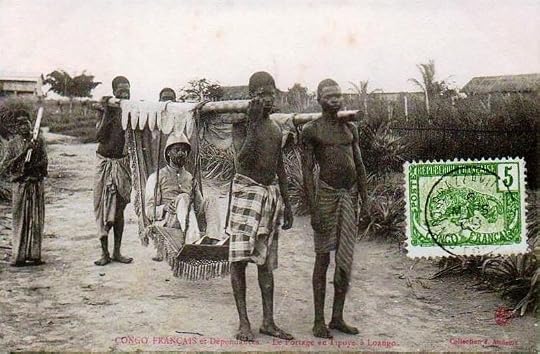
Tata Tollah quickly assumes deiform airs and after arrival: “... was quickly picked up and planted in a litter that we call tipoye and on which blacks had transported whites during colonialism. I found it quite ironic that the man who had come to save us found nothing better to do than be carried around in a tipoye. Tata was pleased and couldn’t stop shaking his scepter.”
Should you not be familiar with this (sustainable!) form of transportation:
Matapari, or Michael, is moved by the power of both of the candidates as is the crowd, during the campaign rally, but finds himself feeling a bit vacant and confused afterwards. Walking home with his father:
“Frightened in retrospect by this huge crowd calling for a savior, I took his hand and suddenly felt reassured. He squeezed my hand into his as if he had read my mind and sensed, through our skin contact, the fragility of a son. He stopped and looked at me. “You know, Michael, a German writer that I like very much once wrote: ‘No good will come to a people that needs a hero.’” I say: “No good will come to a people that needs a savior.”
The fragility of a son.
This book has moments of magical realism, too. A different flavor than that found in Latin American stories, more rain forest based, and power-filled. Think Tutuola, this without the Orishas. The characters are scrumptious. The story is hilarious.
Don’t you wish it could have been different? I find myself staring out the window wondering – what would that continent have looked like Right Now if there had never been any colonialization? No Leopold, no Rhodes, no apartheid, no forced labor in gold mines, rubber plantations, no slave trade, no tipoyes? No...
Maybe asking inexplicable questions to which there are only inscrutable answers in this dire time is just wishing for the counterfactual history fairy to grant my wish. Wishes. Don’t know. Don’t know nuthin’.
His maternal grandfather is dying: “...how could it be that we could wake up one morning and find our great Congo River no longer there? Grandfather was for me like our great river, that inexhaustible sum of everything that existed in our primal forests. Grandfather was our source, his village was the village of our origins, his life the seed of our lives, his views and convictions the fire of our ideas and of our actions…
Come to think of it, I believe I am what I am more because of him than because of Papa. He had been the first one to tell me when I was but eight years old that, after eating, dancing, and making love, a man should use the rest of his time to try to unravel what was behind the appearance of things, since the rambling universe wore a mask. “You must know how to read both the books of man and the book of the universe,” he had told me. ...”
Or, maybe a better final quotation would be: “Don’t you cry, Matapari. You know life is lots of little gray clouds in a great blue sky.”
ماتاپارا قصه ی نوجوانی که از بدو تولد داستان زندگی اش را که از زبان دایی جان بولا بولا شنیده است برای خواننده بازگو میکند . کتاب یک کتاب سیاسی اما مثل قند شیرین است... اگر فکر کردید یک کتاب سیاسی با کلمات سخت و سخیف و غیر قابل فهم است اشتباه میکنید ، بی شک این کتاب روان ترین کتاب سیاسی بوده است که تا به امروز خوانده ام .... ماتاپارا نوجوان کنگویی( آفریقایی) کشور استعمار زده ی آفریقا را با نگاهی عجیب و طنز برای ما بیان میکند که کشور از حاکمیت حزبی میخواهد خارج شود و تلاش های مردم را در جهت تغییر سیاسی و رسیدن به دموکراسی و آزادی بیان میکند.... این کتاب را بخوانید چون زیباست و ارزش خواندن دارد و بی شک درباره ی سیاست چیزهایی جدید را از آن خواهید آموخت ❤️📚 در این میان دوست دارم بگم ممنونم از مترجم خوب این کتاب و نشر آگاه ، که همچین کتاب زیبایی را در اختیار ما قرار دادند .
זהו סיפור מקסים שמסופר מנקודת מבטו של ילד קונגולזי בן 15, בן למשפחה משכילה ואחיין לדוד שהגיע לצמרת הפוליטית של קונגו אשר נשלטה באותם ימים ע"י מנהיג דיקטטורי. המספר מתאר בלשון ציורית, המשלבת חוכמה עם הומור, את תקופת ילדותו בצל מאורעות ושינויים פוליטיים שעברו על ארצו. לטעמי זהו ספר מיוחד שחבל שילך לאיבוד בין שלל רבי המכר שכיסו אותו מעיני הציבור
I think I would have liked this more had I not read Cutting for Stone before it. I think it's a pertinant book to read, and an interesting read, just not not well presented. Part of this could be due to translation
My reaction to this book was similar to A Man called Ove. The book was very funny and profound but I had a hard time engaging. It did get better in the end when it was dealing with topics I could relate to better.
This poignant story of a young man who thought he might should not have been born is a revealing novel of an unnamed country in Africa. This country is the epitome of the colonization of most African countries that have been robbed and raped of their resources. Crooked politics reign while speakers and seers if truth are persecuted. Powerful story.
L'histoire qui vous fait réfléchir, pleurer et rire, tout en même temps. Je l'ai commencé à lire comme le témoignage de la situation au Congo dont je ne savais rien, mais le livre est beaucoup plus que ça. C'est le chemin d'un pays, d'un garçon et d'une culture et en le finissant je peut dire qu'elle mène sinon à la compréhension, au moins à l'inspiration.
I just started this short funny read about the third triplet in a modernized Congo. Dongala has juxtaposed Colonialist pre-developed rule with current technologies in a way that is sad and satirical. The first two chapters are full of satire poking fun at some of our favorite victims, religion, medicine, the power of NAMING as a means to Other or control, law and order, and parenting.
Alliyah finished it in a day or two and recommended it for perhaps a handful of other scholars, though don't be surprised if you see chapters for intros to Satire which go perfectly with my favorite, "The Gods Must Be Crazy"!!
Little Boys Come From the Stars has been less satirical, though shining lights upon the evils done to African countries from within. Uncle Boula Boula’s sudden rise to political fame through fabricated resumes, attainments and experiences is reminiscent of politics around the globe.
I’m loving the way Dongala juxtaposes some of the modern 28-9 while our young triplet protagonist, Michel, Matapari or the Cursed Left-Handed One, is reveling in the forces of his tribal ways that his grandfather showed both him and his teacher father on their mountain trek. “Grandfather made me drink fresh water collected from ravenala leaves, and we ate fresh wild fruits. We were now in the forest bordering the little village; Papa and I followed grandfather, who showed no signs of fatigue despite his advanced age, on the narrow path that led all the way to the source of the river where the village drew its drinkable water. Squatting, I drank this pure water that came from the earth’s insides, that sprang up through the rock fissures to pour down on the white sand that carpeted the riverbed. Grandfather explained a few things to Papa at length, and then, with me still trotting behind, we left the forest for the savanna…”
“An aunt forced me to wash with water (full of strange herbs)” heated over a wood fire on three rock. He exlains how this ritualistic washing was done by the aunt, even though “I was big enough to wash myself”. “Rubbing my body with a plantlike sponge and my feet with a pumice stone, then dabbing me with some lotion in a flask to protect me, she said. From what? I asked. From the snakes along the path and from life’s accidents.”
This is immediately followed with, “I was really worn out, and since there wasn’t a television, I couldn’t watch the music videos from the last Top Africa or better yet X-OR, the new Japanese cartoon series that had replaced Goldorak…laser gun.”
Dongala has this way of fast-forwarding to modernization juxtaposed again a backdrop of tribal, ritual and cultural norms. I also love the way only Matapari, the youngest of the triplets gets all this extra special education because men relatives take a special sympathy or shine to him.
25-29—NAMING –the In his name, with the maps, as well, Dongala addresses the NAMING through Ouagadougou and other names lost once colonization began. 30, revises this NAMING of the third trip!
39-40 Satire of Religion and great dreams for Father Boniface
42-45 Uncle Boula Boula’s Office of Free Ideas scam 49—juxtaposition Jack-in-the-Box with a gazelle in the wild. “I bolted from under their bed like a Jack-in-the-Box and took off like a savanna gazelle, scattering their clothes all the way to the outside door of the living room..”
56—Satire and Religion “Boniface, what is this bullshit about some God’s tear up my kid’s nose?” Continued on 58—“It’s nothing,” said my father, “merely irritation and a lot of tears. Christ’s tears, are they not?” Not a miracle, simply a natural reaction to an itch = sneezing.
62—bottom “Doctor of Agitation and Propaganda” & 65—top PhD of Agitation and Propaganda = Scam-Artist
63—bottom & 64—top a hooker for official staying at Boula Boula’s shack.
74—Comrade FARCE
77—“Have you heard of nepotism?” “Uh, no. What kind of business is that?” Papa didn’t answer and kept silent for a good while. My uncle stared at him, patient. “Well?” he pressed. On one hand the uncle is incredibly intelligent, referring to his brother-in-law as Candide and able to come up with crazy schemes to get into the Big House, while he thought nepotism was a name of a restaurant. Can you say Bush.
79-81 The Destruction of the Rain Forests
This is great that not too long after explaining to my kids how the forest floor is mineral depleted, here Dongala explains why deserts appear after idiots tear down the forests. Their plans to replenish the trees with other viable life fails because there is NOT enough nutrients to sustain these new plants, trees or crops.
83—mid through 85 Matt Henson and Racism I found this section particularly interesting because it’s about “the first man” to arrive at the North Pole, however, in the accounts Eskimos had been going there, or been there long before any “civilized” explorer. Yet, you’ll be hard pressed to locate names of these tribes of people who, for generations, would have been well away of it. Similar to the Indigenous around Machu Picchu, BEFORE Hyram Bingham.
Still, this duality of Racism against giving Henson his props, echoes with Africans and the entire continent and Imperialism and NAMING shit.
90—Not Imperialism but Nepotism, Greed, Propaganda from WITHIN has been equally culpable for the destruction of cultural, national norms. Again, this brings to mind the Tribal leaders who were complicit in Slave Trade that we never truly hear about, since it’s always a finger-pointing blame game against those of the lighter pigments. True, the larger transgressors with Europeans, Blacks in many areas profited greatly from selling off their “enemies”.
115—First Cigarette, hilarious contrasts of the “real men” don’t gag when they smoke contrasted immediately with the “black soot” on his young lungs from one puff.
116-17 — Violence is not an answer.
118-19 — The Power of Books
120 —Uncorrupted Music and the TFA Connections to Unoka’s sad yet celebratory flute “I no loner felt sad; on the contrary, a smile slowly welled up from my heart to brighten my face, and I was so happy, so light that I thought for a moment my body was aflame. I felt an urge for music. For once, I want neither rap nor ragamuffin. I chose kora harp music, without lyrics, because I noticed that the words of men often had the ability to obscure the essence of things and sometimes even corrupt them. I closed my eyes, and I began vibrating with these bright and melancholy notes.”
Matapari goes on to explain how without the corruptions of words, the notes took him to to the very beginnings of time, itself. In his existential experience, he was able to “Arab caravan coming from the North, Koran in one hand, saber in the other,” and understand the messages within the rhythms of the balaphones woven into that of the kora helping him to achieve peace and power all at once. Unoka, in Achebe’s Nigerian Classic, is seen as a weak man, yet through his upbeat playing, even he had power in traversing to other places, uplifting others while bringing the player to a sad place, all at once. (TFA pg 7)
121 — "Glory has a ballistic trajectory: there comes a point where it reaches its peak, and then, the descent is unstoppable," Mata referring to a conversation with his father, the village teacher and Scientist
143 — The General and Viagra
153 — “I knew about and realized that there were more ways to kill a man than to save them,” Matapari in the juxtaposition of modern Weapons of Mass Destruction of the nuclear family, human morale and the community: Schwarzenegger, Gibson, and Stalone metallic killing machines against the simplistic torturing methods one can just as easily use against another person’s body, mind and soul.
This relates to that 116-19 setting up books and education as a better savior than violence and as one of the book’s motif’s SCIENCE as this also connects with that science quote — 211 — morals and science having responsibilities to humanity first.
189-90 — Garden of Eden
190 last ¶ — Environmental Concerns
203-05 — Fickle public quickly forgetting past atrocities = Uncle Boula Boula’s crimes.
211—"As you all know, science without morals ruins the soul," one of the politicians, Tata Tollah, speaking at pre-Election Democratic Conference.
دوقلوها که به دنیا آمده بودند؛ ماما کوسا مادر را اطمینان داده بود که میتواند از بیمارستان مرخص شود. ولی مادر هنوز درد داشت. مادر را که دردش رو به فزونی بود؛ از شدت درد که به بیمارستان برده بودند، تازه دکترها متوجه شده بودند که آن دوقلو، یکقلوی دیگر هم داشته است و از زایمان جا مانده بود. پس ماتاپاری درست دو روز بعد از به دنیا آمدن برادرهای دوقلوی خود به دنیا آمده بود و حالا نویسنده قصد داشت راوی رُمان خود را به عهدهی همین ماتاپاریایی بسپارد که به چنین سرآغاز مضحکی پا به دنیا گذاشته بود.
و در ادامه این ماتاپاری کوچولوموچولو بود که تا تهِ کتاب روایت بچهگانهی خود از اوضاع قمردرعقرب سیاسی اجتماعی زادگاهش را به دست گرفته بود. پدر ماتاپاری معلمِ مدرسهشان بود. تنها کسی در دِه و دیارشان که همهچیز را از دریچهی علم زیر ذرهبین میبُرد. در نقطهی مقابلِ او، مادرِ ماتاپاری بود که دلبستهی مذهب کاتولیک مانده بود و اوج و فرود هر مسألهای را از زبانِ مذهبش، درک میکرد. ولی پدربزرگ که دورهی تحتِ استعمار فرانسه را زیسته بود؛ فردی جنگنده بود. پدربزرگ که در زمانهی خود، مدیر یک مدرسه بود؛ با کشیشی که از طرف حاکمیت استعماری فرانسه، حمایت میشد دراُفتاده بود. کشیش خواسته بود که در مدرسهی تحت مدیریت پدربزرگ، مراسم دعا و مناجات برای دانشآموزان، برپا کند؛ که با مخالفت او مواجه شده بود. او که خود را ملتزم به اطاعت از قوانین جمهوری لائیک میدید؛ شکایت به فرماندار بُرده بود. ولی فرماندار که میبایست به تحکیم پایههای این قوانین کمک میکرد، بهدلیل همنژادیاش با کشیش، به مخالفت با پدربزرگ برخواسته بود. اما در ادامه، پدربزرگ با جدوجهد فراوان توانسته بود که کشیش را به پای میز محاکمه بکشاند.
هرچهقدر که پدربزرگ آدمی بود که از خواستهها و اعتقاداتِ خود کوتاه نیامده بود؛ داییِ ماتاپاری انگاری که به چیزی اعتقادی نداشت. دایی بولابولا انگاری قرار بود تیپیکِ آدمهای فرصتطلب و هُرهُریمذهب را بازی کند. به چیزی پایبند نبود و به هر وزشِ تندبادهای مرسومِ کشورهای از توسعه جا مانده، به جناحِ حاکم و قدرقُدرت میپیوست.
کتاب روایت آگاهی جمعی از تاریخ کشور کنگو است که سه نسل مختلف را دربر میگیرد. پدر بزرگ که دورهی استعمار تحت کشور فرانسه را تجربه کرده، پدر که دورهی استقلالِ دیکتاتورپرور را پشت سر گذاشته و خودِ ماتاپاری که حالا داشت دورهی مشنگبازی پس از زمینخوردنِ دیکتاتوری را تجربه میکرد. پدربزرگ، صدای نادری از جامعهی عقبافتاده است که مقاومت و ایستادگی و جنگندهگیاش به عرف و سنت جامعه تبدیل نمیشود. پدر، صدای عقل و درایتِ وقایع و رخدادهای سیاسیست. کسیکه به زیرو بم ترفندها و بده و بستانهای سیاسی یک جامعهی توسعهنیافته آگاه است. و با علمی که به سیاستورزی خردمندانه دارد، همهی رخدادهای سیاسی پیرامون خود را به سخره میگیرد. نمیتواند در آن هظم شود. نمیتواند قاطیشان بشود و به کنارهگیری خود، فقط میتواند که خود را از آلودگیهای آن نجات دهد. حتی نمیتواند در جامعهی خود مؤثر واقع بشود. جامعه در ناآگاهی خود، در سیلان بین جادوجمبل و عالمانی گمراه، راه به پرت و پلاها طی میکند. اگرچه قصدِ نویسنده به تصویر کشیدن حالوهوای سیاسی کنگو بوده، ولی اینها را با تمرکز بر زندگی روزمره و از دلِ زندگی بیرون کشیده است. انگاری تاریخ معاصر کنگو، به زبانِ زندگی روایت شده باشد.
C'est l'histoire d'un petit garçon qui a la malchance de naître 2 jours après ses 2 jumeaux, le jour de la fête nationale de l'indépendance de son pays africain, Matapari , celui qui porte malchance; et oui, c'est en partie un roman, plus ou moins autobiographique, inspiré de réalisme magique, où Matapari grandit, apprend et fait des erreurs, comme son pays. Mais c'est bien plus qu'une série de personnages truculents et représentatifs de différentes personnalités typiques, comme son père et grand-père, tous les 2 instituteurs motivés pour leurs élèves ainsi que l'apprentissage continu, sa mère férue catholique et travaillant dur au marché pour arrondir les fins de mois, et l’oncle Boula Boula, incorrigible opportuniste dans les affaires comme la politique. Cette famille sonne vrai en fin de compte, comme toutes les vraies familles avec leurs contradictions. En particulier, le grand-père qui a chassé à coups de chaussures le prêtre venu empiéter dans son école résonne particulièrement pour moi car mon grand-père, instituteur directement issu de Jules Ferry, aurait très bien pu faire de même! Ce grand-père qui meurt entouré de ses encyclopédies et de ses masques africains, cette mère qui a trouvé comment combiner le meilleur du catholicisme et des croyances ancestrales, ce père si courageux pour demander la démocratie auquel son pays a droit, Matapari lui même avec ses moments fiers et ses moments plus faibles, tous donnent un élan inoubliable à ce livre.
Emmanuel Dongala. Je n’ai jamais entendu le nom avant qu’un ami, Christopher Scholz m’a croisé à la bibliothèque en train de retourner Les Petits Garçons Naissent Aussi des Étoiles, en me disant que c’était excellent. J’avais déjà 4 livres à sortir, mais le mot « excellent » et livre, surtout par un auteur Africain, je ne peux pas résister. Quelle découverte ! Dongala est un talent énorme. Le lieu : un village au Congo Brazzaville. L’époque : Sassou. Ce roman est rempli de l’humeur et de tristesse. Humeur, parce que on ne peut pas survivre dans un tel climat politique si on n’est pas capable de rire. Triste, parce que c’est l’histoire trop connu de trop de pays sur ce continent – le chef devient dictateur et garde le pouvoir a un prix trop élevé. C’est l’histoire d’un petit peuple qui visent grand pour reprendre le contrôle de leur destin pour faire une vraie démocratie.
The narrator is heavily biased, which I felt was to the benefit of the book, skewing the pieces unfolding with the perspective of a teenager.
This is such a short read that I don’t know if I particularly engaged with any part of it, but I think it stands well as it is.
I debated between 2 and 3 stars because I wasn’t overly taken with it, but I do think it was well done and enjoyable, so I’m giving it a positive 3 stars.
While I wouldn’t run out to recommend Little Boys Come from the Stars, I liked reading it and look forward to the discussion it will foster at book club.
On the whole this is written as quite a light hearted coming of age story but alongside it also satirises the post colonial history of the country that it is set in and as a result the author doesn’t refrain from including violence and brutality when necessary. I had presumed that this history was based on Dongala’s birthplace of Congo Brazzaville but I don’t know if this is the case other than the fact that a basic internet search shows up superficial similarities at least. Either way it is an enjoyable read - fun and quirky but with some dark edges.
کتاب داستانی است از زبان یک پسر بچه به نام «ماتاپاری» اهل شهر کوچک و به ظاهر کماهمیتی در کنگو. در طول کتاب شما با ماجرای عجیب تولد ماتاپاری، خانواده و اطرافیانش، فرهنگ مردم و وقایع سیاسی دورهای از کنگو آشنا میشوید. روایت پسر بچه بسیار زیبا و با رعایت ظرافتهای خاص زبان یک کودک پیش میرود. مثلا شما یک شوخی کنابهآمیز را چندین بار در طول کتاب میبینید. درست همانطور که یک کودک ممکن شوخی جالب خود را بارها برای شما تکرار کند. به طور کلی کتاب بسیار شیرین، جالب و خواندنی است. نثری روان دارد و ترجمه و ویراست و چاپ کتاب هم از نشر آگه بسیار خوب و قابل تقدیر از آب درآمده است.
My first encounter with African Literature and yes the book is amazing. Storytelling is top notch and you learn a lot, no matter how old you are. I always think about it this way: Learn about countries and cultures by reading their writers’ works and not what media shows and wants you to see.
Okay have to go and shed tears because the book has haunted me beautifully.
I think I am too stupid to read books like this! I had to look up a word, every 5 sentences. Why do smart African writers, feel the need to show off their high-end vocab skills.?? Anyway, plot was great, just wished I knew more.
Evelyn Waugh's Black Mischief, but written by a black man, with a dash of Clockwork Orange and magical realism, all narrated through the misunderstandings of a posturing young man. Felt the last third of the book dragged with the change to democracy, but the ending held.
ספר יפיפה המספר על שנות התבגרותו של ילד אחד בכפר קטן בקונגו. הספר מלא סיפורים ומאורעות קטנים וגדולים שהתרחשו בשנות ההתבגרות בשפה קולחת ומעניינת. הסיפור שוזר ארועים פוליטיים שהתרחשו בשנות התבגרותו של הילד בקונגו ושופכים אור על תרבות והיסטוריה שאינם מוכרים לרוב הקוראים
Congo. (Not to be confused with the Democratic Republic of Congo.) Youngest of a set of triplet brothers tells the story of political corruption in his country in a humorously naive manner.
This is set in the Republic of the Congo (former French Congo), not the Democratic Republic of the Congo (former Belgian Congo and formerly Zaire). Dongala does not help the confusion by mentioning Patrice Lumumba and Mobutu, but none of his own leaders by name.
It is the story of a corrupt and repressive regime as seen through the eyes of a young boy. He starts off believing everything he is told, but starts to question things more as he gets older. It is also the story of his family and village. Most of the characters are not shown in great depth, but they are realistic and human. This is a confused country, animism mixes with Christianity and neither mix with science, folk tales mix with manga comics and television series, modern medicine (such as IVs) mixes with herbal infusions and chants. The book is also funny in places. It ends with the coming of democracy to the country, but is not optimistic. This book is a good read and very enjoyable. I would recommend it to anyone wanting to visit the country in fiction. It is not either great or amazing, so does not get five stars.
It's been a while since I read this book, and I've been meaning to write a few folks about it for some time now -- so please forgive any omission of detail. I really enjoyed reading this piece. I rarely read fiction, so it's possible this book was a draw to me because of the political, cultural, and interpersonal depth it offerred (plus, it was a gift). It is basically a story of an unnamed African country's experience of political upheaval, told from the perspective of a young boy. It's fascinating to read about another culture (or, more likely, melding of cultures) so far from my own -- not to mention narration based on a very different maturity level and consciousness. In thinking back on this novel, I am reminded a little of images from the film _The Last King of Scotland_.
I definitely think this is worth the read if you want something semi-light (insofar as probably being distant from your own daily life and about a little boy's experience of life) but very rich with an important dose of political reality that we must never forget exists in all too many places.
This was a gem of a book! The narrator is a 15-year-old boy living in Africa. He is one of triplets but because he was unexpectedly born a day after his other two brothers, his mother thinks of him as a curse on the family and treats him as such. Fortunately, the boy has a supportive, intellectual father who treats him as a kindred spirit, sharing his knowledge and theories with him. The best part of the book is its sense of humor. The author pokes continual fun at the political system in Africa. Those in charge, including the boy's uncle, are such buffoons, constantly changing laws to fit their whims. I really enjoyed this different slice of African life, without violence and starvation.
Matapari le dit, il n'aurait même pas dû naître. C'est que, dernier né de triplés, il ne quitta le ventre de sa mère que deux jours après ses frères, peut-être par discrétion, ou par prudence. De cette naissance, il conçut un don de curiosité insatiable pour le monde. Et ce qu'il voyait autour de lui, avec les yeux de l'innocence, était parfois étrange, comme ces menées de tonton Boula Boula avec la femme du vieux Bidié ou - autre flirt du même - avec les hautes sphères politiques du pays. Par cet oncle donc, cet enfant faux naïf pointe les vicissitudes d'une Afrique otage de ses dirigeants post-coloniaux reclus dans la citadelle de leur Parti Unique. Un roman grinçant et plein d'humour, sur une réalité africaine encore largement actuelle, sorte de "Candide au Congo".
I really enjoyed reading Little Boys Come From The Stars by an author from the Congo Republic, Emmanuel Dongola. He captivates his reader with an innocent account of growing up in Africa, then gives his interpretation of the turmoil that spreads through the government. I think he captures, in a very personal way, the impact of oppression such as Apartheid. Another more disturbing first hand account account, although not of Apartheid but of similar oppression in Sierra Leone, West Africa is by Ishmael Beah, A Long Time Gone.
This was really good. I'd never heard of it before, but had to read it for class and was very pleasantly surprised at how much I liked it. The book's narrator, Matapari, is very endearing and innocent amidst the political turmoil of his "small, no-name African village". There is a really beautiful quote from the book: "Don't you cry, Matapari. You know life is lots of little gray clouds in a great blue sky."
Emmanuel Dongala created such an interesting read. His storytelling is endearing and clever. He uses humor as he presents some very serious insight into the political struggles of the Congo (Brazaville) as it moves from a Communist dictatorship to a more democratic nation. Again, for most Americans, this is a situation most of us are totally unaware. Also interesting is the exposure that Dongala gives to the tribal religious and cultural traditions.
Underlying themes of the first-ever born set of triplets in village, familial ties and traditions, and "democracy" as seen through different lenses, made for a story that was witty, enlightening, and educational.
I loved seeing the farce of African politics through the eyes of a young boy in all his innocence. His take on everything kept me smiling as did the political antics that went on. I greatly enjoyed Dongala's writing - I will definitely be reading more by him.