Jump to ratings and reviews
Rate this book

Grandma Rachel's Ghosts

Rate this book
A Jewish Fantasy Story

Can the dead speak to us? And if they can, will we listen?

Jacob was five the first time he saw them, the two strange women in Grandma Rachel's kitchen. They appeared suddenly, from thin air.

It was summer and scorching hot, but the two women wore old-fashioned heavy winter dresses. They spoke with an accent like Grandma, from a land far away.

They had stories to tell. Nice stories that Jacob loved hearing, and awful, painful stories that made him cover his ears.

Now, years have passed and Grandma Rachel is dying. Will Jacob finally be able to listen to what the ghosts have to tell him before it's too late?

You will love Grandma Rachel's Ghosts because it is a Jewish fantasy story about love, family, loss, and the connection between past, present, and future.

32 pages, Kindle Edition

First published March 15, 2017

Loading...
Loading...

About the author

Jonathan Dunsky

20 books229 followers
Jonathan Dunsky is the author of eight crime novels, seven of which -- Ten Years Gone, The Dead Sister, The Auschwitz Violinist, A Debt of Death, A Deadly Act, The Auschwitz Detective, and A Death in Jerusalem -- are mysteries taking place in the early days of the State of Israel and featuring private investigator Adam Lapid, a holocaust survivor and former soldier and Nazi hunter. He has also published a standalone thriller called The Payback Girl and a number of short stories in various genres.

Born in Israel, he served for four years in the Israeli Army. After his military service he worked as a team leader in various high-tech firms, ran his own Search Engine Optimization business, and lectured in the faculty of Business Management in Tel Aviv University. He holds a degree in computer sciences and business. He's lived for several years in Europe and currently resides in Israel with his wife and two sons.

You can contact him at http://jonathandunsky.com/contact/

Ratings & Reviews

What do you think?
Rate this book

Friends & Following

Create a free account to discover what your friends think of this book!

Community Reviews

5 stars
60 (60%)
4 stars
23 (23%)
3 stars
13 (13%)
2 stars
3 (3%)
1 star
1 (1%)
Displaying 1 - 14 of 14 reviews
Profile Image for Tamar...playing hooky for a few hours today.
867 reviews211 followers
June 16, 2024
September 2026 (updated review)

Jonathan Dunsky is the author of this week’s GR Short Story Club selection, Grandma Rachel's Ghosts. Mr. Dunsky, is an Israeli author who is better known for his Adam Lapid murder mysteries which take place at various times before, during, and after the Israeli War of Independence, including also descriptions and mysteries from the horror of his internment at Auschwitz. Dunsky also writes short stories and, I proposed this story for this week's discussion.

Grandma Rachel's Ghosts is a magical realism, bitter-sweet story which, among other things, touches on the disparity between three generations' coping mechanisms for dealing with the trauma of the Holocaust: A Grandmother who lived through the period but emigrated before the Nazi round-up and murder of her entire family, her daughter who didn't want to know and refused to listen, and a grandson who was curious and wanted to know but was too young to fully comprehend (growing up to leave his grandmother and past behind – only to be reunited with her on her death-bed).

I read the story several years ago and I remembered that it made me cry but also that I absolutely loved it – not only because of the intriguing story, which I enjoyed, but also because of loving and mouth-watering description of Grandma Rachel’s rugelach. I swear to you, that when I finished the story and raised the tissue to my tearing eyes and dripping nose, I could smell cinnamon on my fingertips….I actually did this several times and each time I smelled the fragrant scent of the spice. If you tend to be a little emotional (I certainly can be), maybe you shouldn’t read the story in the middle of the night, because it is hard to fall asleep when your nose is all backed up from weeping.

The first thing I noted in the story was the reaction of Grandma Rachel’s Daughter to the stories she needed to tell, but which the daughter did not want to hear. In Israel, where there is a high but naturally dwindling concentration of Holocaust survivors, this dynamic is not unique. Suffice it to say that many survivors internalized their trauma to protect their children or avoid breaking down. Consequently, their children often grew up with only an unclear understanding of what their parents suffered just before and during the period where the Jews of Europe were rounded up and herded off to concentration camps. Often, the Grandparent (Generation One) internalized their trauma and could not bring themselves to speak of the horror and ordeals they endured. Consequently, their children (Generation Two) were not exposed to or did not want to succumb to the heavy secondary emotional trauma suffered by their survivor parents. Yet, the next generation (Generation Three) was sensitive to the pain and suffering of their grandparents and were more open to hearing their stories.

However, as the Survivors age, many feel compelled to tell their stories. Often, the grandchildren are the ideal, emotionally unburdened receptacles for these stories. Also other institutions, such as the Spielberg Project, took it upon themselves to document the testimonies of as many survivors willing and able to tell their stories. At the same time, numerous Survivors and members of the Partisans have taken it upon themselves to document their trauma in written memoirs.

This, in my opinion, is a major theme in this story.

The story is told in alternating timeframes, beginning when Jacob is 5 years old and being raised in part by his Grandmother while is mother is at work, and later, after he has grown and left the fold of his family, returning the to bedside of his dying Grandmother.

It is when he is young that he sees the ghosts of his Grandmother’s two sisters (Tova and Esther) hovering nearby in the kitchen chattering away, while his Grandmother kneads her mother’s recipe for Rugelach. When he asks about their strange clothing and why Esther was crying, the Grandmother is shocked that Jacob can see her sister. Jacob's grandmother explains that her sister was sad because she missed her baby, Yitzhak. Grandma Rachel's daughter dismisses her mother's conversations about Tova Esther and Yitzchak as the rantings of an aging delusional woman – and you will have, presumably, read the rest.

One other theme that I noted in the story (only on my last reading – probably because I read it once again just before the Jewish New Year) – was the literary parallel (similar theme and cadence) to a verse from the Jewish High Holiday Prayer Services:

(from the Unetanneh Tokef (Liturgical Section) – circa 11th Century)

On Rosh Hashanah it is inscribed, and on Yom Kippur it is sealed:
How many shall pass away and how many shall be born,
Who shall live and who shall die,
Who shall reach the end of their days and who shall not,
Who by water and who by fire,
Who by sword and who by wild beast,
Who by hunger and who by thirst,
Who by earthquake and who by plague,
Who by strangling and who by stoning,
…..


This text refers to what God sees for His People in the coming year…

And, from Dunsky’s text:

When I was fifteen, Tova decided to torment me [and his grandmother]. During dinner with Mother and Grandma Rachel, she stood by the table, recounting the names of their parents and uncles and aunts and cousins. She told me how each of them had died, who by a bullet and who in the camps, who from exposure and who of starvation…

…while this latter text refers to how man killed His People

So maybe I imagined the correlation, but it works for me.

June 2024 [five stars] Because of the Rugelach

Okay, I probably would have just left the five star review and not elaborated but a little bit of the ghosts wore off on me (literally - see below)....

This beautiful little story is the recollection of a small boy (of five) seeing his Grandma Rachel's sisters for the first time (and then many times over the years). His grandmother Rachel speaks to them often and she was surprised when her grandson, the narrator, asks questions about their conversations. Realizing that her grandson can see and hear her sisters (who died in the Holocaust) as clearly as she does, a strong bond develops between the four of them. The dialogue continues over the years until Grandma Rachel lay dying on her hospital bed. I admit that I got choked up a couple of times while reading, but I tend to get emotional when I read, especially these types of stories.

But the real reason I am writing this is because of the rugelach - Dunsky writes with passion about the rugelach (also in his book Ten Years Gone). He writes about his Grandma kneading and rolling up the doughy treats, the sour cream, the cinnamon, the raisins, the aroma of freshly baked... His descriptions of rugelach make my mouth water and sound even better than my own. But the thing is, that when I finished the story, the tips of my fingers wafted faintly of cinnamon. I swear to you that I am not kidding. I checked several times to convince myself that it was not my imagination, and it was not!

This story and Dunsky's books are not easy to find in libraries, but if your library subscribes, they are all available on Hoopla!
Profile Image for Cecily.
1,383 reviews5,658 followers
September 26, 2026
I read this knowing only that it’s a contemporary Jewish fantasy. I wondered if aspects may be a little obscure (Jewish culture has not permeated the UK mainstream in the way I think it has in New York and parts of the US). The dedication reads:
“For Grandma Rachel. Thank you for the rugelach, and for everything else.”
I’d never heard of “rugelach”, and didn’t know if it meant something abstract like “love” or “advice”, or more concrete like “gifts” or “hugs”.

I need not have worried. It was clear, profound, and transcended boundaries of time, place, and nationality - which is one message of the story.


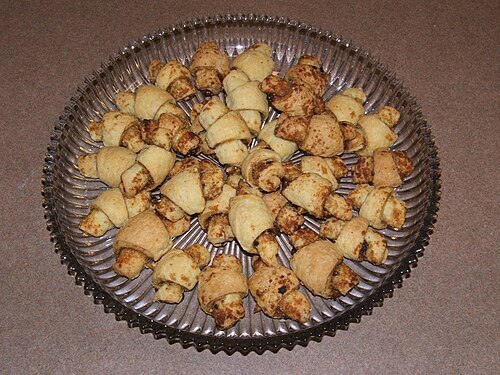
Image: A plate of rugelach - a type of filled and rolled pastry, common among Polish Jews and their descendants (Source)

“I grew up in a family of women. There were the live ones, Mother and Grandma Rachel, and there were the dead ones, Esther and Tova.”
It is simply told in short sections, alternating between “Now” (when Grandma Rachel is dying) and “Then” (the narrator's memories of her from age five onwards). It’s immersive, with minimal explanation or context, which works especially well in the childhood sections.

It explores the generational trauma of the Holocaust in a gentle and sensitive way that I found truly moving: some need to talk about it, some want to learn (but may be too young to comprehend), while others won’t listen and just want to look to the future.

“He tells me they will do what they can to make sure that Grandma suffers as little as possible. I don't tell him that given the choice, she wouldn't have minded a little suffering. It would have made her feel less guilty.”

It’s short, and suitable for all ages.

Short story club

I read this with The Short Story Club.

You can read this story HERE.

You can join the group here.
Profile Image for Amanda NEVER MANDY.
711 reviews107 followers
September 25, 2026
A boy sees and a mom denies.

From one generation to the next, stories are passed down. A grandmother that knows, wants to tell a daughter who does not want to know. A grandchild is listening.

Why only three stars? The content was complex, but the writing style was simple. The story carried emotional weight, but it didn’t take me under. What I learned about the story, I picked up from a reading group. I am not quite sure how I feel about that. Was it the author’s intention to get the generations talking with just enough of a story to spark interest, or was it just a story that didn’t fully do its job? I don’t know.
Profile Image for Connie  G.
2,253 reviews733 followers
September 21, 2026
"Grandma Rachel's Ghosts" is a Jewish fantasy story about how difficult it is for people who lived through the Holocaust to communicate about their experiences and the fates of family members who died. Grandma Rachel, who emigrated before the Nazis came into power, wants to talk to her daughter about her sisters who died in a Nazi concentration camp. However, her daughter does not want to listen to such a painful family history.

Her young grandson, Jacob, could see the ghosts of his grandmother's two sisters, and formed a close bond with Grandma Rachel and his great-aunts. He had to keep their conversations a secret because no one would believe he was talking to ghosts. Years late, when his grandmother became ill, the doctor believed she was delusional since she talked to spirits in the room.

The author used magical realism to write a fairly gentle book about the lasting effects of the Holocaust on a family. This makes it an appropriate book for older children as well as adults. The family history has its warm moments such as Grandma Rachel making her delicious rugelach. It also shows how painful the family history is to Grandma and her two sisters. There is generational trauma, but it's important to listen to the family history of the Holocaust before the older generation dies.

Thanks to Tamar for introducing this story to the Short Story Club.
Profile Image for Stacey B.
518 reviews239 followers
July 29, 2021
Having read all of the books this author wrote, I wasn't aware he wrote short stories as well.
This book was one of them.
Twenty-five pages tells us stories of Jacob at five years old, first meeting his grandmothers two sisters long after they were killed in the Holocaust.
He has now come home to be with Rachel before she passes away, and is also dealing with his mother
grief. Jacob has never shared any of this information with his mother. Why? His mother never wanted to hear anything about her mothers past.
Jonathan Dunsky writes from heart. His Adam Lapid novels and others are wonderful.
Profile Image for Hester.
768 reviews
September 21, 2026
Here is an intergenerational story set in Israel where the ghosts of two sisters who died in The Holocaust are visible to both their remaining sister and her grandson , a five year old child . Both ghosts are are able to communicate freely and over time are able to bring the rich family story and it's terrible tragedy to this engaged child . His mother , keen to build a new life and look forward , is not party to the ghostly presence and thinks her mother delusional .

The story asks the simple question How do we keep the memory of those we love alive when not talking about such horrors is an understandable response ? By framing the experience through a child's eyes the story is accessible to adults and older children alike .

The writing style was a tad saccharine for my taste and the dialogue unrealistic but the ghosts were as real to me as to the narrator and they stole the show .
Profile Image for Linda   Branham.
1,834 reviews30 followers
November 2, 2018
It says kindle edition but I have a paperback edition
As a child Jacob sees 2 strange women in Grandma Rachel's kitchen - he doesn't know they are ghosts. He loves listening to their stories
As year past and Grandma Rachel is getting older - Jacob worries about her being gone
Profile Image for Sue Ben-Dor.
158 reviews1 follower
February 10, 2021
Lovely

This was the best of all of his. I read them all and this is my favorite. I wish I could still see and talk to my grandma.
Profile Image for Frances Rouse.
7 reviews
June 25, 2020
Wonderful Story


I love this book. The stoke my heart. I was Nursing home nurse who felt that so called confused pAtients felt safer and loved in their memories.
Profile Image for Mary.
179 reviews27 followers
August 4, 2021
A ghost story that will touch your heart

Only Jacob and his grandmother can see the ghosts. Only the two of them can hear the stories the ghosts tell. Jacob’s mother can’t or won’t see them. This beautiful ghost story reminds us of the importance of listening to our family history before it is too late.
1 review
March 11, 2021
We must never forget!

This is a wonderful way to keep the memory alive of those who were lost during the Holocaust. It's far gentler than many memoirs while bringing a necessary truth into today's growing skepticism of our well-documented past.
3 reviews
Read
March 19, 2021
Disappointed

I am a true fan of Mr. Dunsky. I was eager to start this book. Perhaps I missed something, but did not enjoy the read. Look forward to reading other books from Mr. Dunsky.
Displaying 1 - 14 of 14 reviews