Sinds de dood van Vincent van Gogh, nu 125 jaar geleden, waren het incident waarbij hij zijn oor afsneed en zijn zelfmoord met een revolver een permanente bron voor discussie. Ze speelden een grote rol in het creëren van de mythe rond de kunstenaar. Wat was precies de ziekte waaraan Van Gogh leed en hoe heeft deze zijn werk beïnvloed? Deze fascinerende publicatie onderzoekt hoe Van Goghs ziekte zich al in zijn jeugd manifesteerde en hoe hij er tot aan zijn dood mee worstelde, hoe mensen rondom hem erop reageerden en hoe deze mentale toestand een weerslag had op zijn werk. Brieven aan zijn broer Theo en andere familieleden worden geconfronteerd met kunstwerken uit diezelfde periode en tonen aan hoe Van Goghs verknochtheid aan zijn werk het enige was dat hem weerhield om het vroeger op te geven. Dit boek is rijkelijk geïllustreerd met historische documenten, foto's en ander materiaal. Het schetst een genuanceerd en weldoordacht beeld van een buitengewoon man die moest zien te overleven met een geestesziekte in een tijd dat dergelijke ziekten nog grotendeels verkeerd werden begrepen en er nauwelijks behandelingen voor waren. De eerste publicatie die de complexe aspecten van Van Goghs ziekte en hoe deze zijn werk heeft beïnvloedt, grondig onderzoekt.
This book was published to accompany the current exhibit at the Van Gogh Museum in the Netherlands, focusing on the last two years of his life (1888-1890) when he suffered acutely from mental illness, which then culminated in his tragic suicide at the age of 37.
I have long admired Vincent Van Gogh's art and have been lucky to see many pieces in different exhibitions around the world. I knew about his famous "ear incident" but other than that, I must say I've been quite ignorant. It was interesting to read this, because so much of the insights came from his correspondence with his brother Theo (who was a kind and caring ally), and I appreciated hearing Vincent's voice that way.
He suffered terribly, and was in and out of mental asylums with regularity. He scared his neighbours, he heard voices, he ate and drank toxic substances, drank far too much, and was completely despondent. He also cut off his own ear and presented it to a prostitute at a local brothel. He painted a great deal during this turbulent time, some truly haunting and personal pieces.
It is a sad story - obviously we will never be able to illuminate, or diagnose precisely what his mental or physical conditions were. At the time, doctors diagnosed him with epilepsy, melancholia, alcohol abuse, and there was one dubious claim of syphilis. After his death, many have tried to speculate, given what we know now - perhaps bi polar disorder, perhaps schizophrenia - but we will never know.
I like that the book, despite its focus on his illness, does not take away from Van Gogh his artistic genius:
"His artistic achievement was definitely not a side effect of his illness. It was rooted instead in the skills of his craft, which he continued to develop even during the stormy final year and a half of his life."
Indeed, he did. And the works included in this book shine, beyond anything else. They reach beyond his illness and continue to amaze and touch us today.
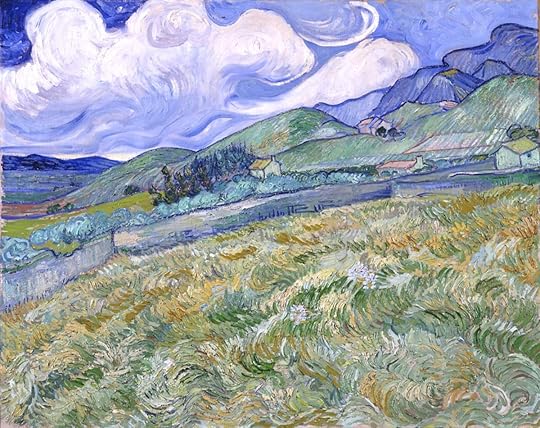
Landscape from Saint-Remy, 1889
I received a free ARC of this book via Netgalley, in exchange for an honest review. Thank you, Yale University Press!
This book describes the mental health of a famous artist.
I found this book interesting in places, but (given the time that has elapsed since the events described) there was a lack of any real conclusion, besides the artist probably had a mixture of mental health problems.
The reproductions of the artist’s pieces showed the range of his work.
I received this from NetGalley in exchange for an honest review.
I'm a huge fan of Van Gogh, (in fact, my visit to the Van Gogh Museum was the highlight of my trip to the Netherlands) and I've read a lot of books about his life. However, this book still presented information and pictures that I hadn't read or seen before. It's an informative and heartbreaking look at the genius of Van Gogh, supplemented through paintings, historical documents, and photos. Extremely timely as he died 126 years ago yesterday - highly recommended.
Sad but interesting examination of Van Gogh's struggles with mental illness. Includes reproductions of relevant paintings, sketches, photographs, and historical documents.
The authors have written a compelling book on the mental health of Vincent van Gogh. The mental and physical diagnoses of van Gogh in his time are examined, as well as several other possible diagnoses that have been proposed over the decades since his death. The author stops short of forming their own opinion, since it is impossible to a modern examination of the patient using the knowledge that has been gained over the years. As a huge fan of Vincent van Gogh, I appreciated this in-depth look at his health with a timeline of his decline. Even though I have read a lot of about van Gogh's life and his art this was a new approach.
Super interessant boek rondom het leven van van Gogh. Met de focus op zijn mentale problemen. Verklaringen van medisch personeel, familie en buurtbewoners. Ik heb meer geleerd over hoe briljant van Gogh was. Dat hij troost in zijn kunst vond maar dat je ook kunt zien hoe hij steeds verder afgleed in zijn problemen. Het hoofdstuk over een mogelijke diagnose vond ik als social worker ook interessant.
Well researched account of the struggle Van Gogh had with his mental health. The book goes beyond the tropes we’ve heard anecdotally and presents the accounts from the people in Van Gogh’s life in their own words.
Because of the much publicised new evidence unearthed by Bernadette Murphy the Van Gogh Museum of Amsterdam has a new an exhibition of this title and this book accompanies it. Whilst the evidence unearthed was interesting, clarifies just how much of his own ear the painter removed, and gives more back story to the characters involved in this episode, it doesn’t add to the body of work left behind nor of the knowledge of Van Gogh’s mental condition. He seems to have been incredibly fortunate to have not only his self-sacrificing brother, Theo, but concerned parents and even helpful neighbours quite apart from the latest in medical thinking and very humane treatment when in hospital. It was thought he was epileptic and was given all the support possible for the times. At times he was considered well enough to be allowed day-release (which didn’t exist then for mental patients) and was treated with courtesy and sympathy and encouraged to return to his art – which led to him eating the paints on occasion! Most of this is shown in the first section of the book, as it is in the second. Only the newer evidence recently unearthed is not included, despite the artefact being in the exhibition which this book accompanies. Whilst I don’t feel better informed as a result of reading the book, I perhaps would do had I not already studied previous works about the artist. For a newly interested reader it’s perfectly fine
Ik wilde graag meer weten over Vincent’s ziekte. Daarom kocht ik dit boek in het Van Gogh Museum. Het boek is erg fijn geschreven en geeft een goed inzicht in Vincent’s mentale en fysieke gesteldheid.
Het einde vond ik erg plotseling, maar toen las ik nog alle originele documenten. Deze werden ook eerder in het boek vermeld. De documenten waren heel goed hertaald en daardoor goed te lezen. Het laatste document was een brief Emile Bernard aan zijn vriend Georges-Albert Aurier over de begrafenis van Vincent. Ik vond dit erg emotioneel om te lezen, maar ook een mooi einde aan het boek.
Ik zou dit boek zeker aanraden aan de mensen die meer willen leren over Vincent en zijn ziekte. Ik ga mij nu meer verdiepen in alle schilderijen die Vincent heeft gemaakt. Daarnaast ga ik verder met het lezen van zijn brieven.