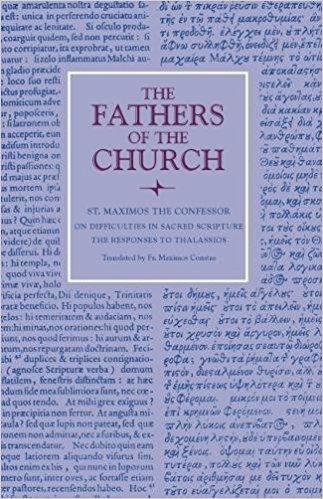
Maximos the Confessor (ca. 580-662) is now widely recognized as one of the greatest theological thinkers, not simply in the entire canon of Greek patristic literature, but in the Christian tradition as a whole. A peripatetic monk and prolific writer, his penetrating theological vision found expression in an unparalleled synthesis of biblical exegesis, ascetic spirituality, patristic theology, and Greek philosophy, which is as remarkable for its conceptual sophistication as for its labyrinthine style of composition. On Diculties in Sacred Scripture, presented here for the first time in a complete English translation (including the 465 scholia), contains Maximos's virtuosic theological interpretations of sixty-five difficult passages from the Old and New Testaments. Because of its great length, along with its linguistic and conceptual difficulty, the work as a whole has been largely neglected. Yet alongside the Ambigua to John, On Diculties in Sacred Scripture: The Responses to Thalassios deserves to be ranked as the Confessor's greatest work and one of the most important patristic treatises on the interpretation of Scripture, combining the interconnected traditions of monastic devotion to the Bible, the biblical exegesis of Origen, the sophisticated symbolic theology of Dionysius the Areopagite, and the rich spiritual anthropology of Greek Christian asceticism inspired by the Cappadocian Fathers.
Maximus the Confessor (Greek: Μάξιμος ὁ Ὁμολογητής) also known as Maximus the Theologian and Maximus of Constantinople (c. 580 – 13 August 662) was a Christian monk, theologian, and scholar.
In his early life, Maximus was a civil servant, and an aide to the Byzantine Emperor Heraclius. However, he gave up this life in the political sphere to enter into the monastic life. Maximus had studied diverse schools of philosophy, and certainly what was common for his time, the Platonic dialogues, the works of Aristotle, and numerous later Platonic commentators on Aristotle and Plato, like Plotinus, Porphyry, Iamblichus, and Proclus. When one of his friends began espousing the Christological position known as Monothelitism, Maximus was drawn into the controversy, in which he supported an interpretation of the Chalcedonian formula on the basis of which it was asserted that Jesus had both a human and a divine will. Maximus is venerated in both Eastern Christianity and Western Christianity. His Christological positions eventually resulted in the mutilation of his tongue and right hand, after which he was exiled and died on August 13, 662 in Tsageri, Georgia. However, his theology was upheld by the Third Council of Constantinople and he was venerated as a saint soon after his death. He is almost unique among saints in that he has two feast days: the 13th of August and the 21st of January. His title of Confessor means that he suffered for the Christian faith, but was not directly martyred. The Life of the Virgin is commonly, albeit mistakenly, attributed to him, and is considered to be one of the earliest complete biographies of Mary, the mother of Jesus.
Here Maximus clarifies some of his more ambiguous assertions on eschatology in Ambigua: for Maximus stasis is keeping stable within a limit while motion is moving beyond a limit. In terms that saved souls have no limit to go across, they are not in motion in a mundane sense; while in terms that saved souls will not be kept within any limit, they are not in rest in a mundane sense. The synthesis, therefore, is an "ever-moving rest". Maximus says that it is a circular motion around God, a notion clearly influenced by Aristotle.
I think that there is a typo either in translation or in print between page 477 and page 478, where the text suggests that the Old Testament corresponds to the contemplative part of the soul and the New Testament corresponds to the practical part of the soul. According to Maximus' own theory, the contemplative part should conrespond to the New Testament. Here Maximus transforms and Christianises Aristotle again: for Aristotle theoria is nobler than praxis, and Maximus explains that phenomenologically, namely, praxis is necessary for our fallen nature to combat passion, but it is never an end in itself, for after the passion is cleared, there is only contemplation according to Grace. Ancient people (especially Ancient Greek people) have a highly implicit writing style that we moderns may not easily decipher, but Maximus suggests what Franz Brentano says explicitly: fascination in praxis is inferior and whenever a time period places praxis above theoria, it is a sign of ontological deformity and civilisational depravity. There is nothing positive and creative in a pragmatic, utilitarian society, only endless reactions that give rise to death.
Some modern Greek philosophers and theologians call Maximus "empiricist" against rationalism of Western scholasticism. That might be misleading. Maximus is "empiricist" in the sense that he believes that the ultimate truth cannot be reached by syllogisms (or any modern logical tools), but he is not "empiricist" in the sense of Locke and Hume are empiricists. Maximus stands far closer to Leibniz than to Hume, and I remind you, Leibniz is a faithful Lutheran theologian and not a "rationalist" in any technocratic sense. For both Maximus and Leibniz faith is a super-rational, not sub-rational act, and reason is not the "cold logic" in a technocratic (which is always empiricist) sense, but the faculty to love fellow humans with equity. Faith will sound foolish not because it is irrational, but because it is not empirical in Hume's sense, and is therefore contrary to worldly wisdoms.
This book is easier to approach than the Ambigua since it is more phenomenological than ontological. I should read it more than once, but I will stop reading Church Fathers for a while.
Read Questions 61-64 for class today. Love seeing how the patristics aren’t afraid to “read too much into” Scripture. I’ll be thinking about Maximus’ typology of Jonah for a long time… the gourd vine as the Law, Christ as the worm who devoured the Law and took on flesh over the “fishhook of divinity” to lure in the whale (the devil) so that he would vomit out the saved…. “Obviously Christ is the worm in the Jonah story,” says Max, “he said so himself when he quoted David, ‘I am a worm, not a man.’” Amazing stuff. Also thinking I’ll write my paper on the atonement restoring us to rest thanks to Mr. Max.
A wonderful translation with clarifying notes that makes Maximos accessible to readers. I wish the Greek text was included like in the Ambigua. But beggars cannot be choosers.