

What do you think?

Industries - version bilingue
En 1986, il commence à utiliser un appareil photo au format panoramique et participe à la mission photographique de la DATAR, dont l’objectif est de «?représenter le paysage français des années 1980?». Il sillonne alors la France, puis le monde entier, pour rendre compte de l’influence de l’homme moderne sur le paysage. Le livre est composé de quarante photographies panoramiques choisies par l’artiste et François Hébel parmi les plus emblématiques de ce thème. Ces images, prises sur tous les continents, témoignent des grands travaux humains, allant des usines aux carrières, en passant par d’énormes complexes miniers et des zones abandonnées. Les photographies transportent le lecteur dans des zones inaccessibles et méconnues, entre désolation et curiosité, pour rendre compte de l’imposante réalité de l’industrie. Forte de cette esthétique photographique caractéristique du travail de Koudelka, cette selection donne à voir un imposant travail en noir et blanc. L’ouvrage paraît à l’occasion de l’exposition éponyme au festival Foto/Industria de Bologne, biennale photographique internationale créée en 2013, où les expositions investissent la ville pendant près de trois mois.
120 pages, Hardcover
Published October 12, 2017
About the author
Josef Koudelka
42 books39 followersJosef Koudelka was born in Czechoslovakia in 1938. He began his career as an aeronautical engineer, and started photographing gypsies in his spare time in 1962, before turning full-time to photography in the late 1960s. In 1968 Koudelka photographed the Soviet invasion of Prague, publishing his photographs under the initials P.P. (Prague photographer). In 1969, he was anonymously awarded the Overseas Press Club’s Robert Capa Gold Medal for the photographs. Koudelka left Czechoslovakia seeking political asylum in 1970, and shortly thereafter he joined Magnum Photos.
In 1975 his first book, Gypsies, was published by Aperture, and subsequent titles include Exiles (1988), Chaos (1999), Invasion 68: Prague (2008), and Wall (2013) and, most recently Ruines (2020). Koudelka has won major awards, such as the Prix Nadar (1978), Grand Prix National de la Photographie (1989), Grand Prix Cartier-Bresson (1991), and the Hasselblad Foundation International Award in Photography (1992).
Exhibitions of his work have been held at The Museum of Modern Art and the International Center of Photography, New York; Hayward Gallery, London; Stedelijk Museum of Modern Art, Amsterdam; Palais de Tokyo, Paris; Art Institute of Chicago; and Museum of Decorative Arts and the National Gallery, Prague. In 2012, he was named Commandeur de l’Ordre des Arts et des Lettres by the French Ministry of Culture and Communication. He is currently based in Paris and Prague.
In 1975 his first book, Gypsies, was published by Aperture, and subsequent titles include Exiles (1988), Chaos (1999), Invasion 68: Prague (2008), and Wall (2013) and, most recently Ruines (2020). Koudelka has won major awards, such as the Prix Nadar (1978), Grand Prix National de la Photographie (1989), Grand Prix Cartier-Bresson (1991), and the Hasselblad Foundation International Award in Photography (1992).
Exhibitions of his work have been held at The Museum of Modern Art and the International Center of Photography, New York; Hayward Gallery, London; Stedelijk Museum of Modern Art, Amsterdam; Palais de Tokyo, Paris; Art Institute of Chicago; and Museum of Decorative Arts and the National Gallery, Prague. In 2012, he was named Commandeur de l’Ordre des Arts et des Lettres by the French Ministry of Culture and Communication. He is currently based in Paris and Prague.
Ratings & Reviews
Friends & Following
Create a free account to discover what your friends think of this book!
Community Reviews
Displaying 1 - 1 of 1 review

January 21, 2023
This book presents a selection of panoramic photographs Koudelka took on large industrial sites. The core of this body of work was made in the 1980s and 1990s and originally published in a series of landmark portfolios: Regards d'Acier (Soccal steelworks in Dunkerque, France, originally published in tandem with work by Harry Gruyaert and Sebastiao Salgado, 1988), The Black Triangle (coal mining in Czechoslovakia, 1994), and Lime Stone (extraction and processing of minerals in the mainly European quarries and factories managed by the Belgian Lhoist group, 2001). These publications have been out of print for ages. This book provides renewed, affordable access to this signature part of Koudelka's work. A distinctive aspect of the original books remains their monumental size. Printed as leporellos they present the panorama images at an impressive width of 56 cm. In Industries the images have shrunk to 38 cm. The core corpus has been complemented here with a few stray images from later work (En Chantier, Piemont, Wall) but, honestly, they should have better been left out as they dilute the original conception. Paper and printing quality are very good. The spiral binding is unconventional, but facilitates moving back and forth in the visual narrative.
Koudelka's vision of the Faustian energies manifested in these places is haunting. The absence of human figures, the sombre palette and the predominance of abstract patterns create a dystopian mood. Echoes of war, incarceration, slavery and torture are omnipresent. At times it feels as if pictures have been taken on Mars, or other extraterrestrial bodies ruthlessly pillaged by humans. These pictures look forward to a possibly imminent future in which humanity will have to fight tooth and nail for a precarious foothold on this planet.
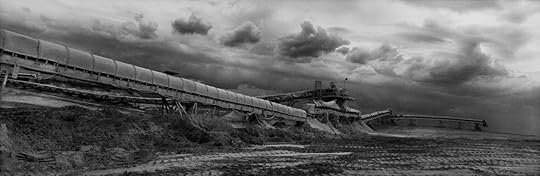
Conveyor belts at the Lhoist Sorcy limestone quarry, France (picture: Josef Koudelka, 1998)
Koudelka's vision of the Faustian energies manifested in these places is haunting. The absence of human figures, the sombre palette and the predominance of abstract patterns create a dystopian mood. Echoes of war, incarceration, slavery and torture are omnipresent. At times it feels as if pictures have been taken on Mars, or other extraterrestrial bodies ruthlessly pillaged by humans. These pictures look forward to a possibly imminent future in which humanity will have to fight tooth and nail for a precarious foothold on this planet.
Conveyor belts at the Lhoist Sorcy limestone quarry, France (picture: Josef Koudelka, 1998)
Displaying 1 - 1 of 1 review