

What do you think?

Llewellyn's Complete Book Series #12
Llewellyn's Complete Book of the Rider-Waite-Smith Tarot: A Journey Through the History, Meaning, and Use of the World's Most Famous Deck
Discover the Fascinating History and Divinatory Power of the 20th Century's Most Popular Tarot Deck
Originally published in 1909 to little fanfare, the Rider-Waite-Smith Tarot went on to become the bestselling tarot deck of all time. This complete guide shares the compelling story of the deck's creation, a complete analysis of what each card means, and 78 spreads to help you integrate each card's unique spiritual energy.
Discover how artist Pamela Colman Smith and occultist Arthur Waite combined their knowledge of astrology, Kabbalah, metaphysics, mythology, and theater to realize their profound vision. Llewellyn's Complete Book of the Rider-Waite-Smith Tarot delves deeply into the roots of these influential cards, exploring how Waite and Smith brought together an enchanting set of esoteric symbols and formed a magical deck that has guided, inspired, validated, and challenged the countless readers and seekers who have sought its wisdom.
Originally published in 1909 to little fanfare, the Rider-Waite-Smith Tarot went on to become the bestselling tarot deck of all time. This complete guide shares the compelling story of the deck's creation, a complete analysis of what each card means, and 78 spreads to help you integrate each card's unique spiritual energy.
Discover how artist Pamela Colman Smith and occultist Arthur Waite combined their knowledge of astrology, Kabbalah, metaphysics, mythology, and theater to realize their profound vision. Llewellyn's Complete Book of the Rider-Waite-Smith Tarot delves deeply into the roots of these influential cards, exploring how Waite and Smith brought together an enchanting set of esoteric symbols and formed a magical deck that has guided, inspired, validated, and challenged the countless readers and seekers who have sought its wisdom.
504 pages, Paperback
Published September 8, 2018
Ratings & Reviews
Friends & Following
Create a free account to discover what your friends think of this book!
Community Reviews
Displaying 1 - 10 of 10 reviews

April 6, 2020
I went back and forth on whether to give this book five stars or four, but ultimately I have to concede that there simply isn't a better single reference for tarot for beginning or intermediate readers, and even advanced students will likely find much to learn from here.
Unlike many authors, Sasha Graham takes the time to delve into the history of tarot's development through the western esoteric tradition, specifically the contributions of Éliphas Levi and the Golden Dawn, which I think is essential to understanding the cards. She also devotes a lot of space to the biographies of Arthur Waite and Pamela Smith, which provides important context and is interesting in any case. Nor does she stop with simple interpretations of the cards, but also lays out astrological and elemental correspondences, and a basic course on the qabalistic tree of life, which are crucial.
All of this is presented in straightforward, easy to digest language that would be appropriate for someone who had never heard of the tarot before, while not being so dumbed down that it would alienate the rest of us. In short, you could hardly do better when looking for your first book on this subject.
That being said, the book is not without its faults, and here they are:
1) The author hews a little too closely to Waite's interpretations for my liking. Granted, it's his deck, but he was notorious for deliberately obscuring and omitting useful information, as the author herself admits. His own "Pictorial Key to the Tarot" is fairly useless, with its fortune teller style readings crowding out the true esoteric meanings of the cards, so it's disappointing to see so much of that book reprinted uncritically here. Personally, I find Aleister Crowley's interpretations given in his "Book of Thoth" to be much more insightful and faithful to qabalistic principles, although that book would be pretty impenetrable for a beginner without a thorough knowledge of qabalah.
2) The text contains several small but annoying errors apt to throw a beginner into confusion. For example, Graham confuses the Pillar of Severity with the Pillar of Mercy on the tree of life, and omits The Wheel of Fortune and the Blasted Tower from her section on astrological correspondences. For those curious, The Wheel of Fortune corresponds to Jupiter and The Blasted Tower to Mars. She also omits The Hanged Man, but its correspondence is the element of water rather than a planet, so perhaps that is forgivable. I assume and hope that these errors are the result of carelessness and not a carrying on of Waite's tradition of deliberately misleading his readers.
3) A large section at the end of the book consists of 78 different tarot spreads, more or less arbitrarily designed by the author. I find no value in these. For example, the spread corresponding to the Ten of Pentacles card mimics the tree of life in its layout, but makes no effort to connect the divinatory readings of each card to the corresponding sephirah on the tree. This space would have been better spent with an in depth discussion of a tried and true spread like the Celtic Cross rather than a huge number of arbitrary spreads likely to confuse the beginner.
I wouldn't say these complaints are trivial, but they were not enough for me to knock off a star, simply because there is so much good information presented in such an accessible manner here. As long as you are aware of these defects going in, I would regard this as an essential addition to any tarot reader's library. And then after you've read it, go buy Crowley's Book of Thoth.
Unlike many authors, Sasha Graham takes the time to delve into the history of tarot's development through the western esoteric tradition, specifically the contributions of Éliphas Levi and the Golden Dawn, which I think is essential to understanding the cards. She also devotes a lot of space to the biographies of Arthur Waite and Pamela Smith, which provides important context and is interesting in any case. Nor does she stop with simple interpretations of the cards, but also lays out astrological and elemental correspondences, and a basic course on the qabalistic tree of life, which are crucial.
All of this is presented in straightforward, easy to digest language that would be appropriate for someone who had never heard of the tarot before, while not being so dumbed down that it would alienate the rest of us. In short, you could hardly do better when looking for your first book on this subject.
That being said, the book is not without its faults, and here they are:
1) The author hews a little too closely to Waite's interpretations for my liking. Granted, it's his deck, but he was notorious for deliberately obscuring and omitting useful information, as the author herself admits. His own "Pictorial Key to the Tarot" is fairly useless, with its fortune teller style readings crowding out the true esoteric meanings of the cards, so it's disappointing to see so much of that book reprinted uncritically here. Personally, I find Aleister Crowley's interpretations given in his "Book of Thoth" to be much more insightful and faithful to qabalistic principles, although that book would be pretty impenetrable for a beginner without a thorough knowledge of qabalah.
2) The text contains several small but annoying errors apt to throw a beginner into confusion. For example, Graham confuses the Pillar of Severity with the Pillar of Mercy on the tree of life, and omits The Wheel of Fortune and the Blasted Tower from her section on astrological correspondences. For those curious, The Wheel of Fortune corresponds to Jupiter and The Blasted Tower to Mars. She also omits The Hanged Man, but its correspondence is the element of water rather than a planet, so perhaps that is forgivable. I assume and hope that these errors are the result of carelessness and not a carrying on of Waite's tradition of deliberately misleading his readers.
3) A large section at the end of the book consists of 78 different tarot spreads, more or less arbitrarily designed by the author. I find no value in these. For example, the spread corresponding to the Ten of Pentacles card mimics the tree of life in its layout, but makes no effort to connect the divinatory readings of each card to the corresponding sephirah on the tree. This space would have been better spent with an in depth discussion of a tried and true spread like the Celtic Cross rather than a huge number of arbitrary spreads likely to confuse the beginner.
I wouldn't say these complaints are trivial, but they were not enough for me to knock off a star, simply because there is so much good information presented in such an accessible manner here. As long as you are aware of these defects going in, I would regard this as an essential addition to any tarot reader's library. And then after you've read it, go buy Crowley's Book of Thoth.

August 30, 2019
This is an odd book for several reasons. In reading it, I could not help but think that despite the author's intentions that this book would tend to make people more skeptical about the reasons why tarot decks in general and this tarot deck in particular have become popular despite being released more than a century ago without fanfare or much attention at all. The fact that the writer spends so much effort trying to untangle the various influences on the deck and the interpretation of the various cards as well as various possible spreads suggests that she takes tarot seriously enough to view it as a possible source of insight, but what she discusses about the deck of cards and the motivations and influences that went into the art design of the cards themselves would tend to make one less confident that the importance that is given to the way that tarot cards look in terms of how they are to be interpreted is remotely worth the effort the author (and others) spend on it. Admittedly, I come to the book as a biased and not particularly friendly reader, but for me this book and its account of the popular Rider-Waite-Smith deck only increases my disdain for tarot in general as well as the untrustworthiness of such mystical art in general.
This book is a large one at almost 500 pages, and it is divided into ten chapters based on various esoteric contexts that appear to come from the Hebrew kaballah (and may be distantly familiar in a different form to some readers of the Bible). The book begins with a foreword by one Stuart Kaplan that gushes over the author's work and the tarot deck in particular as well as a timeline and introduction of the material. After that comes a short discussion of the big picture of tarot (1) and ten a deeper look into the supposed wisdom that is sought from it (2). After that comes a chapter that encourages the reader to understand the history of the Golden Dawn and its influence on the tarot deck (3) as well as some information about the Kabbalistic tree of life on which the tarot stands (4). This leads to a discussion of astrology (5). Coming after this the author then devotes the vast majority of the book to a discussion of the major arcana (6), minor arcana (7), and court cards (8) of the tarot deck, including their imagery and the influences on that imagery, a discussion of the ways that they are interpreted normally and reversed in spreads, as well as various planetary and astrological meanings associated with them. After that the book ends with a brief discussion of how to read the cards (9) and 78 spreads (10), one for each of the cards, that the author has either created or adapted for the reader, after which the book ends with a symbol dictionary in an appendix as well as a glossary, thank you, image credits, bibliography, and index.
What one gets out of this book is an understanding of a few matters that tend to reflect badly on the tarot and the people who have made such decks. For one, the author of this particular deck was involved in a fractious group that was devoted to esoteric knowledge but which split apart because everyone was interested in seeking power and not enough people were interested enough in following moral and ethical principles of common (much less noble) decency. It is not as if the artist comes off any better, plagiarizing previous tarot decks as well as making a lot of theatrical drawings about actress Ellen Terry and generally showing the art of the tarot deck to have been immensely superficial and even idolatrous in nature. It is striking that the author's interest in biblical language and in the way that biblical terms are used in esoteric thinker only demonstrate the way that mankind seeks to acquire divine power for corrupt ends and to avoid the necessary path of repentance in order to reconcile with God and obtain eternal life as well as the divine power of the Spirit. If you want a book that shows how messed up tarot has been throughout its history and certainly today, this book is a good one, contrary to the author's intentions.
This book is a large one at almost 500 pages, and it is divided into ten chapters based on various esoteric contexts that appear to come from the Hebrew kaballah (and may be distantly familiar in a different form to some readers of the Bible). The book begins with a foreword by one Stuart Kaplan that gushes over the author's work and the tarot deck in particular as well as a timeline and introduction of the material. After that comes a short discussion of the big picture of tarot (1) and ten a deeper look into the supposed wisdom that is sought from it (2). After that comes a chapter that encourages the reader to understand the history of the Golden Dawn and its influence on the tarot deck (3) as well as some information about the Kabbalistic tree of life on which the tarot stands (4). This leads to a discussion of astrology (5). Coming after this the author then devotes the vast majority of the book to a discussion of the major arcana (6), minor arcana (7), and court cards (8) of the tarot deck, including their imagery and the influences on that imagery, a discussion of the ways that they are interpreted normally and reversed in spreads, as well as various planetary and astrological meanings associated with them. After that the book ends with a brief discussion of how to read the cards (9) and 78 spreads (10), one for each of the cards, that the author has either created or adapted for the reader, after which the book ends with a symbol dictionary in an appendix as well as a glossary, thank you, image credits, bibliography, and index.
What one gets out of this book is an understanding of a few matters that tend to reflect badly on the tarot and the people who have made such decks. For one, the author of this particular deck was involved in a fractious group that was devoted to esoteric knowledge but which split apart because everyone was interested in seeking power and not enough people were interested enough in following moral and ethical principles of common (much less noble) decency. It is not as if the artist comes off any better, plagiarizing previous tarot decks as well as making a lot of theatrical drawings about actress Ellen Terry and generally showing the art of the tarot deck to have been immensely superficial and even idolatrous in nature. It is striking that the author's interest in biblical language and in the way that biblical terms are used in esoteric thinker only demonstrate the way that mankind seeks to acquire divine power for corrupt ends and to avoid the necessary path of repentance in order to reconcile with God and obtain eternal life as well as the divine power of the Spirit. If you want a book that shows how messed up tarot has been throughout its history and certainly today, this book is a good one, contrary to the author's intentions.

December 10, 2022
As the title of Llewellyn's Complete Book of the Rider-Waite-Smith Tarot: A Journey Through the History, Meaning, and Use of the World's Most Famous Deck suggests, the RWS Tarot is indeed arguably the most famous tarot deck in popular usage. According to the history of the tarot—delivered briefly by author Sasha Graham—gaming usage generally precedes tarot decks' occult usage by several centuries, but with the RWS deck, tarot's association with the occult was ever solidified (even though Continental Europe still uses tarot decks for trick-taking games akin to bridge, which was the original purpose of the so-called Major Arcana). Along those lines, Llewellyn's Complete Book of the Rider-Waite-Smith Tarot is absolutely a more-or-less definitive guide to the deck in general and the supposed symbolism on the cards and their history in particular; what I just wish, though, is that the art and symbolism on the RWS deck wasn't so problematic in and of itself.
Graham's research and narrative is thorough, at the very least, as illustrated by her extensive and well-researched bibliography from a wide variety of sources, and Stuart R. Kaplan's introduction is a pretty good history of the adoption of the RWS deck. Also, while the book could've used full-color illustrations throughout, Llewellyn's Complete Book of the Rider-Waite-Smith Tarot faithfully reproduces the individual cards of the RWS deck in sufficient detail as to meaningfully compare co-creator Arthur Edward Waite's explications of the symbolism with Pamela Colman Smith's artwork thereupon. But the chief problem with this book, as with, I'd expect, any book on the RWS Tarot, is its pervasive cultural appropriation of Jewish symbolism.
The origins of the RWS deck, in Waite and Aleister Crowley and others' Hermetic Order of the Golden Dawn, irrespective of the deck's supposed universality, lie in the idea of Christian cabala, a willful perversion of Jewish symbolism in general and mysticism in particular, misappropriating that symbolism in an active effort to convert the Jewish community in Great Britain to Christianity. As suggested in many, many scholarly works (among them From Shylock to Svengali: Jewish Stereotypes in English Fiction), and illustrated ever so sharply for popular consumption by Will Eisner's Fagin the Jew, antisemitism in Great Britain in the 19th century was severely rampant, and in a society that literally invented the blood libel centuries before and that arguably perfected racial antisemitism before Gobineau and the Nazis got ahold of it. British Israelism, the idea that Christian British people were the actual Jews of the world, flourished most prominently during the late 19th and early 20th centuries, and gave rise to the United Kingdom's Palestine Mandate in what is now Israel—as well as the white supremacist Christian Identity movement, a philosophy that has literally led to multiple violent murders—and much of the Golden Dawn's beliefs and teachings were entirely of a part with British Israelism. With that in mind, the RWS Tarot regularly and frequently culturally appropriates Jewish symbolism: Whether multiple depictions of the four-letter Ineffable Name of The Almighty, usage of Hebrew letters and numbers, or depictions of imagery from the Hebrew Bible but interpreted in an explicitly Christian manner, the RWS Tarot deck over and over and over again shows Jewish imagery in a light that's wholly incorrect, if not actually misleading, over and over and over again.
Ultimately, it's not actually Graham's fault that the RWS deck—and her explication thereof in Llewellyn's Complete Book of the Rider-Waite-Smith Tarot—are deeply appropriative of Jewish culture, religion, and symbolism, and irritatingly and repeatedly so; Graham's narrative is actually enlightening, thorough, engaging, and (mostly) inclusive. But when Graham inadvertently repeats certain misstatements about Judaic practice and imagery, it's frustrating. Take this Major Arcana for example:
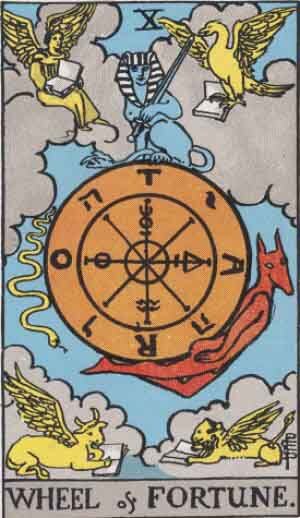
It's bad enough that the Wheel of Fortune card's Hebrew lettering represents YHWH, the aforementioned Ineffable Name. It's worse that Graham describes the Latin script as reading "TARO[T]", read clockwise, when in reading the Latin letters in the same direction as the Hebrew letters, they read "TORA[H]"—a word found, spelled "properly", on The High Priestess. And it adds insult to injury when Graham describes the four angelic figures around the Wheel of Fortune in Christian terms—rather than as representing the four angels of Ma`aseh haMerkaḅah in the Book of Ezekiel. And given that Graham makes these not-really-difficult-to-factcheck errors more than once, it simply adds to the Jewish reader's frustration, given just how well-researched the rest of the book is; at that point, I couldn't bring myself to finish the book once Graham got into specific patterns of reading the RWS Tarot, and even the Minor Arcana Court cards. (This is why Jewish women such as Rachel Pollack and Zo Jacobi {the latter using the art of Ephraim Moses Lilien} are actively attempting to reclaim the imagery in tarot in a Jewish context.)
And the sum total thereof makes Llewellyn's Complete Book of the Rider-Waite-Smith Tarot sufficiently frustrating that I couldn't bring myself to unreservedly enjoy reading the book. Yes, Graham and Kaplan's information is often, if not usually, excellent, but the aforementioned flaws detract depressingly from an otherwise valuable volume.
Graham's research and narrative is thorough, at the very least, as illustrated by her extensive and well-researched bibliography from a wide variety of sources, and Stuart R. Kaplan's introduction is a pretty good history of the adoption of the RWS deck. Also, while the book could've used full-color illustrations throughout, Llewellyn's Complete Book of the Rider-Waite-Smith Tarot faithfully reproduces the individual cards of the RWS deck in sufficient detail as to meaningfully compare co-creator Arthur Edward Waite's explications of the symbolism with Pamela Colman Smith's artwork thereupon. But the chief problem with this book, as with, I'd expect, any book on the RWS Tarot, is its pervasive cultural appropriation of Jewish symbolism.
The origins of the RWS deck, in Waite and Aleister Crowley and others' Hermetic Order of the Golden Dawn, irrespective of the deck's supposed universality, lie in the idea of Christian cabala, a willful perversion of Jewish symbolism in general and mysticism in particular, misappropriating that symbolism in an active effort to convert the Jewish community in Great Britain to Christianity. As suggested in many, many scholarly works (among them From Shylock to Svengali: Jewish Stereotypes in English Fiction), and illustrated ever so sharply for popular consumption by Will Eisner's Fagin the Jew, antisemitism in Great Britain in the 19th century was severely rampant, and in a society that literally invented the blood libel centuries before and that arguably perfected racial antisemitism before Gobineau and the Nazis got ahold of it. British Israelism, the idea that Christian British people were the actual Jews of the world, flourished most prominently during the late 19th and early 20th centuries, and gave rise to the United Kingdom's Palestine Mandate in what is now Israel—as well as the white supremacist Christian Identity movement, a philosophy that has literally led to multiple violent murders—and much of the Golden Dawn's beliefs and teachings were entirely of a part with British Israelism. With that in mind, the RWS Tarot regularly and frequently culturally appropriates Jewish symbolism: Whether multiple depictions of the four-letter Ineffable Name of The Almighty, usage of Hebrew letters and numbers, or depictions of imagery from the Hebrew Bible but interpreted in an explicitly Christian manner, the RWS Tarot deck over and over and over again shows Jewish imagery in a light that's wholly incorrect, if not actually misleading, over and over and over again.
Ultimately, it's not actually Graham's fault that the RWS deck—and her explication thereof in Llewellyn's Complete Book of the Rider-Waite-Smith Tarot—are deeply appropriative of Jewish culture, religion, and symbolism, and irritatingly and repeatedly so; Graham's narrative is actually enlightening, thorough, engaging, and (mostly) inclusive. But when Graham inadvertently repeats certain misstatements about Judaic practice and imagery, it's frustrating. Take this Major Arcana for example:
It's bad enough that the Wheel of Fortune card's Hebrew lettering represents YHWH, the aforementioned Ineffable Name. It's worse that Graham describes the Latin script as reading "TARO[T]", read clockwise, when in reading the Latin letters in the same direction as the Hebrew letters, they read "TORA[H]"—a word found, spelled "properly", on The High Priestess. And it adds insult to injury when Graham describes the four angelic figures around the Wheel of Fortune in Christian terms—rather than as representing the four angels of Ma`aseh haMerkaḅah in the Book of Ezekiel. And given that Graham makes these not-really-difficult-to-factcheck errors more than once, it simply adds to the Jewish reader's frustration, given just how well-researched the rest of the book is; at that point, I couldn't bring myself to finish the book once Graham got into specific patterns of reading the RWS Tarot, and even the Minor Arcana Court cards. (This is why Jewish women such as Rachel Pollack and Zo Jacobi {the latter using the art of Ephraim Moses Lilien} are actively attempting to reclaim the imagery in tarot in a Jewish context.)
And the sum total thereof makes Llewellyn's Complete Book of the Rider-Waite-Smith Tarot sufficiently frustrating that I couldn't bring myself to unreservedly enjoy reading the book. Yes, Graham and Kaplan's information is often, if not usually, excellent, but the aforementioned flaws detract depressingly from an otherwise valuable volume.

May 9, 2021
Antier termine de leer este libro y debo decir que me encantó ⭐️⭐️⭐️⭐️⭐️
El libro es como su titulo lo describe, abarca marco histórico, habla sobre la vida de la ilustradora y la mente maestra detrás de cada carta.
También hace una detallada y exhaustiva explicación de las 78 cartas con su respectiva tirada para consolidar mejor la comprensión de las mismas.
Amé los ejercicios que proponen para el estudio del tarot cada día y su glosario de símbolos escondidos o muy obvios en cada carta.
Con respecto al inglés, está muy fácil, fueron contadas las palabras que tuve que buscar traducción. El libro es de más de 600 páginas, muy bien invertidas por cierto ✨
El libro es como su titulo lo describe, abarca marco histórico, habla sobre la vida de la ilustradora y la mente maestra detrás de cada carta.
También hace una detallada y exhaustiva explicación de las 78 cartas con su respectiva tirada para consolidar mejor la comprensión de las mismas.
Amé los ejercicios que proponen para el estudio del tarot cada día y su glosario de símbolos escondidos o muy obvios en cada carta.
Con respecto al inglés, está muy fácil, fueron contadas las palabras que tuve que buscar traducción. El libro es de más de 600 páginas, muy bien invertidas por cierto ✨
September 15, 2026
This is a big, generous book for someone who wants to live with the Rider-Waite-Smith deck for a while instead of just learning what the cards “mean.” Sasha Graham covers its history, Waite and Pamela Colman Smith’s collaboration, the symbolic machinery behind the images, practical reading approaches, and then gives the individual cards the kind of space they deserve. I particularly enjoyed the attention paid to Smith, who too often gets treated as the illustrator who simply carried out somebody else’s grand occult vision. The book is full of enthusiasm, and Graham makes the RWS feel approachable without flattening it into a list of keywords. It is also physically substantial enough to work as a reference, which is nice when so many “complete” tarot books turn out to be mostly filler. My caveat is that the word complete is doing some heavy lifting. Five hundred pages can create the impression that every historical question is settled, and a few sections move quickly through complicated occult and publishing history where I wanted more sourcing, nuance, or an acknowledgement of scholarly disagreement. The practical sections can feel a little overstuffed too, as if the book wants to be a history, course, spellbook, journal, and card dictionary all at once. But the heart of it is excellent. Graham clearly loves this deck, and she gives readers many ways to love it more intelligently.

August 12, 2023
Definitely complete, at least as far as the Golden Dawn (which RWS were members, duh) shows. It's a lot easier to read than Rachel Pollack. Good for beginners and those who want to have a one-stop-shop for Golden Dawn and Tarot info.

January 14, 2022
Interesting and easy read if very long and seemingly repetative in places but not a bad book to start out with if interested in using the RWS Taro deck.

October 18, 2024
Very thorough and informative.

June 20, 2025
A lot of good information, especially regarding the history and symbolism of each card. I found the 78 spreads less useful.

September 16, 2026
This book is fantastic and really insightful. I loved learning about Arthur Waite and Pamela Colman Smith and this book has given me a new appreciation of her art and the RWS deck.
Displaying 1 - 10 of 10 reviews