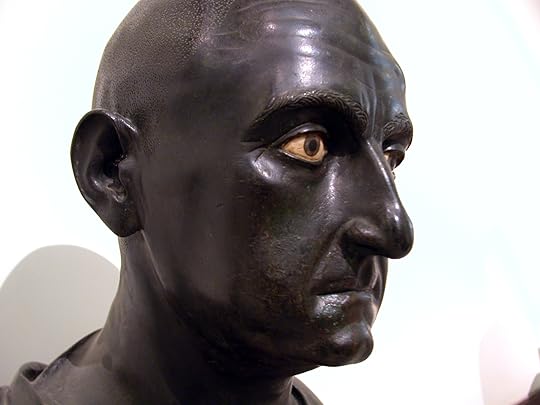
Livy (Titus Livius), the great Roman historian, was born at or near Patavium (Padua) in 64 or 59 BCE; he may have lived mostly in Rome but died at Patavium, in 12 or 17 CE.
Livy's only extant work is part of his history of Rome from the foundation of the city to 9 BCE. Of its 142 books, we have just 35, and short summaries of all the rest except two. The whole work was, long after his death, divided into Decades or series of ten. Books 1-10 we have entire; books 11-20 are lost; books 21-45 are entire, except parts of 41 and 43-45. Of the rest only fragments and the summaries remain. In splendid style Livy, a man of wide sympathies and proud of Rome's past, presented an uncritical but clear and living narrative of the rise of Rome to greatness.
The Loeb Classical Library edition of Livy is in fourteen volumes. The last volume includes a comprehensive index.
Titus Livius (Patavinus) (64 or 59 BC – AD 17)—known as Livy in English, and Tite-Live in French—was a Roman historian who wrote a monumental history of Rome and the Roman people – Ab Urbe Condita Libri (Books from the Foundation of the City) – covering the period from the earliest legends of Rome before the traditional foundation in 753 BC through the reign of Augustus in Livy's own time. He was on familiar terms with the Julio-Claudian dynasty, advising Augustus's grandnephew, the future emperor Claudius, as a young man not long before 14 AD in a letter to take up the writing of history. Livy and Augustus's wife, Livia, were from the same clan in different locations, although not related by blood.
"Many things which, owing to distance, are not now evident the war will reveal. It is part of a man and a general not to prove wanting when fortune presents herself, and to fit what is offered by chance into his plans." - Livy, Book XXVIII, xliv
Books 28-30 of Livy's History of Rome details the 2nd Punic War, specifically in Spain and Africa.
Book 28 sees Scipio's lieutenant, Silanus, successful against the Carthaginians in Spain in the 14th year of the war. Scipio ventures into Africa to form a treaty with Syphax, King of the Massylians. During the siege of Gisia, the citizens end up killing their own wives and children (and gold) and then threw themselves on the pyre. Scipio gets sick, some of his army mutinies, and he quells it. Scipio also makes friends with Masinissa, King of the Numidians. Scipio returns to Rome and is elected Consul. He is given Africa (despite Quintus Fabius Maximus' opposition). Mago, son of Hamilcar, crosses to Italy.
Book 29 sees Gaius Laelius sent on a raiding party by Scipio into Africa and he returns with an immense booty. Scipio crosses from Syracuse into the Bruttian territory (tip of the Roman toe) and puts Hannibal to flight. The Locrians send envoys to Rome to complain about Pleminius carrying away money from the temple of Prosperpina (as well as outraging their wives and children). Scipio is also accused in the Senate. Scipio is cleared, and with the permission of the Senate, crosses into Africa. Syphax, meanwhile, has married the daughter of Hasdrubal, making the previous treaty with Scipio a bit precarious. Masinissa, however, joins Scipio in Africa, and early in the campaign slays Hanno, son of Mamilcar. Scipio faces off with Hasdrubal and Syphax, and is forced to raise the siege of Utica.
Book 30, Scipio defeats the Carthaginians (Syphax and Hasdrubal) in a number of battles with the help of Masinissa. He assaults two Carthaginian camps and wipes them out with fire. He captures Syphax, Masinissa marries Syphax's wife to protect her from Rome. Scipio has to deal with the difficulties that arise from one of his allies marrying one of his enemies wives. Hannibal is asked to return to Carthage to defend his home. He tries to negotiate from a place of strength, but after negotiations falter, Hannibal is defeated in battle by Scipio. Scipio eventually negotiates a peace with the Carthaginians, despite their Senate's slipperiness. Mago dies. Masinissa regains his kingdom (and loses his new wife). Scipio returns triumphantly to Rome and is given the name Africanus.
***
Having grown up with an older brother who idolized Hannibal, it is hard to see his star fade as it is replaced by Scipio. But after harassing Rome on their own land for 17+ years, there is a solid reason Hannibal belongs in the history books. He was brilliant, bold, and seemed to always see the coin of battle flip in his favor...until the coin stopped spinning his way. It seemed Hannibal was defeated as much by his own people and a couple key mistakes (stemming from pride) as he was by just fate. Hannibal eventually lost in Africa, but I'm sure one could make an argument that he was almost never out generaled. That said, he WAS eventually defeated by Rome's great general Scipio. Young, bold, and brash, Scipio had both the skill and the luck needed to eventually defeat Hannibal and humble Carthage.
A narrative masterpiece. It’s worth reading the entire pentad together: this and the previous volume back to back. Slow at first, like water building behind a dam, and then the dam breaking. That rush of water is Scipio. There’s just too much terrific stuff to mention it all. Stand-out bits are when Scipio and his mortal enemy Hasdrubal arrive in King Syphax’s harbour at the same time but can’t fight because it would be rude, and end up having dinner together. And later when young Scipio and old Hannibal meet to parley and symbolically it’s not just two men but two civilisations. The young barbarians and the ancient civilisation, mortally wounded and asking for mercy.
This review is the same for each of his volumes: Livy is the quintessential historian of ancient Rome. He had his obvious flaws - no one could consider him unbiased in his approach, and he creates dialogue between historical figures that encourage the virtues of the citizens. Still, he is very entertaining. Each of his extant works - most of his books have been lost - presents a far nobler Rome than we have come to expect. Reading Livy is a luxury few are privileged to partake of. Fantastic.