Jump to ratings and reviews
Rate this book

Крещеный китаец

Rate this book
Роман «Крещеный китаец» был задуман как продолжение автобиографической повести А. Белого «Котик Летаев». Роман, первоначально озаглавленный, как «Преступление Николая Летаева» последовал спустя четыре года после «Котика»

168 pages, Kindle Edition

First published January 1, 1927

34 people want to read

About the author

Andrei Bely

161 books155 followers
Boris Bugaev was born in Moscow, into a prominent intellectual family. His father, Nikolai Bugaev, was a leading mathematician who is regarded as a founder of the Moscow school of mathematics. His mother was not only highly intelligent but a famous society beauty, and the focus of considerable gossip. Young Boris was a polymath whose interests included mathematics, music, philosophy, and literature. He would go on to take part in both the Symbolist movement and the Russian school of neo-Kantianism.

Nikolai Bugaev was well known for his influential philosophical essays, in which he decried geometry and probability and trumpeted the virtues of hard analysis. Despite—or because of—his father's mathematical tastes, Boris Bugaev was fascinated by probability and particularly by entropy, a notion to which he frequently refers in works such as Kotik Letaev.

Bely's creative works notably influenced—and were influenced by—several literary schools, especially symbolism. They feature a striking mysticism and a sort of moody musicality. The far-reaching influence of his literary voice on Russian writers (and even musicians) has frequently been compared to the impact of James Joyce in the English-speaking world. The novelty of his sonic effects has also been compared to the innovative music of Charles Ives.[citation needed]

As a young man, Bely was strongly influenced by his acquaintance with the family of philosopher Vladimir Solovyov, especially Vladimir's younger brother Mikhail, described in his long autobiographical poem The First Encounter (1921); the title is a reflection of Vladimir Solovyov's Three Encounters.

Bely's symbolist novel Petersburg (1916; 1922) is generally considered to be his masterpiece. The book employs a striking prose method in which sounds often evoke colors. The novel is set in the somewhat hysterical atmosphere of turn-of-the-century Petersburg and the Russian Revolution of 1905. To the extent that the book can be said to possess a plot, this can be summarized as the story of the hapless Nikolai Apollonovich, a ne'er-do-well who is caught up in revolutionary politics and assigned the task of assassinating a certain government official—his own father. At one point, Nikolai is pursued through the Petersburg mists by the ringing hooves of the famous bronze statue of Peter the Great.[citation needed]

In his later years Bely was influenced by Rudolf Steiner’s anthroposophy[3][4] and became a personal friend of Steiner's. He died, aged 53, in Moscow.

Bely was one of the major influences on the theater of Vsevolod Meyerhold.[citation needed]

The Andrei Bely Prize (Russian: Премия Андрея Белого), one of the most important prizes in Russian literature, was named after him. His poems were set on music and frequently performed by Russian singer-songwriters.

Ratings & Reviews

What do you think?
Rate this book

Friends & Following

Create a free account to discover what your friends think of this book!

Community Reviews

5 stars
4 (40%)
4 stars
2 (20%)
3 stars
3 (30%)
2 stars
0 (0%)
1 star
1 (10%)
Displaying 1 - 3 of 3 reviews
Profile Image for Vit Babenco.
1,787 reviews5,800 followers
October 7, 2024
To those who knew Andrey Bely he always seemed to be a rare bird…
“Andrey Bely’s room is next to them. He pulled out a drawer of the night-table and cannot put it back: the knob is preventing it – he holds it length-way, not across its width. He struggles with it for a long time, but cannot put the drawer back. Putting it on the floor, he looks at it, then makes some strange movements over it, whispers something as though exorcizing it. Then he again grasps it, but this time the right way, and the drawer goes in easily as it should. Bely’s face radiates happiness.” Nina BerberovaThe Italics Are Mine.
Strange people write strange books… The Christened Chinaman is an almost impassable thicket of odd words and a metaphorical conundrum.
Sunset!
In the distance the horizons were pillared by a strengthening smoke; everywhere pillars hang motionlessly; hardly overhanging, barely moving, not falling a drop; and the heavens are no longer the heavens; what can be yellower? Simply some sort of canarium? –
and Papochka is – illumined by the heavens, enlightened by the spirit! – In the completely turquoise heavens singing luminaries come clearly to life out of the cloud – with a cry: in a cherry one; they go out: and it became stem, and became lilac: exactly like a symphony, where humor taking to its wings, flowing together with tears into a crystal little lake, raises up resounding songs of seethrough icebergs and crystals: you know not what it is: crystallography, music?

On the genre side The Christened Chinaman is a fizzy brew of surrealism and expressionism. And the family life in Andrey Bely’s depiction more resembles the living in some exotic vivarium. And the Christened Chinaman is Papochka – the narrator’s learned daddy…
Confucian wisdom filled him; his favorite phrases are:
“Everything is – a measure of harmony!”
“Where there is harmony, you know, there is measure!”
“In the middle ground and, yes, in constancy – the real man appears”…
“We go to the world, in order, having become the world, to stand above the world, – in the world, in relationship to which the world is – only an atom, moving from world to world; the world of worlds, this is – we: the root of us is a numeral, and a numeral is a harmony of measure.”
“Thus everything is a harmony of measure.”

And the narrator is a strangely imaginative child full of convoluted fancies and flowery fantasies…
And I am deep in thought about all of this world – both vicious and pernicious! I listen, how headlessly, armlessly, dumb shadows pass into blackening niches; there is – an assembly of shadows; there is a multitudinous-multitude of them; the comer compresses them gloomily; in the comer rustling little spheres begin to roll: mice; and quicklegged thoughts from my head run about the rooms; and seethrough handlegs of shadows hung headlessly; a handleg began to run along the parquets-onto the walls; from the walls – to the ceiling; –
– from the shadows a blackhorned-legless suddenly rises, it falls with its multimanus, encircles with its arms, grabs around and will suck everything there is out of me, pouring it into itself; and I will be swept about as an all-together weightless shadow inside of its existence; and – it will dance away with me to the enormous distances, beyond the windows…

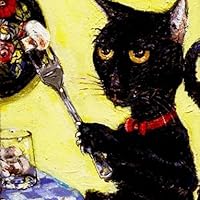
Strange saplings grow up into strange trees.
8 reviews
April 22, 2025
Книга попала мне в руки случайно, это первое для меня произведение Белого, и с прозой его современников Брюсова и Ремизова я тоже пока не знаком. В общем, пусть это отзыв дилетанта, но "Крещёный китаец" мне понравился. Это продолжительная автобиографическая зарисовка, главные герои которой - Котик и математик. Самое в ней захватывающее - это убедительное погружение в непрерывную, красочную галлюцинацию, которую представляет собой мир глазами пятилетнего ребёнка. Этот маленький мир - комнаты родительской квартиры, свет в окнах, звуки внутри и снаружи, мебель, семья, прислуга, прогулки по Арбату, приходящая в гости к папе профессура - пульсирует в едва складывающемся сознании рассказчика, как пластилиновый мультфильм, хотя в 1880-х не было ещё ни мультфильмов, ни пластилина. Явления и предметы еще не застыли в привычных формах и названиях и переливаются друг в друга, рифмуясь, отбивая ритм, лаская невинные слух и зрение. Целыми страницами Белому удаётся скользить по волне этой детской восприимчивости, и когда её сменяют приёмы взрослые - метафора, например, или ирония, сменяют на ходу, исподволь, тогда только с удивлением вспоминаешь, что это текст сорокалетнего автора. Весьма, весьма впечатляет этот эффект отождествления детского, серьёзного выговаривания и изобретения новых, свежих слов с футуристической игрой в те же слова взрослого поэта, хотя местами бывает, что теряешься в бурной череде образов. Но как-то верно, естественно, не увлекаясь представлением жертвы, но и не закрывая глаза на ранящие, тяжелые события детства, указывает Белый на истоки обыденного, всем нам свойственного психоза.
Profile Image for Glinsky.
59 reviews
August 31, 2020
... bursting like a deaf rhinoceros into unfaceted music:- ...

A spreadpawed armchair slants like a walnut tree; the lacquer smiles at me; I go up to it and nibble at it with my little teeth; no-it is not tasty!-

-Tenderly he stared beyond the window: at the Persian colors of peacock sunsets:-

and it seemed to me, that Auntie-livens up, Granny is-pale white, Mama is-totally an aromatic; we all were pineappled with the spirit;
Displaying 1 - 3 of 3 reviews

Can't find what you're looking for?

Get help and learn more about the design.