

What do you think?
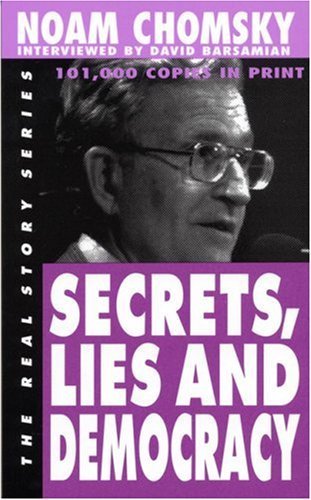
Secrets, Lies and Democracy
This fascinating book describes how the Nazis won WWII, the coming eco-catastrophe, and much more. It has averaged 1700 copies a month for years, and sales are actually increasing.
Noah Chomsky has been hailed by the New York Times as "arguably the most important intellectual alive". In this third volume in a series of illuminating interviews, Chomsky discusses why the U.S. is more violent than other countries, how our claim to be a democracy is defective, and what "democracy" actually describes in the real world.
Noah Chomsky has been hailed by the New York Times as "arguably the most important intellectual alive". In this third volume in a series of illuminating interviews, Chomsky discusses why the U.S. is more violent than other countries, how our claim to be a democracy is defective, and what "democracy" actually describes in the real world.
128 pages, Paperback
First published January 1, 1994
About the author
Noam Chomsky
1,012 books17.5k followersAvram Noam Chomsky is an American professor and public intellectual known for his work in linguistics, political activism, and social criticism. Sometimes called "the father of modern linguistics", Chomsky is also a major figure in analytic philosophy and one of the founders of the field of cognitive science. He is a laureate professor of linguistics at the University of Arizona and an institute professor emeritus at the Massachusetts Institute of Technology (MIT). Among the most cited living authors, Chomsky has written more than 150 books on topics such as linguistics, war, and politics. In addition to his work in linguistics, since the 1960s Chomsky has been an influential voice on the American left as a consistent critic of U.S. foreign policy, contemporary capitalism, and corporate influence on political institutions and the media.
Born to Ashkenazi Jewish immigrants (his father was William Chomsky) in Philadelphia, Chomsky developed an early interest in anarchism from alternative bookstores in New York City. He studied at the University of Pennsylvania. During his postgraduate work in the Harvard Society of Fellows, Chomsky developed the theory of transformational grammar for which he earned his doctorate in 1955. That year he began teaching at MIT, and in 1957 emerged as a significant figure in linguistics with his landmark work Syntactic Structures, which played a major role in remodeling the study of language. From 1958 to 1959 Chomsky was a National Science Foundation fellow at the Institute for Advanced Study. He created or co-created the universal grammar theory, the generative grammar theory, the Chomsky hierarchy, and the minimalist program. Chomsky also played a pivotal role in the decline of linguistic behaviorism, and was particularly critical of the work of B.F. Skinner.
An outspoken opponent of U.S. involvement in the Vietnam War, which he saw as an act of American imperialism, in 1967 Chomsky rose to national attention for his anti-war essay "The Responsibility of Intellectuals". Becoming associated with the New Left, he was arrested multiple times for his activism and placed on President Richard M. Nixon's list of political opponents. While expanding his work in linguistics over subsequent decades, he also became involved in the linguistics wars. In collaboration with Edward S. Herman, Chomsky later articulated the propaganda model of media criticism in Manufacturing Consent, and worked to expose the Indonesian occupation of East Timor. His defense of unconditional freedom of speech, including that of Holocaust denial, generated significant controversy in the Faurisson affair of the 1980s. Chomsky's commentary on the Cambodian genocide and the Bosnian genocide also generated controversy. Since retiring from active teaching at MIT, he has continued his vocal political activism, including opposing the 2003 invasion of Iraq and supporting the Occupy movement. An anti-Zionist, Chomsky considers Israel's treatment of Palestinians to be worse than South African–style apartheid, and criticizes U.S. support for Israel.
Chomsky is widely recognized as having helped to spark the cognitive revolution in the human sciences, contributing to the development of a new cognitivistic framework for the study of language and the mind. Chomsky remains a leading critic of U.S. foreign policy, contemporary capitalism, U.S. involvement and Israel's role in the Israeli–Palestinian conflict, and mass media. Chomsky and his ideas are highly influential in the anti-capitalist and anti-imperialist movements. Since 2017, he has been Agnese Helms Haury Chair in the Agnese Nelms Haury Program in Environment and Social Justice at the University of Arizona.
Born to Ashkenazi Jewish immigrants (his father was William Chomsky) in Philadelphia, Chomsky developed an early interest in anarchism from alternative bookstores in New York City. He studied at the University of Pennsylvania. During his postgraduate work in the Harvard Society of Fellows, Chomsky developed the theory of transformational grammar for which he earned his doctorate in 1955. That year he began teaching at MIT, and in 1957 emerged as a significant figure in linguistics with his landmark work Syntactic Structures, which played a major role in remodeling the study of language. From 1958 to 1959 Chomsky was a National Science Foundation fellow at the Institute for Advanced Study. He created or co-created the universal grammar theory, the generative grammar theory, the Chomsky hierarchy, and the minimalist program. Chomsky also played a pivotal role in the decline of linguistic behaviorism, and was particularly critical of the work of B.F. Skinner.
An outspoken opponent of U.S. involvement in the Vietnam War, which he saw as an act of American imperialism, in 1967 Chomsky rose to national attention for his anti-war essay "The Responsibility of Intellectuals". Becoming associated with the New Left, he was arrested multiple times for his activism and placed on President Richard M. Nixon's list of political opponents. While expanding his work in linguistics over subsequent decades, he also became involved in the linguistics wars. In collaboration with Edward S. Herman, Chomsky later articulated the propaganda model of media criticism in Manufacturing Consent, and worked to expose the Indonesian occupation of East Timor. His defense of unconditional freedom of speech, including that of Holocaust denial, generated significant controversy in the Faurisson affair of the 1980s. Chomsky's commentary on the Cambodian genocide and the Bosnian genocide also generated controversy. Since retiring from active teaching at MIT, he has continued his vocal political activism, including opposing the 2003 invasion of Iraq and supporting the Occupy movement. An anti-Zionist, Chomsky considers Israel's treatment of Palestinians to be worse than South African–style apartheid, and criticizes U.S. support for Israel.
Chomsky is widely recognized as having helped to spark the cognitive revolution in the human sciences, contributing to the development of a new cognitivistic framework for the study of language and the mind. Chomsky remains a leading critic of U.S. foreign policy, contemporary capitalism, U.S. involvement and Israel's role in the Israeli–Palestinian conflict, and mass media. Chomsky and his ideas are highly influential in the anti-capitalist and anti-imperialist movements. Since 2017, he has been Agnese Helms Haury Chair in the Agnese Nelms Haury Program in Environment and Social Justice at the University of Arizona.
Ratings & Reviews
Friends & Following
Create a free account to discover what your friends think of this book!
Community Reviews
Displaying 1 - 30 of 53 reviews
March 31, 2010
I find Noam Chomsky is easier to understand in interviews. He clears away the fog manufactured by governments and corporations to hide their real motives. There is a hint of anger toward these villains but a belief that ordinary citizens can direct their own lives and live in harmony through organizing and activism.

March 8, 2019
For those too intimidated by Chomsky's writing, this is a great starting point that won't overwhelm you.
The short read is a series of interviews conducted with Chomsky on topics such as Haiti, corporations, democracy, the environment, and much more. There aren't a couple thousand footnotes, like much of his written work has, and it has an edge of hope to it (though I suppose some would still find it too depressing).
Even if you are well-versed in Chomsky, this is still worth reading, as it shows how he can take a vast problem and break it down simply. The problem with that, of course, is you miss a lot of the nuances which are essential to many of his theories.
The short read is a series of interviews conducted with Chomsky on topics such as Haiti, corporations, democracy, the environment, and much more. There aren't a couple thousand footnotes, like much of his written work has, and it has an edge of hope to it (though I suppose some would still find it too depressing).
Even if you are well-versed in Chomsky, this is still worth reading, as it shows how he can take a vast problem and break it down simply. The problem with that, of course, is you miss a lot of the nuances which are essential to many of his theories.

April 8, 2017
Excellent breakdown of Chomsky's core philosophy and societal/philosophical diagnoses. Even with some dated references to Clinton-era foreign affairs, there's a lot here that's still as pertinent as when it was first published. This being said, I'd start with the slightly superior "The Common Good" before jumping here.
Favorite quote: "...the burden of proof is always on the authority...any authoritarian role requires justification. It's never self-justifying."
Favorite quote: "...the burden of proof is always on the authority...any authoritarian role requires justification. It's never self-justifying."

December 14, 2018
Regarding the longstanding “conservative” attack on “big” government Noam says: “The government is the only power structure that’s even partially accountable to the population, so naturally the business sectors want to make that the enemy. – not the corporate system which is totally unaccountable.” We are carefully indoctrinated to think the government is the enemy. “If you abandon the political arena, somebody is going to be there. Corporations aren’t going to go home and join the PTA.” Noam is amused how Right cherishes their guns, not in a backward third world country where they might one day be somewhat effective, but here in the U.S. where the government has tanks, satellites that can see a lit cigarette under a tree from space, and atomic weapons. Noam sees the CIA’s purpose as, “to carry out secret and usually illegal activities for the executive branch, which wants to keep these activities secret because it knows the public won’t accept them.” Noam says the CIA rarely does things on its own, and little of the CIA’s role is “intelligence-gathering”. Those who control the reins of power, “don’t want decision-makers and participants; they want a passive, obedient population of consumers and political spectators – a community of people who are so atomized and isolated that they can’t put together their limited resources and become an independent powerful force that will chip away at concentrated power.”
I always wondered why spectator sports in the U.S. (watching team sports you no longer play) are so huge and conjure up so much pride of one’s town while showing anger and ridicule towards other towns with teams. Noam says, “Mass hysteria about spectator sports plays a significant role. First of all, spectator sports make people more passive, because you are not doing them – making people passive, atomized, obedient nonparticipants – non-questioning, easily controlled and easily disciplined. – Secondly, they engender jingoistic and chauvinist attitudes, sometimes to an extreme degree. These kids (high school teams) can’t even do civil things like greeting one another because they are ready to kill each other. They (spectator sports) are designed to organize a community to be hysterically committed to their gladiators. That’s very dangerous. You have succeeded in directing people away from what really matters and is important.”
“This is a very fundamentalist society. It’s like Iran in its degree of fanatic religious commitment. For example, I think about 75% of the U.S. Population has literal belief in the devil. There was a poll several years ago on evolution. The number of people who believed in Darwinian evolution was less than 10%.” The real objection of the U.S. government has been against “economic nationalism” in all its forms, not communism. Many governments thought they could address inequality among their people, or increase production for “domestic needs”, but that is precisely what the U.S. has historically never tolerated. So, now you get places like Haiti, “a starving island, (which) is exporting food to the U.S.” And squeezing its poor by the balls gets us baseballs, made for 10 cents per hour by workers if they meet their quota, otherwise they get 5 cents per hour. The generosity of U.S. capitalism knows no bounds. U.S. patriotism has become the sociopathic joy of hearing other countries scream. Don’t forget Haitian baseballs are better because women without other employment opportunities dip them in a toxic brew that hurts those who do the dipping. In Haiti, the business community is morally torn: do you hack people up and leave them in ditches to get rid of them, or do you make them work for pennies? The “moderates” want them working for pennies. That’s Haiti, where asylum seekers who flee to the US are returned Haiti, often to be hacked to pieces. Terror throughout Latin America is done to “domesticate people’s aspirations, make them think there is no alternative, to drive out any hope. Once you’ve done that you can have elections without too much fear.” In Southern Italy, to get the election results we wanted, the U.S. “simply reinstated the fascist order.” Northern Italy had already liberated themselves (how dare they?) so we went in and immediately “restored the old (fascist) order.” In Chile, there were two responses to Allende’s starting taking care of the poor in Chile. The U.S. moderate’s plan (Ambassador Edward Korrey) was “to do all within our power to condemn Chile and the Chileans to utmost deprivation and poverty.” The hardline plan, of course, was a wildly illegal coup. Thoughtfully, the U.S. always gives other countries a choice; you can happily submit to all our requests or you can watch us destroy your country’s future while lying about our intentions. Vietnam redux anyone?
Don’t you just love all those black POW/MIA flags which adorn the houses of the uneducated, and the backs of Harley Davidson’s, all for no factual reason (see Mythmaking in America, by H. Bruce Franklin)? Would it surprise you to know that none of those flag wavers understand “the United States’ own record with POWs has been atrocious – not only in Vietnam, where it was monstrous but in Korea, where it was even worse. And after WW II, we kept POW’s illegally under confinement, as did the British.” The fun part of hypocrisy is if you purposefully stay uneducated, you can pretend you are not a hypocrite as you rail against things others, do while your own country is far more culpable. There are many books out since Noam wrote this one, on the brutal treatment of Germans by the Allies Post-War, (the 2007 book Crimes and Mercies, by Noam-cited James Barque states more than 9 million Germans died by deliberate Allied starvation - “the largest act of ethnic cleansing the world has ever known”) but here Noam writes: “I forgot for how long but I think the US kept German POW’s until 1946. They were used for forced labor, beaten and killed. It was even worse in England. They kept their German POWs until mid-1948. It was all totally illegal.” Noam adds we know most about German POWs because German are meticulous as document keepers, whereas Italians, not so much, explaining the dearth of information about Italian POWs who he suspects were treated much worse. Another amazing book by Noam Chomsky.
I always wondered why spectator sports in the U.S. (watching team sports you no longer play) are so huge and conjure up so much pride of one’s town while showing anger and ridicule towards other towns with teams. Noam says, “Mass hysteria about spectator sports plays a significant role. First of all, spectator sports make people more passive, because you are not doing them – making people passive, atomized, obedient nonparticipants – non-questioning, easily controlled and easily disciplined. – Secondly, they engender jingoistic and chauvinist attitudes, sometimes to an extreme degree. These kids (high school teams) can’t even do civil things like greeting one another because they are ready to kill each other. They (spectator sports) are designed to organize a community to be hysterically committed to their gladiators. That’s very dangerous. You have succeeded in directing people away from what really matters and is important.”
“This is a very fundamentalist society. It’s like Iran in its degree of fanatic religious commitment. For example, I think about 75% of the U.S. Population has literal belief in the devil. There was a poll several years ago on evolution. The number of people who believed in Darwinian evolution was less than 10%.” The real objection of the U.S. government has been against “economic nationalism” in all its forms, not communism. Many governments thought they could address inequality among their people, or increase production for “domestic needs”, but that is precisely what the U.S. has historically never tolerated. So, now you get places like Haiti, “a starving island, (which) is exporting food to the U.S.” And squeezing its poor by the balls gets us baseballs, made for 10 cents per hour by workers if they meet their quota, otherwise they get 5 cents per hour. The generosity of U.S. capitalism knows no bounds. U.S. patriotism has become the sociopathic joy of hearing other countries scream. Don’t forget Haitian baseballs are better because women without other employment opportunities dip them in a toxic brew that hurts those who do the dipping. In Haiti, the business community is morally torn: do you hack people up and leave them in ditches to get rid of them, or do you make them work for pennies? The “moderates” want them working for pennies. That’s Haiti, where asylum seekers who flee to the US are returned Haiti, often to be hacked to pieces. Terror throughout Latin America is done to “domesticate people’s aspirations, make them think there is no alternative, to drive out any hope. Once you’ve done that you can have elections without too much fear.” In Southern Italy, to get the election results we wanted, the U.S. “simply reinstated the fascist order.” Northern Italy had already liberated themselves (how dare they?) so we went in and immediately “restored the old (fascist) order.” In Chile, there were two responses to Allende’s starting taking care of the poor in Chile. The U.S. moderate’s plan (Ambassador Edward Korrey) was “to do all within our power to condemn Chile and the Chileans to utmost deprivation and poverty.” The hardline plan, of course, was a wildly illegal coup. Thoughtfully, the U.S. always gives other countries a choice; you can happily submit to all our requests or you can watch us destroy your country’s future while lying about our intentions. Vietnam redux anyone?
Don’t you just love all those black POW/MIA flags which adorn the houses of the uneducated, and the backs of Harley Davidson’s, all for no factual reason (see Mythmaking in America, by H. Bruce Franklin)? Would it surprise you to know that none of those flag wavers understand “the United States’ own record with POWs has been atrocious – not only in Vietnam, where it was monstrous but in Korea, where it was even worse. And after WW II, we kept POW’s illegally under confinement, as did the British.” The fun part of hypocrisy is if you purposefully stay uneducated, you can pretend you are not a hypocrite as you rail against things others, do while your own country is far more culpable. There are many books out since Noam wrote this one, on the brutal treatment of Germans by the Allies Post-War, (the 2007 book Crimes and Mercies, by Noam-cited James Barque states more than 9 million Germans died by deliberate Allied starvation - “the largest act of ethnic cleansing the world has ever known”) but here Noam writes: “I forgot for how long but I think the US kept German POW’s until 1946. They were used for forced labor, beaten and killed. It was even worse in England. They kept their German POWs until mid-1948. It was all totally illegal.” Noam adds we know most about German POWs because German are meticulous as document keepers, whereas Italians, not so much, explaining the dearth of information about Italian POWs who he suspects were treated much worse. Another amazing book by Noam Chomsky.

December 14, 2017
I'll admit that I mostly picked this book up to pad my year-end number for Goodreads.
I must say, however, that I have never read a Chomsky book that so clearly and so concisely summed up some of his greatest hits. My man can be a bit long-winded so I appreciated how brief and powerful the content was in this slim volume.
If you are interested in getting someone else hooked on Chomsky, or if you yourself are curious about what he has to say but a little intimidated by massive doorstops like American Power and the New Mandarins, Manufacturing Consent, or huge monster Indispensible Chomsky, this little book might be the perfect gateway drug.
I must say, however, that I have never read a Chomsky book that so clearly and so concisely summed up some of his greatest hits. My man can be a bit long-winded so I appreciated how brief and powerful the content was in this slim volume.
If you are interested in getting someone else hooked on Chomsky, or if you yourself are curious about what he has to say but a little intimidated by massive doorstops like American Power and the New Mandarins, Manufacturing Consent, or huge monster Indispensible Chomsky, this little book might be the perfect gateway drug.

Read
August 18, 2025Tik tok for radicalization in book form

May 26, 2025
A great introduction to Noam Chomsky. Painfully relevant, today. It’s interesting reading this book in an era of ai, algorithms, and socioeconomic stratification like never before. We are living the speculative futures predicted in this book, and it’s haunting to say the very least. Go outside; touch grass; get to know your neighbors, and make an effort to break patterns of isolation and anxiety.

December 27, 2024
I really enjoyed the Q&A format of this Real Story Series. This one takes you back to NAFTA/Clinton Era policies for most of the middle chunk, but also history/context for getting there. As described on the back cover: short, well-written, and to the point, as to prevent drawn out boredom in the political conversation.

May 11, 2025
The Nazi thing has absolutely gagged me

December 28, 2022
The first third of the book is riveting as Chomsky tears into the western "democratic"political system. To him both the Democrats and Republicans are two sides of the same coin - pro business. The Dems more big/international business and the Reps focused on domestic/main street type business. His main point is that the public's involvement in planning or implementation of public policy has been marginal throughtout U.S. history. We are merely invited to vote every few years for two sides of the same coin. The U.S. promotes democracy throughout the world but it is a top down democracy that leaves traditional power structures (corporations) in effective control.
Very interesting and thought provoking ideas. The remainder of the book focuses on specific current events. Unfortunately they are the current events of 30 years ago. So the first third of the book gets 5 stars the remining book 1 star. Final verdict: 2 stars
Very interesting and thought provoking ideas. The remainder of the book focuses on specific current events. Unfortunately they are the current events of 30 years ago. So the first third of the book gets 5 stars the remining book 1 star. Final verdict: 2 stars
July 19, 2007
I have recently begun to question my understanding of history, ethics, and authority. Philosophy teaches us there are several ways to interpret who/what deems truth – authority is one way. However, what are the principles and ethics upon which that authority is legislating decisions.
I enjoyed the array of coined terminology that Chomsky enlightens the readers as to the layman meaning. Additionally, the more I can learn what the agenda(s) of authority is, the more I am able to compare and contrast. I perceive the “a priori” of rational authority should be based in love – not profit, authority, power, or domination.
Excerpts:
The “US seeks to create a form of top-down democracy that leaves traditional structures of power – basically corporations and their allies – in effective control. Any form of democracy that leaves the traditional structures essentially unchallenged is admissible. Any form that undermines their power is as intolerable as ever.”
“More recently, Walter Lippmann called [the general population] ‘ignorant and meddlesome outsiders.’ He felt that ‘responsible men’ should make the decisions and keep the ‘bewildered herd’ in line.”
It become evident that our government is making decisions that suppress an Americans ability to have access to free services like healthcare or retirement packages – so “responsible men” can profit. Hmm, that makes me just "Sicko", not to mention the blatant violations of international law and the Universal Declaration of Human Rights.
Hmm… we need Tom Cruise to save us w/ his witchcraft! or we could follow Gandhi's advice...
I enjoyed the array of coined terminology that Chomsky enlightens the readers as to the layman meaning. Additionally, the more I can learn what the agenda(s) of authority is, the more I am able to compare and contrast. I perceive the “a priori” of rational authority should be based in love – not profit, authority, power, or domination.
Excerpts:
The “US seeks to create a form of top-down democracy that leaves traditional structures of power – basically corporations and their allies – in effective control. Any form of democracy that leaves the traditional structures essentially unchallenged is admissible. Any form that undermines their power is as intolerable as ever.”
“More recently, Walter Lippmann called [the general population] ‘ignorant and meddlesome outsiders.’ He felt that ‘responsible men’ should make the decisions and keep the ‘bewildered herd’ in line.”
It become evident that our government is making decisions that suppress an Americans ability to have access to free services like healthcare or retirement packages – so “responsible men” can profit. Hmm, that makes me just "Sicko", not to mention the blatant violations of international law and the Universal Declaration of Human Rights.
Hmm… we need Tom Cruise to save us w/ his witchcraft! or we could follow Gandhi's advice...

December 6, 2013
Get a brain boner. Read this book.
May 1, 2009
The only accepted "conspiracy theorist" in the world.

October 12, 2015
Even though it was published in 1994- it is amazingly relevant to the issues today.
Read
December 19, 2019Első Noam Chomskyval való találkozásom, persze a nevét hallottam már korábban, de semmit nem olvastam tőle. A könyv nagyon tetszett és mindenkinek ajánlom. Értékelni két dolog miatt nem akarom, egyrészt nem követtem le, hogy amiket állít azok tényszerűek-e (remélem, hogy igen). Másrészt, egy interjú leiratáról beszélünk, amitől nem elvárható ugyanaz, mint egy könyvtől.
Ezek után is azt tudom mondani, hogy ez egy nagyon jól összeszedett, gondolatébresztő könyv, ami rávilágít arra, hogy pontosan milyen világban élünk. Nem jobb vagy bal oldalt, hanem az effektíve működő világrendet támadja. Ezen belül kifejezetten a nagyvállalatok túlhatalmát, a politika elshowműsorosodását, a média és konzumerizmus elburjánzását, a fejlett államok neoliberális beállítottságát ostromolja, de a látványsportokról is van mondanivalója. Beszél emellett az egyenlőtlenségről és a munkavállalók lehetőségeiről a hatalomgyakorlásra egy működő demokráciában.
Összeségében, a könyv segíthet megmagyarázni a világ működését és, hogy honnan fakadnak a ma problémái. Chomsky meggyőzően érvel a saját igaza mellett, tényeket, eseményeket sorol, melyek megvilágítják miért jutott egy-egy következtetésre. Ugyanakkor, ahogy már írtam, ez egy interjú leirata, nem pedig mélyelemzés, kiindulópont lehet további olvasmányokhoz, a világ eseményeinek más szemszögből való értelmezéséhez, de önmagában nem lehet elégséges a nézőpontunk megváltoztatásához. A könyv saját műfajában kiváló gondolatébresztő, akármilyen is a politikai beállítottságunk érdemes olvasásra, hogy komplexebben lássuk a valójában nagyon komplex világot.
Néhány idézet:
Ezek után is azt tudom mondani, hogy ez egy nagyon jól összeszedett, gondolatébresztő könyv, ami rávilágít arra, hogy pontosan milyen világban élünk. Nem jobb vagy bal oldalt, hanem az effektíve működő világrendet támadja. Ezen belül kifejezetten a nagyvállalatok túlhatalmát, a politika elshowműsorosodását, a média és konzumerizmus elburjánzását, a fejlett államok neoliberális beállítottságát ostromolja, de a látványsportokról is van mondanivalója. Beszél emellett az egyenlőtlenségről és a munkavállalók lehetőségeiről a hatalomgyakorlásra egy működő demokráciában.
Összeségében, a könyv segíthet megmagyarázni a világ működését és, hogy honnan fakadnak a ma problémái. Chomsky meggyőzően érvel a saját igaza mellett, tényeket, eseményeket sorol, melyek megvilágítják miért jutott egy-egy következtetésre. Ugyanakkor, ahogy már írtam, ez egy interjú leirata, nem pedig mélyelemzés, kiindulópont lehet további olvasmányokhoz, a világ eseményeinek más szemszögből való értelmezéséhez, de önmagában nem lehet elégséges a nézőpontunk megváltoztatásához. A könyv saját műfajában kiváló gondolatébresztő, akármilyen is a politikai beállítottságunk érdemes olvasásra, hogy komplexebben lássuk a valójában nagyon komplex világot.
Néhány idézet:
Az üzleti szféra szereplői a profit, a hatalom, a piaci részesedés és az állam feletti ellenőrzés maximalizálására törnek. Amit eközben tesznek, az néha segít másoknak, de ez merő véletlen.
„a demokrácia nem önmagáért való cél, hanem eszköz, melynek révén az emberek felfedezik, kiterjesztik és kinyilvánítják alapvető emberi természetüket és emberi jogaikat.
(…) a profitot privatizálni kell, a költségeket viszont társadalmasítani. A költségeket a nemzet és tagjai viselik, a haszon azonban nem az övék; mint ahogy a döntést sem ők hozták (…)
A munkavállalók szervezetei jelentik a legfőbb (ha nem is az egyedüli) lehetőséget arra, hogy az igen korlátozott hatalommal és forrásokkal rendelkezők összetömörüljenek, és politikai érdekeket fejezhessenek ki.
A kritikus körülmények pedig, ha nincs kilátás pozitív változásokra vagy építő jellegű társadalmi részvételre, erőszakot szülnek.
(…) nincs szükségük döntéshozókra és aktív résztvevőkre; olyan lakosságra van szükségük, amely passzív és engedelmes fogyasztókból és politikai nézőközönségből áll – egy olyan „közösségre”, mely annyira atomizált és elszigetelt egyedekből áll, hogy képtelen összefogni a maga korlátozott forrásait, hogy független, hatalommal bíró erővé váljon, olyanná amely képes megnehezíteni a koncentrált hatalom dolgát.
Szóval csak meredsz a képernyőre, ahol megjelenik egy reklámember valami új termékkel, amikor is neked az kell ,hogy eszedbe jusson: Húú, a mindenit, nekem ez a cucc kell! Ekkor megnyomsz egy gombot, és a dolog pár óra leforgása alatt már a küszöböd előtt áll.
Ha a világ eseményeit egy-egy személyhez tudod kötni – legyen az Hillary Clinton vagy Tonya Harding -, már sikerült is eltérítened az emberek figyelmét a valóban fontos kérdésekről.
A nagyvállalatokban egyáltalán nincs semmi individualista jelleg. Ezek alapvetően óriási totalitárius intézményi konglomerátumok. Az egyes ember itt egyszerű csavar a gépezetben. Kevés olyan intézményét ismerjük az emberi társadalmak történetének, amely ennyire felülről vezérelt és hierarchikus lett volna, mint egy üzleti szervezet.
A spekulatív tőkének ez a hatalmas tömege a deflációs politikát erősíti, mivel a spekulatív tőke számára az alacsony növekedés és az alacsonyan tartott infláció a legmegfelelőbb közeg. Így hát a világot ez a jelenség az alacsony növekedés és az alacsony jövedelmek jellemezte egyensúlyi helyzetbe vezeti.
(…) a fogyasztás nagy részét mesterségesen indukálják – nincs semmi köze az emberek akaratához és valós szükségleteihez. Az emberek valószínűleg jobban is éreznék magukat, ha kevesebb dolgot birtokolnának.

June 5, 2022
Edited interviews of Noam Chomsky conducted by David Barsamian in the first half of the 1990s. Chomsky's perspectives are particularly bleak, even for him. The hopes he expressed for democracy and direct action in the 1970s and 1980s are largely missing. The interviews ramble and stray, and are occasionally interrupted by callers who bring up items that may have been timely or relevant then, but are now moot or largely forgotten. Various claims or statements were made without support and then dropped.
Still, it was a fast, easy read. I think that the take-home messages are summed up in the book, The people running the country don't want most people to know what is really going on. The media works with them to obfuscate the truth and redirect peoples' attention from really important matters they face in everyday life—such as worker's wages or health care—to matters where people have no influence on the outcome and arguably no changes in their everday lives—like sports and religion.
Politicians are serving the same elites and tend to support the same outcomes, regardless of the consequences for the majority of the population and electorate. He places no less blame on Clinton than he did on Bush for undermining democracy. As a result, people have lost faith in democracy. I don't think of Chomsky as a conspiracy theorist, but he is able to explain why conspiracy theorists have found America to be such a fertile place. Where politicians disagree, it is when elites clash. Through that lens, the 2016 election can be seen as an elite composed of the old industrial economy, such as autos, steel, petroleum, and real estate prevailing over an emerging elite based on finance, electronics, the internet, and pharmaceuticals. The populist movement for a brazenly undemocratic authoritarian leader prevailed in part because it was opposed to an unpopular elitist whose history of concealing the truth went back far before 2016. Both candidates had a history of manipulating the truth and telling outright lies, so honesty was off the table as a political issue.
Chomsky was also asked about the internet, which was quite new at the time. He voiced concern that it would isolate and polarize people. He also acknowledged the internet's capacity to share information but also to spread disinformation and reinforce propaganda. In a sense, he was more accurate than the technological optimists of the era, like Stewart Brand, Steve Jobs, and Nicholas Negroponte. He did not see the emergence of Facebook, Amazon, Google, or Twitter as economic and political powerhouses that would have outsized influence on electoral politics and supposedly democratic institutions, but he could sense that corporate power would be exerted over the internet and it was a replay of debate about how to regulate broadcast technology in the 1920s and 1930s.
It is perhaps too much to expect politicians to be honest or government institutions to be transparent. However, if democracy is to be restored in the US, it will take more than casting votes on election day or writing to elected representatives. Chomsky struggles to find some positive things to say and not fall into a pit of nihilism. If we are to make democracy succeed, it is more important to be engaged at the local level than the national or global level. Corporations are not going to bother with controlling the local PTA, for example. Get involved at the work place. From there, it is a long way to go to be able to change things on a larger scale, but it is possible. It won't be easy. Chomsky says organizing is the only answer. He calls for the building of organizations, such as stronger labor unions, and political coalitions that will be powerful enough to take on corporate power.
Still, it was a fast, easy read. I think that the take-home messages are summed up in the book, The people running the country don't want most people to know what is really going on. The media works with them to obfuscate the truth and redirect peoples' attention from really important matters they face in everyday life—such as worker's wages or health care—to matters where people have no influence on the outcome and arguably no changes in their everday lives—like sports and religion.
Politicians are serving the same elites and tend to support the same outcomes, regardless of the consequences for the majority of the population and electorate. He places no less blame on Clinton than he did on Bush for undermining democracy. As a result, people have lost faith in democracy. I don't think of Chomsky as a conspiracy theorist, but he is able to explain why conspiracy theorists have found America to be such a fertile place. Where politicians disagree, it is when elites clash. Through that lens, the 2016 election can be seen as an elite composed of the old industrial economy, such as autos, steel, petroleum, and real estate prevailing over an emerging elite based on finance, electronics, the internet, and pharmaceuticals. The populist movement for a brazenly undemocratic authoritarian leader prevailed in part because it was opposed to an unpopular elitist whose history of concealing the truth went back far before 2016. Both candidates had a history of manipulating the truth and telling outright lies, so honesty was off the table as a political issue.
Chomsky was also asked about the internet, which was quite new at the time. He voiced concern that it would isolate and polarize people. He also acknowledged the internet's capacity to share information but also to spread disinformation and reinforce propaganda. In a sense, he was more accurate than the technological optimists of the era, like Stewart Brand, Steve Jobs, and Nicholas Negroponte. He did not see the emergence of Facebook, Amazon, Google, or Twitter as economic and political powerhouses that would have outsized influence on electoral politics and supposedly democratic institutions, but he could sense that corporate power would be exerted over the internet and it was a replay of debate about how to regulate broadcast technology in the 1920s and 1930s.
It is perhaps too much to expect politicians to be honest or government institutions to be transparent. However, if democracy is to be restored in the US, it will take more than casting votes on election day or writing to elected representatives. Chomsky struggles to find some positive things to say and not fall into a pit of nihilism. If we are to make democracy succeed, it is more important to be engaged at the local level than the national or global level. Corporations are not going to bother with controlling the local PTA, for example. Get involved at the work place. From there, it is a long way to go to be able to change things on a larger scale, but it is possible. It won't be easy. Chomsky says organizing is the only answer. He calls for the building of organizations, such as stronger labor unions, and political coalitions that will be powerful enough to take on corporate power.

July 31, 2020
If you're looking for chapter and verse on the abuses of U.S. corporate and governmental power, then this is not it. It can't be. Noam Chomsky, who has been exposing the lies of these entrenched powers for half a century, gives snapshots of complex cases (due to the wide-ranging nature of this short volume) and does not go into the detail to make any of it convincing in itself. This is no shortcoming but merely necessary given the scope of the slim work, but he makes enough points, as any skillful seminar lecturer would, for the thoughtful and serious student to follow themselves. The truth is out there, and as he points the way, we must follow. This short work, published in 1994, shows both his command of information (he and his researchers keep voluminous records of the abuses of power by those groups, often culled from quite public sources), his commitment to reason, and his refusal to downplay anything. Criminality is criminality, regardless of the perpetrators. For readers who believe that the United States (its government and power centers in business and finance) are forces for good in the world, this book will come as a shock. For those who have been, like Dorothy and her Oz friends, looking behind the curtain, this will show that, as FRELIMO and other fighters for independence across southern Africa said then, "A luta continua."

November 25, 2024
کتاب رازها، دروغها و دموکراسی از نوآم چامسکی، به بررسی نحوه دستکاری اطلاعات و دروغگوییهای دولتی و رسانهها میپردازه از جمله استفاده دولتها از پروپاگاندا برای دستکاری افکار عمومی. چامسکی نشون میده که چطور دولتها با استفاده از رسانهها، واقعیتها رو تحریف میکنن تا منافع خودشون رو پیش ببرن. اون به چالش کشیدن دموکراسی واقعی رو مطرح میکنه و تأکید داره که مردم باید به اطلاعات درست و معتبر دسترسی داشته باشن تا بتونن تغییر ایجاد کنن. وگرنه این رسانهها نه فقط اطلاعات رو گزینش میکنن بلکه بهطور عمدی تصویری دروغین از واقعیت رو به مردم منتقل میکنن که منافع قدرتهای سیاسی و اقتصادی رو تقویت کنه. این پروپاگاندا به مردم اجازه نمیده که حقیقت رو ببینن و در نتیجه بر قدرت و تصمیمگیریهای اجتماعی تأثیر میذاره. و انسانها و ملتها به نفع دولتها به جون هم میفتن.
این کتاب، با نگاه تیزبینانش به سیاست و رسانه، یادآور میشه که همیشه باید نسبت به اطلاعاتی که به ما میرسه شک و تردید داشته باشیم.و از خودمون بپرسیم که این حقیقتیه که به ما گفته میشه یا چیزی دیگه پشتش هست.و همیشه سعی کنیم حتی شده یک قدم به عقب بریم و یک سرکی پشت پرده بکشیم!!
این کتاب، با نگاه تیزبینانش به سیاست و رسانه، یادآور میشه که همیشه باید نسبت به اطلاعاتی که به ما میرسه شک و تردید داشته باشیم.و از خودمون بپرسیم که این حقیقتیه که به ما گفته میشه یا چیزی دیگه پشتش هست.و همیشه سعی کنیم حتی شده یک قدم به عقب بریم و یک سرکی پشت پرده بکشیم!!

October 9, 2024
This was a very digestible version of Chomsky. The sentences are succinct and often leave you thinking. Even though this book was written 30 years back, it's kinda uncanny how relevant some of these issues still are; which is just another testament of how little we have achieved since. The issues of inequality, decoupling of politics and policy and the ever expanding power of corporates have only increased since then. This general political powerlessness of people leads to other malaise of our times, namely violence and polarisation. The book also highlights the democratising power of unions and how they're demonised but corporate lobbying is perceived as harmless. It left me wondering what would Chomsky think of the tech monopolies of today- Google, Facebook, Apple who make more money than most nations and also have the oil of 21st century - data.
November 16, 2022
Plain spoken political primer for the common person, suprisingly relevant almost 30 years after first publication. Occasional lapses of black and white Manichaeism, however, may cause it to inspire more hotheads than activists.

Read
June 5, 2023Essence and menifestation of Democracy. Who runs and what are the intrests in health care, gun control, labor and roles of media, CIA. What does mean to be fundamentalist..... intresting read with exciting cross references.
October 10, 2023
Ok, I didn’t want to give this five stars (because Chomsky and Epstein connections) but taking him as a person out of this, his work on making people understand and economics, industry, corporations, and the US government is truly fascinating.

June 24, 2024
A bit outdated in terms of current event content, but the core of Chomsky's political belief is here. The breaking down of hierarchical power structures, realligning US economic policy against dictatorial corporations, and mindful consumption of media narratives.

January 17, 2020
Can only say that this not Chomsky's best work. He's written far better books with more meaningful information.

September 9, 2020
I feel sad about Chomsky's death even though he hasn't died yet. Once in a lifetime kind of mind.

December 28, 2020
These Noam Chomsky The Real Story Series books should be part of every US history curriculum.

May 4, 2023
first book i’ve read all year and non-fiction at that!

October 1, 2023
A very careful and detailed analysis on what democracy means in the context of imperialism and the global north-south dynamic. Chomsky is always a must-read!!

July 10, 2024
A simple starter at best. Atleast along the right lines though.
May 9, 2025
"...las utilidades son privadas pero los costos se socializan...:
Displaying 1 - 30 of 53 reviews