

What do you think?
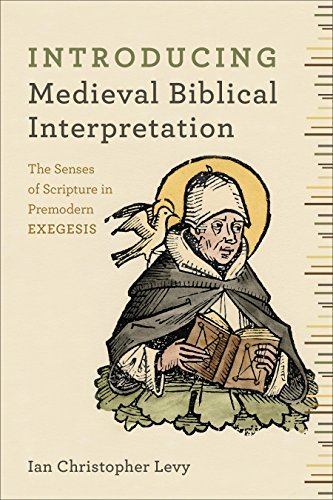
Introducing Medieval Biblical Interpretation: The Senses of Scripture in Premodern Exegesis
This introductory guide, written by a leading expert in medieval theology and church history, offers a thorough overview of medieval biblical interpretation. After an opening chapter sketching the necessary background in patristic exegesis (especially the hermeneutical teaching of Augustine), the book progresses through the Middle Ages from the eighth to the fifteenth centuries, examining all the major movements, developments, and historical figures of the period. Rich in primary text engagement and comprehensive in scope, it is the only current, compact introduction to the whole range of medieval exegesis.
322 pages, Kindle Edition
Published February 20, 2018
Ratings & Reviews
Friends & Following
Create a free account to discover what your friends think of this book!
Community Reviews
Displaying 1 - 9 of 9 reviews

March 23, 2024
Incredibly illuminating. This book has cleared up so many misconceptions that abound on the popular level (for both Protestants and Roman Catholics) about medieval views of Scripture and tradition. I was shocked to see how many Reformation-like-precursors there were throughout the Middle Ages. It seems clear that both Protestants today and Roman Catholic both lay legitimate claim to a history of interpretation that traces through the medieval church to the earliest fathers on matters such as biblical canon, the role (and definition) of the “literal sense” of Scripture, and even the papacy and the matter of who wields the keys to the kingdom of heaven. This is not to say that the Reformers did not make genuinely unique contributions, but only that the kinds of arguments they were making were not altogether unprecedented in the medieval church (and their precursors were not only those regarded as extremists or sectarians for their time, but were rather mainstream, unless Levy is totally misrepresenting the situation).

August 18, 2020
2020 reads: 32/52
Rating: 4 stars.
In a recent interview with Matthew Barrett, Craig Carter makes the audacious claim that “Evangelicalism will drift off into neopaganism and die out unless it recovers Nicene orthodoxy.” (https://credomag.com/article/contempl...). Carter has himself put much effort into theological retrieval, specifically as it relates to biblical interpretation (see his book here: https://www.amazon.com/Interpreting-S...). Again, Carter states, "The liberal project is the attempt to revise Christian doctrines in order to make them fit within the metaphysical constraints of modernity. Modernity is a cultural pathology caused by the rejection of God and it entails rejecting the major metaphysical doctrines of the Great Tradition point by point."
Now, this is a serious claim, but I'm taking it seriously. My own shifts in understanding hermeneutics and interpretation have only been confirmed by Carter's concerns. Modernism has many problems and falls short of the historic practices of biblical interpretation. All of this is just a backdrop to why I took up this present book by Ian Levy.
Modern evangelicals suffer from an impoverished hermeneutic that attempts to stand as master over the text, employing a purely scientific method (grammatical-historical), as opposed to standing under the text in submission, in a posture of faith seeking understanding. To that end, Levy's introduction is a solid start to get to grips with pre-modern methods.
I’ll just highlight a few nuggets that I took away from this fairly thorough survey, which covers the fathers up till the age of late medieval period including Augustine, Jerome, the Venerable Bede, Hugh of St. Victor, John Wycliffe, and many more.
1. Pre-modern interpretation emphasizes the Holy Spirit as the composer of Scripture, and, as such, any attempt to comprehend the sacred text was possible only under this same Spirit’s guidance.
2. The “paschal event” (Jesus’ life, death, resurrection and ascension) provides a radically new “historical context” which sheds light upon ancient texts and causes them to undergo a change in meaning.
3. The theological and philosophical rigor of the fathers and medieval monks/universities.
4. The emphasis on virtue in interpretation, both as a goal and a vital tool.
5. The regula fidei in interpretation, i.e. relying on and building upon the historical/traditional interpretations.
6. Ultimately what existed was a fourfold method, four senses of the biblical text (each author utilizing the sense in varying degrees), though mostly relying on a literal and grammatical foundation: a) historical (literal); b) allegorical (symbolism); c) tropological (moral application); and d) anagogical (eschatological foreshadowing).
Why only four stars? It's a little cumbersome, some sections are too long and needed sub-headings, and it's an otherwise 'dry' read—could maybe have done with some more creativity.
Rating: 4 stars.
In a recent interview with Matthew Barrett, Craig Carter makes the audacious claim that “Evangelicalism will drift off into neopaganism and die out unless it recovers Nicene orthodoxy.” (https://credomag.com/article/contempl...). Carter has himself put much effort into theological retrieval, specifically as it relates to biblical interpretation (see his book here: https://www.amazon.com/Interpreting-S...). Again, Carter states, "The liberal project is the attempt to revise Christian doctrines in order to make them fit within the metaphysical constraints of modernity. Modernity is a cultural pathology caused by the rejection of God and it entails rejecting the major metaphysical doctrines of the Great Tradition point by point."
Now, this is a serious claim, but I'm taking it seriously. My own shifts in understanding hermeneutics and interpretation have only been confirmed by Carter's concerns. Modernism has many problems and falls short of the historic practices of biblical interpretation. All of this is just a backdrop to why I took up this present book by Ian Levy.
Modern evangelicals suffer from an impoverished hermeneutic that attempts to stand as master over the text, employing a purely scientific method (grammatical-historical), as opposed to standing under the text in submission, in a posture of faith seeking understanding. To that end, Levy's introduction is a solid start to get to grips with pre-modern methods.
I’ll just highlight a few nuggets that I took away from this fairly thorough survey, which covers the fathers up till the age of late medieval period including Augustine, Jerome, the Venerable Bede, Hugh of St. Victor, John Wycliffe, and many more.
1. Pre-modern interpretation emphasizes the Holy Spirit as the composer of Scripture, and, as such, any attempt to comprehend the sacred text was possible only under this same Spirit’s guidance.
2. The “paschal event” (Jesus’ life, death, resurrection and ascension) provides a radically new “historical context” which sheds light upon ancient texts and causes them to undergo a change in meaning.
3. The theological and philosophical rigor of the fathers and medieval monks/universities.
4. The emphasis on virtue in interpretation, both as a goal and a vital tool.
5. The regula fidei in interpretation, i.e. relying on and building upon the historical/traditional interpretations.
6. Ultimately what existed was a fourfold method, four senses of the biblical text (each author utilizing the sense in varying degrees), though mostly relying on a literal and grammatical foundation: a) historical (literal); b) allegorical (symbolism); c) tropological (moral application); and d) anagogical (eschatological foreshadowing).
Why only four stars? It's a little cumbersome, some sections are too long and needed sub-headings, and it's an otherwise 'dry' read—could maybe have done with some more creativity.

September 17, 2018
Levy gives a thorough overview of medieval biblical interpretation.
"So it was, according to Augustine, that Jews had mistaken signs for things. They were lost in the letter (littera) and therefore missed the spiritual import of the things that were functioning as signs." (p. 21) (Augustine 354-430)
That was the biblical view of many early Christian interpreters (2 Co 3:6, 14). There were exceptions such as Antiochene interpreters Theodore of Mopsuetia (350-428) and Diodore of Tarsus (about 390). Theodore believed that metaphoric language belonged to the literal sense, while Diodore taught that lapse into allegory destroyed the historical sense.
"The establishment of a reliable Latin text, well grounded in the Hebrew and Greek originals, was considered essential from the Carolingian period straight through into the fifteenth century. This concern was itself grounded in the bedrock hermeneutical principle that the search for meaning begins with a solid grasp of the text’s literal-historical sense. Perhaps no two medieval exegetes will better exemplify this commitment than the twelfth-century Augustinian canon Hugh of St. Victor and the fourteenth-century Franciscan friar Nicholas of Lyra." (p. 3).
Nicholas (1270-1349) may have defended the literal sense to avoid criticism of his extensive use of Jewish exegesis (p.235-36). He spoke of a double literal sense for the historical and mystical. St Thomas Aquinas (1225-1274) had said that there were many senses in scripture, and the literal sense was the one intended by the author. (p. 209) Fourteenth-century scholars Abba Nesteros and John Cassian saw different levels in scripture.
"That is, the letter teaches you about the historical events, the allegorical sense what you ought to believe, the moral sense how you ought to behave, and the anagogical sense what you should strive to attain." (p. 34).
Nicholas was probably the most influential commentator of the middle ages (P. 228), and his commentary was the first one printed by the new technology of the printing press.
The author gives the impression of progress leading up to historical-literal interpretation.

April 29, 2019
If one is unaware of so-called “historical-critical” exegesis of the Bible, one might not understand the necessity of writing/publishing a book like Introducing Medieval Biblical Interpretation: The Senses of Scripture in Premodern Exegesis. In the former style of exegesis, the foundational principle is that a scholar/interpreter prioritizes the historical situation and meaning of the text in history, while recognizing the collation and editing of disparate fragments into traditions and, eventually, the final form (not only the textual criticism admitted by the medieval scholars, but that of source criticism, form criticism, redaction criticism, and rhetorical criticism). In the methodology of the medieval tradition upon which this book is written, one doesn’t discount the historical situation, but moves rather quickly into a spiritualization of meaning described variously below.
Personally, I come from a non-Catholic Christian tradition and, outside of a superficial awareness of church history, have rather neglected the church fathers and the medieval tradition. When a friend shared with me about Introducing Medieval Biblical Interpretation: The Senses of Scripture in Premodern Exegesis, I was intrigued at an opportunity to backfill some of my ignorance. I do not agree with the blurb on the back cover which suggests that this book is “a sly way of showing how to interpret the Bible today.” As this book shows, medieval interpretation was imaginative and hurried, often too quickly, away from the historical meaning of the text to speculative spiritualization.
The big question to be answered in that regard is addressed on p. 281. Does the emphasis of historical-critical approaches to the biblical text cause the interpreter to forfeit the multiple spiritual meanings seen by the pre-critical interpreters? After all, many of the modern rhetorical critical and reader-response interpreters are just as imaginative in their way. And yes, the interpreter of the historical-critical method may become say attached to the historical meaning for the human author/compiler/editor that the power of the Holy Spirit may be neglected. That is a danger, but what is the danger of eisegesis (reading what you want into the text) in the pre-critical approach.
There are some good ideas in the approach of the church fathers and these medieval interpreters. Few of these interpreters abandoned the so-called literal (obvious?) meaning of the text completely, but they clearly valued the so-called spiritual interpretations more. Gregory the Great believed the Bible was written in interior allegory and external history (p. 28). Likewise, Nesteros’ theory of interpretation stressed history as knowledge of the past as leading to analogy with additional spiritual meaning, upon which one discovers an additional (but heretofore invisible) meaning and then, applies as tropological (moral application) meaning (p. 33). The venerable Bede restricted interpretation to a simple two-fold meaning: literal-historical and figurative-mystical awareness (p. 42). Honorius uses the four “senses” of scripture to interpret Song of Songs as a) historical in the sense of human marriage, b) allegorically as Word of God made flesh or Christ joined with His church, c) tropological meaning as the soul uniting with Christ, and d) in anagogical sense as how one ascends to heaven after the bodily resurrection (p. 112). Hugh of St. Victor compared scripture to a honeycomb with three levels: history, allegory, and tropology (p. 142).
Yet, even though my literary background and personal predisposition allows me to acknowledge the validity of some allegory and reader-response approached to the text, I find myself quite uncomfortable with many of the interpretations recounted in this volume. For example, Bruno of Segni interpreted the “lily among thorns” of Song of Songs 2:2 as “literally” meaning the church of his own era, beset by heretics (p. 111). I was intrigued, but unconvinced, by William of Sainte-Thierry’s very erotic view of the Trinity as presented in his interpretation of Song of Songs (pp. 131-132). I wasn’t convinced by Nicholas of Lyra’s understanding of Song of Songs 1:2 (English), “Let him kiss me with the kiss of his mouth,” as referring to the mystical union between Christ and the church (p. 240).
From my perspective, I can share Peter the Chanter’s concern that over-intellectualizing might force heavenly wisdom to conform to human preconceptions (p. 191). In emphasizing meditation and an openness to spiritual insight, Peter also exhorted his students and readers to live moral lives where they would crave God’s insight. Levy quotes Peter as saying, “He who does not burn with sanctity will never set others ablaze.” (p. 191) I also agree, though with varying methodology, with Thomas Aquinas’ statement that the literal-historical interpretation doesn’t exhaust the scriptural meaning (p. 211). Yet, I don’t find myself wishing to become part of a vanguard to return to a pre-critical approach similar to that advocated by Robert Wilken on the back of the book. Yet, reading this volume does provide the additional perspective for which I was looking when I purchased the book. It’s thorough, even if the historical approaches represented may not be as useful as some claim.
Personally, I come from a non-Catholic Christian tradition and, outside of a superficial awareness of church history, have rather neglected the church fathers and the medieval tradition. When a friend shared with me about Introducing Medieval Biblical Interpretation: The Senses of Scripture in Premodern Exegesis, I was intrigued at an opportunity to backfill some of my ignorance. I do not agree with the blurb on the back cover which suggests that this book is “a sly way of showing how to interpret the Bible today.” As this book shows, medieval interpretation was imaginative and hurried, often too quickly, away from the historical meaning of the text to speculative spiritualization.
The big question to be answered in that regard is addressed on p. 281. Does the emphasis of historical-critical approaches to the biblical text cause the interpreter to forfeit the multiple spiritual meanings seen by the pre-critical interpreters? After all, many of the modern rhetorical critical and reader-response interpreters are just as imaginative in their way. And yes, the interpreter of the historical-critical method may become say attached to the historical meaning for the human author/compiler/editor that the power of the Holy Spirit may be neglected. That is a danger, but what is the danger of eisegesis (reading what you want into the text) in the pre-critical approach.
There are some good ideas in the approach of the church fathers and these medieval interpreters. Few of these interpreters abandoned the so-called literal (obvious?) meaning of the text completely, but they clearly valued the so-called spiritual interpretations more. Gregory the Great believed the Bible was written in interior allegory and external history (p. 28). Likewise, Nesteros’ theory of interpretation stressed history as knowledge of the past as leading to analogy with additional spiritual meaning, upon which one discovers an additional (but heretofore invisible) meaning and then, applies as tropological (moral application) meaning (p. 33). The venerable Bede restricted interpretation to a simple two-fold meaning: literal-historical and figurative-mystical awareness (p. 42). Honorius uses the four “senses” of scripture to interpret Song of Songs as a) historical in the sense of human marriage, b) allegorically as Word of God made flesh or Christ joined with His church, c) tropological meaning as the soul uniting with Christ, and d) in anagogical sense as how one ascends to heaven after the bodily resurrection (p. 112). Hugh of St. Victor compared scripture to a honeycomb with three levels: history, allegory, and tropology (p. 142).
Yet, even though my literary background and personal predisposition allows me to acknowledge the validity of some allegory and reader-response approached to the text, I find myself quite uncomfortable with many of the interpretations recounted in this volume. For example, Bruno of Segni interpreted the “lily among thorns” of Song of Songs 2:2 as “literally” meaning the church of his own era, beset by heretics (p. 111). I was intrigued, but unconvinced, by William of Sainte-Thierry’s very erotic view of the Trinity as presented in his interpretation of Song of Songs (pp. 131-132). I wasn’t convinced by Nicholas of Lyra’s understanding of Song of Songs 1:2 (English), “Let him kiss me with the kiss of his mouth,” as referring to the mystical union between Christ and the church (p. 240).
From my perspective, I can share Peter the Chanter’s concern that over-intellectualizing might force heavenly wisdom to conform to human preconceptions (p. 191). In emphasizing meditation and an openness to spiritual insight, Peter also exhorted his students and readers to live moral lives where they would crave God’s insight. Levy quotes Peter as saying, “He who does not burn with sanctity will never set others ablaze.” (p. 191) I also agree, though with varying methodology, with Thomas Aquinas’ statement that the literal-historical interpretation doesn’t exhaust the scriptural meaning (p. 211). Yet, I don’t find myself wishing to become part of a vanguard to return to a pre-critical approach similar to that advocated by Robert Wilken on the back of the book. Yet, reading this volume does provide the additional perspective for which I was looking when I purchased the book. It’s thorough, even if the historical approaches represented may not be as useful as some claim.

June 7, 2024
Dr. Levy steps through succeeding periods of the Middle Ages and selects a few prominent Biblical scholars in each. He summarizes the scholar's approach to interpreting the Bible and gives some examples of how they apply their method. I am not always a fan of 'clip show' books, buy Levy gives enough meat for each scholar to be satisfying.
I've taken a grad course on the Bible and several on theology and was pleased to see a lot of technique in Levy that I recognized. John Cassian, a monk circa 400 AD, said you interpret the Bible using 4 senses - the historical/literal, the mystical/allegorical, the moral, and the future. Most of Levy's featured scholars used some variation on this approach. I appreciate that most emphasize that you need to appreciate what the text literally says (allowing for metaphor, satire, figures of speech, etc.) before you try more esoteric interpretations.
I learned a lot.
I've taken a grad course on the Bible and several on theology and was pleased to see a lot of technique in Levy that I recognized. John Cassian, a monk circa 400 AD, said you interpret the Bible using 4 senses - the historical/literal, the mystical/allegorical, the moral, and the future. Most of Levy's featured scholars used some variation on this approach. I appreciate that most emphasize that you need to appreciate what the text literally says (allowing for metaphor, satire, figures of speech, etc.) before you try more esoteric interpretations.
I learned a lot.
September 9, 2020
Interesting to learn about how people throughout the mid to late medieval era interpreted scripture as well as their thoughts on who should be allowed to do so. The book provided many examples which was helpful but if there was a weakness it is that many of the examples were similar to each other. On the positive side it was neat to see the examples of symbolic, non-literal interpretations.

January 6, 2026
Interesting
This book is a mindblower. I learned so much about medieval thought on the Bible. This book proves that much about the past is worthy of preserving and using in the present.
This book is a mindblower. I learned so much about medieval thought on the Bible. This book proves that much about the past is worthy of preserving and using in the present.

July 5, 2022
A good resource. But after reading Lubac, it is dry. This book is a great reference work, but not the best book for reading.

April 19, 2019
I had one recurring thought while reading this book, "Historical-critical biblical interpretation stole much from the church." Not that this book argues we should forget the many useful tools that historical-critical exegetes have given the church. However, the Medieval scholars and patriarchal scholars before them, understood that while the "literal" reading of the words of the biblical text ground all other levels of interpretation, there are deeper levels of meaning to the Bible than just the historical words and their writers' contexts. The Bible is actually living and inexhaustible in its message. This book gives tools to the person interpreting the Bible to go beyond the simple historical-grammatical readings to the allegorical and spiritual messages God has for us today. I highly recommend this book.
Displaying 1 - 9 of 9 reviews