David Hook, granjero de Illinois orgulloso de las tierras y del ganado que posee, sufrió un duro golpe cuando su mujer falleció en un accidente de coche siete años atrás. Ahora, frente al ataúd de su primogénito de dieciocho años, Hook tiene el corazón y los ojos secos. Christopher Hook murió lejos de casa, en California, y la policía afirma que se suicidó. David está seguro de que su hijo no se quitó la vida, y para demostrarlo y averiguar la verdad de lo ocurrido viaja a Santa Bárbara. Allí conocerá a las dos testigos de la muerte de su hijo: La atractiva y autodestructiva Liz Madera, y la señora Rubin. La primera mantiene una relación con el aspirante a congresista Jack Douglas, y la segunda trabaja para él. Furioso y ávido de venganza, Hook se convertirá en su peor pesadilla y los acosará sin tregua para limpiar el nombre de su hijo.
Publicada por primera vez en 1973, Morir en California deja al descubierto la corrupción y la degradación que se escondían tras el glamour y la opulencia de la Costa Oeste en los años setenta.
Born in Harvey, Illinois, Thornburg graduated from the University of Iowa with a Fine Arts degree. He worked in a variety of jobs before devoting himself to writing full-time (or at least in tandem with his cattle farm in the Ozarks) in 1973. His 1976 novel Cutter and Bone was filmed in 1981 as Cutter's Way. The New York Times called Cutter and Bone "the best novel of its kind for ten years." Another novel-to film Beautiful Kate was filmed in Australia in 2009 and starred Bryan Brown and Ben Mendelsohn. It was directed by Rachel Ward, who is Bryan Brown's real-life wife. Thornburg died on May 9, 2011, a few days shy of his 82nd birthday.
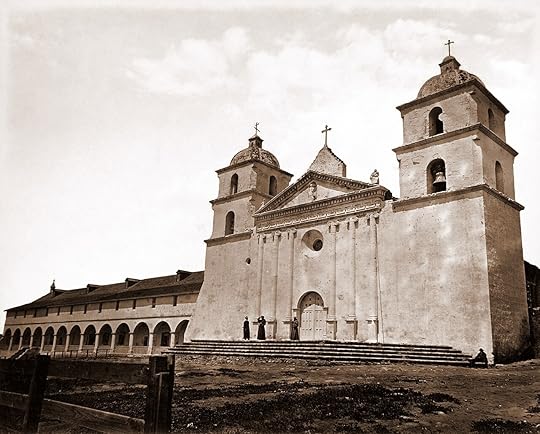
La Missione Francescana di Santa Barbara, costruita prima della città con l’intento di convertire la popolazione di nativi Chumash-Barbareño, che ora sono seppelliti nel cimitero della missione.
Gli anni sono quelli di Reagan governatore della California, il suo primo o secondo mandato. Presidente è Nixon e Kissinger sta sicuramente combinando guai. Charles Manson e Cielo Drive sono da poco cronaca comune. La guerra in Vietnam imperversa, i giovani vengono chiamati alla leva militare, l’esercito ha bisogno di carne fresca. Siamo quindi all’inizio degli anni Settanta, l’alba di quel decennio (il romanzo è stato pubblicato nel 1973).
Il tribunale di Santa Barbara costruito dopo l’ennesimo terremoto, quello del 1929, in stile ispano-moresco, definito la struttura revival in stile Coloniale Spagnolo più grandiosa mai costruita e visitato da una media di 50mila persone l’anno. Magnifici giardini, murales, piastrelle, arredi, e tutta una serie di rimandi allo stile delle antiche missioni, con colori accesi e brillanti. Dalla cima della torre dell’orologio (El Mirador) si può ammirare uno dei più bei panorami di Santa Barbara.
Chris Hook ha quasi diciannove anni. Per questo ha ricevuto la cartolina che lo chiama alle armi. Dovrà presentarsi, ma prima decide di concedersi un viaggio, di quelli iniziatici: sacco a pelo e autostop. Dall’Illinois, dalla grande fattoria di famiglia, all’ovest, in California.
Qualche settimana dopo, a inizio di dicembre suo padre, David Hook, viene avvisato che il figlio è morto. Suicida: si è buttato dall’alto di una scogliera di Santa Barbara e si è schiantato sulle rocce. Aveva nel sangue un tasso alcolico elevato. Al padre non resta che partire per la California per il riconoscimento del figlio morto e poi tornare a casa con il corpo in una bara.
Santa Barbara con il suo corredo di palme e il suo clima magnificamente temperato – mai troppo caldo, mai troppo freddo – e sullo sfondo le montagne di Santa Inez che d’inverno s’imbiancano di neve.
Solo che al suicidio del figlio l’uomo non ci crede. E quando arriva l’ultima lettera scritta a casa dal giovane poco prima di morire, i sospetti vengono confermati: dal tono di quella lettera è impossibile convincersi che il figlio abbia davvero voluto suicidarsi. A Hook – il narratore lo chiama sempre così, per cognome – non resta che tornare in California a scoprire la verità.
Il molo di Santa Barbara.
Si alzò per andare a letto, e diede a Chris una pacca sulla spalla, perché era così che faceva un americano. Ora rimpianse con tutto il cuore di non avere preso suo figlio tra le braccia baciandolo con calore e naturalezza, come avrebbe fatto un padre ebreo o italiano di vecchio stampo. Ma era troppo tardi ormai. Comincia così questo thriller crime basato più sulla psicologia dei personaggi, sulle loro interrelazioni che sull’azione: perché di fatti ne succedono pochi, i giorni passano facendo domande, parlando, bevendo, guardando, indagando, con incontri e chiacchiere più che con accadimenti. Si direbbe che Thornburg sia più interessato a problemi filosofici che all’action, alle questioni morali che alla risoluzione del giallo e del mistero. Nonostante il suo romanzo rientri nella categoria dei thriller.
Santa Barbara, sulla costa del Pacifico, centocinquanta chilometri a nord di Los Angeles.
E se c’è qualcosa di David Hook in chi lo ha creato, se Newton Thornburg ha somiglianze con il suo protagonista, si direbbe che entrambi, col passare degli anni e il crescere dell’età (Thornburg aveva la stessa età del suo personaggio quando ha scritto il romanzo, un po’ più di quarant’anni), si direbbe che entrambi si siano scoperti delusi dalla partecipazione politica e dalle idee progressiste della gioventù sono passati a circoscrivere i propri valori alla famiglia e a quel nucleo di affetti.
Echi dostoevskijani, Delitto e castigo non è poi così lontano. E anche se il romanzo è principalmente ambientato nella sunny California a due passi dalla mecca del cinema, Thornburg si astiene da qualsiasi tentativo consolatorio: niente happy ending, la verità è triste e amara.
Le Channel Islands, parco naturale, al largo della costa di Santa Barbara.
Thornburg's second hardback is one of the great neglected crime novels--some would just say “novels”--of the 20th century. This book, To Die in California, his first, is not quite up to its high standard, but it is a satisfying book nonetheless. Besides, when Thornburg sold its rights (for a movie that was never made), To Die in California earned him enough money to buy his own cattle ranch and with it the solitude to compose his masterpiece--that second book I mentioned--the superb Cutter and Bone.
David Hooks, a forty-five year old cattle rancher, a widower with three children, receives word that his nineteen year old son Chris has died while travelling in California. The witnesses say it was a suicide, but Hooks refuses to believe it, and travels to Santa Barbara to rescue his son's reputation from the stigma of suicide. In the course of his investigations, he meets a beautiful and sexually available woman from an old Spanish California family and a local politician with limitless ambition running for Congress, together with his vigilant private secretary and his faithful bodyguard, a football couch who idolizes his old high school buddy and is determined to do what he can to protect his friend's career. Hook is convinced that at least one—perhaps every one—of these people is lying. But how can he make them reveal the truth? And what really happened to his son?
The book begins well and ends well, and Hooks is a hero a reader can respect and like, but the novel loses its way about two-thirds of the way through, when Hooks and the politician engage in an insufficiently motivated night of marathon drinking. Sure, it gives Thornburg a chance to expand upon a few key themes, but it goes on much too long, confusing the novel's structure and muddying its clarity.
Still, it is an absorbing and disturbing work, and gives the reader a vivid picture of early '70's California, when adults felt uprooted, young people felt alienated, and Vietnam, drugs, and the Nixon presidency darkened America like great brooding clouds.
To Die In California by Newton Thornburg feels like the most eloquent and finely crafted entry of a mystery sub-genre I've grown to dislike, the "some man and his problems" story. Published in 1973, it's a novel of its time, in which a man's duty or sense of himself was thrown helter skelter by the collapse of society. Thornburg is author of Cutter and Bone, the Santa Barbara noir whose pirate esprit de corps sets it apart, and continuing in my jag of Californian noir, I was interested in giving this one a try.
David Hook is a farmer in southwestern Illinois introduced burying his oldest son, Chris. Hook went into farming by accident, graduating from the University of Illinois with a bachelor's degree in English and comparative literature. He met his wife at college but found teaching did not suit him, and took over his grandfather's farm, expanding it to 300 acres and three hundred head of beef cattle. A widower for seven years after his wife was killed in a car accident, Hook flies to Santa Barbara, California to identify Chris's body and return home with him. The official explanation is that his son, hitchhiking through the area, committed suicide by throwing himself from a cliff at Hope Ranch Beach.
No one back home including Hook believes Chris killed himself and a week before Christmas, he returns to Santa Barbara. The police believe that Chris was picked up by Elizabeth Madera, a twenty-five-year-old society girl who comes from an old Santa Barbara family. She took him back to the beach house she shares with a woman named Dorothy Rubin who works for a public relations firm, and the women maintain that Chris became despondent over not being able to perform sexually with Liz and threw himself to his death. They and others seem devoted to protecting Jack Douglas, a local politician being groomed for a U.S. Congressional seat. For answers, the Midwestern farmer enters the hippie scene.
Following him, Hook stepped into the sort of room he had seen before only in magazines, a careful assemblage of the mod, the outrageous, and the simply unlivable. the wood floor was painted black, the walls red, the ceiling pink. There was a polka-dot mattress on the floor, an Eames chair, an old double car seat, a legless dining room table painted lie a checkerboard, and a huge inflated clear plastic doughnut in which a young Negro male with a huge halo of Afro hair lolled sleepy-eyed. Overhead, a mobile made of mirrors of many colors and shapes turned slowly, catching the room's candlelight and bouncing it off the walls, which were covered with collages and protest posters and beautifully framed photographs of nude models, mostly male, the work of Icarus, Hook assumed. On the mattress a girl in a granny dress and rimless spectacles lay on her side, insouciantly studying Hook as she toyed with the shoulder-length tresses of a lean muscular young man sitting in front of her on the floor, with his head resting back against the swell of her hip. He was wearing an Indian headband, a threadbare serape, jeans and sandals, as he watched Hook with a look of weary contempt, as if the two of them were old enemies. As Icarus introduced Hook, not one of the three said a word.
To Die In California is an overcast day in a California beach city, "June gloom" as it's called. The coastal ambiance and natural beauty of the area is evident but gray skies obscure much in the way of delight. A young man's senseless death and efforts to discredit it are given appropriate thought by Thornburg as opposed to being used to set off a violent tale of revenge. I appreciated how deep the novel cut. Politics and counterculture are portrayed as dens of moral depravity, and taken at their most extreme, Thornburg does have a point. But thte book unloaded a lot for me to drag around. The prose, however, is expressive and powerful.
Montecito was to Santa Barbara as Beverly Hills was to Hollywood--adjacent, separate, unequal. In Santa Barbara people lived and worked; in Montecito they only lived. It was a bedroom community, and to Hook's eyes it looked as if each bedroom had its own dressing room and bath. It also had trees, great drooping sycramore and eucalyptus and live oak crowding the narrow serpentine streets so tightly Hook wondered how drunks ever managed to negotiate the maze at night, as he was trying to do now, sober, driving slowly, watching for street signs. What houses there were sat far back from the road, looking as dimly lit as forest cabins through the trees, and in front of each there was usually a rustic stone wall or iron-bar fence, the kind Carl Sandburg said would be penetrated only by death and rain and tomorrow.
As great as the writing often is, what holds me back from loving this novel is how little empathy I had for the main character or his problems. His oldest son wants to see the country before Uncle Sam comes for him, hitchhikes out west, is in the wrong place at the wrong time and is killed. This is no more tragic than anything servicemen and women in Vietnam experienced or what people in urban communities occupied by police or National Guardsmen experienced. Hook owns a profitable farm which is a lot more than most people had at that time. I'd definitely read another novel by Thornburg, but probably wouldn't recommend this one without a lot of qualifications.
p.s. I bought a used hardback copy at a reasonable price that the seller claimed is signed by the author, but based on the signature, I can't tell. I'll allow my optimism to defeat my cynicism and believe this is Thornburg's signature. Who else but authors signs their books?
To seek the truth proved to be a disturbing endeavor in this early novel of Newton Thornburg. Perhaps it is more correct to say it was meant to be crime investigation novel. It is an interesting story which, however, was spun out too long and too far, thus becoming too long-winded. Not one witty remark to be found. The righteousness of the world-weary truth seeker became thus slightly irritating. But, no doubt about it, the novel is well written. However, for me it lacked any of the great wit of Thornburg’s ‘Cutter and Bone’, a novel I did seriously love and remains one of my favorite novels ever.
My least favorite among the three Thornburg novels that I have read so far. David Hook, a farmer from Illinois reaches California to find out the truth behind the apparent suicide of his son. The plot reminded me of Cutter and Bone because there is this sense that Hook is unhinged and he could be wrong about his suspicions about what the wealthy socialites did to his son. In Cutter and Bone, you suspect the intentions and conclusions that the two lead characters make about what the chicken farmer did to the young prostitute.
The fact that Hook easily melds into the life of the socialites and politicians and goes on hard drinking binges with people who might have murdered his son was a bit hard to digest. The long drinking scenes were also quite boring. The plot points and progressions seemed to be uninspired and the novel plodded on and on with two of the whiniest "bad guys" ever created, locking horns with the tough farmer from Illinois.
The descriptions of California in the 70s made my heart yearn to be over there. It is clearly a novel where the parts are much better than the whole. It works as a novel of place. But as an action packed revenge novel and murder mystery, it fails completely.
To Die in California is an unusual crime novel and it is even unusual for fans of Thornburg’s writing due to its pacing and lack of action. Indeed, not all readers will enjoy this one. The first chapter where David Hook buries his son, Chris, and breaks down and the entire world drowns in his tears. No one alive can emerge unmoved from the great tragedy of the first chapter. It is so astounding in its emotion that a reader might expect similar depths from every page in the rest of the book, but the remainder of the book has a different pace and a different feel.
Nevertheless, Thornburg presents us with a rather interesting and captivating novel. The primary focus of the novel is the protagonist, Hook, a college-educated cattle rancher from southern Illinois, stiff and unyielding in his understanding of right and wrong. His world is shattered beyond recognition when he is told his eldest son died in California, a suicide. This he cannot accept and know it cannot be true even as he retrieves the body from Santa Barbara and begins to understand that no one wants to reopen the matter. It is neatly concluded and tied with a bow. The story is about his return to Santa Barbara after the funeral and his attempts to understand precisely what happened because the bits and pieces of information he has are not sufficient to close the matter in his eyes. With a letter Chris wrote two days before his demise in hand, Hook returns to Santa Barbara, a land in 1967 filled with hitchhiking hippies living on the sand and a landed class of gentry, cold and indifferent to how bare and empty their lives are.
There’s not much to go on and even Hook is not quite sure what happened, but he means to dialogue the people who were with Chris at the end and satisfy himself what really happened. What follows gets quite curious as he engages these people, who he thinks are covering up his son’s death, in dialogue, only to be rebuffed at every angle and told to go home and not upset the apple cart. This he cannot do. He cannot walk away. He does not know how he will get the truth, but he will not go home until he gets it one way or the other. With some of the people Chris spent time with, Hook gets close to them, spends time with them, and gets to understand them. With others, he is continually at odds with them and verbally sparring, trying to get them to come forward and being challenged to leave it be and not make trouble.
It is an emotionally complex work, not merely one of a wounded parent hell-bent on revenge. Hook is not an avenging angel. He just wants the truth and is not sure if he will ever get it or if it will even matter. He is sometimes as confused as anyone else in the novel and that is part of what gives it power. How does one spar with those who have done you wrong without coming to blows at every opportunity? How does one ferret out the truth when it is quite inconvenient for everyone is involved? After all, Hook is told Chris is dead and nothing he does can change that.
The setting is interesting, particularly how Thornburgh juxtaposes the stoic midwestern farmer with the hedonistic hippie California. Moreover, the setting in wealthy Santa Barbara is also interesting as it contrasts the wealthy folks who are filling their empty meaningless lives with games and frivolity with Hook’s determination.
Overall, a satisfying and compelling read. It is a different kind of crime novel, one that focuses on the main character, Hooks, not necessarily on a resolution to the underlying question.
"...Thorton's books are bleak, disillusioned and cynical." - Sam Moore writing about Thornton on The Airship blog 9/16/2014*
Bleak, disillusioned, and cynical are the best three words to describe Newton Thornburg's first commercially successful novel, although you could add disenchanted, negative, hardened, world-weary, and many other synonyms as well. There is potential in the story of an Illinois farmer who is relentlessly driven to prove that his teenage son's death in Santa Barbara, California was not suicide but rather a politically motivated cover-up of a horrible accident or even murder, although it is so awash in the Midwestern skepticism and distrust of anything from the Golden State (I have relatives who claim that if the country were tipped on its side, anything loose would wind up in California) that most readers will find themselves exhausted before the plot arrives at its obvious conclusion. There is some potential here in the story elements and prose, but the characters are little more than stock archetypes who serve as dartboards for Thornburg's bitterness.
This is the best novel I've read this year. You know that you're in tune with a book when it rolls along and you find yourself imagining the final scene - not the climax but the ending - and it happens as you believed it should.
Newton Thornburg was a very talented and successful painter who transitioned into writing. To Die in California came out in 1973. I'm surprised that it wasn't taken up by Hollywood. Apparently someone acquired the rights for a film, but the project didn't materialize.
David Hook is a successful farmer and rancher in Illinois. He is a widower and has three children - a son Chris, who is nineteen and is about to be drafted, who decides to see California in the 6 months he has left; and another son and a daughter who are high-school age. They get word that Chris has committed suicide out in California. David can't, and doesn't, believe it. Chris was a smart, handsome and popular young man who has not been prone to make rash decisions. David travels to Santa Barbara to dig into the circumstances of Chris's life there and the events just before his death. Two women who live and work together have reported that David stayed with them on the last day of his life, and that he became despondent after coming up impotent with one of them. He jumped off the cliff behind their beachfront home and broke his neck. David learns that these women work for a man named Jack Douglas who is a local politician. Nothing David hears affects his certainty that Chris did not kill himself. We then move along with David ever more deeply into the lives of the women and Jack Douglas, with ever-increasing suspicion of foul play. David, with the weight of his son's reputation always in his mind, pursues things with dogged determination and with obvious risk to his own well-being. To Die in California can be likened to Chinatown, but whereas Jake Gittes wades into a morass of political and corporate greed, the corruption that David Hook suspects is purely on a personal level, even though with Jack Douglas it could spell political doom.
As with Thornburg's Dreamland, another Southern California piece which I read last year, I loved everything about Thornburg's creation - the gripping plot, his writing style and cinematic settings, and his vivid, larger-than-life characters. While the writing style is his own, the way that Thornburg developed the characters here has a similarity to Steinbeck, in the depth of their psychological makeup.
One of Thornburg's largest themes in To Die in California is coming to grips with the reality that, just as the world is a place not of black and white, evil and good, but of grays in between, so are the relationships we have with each other.
The Summer of Love: Hippies and politicians created a world of filth and chaos and then they killed his oldest son -- that's what Mr. Hook surmised. Hook will nail all their asses to the barn door.
The Santa Barbara locals think Hook is a shitkicker from Peoria, but the reader knows better. We hear all of Hook's complicated thoughts: Frustration, uncertainty, righteousness, and rigorous reasoning.
I liked the somewhat slow pace. It gave me more time for stewing, fuming, and muttering to myself.
"'It isn't any man I'm dying over, Mr. Hook. It's as I said—I'm dying of life. I'm twenty-six. I've been married and divorced, and I've caused other divorces. I wake up with strangers, and I've been through analysis and drugs and travel, and I've tried to find it in religion and books. But it wasn't there. Not for me.' Looking up again, she smiled disparagingly, pretending she had not drilled into bare nerve. 'Anyway, it's not important, is it? I'm just one among millions in this country right now. In fact, I'm not sure I know anybody who isn't dying inside or at least living as if they were. It's our contemporary Black Death. Do you have it in Illinois?"
*****
Newton Thornburg is an American treasure. His best novels — and TO DIE IN CALIFORNIA is among them — capture the half-shuttered blind shadows of the American Dream through the lens of crime fiction with literary heft, poetic flair and a diseased but still dreaming heart.
What distinguishes this novel from the rest of his best is the stubborn glow of hopefulness that doesn't allow the fog of cynicism to fully smother this story of a Midwest-farmer father bent on knowing the truth about his son's death in Santa Barbara, and the damaged but less than dead-eyed people associated with it. Namely, that the truth is one thing to one person, something else to another, and the facts represent their own incomplete version of truth, and that none of the assertions made in the name of truth square up so easily—not the least of which is the uncomfortable reality that maybe the bad people aren't completely bad, just maybe a little more bad than not, and maybe that leaves room for even more truths of assorted depth.
The miracle of TO DIE IN CALIFORNIA is that it was published in 1973, when the nation had a sickened bellyful of Vietnam and Manson and Watergate and drugs and sex and moral drift, and that it still has room in its middle-aged creator's belly for characters whose culpability is measured by degrees so fine they might as well be filigrees of California ocean spray, who are pitiable and human and still carry a glow of conscience in their sleek and tanned bellies, like a coal that still emanates warmth from beneath a suffocating pile of ashes. It's that nuance that makes the pages turn, that provide the book's pleasurable uncertainty over who is right, who is wrong, and who deserves to be punished, and who is best suited to deliver that punishment.
TO DIE IN CALIFORNIA is a novel that believes in people even as it's populated by some of the worst specimens of them — self-pitying, self-protective would-be congressional candidate Jack Douglas and his mistress, a Poor Little Rich Girl named Liz Madera — that isn't a bit naive, just as persistent as David Hook in his quest for truth, and THE truth, and that lack of total nihilism gives this novel a shot of something more than mere noir even as it swims in the lapping black midnight tide of the American noir tradition. That something more, the understanding that we can't get a grasp on darkness without at least a glimpse of light, that what we think of is evil is truly the triumph of banality, is what should lift this delectably written novel into the upper echelons of the canon of post-Sixties literature, genre or otherwise.
TO DIE IN CALIFORNIA is a a great novel, certainly greater than the grudging critical due that it got, and its great creator ever got in his largely disappointed lifetime.
After an incredible first chapter, the tone changed and I don't like it at all now. Very confrontational, perhaps that’s realistic, but not what I want. The tone is very angry and depressing.
----
Chapter One is astonishing. Wow. One of the best first chapters I've ever read.
Quotes here:
Wow, page 2. Already, extraordinary prose: He himself would not cry, could not cry. He knew that if he allowed himself that luxury for even a moment he would end up falling on the casket like some poor sobbing peasant mother and that it would take men, it would take farmers like himself, to pull him free. So he held on to all he had in the world now, his two children and his rage—for there was still that, of course, and it had become his spine now, his blood and breath, his tomorrow and the next day and the day after that. As long as he had it, this treasure of rage, he could go on.
-
Hook felt the thing [death] coming at him anew, and all out of control now. It was like being in a skiff on a fogged sea and out of nowhere there was suddenly this great dark shape slipping silently toward him through the mist, a ship’s prow, a shape of death, of loss. And then abruptly it was gone, was past him, moving just as silently on. Someday it would not miss him, he knew. But now was not the time for it, not the time for grief. Now was the time for control.
Wow! Page after page of exquisite prose. Incredible.
It was one of the things he liked least about himself, that he valued the respect of men he in turn respected hardly at all.
Lo primero que llama la atención es la brillante construcción de los personajes. Descripciones y diálogos los dibujan misteriosos, magnéticos y llenos de carisma. Nunca olvidaré al protagonista David Hook, inteligente y decidido; Chris Hook, lleno de luz y belleza, y el mito, la hermosa y maldita Elizabeth Madera. . Retrata de manera exuberante y despiadada la California de los ‘60, en la que hippies colgados campan a sus anchas, mueren de sobredosis y son tratados como mendigos. En la superficie todo es brillo y opulencia pero en su interior se esconde una moral en descomposición. . Con una potente carga simbólica, una sexualidad muy presente, reflexiona sobre la muerte, la extrema vulnerabilidad de los seres humanos, la rabia y la venganza como motor. Quizá abuse de las descripciones en algunos momentos, pero los diálogos son de una agudeza y una tensión dramático-detectivesca que aumentan el ritmo cardíaco. . Y el final. El final me ha encantado. Un original revés a la típica visión de la venganza como bálsamo para el alma.
It seems there are not many novels written like this anymore, for all kinds of reasons. This one has classic structure and story, a strong protagonist facing obstacles to reaching his goal. This was good, solid storytelling capturing a point in time in the 1970s California as well as a style of novel during that era.
For David Hook, it is all about seeking the truth. When he gets the unfortunate news that his son Chris had committed suicide, he heads to California to uncover and unearth the details and circumstances into his son’s death.
I found this book to be a rather bleak reading experience. Now there is effective bleak and then there is just bleak-bleak, and this book is definitely the latter rather than the former. There’s just a depressing vibe throughout and a lot of this had to do with the feel of the plot and Hooks’ quest. I suppose this is par for the course, given the premise, but still this novel was just a book I just didn't want to pick up and read every night. There is a very confrontational feel to the character interactions as well, as they seemingly are always at each other’s throats.
Alongside this, Hook’s investigations into his son’s death felt very circular and repetitive, like we continue to retread and go over the same ground over and over again. I felt like skimming some parts of the book because it takes so long to get to the meat of the book. I guess it is because of all the mind games, duplicity, and deception throughout.
Hook treks into some very dark territory, with seedy characters, drugs, dirty politics, as he tries to get closer to the truth. I honestly just didn’t like the direction the book took, especially in the final third or so, especially some of Hook’s decisions.
I would be remiss to not mention, however, that Thornburg’s prose is a definite plus as well the symbolic nature of the title, which takes on the obvious and maybe not so obvious meaning. Hook struggles internally at many points, and Thornburg digs into the psyche of his emotional turmoil effectively.
This was my first read from Thornburg and I would be willing to give it another go with one of his other novels.
Great American novel. Thought Don Carpenter had angelic prose, Thornburg is quite majestic. Oh my how this one transcends time. Characters, plot, philosophy. Amazing the unsensational aspect of violence. The American that is getting squeezed, by the same type of protagonists still to this day. Still plagued by these marketing folk acting as political saviors caring for normal people, arguing with the out of touch anarchists about that American we all miss that just died in Cali, that fun American that had its own will power and just tried to carve his own piece of the pie, could've turned to Bunny from Sinclairs' Oil, but Thornburg just kills him bringing us even closer to Newton's issue the lament for the posthumous reputation (there is no direct word translation for what ancient greeks believed in υστεροφημία ) of the great American individual a just battle.
Witnessing Hook's character transition from beginning till end is mesmerizing.
This is perhaps the most brutally bleak crime novel/family drama I've ever read, and easily one of the best. It examines the nature of grief and anger better than many books in any genre, and takes the truism that no good deed goes unpunished to its logical, excruciating conclusion.
The story is about a father that heads from Missouri to California to find out why his eldest son has died. The local police have it as a suicide but he knows his son would not commit suicide. In his search for the truth he slowly destroys the type of person he is and also his family with his commitment to the dead and and not to the living.
Mentre si legge le immagini ci passano davanti come sul grande schermo del cinema. I personaggi sono vivi, reali, pur non essendo descritti nei dettagli lì vediamo muoversi, li sentiamo parlare. Sentiamo il dolore di un padre, l’angoscia dei fratelli, la desolazione di un politico, la ingenuità di un giovane, la tristezza di una donna senza valori
PROTAGONIST: David Hook, midwestern farmer SETTING: Illinois; California RATING: 2.75 WHY: David Hook and his family have worked hard to make a success of their farm in Illinois. Their world is destroyed when the oldest son, Chris, dies in California, supposedly a suicide. He had gone there on an adventure and was expected to return. David cannot accept the finding and goes to California to learn the truth. The characters in the book aren’t very likeable. The plot was thin and repetitive; it sometimes felt like Hook was investigating the composition of air. The prose was often beautiful, and I savored that aspect of the book. Despite that, I found the book to be a chore to read.
Nos encontramos sin lugar a dudas ante una historia que perfectamente puede ocurrir paralela a las andanzas de Cutter y Bone. Es la misma América decadente de los 70 donde comenzaron a forjarse los salvapatrias que hoy se hacen poseedores de la bandera de lo que debe ser y lo que no.
Un granjero (que ya veremos que no es un paleto ni mucho menos) pierde a su hijo mientras estaba de viaje de autoconocimiento en un acto de suicidio. Convencido de que no es así, con la tozudez por bandera recorrerá los bajos (y los altos) fondos californianos en busca de la verdad.
Reconozco que disfruto del carajo leyendo a Thornburg y al asco que destila sus letras hacia la sociedad en la que vivía. Amo a sus personajes: al granjero tozudo, al Trump demócrata, al Dani de desokupa macarroni... Un disfrute que espero poder seguir teniendo si la editorial continúa con la traducción de su obra
Read this book! It's a brilliant, compelling study of grief, loss and dogged perseverence -- and the price of obsession. It's also a rewarding, unpredictable and page-turning read, imbued with a keen sense of place and a strangeness that puts it well beyond the bounds of any formulaic genre label.
My only reservation: some lingering, '70's-style, male fantasy (yawn!) sexism, particularly in the interaction between the protagonist and the main female character (hot confused rich chick), but also other minor female characters, who are either pay-per-hour sex objects, evil lezzos, inscrutable daughters, or saintly aunts. In fact, the women in this story are drawn comparatively weakly; as a female reader, the novel lost me briefly for this reason.
Still, a very, very good book. The above is a personal gripe. If you're not a feminist, this last quibble probably won't bother you at all. If you are a feminist, my bet is that you'll still find this moving and affecting, and here's the highest accolade: impossible to forget.
This is a profound story about the consequences of tragedy, grief and the search for justice. Just like life, nobody comes out of it smelling clean. While you back the protagonist in his fever to serve justice, you can't help but notice that he's neglecting the loved-ones who need him most.
Such a fine novel. You could hardly find anything so similar in structure and presentation to Cutter and Bone (also by Thornburg) and yet so distinct in its soul and its characters. I don't know how else to say it, except to reiterate my claims elsewhere that Newton Thornburg should be mandatory reading.
A knock-out noir thriller that is also a well-written novel on serious themes. The summary for this book is extremely misleading. The main character doesn't find exhilaration and pleasure on his visit to Santa Barbara to trace his son's last days before his supposed suicide. As a true noir hero, he's dropped into an unfamiliar environment and up against hard, cynical and broken human beings.
Surprisingly ho-hum. Very well written but it doesn't feel as dark as it should have been. Honestly just watch Hardcore(1979) and you'll basically be getting the more grimy version of this.
Some period novels, when read decades later, appear horribly dated, but others wind up even more timely today than when they were written. A good example is Newton Thornburg's To Die in California, a Vietnam-era story of a father searching for the truth about the death of his son. The book has a political subtext that may not have been fully understood in 1972, before Watergate turned political scandals into mainstream news, but it registers powerfully today.
The father in To Die in California is David Hook, a well-to-do Illinois farmer. His 19-year-old son Chris was facing the draft with a low lottery number and decided to take a few months to hitchhike across country (back in the days when this was a common rite of passage for youths of that age). A few months later, Chris turned up dead, an apparent suicide. A wealthy young woman picked Chris up while hitchhiking and took him to her cliffside house high above the ocean. According to the woman, Chris felt guilty because he was unable to cut the mustard in bed with her, became depressed, and jumped off the cliff. David is unwilling to accept this version of the facts and flies out to California to investigate. Not surprisingly, he discovers that the truth is somewhat more complicated than the initial story. Specifically, the woman who picked Chris up is also the mistress of a rising, charismatic politician, and the official story appears to be a cover-up to keep the politician out of the news.
To Die in California is generally classified as a mystery, and, to be fair, the main storyline involves David’s attempt to find the truth about what happened to his son. But to call the book a mere mystery is akin to calling Hamlet a murder mystery for the same reason. There’s not a lot of high-level investigation in To Die in California; instead, David’s method of investigating is to keep pressing the main characters to admit to their involvement. It’s basic, but it works, just as similar tactics worked for the investigator in Crime and Punishment, a work that To Die in California channels in various ways.
Most readers won’t have a great deal of difficulty figuring out what really happened to Chris, but some might want to skip the rest of this paragraph, as it veers close to being a spoiler. To Die in California is actually a classic tragedy. There are no real villains here, just some decent but flawed people, who make the wrong decisions under pressure. And a large part of the rationale for making those wrong decisions is the idea that advancing the career of a politician who “makes a difference” is worth bending or breaking the law. Reading the book is a sad but powerful experience, a reflection on morality and politics that’s as relevant today as it was four decades ago.
Newton Thornburg wrote several novels over the forty years before his death in 2008, but he’s largely forgotten today. That’s a shame, because his prose, although verbose at times, is quite powerful. He also creates some good, suspenseful scenes, such as one in which David goes on a fishing trip with the politician and one of his flunkies and he, as well as the readers, wonder if and when the politician will try to arrange an accident for the farmer turned detective. There’s even an interesting subplot, as it turns out that David had spent time in Santa Barbara immediately after World War II in the company of an older woman who was his first real lover. In his mind, David keeps coming back to his own experiences and contrasting them with what happened to his son.
Some people may find To Die in California a bit slow moving and, in all honesty, some of the scenes do go on too long and stretch credibility somewhat. But the book certainly resonated with me (I was about the same age in 1972 as Chris was and faced the prospect of the draft as well), and both the themes it raises and the political intrigue are probably timeless. For younger readers, this book gives a good feel for the Vietnam era, while for older ones it will bring back some possibly not-so-fond memories. For those of any age, however, To Die in California is a darn good read.
If Thornburg's story were a movie, an old Jan-Michael Vincent would be pursuing the godless California heathens who killed his son (a young Jan-Michael Vincent), surrounded by the dangerous psycho-hippies who pop up in Clint Eastwood and Charles Bronson movies. There's even a hissable, fat lesbian accomplice to the murder who "fights like a caught game fish". All this is coupled with the middle-aged angst of Jack Lemmon in "Save the Tiger" and Paul Schrader's "Hardcore." The evil Californians are as corrupt as the Nixon administration, thugs and politicians and beautiful women whose eyes are "brilliant with pain and irony". Yet there's a lot more here. If you can ignore the dated material--which I think is a kick--the author creates plenty of beautiful elegiac passages concerning city people versus country folk, self-loathing, dysfunctional parenting, and pop culture. TV seasons mark the directionless nature of people who don't participate in life. "Death is the one true and final government." And when was the last time a noir--a domestic noir--contained a metaphor like: "they were the black filth that had come gushing out of the sea like the blood of a rectal carcinoma". Talk about punk rock lyrics! The obsessed father even has to tangle with the seductive noir woman who caused the death of young Jan-Michael Vincent with questionable results. Nonetheless, it's a mix of realism and one-dimensional portraits. Thornburg enjoys his father character's unfamiliarity (see: contempt) for Santa Barbara and its people, whether it concerns an Italian thug and his breath,"a sour muck of booze and garlic and fear", and there's the implication that young Jan-Michael Vincent was not only a homo but impotent as well. God help America. Luckily, in true 70s movie fashion, out pops a friendly hippie (and homosexual) who helps old Jan-Michael Vincent out, and the character doesn't die. Not everybody's bad. Thornburg also makes sure there's not so much an apocalyptic ending but one definitely drenched-in despair.
Morir en California es una de las dos obras principales del autor norteamericano Newton Thronburg. Se publicó en 1973 y podría decirse que es la novela que lo consagró en el mundo literario.
Me topé con ella en una de mis librerías de confianza por pura casualidad. El título y la sinopsis me parecieron atrayentes porque, sin ser demasiado consciente, buscaba algo para lidiar con la muerte y la ausencia de un ser querido. Esto es lo que hace también su protagonista, David Hook, un granjero del interior norteamericano al que informan de la muerte de su hijo en el otro extremo del país.
Supongo que, para mí, la cualidad más importante del libro es la verosimilitud de los personajes. La primera parte de la novela narra de forma magistral todo el horror y los hechos que siguen al suceso más traumático posible para un padre. Después, a lo largo del texto, los personajes se retratan de forma excepcional con sus contradicciones, tentaciones, vergüenzas y algún que otro buen sentimiento también. En un análisis algo más profundo, podemos decir que el clímax consiste en que el autor tiene que enfrentarse al hecho de que quizá su moral, que siempre ha sido su timón y el de toda su familia, no sea todo lo elevada que él piensa.
El estilo es completamente refinado y parece que emana de forma natural de la profundidad de los personajes. Los cambios en el punto de vista, entre monólogo interno y diálogo entre los personajes y lo que muestran sus acciones, forman una superficie homogénea por la que la trama general se desliza suavemente. Además, se trata de una obra completamente realista en la que no es necesario ningún elemento fantástico para transmitir sentimientos extremos, relacionados con el mal, el bien, el azar o la degradación psicológica del ser humano.
Me ha encantado, creo que es una obra de gran calidad y en especial adecuada para momentos en los que la tristeza por la muerte de un ser querido sigue estando ahí.
I'm not much of a crime fiction reader but I picked this up because I really liked Thornburg's "Cutter and Bone". That book is a great take on the genre with fumbling, flawed protagonists set during the craziness of the 70s.
"To Die in California" falls short for a number of reasons. The main reason it feels is that it just feels dated in a bad way. Where "Cutter and Bone" evoked its time period "To Die in California" is trapped by the language and dated thinking of the time period. "To Die in California" was published 1973 and deals with the California coast populated by hippies and wealthy dissolute liberals.
A lot of the what causes the plot to move forward will feel silly to modern readers. The Midwestern straight laced protagonist is on a mission to find out what happened to his son who supposedly killed himself because he was gay. He does all kinds of digging to prove that his son has had sex with a woman as if that proves conclusively he isn't gay. This is a theme throughout.
The language is cringeworthy. A black character is described as "a negro" or a gay character is "an invert". I'm not one to judge a work by the standards of a later day if the other attributes of the book are worthwhile. This is Thornbergs first book and I did like "Cutter and Bone" so I'll probably try him again someday.