

What do you think?

Trumponomics: Inside the America First Plan to Revive Our Economy
Donald Trump promised the American people a transformative change in economic policy after eight years of stagnation under Obama. But he didn’t adopt a conventional left or right economic agenda. His is a new economic populism that combines some conventional Republican ideas–tax cuts, deregulation, more power to the states–with more traditional Democratic issues such as trade protectionism and infrastructure spending. It also mixes in important populist issues such as immigration reform, pressuring the Europeans to pay for more of their own defense, and keeping America first.
In Trumponomics, conservative economists Stephen Moore and Arthur B. Laffer offer a well-informed defense of the president's approach to trade, taxes, employment, infrastructure, and other economic policies. Moore and Laffer worked as senior economic advisors to Donald Trump in 2016. They traveled with him, frequently met with his political and economic teams, worked on his speeches, and represented him as surrogates. They are currently members of the Trump Advisory Council and still meet with him regularly. In Trumponomics, they offer an insider’s view on how Trump operates in public and behind closed doors, his priorities and passions, and his greatest attributes and liabilities.
Trump is betting his presidency that he can create an economic revival in America’s industrial heartland. Can he really bring jobs back to the rust belt? Can he cut taxes and bring the debt down? Above all, does he have the personal discipline, the vision, the right team, and the right strategy to pull off his ambitious economic goals? Moore and Laffer believe that he can pull it off and that Trumponomics will usher in a new era of prosperity for all Americans.
In Trumponomics, conservative economists Stephen Moore and Arthur B. Laffer offer a well-informed defense of the president's approach to trade, taxes, employment, infrastructure, and other economic policies. Moore and Laffer worked as senior economic advisors to Donald Trump in 2016. They traveled with him, frequently met with his political and economic teams, worked on his speeches, and represented him as surrogates. They are currently members of the Trump Advisory Council and still meet with him regularly. In Trumponomics, they offer an insider’s view on how Trump operates in public and behind closed doors, his priorities and passions, and his greatest attributes and liabilities.
Trump is betting his presidency that he can create an economic revival in America’s industrial heartland. Can he really bring jobs back to the rust belt? Can he cut taxes and bring the debt down? Above all, does he have the personal discipline, the vision, the right team, and the right strategy to pull off his ambitious economic goals? Moore and Laffer believe that he can pull it off and that Trumponomics will usher in a new era of prosperity for all Americans.
304 pages, Hardcover
First published October 30, 2018
About the author
Stephen Moore
150 books34 followersLibrarian Note: There is more than one author in the GoodReads database with this name. See this thread for more information.
Stephen Moore is an American economist who advocates free-market policies and limited government. He has a B.A. from the University of Illinois and an M.A. from George Mason University. Moore is the founder of two political advocacy groups: the Club for Growth and the Free Enterprise Fund.
Stephen Moore is an American economist who advocates free-market policies and limited government. He has a B.A. from the University of Illinois and an M.A. from George Mason University. Moore is the founder of two political advocacy groups: the Club for Growth and the Free Enterprise Fund.
Ratings & Reviews
Friends & Following
Create a free account to discover what your friends think of this book!
Community Reviews
Displaying 1 - 26 of 26 reviews

April 29, 2019
Moore and Laffer provide a good overview of the run-up to the November 2016 election. They highlight their interaction with then-candidate Donald Trump and then President Trump.
The authors note the benefits of the regulatory reforms, Tax Cuts and Jobs Act, and the economic turnaround from improved economic expectations and a more competitive business environment. They acknowledge their concern about the President's actions and rhetoric regarding international trade and immigration but focused their efforts on other areas that have contributed to a tight labor market and a stronger economy compared with the Obama years.
The bottom line is that policies matter. The key is to now build on these pro-growth policies of sensible regulations and tax cuts for the vast majority of Americans by doing more of those but putting more emphasis on reining in government spending and ending the uncertainty around international trade. Achieving these two latter key points would provide the environment for the U.S. to be an economic juggernaut for the foreseeable future.
I give the book 4 stars. Check it out!
The authors note the benefits of the regulatory reforms, Tax Cuts and Jobs Act, and the economic turnaround from improved economic expectations and a more competitive business environment. They acknowledge their concern about the President's actions and rhetoric regarding international trade and immigration but focused their efforts on other areas that have contributed to a tight labor market and a stronger economy compared with the Obama years.
The bottom line is that policies matter. The key is to now build on these pro-growth policies of sensible regulations and tax cuts for the vast majority of Americans by doing more of those but putting more emphasis on reining in government spending and ending the uncertainty around international trade. Achieving these two latter key points would provide the environment for the U.S. to be an economic juggernaut for the foreseeable future.
I give the book 4 stars. Check it out!

January 6, 2019
About two thirds through this fine piece of economic cheerleading for Donald Trump’s successful efforts to deregulate and dismantle everything standing between him and his tax cuts and deregulation, punch drunk and bilious, I came across one little nugget that not only got under my skin. I took it personally.
In a passage championing America plundering its land in order to access energy reserved, touted as hundreds of years’ worth one page and then infinite in another, Stephen Moore and Arthur Laffer claim that “In Youngstown, Ohio, steel plants are being rebuilt.”
My family is from Youngstown, and every time a politician appears there to highlight the decaying rust belt and desperation of the white working class, I can’t help but notice. My grandfather worked in those steel mills. Steel worker unions and union wages helped put me through college. So of course I was overjoyed to learn that Trump was making good on a campaign promise.
Except, of course, he hasn’t. I don’t think fact checking means anything anymore, but for what it’s worth, PolitiFact reports there’s some evidence of steel mills reopening here and there, but not many, and the number of steel worker jobs is now the same as it was before he was elected, with an overall downward trend in jobs due to technological innovations and other global factors.
So no. No new steel mills. That’s a lie, and this time they lied about my mother’s home town.
Well, maybe that’s just an error. Just like their claim that he added 50,000 coal mining jobs (again, the dreaded fact checkers at PolitiFact found this to be misleading).
Or that the U.S. expansion of shale oil has brought down carbon emissions more than anything (it’s way more complicated than that and is still killing the planet).
Or their claims about pollution control or voter attitudes or...you know, I think I’m starting to see a pattern here. Trumponomics could not be better named. Like the authors’ boss’s name, it evokes spin, salesmanship absent substance. It screams bullshit.
But hey, maybe that’s all just detail. If we’re going to get to the core of the matter, maybe we’d want to take a closer look at the central premise of the book. Laffer and Moore, who have a long track record of talking up supply side economics, start the book with several chapters’ worth of retelling their story of the campaign, chronicling their work to get the tax reform of 2017 passed and patting themselves and Trump on the back every other page for the “historic growth” we’ve seen since. Their recipe for success: deregulation and tax cuts have historically led to strong economic growth of 3 or 4 percent. Under Kennedy, Reagan and Clinton, their thinking goes, the economy grew rapidly, added jobs and decreased the number of people on the dreaded welfare roletherefore all you have to do is cut taxes and deregulate, sit back and watch American become Great Again. Whatever that means.
Ok, I get wanting to take credit for the economy’s recovery. Trump is hardly the first president to do that. But, again, as fact checkers point out, there’s a range of factors to consider when evaluating an economy, and these guys, who claim to be economists, don’t seem to want to acknowledge that. Besides, Trump’s claims about job creation and growth on his term range from misleading to false, and their credibility is shattered once they start echoing them themselves.
At any rate, evidence that the country rocks under low taxes depends on how you analyze economic growth over the years, In the past week, as newly sworn in Representative Alexandria Ocasio-Cortez talks about upping marginal rates and getting high earners to pay as much as 70 percent, economists like Paul Krugman are looking at the numbers and seeing nothing to indicate that this would cripple growth. In fact, quite the reverse.
Look, I can’t claim to have the right answers on economic policy here. As I have made clear time and time again, I am no economist. When it comes to money matters, my philosophy is “I like it.”
But I know bullshit when I see it. And this book is loaded with it.
Moore and Laffer can’t conceive of anyone doing anything without examining the taxes involved. They equate Medicaid, Social Security, libraries and unemployment benefits as “welfare,” a dog whistle for Trump supporters if ever I heard one. They keep pointing to the 2016 election and claiming “the voters made it clear” they wanted all of Trump’s policies, apparently being unaware of the margin of victory and who actually won the popular vote. And when the voters don’t agree with their policies, like in 2017 when only 25 percent supported the tax bill, it’s because they’ve been brainwashed by the leftist propaganda machine.
They repeatedly roar in triumph over what the private sector can do with computers, phones, the Internet and pharmaceutical drugs, apparently completely ignorant as to where these things came from. They reluctantly acknowledge climate change, but only by adding air quotes and talking about hysteria and paranoia; they can’t envision a world reeling from the effects of rising sea levels and higher levels of carbon in the air, and it never occurs to them that that’ll have to be paid for in the long run. All they see is the immediate price tag.
And when they deplore the financial crisis, all they can talk about is Obama’s response to it; the Wall Street regulation that most people support isn’t even a thought that occurs to them.
To their credit, they stick to their guns over their differences with Trump regarding trade deficits and immigration. But I don’t care. These are the guys who compare him to P.T. Barnum (the man who said there was a sucker born every minute) as if that’s a plus, and they’re the guys who think that the African-American unemployment rate falling is proof that Trump couldn’t possibly be a racist. My God.
I’m under no illusions about the effect of this book, or any criticism of it, making much of a difference. Trump supporters will read it and go “See?” Trump critics will pick it apart and get absolutely nowhere. At any rate, the authors are impervious to fact checking and criticism. Mehdi Hasan has been heroic in his efforts to pin down Laffer’s evidence for the effectiveness of trickle down economics (both years ago and recently) but in them, when Laffer doesn’t simply point to his own claim and say “There you go,” instead he simply discounts contrary evidence and says “I don’t believe that.” And Moore has made quite a career out of being wrong, starting with his prognostications about the Bush economy, failure to fact check claims about the economy or Obamacare, and going right into last week, when he claimed the U.S. economy was going through deflation and ignored what Trump’s trade war had to do with it all.
None of this matters. They’re getting their way. They’re drilling and blasting the country for the energy; they’re screwing their and our grandchildren to pursue short term gain; they’re dismantling any and every social service they can while the rich, already doing well, get even richer. But hey, at least we’ll have cheap hamburgers and toasty winters to get us through the tough times.
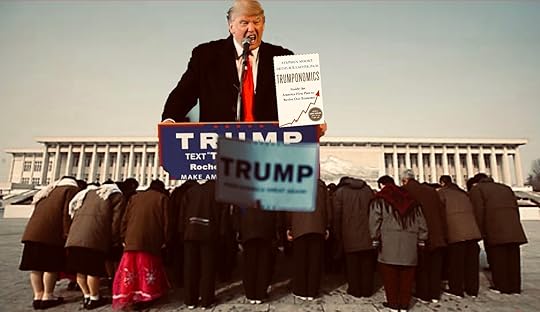
In a passage championing America plundering its land in order to access energy reserved, touted as hundreds of years’ worth one page and then infinite in another, Stephen Moore and Arthur Laffer claim that “In Youngstown, Ohio, steel plants are being rebuilt.”
My family is from Youngstown, and every time a politician appears there to highlight the decaying rust belt and desperation of the white working class, I can’t help but notice. My grandfather worked in those steel mills. Steel worker unions and union wages helped put me through college. So of course I was overjoyed to learn that Trump was making good on a campaign promise.
Except, of course, he hasn’t. I don’t think fact checking means anything anymore, but for what it’s worth, PolitiFact reports there’s some evidence of steel mills reopening here and there, but not many, and the number of steel worker jobs is now the same as it was before he was elected, with an overall downward trend in jobs due to technological innovations and other global factors.
So no. No new steel mills. That’s a lie, and this time they lied about my mother’s home town.
Well, maybe that’s just an error. Just like their claim that he added 50,000 coal mining jobs (again, the dreaded fact checkers at PolitiFact found this to be misleading).
Or that the U.S. expansion of shale oil has brought down carbon emissions more than anything (it’s way more complicated than that and is still killing the planet).
Or their claims about pollution control or voter attitudes or...you know, I think I’m starting to see a pattern here. Trumponomics could not be better named. Like the authors’ boss’s name, it evokes spin, salesmanship absent substance. It screams bullshit.
But hey, maybe that’s all just detail. If we’re going to get to the core of the matter, maybe we’d want to take a closer look at the central premise of the book. Laffer and Moore, who have a long track record of talking up supply side economics, start the book with several chapters’ worth of retelling their story of the campaign, chronicling their work to get the tax reform of 2017 passed and patting themselves and Trump on the back every other page for the “historic growth” we’ve seen since. Their recipe for success: deregulation and tax cuts have historically led to strong economic growth of 3 or 4 percent. Under Kennedy, Reagan and Clinton, their thinking goes, the economy grew rapidly, added jobs and decreased the number of people on the dreaded welfare roletherefore all you have to do is cut taxes and deregulate, sit back and watch American become Great Again. Whatever that means.
Ok, I get wanting to take credit for the economy’s recovery. Trump is hardly the first president to do that. But, again, as fact checkers point out, there’s a range of factors to consider when evaluating an economy, and these guys, who claim to be economists, don’t seem to want to acknowledge that. Besides, Trump’s claims about job creation and growth on his term range from misleading to false, and their credibility is shattered once they start echoing them themselves.
At any rate, evidence that the country rocks under low taxes depends on how you analyze economic growth over the years, In the past week, as newly sworn in Representative Alexandria Ocasio-Cortez talks about upping marginal rates and getting high earners to pay as much as 70 percent, economists like Paul Krugman are looking at the numbers and seeing nothing to indicate that this would cripple growth. In fact, quite the reverse.
Look, I can’t claim to have the right answers on economic policy here. As I have made clear time and time again, I am no economist. When it comes to money matters, my philosophy is “I like it.”
But I know bullshit when I see it. And this book is loaded with it.
Moore and Laffer can’t conceive of anyone doing anything without examining the taxes involved. They equate Medicaid, Social Security, libraries and unemployment benefits as “welfare,” a dog whistle for Trump supporters if ever I heard one. They keep pointing to the 2016 election and claiming “the voters made it clear” they wanted all of Trump’s policies, apparently being unaware of the margin of victory and who actually won the popular vote. And when the voters don’t agree with their policies, like in 2017 when only 25 percent supported the tax bill, it’s because they’ve been brainwashed by the leftist propaganda machine.
They repeatedly roar in triumph over what the private sector can do with computers, phones, the Internet and pharmaceutical drugs, apparently completely ignorant as to where these things came from. They reluctantly acknowledge climate change, but only by adding air quotes and talking about hysteria and paranoia; they can’t envision a world reeling from the effects of rising sea levels and higher levels of carbon in the air, and it never occurs to them that that’ll have to be paid for in the long run. All they see is the immediate price tag.
And when they deplore the financial crisis, all they can talk about is Obama’s response to it; the Wall Street regulation that most people support isn’t even a thought that occurs to them.
To their credit, they stick to their guns over their differences with Trump regarding trade deficits and immigration. But I don’t care. These are the guys who compare him to P.T. Barnum (the man who said there was a sucker born every minute) as if that’s a plus, and they’re the guys who think that the African-American unemployment rate falling is proof that Trump couldn’t possibly be a racist. My God.
I’m under no illusions about the effect of this book, or any criticism of it, making much of a difference. Trump supporters will read it and go “See?” Trump critics will pick it apart and get absolutely nowhere. At any rate, the authors are impervious to fact checking and criticism. Mehdi Hasan has been heroic in his efforts to pin down Laffer’s evidence for the effectiveness of trickle down economics (both years ago and recently) but in them, when Laffer doesn’t simply point to his own claim and say “There you go,” instead he simply discounts contrary evidence and says “I don’t believe that.” And Moore has made quite a career out of being wrong, starting with his prognostications about the Bush economy, failure to fact check claims about the economy or Obamacare, and going right into last week, when he claimed the U.S. economy was going through deflation and ignored what Trump’s trade war had to do with it all.
None of this matters. They’re getting their way. They’re drilling and blasting the country for the energy; they’re screwing their and our grandchildren to pursue short term gain; they’re dismantling any and every social service they can while the rich, already doing well, get even richer. But hey, at least we’ll have cheap hamburgers and toasty winters to get us through the tough times.
December 29, 2018
This guy goes on CNN and peddles one false notion after another. He does not even know how to explain proven economic trends. He keeps forgetting that the HUGE tax cuts are what falsely fueled the economy like candy to a kid. He keeps comparing our economy to apples vs oranges scenarios. What happened to the integrity with this guy and many others who support Trump? Catherine Rampell takes him down every single time with facts. She is a real economist. Stephen Moore is a political hack from the Heritage Foundation. Read the book as opposition research, lol.

November 9, 2018
I think if you need to understand the President policy Platform on tax policy, this book is the place to look. I really enjoyed this book. It gives the reader a front row seat into the decision-making process that went into formulating the new tax code.
February 22, 2022
When I started reading this book, I wanted to put my personal opinions of Trump aside and study his economic plans systematically and objectively without bias or partisan propaganda, and I assumed that the reputable economists who authored the book would provide scientific analyses and theories about the effects of the economic changes the president made. Instead, almost all of the book is spent describing the meetings with Trump (as a candidate and then as a president) and his team, and how an amazing, selfless, and great person he is. According to the authors, America had been in a major decline heading toward catastrophe, and Trump and his populist agenda are the only saviors to get it back! The confident and arrogant tone they use to talk about economic proposals and results is just foolish for anyone who knows anything about the uncertainty of macro-economy, and the infinite factors that affect it. It's really disappointing to see reputable economists with this long experience, writing such mediocre analyses that are anything but objective and scientific! Even when the authors admit the disastrous effects of tariffs and trade restrictions, they still defended Trump's anti-free trade policies in a clear indication that the book's goal is just propaganda to mislead people, and is far from being an unbiased examination.
While I do agree with some of the authors' stands, like the failure of the current bipartisan system, the inefficiency of the tax code, and the dangers of restricting international trade, the authors' exaggerations, evidence cherry-picking, double standards, foolish confidence, and other factors make this book one of the worst and least informative books I've ever read.
While I do agree with some of the authors' stands, like the failure of the current bipartisan system, the inefficiency of the tax code, and the dangers of restricting international trade, the authors' exaggerations, evidence cherry-picking, double standards, foolish confidence, and other factors make this book one of the worst and least informative books I've ever read.

January 1, 2019
Very interesting and one of the few books that protect and support President Trump. Interesting and well explained economical decisions pro and against in different moments of Trump Presidency. The author is one of the most respected of course, but the way him (and the other economists that doesnt agree with him for that matter) put the questions of how US will keep its superpower status is wrong on my point of view. US economy have to invent itself and be strong at home first, and only than can care to compare in the world. A happy and wealthy US citizen should be the aim of the economy. Than the status should follow. By only competing with words and trade tariffs may create problems for a chinese or europian citizen but will not help (in contrary will hurt) the US citizen.
June 23, 2019
This book should be at the top of the list to read among the dozens of current books addressing what happened in the 2016 campaign and election, plus the follow-on of what actually has transpired in the 2017-18 administration.
More than just a description of the Trump administration approach to the recovery of the U.S economy, this book by two of the principle economic advisers to Candidate Trump and President Trump describes their observations on the business- and success-oriented worldview of Donald J. Trump. Moore and Laffer acknowledged that DJT is not a traditional conservative, nor a strict Reaganite conservative; rather, they show how his concern for improvement of the U.S> economy, with focus on jobs and wages, has already bettered the position of many in middle America. They clarify where they agree with his approaches, including much based on their advice to him, and where they disagree with him, principally on the subject of total free trade (no tariffs or barriers) and his insistence in "fair and free trace." I found the book highly informative, educational on the aspects of economic theory relative to Keynesian and Laffler supply-side theories, and the intersection of climate change proponents versus national and worldwide improvement of both the climate and the economy. Moore and Laffler did not hold back their observations no the comparison of Obama (and HRC) approaches to government action on the economy.
More than just a description of the Trump administration approach to the recovery of the U.S economy, this book by two of the principle economic advisers to Candidate Trump and President Trump describes their observations on the business- and success-oriented worldview of Donald J. Trump. Moore and Laffer acknowledged that DJT is not a traditional conservative, nor a strict Reaganite conservative; rather, they show how his concern for improvement of the U.S> economy, with focus on jobs and wages, has already bettered the position of many in middle America. They clarify where they agree with his approaches, including much based on their advice to him, and where they disagree with him, principally on the subject of total free trade (no tariffs or barriers) and his insistence in "fair and free trace." I found the book highly informative, educational on the aspects of economic theory relative to Keynesian and Laffler supply-side theories, and the intersection of climate change proponents versus national and worldwide improvement of both the climate and the economy. Moore and Laffler did not hold back their observations no the comparison of Obama (and HRC) approaches to government action on the economy.

June 12, 2020
I was expecting to read about serious economic theories, or at least some reason and argument back by evident or studies. Instead most of the writing is spent on praising Trump and his brilliant economic plan, without explain why it is good and how the others plan is bad.
Very disapointed
Very disapointed

April 27, 2024
“Trumponomics” by Arthur Laffer and Stephen Moore is a deep dive into the theory, assumptions, and politics of the 2017 Trump tax bill. It is an instructive memoir for those interested in economic theory or tax policy.
Laffer was an Associate Professor of Business Economics at the University of Chicago, from 1970 to 1976, and a member of the Chicago faculty from 1967 through 1976. From 1976 to 1984 Dr. Laffer was the Charles B. Thornton Professor of Business Economics at the University of Southern California. Following his tenure at USC, Laffer was a Distinguished University Professor at Pepperdine University.
Best known for the Laffer curve, a theory that demonstrates the relationship between tax rates and the amount of tax revenue collected by the government, Laffer is often called the godfather of supply-side economics.The Laffer Curve shows that there is a certain point between 0% and 100% where tax revenues are maximized.
Thus, two tax rates that will yield revenue with absolute certitude. The Laffer curve assumes that no tax revenue is raised at the extreme tax rates of 0% and 100%, meaning that there is a tax rate between 0% and 100% that maximizes government tax revenue.
Stephen Moore, a "Distinguished Visiting Fellow." at the Heritage Foundation, worked with Laffer, and Larry Kudlow to overhaul the US Tax Code for the Trump administration.
Many have attempted to find provenance in the truism: When you subsidize something, you get more of it; if you tax something, you get less of it. This motivated the authors, as well as Austrian's such as Rothbard. People are not widgets. In his discussion on methodology, Rothbard stated:
Praxeology, is based on the fundamental axiom that individual human beings act, “That is, on the primordial fact that individuals engage in conscious actions toward chosen goals…. This structure is built on the fundamental axiom of action, and has a few subsidiary axioms, such as that individuals vary and that human beings regard leisure as a valuable good…Furthermore, since praxeology begins with a true axiom, A, all the propositions that can be deduced from this axiom must also be true. For if A implies B, and A is true, then B must also be true."
Tax cuts work. They increase revenue. The Democrat party is now about fairness, not growth. Growing the denominator(GDP) versus the numerator(Deficit) is the mathematical solution. Many high school students once learned the “Rule of 72.” We no longer own such knowledge. We should.
Laffer was an Associate Professor of Business Economics at the University of Chicago, from 1970 to 1976, and a member of the Chicago faculty from 1967 through 1976. From 1976 to 1984 Dr. Laffer was the Charles B. Thornton Professor of Business Economics at the University of Southern California. Following his tenure at USC, Laffer was a Distinguished University Professor at Pepperdine University.
Best known for the Laffer curve, a theory that demonstrates the relationship between tax rates and the amount of tax revenue collected by the government, Laffer is often called the godfather of supply-side economics.The Laffer Curve shows that there is a certain point between 0% and 100% where tax revenues are maximized.
Thus, two tax rates that will yield revenue with absolute certitude. The Laffer curve assumes that no tax revenue is raised at the extreme tax rates of 0% and 100%, meaning that there is a tax rate between 0% and 100% that maximizes government tax revenue.
Stephen Moore, a "Distinguished Visiting Fellow." at the Heritage Foundation, worked with Laffer, and Larry Kudlow to overhaul the US Tax Code for the Trump administration.
Many have attempted to find provenance in the truism: When you subsidize something, you get more of it; if you tax something, you get less of it. This motivated the authors, as well as Austrian's such as Rothbard. People are not widgets. In his discussion on methodology, Rothbard stated:
Praxeology, is based on the fundamental axiom that individual human beings act, “That is, on the primordial fact that individuals engage in conscious actions toward chosen goals…. This structure is built on the fundamental axiom of action, and has a few subsidiary axioms, such as that individuals vary and that human beings regard leisure as a valuable good…Furthermore, since praxeology begins with a true axiom, A, all the propositions that can be deduced from this axiom must also be true. For if A implies B, and A is true, then B must also be true."
Tax cuts work. They increase revenue. The Democrat party is now about fairness, not growth. Growing the denominator(GDP) versus the numerator(Deficit) is the mathematical solution. Many high school students once learned the “Rule of 72.” We no longer own such knowledge. We should.

February 19, 2019
... like any econ or business major, if you see the name Arthur Laffer (see Laffer Curve, supply side economics), attached to any periodical, you will take notice. Couple that with the name Larry Kudlow (see CNBC, now Director, National Economic Council) and you will strongly consider a purchase.
Trumponomics, Inside the America First Plan to Revive Our Economy, co written by Stephen Moore and Laffer, with a foreword by Kudlow is an All-star attempt to define the president's approach to trade, taxes, employment, infrastructure, and other economic policies.
I got suckered.
Laffer makes a few scant appearances but it's Moore's voice that rings the loudest - which is ok; this is not about the authors per se but surely it was their collective perspective which I found enticing.
As expected, there are many sniper attacks against former president Obama, as decidedly much of Trump's platform was an attempt to dismantle many, if not all, Obama policies under the guise of America first. And, of course, what would any book about the Trump administration be without a few jabs at Hillary, or how contemptuous and sanctimonious the left.
Trumponomics revolves around a handful of core principles: reject globalism; restore American patriotism; empower Americans to make decisions for themselves; rebuild America's inner cities; secure and protect our borders from drug runners, terrorists, illegal immigrants and criminals; promote and support American business; reject identity politics; reject declinism; for America to lead by example and finally, that growth is everything.
I've listed these without additional context because on the surface these are rational and well thought out principles. The only problem is that context matters and perhaps too often Moore routinely asks the reader to dismiss any other behavior associated with the man driving the bus and how we get there.
Trumponomics, Inside the America First Plan to Revive Our Economy, co written by Stephen Moore and Laffer, with a foreword by Kudlow is an All-star attempt to define the president's approach to trade, taxes, employment, infrastructure, and other economic policies.
I got suckered.
Laffer makes a few scant appearances but it's Moore's voice that rings the loudest - which is ok; this is not about the authors per se but surely it was their collective perspective which I found enticing.
As expected, there are many sniper attacks against former president Obama, as decidedly much of Trump's platform was an attempt to dismantle many, if not all, Obama policies under the guise of America first. And, of course, what would any book about the Trump administration be without a few jabs at Hillary, or how contemptuous and sanctimonious the left.
Trumponomics revolves around a handful of core principles: reject globalism; restore American patriotism; empower Americans to make decisions for themselves; rebuild America's inner cities; secure and protect our borders from drug runners, terrorists, illegal immigrants and criminals; promote and support American business; reject identity politics; reject declinism; for America to lead by example and finally, that growth is everything.
I've listed these without additional context because on the surface these are rational and well thought out principles. The only problem is that context matters and perhaps too often Moore routinely asks the reader to dismiss any other behavior associated with the man driving the bus and how we get there.

October 26, 2019
The main reason I picked up this book was because Arthur Laffer came to Liberty University and spoke at our convocation. I had heard of him and was intrigued by his book.
The book itself is pretty good. It's only 270 pages(a fact of nonfiction books that I'm pleased with and also irks me) and reads pretty fast. By making it only 9 chapters, Moore and Laffer ensure that it can be read in 9ish sittings maximum.
The topic of how they influenced Trump on taxes were fascinating. It was also interesting how they really disagree with Trump on trade. As a whole, the strongest aspects of this book is that it focuses on discussions between them and President Trump and how they helped shape the election.
There are two downsides to this book that made some of it hard to read. One of the downsides was that they repeated themselves in the first couple of chapters WAY too much. This book could have been EVEN SHORTER if they had done that(and I am not an advocate for making books shorter usually). The other downside is that when they go deep into the economics of an issue, it can be hard to follow and dissying. When they make the concept relatable and use an analogy or metaphor, it becomes more interesting. Unfortunately, it was mostly straight and too the point.
As a whole, this book was ok, and I would go so far as to call it good if you're a political/economics junkie like me. However, this book just wasn't as engaging as other books by economists(Milton Friedman) or as interesting as narrative/fiction. 5.8 out of 10.
The book itself is pretty good. It's only 270 pages(a fact of nonfiction books that I'm pleased with and also irks me) and reads pretty fast. By making it only 9 chapters, Moore and Laffer ensure that it can be read in 9ish sittings maximum.
The topic of how they influenced Trump on taxes were fascinating. It was also interesting how they really disagree with Trump on trade. As a whole, the strongest aspects of this book is that it focuses on discussions between them and President Trump and how they helped shape the election.
There are two downsides to this book that made some of it hard to read. One of the downsides was that they repeated themselves in the first couple of chapters WAY too much. This book could have been EVEN SHORTER if they had done that(and I am not an advocate for making books shorter usually). The other downside is that when they go deep into the economics of an issue, it can be hard to follow and dissying. When they make the concept relatable and use an analogy or metaphor, it becomes more interesting. Unfortunately, it was mostly straight and too the point.
As a whole, this book was ok, and I would go so far as to call it good if you're a political/economics junkie like me. However, this book just wasn't as engaging as other books by economists(Milton Friedman) or as interesting as narrative/fiction. 5.8 out of 10.

January 28, 2019
This book was written by the team that influenced Donald Trump's economic program. And as such it is a cheerleading tome that dissects and explains its anticipated long term success.
Economics and its applications will be tweaked and debated to the end of time of course but most of us will judge the effects in the short term. Like presidential term. So far the plan has seen results and those results have fattened the wallet for many. Some would argue for the less than many at the top. But overall we have seen growth and expansion, shrinking unemployment and new opportunity.
Where this will lead us is yet to me determined but one can argue that freeing up markets to work their magic, works for the most part. And of course the extremes of the freeing brought us the abuses and criminal (yet unpunished) of the housing meltdown of '08.
So take your side, wave your banner, don your cap, whatever gets you through the night. The markets will still be here tomorrow and we shall see what they bring or don't bring. This book will get you up to speed on what has been underway and what to expect.
Economics and its applications will be tweaked and debated to the end of time of course but most of us will judge the effects in the short term. Like presidential term. So far the plan has seen results and those results have fattened the wallet for many. Some would argue for the less than many at the top. But overall we have seen growth and expansion, shrinking unemployment and new opportunity.
Where this will lead us is yet to me determined but one can argue that freeing up markets to work their magic, works for the most part. And of course the extremes of the freeing brought us the abuses and criminal (yet unpunished) of the housing meltdown of '08.
So take your side, wave your banner, don your cap, whatever gets you through the night. The markets will still be here tomorrow and we shall see what they bring or don't bring. This book will get you up to speed on what has been underway and what to expect.

July 5, 2019
I was skeptical of the term "Trumponomics" before reading this book. It felt like a stretch term pointing at Reaganomics. After reading this book and watching Trump as president for years. I do believe the term Trumponomics has more weight in economics now.
My takeaway was Trumponomics involves a mix of Tax and regulation cuts with a heavy dose of tariffs.
This book was written by Moor and Laffer, two of the principle economic advisers to Trump. They describe their observations during the election process and economic meetings with Trump. Moore and Laffer agree that Trump is not a traditional conservative. They disagree with Trump on tariffs but support Trump on his tax and regulation cuts.
My takeaway was Trumponomics involves a mix of Tax and regulation cuts with a heavy dose of tariffs.
This book was written by Moor and Laffer, two of the principle economic advisers to Trump. They describe their observations during the election process and economic meetings with Trump. Moore and Laffer agree that Trump is not a traditional conservative. They disagree with Trump on tariffs but support Trump on his tax and regulation cuts.

June 21, 2020
Well written and clear picture of what the current administration's vision is for the US economy. Sure to upset those who don't like Trump while bolstering enthusiasm for those who do. Those stuck somewhere in between get a look at the policies constructed by adept economic pros like Art Laffer who's been around and is always sensible.
IF you're a Keynesian, you're gonna hate it. If you're an Austrian, you'll cheer it. No matter, it paints a much different picture than the corporate media does.
IF you're a Keynesian, you're gonna hate it. If you're an Austrian, you'll cheer it. No matter, it paints a much different picture than the corporate media does.

August 18, 2019
Excellent introduction to the Trump phenomenon. I like Larry Kudlow, Arthur Laffer, and Stephen Moore, and am glad they are on the Trump team. The book ends about May of 2018, so it pretty much will be dated material for future readers. As an exposition describing the current era of Trump, it is a tour de force. Nice pacing, large print, and reads fast. Thanks, guys.
July 24, 2022
Moore and Laffer must have spent a lot of time at the orthopedics to relieve the strain they got from patting themselves on the back so excessively! I think they took liberties with the cause and effect of some of their policies and they did little to discuss trends that transited multiple presidential terms.
January 19, 2025
Well written
This is a well-written, interesting, and (somewhat) easy explanation of Trump's economics. It was written before the 2020 election. I would love to see a revised edition.
I recommend this read to both pro- and anti-Trump people who want a clear perspective of Trump economics, especially heading into Trump's second term.
This is a well-written, interesting, and (somewhat) easy explanation of Trump's economics. It was written before the 2020 election. I would love to see a revised edition.
I recommend this read to both pro- and anti-Trump people who want a clear perspective of Trump economics, especially heading into Trump's second term.

April 18, 2019
The individuals who worked with Trump on his tax plan and economic strategy give an overview. The authors don’t agree with Trump on everything and we’re told. A good job contrasting Obama’s economy. A good read for MAGAonomy.

May 1, 2022
This is more of a cheerleading leading book than one on economics. The authors were once very critical of Trump's economic ideas. Yet, they all jumped on the wagon when invited to be part of the administration. Oddly, economics was not discussed.

January 10, 2019
Could have used more examples to back up assertions.

September 12, 2019
This is like a longer version of their regular WSJ contributions. Enjoyable read, and glimpse into the Trump administration.
March 3, 2021
Great plan. Too bad it cannot be enacted.

December 25, 2024
I read this in December 2024, after Trumps second election. Will be interesting to see what will be different in the second term.
September 26, 2025
I tried to finish this book but I was not able to.

July 28, 2021
Excellent exposition of the thinking behind Donald Trump's economic policies.
July 10, 2021
Stephen Moore and Art Laffer's perspective on the success of their involvement in the Trump administration.
Displaying 1 - 26 of 26 reviews