Jump to ratings and reviews
Rate this book

Oceanspace

Rate this book
Tethys is the world's first completely self-sufficient undersea research station, hundreds of feet below the Atlantic. Within this oasis of technology are those who seek to unlock the mysteries of the unknown deep. Outside of the station is a presence which may be the greatest discovery of all.

385 pages, Mass Market Paperback

First published January 1, 2000

11 people are currently reading
226 people want to read

About the author

Allen M. Steele

235 books416 followers
Before becoming a science fiction writer, Allen Steele was a journalist for newspapers and magazines in Massachusetts, New Hampshire, Missouri, and his home state of Tennessee. But science fiction was his first love, so he eventually ditched journalism and began producing that which had made him decide to become a writer in the first place.

Since then, Steele has published eighteen novels and nearly one hundred short stories. His work has received numerous accolades, including three Hugo Awards, and has been translated worldwide, mainly into languages he can’t read. He serves on the board of advisors for the Space Frontier Foundation and is a member of the Science Fiction and Fantasy Writers of America. He also belongs to Sigma, a group of science fiction writers who frequently serve as unpaid consultants on matters regarding technology and security.

Allen Steele is a lifelong space buff, and this interest has not only influenced his writing, it has taken him to some interesting places. He has witnessed numerous space shuttle launches from Kennedy Space Center and has flown NASA’s shuttle cockpit simulator at the Johnson Space Center. In 2001, he testified before the US House of Representatives in hearings regarding the future of space exploration. He would like very much to go into orbit, and hopes that one day he’ll be able to afford to do so.

Steele lives in western Massachusetts with his wife, Linda, and a continual procession of adopted dogs. He collects vintage science fiction books and magazines, spacecraft model kits, and dreams.

Ratings & Reviews

What do you think?
Rate this book

Friends & Following

Create a free account to discover what your friends think of this book!

Community Reviews

5 stars
35 (13%)
4 stars
55 (20%)
3 stars
130 (49%)
2 stars
34 (12%)
1 star
8 (3%)
Displaying 1 - 30 of 36 reviews
Profile Image for Michael Fierce.
334 reviews23 followers
December 9, 2015

In all but name, this can be thought of as an unofficial sequel to The Deep Range by Arthur C. Clarke, pictured here:
  description
I've always been DEEP into fiction centered on and surrounded by the ocean, whether it be fantasy, sci-fi, or horror.
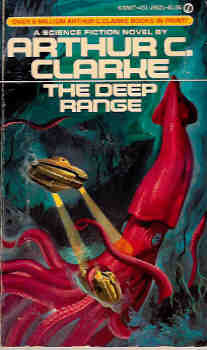


When I came across this book at one of my favorite bookstores, The Book Shop, in Hayward, CA, I was pulled in at first glance by the cover and then to the synopsis on the back:

"It is called Tethys - the first completely self-sufficient undersea research station, situated hundreds of feet below the Atlantic. It is the stepping-stone to a new frontier. Within this oasis of technology are those who seek to unlock the mysteries of the unknown deep. But they are not alone...Something is stirring from the very depths of the ocean. Something that may be the greatest discovery of all."

I was intrigued. And then I read this quote:

"The closest thing in years to Arthur C. Clarke's The Deep Range"

Now I was caught -- hook, line and sinker.

The Book Shop is a surprising little store that has many used books in the back behind all the new stuff.

I love the place...

...and..it..probably doesn't hurt that I have a huge crush on this short dark-haired beauty who works there, of course! ;)

Oh...kay!

So. I now not only wanted to read this book but I had to read both. And right away.

I bought the books a few minutes later and left (somewhat reluctantly).

You can read my review about The Deep Range here : http://www.goodreads.com/review/show/....

In short, I really enjoyed The Deep Range.

Oceanspace, on the other hand, did not live up to snuff.

First off, the character's, while fun to get to know, were cut from the same cloth as Jurassic Park -- Which is ok by me! However...

The first half had the Jurassic Park formula down to a T. The second half failed, much in the same way but not as bad as Michael Crichton did with his own book, Congo, 10 years before he had mastered his own Jurassic Park formula. If you read my review of Congo, here: http://www.goodreads.com/review/show/..., you will know that the main reason why it failed there, as it did here, was because it had me asking the same question:

descriptiondescription

Meaning, the book's synopsis advertized it as being a cryptid aventure, taking place in the deep oceans below the undersea research station, Tethys, hinting rather enormously that something was stirring down there.

And that usually entails that it's going to be something BIG and it's probably what the whole novel is 'sposed to be about.

Well. It is. Kinda.

Only, it builds up all this Jurassic Park character development and tension, even to the point of having the whole good guys who are bad guys scenario and then?

NOT ENOUGH BEEF.

The creatures, what they are I'm not going to spill the full can of beans about, but will say, they aren't Kraken, Meg sharks, Leviathan's, or made-up monstrosities, and they are ferocious but, they aren't as magnetic as many cryptids and worse, they don't show up often enough for my tastes nor does it culminate in a well-needed confrontation of gigantic proportions.

If Oceanspace - cool name btw - had've taken the quiet, intelligent, route of The Deep Range with it's simple and yet complex reading experience, the ending would've probably worked flawlessly.

As it was, being more like a poorman's version of a Michael Crichton novel just didn't work to it's favor.

Realizing that Allen Steele is a three-time Hugo Award-winning writer, along with the fact he has won several other awards, I know he has put out stronger work than this.

I know that he won the Hugo Award for Best Novella in 1996 with, The Death of Captain Future, and again in 1998 for the short story, ...Where Angels Fear to Tread, and the Hugo for Best Novella, again, in 2011 for The Emperor of Mars.

This tells me he's most likely better at writing shorter fiction.

Not brilliant or spectacular but, a good page-turner, if you crave some ocean fiction and you either can't find something a bit better or you are just wanting to read this back-to-back with The Deep Range like I did which was fun.

*Pretty cool cover!
Profile Image for audrey.
695 reviews74 followers
April 2, 2018
Judith abruptly realized that she had seldom thought of Peter since she had departed Tethys nearly two days ago, even though she had left him in the company of a woman who was clearly interested in him. Between fruitless searches for sea serpents and hyperthermophiles, she had given scarce thought to her own husband. Perhaps this was forgivable in an ambitious marine biologist, yet nonetheless the pursuit of science was no excuse for negligence.

Synopsis: Toolbox ex-Navy sub pilot accompanies his marine-biologist wife and a journalist 350 feet below the ocean's surface on the chance of seeing a giant eel and running it down with his new experimental prototype sub. Instead, he chases after the evil French and sticks his hand down the journalist's pants.

So. I am a sucker for any book that involves great big mysterious things that live in the ocean, especially if they live in really inaccessible parts of the ocean and have a lot of teeth. And I always, always root for them to win.

I am even more of a sucker for these books if they feature dramatic fonts, pictures of futuristic diving bells on teal-blue covers and if I am shopping at the Goodwill or in the quarter-books barrel at Hannafords. It's a failing.

And starting in the late 70s, apparently the American publishing industry went bananas for these very same things, because Peter Benchley spawned an entire genre of the things with Clive Cussler, and thus, if I look carefully, I can find some true gems of 400-page sea-beastie snacktaculars.

Now granted, Oceanspace wasn't published until 2001, but it has all the hallmarks of its predecessors: Gritty, ocean-obsessed ex-Navy pilot with the failing marriage; feisty lady journalist who wears a skirt while visiting an off-shore diving rig; luckless good-guy bit players who provide set-dressing and drive the subs; innocent teen in the wrong place at the wrong time; a bad guy whose skin is several really really noticeable shades darker than the all the good guys'; and a toothy sea beastie with cold dead eyes who makes the book actually readable.

Oh, it's pretty much a one-person drinking game, this genre.

Peter Lipscombe is merrily tootling around in his experimental sub prototype saving whales from non-American bad guys when his old buddy Joe sends out a distress signal from his own experimental sub prototype. When Peter zips to the rescue, he manfully jumps into the ocean for no reason. Afterwards, Joe tells him what happened anyway: sea serpent attack.

STFU, says Peter, manfully.

No wai, Joe replies. I put the pix up on flickr.

N000000000000, wails Peter, no one can see them until my world famous marine biologist wife gets back from Dominica. She must see them first!

After a minute, Joe asks, how's the marriage going?

STFU, says Peter again, bitterly.

And from there we have plot-a-go-go. Everyone convenes on the Offshore Rig of Science and Peter shows the pictures to, well, EVERYONE HE CAN FIND ON BOARD. Including the journalist and her skirt. If you are thinking to yourself at this point, Peter, he has spent one day too few in Mr. Hyperbaric Chamber, you are very, very close. But no.

In reality, Peter Libscombe is a fucking toolbox.

It's not any of the aforementioned activities, exactly, nor is it how when he forgets he agreed to host his 17-year-old niece onboard the Offshore Rig of Science, after not having seen her for two years, he spends the first five minutes of their reacquaintance thinking two things: one, how he can use her "unexpected" visit to his advantage, and two, whoa, she's not fat anymore.

You realize, of course, that all these people are going to have to go down to the Offshore Science Station of Science (Three! Hundred! And fifty feet! Below the surface of the ocean!) and make each other homicidal, right? Well, as soon as they all arrive down there, and Peter is giving a tour to his niece and the skirted journalist, this happens:
"Hey, Uncle Pete?" Andie interrupted. "Not to make a big deal about it, but I gotta change into something warmer."

"Sure...but you better get used to getting undressed in front of other people. Things get pretty tight in here sometimes, and there's always someone using the head when you want it."

Andie grumbled something under her breath as Peter turned his back to her and Leslie did the same.
And on the next page, he tells them both about exactly how he strips down to his underwear, and then takes a moment to reflect that these two little fillies seem to be on the verge of fighting over him! Whoa!

Um... Seventeen. Niece. FUCKING. TOOLSHED.

As I personally am not blessed with any offspring, I am writing this as the disinterested party who sits over here on the couch and marvels drily at society's foibles, but, for those of you who have seventeen-year-old offspring*, if you were to learn that one of your siblings (or sibling-in-laws) had behaved in this manner, what, pray tell, might be your reaction?

Me? I really, really wanted the sea serpent to eat that dude. That or for his wife to speargun him in a particularly exciteable area. Like the lab, for instance.

However, Mrs. Lipscomb kind of deserves Peter. Apparently world-famous marine biologists do precious little biologing in the marine because they have to run around being ruthlessly infantilized and belittled by the text. No, not at all kidding:
She absently gnawed the fingernail of her left thumb until she realized what she was doing. An old childhood habit she had never completely overcome.


She's the designated coffee server, because female, and she constantly apologizes for interrupting when the men are talking and has no problem being called "dear" by her colleague.
...this was just the sort of adventure that makes little girls from Bangor, Maine want to become scientists in the first place. She had met marine biologists twice her age, many of whom had been actively studying deep-ocean life when she was trying to get a date for the senior prom.


Crying jag? Check. Dropping all attempts at science to scream at the other woman in public? Check. Snapping repeatedly at everyone who's helping her do her science? Check.

And once we're all down in an enclosed space and feeling claustrophobic, nauseated and on-edge from the possibility of being Sea Serpent Chex Mix, cue an invasion by the evil Gitane-smoking French! Rar!

Also, how is it possible we're still standing for books where the only people of color are the villains? Come the fucking ON. There are a half-dozen white scientists in the Diving Bell of Science and one black one. So who would you suspect is the scientist selling secrets to the French? I know! Dead giveaway, right? Is it because he longs to escape the poverty of his third-world youth?

*pause for a teeth-grinding break*

Other than that, it's a sea of lilywhites. Oh wait, I'm wrong. There's one other black dude, who Mrs Lipscomb describes as reminding her of "Queequeg, the Polynesian harpooner from Moby Dick; all he needed was a beaverskin top hat and a shrunken head" -- good gravy, y'all. He's there to drive the smaller sub while everyone else screams about sea monsters and underwater volcanoes.

Seriously, he has the least number of lines of anyone on that mini-sub.

And then there's the journalist, who's Asian, so of course, she's "an expert at the art of seduction", and so little lacking in morals that when her attempts to seduce Toolbox Pete fail**, she decides to go from writing a balanced article on the research to a smear piece that highlights the top secret thing she's been told she's not allowed to see, mention or write about. And she explicitly says that it's because she couldn't get more than Pete Lipscombe's hand down her pants.

And the book is listed as science fiction.

As an added bonus, Toolbox Pete's wife suspects he banged the journalist but wisely decides not to you know, ASK HIM, because she figures ask no questions, be told no lies. Instead, suffer in tortured wounded curiosity.

And I add this bit at the end because it's very possible that as an author, you could set up that situation in fiction and create pathos and empathy and draw a finely nuanced picture of a doomed marriage. You could highlight Mrs. Lipscomb's treatment by the others and her own responses and make commentary on that and I would praise your insight to the heavens.

You could even draw the situation where Pete's behaving inappropriately as long as it was handled ENTIRELY DIFFERENTLY. Like, where someone is aware of the situation or either of the two women respond to it, or he's caught, or he realizes he needs help and possibly to throw himself out the nearest airlock.

But there's none of that self-aware analysis going on in this book, so I have to take it at face-value that, ladies and gentlemen, the hero of our underwater adventure story is the type of man who thinks, "he would have dearly loved to blow a torpedo up their ass" while gunning after the evil French in his experimental sub.

I want my quarter back.


*Not that I am, for a moment, intimating that any of you are old enough to have 17-year-olds. No. You're all looking beautiful, babies. Beautiful.

**That's right. Pete lets the journalist get into his bunk, kisses her, looks down her shirt, sticks his hand down her pants and then tells her he's sorry, he can't go through with it because he just can't cheat on his wife. So for all of you who are wondering where the lines are drawn in that situation, there you go. One hand, in the pants, for free, and it's still not cheating. GO TEAM USA.
Profile Image for Joah.
12 reviews4 followers
September 4, 2018
Good science and submarine scenes! To much TV drama...
Profile Image for Jaq Greenspon.
Author 14 books77 followers
December 15, 2013
Ouch! I'm a HUGE fan of underwater stories. Doesn't matter what the general plot is, be it monster or character, I'll go to it like a...well...like a fish to water. So when I first caught sight of Allen Steele's "Oceanspace" needless to say I was very excited.
What a bad move that was.

You'd think someone of Mr. Steele's reputation (the dust jacket AND the imprinted cover proudly exclaim he's won TWO Hugo awards) would proof read the manuscript before allowing it to be published. There are so many typos (missing words, words out of order, etc.) that the book was barely readable to begin with. People make mistakes. I could forgive this if the story was so unbelievably good it held my attention completely. Unfortunately, that wasn't the case here.

In Oceanspace (which is Mr. Steele's way of comparing the underwater world to what's outside our atmosphere; not the most original of metaphors) the general writing feels like it went through the typewriter once, with hardly a glance down, and then was sent off to a publisher to fulfill a contract. Characters are referred to by both first and last names repeatedly, which is good because they are so non-distinct this is the only way to tell them apart.

Once we get past the names, the characters become such stock stereotypes I find it hard to believe this writer has ever been published before, much less won awards (Wait, no, if he has won awards, then the people at he publishing houses must thing we'll buy anything and they don't have to worry about quality). We have the couple on the verge of a break-up; the temptress bitch who has her own agenda, the plucky teenager who comes through at the end, and the older, wiser teacher who, no matter what, must impart a final lesson. The only reason we know anything about these people is we are told what to think about them. Their actions are NEVER defined by any motivation other than Mr. Steele needing them to act a certain way to drive the plot forward.

Speaking of the plot...where was it? There were several stories going on, but none of them carried any emotional weight. The sea monster storyline (which started the book off with some great moments) was dropped as quickly as the Serpent disappeared into the briny deep. The high tech espionage bit was never explained enough to let the reader know what was at stake. The reporter who was there to do an in-depth piece on the habitat and it's people but instead went looking for a cover-up was the most blatant plot device of all. And as for Andie, the 17 year old who just happened to be visiting her aunt and uncle when everything went down...why were her parents fighting? The book was set in the year 2011, presumably so the technology to make an underwater research center would be realistically present. And yet, everything else seems to have stood still. Our favorite teen listens to music she wouldn't listen to as a 17 year old today. The submarine operators (who are at a premium for space) still elect to carry CDs (in their jewel cases no less) rather than opt for MP3 or its futuristic equivalent.

The one nice thing Mr. Steele does, however, is name a couple of glorified extras (who come in near the end of the book) after Jack Williamson and Fred Pohl, who wrote a trio of underwater stories in the 50s. At least he's tipping his hat in the right direction.

Ultimately, though, the book just doesn't work. While some of the technical detail is nice, there's not enough of it (and it's not accurate enough) to make it okay to jettison the characters and plot. If you're reading this looking for a good underwater adventure...don't hold your breath.
Profile Image for Laurie Green.
Author 14 books32 followers
March 13, 2010
The year is 2011, and it's undersea vessel vs. sea monster.

That's the suspenseful opening of this good science fiction/suspense released in 2000 that weaves a tale of scientists, subs, undersea vents, and industrial espionage. Although the story doesn't center on the monster, it does make more than one appearance. Although the characters were a bit flat, I was still caught up in their story--especially the relationship tension between Peter, and ex-Navy seal, his wife, Judith, a scientist, and an ambitious female reporter. I didn't really see the point in the neice's character arc--and her presence was also a bit of a stretch at times. Personally, I think it could have been a better story without the distraction of this teenage character.

The technical and mechanical explanations were well done and imaginative, but at times I skimmed some of the lengthy descriptions to get back to the character's story. After the shocking opening, the story dragged a bit until the last third, but from there it was a fast read until the conclusion.

This book had quite a few errors such as typos and missing words (where was the editor?), but most didn't detract from the meaning being conveyed.

All in all, I'd recommend it to anyone who has an interest in ocean exploration and discovery.
Profile Image for Seawater.
52 reviews2 followers
January 14, 2012
So, it starts off fairly interesting, with a dramatic attack by a somewhat mysterious sea monster. However, very little of the book is actually about the creature and even references to it are few and far between.
The next couple hundred pages are filled with inane blather between a handful of overly unimaginative characters.
Eventually, right near the end, some actual events happen. Sadly, they werent all that interesting.
It all reminded me of an episode of Seinfeld. We follow a small group of annoying people around their incredibly pointless lives where nothing really happens.

The author obviously went to a lot of work to make everything sound right, but that really doesnt save it.
Profile Image for Sotto.
55 reviews1 follower
September 22, 2023
NASA spent over $28 billion to send astronauts to the moon during the Cold War. In more recent years, Elon Musk's SpaceX has launched over 250 rockets into outer space using mostly reusable rockets, with companies such as Virgin Galactic and Blue Origin launching more than 100 space vessels in total in order to compete in the super-orbital pissing contest that has defined much of space exploration in the last two decades. The total expense of these private endeavors tops $600 million by conservative estimates, considering materials and fuel alone.

Written in the early 2000s, Steele's Oceanspace attempted to answer the question of what would have happened if humanity had devoted a comparably large degree of mental and financial resources to exploring the oceans instead. Or that's how I think of it, anyway.

Honestly, this book is a bit difficult to review, as it seems to have one foot on science fiction, one foot on espionage thriller, one hand on horror, and one hand on romance drama. Unfortunately, it doesn't quite deliver on most of them. If I were the executive producer of a film based on this book, I would be asking, "Who is your main audience here, Steele???"

What it does well is to provide us with a believable schematic of a sea-based research station - with one part of the installation floating on the water (anchored with cables to the ocean floor) - and one part submerged at the bottom. It also informs us of the kinds of difficulties one would expect when conducting deep sea research: pressure adjustments, low visibility, heavy dependence on sonar, limited ability to communicate using satellites, and perhaps an encounter with a Serpent of Unusual Size (SoUS!). However much the technical specificity of the sea station makes it feel true-to-life, one is left feeling that the characters, minor plot twists, and overall setting add up to something less than the sum its parts.

One of the issues with this narrative is that there are too many characters, few of which are really likable, relatable, or even impressively cool. There is a U.S. Navy vet who pilots an experimental mini-submarine who is married to a cryptozoologist. There is a Dominican marine biologist who was mentor to both of them. The Navy vet's self-conscious, teenage niece, who is on vacation. A submersible "truck" pilot. A too-close-to-stereotype cunning Asian reporter for some high profile magazine. And a barrel-chested sea dog with a sob story about his father. Even when not totally one-dimensional, most of these characters didn't really do or accomplish anything that really impacted the course of the story. Instead, it seemed like the claustrophobic interior of the submersibles described in this story somehow affected the author's own perception and psychology to result in a story in which many people try to do things, but most of them fail without learning anything from the result. Overall, Oceanspace is an adventure of frustratingly small scale and emotional consequence.
Profile Image for Matthew Kresal.
Author 36 books49 followers
March 27, 2021
It is often said that we know more about the surface of the Moon or Mars than we do about the ocean floor. It's no wonder then that science fiction writers have often delved into its depths and what may lie in often miles of water that separate the surface from the ocean floor. Allen Steele is one of those writers who has traded outer space for "oceanspace," as he named this 2000 novel. A work that, at its best moments, takes readers miles below the ocean surface in a high-tech but potentially dangerous world of exploration and exploitation set in the then near-future. Yet, Oceanspace suffers from the same problem I had with Steele's The Tranquillity Alternative a few years back: the uneasy combination of a thriller that takes forever to kick in alongside SF elements. To the point, in fact, that the novel is halfway over before most of the characters have even arrived at the sea base. The characterizations are also a mixed bag, ranging from cardboard to laughable, not to mention riffing perhaps a little too close to James Cameron's The Abyss (and Orson Scott Card's novelization of it) for comfort at times.

Oceanspace is a decent read, especially for anyone seeking out SF set under the waves. But it isn't a great one, and it certainly isn't the thriller that Steele tries to force it to be. I'd love to have see this as a more straight-forward SF novel and with a different set of characters.
90 reviews1 follower
March 5, 2020
Title:A strange attack by an unknown creature brings intrigue and danger to an undersea base.

A routine maintenance run is disrupted by the attack of an unknown creature. The pilot captures a clear picture right before he ejects from his craft. It is something that shouldn’t exist. Luckily for him he knows someone that might just believe his story...

This is the incident that brings a wide range of characters to the undersea station Tethys. A researcher with a side hobby of crypto-biology, a professor with hopes of securing his future, a teenager who thought she was going to be hanging out at the beach on her vacation, and a reporter who is hoping that her expose will be what puts her on the front page.
All these people will be drawn into events that will change their lives and show them that sometimes the mysteries of the sea aren’t the ones that are the most dangerous.

My Thoughts:
I thought this was a pretty good read. Like most of this authors stories, this one takes place while normal people go about their normal lives. Something happens, but it is usually not the focus of the story until the characters get dragged into it somehow. It’s different and makes the story more enjoyable. If you like sci-fi with a realistic approach give this one a read.
Profile Image for Tim Martin.
872 reviews53 followers
August 6, 2017
_Oceanspace_ by Allen Steele is a near future undersea thriller set in the year 2011 (well, near future at the time of publication), one that seemed pretty believable, a story that could occur at some point, though I think perhaps not as soon as the year of the novel's setting.

The primary locale of _Oceanspace_ is the largely self-sufficient undersea research station _Tethys_, located off the coast of Florida (a map would have been helpful but not essential). Actually, _Tethys_ is two stations. Above the waves is a facility not unlike an offshore oil rig, _Tethys 1_ which contains administrative facilities, a landing pad for VTOL aircraft, and other structures. The main research station, _Tethys 2_ is located 328 feet (100 meters) below, connected to _Tethys 1_ via a snorkel tube (which allows fresh air into the undersea habitat) and an interesting device called the OTEC (Ocean Thermal Energy Conversion) power plant, a series of large intake and discharge pipes, condensators, evaporators, and other devices designed to move cold water up from deep beneath the sea and warm water from the surface to run turbines to produce electricity, some of which is used to run desalination devices to provide water for the station. Moving between the two portions is not quick or easy, as _Tethys 2_ is under higher pressure, about ten atmospheres, and to avoid decompression sickness crew members must use special facilities to allow their bodies to adjust.

I found _Tethys_ well described and a believable and though I am certainly no expert, a workable design. The beginning of the book had a two page diagram of the station, focusing largely on the undersea portion, which I found helpful.

The primary purpose of the privately owned station (built and run by the Yemaya corporation) is to facilitate the undersea mining of manganese nodules on the seafloor, a service performed by autonomous robotic submersibles, which harvest from a designated portion of the seafloor and are periodically relieved of their cargo by a manned submersible. Almost as important though is the harvest and study of organisms collected from deep sea hydrothermal vents, "black smokers," which are used to produce lucrative chemicals and other biotech products. In addition, Yemaya rents out space on _Tethys 2_ to visiting marine biologists and geologists.

There are several plotlines followed in the book. One plot involves industrial espionage, the nature of which does not become evident until later on in the novel. I found that storyline pretty interesting and thought it had an exciting climax. A second plotline involved possible sea monsters; the first chapter, one of the best in the book, vividly described an attack on a manned submersible that was going to relieve a robotic harvester of its cargo of manganese nodules. The sub's operator, Joe Niedzwiecki, barely escapes with his life as the huge creature attacks and nearly destroys his vehicle. One of the main characters of the book, Judith Lipscomb, a researcher based at the station with her submarine operator husband Peter, became obsessed with the creature, as in the past tracking down sea monsters had been a hobby of hers. When a new vent field is discovered, she hoped to use the mission to map and survey it from a research submarine to investigate the wreckage of Niedzwiecki's submarine and maybe even spot the creature. Though I do not wish to give too much away, I found that thread not explored to the degree I would have liked it; the creature in the end pretty much remained a mystery. I imagined maybe some huge revelation, a major discovery, maybe people fighting for their lives on _Tethys 2_ (thinking that perhaps this was why Steele went to such efforts to describe the facility) but alas that was not to be.

Other plotlines involve the interaction of the various characters. The Lipscomb's play host their niece, Andie Lipscomb, a seventeen-year old allowed to visit her aunt and uncle, and she went from some resentment at being there to being a valuable addition to the mission. I am glad they didn't make her out to be some sort of supergenius; I found her pretty believable, though I thought she had access to more things than would be probably happen in real life. The station also was host to a visiting reporter for _Millennium_ magazine (apparently a hipper version of _National Geographic_), one Leslie Sun, an aggressive, underhanded, pushy woman with designs on Peter Lipscomb, attempting to seduce him. I found her pretty one dimensional, put there to be hated, and didn't care much for her character. I have seen journalists beat up in other novels and while some certainly believe they may deserve it I don't know that I do. Still, she was integral to some of the other plots.

Not a bad book, it had a good pace. I found the dialogue almost a tiny bit corny at times; not most of the time, most of the time it was fine, but just once in a while I would roll my eyes at some exchange, particularly the occasional joke or humorous remark. Occasionally an emotional reaction did not ring true with me, such as in one instance when a very upset Judith started laughing over some off-color remark made by someone else. As I have said, I wished that the sea monster angle was better explored, though I guess Steele was going for mystery rather than revelation. The overall story was believable, and except for the habitat itself and the level of technology on some of the submarines, the story was almost not science fiction, more of a straightforward thriller. It was apparent that for the most part that Steele had done some research, proudly noting that with a two page bibliography.
Profile Image for Marti Dolata.
278 reviews34 followers
January 23, 2019
Think cheesy 70's B movie novelization and you've got this book. Cookie cutter characters, plot and dated stereotypes. Check out Audrey's masterly review for all the fails. I've read other novels by Mr Steele which is why I read it to the end, but he phoned this one in. He can do a lot better than this, but he had dropped off my buying list of authors. Glad I got this one from the library. Rating system 5 buy it now, 4 excellent of its genre, 3 average, 2 waste of money, 1 waste of paper.
Profile Image for Paul Olkowski.
162 reviews7 followers
April 25, 2023
Oceanspace isn't so much a sci-fi book as it is a mild thriller. It starts out very well but levels out to a well written thriller with a quick climax that leaves the reader asking is that it?
Allen Steele writes well and keeps the reader interested in the narrative. his grasp of detail is first rate but his storyline was too simplistic. I expected a much better and deeper story about sea monsters, than a story about corporate betrayal and secrete selling.
3.5 out of 5 for OCEANSPACE
Profile Image for Vince A..
Author 1 book
November 29, 2019
12/4/2016 journal entry: "Another 'shrug, shrug, LAME!' Cliche-filled, over-yammered, no-action (specifically on the so-called 'sea monster' on which the story supposedly revolved having only 2 brief cameo appearances withou any hint of takng advantage of potential. Come on!"
Profile Image for Allan Beatty.
144 reviews1 follower
May 21, 2024
Not one of the plot lines captured my interest. I also found a huge swath very technical and not interesting. Wasn’t sure what was technically feasible and what was science fiction. Glad I’m done, I suppose if your a diver or deep water submarine fan you may find this interesting, but I’m niether.
Profile Image for James.
71 reviews3 followers
May 5, 2020
After reading the back and the first chapter..i thought it was going a different direction.. I still ate it up
225 reviews6 followers
May 21, 2020
I've gone through my all - I think - of my unread Allen Steele books this past couple of weeks so maybe that made me feel that it was easy to predict how things would turn out at the end.
Profile Image for WayBackWhen.
201 reviews
Read
June 7, 2025
DNF at 32%. Not enough here to make me want to continue.
Profile Image for Stacie Ruggiero.
14 reviews
February 21, 2017
I love a good sci-fi book. I thought this was well written and it kept my attention.
Profile Image for Bryan.
326 reviews7 followers
November 9, 2010
I really enjoy Allen Steele's novels! He certainly writes the kind of SF that I enjoy - big ideas, scientifically accurate details, and decent characters.

This one is a real treat - under the ocean in submarines, undersea habitats, deep sea diving suits, remote ROV units, etc. Highly recommended for anybody who's ever enjoyed a submarine movie. (But there is so much more here than just submarines! The pressurized habitat alone provides plenty of freaky phenomena for your mind to puzzle over and ponder...)

If there is a complaint, it may be that the plot's conflict is too compartmentalized. Hopefully avoiding spoilers, there's the sea serpent, then the spy ring, then the new ocean floor vent... Each seems separate and disjointed. Steele ties them up at the end, but guess which 2 will converge on each other?

All in all, this was a splendid way to spend a few hours. Well done, Mr. Steele. And more, please.

Oh... and bonus points for referencing the "The Undersea Trilogy" of books by Frederik Pohl & Jack Williamson. A nice gesture! Watch for them in the last handful of pages. (Got to go check out those books soon...)
Profile Image for John Loyd.
1,383 reviews30 followers
April 7, 2015
Oceanspace (2000) 370 pages by Allen Steele

Excellent. Good characters, good storyline, good science fiction elements.

Joe is on a routine mission to pick up from the ocean trench what the mining robot has harvested. He's just on his way back when he's attacked by some gigantic sea creature.

Peter gets back from a test run of the top secret one man sub, about the same time Joe is rescued. Judith says it better be something good when she receives a call interupting her vacation.

Meanwhile 17 year old Andie Lipscomb is on a plane heading for what she thinks will be her Florida beach vacation with Uncle Peter and Aunt Judy. Well, not quite, it's the reseach station 90 miles off the Florida coast. At least Andie handles the plane ride better than the vixen reporter.

When everyone gets together to decide what to do about the creature, a new thermal vent, with it's potential new profitable lifeforms, is seismically detected.

They can't really ask for a sub to check out the creature -- too many people would think it a hoax -- but the vent allows them to get the sub and they can swing by on their way...

It was a great story whether you got your vicarious thrills putting yourself in the position of Andie, Peter or Judy.
Profile Image for CleverBaggins.
245 reviews2 followers
October 16, 2016
So this book was ok, but it wasn't scifi and it wasn't what was promised at all. The description said that we built our first self sustaining deep sea station and awaken "something" from the deep. I was excited for monsters or aliens or who knew what. This had a sorta monster that shows up a little but mostly not and described a lot of how things work or could undersea. Like I said, it was okay.

Now, I'll admit I am/was a HUGE fan of Seaquest DSV back in the day and I guess maybe that's what I was hoping for? Or something along those lines of those movies that came out in the 90s I think. Abyss? It's been forever since I thought of the but I adored them growing up and I guess expected something like that. This wasn't it.
Profile Image for Reese Copeland.
271 reviews
September 18, 2011
While I did enjoy the story, and the struggles of the characters, I found the lack of appropriate editing to be really distracting. Words left out in some sentences, words added to others that didn't make sense. Steele describes the atmosphere of the ocean and the cold vastness of it really well. You really come to no conclusion regarding the creature that's encountered, which sometimes I like in a story. However, in this case, as that's how the story began, it was really disappointing to have that left as a loose end.
Profile Image for Beck.
53 reviews1 follower
October 1, 2013
Not bad. An easy read. I wouldn't call it "a significant work" like the book cover does. Very little happens and there is little payoff in regards to the opening pages which are quite thrilling.

I would recommend Coyote if you're looking for something from Steele. Or, if you're looking for short fiction from Steele, The Days Between is one you can actually find in its entirety online. I think both are stronger than OceanSpace.
Profile Image for Angraecus Daniels.
Author 6 books4 followers
September 4, 2014
Steele has written better. Oceanspace has too much exposition and intrusive background information. The characters are trite and poorly developed. The plot literally goes no where. It kind of reminded me of the pilot episode of SeaQuest DSV; spending way too much time on the environment and not enough on character or story development.
Profile Image for Craig.
6,330 reviews179 followers
July 25, 2009
A very good under-sea story; Steele translated his fascination with space exploration with remarkable skill to this submarine adventure. The characters are very well developed, especially the main scientist and her family.
Profile Image for grundoon.
623 reviews12 followers
September 21, 2012
3.5 I may never understand how so much technical attention to detail can coexist with so much schlock elsewhere. Enjoyable for the well-researched oceanographic tech, but you'll probably want to slap the plotting around during especially ludicrous moments.
Profile Image for Laura.
364 reviews
October 10, 2013
WE ALL LIVE IN A BITCHY SUBMARINE / A BITCHY SUBMARINE / A BITCHY SUBMARINE

I can only assume this was written during a time when women were really working the author's last nerves. Every female character is manipulative and annoying as hell.
Profile Image for Thomas.
2,690 reviews
August 2, 2015
Steele is clearly influenced by Arthur C. Clarke, and this book imitates Clarke's dry style, but the scientific ideas are not as original and incisive as Clarke typically produced. That said, it is entertaining.
Displaying 1 - 30 of 36 reviews

Can't find what you're looking for?

Get help and learn more about the design.