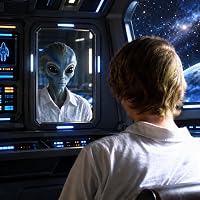
Scott Sigler has set the stage for intergalactic war heading into Alone, the final leg of the Generations trilogy. Em, Bishop, Spingate, Gaston, and the other Birthday Children have subdued the planet Omeyocan and learned to live at peace with the Springer alien race, but the danger is far from passed. Matilda Savage and the rest of the Grownups hover in orbit on the Xolotl starship, awaiting their opportunity to abduct the Birthday Children and overwrite their own consciousnesses into them. O'Malley, the love of Em's life, has already been overwritten by his correlating Grownup, prompting Em to kill him to free him from the prison his body had become. Sensors indicate that multiple starships from various corners of the universe are en route to Omeyocan, and the planet's history strongly suggests that when foreigners come here, their intent is to make war and colonize. On top of these problems, Em's people and the Springers show symptoms of an increasingly violent disposition, and keeping peace is difficult. Will the Birthday Children even survive until the alien ships approach Omeyocan?
"When evil comes, you can't always talk to it—sometimes it must be destroyed."
—Alone, PP. 44-45
Em detects a menacing presence deep in an underground grotto, and heads down to check it out. It turns out her excavators' instinctive fear of poking around in here was justified: Omeyocan is host to a creature of enormous psychological power, who sends irresistible signals to far-flung civilizations to come tend to its desires. Suddenly the many starship migrations to Omeyocan make sense: these species didn't all build spacecraft and travel unimaginable distances to settle the same planet by coincidence; they were directed by an intelligence far more sophisticated than their own. Even if Em's people fend off the starships already on their way to Omeyocan, more will come, bringing barrages of military might until the Birthday Children are wiped out. Establishing a longterm colony on this planet of war isn't feasible, but what will Em's people say if she demands they leave? Will they take her word and abandon the planet their bodies and minds were engineered to inhabit?
"(R)eality is what it is whether we like it or not."
—Alone, P. 432
There's no time to agonize over their options. When aggressive aliens that Em calls the Wasps alight on Omeyocan, the Birthday Children go on the offensive, but eradicating the Wasps won't be easy. Attacks brought by the Springers end in massacre; they're no match for the heavy artillery of the Wasps. Once the invaders realize the Birthday Children pose little more threat than the Springers and launch an assault, Omeyocan will be uninhabitable for Em and the other humans, but are their odds better in outer space? With the Grownups waiting to nab them if they stray into the Xolotl's range, Em must choose between two evils, and her people aren't making it easy. Fueled by the bewildering rage that's infected them since they came to Omeyocan, the Birthday Children need more than a strong leader who can convince them to flee the Wasps and take their chances in deep space: they need a miracle bought by self-sacrifice on the part of Em and her inner circle. How much is Em willing to give up so the human race might live on?
"Sometimes courage is carried by a roar—sometimes it is hidden within a wavering voice."
—Alone, P. 495
I have a harder time judging Alone than most novels. It's a long book, and feels long. The action scenes aren't especially compelling, and I can't say the narrative crackles with emotion or immediacy. But there are themes that can't be ignored, which lend the story emotional resonance. What stance should a moral society take on torture? It's simple to say it should be outlawed, maybe too simple. Do you forgo torture in extracting information from terrorists, even if that means innocent people die? Are the lives of citizens who trust you to protect them worth trading for the ability to say you won't stoop to torture? If torture is allowed in certain circumstances, is it inevitable that eventually it will be allowed in any case where someone withholds information? Does permitting torture guarantee that innocent people will someday be subjected to it? The climactic scene dealing with this subject in Alone is graphic and haunting, and has repercussions for the rest of the book. Themes of personal identity and consciousness are also a hallmark of Alone. Can humans cope with immortality if technology makes it possible? Time changes a person, as we see from Em and her Grownup counterpart, Matilda. Can only one of them peacefully exist in the universe? Matilda is more than 1,200 years old and Em has only been conscious for a year, a canyon that seems unbridgeable. Is emotional and intellectual reconciliation possible between our past and present selves? It's someone else who helps Em discover the answer to that in the poignant ending to Alone, someone who loves her dearly and would sacrifice anything to merit her love in return. That sacrifice brings the Generations trilogy to a surprising, beautiful finish. At one point in Alone, Em asked herself, "Why do I only discover my true feelings for people when it is too late to do anything about them?" Now, after a lifetime of loneliness, maybe that can change.
"We don't have to be bad forever. We can fight our urges. We can choose to be good."
—Alone, P. 525
I'm not sure I'd label myself a fan of Scott Sigler, but Alone proves he knows how to close a trilogy. How do I rate a book of such ups and down, long stretches where I felt bored mixed with scenes of unforgettable emotional connection? I'd give it two and a half stars, but the dividing line between rounding up or down could not be more tenuous. Either way, I'm not sure my choice will be the right one. This series had loads of potential and Scott Sigler fulfilled some of it, but I can't help thinking that if Neal Shusterman had been handed the story idea to write however he saw fit, the Generations trilogy could have been one of the greatest in YA history, a mindblower. I lament the missed opportunities even as I appreciate what Scott Sigler accomplished. After nearly 1,300 pages, I'm ready to say I liked this trilogy. I know I'll always remember it.