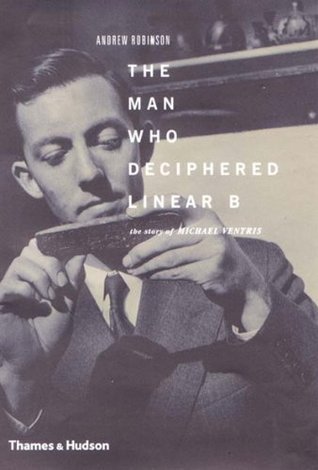
More than a century ago, in 1900, one of the great archaeological finds of all time was made in Crete. Arthur Evans discovered what he believed was the palace of King Minos, with its notorious labyrinth, home of the Minotaur. As a result, Evans became obsessed with one of the epic intellectual stories of the modern era: the search for the meaning of Linear B, the mysterious script found on clay tablets in the ruined palace.
Evans died without achieving his objective, and it was left to the enigmatic Michael Ventris to crack the code in 1952. This is the first book to tell not just the story of Linear B but also that of the young man who deciphered it. Based on hundreds of unpublished letters, interviews with survivors, and other primary sources, Andrew Robinson’s riveting account takes the reader through the life of this intriguing and contradictory man. Stage by stage, we see how Ventris finally achieved the breakthrough that revealed Linear B as the earliest comprehensible European writing system.
(William) Andrew Coulthard Robinson is a British author and former newspaper editor.
Andrew Robinson was educated at the Dragon School, Eton College where he was a King's Scholar, University College, Oxford where he read Chemistry and finally the School of Oriental and African Studies in London. He is the son of Neville Robinson, an Oxford physicist.
Robinson first visited India in 1975 and has been a devotee of the country's culture ever since, in particular the Bengali poet and philosopher Rabindranath Tagore and the Bengali film director Satyajit Ray. He has authored many books and articles. Until 2006, he was the Literary Editor of the Times Higher Education Supplement<?em>. He has also been a Visiting Fellow at Wolfson College, Cambridge.
He is based in London and is now a full-time writer.
Librarian Note: There is more than one author by this name in the Goodreads data base.
This is a great book about the amazing, tragic and short life of Michael Ventris, "the man who deciphered Linear B", as the title usefully informs. The life of Ventris is rather typical of his circle of boys from "a good English family" born in the early 1920s: a good boarding school (one of his classmates was Christopher Robin Milne), war service during WWII, decent education (though in Ventris's case, not a university, and nothing academic at all, only architectural training). There are at least two amazing facts about the decipherment which are immediately obvious to a non-specialist: first, that Ventris was a non-specialist (though an extremely gifted linguist in the everyday sense of the word, which is quite rare among professional linguists), an amateur, an outsider — there are thousands of such amateurs in every walk of life these days, especially in the area of decipherment, and they are completely mad; the story of Ventris should serve as a reminder to all of us, because anything can happen. Second, he had been pursuing a certain hypothesis throughout most of his work, and then, when he saw that the facts were against it, dropped it in the blink of an eye; this is a feat of intellectual courage of immeasurable scale. Clearly something bad was happening in his soul, especially in the last months before his tragic and untimely death. I have an impression this often happens to Englishmen who are blessed, or cursed, with huge intellectual abilities (one of John Fowles's novels, Daniel Martin, is all about such a predicament). Robinson tells a compelling story; the book is a real page-turner; without boring his readers with arcane technical details, he still provides enough information for us to grasp the sheer brilliance of mind needed for the discovery such as described in the book. I can't recommend it vigorously enough.
This book is best read as a companion volume to "The Decipherment of Linear B" by Chadwick, Michael Ventris' collaborator. "The Man Who Deciphered Linear B" focuses on Michael Ventris' life, which, frankly, was not particularly interesting (and which was of course cut short by a car accident in his thirties). The author tries to tie in Michael Ventris' training as an architect to his succcess in deciphering Linear B, but he failed to convince me that one skill contributed in any way to the other. He does not go into the intellectual and technical aspects of the decipherment of Linear B in much detail, feeling apparently that those were sufficiently covered in Chadwick's book. He stresses that Chadwick gives an overly rational account of the thought processes that led to the decipherment of Linear B and that in reality, Michael Ventris' progress was a mix of reason, intuition and leaps of imagination. Be that as it may, I would recommend Chadwick's book for anyone seriously interested in trying to follow the intellectual quest of the decipherment of Linear B, and "The Man who deciphered Linear B" for those who want a lighter version.
This is an enjoyable and fascinating biography of Michael Ventris. He trained as an architect but to his dismay in the mid-twentieth century after the war had destroyed many buildings, he did not get to design or build many projects. From his school days he had been interested in Linear B, the script found on clay tablets in the excavation of Crete and Aegean cities. Sadly his wife did not share this interest.
The name Linear B is given because figures are drawn onto a straight horizontal line and clearly the lines start at the left because some finish halfway. A more basic version from an earlier period was dubbed Linear A. This has still not been deciphered. By this time the hieroglyphs had been deciphered and many scholars of early languages were working on the Cretan puzzle. Some of these people had helped to decipher enemy codes during the war.
Ventris was first to write down his own studies and share them out among the scholars, asking for their feedback and progress which he would circulate. The scholars, which included one woman, were used to jealously hoarding their knowledge, with no central access like today. Ventris however was a fluent speaker of many languages and well travelled, and he saw no reason to keep any knowledge to himself. He did not have the faculty and funding issue of professors, I suppose, though that is not covered. He was also outside the field so they may have resented his intrusion. Each scholar was timid about sharing for another reason - whatever they proposed was likely to be scorned publicly by others. One person had suggested that Linear B script was an early use of Greek, but most people including Ventris thought it must be a Minoan dialect drawn from Etruscan.
As well as promoting discussion and sharing, the great leap Ventris made after many years of work, was to assign the names of towns such as Knossos to some characters, leaving out the final S. There was no great evidence but it would have been better than a guess as syllabic values had been assigned to many characters while others were clearly men, horses and tripods. Once towns were named the rest started to fall into place. Further tablets were constantly being discovered and one turned up which proved the hypothesis. Linear B was archaic Greek.
As well as the portrait of this highly talented man, the book notably introduces us to the topic of deciphering scripts. While not a step by step guide, it allows us to see the methods used at the time and results. The first clay tablet shown is covered with angular squiggles. By the famous tripod tablet at the end, the reader is saying 'of course that is Greek, what else could it be?'
I recommend this read. For those wanting a shorter version, a chapter covers the decipherment in The Code Book by Simon Singh.
Was captivating at first, introducing me to a genius I've never heard about in a field I'm always interested in - language. But by the middle of the book I still felt I didn't get a good explanation of how the deciphering of Linear B was achieved, and felt a little bit confused about all the rest of the information thrown at the reader in a quite disorderly way. The book sort of lost me and I lost the track. I managed to pull through and enjoyed the ending, but I wish this book was edited better and had more information and clear explanations about the actual deciphering work.
I'm going to ding just one star, but for multiple reasons. Normally, I'd be a lot harsher, as the errors could easily have been avoided and there's no excuse for that. In this case, though, none of the errors really change anything. The historical facts are essentially correct, the chain of cause and effect in the decypherment is fundamentally sound, the errors are purely ones of bias, with touches of insufficient research in places. A single consequential failing equals a single star of penalty.
It's clear the author is highly caught up in Ventris' brilliance (and he was brilliant) and the failings of centralised, proprietary research (a known problem in academia). Both points are valid, although it should be pointed out that centralised researchers are capable of brilliance and that being independent doesn't make one brilliant. It's a complicated world.
The new-fangled "s's" is annoying but in style guides and grammar texts. I dislike it intensely as it is disruptive to smooth reading and worsens the correlation between written and spoken English.
Some of those who played a crucial role in decypherment are given insufficient acknowledgment and credit. That matters in this game we call academia.
Unfairness isn't merely a matter of who gets to see their name in print (many involved are dead, in any case), because of the way research is evaluated (and funded) and because of how libraries with academic sections try to figure out what is important enough to keep on the shelves, significant work that rarely gets referenced rarely gets seen. It's similar to excessive secrecy in the effect it has, it's very toxic. I have no desire to reward an author for the fact that everyone gets fairly treated across the literature as a whole, the author had no say in what others did and played no positive role there. There being no real harm done is happenstance and that's not a good thing to promote.
Nor did he invent the practice of not being secret. Archimedes and Euclid relied extensively on circulating ideas and documents being updated, preceding him by quite a bit. He didn't really develop the idea much beyond his strategy of releasing the worknotes early-ish and often. For real progress in this conceptual bazaar of ideas, you'd need to wait a decade or so and into a wide range of sciences.
However, as I said, these do not change the events or the processes. These are peripheral to the main story the book is about, which is the cracking of Linear B. This is not an instruction manual on decrypting languages, nor is it professed to be anyone's story other than that of Michael Ventris. It certainly isn't claiming to be a book on grammar! They are technical errors, not factual errors.
I never recommend buying just one book on how something was discovered, as omissions and contextual weirdness is inevitable. This is no exception. If you want to understand a discovery, get into the minds of the discoverers, mentally journey with them, you need both enthused narratives like this (nobody can learn from the dull) and objective but lively books.
Always start with the enthused, if you can, as you need to be interested to go further. This is a great book as your starting point on Ventris-spotting. If that's all you want, that's fine. If you're intrigued, as I am, on intellectual problems and challenges, this is only your starting point.
I will wrap up by saying that the three major breakthroughs in ancient texts (hieroglyphs, cuneiform and Linear B) all used very different methods. Yet other methods exist today. If you're eager to be Ventris Mk. II and solve the remaining unreadable languages, you have a chance but expect your reading list to have some really odd titles.
The book begins with an introduction to Ventris. It covers very briefly his childhood and schooling.
Next, the book examines early attempts at deciphering Linear B and various parties involved in the process.
The theories and slow progress Ventris makes are touched on next. Also introduced are theories and ideas from other scholars that Ventris was using to base his ideas on.
In his architectural education, Ventris then meets his wife. We see how neither of them are ideally suited for a relationship. Well, Ventris just seems to be so consumed with Linear B and unskilled at personal relations that we see this relationship rather minimized. Although his wife does appear consistently throughout the book, there seems to be little relation detailed between the two.
The time Ventris spent in World War II is detailed to a light degree. Next, some of Ventris' work in architecture is explored. To the credit of the author, this is done at a very rudimentary and cursory level as the book does not detail much of his formal career and instead focuses on his obsession with Linear B.
The reader's also introduced to Ventris and his exceptional aptitude for foreign languages. One wonders how this could have positively influenced or affected his abilities to decipher Linear B. Although this is not ever directly stated in the text, it seems like that is suggested as a possible foundation for recognizing his brilliance in deciphering Linear B.
Next, we see how Ventris worked with other people to crack the code. Although lots of ideas and possibilities were exchanged and explored, none of those were fruitful.
The reader then gets to see very briefly how Ventris tackled some of the deciphering process. This is presented at a very high and rudimentary level, but anything beyond that is well beyond the scope of what the book is trying to convey.
The reader then gets to see Ventris' recognition that Linear B is just Greek. After this recognition, Ventris is able to further explore and detail this relation. We see him sharing and coordinating with those that he has worked with previously. The reader also watches as his conclusion gains credibility within the community. Lastly, we watch as he compiles the work and co-authors the book about the process.
The book wraps up with the unexpected and untimely death of Ventris. Thankfully the book concludes very quickly.
The book is very uninspiring. I was not committed to the deciphering of Linear B. Perhaps if more speculation or potential had been teased in the process, I would have been more eager to see it decoded. But at the same time, it also appears that Linear B was only used effectively as an accounting language. With no literary or societal work recovered, Linear B looks like it was just used to track purchases and rudimentary societal things without any significant cultural or literary value. Nothing in the verbiage or style compels me to continue to read. Also, the character of Ventris is very boring. I never connect with him and so have little interest in his efforts.
If you are very interested in foreign language, you might find this book interesting. Otherwise, keep it the bottom of your "to read" list.
Probably one of the best books I've ever read. Ventris is described well and all-round, and the author's effort to gather together many witnesses and sources to enrich the biography is surely commendable. I also appreciated the 40+ pictures, but above all, those more technical and specific parts about Linear B, clearly explained and very useful as a revision for my historical linguistics final!
This is, as far as I can tell, the only biography of Michael Ventris. The book covers it all, from his childhood, through his World War II service and early family life, to the days of the decipherment and finally his disillusionment with the subject and early death in an automobile accident.
As a student of linguistics with much interest in the earliest Indo-European languages, I have long been familiar with data from Mycenaean Greece in syllabic transcription. However, I didn't know how Ventris came to breaking the original script. Robinson's biography is therefore a fine resource. At 160 pages, it gives an overview of the life of Ventris and how he cracked the code without wearing out its welcome on a reader still more interested in grammar than in cryptography. Robinson also fascinatingly puts Ventris' life in context, speaking about some of his more notable peers at school, his 15 minutes of fame in the layman's media, and his achievements as an architect.
The decipherment of Linear B is presented in admirably simple terms, sure to prove understand to anyone who is already educated enough to have developed an interest in the topic. The book is liberally sprinkled with figures, from facsimiles of tables to Ventris's own charts. As Robinson is writing for an audience, however, who doesn't necessarily understand Greek, this reader trained in the language found several points where Robinson could have entertainingly expanded on points had he focused on those with knowledge of Greek.
While I wouldn't say that familiarity with Ventris' life is a must for those whose work somehow involves writing systems or Mycenaean Greek, Robison's biography is entertaining enough. The stories of the crotchety scholars who resisted the outsider Ventris' discoveries to the point of embarassing themselves is sure to tickle readers aware of the uneasy society within academia.
Accomplished little book on Englishman Michael Ventris who deciphered Linear B the ancient Minoan script in 1952. An architect by trade and polymath (he spoke 10 languages fluently) he put aside his architectural work to work full time to solve this puzzle. Robinson ably documents what could have been dull- the analysis of 89 symbols which Ventris charted in numerous ways to find patterns of use. He compared Linear B to several ancient languages including Cypriot and Mycenaean- correctly identifying first which symbols were consonants and which vowels and second, figuring out what were suffixes and plural indicators. By degrees he worked it out by trying out inspired guesses. Linear B is a dialect of ancient Greek not Etruscan as Ventris long figured. Ventris' death by suspicious car accident in 1956 when he was only 34 remains a mystery. It might have been suicide.
Here's what I would say--I thought this would be a very exciting book about a very exciting person. Instead, it was a pretty standard book about a smart guy who just was kind of obsessed with Linear B, and also with architecture. He's an amateur who applied himself and cracked a pretty cool puzzle. But for me, it didn't go beyond that. As an intellectual biography, I was kind of like--okay! I bet I could have met this person and thought, huh, well, I'm glad he likes that kind of thing. I like genius biographies when the person is also nuts, or just has something strange about their brain. This guy, not so much. There was a lot of technical detail about the cracking of the language that I also was just like..well, okay! Not for me, but if you're into Linear B, I bet you'd like this.
This book accomplishes a lot on quite a few fronts: as a general introduction to the problems of decipherment of ancient languages, a profile on a really incredible individual, and shedding light on some of the contentiousness of academic work.
I strongly recommend this very readable biography of an extraordinarily gifted person. Made famous by his discovery that the written form of the language of the late bronze-age peoples of Crete and Greece was an early Greek dialect, Ventris was a fascinating person in so many ways. Andrew Robinson, with a training in classical Greek and the evolution of language, is an author well able to create this nicely written portrait of a complex genius.
Many of us have strong interests in some topic that may go beyond being a hobby. We may become expert enough to take part in a pub quiz or even 'Mastermind', at the risk of also being a dinner-party bore. Ventris' obsession with identifying the language represented by the eighty-plus symbols in the Mycenaean clay tablets went far beyond being a hobby. Trained, and mainly employed, as a post-war architect, he devoted as much time as he could to deciphering these symbols. Some aspects of his focus suggest a degree of Asperger's syndrome - common enough in many gifted individuals. The author mentions that many friends and close collaborators felt that they never got close to Ventris. That is not to suggest that he was aloof or secretive about his work: just the opposite. He made friends easily, was well liked, and was extremely open and generous in sharing his discoveries and even his thought processes with all the others who were working or interested in the decoding of Linear B.
Robinson's well-researched book reveals how extensively Ventris collaborated. Earlier biographies focus on his final collaboration with the Cambridge academic John Chadwick, with passing references to others. This book makes clear the extent of his collaboration: over thirty scholars, including Alice Kober (with whom he did not get on very well personally), the American scholar Emmett Bennett (they became good personal friends) and a host of archaeologists, classicists and philologists. It was a team effort, but it was Ventris' genius for inspired leaps and lateral thinking that led to solution. Both Chadwick and Bennett had been cryptographers during the war, and this may have helped, though wartime security kept individual specialities compartmentalised and the broader code-breaking skills were still secret and not revealed until twenty years after Ventris died.
The book also reveals Ventris' talent for learning languages, and there are humorous anecdotes. For those not familiar with grammatical technicalities of inflection and declension Robinson has been able to provide easy-to-understand similes to illustrate some of the steps in the decipherment. This is a thoughtfully written book, by someone who puts the post-war period into context. Ventris and Chadwick did not address each other by their given names until they had been collaborating for a year. Robinson mentions carbon copies (pointing out that photocopying was unavailable in the 1950s), the absence of readily accessible data sources, and drawing an analogy between Alice Kober's premature death and that of Rosalind Franklin, whose early death prevented her from sharing the Nobel Prize with Crick, Wilkins and Watson. It seems strange to learn that Ventris appeared to lose interest in Linear B once it had been partially deciphered and tabulated. His obsession had been with breaking into the script, rather than with what the script could then tell us about the Mycenaean period. Nevertheless, it remains a tragedy that so talented a person should be killed so young, in a high-speed night-time car crash. Those whom the Gods love...
"The unavoidable fact is that the decipherment was an inextricable combination of intuition and logic, with the second controlling the (not always reliable) leaps of the first. This is why Ventris was a genius -and not a Beattie, or even a Chadwick or a Bennet."
Cuando un tema te fascina siempre es interesante ir más allá y leer sobre las personas que lo hicieron posible, ver más allá del mito. Aunque se trata de una biografía muy poco al uso, ya que mezcla los avances del proceso de desciframiento con la vida de Ventris, su personalidad brillante aparece reflejada en cada página. Arquitecto de profesión y lingüista aficionado, muchos coinciden en que fue precisamente su formación ecléctica la que le permitió enfrentarse a la tarea de descifrar el Lineal B. Y no solo fue una persona brillante en el ámbito académico, sino que siempre estuvo a la altura de sus propias capacidades con modestia, sin buscar honores ni publicitándolos y agradeciendo la ayuda y el apoyo de cuantas personas quisieron embarcarse en esta aventura.
Aún cuando su interés residía simplemente en descifrar la escritura y no profundizar en lo que podía enseñarnos del período micénico, podemos imaginarnos la emoción que debió sentir cuando se dio cuenta, esta vez sin equívocos, que los signos que tenía delante estaban en griego.
A short, readable, informative biography of Michael Ventris. My only complaint is that Robinson, like his subject Ventris, takes a rather dim (and in my opinion misogynistic) view of Alice Kober, describing her strictly logical approach as 'frigid'. Nonetheless, this makes a good read of the subject, especially after The Riddle of the Labyrinth: The Quest to Crack an Ancient Code, which focused much more on Kober. Recommend.
An intriguing story of investigation and compulsion - unlike Ventris, I would like to know more about the implications of these discoveries for our understanding of the pre-classical world, but his story of a childhood interest becoming a major discovery is a compelling one. Robinson tells it well without (giving the impression of) sensationalising.
I was expecting a lot more from this book than it delivered. I wanted a deep account of the deciphering process of Linear B, and the history, etc that comes with that. Instead this is a book that greatly emphasises how amazing a person Michael Ventris was, almost to the point of hero-worship or hagiography.
Four for a well-researched read about a subject new to me. Recommended for those interested in codebreaking, archaeology, and post-WWII life in Britain. Sad to think that Ventris suffered from crippling depression at the end of his short but very full life.
Written on anyone else, this would have been four stars at most. But on a less explored character, Robinson does a really good job laying out the person, both their gold and their lead, and centering the intuition behind his method. I would have like a bit more length however
Short (~165pp.). Vaguely biographical, although too sketchy to really be a biography propper. Rather too much emphasis on Mr. Ventris's life as an architect. The best part is the step through of how it is he actually cracked the ancient sylabic that had theretofore been though of as Etruscan and identified it, much to his own surprise, as Greek (chs. 5-6).
Learning Latin and translating beginning to translate the Aeneid, I found his deciphering method worthy of recording:
1. Analysis: "An exhaustive analysis of the signs, words, and contexts in all the avialable inscriptions, designed to extract every possible clue as to the spelling system, meaning, and language structure." "The main thing is to discuss the data objectively, at this first stage, without looking forward to conclusions which one has reached by more experimental means."
2. Substitution: "An experimental substitution of phonetic values to give possible words and inflections in a known or postulated language."
3. Check: "A decisive check, preferably with the aid of virgin material, to ensure that the apparent results are not due to fantasy, coincidence, or circular reasoning."
The story of the gifted amateur who takes the intellectual leap and makes the discovery that university scholars can't, or won't, always appeals to me. The book contains enough detail of the work on the decipherment to give a feel for it without bogging down in technical detail that is more thoroughly dealt with in Ventris and Chadwick's work. More interesting was the story of Ventris's diverse interests and extraordinary gifts for modern languages, coupled with the inner conflicts of a man who is dividing his time between his job and career and his private "hobby."
Having completed the decipherment and intending to return to architecture, his "real job", Ventris was clearly having some sort of early mid-life crisis. The puzzle that had consumed him since his teenage years was solved and he was trying to accommodate himself to a career path that didn't hold his real interest. The author leaves open the questions surrounding his tragic death but makes it clear that suicide was at least plausible. Alexander's cry that he had no more worlds to conquer comes to mind. It's too bad we didn't get to find out if he could have.
I enjoyed the book. I didn't know what Linear B was before I read it. It was just one of those random moments. I saw the book on the shelf in the library when I was looking for a book on Latin.
Michael Ventris' life seemed sad. He had an enviable gift for languages and got hooked on the puzzle of deciphering Linear B when he was just a kid, though he never seemed interested in what was written in that language. So I was interested in what might have been going on with him.
I'm now interested in learning more about other ancient scripts and languages in general. This site http://www.ancientscripts.com/linearb... looks like it may be a good resource for that.
I'm also interested in learning more about some of the other people mentioned in the book like Alice Kober, one of the other researchers that worked towards deciphering Linear B, but died of Cancer before it could be done.
It was a short book but didn't leave me feeling cheated. I was happy I stumbled onto it.
This is a good short overview of an exciting discovery in ancient language. The insight into how scientific method and inspiration worked together to solve the mystery of Linear B in Ventris' mind is compelling. The correlation of architecture and classics in this one person shows why expertise does not have to have predictable outcomes. I hope you like it too. You can read it in about 2 hours.
I particularly enjoyed reading this book immediately after reading The Riddle of the Labyrinth to get additional perspectively on the players of the decipherment- Evans, Kober, Chadwick, etc. I thought Robinson did an excellent job of following Ventris through the process, but I benefitted greatly from already knowing the work the Kober had put in.
One of the better book on decipherment- it delves into the technical aspects of the process along with some very good (and relevant) biographical material. Ranks up with Coe's book on the decipherment of the Mayan glyphs and FAR superior to "The Linguist and the Emperor", which was dreadful.
Very interesting biography of the inspired amateur who deciphered the ancient script. He had corresponded with others who had been working for years, but the step to enlightenment was his.