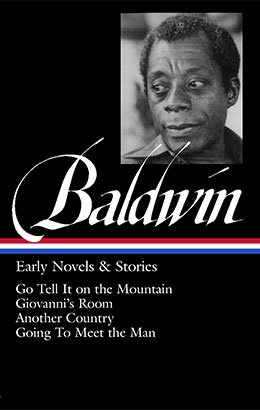
“The civil rights struggle,” said The New York Times Book Review, “found eloquent expression in [Baldwin’s] novels. His historical importance is indisputable.” Here, in a Library of America volume edited by Nobel laureate Toni Morrison, is the fiction that established James Baldwin’s reputation as a writer who fused unblinking realism and rare verbal eloquence.
His first novel, Go Tell It on the Mountain (1953), tells the story, rooted in Baldwin’s own experience, of a preacher’s son coming of age in 1930’s Harlem. Ten years in the writing, its exploration of religious, sexual, and generational conflicts was described by Baldwin as “an attempt to exorcise something, to find out what happened to my father, what happened to all of us.”
Giovanni’s Room (1956) is a searching, and in its day controversial, treatment of the tragic self-delusions of a young American expatriate at war with his own homosexuality. Another Country (1962), a wide-ranging exploration of America’s racial and sexual boundaries, depicts the suicide of a gifted jazz musician and its ripple effect on those who knew him. Complex in structure and turbulent in mood, it is in many ways Baldwin’s most ambitious novel.
Going to Meet the Man (1965) collects Baldwin’s short fiction, including the masterful “Sonny’s Blues,” the unforgettable portrait of a jazz musician struggling with drug addiction in which Baldwin came closest to defining his goal as a writer: “For, while the tale of how we suffer, and how we are delighted, and how we may triumph is never new, it must be heard. There isn’t any other tale to tell, it’s the only light we’ve got in all this darkness.”
James Arthur Baldwin authored plays and poems in society.
He came as the eldest of nine children; his stepfather served as a minister. At 14 years of age in 1938, Baldwin preached at the small fireside Pentecostal church in Harlem. From religion in the early 1940s, he transferred his faith to literature with the still evident impassioned cadences of black churches. From 1948, Baldwin made his home primarily in the south of France but often returned to the United States of America to lecture or to teach.
In his Giovanni's Room, a white American expatriate must come to terms with his homosexuality. In 1957, he began spending half of each year in city of New York.
James Baldwin offered a vital literary voice during the era of civil rights activism in the 1950s and 1960s. He first partially autobiographically accounted his youth. His influential Nobody Knows My Name and The Fire Next Time informed a large white audience. Another Country talks about gay sexual tensions among intellectuals of New York. Segments of the black nationalist community savaged his gay themes. Eldridge Cleaver of the Black Panthers stated the Baldwin displayed an "agonizing, total hatred of blacks." People produced Blues for Mister Charlie, play of Baldwin, in 1964. Huey Newton, co-founder of the Black Panther Party, defended Baldwin.
"'That ain't the kind of love I understand, old lady. What you reckon he'd do if he didn't love me?'"
"'What these children hear ain't going to do them near as much harm as what they see.'" - GTIOTM
GO TELL IT ON THE MOUNTAIN was assigned to me about 25 years ago in my Philosophy of Lit class. As the professor, a crazy old dude who looked like a cross between Twain and Vonnegut, said, "I don't care if you read it. You might not be ready for it. Yet." I wasn't...it would have shattered too much of a facade built up around me. John McDermott is/ was such an important teacher. He knew that literature could be transformative or it could be traumatizing. I took so much away from that class. But I didn't read GTIOTM. And lord, 25 years later, as I get farther into it, I still don't know if I'm ready. Tough, tough business, this one! And it's going to take me a while.
I choke on the similarities to my own childhood, two options for your life: heaven or hell, with no more complexity available. This book highlights the psychological terrorism of religion, and I don't use that word lightly.
I always wondered why Jesus, bloodied, looking skyward, hung on the cross in my bedroom, the lone room in the house with such an artifact. Why was Jesus continually murdered in my bedroom, every day of my childhood? Why didn't anybody else have to look at it? Why did I have to carry that burden, terrified and alone? John is living this, too, and I wish I'd had this book then. I'd have known I wasn't alone.
And then...and then Bakdwin starts jumping characters, none of whom I'm interested in. As talked up as this book is, I did not find it transformative or particularly memorable.
GIOVANNI'S ROOM
Having to put this collection aside for now...the sadness pouring from it is too much for me right now.
I did finish, but the sadness is so overwhelming...not a read for light times. I fully admit this review is not based in the quality of writing, but simply it's rawness. I think I'm still trying to avoid the pain between the lines to this day.
I only read Giovanni's Room, which was probably not the most representative of Baldwin's stuff because his main character is a blond-haired expat living in Paris. It is of interest, however, because it is early Baldwin and thus leans a bit melodramatic and irregular in its pacing at times.
It's the story of a tortured soul who loves his girl Hella (she goes solo to Spain to conveniently set up what goes on in Paris) but meets an Italian guy named Giovanni who attracts him as well. This gives Baldwin a chance to depict his own tortured feelings about his homosexuality through the protagonist who falls in love but feels "unclean" because of it (not to mention tormented over what Dad back in the States will say).
I noted many similarities to Hemingway's The Sun Also Rises, which Baldwin must have liked or used as a model in parts. The Spain angle mentions Pamplona and the running of the bulls. The famous Hemingway drinking hole, Closerie des Lilas, also makes a cameo. At least twice Baldwin mentions a policeman who holds up his "gleaming white baton" (an impotence joke in Hemingway's book) and, in his most desperate moments, Giovanni turns in bed and faces the wall. Hemingway used the wall symbol multiple times in his short stories.
Interesting, if not riveting. And I still want to see that movie! When it comes to TV, that is.
I have this beautiful first edition of this book with velvety bible-like paper and a textured green cover. I, like almost everyone in the writing world, love James Baldwin beyond measure so I've picked this book up many times over the years. I read it whenever I want to use his prowess as inspiration to delve deeper into my writing. His words are a continuum of lessons in the majesty of literature. Today as I begin to re-read it, I see that Toni Morrison selected the content in the book. That makes it even more special.
What can one say about Baldwin that hasn't already been said?
The two most famous works in this collection - Go Tell It on the Mountain and Giovanni's Room - rightfully deserve their place in the canon. The lesser, and the term is relative, two - Another Country and Going to Meet the Man - are interesting in part because Going to Meet the Man comes across as a character study in part.
All the stories are meditations about sexuality and race as well the effect that the racism in society has upon relationships. There is no lecturing in Baldwin - angry, of course; loads of sorrow - but no lecturing. He wants the reader to think, and he wants the reader to feel, and to do so he takes the reader with him along the pathways of thoughts and questions.
GO TELL IT ON THE MOUNTAIN: ****1/2. Beautiful depiction of the lives of Depression-era Black folks in New York City and their struggles with faith, family, and the legacy of migration from the south. Earns every accolade it's gotten. Read 7/14.
GIOVANNI'S ROOM: *****. My first Baldwin, this is clearly the gold standard of the Gay Novel but also plumbs the intricacies of gender and class more compellingly than any other novel I'd read. Read 7/12.
ANOTHER COUNTRY: *****. Then, of course, I read ANOTHER COUNTRY, which, though largely out-of-fashion among his works, I think expresses his authorial intent better than any other of his novels or non-fiction works I've read. The thought that we are all victims and all victimized, that we all are hurt by others and have the power to hurt others, has been addressed nowhere else as compellingly, or with such a vibrant and diverse cast of characters. Read 7/13.
GOING TO MEET THE MAN: ***1/2. Somewhat disjointed collection of stories with no notable low spots and plenty of high ones. The stories tracing (obliquely, of course) the sexual awakening of John, GO TELL IT ON THE MOUNTAIN's protagonist, are especially poignant. Read 7/15.
These stories are all excellently written. Baldwin's use of language is very powerful and persuasive. At times, some of the stories felt a little bloated with detail, which lessened the tension. However, they are wonderful and definitely worth reading. Some of them are hard to read because Baldwin doesn't shy away from revealing ugly truths about what is was to be black in America during the early 1900s. I also love how most of these stories are connected through recurring names - John/Giovanni, David, Paul, Elizabeth etc. To me, although it sometimes felt confusing, it made the stories feel more personal and that they are saying more than I managed to pick up.
'Go Tell It on the Mountain':
I quite liked this novella. It had a satisfying ending, though I was quite bored by the middle part of it. It is an interesting look at the sexual double standards between men and women as they used to be. It explored religion, sexuality, race, sense of self and identity, love, hatred. The main character is John, who is an adolescent who has a difficult relationship with his tyrannical and hypocritical father. I believe this novella is semi-autobiographical. For me, this is a three star story, because although it is exquisitely written, I did find myself thinking it was needlessly long. However, I loved that Baldwin was able to keep the air of injustice throughout the story. I really felt for the main character and, even though the father was shown to have a tragic past, he was never vindicated for the way that he treated his wife and children - particularly his eldest.
'Giovanni's Room':
I first read this novella when I was a student and it immediately became one of my all-time favourites. I'm not in the habit of re-reading books, so this was only the second time that I read it. It's a story about an American called David who goes to Paris, where he meets Giovanni with whom he begins a doomed love-affair. I had much less sympathy for David this time around and much more sympathy for Giovanni. I don't think, when I first read it, that I truly grasped how bad Giovanni's situation really was and how badly David strung him along. However, Baldwin does a good job of making the reader sympathise with David by showing us snapshots from his childhood. As with all of the stories in this book, 'Giovanni's Room' is beautifully written. The descriptions of Paris, the room, the characters, as well as the look and feel of Paris through David's eyes, is absolutely amazing. I am between four and five stars for this story. I don't think the whole work is perfect. However, the ending is definitely perfect and, as ever, a wonderful and - in this case - chilling ending makes up for the odd slow moment. I found the last two lines particularly haunting.
'Another Country':
This is a story about self-destruction in its many forms. It explores race, gender, sexuality, relationships, love, friendship, forgiveness and so much more. The story flips a lot between past and present. It has a lot of characters, most of whom are sympathetic to a point, but highly flawed. I like this. It's a story for adults. None of the main characters are portrayed as wholly good or bad. They are each complex and because the story is so in-depth, they each become quite sympathetic in their own ways. Again, though it is written well, I found it too long and a little too in-depth. I ended up quite bored with it at times because not very much happens. This is probably another one that I would give three out of five.
'Going to Meet the Man':
This is a collection of eight short stories which, overall, I would give four stars. It revisits the characters from 'Go Tell It on the Maintain'. Again, the sense of injustice was there. It was a good snapshot of John's life.
'The Outing':
Is a very short coming of age story. It deals with parental relationships as well as teenaged romance and jealousy. Religion is also a strong background element, which, as in 'Go Tell It on the Mountain' is portrayed as both helpful and unhelpful. To me, there was also an air of ridiculousness about it, though I don't know whether that was intentional, or whether it just seemed that way to me.
'The Man Child':
This was an excellent and highly disturbing view of family life, hidden desires, jealousy and violence. It is almost all shown from the point of view of an eight year old child. This is the only collection in the story in which all of the characters are white. It is a very hard read but also, in my opinion, one of the best stories in the collection, as every word seemed completely necessary and on point.
'Previous Condition':
This was a brilliant portrayal of a poor black man, who is treated like garbage by most of society and is expected to pull himself up by his bootstraps. It's another hard story to read and made me angry and sad.
'Sonny's Blues':
This was very sad and poignant. As with 'Another Country' it showed the impact of one man's spiralling condition on his family, particularly his brother. I loved the references to music and the way this was used as a sort of shield against the rest of the world.
'This Morning, This Evening, So Soon':
I quite liked this story. It is about a family who are about to move from Paris to New York. The father is a black American, mother is a white Swede. The father is partly glad to be moving back to America, but has worries for his son. He is a film star. It's a strange story where quite a lot of things happen. It looks at differing attitudes towards race in Paris, New York and Alabama.
'Come Out of the Wilderness':
This is a sad look at a relationship between a man and a woman. Throughout, there is a sense of dread from the woman that the man is going to end the relationship. Again, I quite liked it, but it didn't particularly grip me.
'Going to Meet the Man':
I loved this story. It's a perfect short story. It's excellently written. It is incredibly tense and has an absolutely horrifying ending. The juxtaposition between innocence and horrifying cruelty and injustice is amazing and unforgettable. For me, this was the best short story in the collection and I can see why all of the short stories were under this title in the book.
Of all the titles, my favourite is between 'Giovanni's Room' and 'Going to Meet the Man'. My least favourite was 'Go Tell It on the Mountain'.
I would not rate every novel as such, but as a collection it is only fair. The voice and writing is superb throughout each story though Go Tell It On the Mountain felt the strongest to me.
This book contains two of Baldwin's early and most known works, Go Tell it On The Mountain and Giovanni's Room, both of which are utter delights to read. Baldwin can tell stories with such emotional detail that it's hard not to feel changed by the end.
I always enjoy diving into Baldwin's profound and moving works! I just finished reading the first two books of this four book compilation. They offer a lot to discuss and reflect upon, making them perfect for an online class I am taking this summer through Eckerd College.
"Giovanni's Room" is a powerful story about love, identity, and self-acceptance. It centers around David, an American living in Paris, who struggles with his feelings for Giovanni, an Italian bartender. Baldwin dives deep into the complexities of David’s emotions as he grapples with his sexuality and societal expectations. The story takes place mostly in Giovanni’s small, claustrophobic room, which becomes a metaphor for David’s trapped feelings. Baldwin’s writing is beautiful and raw, making you feel every bit of David’s confusion and pain. It's a heartbreaking read but also incredibly insightful about the human condition.
"Go Tell It on the Mountain" is semi-autobiographical and tells the story of John Grimes, a teenager in 1930s Harlem, and his relationship with his family and his faith. The novel explores themes of religion, guilt, and redemption. Baldwin vividly depicts the struggles of growing up in a strict religious environment. The book is divided into three parts, with flashbacks providing background on John's family members and their own battles. Baldwin’s rich prose and deep understanding of his characters' inner lives make this novel a compelling and thought-provoking read.
Both books display Baldwin’s incredible talent for exploring complex emotions and social issues. His characters are deeply human, facing struggles that many can relate to. If you enjoy thought-provoking literature that tackles important themes like identity, love, and faith, both Giovanni's Room and Go Tell It on the Mountain are must-reads.
Such a rewarding read! The novels Go Tell It on the Mountain, Giovanni’s Room, and Another Country, plus the eight short stories printed in Baldwin’s only short-story collection, Going to Meet the Man. Reading all these works together, I am left in awe of his ability to create characters, situations, and interactions that feel so real I often felt myself there in the room and frustrated at my inability to embrace or otherwise encourage one of the characters.
Previous to this book, my reading of Baldwin had been limited to Another Country, his essay collection Nobody Knows My Name, and an essay and three short stories I had encountered in various anthologies. I don’t recall how I happened to purchase a copy of Another Country about the time I graduated high school in 1973, but clearly remember the impact it had on me the first time I read it, and how that impact changed the two times I’ve read it over the years since. After reading this collection, I can only wonder at the impact Giovanni’s Room would have had on me in my formative years.
Over the years I had learned more of Baldwin’s life and works through references to him in biographical or historical works not specifically focused on him. Most informative of these was Rachel Cohen’s 2004 book, A Chance Meeting: Intertwined Lives of American Writers and Artists, 1854-1967. The “Chronology” at the conclusion of this volume provides a well-written and continuously intriguing narrative of his life.
James Baldwin is an astounding writer. He deserves to be mentioned in the same breath as Faulkner, Hemingway, et al. -- in short, among the best writers America has ever produced. He is dazzlingly intelligent, perceptive, thoughtful, provocative, bitter, tender, and always astute. That being said, I simply could not engage with his final, sprawling novel, Just Above My Head, no matter how many times I tried. It just seems off, somehow: unfocused and uninhabited compared to his other works. But make no mistake: the novels collected here are eminently worthy of inclusion in the greatest work to come out of America. I would probably rank his novels in the exact order in with they were published, with his earliest works being his greatest, but nearly everything by Baldwin is better than just about anything else out there. He's a major voice, being finally given his due by virtue of these sets from the Library of America.
James Baldwin is an author whose star has been on the rise once again in recent years as America continues to grapple with race, the rights of LGBTQ+ Americans, and the hypocrisy that can be found within religious communities. In this collection of his earliest novels and short stories, Mr. Baldwin faces all of these issues head on, forcing the reader to grapple with the prejudice of their own country as well as their own.
This was a gift to me for my MFA thesis. I've always been a fan of Baldwin but this book (more because of its price) contained the stories that I don't have stand-alone books. It's Baldwin! What more needs to be said. He pulls you in and grips your heart. Your emotions ride a roller-coaster because one moment you're furious, then next laughing, and yet the next, you're in tears. I fell deeply in love with him once again after reading all of these stories. I think if you don't know which book to read "first", this is the collection to get. They are here all in one place, but I do recommend start reading the essays first. Ahhhh
This is my first foray into reading Baldwin and I was struck by the depths to which he goes in exploring so many complex issues. Plenty of authors would feel it was sufficient to simply address one or two smaller aspects, but Baldwin goes all in. As a result, it took me a while to get through the stories because they weren't simple or easy reads. Now I'd really like to read his essays because I think that's where more of his original thoughts around these issues will emerge, and it will likely affect my readings of the fiction.
The longest read of my life - just because it's an omnibus, Baldwin is excellent. Giovanni's Room was reading for an English class in 2004, and this is the volume Bowdoin sold. I loved Baldwin's prose and read Go Tell It on the Mountain three years later. Then in 2015, I picked the volume up again to read the rest of it and started with a re-read of Giovanni's Room, read Another Country in 2016, and read the short stories of Going to Meet the Man in 2017.
i haven't read all of the essays but - literally changed my life. the way he writes is so difficult but mindblowing, his perspective on things is so intelligent but also so down to earth, he has so many ideas on everything, and i just want to be someone that he would approve of....highly recommend to learn about the african american experience but also about l i f e. and also definitely teaches you how to write complexly.
He can really write the gritty characters and life circumstances and just tell it how it is. However, he has a handful of character names and ideas he seems to use over and over again. He switches between time in his story pretty randomly and quickly. It's also a personal pet peeve when a single chapter is like 60 pages long and just keeps winding on for no great reason.
Well, not finished exactly but read as much as I will for this time. I did read two of the novels, Go Tell It on the Mountain and Another Country and one of the short stories, Sonny's Blues. All lyrical and beautifully written. Why did my schools not have me read Baldwin? He is impressive and I'm glad I finally have read some of this work.
Worst book I have ever read bar none. Worse the RA salvatore and that's saying something. The racist pos talks about slavery long long after it was abolished by capitalism and spreads ahrd core mental disease of racism. Sickening!
Not a quick read; thought-provoking, sad, into the soul of the characters. All these works in a single volume give insight into Baldwin and his writings.
Go Tell it on the Mountain was 5 stars. Writing, storytelling all wonderful. Everything after that slowly went down hill. The last story concerning a lynching was truly horrifying
Many of these stories are about the search for love, for a home, for tolerance and acceptance in a hostile world. Some of them are about a rogue, a person between worlds, unable to meet expectations of his or her race or gender.
In Sonny's Blues, an algebra teacher for the first time really listens to his heroin-addicted younger brother speak through his music and finally understands him.
A woman is portrayed so credibly in Come Out the Wilderness that I would never have thought it was written by a man. She goes from one abusive, loveless relationship to another, believing she has no worth. Brought up in the patriarchal, religious culture of the American South, she is discovered as a teenager in what appears to be a compromising position by her brother. Though nothing happened, she is assumed to have been besmirched, and so the incident affects how she conducts herself her whole life. I doubt many "feminists," of either sex, could get it so right.
Every white person should read Going to See the Man often, so they don't forget and fall into complacency and repeat this shameful period in our history.
Giovanni's Room is the story of David, a gay man whose self-loathing is so great that he spends all of his energy trying to be something he's not. When he does surrender to his true nature, he is deliriously happy but is incapable of enjoying it. He ends those happy relationships as cruelly as possible. He is a hateful man -- or, to be more charitable, he is what he describes his middle-aged patron to be: "a fool and a coward." Yet the story is written with such grace and compassion that we feel understanding and kinship with him. David's American sensibilities have instilled in him a deep sense of shame at who he is, and though he has fled to Europe where he is more accepted, it is too late. He is so mortified by his sexual identity that he can't even name it, much less admit to the shame. To preserve his self-delusion and his facade of "normalcy," he manipulates and damages other people. He doesn't just leave his lovers; he destroys them. Maybe he hopes that in doing so he will destroy what he detests in himself. What would be left? It would be the narrator on this last, terrible night, this shell of a human being. He is suffering greatly, but not nearly as much as his victims. Yet we feel pity for him. The story is a confession -- an atonement. In general I liked this story; however, I found the stereotypes jarring. The sexual ideals David and his fiancée aspire to are so absurd it could have been satire, but the style is serious. The independent, feminist Hella, trying to win David back, says, "I want to get married. I want to start having kids.… I'll wear my hair long, I'll give up cigarettes, I'll throw away the books. Just let me be a woman, take me.… That's all I want." She also says "If women are supposed to be led by men and there aren't any men to lead them, what happens then?" Another sexist stereotype is portrayed by an old joke: "Question: Does your girlfriend like being beaten? Answer: She must, she keeps coming back for more!" As if women had a choice during the decades of patriarchal society that seemed almost engineered to keep women dependent upon men and unable to leave even abusive relationships. I have to keep reminding myself that this was written by a brilliant, intellectual black man in the nineteen forties -- one for whom stereotypes must have been a cruel joke.
Another Country is the longest story. I left it for last and I liked it the most. It's so complex, with so many different stories to tell, and the characters growing and changing so much, that you just have to read it to appreciate it. I am like the character Cass, a privileged, naïve, white woman living the American Dream. In reading this, I learned things about race relations in the U.S. that I don't think anyone else could have taught as well.
Go Tell it on the Mountain was my least favorite. It's soaked in religion.
Here's something I learned reading these stories. Shit happens all the time and everywhere. To everyone. But when it happens to blacks, it's usually because they're black. And that is what makes all the difference. If we ever came to the realization that in this country, if you're black, you're screwed right from the start through no fault of your own, we might begin to have the faintest hint of an inkling of an idea of how damaging prejudice really is. People for whom prejudice is as natural as breathing because it's all they have ever known aren't likely to have that awakening or to think that there's any harm in their attitude. If stories like these can change a mind or two, they will have done their job.
Formerly when I heard news stories about incidents like the Rodney King one or, more recently, the one in Ferguson, Missouri, I'd think, why must they always make it about race? I don't ask that anymore.
One of the joys of a bound collection like this is the opportunity to watch a great writer's talent grow over time.
I would disagree with other reviewers here--Go Tell It On the Mountain is the weakest of these four works. But it seems to serve as a palate cleanser, a necessary piece of fictionalized autobiography, that Baldwin perhaps needed to get out before better works could emerge.
Giovanni's Room is a stronger work, a more convincing tragedy that understandably influenced the genre it would help to shape. But Another Country is where his talent truly begins to shine. Here we encounter a cast of characters of depth and complexity that are convincing people even as they allow Baldwin to comment on the Village culture of the late 1950s. (Perhaps the most devastating portrayal is Richard the writer, whose almost unbearable smugness completely blinds him to the multiple self-delusions his limited talent and intellect demand.)
Go Tell it on the Mountain (posted in 2008) - Interesting to read Baldwin right after Morrison and Robinson. Indeed, there's a rich course here in exploring their explorations of race, religion and family. Baldwin is by far the bluntest of the three (but not necessarily the most powerful for that). But he was also breaking ground. Not surprisingly, I found the father-son, husband-wife and man-woman dynamics more compelling than the religious stuff, but Baldwin made me at least acknowledge the potential power of the latter.
Adding "Another Country" (2/14/2023). 3 stars at most and a terrible book to read on Valentine's Day.
Although the times and the setting -- late 50s, the island Manhattan -- are precisely the same, this ain't no West Side Story. There are no Marias or Tonys here (there is a singer). No Anitas or Bernados. Not even a guy with the loyalty of a Riff. Baldwin's characters are (mostly) a bit older, which makes their utter self-centeredness less forgivable. The men, gay, straight and bi can't keep their dicks in their pants or their heads out of their asses. The women, allegedly smarter, stronger and more empathetic, according to themselves (and the narrator's implied view), are not. They're all constantly crying their "love" for each other, but they don't know the meaning of the word. Baldwin heaps on so much racial, sexual and familial bile that the additional self-loathing is gratuitous at best.
"Oh God. It's a miserable world," one of the women croaks after cheating on her husband with a primarily gay man, who does not love her and whose lover is about to land at the airport. Not only is mainstream America -- and NYC in particular, which especially and repeatedly "stinks" here -- toxic, but trying to escape that mainstream for these actors, writers, singers and other outsiders is no salvation. Not in this "aimless, defeated and defensive bohemia."
By the end, it's hard not to see these characters lined up before a beat cop screaming out the lines: "We are sick. We are sick. We are sick, sick, sick. We are psychologically sick!" But there's nothing remotely ironic, humorous or revealing in the scene.