

What do you think?

Tell My Horse: Voodoo and Life in Haiti and Jamaica
A firsthand account of the weird mysteries and horrors of voodoo. Tell My Horse is an invaluable resource and fascinating guide. Based on Zora Neale Hurston’s personal experience in Haiti and Jamaica, where she participated as an initiate rather than just an observer of voodoo practices during her visits in the 1930s, this travelogue into a dark world paints a vividly authentic picture of ceremonies and customs and superstitions of great cultural interest.
311 pages, Paperback
First published January 1, 1938
About the author
Zora Neale Hurston
187 books5,853 followersNovels, including
Their Eyes Were Watching God
(1937), and nonfiction writings of American folklorist Zora Neale Hurston give detailed accounts of African American life in the South.
In 1925, Hurston, one of the leaders of the literary renaissance, happening in Harlem, produced the short-lived literary magazine Fire!! alongside Langston Hughes and Wallace Thurman shortly before she entered Barnard College. This literary movement developed into the Harlem renaissance.
Hurston applied her Barnard ethnographic training to document African American folklore in her critically acclaimed book Mules and Men alongside fiction Their Eyes Were Watching God . She also assembled a folk-based performance dance group that recreated her Southern tableau with one performance on Broadway.
People awarded a Guggenheim fellowship to Hurston to travel to Haiti and conduct research on conjure in 1937. Her significant work ably broke into the secret societies and exposed their use of drugs to create the Vodun trance, also a subject of study for fellow dancer-anthropologist Katherine Dunham, then at the University of Chicago.
In 1954, the Pittsburgh Courier assigned Hurston, unable to sell her fiction, to cover the small-town murder trial of Ruby McCollum, the prosperous black wife of the local lottery racketeer, who had killed a racist white doctor. Hurston also contributed to Woman in the Suwanee County Jail , a book by journalist and civil rights advocate William Bradford Huie.
In 1925, Hurston, one of the leaders of the literary renaissance, happening in Harlem, produced the short-lived literary magazine Fire!! alongside Langston Hughes and Wallace Thurman shortly before she entered Barnard College. This literary movement developed into the Harlem renaissance.
Hurston applied her Barnard ethnographic training to document African American folklore in her critically acclaimed book Mules and Men alongside fiction Their Eyes Were Watching God . She also assembled a folk-based performance dance group that recreated her Southern tableau with one performance on Broadway.
People awarded a Guggenheim fellowship to Hurston to travel to Haiti and conduct research on conjure in 1937. Her significant work ably broke into the secret societies and exposed their use of drugs to create the Vodun trance, also a subject of study for fellow dancer-anthropologist Katherine Dunham, then at the University of Chicago.
In 1954, the Pittsburgh Courier assigned Hurston, unable to sell her fiction, to cover the small-town murder trial of Ruby McCollum, the prosperous black wife of the local lottery racketeer, who had killed a racist white doctor. Hurston also contributed to Woman in the Suwanee County Jail , a book by journalist and civil rights advocate William Bradford Huie.
Ratings & Reviews
Friends & Following
Create a free account to discover what your friends think of this book!
Community Reviews
Displaying 1 - 30 of 249 reviews

November 10, 2019
I've finished this with mixed reactions. I very much enjoyed the section on Jamaica. Found interesting and distressing the background on Haiti, but the Vodoo and Vodoo ceromony parts of Haiti lost me. Found it to be too much to comprehend and process. I don't like how women were regarded in either county. The violence and brutality, the powerlessness was very hard to read.
So the first half of the book I would give a four, the last part less, so I decided on three. Hurston did a good job showing the complexity of these cultures.
So the first half of the book I would give a four, the last part less, so I decided on three. Hurston did a good job showing the complexity of these cultures.

February 5, 2023
I would probably have rewritten the title of this book to be Adventures with Zora in Haiti and Jamaica because Zora saw some THINGS in this book. The first two parts cover the "life" part of the subtitle where she goes over societal aspects in Jamaica and then Haiti. Part 3 is the longest section, which focuses on the practices of voodoo in Haiti. You will learn about zombies, secret societies, poisons, voodoo ceremonies/rituals, and more. Zora was one of the first non-white writers to write about voodoo and to do so in a more authentic and respectful way. Go check out this interesting and unusual book by the great Zora Neale Hurston.

December 10, 2011
[review posted on my blog too]
I stumbled on a little masterpiece the other day, "Tell My Horse" by Zora Neale Hurston, in a rare bookshop. I'd been aware of this title for years (first published in 1938), but had never actually run across a copy. This particular edition (there are others more recent), published by Turtle Island Foundation, Berkeley, CA 1981, caught my attention because of its striking cover of a photograph of a Black man entranced deep within a Voodoo ritual. So I picked it up, only curious
at first, but quickly became engrossed. When I got home, I checked it out on Amazon, a surefire way to find out what the hoi polloi is thinking/doing book-wise. And I was shocked to find no one had even reviewed it or commented on it.
Zora Neale Hurston, though given scant critical or popular notice during her lifetime has since her death become hot stuff, her reputation growing, it seems, in proportion to its distance from her life. Unfortunately, and it's a dirty rotten shame, but that is so often the way it goes for the truly great writers who bequeath to us truly great books. Nobody gets it till they're gone, sometimes long gone.
In view of the new appreciation, if not reverence for, this long ignored major Black American author, it's amazing to me no one has left a comment or review of this book. Both "anthropology" and memoir, "Tell My Horse" is a compelling personal account of Hurston's travels throughout the Caribbean and Haiti in the 30's in search of understanding the mystique and practices of Voodoo in the social fabric of these countries. Hurston’s interest in the subject is not mere voyeurism for a perhaps bizarre cultic demographic, but spurred on by her understanding of the role Voodoo played as an antecedent and influence on the establishment and development of the Black church in the Americas.
This is not just a scholarly, distanced description and evaluation, but a very much hands-on, face to face "experiencing" of the reality and meaning of Voodoo in the lives of the black populace in the region. She is not just an observer, but becomes a participant in the ceremonies etc. and gets to know many of the devotees as individuals and so is able to relate to the reader a real sense of " being there" and a feel for what it is "like" for these people.
The writing is, of course wonderful, but it's her personal involvement in the as-lived phenomenon of Voodoo that makes this book not only a great "read," but also an important contribution to the understanding of those cultures and their world view.
The physical book itself is beautiful and contributes in no small part to the reader's experience of her travels and discoveries. Artfully designed and carefully produced to enhance Hurston's narrative. Surely it will become a collectible and gain esteem among those who appreciate such things.
Kudos to the publisher and regrettable that Zora Neale Hurston did not live to see her reputation rise and the value of her work vindicated. Appallingly, this gifted writer spent her last years cleaning houses for whites in Ft. Pierce, FL.
________________________________________
I stumbled on a little masterpiece the other day, "Tell My Horse" by Zora Neale Hurston, in a rare bookshop. I'd been aware of this title for years (first published in 1938), but had never actually run across a copy. This particular edition (there are others more recent), published by Turtle Island Foundation, Berkeley, CA 1981, caught my attention because of its striking cover of a photograph of a Black man entranced deep within a Voodoo ritual. So I picked it up, only curious
at first, but quickly became engrossed. When I got home, I checked it out on Amazon, a surefire way to find out what the hoi polloi is thinking/doing book-wise. And I was shocked to find no one had even reviewed it or commented on it.
Zora Neale Hurston, though given scant critical or popular notice during her lifetime has since her death become hot stuff, her reputation growing, it seems, in proportion to its distance from her life. Unfortunately, and it's a dirty rotten shame, but that is so often the way it goes for the truly great writers who bequeath to us truly great books. Nobody gets it till they're gone, sometimes long gone.
In view of the new appreciation, if not reverence for, this long ignored major Black American author, it's amazing to me no one has left a comment or review of this book. Both "anthropology" and memoir, "Tell My Horse" is a compelling personal account of Hurston's travels throughout the Caribbean and Haiti in the 30's in search of understanding the mystique and practices of Voodoo in the social fabric of these countries. Hurston’s interest in the subject is not mere voyeurism for a perhaps bizarre cultic demographic, but spurred on by her understanding of the role Voodoo played as an antecedent and influence on the establishment and development of the Black church in the Americas.
This is not just a scholarly, distanced description and evaluation, but a very much hands-on, face to face "experiencing" of the reality and meaning of Voodoo in the lives of the black populace in the region. She is not just an observer, but becomes a participant in the ceremonies etc. and gets to know many of the devotees as individuals and so is able to relate to the reader a real sense of " being there" and a feel for what it is "like" for these people.
The writing is, of course wonderful, but it's her personal involvement in the as-lived phenomenon of Voodoo that makes this book not only a great "read," but also an important contribution to the understanding of those cultures and their world view.
The physical book itself is beautiful and contributes in no small part to the reader's experience of her travels and discoveries. Artfully designed and carefully produced to enhance Hurston's narrative. Surely it will become a collectible and gain esteem among those who appreciate such things.
Kudos to the publisher and regrettable that Zora Neale Hurston did not live to see her reputation rise and the value of her work vindicated. Appallingly, this gifted writer spent her last years cleaning houses for whites in Ft. Pierce, FL.
________________________________________

January 8, 2018
Read in the 1990s. I was delighted by it, by the sheer novelty of reading an academic book by Their Eyes Were Watching God's creator. One day soon I'll re-read this because of Bitter Grounds.
February 11, 2012
i had only read Their Eyes Were Watching God before this, none of her first person writing. Her childhood was so different than many, maybe most, African Americans - her parents were important leaders in a Black owned, Black run “incorporated” town in Florida. i suspect this may have been behind her eventual adoption of right wing politics, as she did NOT see how this country treated most African Americans.
Her level of comfort is obvious as she travels with apparent ease through the Black communities of the Caribbean. This is HER backpack - she was invited to see cultures and culturally sensitive ceremonies that had she been a different color would not have been possible. This is one of the reasons that this book is so important for those of us interested in syncretic religions, especially those African religions that were forced into existence by Roman Catholicism's mandatory application to the slaves arriving in chains from West Africa. She visits, and is welcomed into, some of the least corrupted communities in existence in 1937; and writes in a fashion that does not seem at all political, not at all affected by any preconceived ideas except a few of her own. As someone who has tried, as appropriately as possible, to visit sites, ceremonies, celebrations and rituals of syncretic religions in Brazil, Cuba, Venezuela, the DR, New Orleans with varying levels of success- it is rare that my whiteness is not an issue, a factor that alters something. Not a problem if i were to describe a Bat Mitzvah or a High Mass - not my religion, but (sort of) my "people"?
She is a true anthropologist of religion as there is very little judgement or even description of the social setting - (housing, food distribution or lack of it) except some about the relative importance of Men and Women.
She relates a sad tale of a used girl - lied to and mislead by her mulatto boyfriend, this same creep (my judgement) made sure her next fiance knew she was second hand...she ends poorly… “But what becomes of her is unimportant. The honor of two men has been saved, and men’s honor is important in the Caribbean.” A discussion of the sexist laws follows and more anecdote. Ms. Hurston sarcastically ends with how sacred men’s honor is “even if it takes 40 women to do it” (to protect it).
This is unlike any writing i’ve seen, especially about Haiti, about Voudoun. A really important book.
Her level of comfort is obvious as she travels with apparent ease through the Black communities of the Caribbean. This is HER backpack - she was invited to see cultures and culturally sensitive ceremonies that had she been a different color would not have been possible. This is one of the reasons that this book is so important for those of us interested in syncretic religions, especially those African religions that were forced into existence by Roman Catholicism's mandatory application to the slaves arriving in chains from West Africa. She visits, and is welcomed into, some of the least corrupted communities in existence in 1937; and writes in a fashion that does not seem at all political, not at all affected by any preconceived ideas except a few of her own. As someone who has tried, as appropriately as possible, to visit sites, ceremonies, celebrations and rituals of syncretic religions in Brazil, Cuba, Venezuela, the DR, New Orleans with varying levels of success- it is rare that my whiteness is not an issue, a factor that alters something. Not a problem if i were to describe a Bat Mitzvah or a High Mass - not my religion, but (sort of) my "people"?
She is a true anthropologist of religion as there is very little judgement or even description of the social setting - (housing, food distribution or lack of it) except some about the relative importance of Men and Women.
She relates a sad tale of a used girl - lied to and mislead by her mulatto boyfriend, this same creep (my judgement) made sure her next fiance knew she was second hand...she ends poorly… “But what becomes of her is unimportant. The honor of two men has been saved, and men’s honor is important in the Caribbean.” A discussion of the sexist laws follows and more anecdote. Ms. Hurston sarcastically ends with how sacred men’s honor is “even if it takes 40 women to do it” (to protect it).
This is unlike any writing i’ve seen, especially about Haiti, about Voudoun. A really important book.
March 31, 2010
A jumble of a book with diary, travelogue, political commentary, and ethnography mashed together. I know it's not hip to not fawn over Zora Neale Hurston, but unless you really want to know about vodou in Haiti in 1937, I wouldn't recommend this book.
She deserves a significant amount of credit for her copious documentation of vodou ceremonies and songs, and for treating the religion with respect (as opposed to the sensationalist white writers of the time). But the book is lacking in context for vodou practices, the political analysis is way off, and even though she is respectful, she herself does wander into generalizations when discussing Haitian-ness, and sensationalism when discussing zombies, cannibals, possessions, etc.
She deserves a significant amount of credit for her copious documentation of vodou ceremonies and songs, and for treating the religion with respect (as opposed to the sensationalist white writers of the time). But the book is lacking in context for vodou practices, the political analysis is way off, and even though she is respectful, she herself does wander into generalizations when discussing Haitian-ness, and sensationalism when discussing zombies, cannibals, possessions, etc.

May 16, 2020
Review originally posted here: https://sammythecritic.blogspot.com/2...
Synopsis: Zora Neale Hurston's 1938 memoir Tell My Horse details her experience learning about cultural and spiritual traditions in Jamaica and voodoo (aka voudou, vodoun, or vodun) in Haiti.
My Thoughts: As a Haitian-American guy, I was interested in looking deeper into my heritage and what better way to do that than read about it from the queen of The Harlem Renaissance Ms. Hurston since I can't travel there due to COVID-19 and political turmoil. I went into the book expecting I would instantaneously devour it in less than a week worth of time. Sadly for me, it fell short on the excitement factor. To be clear, I appreciate and respect Hurston's effort to deeply immerse herself in rituals that were derided at the time by middle to upper-class Haitian contemporaries as silly, pointless superstitions. However, I feel like the book dragged on for too long which made the reading process very slow. In fact, it took me nearly four weeks to finish this work of 274 pages for which I procrastinated a lot throughout. One of my main gripes was that it spent too many chapters on the history of Haiti's colonialization and socioeconomic/political divisions. While I understand a certain degree of context in these aspects are integral in fully grasping the contemporaneous state of voodoo, dedicated several chapters to these make much of the passages tangential to book's primary subject matter. Also, perhaps it's just me but the first part, which takes place in Jamaica, was pretty dull since it did not much of a tightly connected premise beyond the various local superstitions detailed, unlike the second portion in Haiti, which made obvious enough that voodoo was supposed to the focus even if it went all over the place with it and meandered too long. On a more positive note, I did enjoy the parts which did actually center around voodoo's rituals and mythology as well as The Secte Rouge, a cannibalistic secret society that can be considered partially responsible for some of the social stigma voodoo.
Final Thoughts: Hurston did try in Tell My Horse and did succeed in providing an accurate portrayal of Haitian voodoo culture. Unfortunately, the lethargic pacing dragged it down a couple of notches to a 2.8 rating, making the book more of a chore to slog through. I hope her fictional works are better than this.
Synopsis: Zora Neale Hurston's 1938 memoir Tell My Horse details her experience learning about cultural and spiritual traditions in Jamaica and voodoo (aka voudou, vodoun, or vodun) in Haiti.
My Thoughts: As a Haitian-American guy, I was interested in looking deeper into my heritage and what better way to do that than read about it from the queen of The Harlem Renaissance Ms. Hurston since I can't travel there due to COVID-19 and political turmoil. I went into the book expecting I would instantaneously devour it in less than a week worth of time. Sadly for me, it fell short on the excitement factor. To be clear, I appreciate and respect Hurston's effort to deeply immerse herself in rituals that were derided at the time by middle to upper-class Haitian contemporaries as silly, pointless superstitions. However, I feel like the book dragged on for too long which made the reading process very slow. In fact, it took me nearly four weeks to finish this work of 274 pages for which I procrastinated a lot throughout. One of my main gripes was that it spent too many chapters on the history of Haiti's colonialization and socioeconomic/political divisions. While I understand a certain degree of context in these aspects are integral in fully grasping the contemporaneous state of voodoo, dedicated several chapters to these make much of the passages tangential to book's primary subject matter. Also, perhaps it's just me but the first part, which takes place in Jamaica, was pretty dull since it did not much of a tightly connected premise beyond the various local superstitions detailed, unlike the second portion in Haiti, which made obvious enough that voodoo was supposed to the focus even if it went all over the place with it and meandered too long. On a more positive note, I did enjoy the parts which did actually center around voodoo's rituals and mythology as well as The Secte Rouge, a cannibalistic secret society that can be considered partially responsible for some of the social stigma voodoo.
Final Thoughts: Hurston did try in Tell My Horse and did succeed in providing an accurate portrayal of Haitian voodoo culture. Unfortunately, the lethargic pacing dragged it down a couple of notches to a 2.8 rating, making the book more of a chore to slog through. I hope her fictional works are better than this.

December 11, 2011
Around the World = Haiti
Tell My Horse is writer and folklorist Zora Neale Hurston's experiences in Jamaica and Haiti in the 1930s as she documented the voodoo rituals and beliefs practiced in these countries. Hurston also explores the African heritage shared by black Jamaicans, Hatians and Americans, and how their experiences inform their lives.
What makes this book outstanding is the depth of Hurston's personal connection to her subject; rather than giving a cool, scholarly observation of ceremonies and rituals, she is an active participant and brings an insider knowledge of the experience of the individuals she encounters, and recounts it to the reader as if sharing an afternoon conversation on the porch swing, with a glass of lemonade.
Tell My Horse is writer and folklorist Zora Neale Hurston's experiences in Jamaica and Haiti in the 1930s as she documented the voodoo rituals and beliefs practiced in these countries. Hurston also explores the African heritage shared by black Jamaicans, Hatians and Americans, and how their experiences inform their lives.
What makes this book outstanding is the depth of Hurston's personal connection to her subject; rather than giving a cool, scholarly observation of ceremonies and rituals, she is an active participant and brings an insider knowledge of the experience of the individuals she encounters, and recounts it to the reader as if sharing an afternoon conversation on the porch swing, with a glass of lemonade.

December 5, 2015
My feeling while reading this book was that it was fine, in the most middle-of-the-road sense possible. Is it nifty how Hurston blends personal narrative with personal observation with tales she's been told with un-sourced speculations, making a text that is as much an ethnographic object as it is an ethnography? Yes. But that sentence was more interesting to say just now than what this book was to read, for the most part. There are moments when the style is quite impressive; there are moments when the style just is.
October 7, 2011
Zora Neale Hurston had to have been an incredible woman. Consider her past. Hurston is black woman who had to make her own way in the world when she was fourteen. She had to struggle just to survive. Remarkably, she found a way to make it back to secondary school, and further, to complete a degree when she was 36. She became an accomplished writer and anthropologist. The tenacity and self-assurance to achieve so much in the time which she lived is...overwhelming to think about.
The writing in Tell My Horse is skillful; the stories flow, and the color of her writing brings her stories to life. The first third of the book is on Jamaica, the rest covers her experiences in Haiti. Hurston was able to make connections with people in all levels of society. She spends considerable time relating how women are perceived and treated, but Hurston must have found a way to garner the respect of men, no little feat in these surroundings.
She speaks with respect, but she is frank about what she says about the people she meets and her observations about the community. For example, on page 102, Hurston writes, "The Hatian people are gentle and lovable except for their enormous and unconscious cruelty." She has no compunction to temper her opinions, and that speaks volumes about her self assurance and her unfailing will to be an authentic folklorist .
I have to wonder how she was able to access the Sect Rouge. It sounds like she HAD to be there, but how??
All in all, this book, and the author, are amazing. She is someone who I wish I could have met.
The writing in Tell My Horse is skillful; the stories flow, and the color of her writing brings her stories to life. The first third of the book is on Jamaica, the rest covers her experiences in Haiti. Hurston was able to make connections with people in all levels of society. She spends considerable time relating how women are perceived and treated, but Hurston must have found a way to garner the respect of men, no little feat in these surroundings.
She speaks with respect, but she is frank about what she says about the people she meets and her observations about the community. For example, on page 102, Hurston writes, "The Hatian people are gentle and lovable except for their enormous and unconscious cruelty." She has no compunction to temper her opinions, and that speaks volumes about her self assurance and her unfailing will to be an authentic folklorist .
I have to wonder how she was able to access the Sect Rouge. It sounds like she HAD to be there, but how??
All in all, this book, and the author, are amazing. She is someone who I wish I could have met.
January 31, 2015
I originally found mention of this book while I was reading through The World's Greatest Unsolved Mysteries' chapter on zombies. My initial reaction was, and I quote:
"'One mother told Zora Hurston about her son who had died and been buried.' ...I would totally read a Zora Hurston collection of zombie sightings."
Turns out that Tell My Horse has very little to do with zombies. There's one chapter on them, and a few mentions here and there, but given the time this book was written, I don't blame Hurston. She did try to figure out more about zombies. Luckily, she had a very devoted group of friends who pointed out to her that trying to worm her way into secret societies and then report on what she found was probably not a very smart move to make. You know. If she wanted to stay alive.
(Of course, Wade Davis eventually got those answers, and published them in his book The Serpent and the Rainbow.)
The first section of the book focuses on the historical and political climates of Jamaica and Haiti at the time, although Hurston herself admits that she was given several conflicting accounts as to how historical events went down. So, it was a fairly sluggish read that, at the end of the day, may not even be fact. Just fact to the best of Hurston's knowledge.
The majority of the book focuses on voodoo, and the various gods and rituals associated with it. This was the most interesting part of the book for me, seeing as how I live in a city that has deep voodoo ties, and where Marie Laveau is still celebrated as the Voodoo Queen.*
*Although I feel I should point out that the voodoo Hurston was studying is different from "New Orleans voodoo". It's also different from "hoodoo", which isn't a religion, but folk magic.**
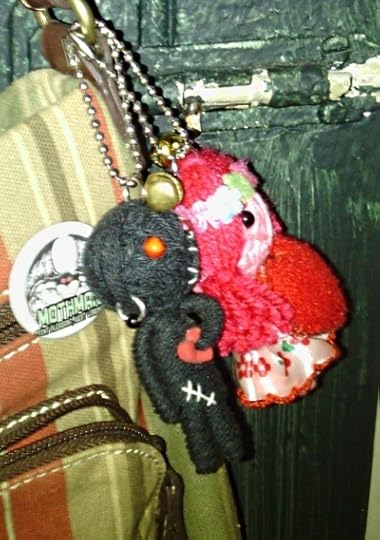
**Fun fact: Voodoo dolls are actually a hoodoo practice that was sort of lumped together with New Orleans voodoo. I've got a growing collection of cutsie voodoo doll key charms.
Credit has to be given to Hurston for taking the religion seriously, and not writing it off as a cheap knock-off of Catholicism, or the delusional beliefs of an ignorant and barbaric culture, which were the general opinions at the time. The appendix is full of the various songs and prayers she heard while she was down there, including sheet music where she actually remembered the tunes.
Some of the songs and ceremonies were beautiful affairs.
But dear lord, there were so many dead chickens by the time I finished the book. So many dead chickens.
"'One mother told Zora Hurston about her son who had died and been buried.' ...I would totally read a Zora Hurston collection of zombie sightings."
Turns out that Tell My Horse has very little to do with zombies. There's one chapter on them, and a few mentions here and there, but given the time this book was written, I don't blame Hurston. She did try to figure out more about zombies. Luckily, she had a very devoted group of friends who pointed out to her that trying to worm her way into secret societies and then report on what she found was probably not a very smart move to make. You know. If she wanted to stay alive.
(Of course, Wade Davis eventually got those answers, and published them in his book The Serpent and the Rainbow.)
The first section of the book focuses on the historical and political climates of Jamaica and Haiti at the time, although Hurston herself admits that she was given several conflicting accounts as to how historical events went down. So, it was a fairly sluggish read that, at the end of the day, may not even be fact. Just fact to the best of Hurston's knowledge.
The majority of the book focuses on voodoo, and the various gods and rituals associated with it. This was the most interesting part of the book for me, seeing as how I live in a city that has deep voodoo ties, and where Marie Laveau is still celebrated as the Voodoo Queen.*
*Although I feel I should point out that the voodoo Hurston was studying is different from "New Orleans voodoo". It's also different from "hoodoo", which isn't a religion, but folk magic.**
**Fun fact: Voodoo dolls are actually a hoodoo practice that was sort of lumped together with New Orleans voodoo. I've got a growing collection of cutsie voodoo doll key charms.
Credit has to be given to Hurston for taking the religion seriously, and not writing it off as a cheap knock-off of Catholicism, or the delusional beliefs of an ignorant and barbaric culture, which were the general opinions at the time. The appendix is full of the various songs and prayers she heard while she was down there, including sheet music where she actually remembered the tunes.
Some of the songs and ceremonies were beautiful affairs.
But dear lord, there were so many dead chickens by the time I finished the book. So many dead chickens.

February 18, 2026
Found this to be a very intriguing collection of writings on Haiti and Jamaica, bolstered by Zora Neale Hurston's storyteller skills, read with gusto by Robin Miles (there are a lot of invocations and ritual words included and her pronounciation was amazing and intense, but I felt weird witnessing / listening to them, if that makes sense).
I don't consider this a source of information on voodoo or the politics in those countries, since I never lost track of the fact that Hurston, keen and insightful as she is - is, after all an American visiting. But the book was engaging and had a lot of little freaky details and anecdotes about zombies, rituals, the occult, secret societies, gender roles, assassinations and so on.
I was very pleasantly surprised by the fact that she uses the phrase class consciousness, I don't know necessarily why I thought this was more of a recent thing, but I found that based! There's also a lot of ironic commentary on gender roles and the honor of Jamaican men that was a bit uncomfortable to read, because sheesh. I would definitely dig more into these topics, maybe with books written by people of those places!
I don't consider this a source of information on voodoo or the politics in those countries, since I never lost track of the fact that Hurston, keen and insightful as she is - is, after all an American visiting. But the book was engaging and had a lot of little freaky details and anecdotes about zombies, rituals, the occult, secret societies, gender roles, assassinations and so on.
I was very pleasantly surprised by the fact that she uses the phrase class consciousness, I don't know necessarily why I thought this was more of a recent thing, but I found that based! There's also a lot of ironic commentary on gender roles and the honor of Jamaican men that was a bit uncomfortable to read, because sheesh. I would definitely dig more into these topics, maybe with books written by people of those places!

January 25, 2012
In the late 1930s Zora Neale Hurston won a Guggenheim fellowship to travel to Jamaica and Haiti to study the "cult of Voodoo." This hard-to-define book -- not quite ethnography, not quite travelogue, and not quite fiction -- is the result of that fellowship, and it's an unusual and deeply rewarding outsider's look at a part of the world the author says has too rarely been studied closely. Her purposes are many: one, to capture the oral culture of Jamaica and Haiti in written language; two, to defend Haiti and Voodoo to United States readers as far more than just a backward place and a backward spiritual practice; and three, to contemplate what she recognizes as an international African diaspora -- that is, a community of Africans and African-descended people spread to all continents but nevertheless united by particular beliefs and other cultural legacies. The book is episodic and certainly of questionable "objectivity." It's also a delicious read -- and one that anybody interested in this great American writer's works should pick up ASAP.

Read
December 18, 2023firstly anthropological, don't wander in imagining a novel. Zora's talking about voodoo in Haiti & Jamaica & o my it is WILD what she was permitted to see, firsthand accounts in Tell My Horse of rituals you would imagine? are private? detail on zombies. & she's coming from such a calm & available place, partly I think because of her anthropological background in college and so forth. but delicious. a quiet entry in some ways , in others, so much.
also go watch this three minute film with her exquisite ! voice!:
https://www.youtube.com/watch?v=chfQ4...
also go watch this three minute film with her exquisite ! voice!:
https://www.youtube.com/watch?v=chfQ4...

September 6, 2009
This book came with me to the Dominican Republic because Zora Neal wrote this about Haiti. The problem is that while she is sympathetic and doesn't belittle Vodou (Anglicised as Voodo), she utterly fails to bring it to life or create roots so it can grow into the readers conscious
In other words, her words are flat colorless and void of life, like a Zombie brought back to life.
In other words, her words are flat colorless and void of life, like a Zombie brought back to life.

January 28, 2018
Might have finished this sooner but I was scared. Lol, I'm just serious *__*

November 26, 2012
(April 2013) Reread this as part of the collection Folklore, Memoirs and Other Writing, reposting review and quotes here. All page numbers are from that version.
Orig. pub. 1938, traveling in Jamaica and Haiti, gathering folklore and voodoo lore. Participant-observer anthropology. (Note, for those it may upset: killing of various farm animals and a dog in ceremonies. Hurston's commentary in multiple areas makes it clear she doesn't enjoy this.)
Skin color in Jamaica is complicated:
In Haiti, p 335-6:
You can read the entire chapter called The Black Joan of Arc (from Tell My Horse, p. 360) here. (At least as of 4/2/2013)
p 398:
p 456, from Ch. 13: Zombies
p 457:
Reasons why people are made into Zombies, p 457-8:
P 458-9, after taking the victim from the tomb (and making it appear that the tomb hasn't been disturbed) the victim is taken away by a large group:
p 469 - Nov. 8, 1936, hospital at Gonaives, permission given to visit by Dt. Rulx Leon, Director-General of the Service d'Hygiene
p. 470:
p 480:
p 483-4 Port-au-Prince physician:
p 484:
Some secret society quotes that confirm Hurston's findings in Tome Premier, L. E. Moreau de St. Mery, can't find original online yet.
p. 492:
Orig. pub. 1938, traveling in Jamaica and Haiti, gathering folklore and voodoo lore. Participant-observer anthropology. (Note, for those it may upset: killing of various farm animals and a dog in ceremonies. Hurston's commentary in multiple areas makes it clear she doesn't enjoy this.)
Skin color in Jamaica is complicated:
p 281: "Everywhere else a person is white or black by birth, but it is so arranged in Jamaica that a person may be black by birth but white by proclamation. That is, he gets himself declared legally white. When I use the word black I mean in the American sense where anyone who has any colored blood at all, no matter how white the appearance, speaks of himself as black."Hurston notes that this does seem to be changing, and there is a new respect for the black songs, stories, dances, etc. - the culture. That was in 1938 and now I wish I could read a history of Jamaica since then.
p 282: "...When a Jamaican is born of a black woman and some English or Scotsman, the black mother is literally and figuratively kept out of sight as far as possible, but no one is allowed to forget that white father, however questionable the circumstances of birth. You hear about "My father this and my father that, and my father who was English, you know" until you get the impression that he or she had no mother. Black skin is so utterly condemned that the black mother is not going to be mentioned or exhibited."
In Haiti, p 335-6:
"..."But where is the body of Charles Oscar Etienne?" Polynice cried. "He cannot be alive or this butchery could not have happened. He is the Chief military officer of Haiti with the care and protection of these unarmed and helpless people."Oscar Etienne was police chief under presidency of Vilbrun Guillaume Sam.
"He is the friend of Guillaume Sam," someone answered him.
"But honor lays a greater obligation than friendship; and if friendship made such a monster of a man, then it is a thing vile indeed. No, Oscar Etienne is dead. Only over this dead body could such a thing have happened..."
...After a while someone told him, "But Oscar Etienne is not dead. He was seen to leave the prison before five o'clock. It was he who ordered the massacre. He has taken refuge in the Dominican legation. He will not come out for any reason at all."
...Polynice rushed to the Dominican legation and dragged out the cringing Etienne who went limp with terror when he saw the awful face of the father of the Polynices. He mumbled "mistakes" and "misunderstanding" and placed the blame upon President Vilbrun Sam...
...He [Polynice] dragged him to the sidewalk and gave him three calming bullets, one for each of his murdered sons and stepped over the dead body where it lay and strode off. The crowd followed him to the home of Etienne where they stripped it first and then leveled it to its foundation. In their rage they left nothing standing that one might say "Here is the remains of the house of Etienne who betrayed and slaughtered defenseless men under his protection for the crime of difference of politics." "
You can read the entire chapter called The Black Joan of Arc (from Tell My Horse, p. 360) here. (At least as of 4/2/2013)
p 398:
"Everybody knows that La Gonave is a whale that lingered so long in Haitian waters that he became an island. He bears a sleeping woman on his back. Any late afternoon anyone in Port-au-Prince who looks out to sea can see her lying here on her back with her hands folded across her middle sleeping peacefully. It is said that the Haitians prayed to Dumballa for peace and prosperity. ...so he sent his woman Cilla with a message to his beloved Haitians. ...The whale performed everything that the Master of Waters commanded him. He rode Madame Cilla so quickly and so gently that she fell asleep, and did not know that she arrived at her destination. The whale dated not wake her to tell her that she was in Haiti. So every day he swims far out to sea and visits with his friends. But at sundown he creeps back into the harbor so that Madame Cilla may land if she should awake. She has the formula of peace in her sleeping hand. When she wakes up, she will give it to the people."Quote from Literary Culture and U.S. Imperialism by John Carlos Rowe, about William Seabrook's vs Hurston's version of stories.
p 456, from Ch. 13: Zombies
"This is the way Zombies are spoken of: They are the bodies without souls. The living dead. Once they were dead, and after that they were called back to life again.
No one can stay in Haiti long without hearing Zombies mentioned in one way or another, and the fear of this thing and all that it means seeps over the country like a ground current of cold air. This fear is real and deep. It is more like a group of fears. For there is the outspoken fear among the peasants of the work of Zombies. Sit in the market place and pass a day with the market women and notice how often some vendeuse cries out that a Zombie with its invisible hand has filched her money, or her goods. ...Also the little girl Zombies who are sent out by their owners in the dark dawn to sell little packets of roasted coffee. Before sun up their cries of "Cafe grille" can be heard from dark places in the streets and one can only see them if one calls out for the seller to come with her goods. Then the little dead one makes herself visible and mounts the steps.
The upper class Haitians fear too, but they do not talk about it so openly as do the poor. But to them also it is a horrible possibility. Think of the fiendishness of the thing."
p 457:
"Yet in spite of this obvious fear and preparations that I found being made to safeguard the bodies of the dead against this possibility, I was told by numerous upper class Haitians that the whole thing was a myth.
...I had the rare opportunity to see and touch an authentic case. I listened to the broken noises in its throat, and then, I did what no one else had ever done, I photographed it. If I had not experienced all of this in the strong sunlight of a hospital yard, I might have come away from Haiti interested but doubtful. But I saw the case of Felicia Felix-Mentor which was vouched for by the highest authority. So I know that there are Zombies in Haiti."
Reasons why people are made into Zombies, p 457-8:
"A was awakened because somebody required his body as a beast of burden. In his natural state he could never have been hired to work with his hands, so he was made into a Zombie because they wanted his services as a laborer. B was summoned to labor also but he is reduced to the level of a beast as an act of revenge. C was the culmination of "ba' Moun" ceremony and a pledge. That is, he was given as a sacrifice to pay off a debt to a spirit for benefits received."
P 458-9, after taking the victim from the tomb (and making it appear that the tomb hasn't been disturbed) the victim is taken away by a large group:
"The victim is surrounded by the associates and the march to the hounfort (voodoo temple and its surroundings) begins. He is hustled along in the middle of the crowd. Thus he is screen from prying eyes to a great depress and also in his half-waking state he is unable to orientate himself. ...First he is carried past the house where he lived. This is always done. Must be. If the victim were not taken past his former house, later on he would recognize it and return. But once he is taken past, it is gone from his consciousness forever. It is as if it never existed for him. He is then taken to the hounfort and given a drop of liquid, the formula for which is most secret. After that the victim is a Zombie. He will work ferociously and tirelessly without consciousness of his surroundings and conditions and without memory of his former state. He can never speak again, unless he is given salt."
p 469 - Nov. 8, 1936, hospital at Gonaives, permission given to visit by Dt. Rulx Leon, Director-General of the Service d'Hygiene
"We found the Zombie in the hospital yard. They had just set her dinner before her but she was not eating. She hovered against the fence in a defensive position. ...She huddled the cloth about her head more closely and showed every sign of fear and expectation of abuse and violence. The two doctors with me made kindly noises and tried to reassure her. She seemed to hear nothing. Just kept on trying to hide herself.
...Finally the doctor forcibly uncovered her and held her so that I could take [a photo of] her face. And the sight was dreadful. That blank face with the dead eyes. The eyelids were white all around the eyes as if they had been burned with acid. It was pronounced enough to come out in the picture. There was nothing that you could say to her or get from her except by looking at her, and the sight of this wreckage was too much to endure for long.
...We discussed at great length the theories of how Zombies come to be. It was concluded that it is not a case of awakening the dead, but a matter of the semblance of death induced by some drug known to a few. Some secret probably brought from Africa and handed down from generation to generation. These men know the effect of the drug and the antidote. It is evident that it destroys that part of the brain which governs speech and will power. The victims can move and act but cannot formulate thought."
p. 470:
"Her name is Felicia Felix-Mentor. She was a native of Ennery and she and her husband kept a little grocery. She had one child, a boy. In 1907 she took suddenly ill and died and was buried. There were the records to show. The years passed. The husband married again and advanced himself in life. The little boy became a man.
...Then one day in October 1936 someone saw a naked woman on the road and reported it to the Garde d'Haiti. ...Finally the boss was sent for and he came and recognized her as his sister who had died and been buried twenty-nine years before. She was in such wretched condition that the authorities were called in and she was sent to the hospital. Her husband was sent for to confirm the identification, but he refused. He was embarrassed by the matter as he was now a minor official and wanted nothing to do with the affair at all. ...he was forced to come. he did so and reluctantly made the identification of this woman as his former wife.
How did this woman, supposedly dead for twenty-nine years come to be wandering naked on a road? Nobody will tell who knows."
p 480:
"...I determined to get at the secret of the Zombies. The doctor said that I would not only render a great service to Haiti, but to medicine in general if I could discover this secret. But it might cost me a great deal to learn. I said I was devoted to the project and willing to try no matter how difficult. He hesitated long and then said, "Perhaps it will cost you more than you are willing to pay, perhaps things will be required of you that you cannot stand. Suppose you were forced to - Could you endure to see a human being killed? Perhaps nothing like that will happen, but no one on the outside could know what might be required. Perhaps one's humanity and decency might prevent one from penetrating very far. Many Haitian intellectuals have curiosity but they know if they go to dabble in such matters, they may disappear permanently. But leaving possible danger aside, they have scruples."
p 483-4 Port-au-Prince physician:
..."We have a society that is detestable to all the people of Haiti. It is known as the Cochon Gris, Sect Rouge and the Vinbrindingue and all of these names mean one and the same thing. It is outside of, and has nothing to do with Voodoo worship. They are banded together to eat human flesh. Perhaps they are descended from the Mondongues and other cannibals who were brought to this island in Colonial days.
...It is because of their great secrecy of movement on the one hand and the fear they inspire on the other. It is like your American gangsters. They intimidate the common people so even when they could give the police actual proof of their depredations, they are afraid to appear in court against them.
...And now, if you are friendly to Haiti as you say you are, you must speak the truth to the world. Many white writers who have passed a short time here have heard these things mentioned, and knowing nothing of the Voodoo religion except the Congo dances, they conclude that the two things are the same. That gives a wrong impression to the world and makes Haiti a subject for slander."
p 484:
"Then I found out about another secret society. It is composed of educated, upper class Haitians who are sworn to destroy the Red Sect in Haiti.Also mentioned: "trial and conviction of the sorceress in the affair of Jeanne Nelie" - but then no one tells the details. No info via googling so far.
Some secret society quotes that confirm Hurston's findings in Tome Premier, L. E. Moreau de St. Mery, can't find original online yet.
p. 492:
"They [the advance guard] are beautifully trained stealthy scouts. They faded off into the darkness swiftly like so many leopards with their cords in their hands. These cords are made from the dried and well cured intestines of human beings who have been the victims of other raids. They are light and have the tensile strength of cello strings. The gut of one victim drags to his death his successor. Except in special cases no particular person is hunted.
...Then the ceremony began to change the three victims into beef. That is, one was "turned" into a "cow" and two into "pigs." And under these terms they were killed, and divided."

January 11, 2022
4.5 stars. Some really compelling discussion of life & religion in Jamaica and Haiti, especially regarding the Maroons in Jamaica and Voodoo in Haiti. Have been meaning to read some of Hurston’s anthropological work for a while, and this was definitely a fascinating place to start. Very cool to read work by a Black anthropologist (long obscured in the field thanks to racism and sexism) about the Caribbean. Hurston’s storytelling and language kept me laughing and shocked in turns, and the 1930s photography (some by Hurston, some by others) was an incredible complement to the written work. If you are superstitious and/or easily disturbed, maybe skip chapters 13 & 14. Overall a really unique, lively, page-turning, insightful work.

February 13, 2023
I have never read such an in depth and thorough explanation surrounding the culture of Haiti and Jamaica - especially around the subject of voodoo. Zora did not just go talk to a few people and write this - she lived there for months: observing, learning, participating.
It's a riveting read and for those of you who wonder if her nonfiction is as good as her fiction - ABSOLUTLEY!
It's a riveting read and for those of you who wonder if her nonfiction is as good as her fiction - ABSOLUTLEY!
July 24, 2022
Very informative and thorough. Though published almost 100 years ago, it still provides a solid introduction to Vodou. I’m interested in referring back to this as I write curriculum for my high school students.

February 17, 2025
I always have a difficult time with the writing and language of materials pre-1950s or so. I can't really make sense of it or follow it adequately. The first few chapters were all right but the reading became very challenging for the bulk of the book. I'm sure the content is illuminating but I found my mind drifting too much to stay engaged with it.

June 16, 2025
i started to tell my husband about this book and he got scared

October 13, 2021
I was really pleased to find this. It was eye opening, and great addition to the field.

March 16, 2009
Part I on Jamaica is scattered, though I would have been satisfied with an entire book about the Maroon hog hunt. Part II on Haitian history is far too editorial for my taste. But Part III on Haitian Vodou is fairly brilliant. Hurston's description of Vodou beliefs and rituals verges on romantic, but it is also well-informed, respectful and endearing. Primarily, this is a book concerned with recording legend and relating it to ritual practice.
I can't help but see the relationship between Tell My Horse and Alice Walker's collections of essays/poems/stories. The practice of combining the author's story telling and poetry with history's stories and the stories of fellow travelers is one that Hurston initiates in this work and Walker expands in the latter half of the century. Walker taught me that truth springs from the convergence of art and experience; now I see she learned that lesson from Hurston.
An interesting aside: while in Haiti researching Tell My Horse, Hurston composed the entirety of Their Eyes Were Watching God.
I can't help but see the relationship between Tell My Horse and Alice Walker's collections of essays/poems/stories. The practice of combining the author's story telling and poetry with history's stories and the stories of fellow travelers is one that Hurston initiates in this work and Walker expands in the latter half of the century. Walker taught me that truth springs from the convergence of art and experience; now I see she learned that lesson from Hurston.
An interesting aside: while in Haiti researching Tell My Horse, Hurston composed the entirety of Their Eyes Were Watching God.
June 14, 2020
So how in the world did I get to be the age I am and just now learning about Zorn Neale Hurston? I should have been reading her all along. I recently bought a shirt that said “Zora & Harper & Eudora & Flannery”. I knew them all, except Zora. So one day I scoped her out and just laughed to myself. How could I not know about her? I bought Tell My Horse and Their Eyes Were Watching God. I finished Tell My Horse last night.
I have always been intrigued with different cultures. Zara’s descriptions of Jamaica and Haiti have me wanting to time travel to the 1930’s so that I can experience some of the ceremonies and characters that she describes so well. I know this is a culture I can never experience, but I did experience it through her words.
I have always been intrigued with different cultures. Zara’s descriptions of Jamaica and Haiti have me wanting to time travel to the 1930’s so that I can experience some of the ceremonies and characters that she describes so well. I know this is a culture I can never experience, but I did experience it through her words.

July 25, 2016
Many, many, many chickens were killed in the research phase for the writing of this book. White chickens, black chickens, gray chickens and occasionally red chickens, sometimes in imaginatively gruesome ways. Zora Neale Thurston is better known as a novelist, most notably as the author of Their Eyes Were Watching God. This is the work of Thurston the folklorist and anthropologist and I found it surprisingly tedious despite what should have been some pretty spicy subject matter. I actually found the history of successive coups more interesting than the zombies, secret societies and cannibalism.

August 28, 2014
I might regret giving this book four stars. Certainly, there were some passages that troubled me- most notably Hurston's political commentary. Nevertheless I found that, for the most part, she wrote of Voodoo (Vodou) respectfully and with the purpose of dispelling Western myths that paint the religion as something other than that- a religion. I have a deep respect for Hurston and her love of the culture of the African Diaspora, which is why I don't too much mind forgiving her suspect political analysis.

February 2, 2012
Hurston uses limited and selective participant observation methods to learn the culture of Haiti and Jamaica.
Of particular interest is her section titled Voodoo in Haiti, and the chapters on Zombies, Sect Rouge, Tell My Horse, and Graveyard Dirt and Other Poisons.
Wonderfully detailed descriptions of various ceremonies dedicated to the loas are included, as well as musical scores and the Creole lyrics of some of the ceremonial songs.
Of particular interest is her section titled Voodoo in Haiti, and the chapters on Zombies, Sect Rouge, Tell My Horse, and Graveyard Dirt and Other Poisons.
Wonderfully detailed descriptions of various ceremonies dedicated to the loas are included, as well as musical scores and the Creole lyrics of some of the ceremonial songs.

September 23, 2017
I initially bought this book over twenty years ago, made it halfway, and then let it sit on a shelf. Finally, many years later, I dusted it off and started anew. Sometimes age makes something much more accessible.
This book is fascinating. It feels near and close, like I'm sitting in a room listening to Zora talk. So many details that much nonfiction lacks. This book feels real, human, experiential. I have dozens of passages marked for further contemplation.
This book fed my imagination.
This book is fascinating. It feels near and close, like I'm sitting in a room listening to Zora talk. So many details that much nonfiction lacks. This book feels real, human, experiential. I have dozens of passages marked for further contemplation.
This book fed my imagination.

March 21, 2019
A few good tales, but overall - torturous. I abandoned my 50 page rule and made it to page 88: a mistake I’ll never make, again. So sad given the author, but it is what it is. Garbage!!
Displaying 1 - 30 of 249 reviews