How does it feel to be constantly regarded as a potential threat, strip-searched at every airport?
Or be told that, as an actress, the part you’re most fitted to play is ‘wife of a terrorist’? How does it feel to have words from your native language misused, misappropriated and used aggressively towards you? How does it feel to hear a child of colour say in a classroom that stories can only be about white people? How does it feel to go ‘home’ to India when your home is really London? What is it like to feel you always have to be an ambassador for your race? How does it feel to always tick ‘Other’?
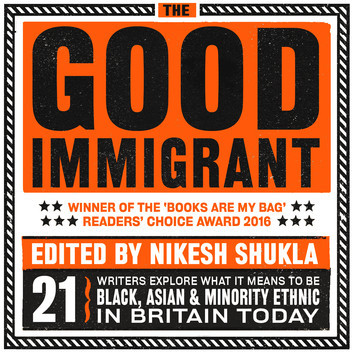
Bringing together 21 exciting black, Asian and minority ethnic voices emerging in Britain today, The Good Immigrant explores why immigrants come to the UK, why they stay and what it means to be ‘other’ in a country that doesn’t seem to want you, doesn’t truly accept you – however many generations you’ve been here – but still needs you for its diversity monitoring forms.
Inspired by discussion around why society appears to deem people of colour as bad immigrants – job stealers, benefit scroungers, undeserving refugees – until, by winning Olympic races or baking good cakes, or being conscientious doctors, they cross over and become good immigrants, editor Nikesh Shukla has compiled a collection of essays that are poignant, challenging, angry, humorous, heartbreaking, polemic, weary and – most importantly – real.
Short review: absolutely essential reading, a real eye-opening account of living in modern Britain.
Long review: Some context. I grew up near Bath, in Somerset. This is a part of the UK that, according to recent data, is 94.5% white. In my secondary school there were perhaps ten students out of a year of over two hundred students who were anything other than pasty, northern European white. In other words, growing up I was surrounded by an almost overwhelming hegemony of whiteness. This was barely challenged during my time studying at Oxford and Exeter (both notoriously white institutions, though still substantially more diverse than my home) and so a lot of my education about people who don't look like me has come in media rather than by experience.
It's easy then, as a white person living in a small world where almost everyone is white, to believe that racism isn't really a thing in the UK any more. Because of course you don't experience it, and you don't see any evidence of it. After all, there are no people around you who would be targets of such racism. And even if you do, by some chance, happen into a friendship with someone who's skin is anything other than Skull White in the Games Workshop paints range, then anything they experience which isn't outright "we don't serve your kind" or "all you people should get out the country" racism completely misses your perception as racism at all.
This book does a fantastic job of opening your eyes to the subtleties of what it means to be British and an immigrant. Over a variety of essays of differing lengths and perspectives it shows, sometimes passively and sometimes with the fervour of a sermon, how life is different for those society deems are just a bit too different. It is the exact enemy of ignorance, including my own, because it simply presents in a personal way how the personal experience differs when your skin tone isn't white.
The essays are definitely of somewhat varying quality, with some of them being really fantastically well-written while others are more of a clunky read, though none of them are any less than enlightening. Other than this mild complaint about the content, I really can't recommend this book heartily enough. I'm immensely glad I read it (thanks to my friend Alex for lending it to me and forcing me to read!) and have definitely left the reading experience enriched in ways that I didn't even realise were impoverished before starting. Five stars.
A touching and often funny set of stories of immigration in the UK, with many parallels to how we've approached immigration and treated immigrants in the US, both historically and currently. Similarities include how we accept most immigrants who are "gifted" and truly exceptional (think of women doing "twice as much to be thought half as good") and how Asian, African/Black, and other ethnic minorities face remarkable and brutal harassment, especially in our schools, and generally with White perpetrators, too. Tokenism and Whiteness-as-default in social media, educational curriculum, and the workplace are similar on either side of the pond, as well. What does this say about human nature, diversity, equality?
This book, like most of what I read these days, makes me reflect on White racism and how it manifests all over the world but particularly vile in the West against people of color. As well, thinking about the role of racism, nativism, and bigotry in the Trump administration, and how the protests many of us attended were largely White, reminded me of this recent article arguing that the "radicalization" of Whites post-election is connected to our complacency if not blindness towards White Supremacy. Our record-setting protests involved reckoning with White guilt (my term) and the denial of White racism for too long. https://afrosapiophile.com/2016/12/10...
White Supremacy may seem tangential to immigration, but it must be central, as the African refugee immigrants in my classroom every term are "model citizens" in every regard, impressive personally and hard-working, yet they all get their doses of bigotry just as a matter of getting through the day - an "n word" at the bus stop, a "terrorist!" hissed in their back in line at the supermarket.
Bringing together 21 exciting black, Asian and minority ethnic voices emerging in Britain today, The Good Immigrant explores why immigrants come to the UK, why they stay and what it means to be ‘other’ in a country that doesn’t seem to want you, doesn’t truly accept you – however many generations you’ve been here – but still needs you for its diversity monitoring forms.
These beautiful, powerful, unapologetic essays collect twenty-one universal experiences: “feelings of anger, displacement, defensiveness, curiosity, absurdity – we look at death, class, microaggression, popular culture, access, free movement, stake in society, lingual fracas, masculinity, and more.”
As with Nasty Women, this essay collection was one I've been eagerly anticipating to read. And more than ever, especially in today’s political climate, is it important that these voices are being published and heard. I definitely took my time to let each and everyone of these written pieces sink in. So instead of beating around the bush, I'd like to next share some of my favorite top notch quotes from The Good Immigrant:
Namaste by Nikesh Shukla:
Cultural misappropriation and language are important key ideas discussed in this introductory essay.
“A comedian, Kumail Nanjiani, an avid gamer, once expressed his delight that the Call of Duty series finally set a level in Karachi, the city of his childhood, now one of the top ten most dangerous cities in the world. He was appalled, on playing the game, to see that all the street signs were in Arabic. Not Urdu. He talks about the effort put into making each follicle on each soldier’s head stand out, into making their boot laces bounce as they ran, the millions spent developing this game, and how at no point did anyone decide to Google the language of Pakistan.”
A Guide to Being Black by Varaidzo:
An incredible discussion on being mixed-race.
“The world saw blackness in me before it saw anything else and operated around me with blackness in mind. There was a drama to blackness, a certain swagger and verve, an active way of experiencing and being experienced that mixedness could not accommodate, one that I was committed to embodying fully. There was one thing I’d never considered about mixing red and yellow: a drop of yellow into red paint won’t do much to change the colour, but one drop of red into yellow and the whole pot is tainted for ever.”
“It’s a tree falling in a forest conundrum: if a white kid raps all the lyrics to ‘Gold Digger’ and there isn’t a black person around to hear it, is it still racist?”
My Name Is My Name by Chimene Suleyman:
This whip-smart written piece left me speechless in the best possible way
“It is there in the white men and women who do not understand, to the point of frustration, why we still walk with the noose of our ancestors around our necks, as we cannot comprehend how they do not carry the indignity of their ancestors tying it there.”
Forming Blackness Through a Screen by Reni Eddo-Lodge:
“To be an immigrant, good or bad, is about straddling two homes, whilst knowing you don’t really belong to either. It is about both consuming versions of blackness, digging around in history until you get confirmation that you were there, whilst creating your own for the present and the future. It is up to you to make your own version of blackness in any way you can – trying on all the different versions, altering them until they fit.”
‘You Can't Say That! Stories Have To Be About White People!’ by Darren Chetty:
This essay from a teacher's point of view about educating the kids in his class on seeing themselves represented in books was beyond powerful.
“If you are a teacher, try this with your class. Ask them to write down their favourite 25 children’s book characters. Then ask them to count how many of those characters are white (and look for other patterns too, such as gender and disability). If you’re not a teacher, ask any child you know. Or maybe ask the staff in a bookshop to show you the picture-books with a black boy, or a mixed-race girl or a Muslim child as the protagonist. I tried this once and received a lot of help in searching from a clearly panicked shopkeeper – but very few books.”
And I love that the #WeNeedDiverseBooks campaign was brought up.
Airports and Auditions by Riz Ahmed:
Having Riz Ahmed featured in here was such a pleasant surprise, especially since I was already aquatinted with his incredible way with words.
“As a minority, no sooner do you learn to polish and cherish one chip on your shoulder, it’s taken off you and swapped out for another. The jewellery of your struggles is forever on loan, like the Koh-i-Noor. You are intermittently handed this Necklace of labels to hang around your neck, neither of your choosing nor making, both constricting and decorative. Part of the reason I became an actor was the promise that I might be able to help stretch these Necklaces, and that the teenage version of myself might breathe a little easier as a result. If the films I re-enacted as a kid could humanise mutants and aliens, maybe there was hope for us.”
I feel this in my heart.
The Wife of a Terrorist by Miss L:
Miss L discusses the importance of seeing yourself reflected in media.
“I mean, it’s supposedly fine to cast white actors in ethnic minority roles (Angelina Jolie, Emma Stone, Mickey Rooney, I could go on …) but the other way round? There’s more chance of seeing Benedict Cumberbatch in the dole queue. ”
This right here!!!
“There are such connotations linked with being Middle Eastern that you generally can’t play a role unless it has something to do with your race. Sure, I can play a doctor or a lawyer or a street cleaner, but only if I’m being forced into an arranged marriage in the background or providing a cover-up for my terrorist husband. If there’s some really daring casting then I might get to play a character that defies my father’s wishes, if that happens then maybe I get to wear a nice dress and not wear a hijab. But very rarely do I get to play a role that isn’t defined by the preconceptions made about the colour of my skin.”
What We Talk About When We Talk About Tokenism by Bim Adewunmi:
Bim Adewunmi suggests that a pre-requisite to a debate on representation is the need to expose the lie behind “universal” experience, to quote this article.
“It appears clear to me that there is a gap in what people mean when they say things like ‘we’re all one race – the human race’ and how they actually see the world. The thing that means a person cannot imagine seeing a Asian man as a superhero (you know, that set of fictional beings with special powers) is pretty much the same thing that makes a person cringe away from feeling empathy for a fictional dying black girl (Rue, played by Amandla Stenberg in The Hunger Games). It leaks into the everyday, too – if you cannot bring yourself to imagine us as real, rounded individuals with feelings equal to your own on screen, how does that affect your ability to do so when you encounter us on the street, at your workplace, in your bed, in your life?”
That last sentence speaks volumes!!! This collection without a doubt articulated significant points that made me both see something I’d previously not noticed and emphasize things I'd felt but not said, to paraphrase Darren Chetty's essay. However, since I got stuck about halfway through and didn't get to read The Good Immigrant consecutively, it made my reading experience a bit less grabbing towards the end. All in all, though, this is a book set to linger with me long after I finish the last page. A truly revolutionary read.
5/5 stars
Note: I'm an Amazon Affiliate. If you're interested in buyingThe Good Immigrant, just click on the image below to go through my link. I'll make a small commission!
Support creators you love. Buy a Coffee for nat (bookspoils) with Ko-fi.com/bookspoils
For some one who is a person of colour and an immigrant to boot, I felt that the rhetoric here, that of lives and narratives of BAME being marginalised came across slightly shriller than warranted. Much of this can be blamed on the cohort of professionals rounded up to give their versions of the "immigrant experience". Being actors, essayists, published raconteurs, novelists: the heightened sensitivity to lived experience and then the talent to mine this into a performance of sorts-either written or spoken- means the chips on the shoulders here are bigger, the posture and the affront excessive. You only have to read Shukla's opening piece to feel this. I probably would also have liked a narrative from an immigrant professional who has made it (or not made it) in the adoptive nation but belongs to a different industry than media/publishing and would treat linguistic/cultural mis-steps with a little more than a sigh.
I do think that while Shukla’s vigor has given the tone to this book's packaging and bumper-sticker shout for acknowledgement, I am not entirely sure if we required these many essays to drive home the plea for filmed and written narratives to have the nuance and the complexity reserved for the mainstream White stories. There are a fair few torchbearers of the newfound cultural police who are obsessed with “authenticity” and are out to wrangle all art creators’ imagination telling them who they should be writing as and who they should be imagining and who they should be casting in movies with millions at stake: I caught a whiff of them in this book and I find them tiresome bores who can’t imagine a world where people could be pigment blind when absorbing culture. I probably would have liked an essay written from a perspective of an end-reader, someone absorbing cultural products: books, films, fashion with no agenda to further one's career within the culture industry, as it became a bit tiresome to read through so many clipped-autobiographies melting into a series of audition grievances.
Not all of us readers are up in arms because of not being "represented" well in films/books or being "misappropriated". I personally am more interested in the way a narrative extracts universal truths and emotions from its characters than their written or shot pigment appropriation. Sometimes I scoff if I see anything misappropriated, but I have an understanding that from a business point of view, making exotic flavours and people palatable can be done better if done in a graded fashion (anathema to Shukla and his brigade here!), and that a person stereotyping me is insecure of having his own space encroached or parading his own lack of knowledge. Yes, I’d be troubled if a decision maker who is my superior took an overt decision to disadvantage me based on the colour, but I live in hope that the laws of the country would come to my rescue. Clearly my skin thickness makes me not the ideal target audience for this book.
While reading non-White authors, and this is attached to the second plea in the book to have a bigger market for writers from Africa/subcontinent who are fed up of being exoticised, I am always reminded of Ben Okri’s exquisite piece a few years ago where he asked for black/African writers (and I’d extend this to all ethnic minority culture creators) to wake up from their mesmerism with the subject. The subject being their skin pigment and the associated histories which has made all the discourse emanating, “the literature less varied, less enjoyable and, fatally, less enduring.” He reminded us of the great Aristotle who claimed that “The aim of art is to represent not the outward appearance of things, but their inward significance.”
With countries like UK accepting immigrants for decades and decades, for every story of someone being disadvantaged due to a stereotype, there is a story of someone excelling. Or someone going through both such experiences in alternation: sometimes being elevated, sometimes being underestimated for talents they are supposed to be having just because they belong to a certain ethnicity. The whole picture is chaotic, and made messy with reactions and estimations completely dependent on the reacting party’s level of education, interest in culture and enthusiasm in confronting their prejudices. To reduce this Tower of Babel to a monotonal high-pitched affront is doing a disservice for those who have been accommodated, who have found love and acceptance and who are just grateful.
There are many other issues that get thrown into the air, and I was rather surprised that almost all essays from black authors were about their exasperation by the monolithic label “black” which then leads to them making it their mission to demonstrate the range and complexity of the black experience in the real world.
Maybe for some balance (and Shukla would hate this) I also would have liked a few perspectives from mainstream White authors on their experience of dealing with key real-life relationships with non-Whites when they were forced to dismantle and confront their stereotypes or need to fetishise/exoticise and/or the private conflicts they face when creating a non-White character or milieu.
In all, while this litany of victimhood, catalogue of misappropriation and petition for complexity contains within it a seed of genuine grievance, it calls for a more patient editor who would have spread the net wider and gone a bit deeper. This would have avoided the marked skewering in tone. In its current form, I recommend reading it with alternating absorption into slightly more positive immigrant experience arcs within UK: say the podcasts of the last decade’s worth of Desert Island Discs where immigrants are the guests and revisit a life time of struggles in assimilating and appropriating themselves while finding their niche in their adoptive nation.
But tradition is an inescapable trait of our communities - those who cannot rely on land or home for their identity. Our parents, and their parents, and theirs before, have little more to leave us beyond their names, beyond their language. We have inherited the knowledge that community means to remain. When we cannot return to our homes - or are waiting for them to be taken from us again - we must get the hang of how to recreate it elsewhere.
[...] Know that for many of us to be proud of our nationality is a death sentence.
[...] ‘Change your name to an English one,’ my mother suggested before I move to New York. ‘I’m worried they’ll wonder what kind of Muslim your name belongs to.
YELLOW - Vera Chok
[...] But when I wanted to be heard, people looked puzzled despite English being my first language. They still do, despite my not having a Malaysian accent. A yellow foreign body gets in the way.
Powerlessness is a particularly heavy weight to fling off. In order to be attractive to men of any colour, we are expected to be small and pliable. I know there is an alternative stereotype – the cold, automaton, dominatrix, femme fatale Asian women – but we don’t seem to be mail-ordering as any of them lot. There was a point in the past when I stopped dressing ‘prettily’ because when I was out with ANY white man, no matter his age or looks, I was talked over and looked down on. It was assumed that I was his escort or mail-order bride.
KENDO NAGASAKI AND ME - Daniel York Loh
Even now, the ‘victory’ we ‘politically correct killjoys’ have ‘won’ has come at a price, in that we’re rarely allowed to out the indignities of having one’s rave/ gender/ orientation/ disability used as the butt of jokes without being implored to ‘get a sense of humour, for God’s sake.
IS NISH KUMAR A CONFUSED MUSLIM? - Nish Kumar
[...] It was a person being Islamophobic I was therefore being racially abused and not even correctly. The only thing worse than racism is inaccurate racism.
FORMING BLACKNESS THROUGH A SCREEN - Reni Eddo-Lodge
To be an immigrant, god or bad, is about straddling two homes, whilst knowing you don’t really belong to either. It is about both consuming versions of blackness, digging around in history until you get confirmation that you were there, whilst creating your own for the present and the future.
BEYOND ‘GOOD’ IMMIGRANTS - Wei Ming Kam
It’s easy to cling to a position of privilege when it acts as protection from the ever-present danger of being seen as outsiders, but playing to the myth of the ‘good immigrant’ does not lead to real equality, or even acceptance. Breaking out of the ‘model minority’ box and looking beyond that statues towards humanity and freedom is the long game.
CUTTING THROUGH (ON BLACK BARBERSHOPS AND MASCULINITY) - Inua Ellams
[...] To put it mildly then, it is insulting, reductive, counter-productive, lazy, disingenuous and deeply, deeply, deeply problematic to attach a single label - one of Western invention as a shield against racism, one as porous a description of skin pigmentation, as ‘black’ - to a group of people so vastly varied and numerous. Whenever we beg for nuances, for our differences to be articulated, for more diversity and accuracy in how our communities are described, in the characters written for ‘black’ actors on stage, on television, or in film, our voices are either silenced or ignored.
WEARING WHERE YOU’RE AT: IMMIGRATION AND UK FASHION- Sabrina Mahfouz
[...] What I’ve found interesting and worrying in varying degrees is the extent to which my ethnic identities can be validated, dismissed, or even proven offensive to others in the U.K., just from me wearing a particular piece of clothing, arguably a luxury others who look ‘less white’ don’t ever get.
AIRPORTS AND AUDITIONS- Riz Ahmed
As children in the 80s, when my brother and I were stopped near our home by a skinhead and a knife was put to his throat, we were black. A decade later the knife to my throat with held by another ‘Paki’, label we wore with swagger in the Brit–Asian subculture and gang culture of the 90s. The next time I found myself as helplessly cornered, it was in a windowless room at Luton airport. My arm was in a painful wrist–lock and my collars pinned to the wall by British intelligence officers. It was ‘post 9/11’, and I was now labelled a Muslim. As a minority, no sooner do you learn to polish and cherish one chip on your shoulder, it’s taken off you and swapped out for another.
The last kid who search led me, a young Muslim boy with an immaculate line-beard and goatee, was particularly apologetic. ‘Sorry, bro. If it makes you feel any better, they search me before I fly too.’ We laughed, not because he was joking, but because he was deadly serious. It was the perfect encapsulation of the minority’s shifting and divided self, forced to internalise the limitations imposed on us just to get by, on the wrong side of the velvet rope even when (maybe especially when) you’re on the right side of it.
SHADE - Salena Godden
[...] In the first minutes of meeting you, people have to figure out what shade you are and this is your superpower, it buys you valuable time. People will show their hand and ask, ‘Where do you come from?’ And if you reply, ‘I just jumped on the tube at Tottenham Court Road,’ they’ll tut and shake head. ‘No,’ they say, ‘where do you come from, as in...’ Pause. ‘... come from, come from?’ You earn time to chameleon, to camouflage, to make your shade darker or lighter. To morph into what is required or expected. Whatever it takes to survive, whatever it takes to be heard, whatever it takes to get the job. Whatever armour you must wear that day. It’s all positive discrimination. Right? No. Wrong. Very. Wrong.
The shade of your skin is not the whole content of you and your work. The shade of your skin should not be the measure of your worth. The shade of your skin is not your only audience nor should it be a limitation. The universal job of being a writer is to write, to write with empathy, to be brave and honest, to find joy conveying a journey and in sharing your passion. Your ink is replenished by your life experiences, by taking off the mask and using your limitless imagination, by stepping out of the shade and into the light. As a woman may write in the voice of a man, I don’t see why a writer cannot imagine the voice of another shade and culture, that is what imagination is all about. Whatever shade you are, as a writer, you have just one task each day, one battle, and that is you against the blank page.
THE WIFE OF A TERRORIST - Miss L
[...] But very rarely do I get to play a role that isn’t defined by the preconceptions made about the colour of my skin. What really gets me is that all the roles are so helpless, and this is something that’s often true of a lot of female roles. Every role I go up for that is specifically Middle Eastern is a woman that is basically having her life controlled, and her story is that she is either suffering through it or trying to escape it.
Yes, I will play the role of a wife or wife-to-be. Yes, I know that I sometimes get work purely because I’m a good diversity box-ticker. Yes, I’ll never be cast in Pride and Prejudice. But none of that really matters because I get to represent a bunch of incredible women who are vastly unrepresented.
THE UNGRATEFUL COUNTRY- Musa Okwonga
It was as if, even though we had been born here, we were still seen as guests, our social acceptance only conditional upon our very best behaviour.
This is one of the most important books I’ve read in a long time, and everyone should read it.
It’s a collection of essays about British immigrant experience, all of them fascinating, informative, funny, angry. The essays are each specific and detailed, with huge variety and breadth in the ways they talk about the subject, but the common threads of how immigrants are treated here come through in a way that makes me, frankly, pretty bloody ashamed. This was shockingly eye opening to me as a white Brit; it exposes the grubby soul of this country in a quite remarkable way.
It was crowdfunded (to which I contributed a couple of quid, if that’s necessary disclosure) after the Brexit vote, and it does more to cast light on the stupid self-harming insularity of that vote, as well as the rise of open, shameless xenophobia here, than much else I’ve read. This is a book Britain needs right now. Some people need hitting round the head with it.
It is massively readable--I glommed it in the course of a day, ignoring a looming deadline—constantly interesting, and often laugh out loud funny, in case you’re thinking of shelving it under ‘worthy’. If you’re British, no matter where you or your parents are from, or if you want to think about the immigrant experience, or if you just like powerful, thoughtful, humane, human writing, you need this.
4.25 stars “good immigrant and bad immigrant, refugee and benefit scrounger. This keeps us in our place, humans bickering, focusing on their differences, distracted, and at each other’s throats, competing and separating” A set of twenty-one essays edited Nikesh Shukla which look at the issue of race and immigration from an ethnically diverse group of people. This was a crowd funded project. The essays address the current culture and an increasingly potent post-imperial nostalgia and some of the author’s frustrations with this. Here is Chimene Suleyman reflecting on historical violence: “It is there in the white men and women who do not understand, to the point of frustration, why we still walk with the noose of our ancestors around our necks, as we cannot comprehend how they do not carry the indignity of their ancestors tying it there.” Many authors also look at the issue of blackness; as Reni Eddo-Lodge says: “It is up to you to make your own version of blackness in any way you can – trying on all the different versions, altering them until they fit.” The essays cover a wide area including take away food, relations with the police, life in a small village, comedy, acting and getting parts, Kendo Nagasaki (well done if you get the reference, I didn’t), terrorism, school life, family life, airports, everyday racism and the difference between a good and a bad immigrant (win an Olympic gold to be a good one). The authors make some very pertinent points. The actor Riz Ahmed makes this point: “The pitfalls of the audition room and the airport interrogation are the same. They are places where the threat of rejection is real. They’re also places where you’re reduced to your marketability or threat-level, where the length of your facial hair can be a deal-breaker.” He played a terrorist on film and describes the inability of airport staff to distinguish between film and real life leading to some long stays at the airport. These essays are a useful light shining onto a society which is becoming increasingly racist and xenophobic. There are now US and Dutch versions. Some of the essays are inevitably stronger than others, but it’s an interesting collection and I like the way the mainstream publishers were side-stepped.
* This book was sent to me for review by the publisher (AND I AM SO VERY GLAD IT WAS!) *
I LOVED THIS. Literally, this is THE BEST essay collection I've ever read by a million miles. I tabbed over 60 lines and pages within this, not a single essay doesn't have a tab or something that moved me, hit me or infuriated me. This is passion, raw and simple. It billows out onto the pages as these people share their stories and their experiences in an honest, clear, yet VITAL way. These stories struck me right through to the core. This book is essential reading. I know for a fact it will make my top of 2017 list. That's HIGH praise so early in the year.
I will go more into detail on these individual essays and writers when I do my video review, but I basically loved this whole thing and could not put it down. I would recommend that EVERYONE goes and gets themselves a copy of this right now, and reads it, and tries to understand and speak out about what's written right in front of you.
These people deserve to live in Britain just as much as I do, so what if they moved here or their families did?! They matter and are humans JUST LIKE ME and I don't ever want anyone to have to feel like some of them do, living in the country I live in, so I am jolly well going to do my damnedest to make sure I speak about this on my channel and check myself and my own privilege where I can. I want people of all races, religions, body types, heritage, sexuality, gender (and more) to be welcome into my country, and I am not afraid to say that after reading these stories and listening to these voices. You should read it too. 5*s
A really fun and insightful look at what being a 'good immigrant' is like in Britain today. Not the doctors, or dentists. Just a regular bunch of people, who live everyday lives, but with a much higher standard put on them. I laughed and despaired at the similar situations each of these writers experienced. I recognised some of what was said, but leant a lot of new things too. Which is exactly how it should be.
I'd highly recommend this book to anyone. Especially if you're wanting to diversify your reading, find new authors and put your money towards a worthwhile publishing effort.
It's hard to review a book written by so many different people - there are inevitably some I enjoyed more than others, some that were better-written or which touched me more - but as a collection this is a must-read. I thought I knew about immigration in my country but these stories showed me I have no idea what fellow Britons of all skin tones and backgrounds have to go through. It opened my eyes and more people should read this and take that chance to walk in someone else's shoes.
I read it slowly, no more than one chapter a day, and I think that was a good way to read it because it gave time for each person's narrative to swim around in my brain for a while afterwards. It's not a book to consume cover to cover, one story after another, in my opinion.
The Good Immigrant is a collection of 21 essays by persons belonging to black, Asian and ethnic minority communities of UK.
In his editorial note, Nikesh Shukla quotes Musa Okwona in his essay The Ungrateful country – “…Society deems us bad immigrants – job stealers, benefit-scroungers, girlfriend-thieves, refugees – until we cross over in their consciousness, through popular culture, winning races, baking good cakes, being conscientious doctors, to become good immigrants. Nikesh Shukla adds – “And we are so tired of that burden.”
This is pretty much what the book is about. The essays are honest and from the heart. The writers talk about how they really are and how the society forces them to be something else or puts labels on them even when they are nothing like what the labels describe.
Debating between 3 and 4 stars for this book, but in the end the strong essays outweighed the mediocre ones (not to mention the truly great ones). These are all British BAME writers (Black, Asian, minority ethnic) discussing their experiences of being "othered" in the UK. An insightful (and often surprisingly funny) look at race, colorism, religion, fashion, film, airport security, education, and so much more. Like I said, some of the essays are noticeably weaker (and for some reason those ones seemed to be front-loaded), but it's worth it to read the whole collection to get to the fantastic ones. It's old news to say this kind of book is "important," but in our increasingly nationalistic, xenophobic times, that's the best way to describe it.
This is a book about race, not a book about immigration. However, it is called The Good Immigrant, not 'Britain is Racist' (which is absolutely is, of course), so I'll review it as a book about immigration. Disclaimer - I am a UK resident and a non-EU white female queer migrant from a relatively privileged socioeconomic background who also happens to be a member of an ethnic and religious minority in my country of origin.
The biggest issue I had with this book is that it focuses on second and third generation immigrants. Almost none of the contributions actually discussed immigration itself, the experiences of migrants, the motivation for migration, personal and structural issues immigration creates for the migrants and, of course, immigration systems they have to battle. Some of the contributions mentioned parents who went through all of that - I would very much rather have read a book written by the said parents.
For a book on immigration published in 2016, this collection does not deal with the key issues surrounding immigration in the UK in the 2010s. It does not mention or engage with the Hostile Environment. It is hard to overstate just how significant this omission is. The Hostile Environment defines the non-EU immigration experience in the UK today - from thousands paid in visa fees and legal discrimination in job applications to police monitoring and no recourse to public funds. Absolutely nothing in an immigrant's life - our work, our studies, our careers, our personal relationships, our planning for the future - is unaffected by the Hostile Environment. It defines what it means to be an immigrant in the UK. Not talking about it in a book on immigration is baffling to say the least.
The book does not discuss the biggest rift in immigrant communities of the past decade, the division between EU and non-EU immigrants, and the amount of public support and sympathy EU migrants get and non-EU don't (spoiler alert - the reason for that starts with r and ends with acism). For a book promoting diversity, it is also surprisingly not diverse. It does not discuss many communities which have been under constant attack in the last decade, from Polish and other Eastern European people to the Jewish community. Contrasting some of these experiences with the experiences discussed in the book would have also allowed the editor to engage with the issues of racism vs xenophobia, to discuss white privilege and potentially to strengthen the central argument of the book (race is the defining characteristic of an immigrant).
Most contributions do not discuss the effect social origin has on the experience of immigration and the immigrant's place in their diaspora (with the exception of the brilliant piece by Sarah Sahım). It is crurical to the title of the book - the 2010s immigration policy shaped and framed the myth of the 'Good Immigrant', the 'brightest and the best', the contributor, the acceptable migtant. It is all a myth, of course, but that myth does not erase the privileges more educated and 'skilled' migrants who can obtain a visa job offer or who can pay overseas tuition fees have. Even within that, of course, there is diversity - there is a world of difference between an oligarch's daughter and someone whose parents just about scrapped enough for one master's degree abroad.
Other types of diversity are ignored in this collection, as well. What about people who do not belong to the titular nation in their home countries? is their perspective on immigration different? A contribution by an indigenous Canadian or Australian migrant to the UK would have opened a really interesting perspective. The immigrant experience described in this book is overwhelmingly straight - despite the fact that the 2010s witnessed a surge in LGBTQ+ migrants and asylum seekers around the globe. Queerness is central to migration of queer folk, as it can define the relationship between the migrant and their diaspora, which might not accept them, thus denying them a link to 'home' and shaping the immigrant experience. The collection does touch on gender a bit - most prominently, in the pieces on sexual encounter and typecasting of brown women - but otherwise it presents a monolith 'immigrant experience' or perspective. A monolith defined by racism.
It is very important to talk about that. But racism as a focus in a book about immigration (as opposed to immigration as a lens in a book about racism) centers and privileges white British perspective and terms. It becomes a book about the lack of acceptance by white people, not a book about the experiences of migrants, of which racism is one. Is this a good book about racism? Yes. It is powerful and it gives platform for people who experienced racism in different contexts (although creative industries and issues specific to them are massively over-represented - it seems like half of the contributors are professional actors and entertainers). If you want a book about racism in the UK today, this is a good place to start.
When I read a book about immigration, I want to hear more about migrants themselves. I also want to learn something new. The most interesting stories in this collection are exactly that - they talk about immigration and they teach the reader something new. I especially appreciated the contributions by Nish Kumar, Riz Ahmed (the only one to actually talk about visas and border controls), Sarah Sahim (who talked about casteism in the diaspora) and Musa Okwonga (who provided the only contribution to even mention queerness). However, this book is as much about what it doesn't talk about as about what it does, and I personally can't overlook the glaring omissions discussed earlier.
I didn't like this book but it's probably my own fault. I bought it because I wanted to read interesting stories by high achievers, stories about overcoming odds, or I don't know, interesting anecdotes about their parents and navigating two worlds, one of which doesn't accept you. Unfortunately, I got a lot of repetitive, overbroad, and unsourced essays.
Only 3/21 of the essays provided a new perspective or novel idea:
- (1) Darren Chetty's "You can't say that. Stories have to be about white people!" led me to the realization that I've never tried to write a short story or poem about my own culture or someone similar to me. It'd be an interesting and worthwhile exercise to practice with kids. - (2) Inua Ellam's "Cutting through," on black barbershops and masculinity. I loved that he travelled through a few African nations and provided little snippets of what he learned there, he also tied it in nicely to the #IfAfricaWasABar hashtag. - (3) Musa Okwonga's "The Ungrateful Country," was a beautifully written coming-of-age story and was probably the best essay to end the book with. - Most of the other essays tried too hard to touch on everything related to race: a personal anecdote, representation in media, violence, casual racism, fetishization, (interestingly family is missing). How can you write a compelling, insightful essay on 3+ of those things in 8-10 pages? You can't. But many of the contributors tried and this book suffered because of it. - Nish Kumar's essay was extremely witty, which has encouraged me to look into his comedy, but again it lacked a compelling argument or narrative. - Reni Eddo-Lodge's piece was extremely well written and made me look forward to reading her "Why I'm no longer talking [to white] people about race." - I could definitely relate to some of the anecdotes, such as "No, but where are you really from?" But after reading it in 3 different essays I became bored. Sure I related to them but it didn't make me feel "powerful" or "moved" as some of the reviews (included on the cover) suggested. I just felt annoyed that there were all these voices with no solutions besides having more BAME TV/movie characters. I found it lazy.
Also, there was some poor editing: - Sandra Bland died in jail, not prison. - In Salena Godden's "Shade" she states that "the billboards and buses (in Bangkok) are dominated by adverts for a skin-lightening product called 'Snail White.'" This statement is only half true, Snail White is an extremely popular product but it is NOT skin lightening. In fact, many Asian companies use the words whitening and brightening synonymously. Brightening is basically lifting hyperpigmentation and evening skin tone. South East Asian nations, Thailand included, prize extremely fair skin, but I thought it was unfair to the company to peg their product as such because the author made an assumption. In fact, the only place I see the words "skin lightening" is in an Amazon seller's description, which sadly appeals to their consumer base.
I guess it's not as bad as I'm making it seem, it's just a wholly unforgettable book (with the exception of Chetty & Ellam's essays).
I wanted to like this more than I did, but that doesn't mean that I didn't like it. That being said, my favourite essays were definitely My Name is My Name, Airports and Auditions, and Shade.
(To be honest, I had hoped that this anthology would speak to my own immigrant experiences, but the fact that it didn't doesn't mean that I didn't like it, or that it failed as a book about immigrants or something. There's more than one immigrant experience, and it doesn't follow that if a book is "unrelatable" it is bad. Relatable books are great, but I don't read for relatability. I read for exposure, for knowledge, for understanding. And if this book is relatable to anybody, even a single person, I am glad.)
Some of these essays were 5 stars, some 3 and a couple 2 stars, so overall 3.5 stars (rounded down) seems fitting. A very timely collection given what has happened in the UK since the EU referendum last June.
I have come to this book late, so have little to add to the many other reviews, other than to strongly recommend it. It is an anthology and inevitably some pieces work better than others for each reader but actually one of the collection's strengths is the different, and in some cases differing, perspectives on experiences of race in contemporary Britain.
I read this book in the 5th anniversary edition, with a new preface from Nikesh Shukla. In it he refers to a text Musa Okwonga sent him when he first mentioned the idea of the book, "half as a joke". The text quoted Chinua Achebe's words If you don't like someone's story, write your own.
That quote comes from a Paris Review interview (https://www.theparisreview.org/interv...), and earlier in that same interview Achebe had explained the importance of writing your own story.
Then I grew older and began to read about adventures in which I didn’t know that I was supposed to be on the side of those savages who were encountered by the good white man. I instinctively took sides with the white people. They were fine! They were excellent. They were intelligent. The others were not . . . they were stupid and ugly. That was the way I was introduced to the danger of not having your own stories. There is that great proverb, that until the lions have their own historians, the history of the hunt will always glorify the hunter. That did not come to me until much later. Once I realized that, I had to be a writer. I had to be that historian. It’s not one man’s job. It’s not one person’s job. But it is something we have to do, so that the story of the hunt will also reflect the agony, the travail, the bravery, even, of the lions.
Ingiltere'de is aramaya basladigimda beni en çok sasirtan sey, online başvuru formunun sonunda dini inanclarımı, irkimi ve cinsel tercihlerimi sordukları kisim olmuştu. Ilk gördüğümde dehşete düşmüştüm, ve 'of, buralarda irkicilik bu kadar mi yaygın' diye düşünmüştüm. Sonradan dank etti, formun o kısmı işverene degil devlete gidiyor, iste guya devlet ne kadar ayrimcilik var, sosyal desenler nasıl anlamaya calisiyor vs vs. Bana çok değişik geliyor, Turkiye'de is başvurusu formu doldurmaya alismis biri olarak.
Ingiltere çok kozmopolit bir ülke. Burada yasayan ve ten rengi "beyaz" olmayan insanların tecrubelerini dinlemek benim icin faydali bir deneyim oldu.
Kitaba katkida bulunan yazarların bir kısmı çok bastan savma yazılar yazmışlar, ancak çok degerli bölümler de vardi. Bundan dolayı kitaba sadece uc yıldız veriyorum. Ama okuduğuma memnunum. Özellikle Darren Chetty, Kieran Yates ve Coco Khan'inkileri beğendim.
I read this as part of my reading for UK Black History Month (every October), even though not every essay is by a black author here: authors of multiple heritages are featured, including Malaysian, Egyptian, Ugandan, Indian, and some who are mixed race.
Some of the essays featured here take a more humorous approach, some have a noticeably sterner tone, but all confront the very real -ims and -phobias still present in the UK in the 21st Century, from not viewing 'yellowface' as a problem and many thinking doing a 'Chinese' accent isn't problematic, to casting white actors in very obviously non-white roles, and white Brits bemoaning 'tokenism', to hair, how blackness is viewed (or if it even exists) and functioning as a non-white person in society.
I took away something from almost every essay, with standouts being 'Yellow' by Vera Chok, 'Kendo Nagasaki and Me' by Kendo Loh, 'Shade' by Salena Godden, and 'Flags' by Coco Khan. As an educator, I probably took the most from Darren Chetty's 'You Can't Say That! Stories Have To Be About White People', which gave me food for thought, being a teacher of mostly non-white students who'll write stories about Bob and Judy and their golden blond hair and sapphire eyes.
Only one essay didn't land for me, and it's the one where I felt a lack of personal connection from the author - Sarah Sahim's 'Perpetuating Casteism' was criticising casteism but from the point of view of someone with seemingly no negative repercussions from it? Lots of facts, lacking in anecdotes or personal connection - it was an odd one to include.
Anyway, overall, this was a fantastic connection, it got my mind whirring, my breath intaking sharply at points, and it felt like I learned without being lectured at - my favourite kind of learning (I'm sure some of my students would yell at this and say that's not how I always teach, however. Oh well.) Also, as someone who grew up in a very, very, very white town - we're talking 98.8% white, less than 10 non-white students in my school of 1500 pupils - it helped expose me to questions and situations I'd never necessarily considered for any prolonged period of time.
Recommended, especially for British readers, who I think will get the most out of this.
Initial thoughts: Teetering between 4.5 and 5 stars. This is an excellent book containing a lot of insight into the lives of immigrants originating from many different countries. The reason I'm not entirely bent on 5 stars is that the essayists are by and large working in the media and/or entertainment industry. Nikesh Shukla does admit in his preface that the contributors generally know each other. With a general title referring to the immigrant, I expected a more cohesive narrative representing voices from more varied samples of British immigrants. Then again, 21 is a small sample size, so I might have expected too much in terms of representation. That being said, I thought the essays were all thought-provoking and most importantly, honest.
Nov 2016: "I've said a few times that I was looking for a British equivalent of the Ta-Nehisi Coates book, and some others were interested in the idea too. This appears to be the closest thing so far, although it's a multi-author essay collection." [Somehow that bit got 9 likes.]
This is an outstanding and varied essay collection that explores many aspects of what it is like to be an immigrant or a minority in the UK.
There is something of value in each and every one of these essays. I had a couple of minor gripes while reading a couple of the earlier pieces, but as the collection went on it went from strength to strength.
Essential reading. Packed full of diverse, important voices.
Frequent followers of this blog know I was born in Canada. My parents moved there, from Malta in 1974, mainly for political reasons ( that’s a story for another day). The first 9 years were spent in an North American Indian reservation. The remaining 4 years were spent in a small town in Ontario. That’s were problems started for me.
The first sign was when on my first week, some of my classmates heard my parents speak in Maltese and behind their backs made turkey noises at me, indicating the rapid fast guttural inflections of the Maltese language. Other incidents cropped up : children saying Maltese are stupid (how would they know!) even my fourth grade teacher making fun of my mother’s accent and when National Geographic dedicated an article on Malta during the second world war and published a picture of twin girls who resembled elaborate plum puddings. The flak I got for that! Once I got fed up at one particular nasty comment involving Maltese and the ovens in Auschwitz and retaliated. I was the one who got into trouble.
On returning to Malta in 1992, I found out that other problems occurred but I don’t want to make this whole review about me.
The reason behind my rather long spiel is because the 21 BAME authors, journalists and actors in The Good Immigrant all speak about their experiences in 21st century Britain as children of immigrants. Rascist slurs, being ignored or bullied and cultural appropriation all feature here. In fact the title itself comes from the fact that immigrants have to earn their right to be a British citizen proving themselves, be it in a baking competition or in a TV programme. That is how they become ‘good’ immigrants.
However, the main emphasis is on language: how certain foreign phrases are ingrained incorrectly in culture, how in the language of media the representation of BAME characters is poor, even when it comes to fashion there are prejudices and assumptions.
Generally with such a varied collection, the quality will vary but it’s pretty consistent. Obviously there will be some favourites. I laughed LOUDLY at Daniel York Loh’s Kendo Nagasaki and Me which speaks about Asian representation on TV, Nikesh Shukla’s essay on British bastardization of Indian culture, Namaste is brilliant. I could relate to Chimene Suleyman’s My Name is my Name ( all those years of my surname being pronounced as Pis-ZANY) , Sabrina Mahfouz’s Wearing Where You’re at: Immigration and UK Fashion is an insightful piece about fashion trends and also about skin color.
The Good Immigrant creates an awareness, sometimes through humor, sometimes through more tragic events but it does succeed in giving these contributors voice and helping us realise that both U.K. and U.S. cultures have to start paying more attention. In Bim Adewumni’s essay What We Talk About When We Talk About Tokenism she states that there are slow steps being made, but they can take everyone back just as easily. Personally I see this anthology as part of that progression. Considering the events that have been happening in 2020 alone, I see The Good Immigrant, which was published in 2016, even more relevant than ever.
An interesting and entertaining essay collection about the experiences of BAME people in the UK. The essays were very personal and the fact that I listened to the audiobook narrated by the authors only enhanced this.
I would, however, have liked to have seen a few more issues tackled. A lot of the essays focused on media representation and whilst that is inevitable with the collection being written by people in that industry, they were starting to become slightly repetitive by the end.
I would also have liked to see a few more essays from first generation immigrants as their experience in unique from second and third generations.
Overall though, this collection was important and I think it is a must read for anyone who wants to better understand the rich cultural landscape of the UK.
I underestimated the gravity of this collection, thinking I could finish it in a couple sittings. Instead it forces you to take one chapter at a time, swallow the writer's experience living in Britain and not yet feeling 'British'. And let me tell you, these stories will make you sad, angry but also laugh.
A fantastic collection of short essays from authors of colour across Britain. Highly recommended if you're looking for short, accessible nonfiction about race and growing up in the UK, and ranging from humorous to heartfelt.
Can we have more of this book please? Im sick and tired of watching white rom-coms, I’m sick and tired of watching white people acting as all other races in all movies and shows, while god forbid Idris Elba portrays 007, like 007 can lick Elba’s boots, I’m sick of able bodied people representing the disabled community. Are you telling us that there are no people from these communities to represent them? And why are all the POCs and LGBTQ+ people are only in movies if there is something happening to them with regard to their otherness and not just about their EFFING selves? Why is it so hard for people to just be human? Racism is tiresome and boring. Where are we actually fucking from? Someone’s uterus most probably.
I liked the comment section under this title. It seems like most people have enjoyed the book. We all love ''scenes.'' But we don't want to become the scene for other's consumption.